
Ask ten mechanics which bikes cause them the fewest headaches and nine will say Japanese. The tenth will think about it for a moment and then say Japanese too.
That's not a coincidence. Japanese motorcycles — Honda, Yamaha, Suzuki, Kawasaki — have dominated reliability rankings for over five decades for reasons that go deeper than brand loyalty or marketing. There is actual data behind it. There is actual engineering behind it. And if you are considering importing a used motorcycle from Japan, understanding why these bikes are built the way they are will change how you look at every bike on an auction sheet.
This guide breaks down the Consumer Reports numbers, explains the manufacturing philosophy that produces them, and covers what "reliable" actually means once a bike has 40,000 miles on it and a decade of Japanese winters behind it.

Are Japanese Motorcycles Reliable? The Short Answer
Yes — and the data is not even close.
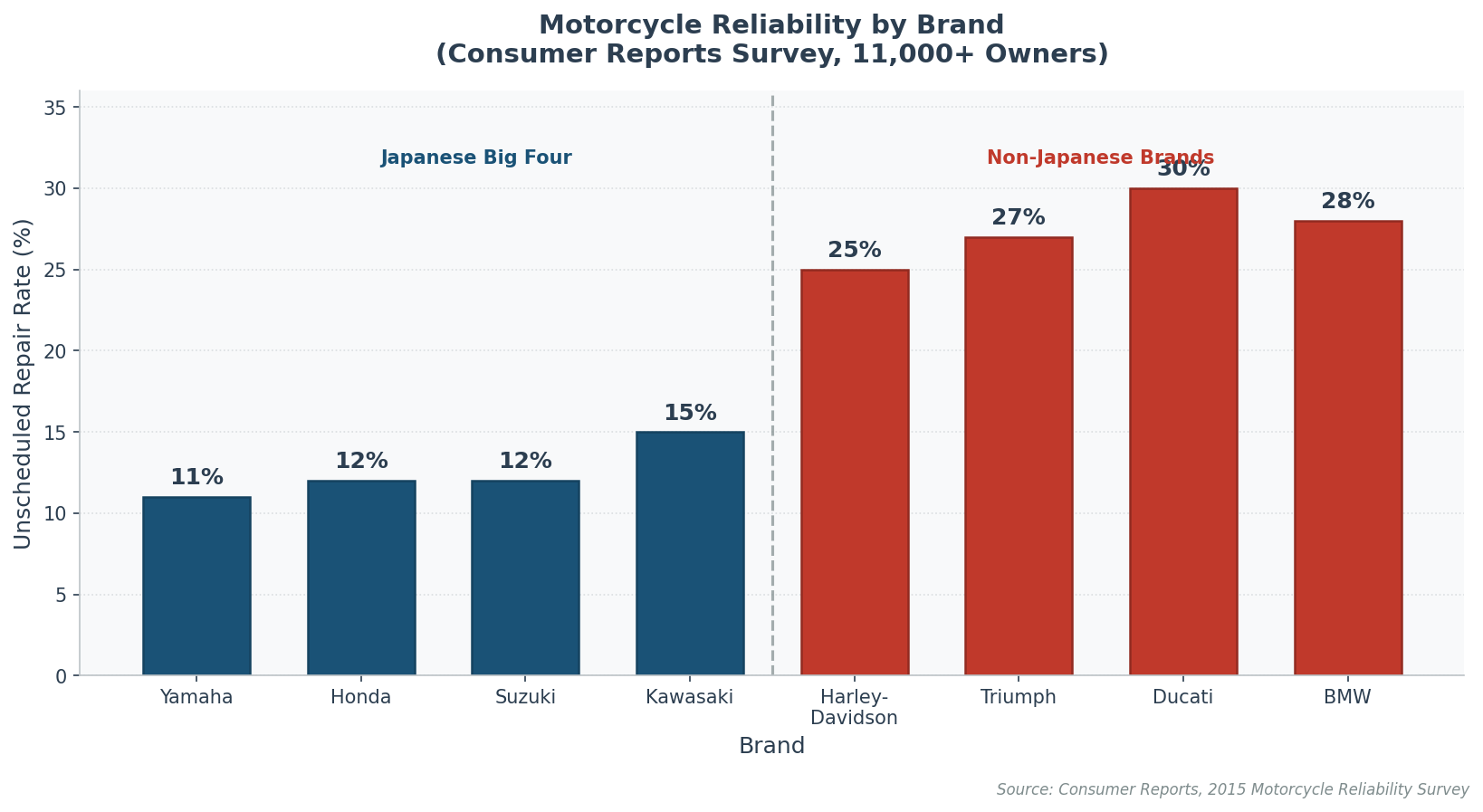
According to a Consumer Reports survey of over 11,000 motorcycle owners, the failure rates for the Japanese Big Four were:
- Yamaha: 11% needed unscheduled repairs in a 12-month period
- Suzuki: 12%
- Honda: 12%
- Kawasaki: 15%
For comparison, Harley-Davidson came in at around 25%, Ducati around 30%, and BMW and Triumph were worse again. The gap between the best Japanese brand and the best European brand is wider than most people expect.
But "reliable" is not a single number. It depends on the model. It depends on maintenance history. It depends on how the bike was stored, what fuel was left in the carb, whether the coolant was flushed on schedule. A well-maintained BMW will outlast a neglected Honda every time. The Japanese manufacturers give you a higher baseline — that is what the data shows. What you do with it after that is up to you.
What the Data Actually Says About Japanese Motorcycle Reliability
The Consumer Reports 2015 study is the largest independent reliability survey of the motorcycle industry on record. Over 11,000 verified owners reported on unscheduled repair needs across 12 months. The methodology was consistent across brands, and the sample was large enough to be statistically meaningful.
Here is what stood out:
Failure rates nearly half of the competition. Yamaha at 11% versus Harley-Davidson at 25% means, roughly speaking, if you buy a random used Yamaha versus a random used Harley from the same era, the Yamaha is twice as likely to get you through the year without an unplanned workshop visit.
Japanese brands fill the top four spots. Not three out of five. Four out of four. Every single brand at the top of the reliability chart is Japanese. That consistency across four entirely different companies — different models, different price points, different rider demographics — points to something systemic.
The gap widens at higher mileage. Surveys of owners with 50,000+ miles on their bikes show the gap between Japanese and non-Japanese brands growing. At low mileage, almost any modern motorcycle holds together. The separation happens once the bike has lived a real life.
The J.D. Power automotive studies reinforce the pattern. In their 2024 Japan Initial Quality Study, Japanese automotive brands topped overall quality rankings — Suzuki ranked highest in initial quality for the first time, and Lexus held the luxury segment for a third consecutive year. The data for cars tracks directly with motorcycles: the same manufacturing culture produces both.
Why Japanese Motorcycles Are Built to Last
The reliability advantage is not accidental. It traces back to specific decisions made at the factory level — decisions that prioritize longevity over short-term cost savings or peak performance numbers.
Conservative tolerances
Japanese motorcycle engineers build to tighter manufacturing tolerances than many European competitors. Parts fit together precisely. Clearances are spec'd conservatively. Engines that run happily at higher RPM still have headroom above the operating range. This approach trades a fraction of peak performance for a much larger gain in long-term durability. When you read that a Honda CB500 engine has "tight tolerances," that is not a marketing phrase — it is an engineering spec that shows up 80,000 miles later in an oil analysis.
Over-specified components
Bearings that could theoretically handle X load are spec'd to handle 1.5X. Wiring harnesses are designed for the heat cycles of a country that gets cold winters and hot summers. Chain tensioners use materials that outlast the service intervals printed in the manual. The Japanese philosophy — particularly Honda's, which stems from Soichiro Honda's own obsession with engineering integrity — is to build more than is strictly necessary for the minimum spec. You notice this if you have ever pulled apart an old Honda versus an old European bike. The Honda parts look almost new. The European parts often look like they were designed to last exactly as long as the warranty.
Lean manufacturing and Kaizen
Every major Japanese motorcycle manufacturer operates on lean manufacturing principles, including Kaizen — the continuous improvement philosophy rooted in Toyota's production system. Defects are tracked, root-caused, and eliminated. Supply chains are just-in-time, which means fresh components rather than aging inventory. Quality control is systematic and data-driven rather than relying on end-of-line inspection alone.
This is not abstract philosophy. It produces fewer production defects, tighter part consistency, and a statistical improvement in early reliability that compounds over time. A bike that arrives at the dealer without defects is less likely to have a premature failure three years later.
The shaken factor — why Japanese used bikes are different
Here is something specific to imported bikes that most reliability discussions miss entirely.
Japan has a vehicle inspection system called shaken (車検). Every motorcycle over a certain age must pass a mandatory government inspection every two years to remain road-legal. The inspection covers brakes, lights, emissions, frame condition, tire condition — the full vehicle. It is not easy to pass, and it is not cheap to repair a bike that fails.
The result: used bikes from Japan arrive on the market in condition that reflects actual compliance with strict safety standards. A 10-year-old Honda that passed shaken six months ago has proven brakes, proven lights, proven frame integrity. The inspection record is typically included in auction documentation.
Compare that to a used bike from a market with no mandatory inspection regime. The service history is self-reported, if it exists at all. There is no external verification. You are taking the seller's word for what they say the bike had done to it.
Brand-by-Brand Reliability Breakdown
Each of the Japanese Big Four has a distinct engineering personality that shows up in their reliability profiles. They all score well, but differently.
Honda — the benchmark
Honda is the name most people reach for when they want a motorcycle that will simply work. The CB series, the NC series, the Africa Twin — these bikes are designed to be maintained by non-specialists in countries with limited parts availability, and they are. Honda has sold over 100 million Super Cubs since 1958. It is the most produced motorized vehicle in history, and it is still running in active service across dozens of developing countries precisely because it does not break.
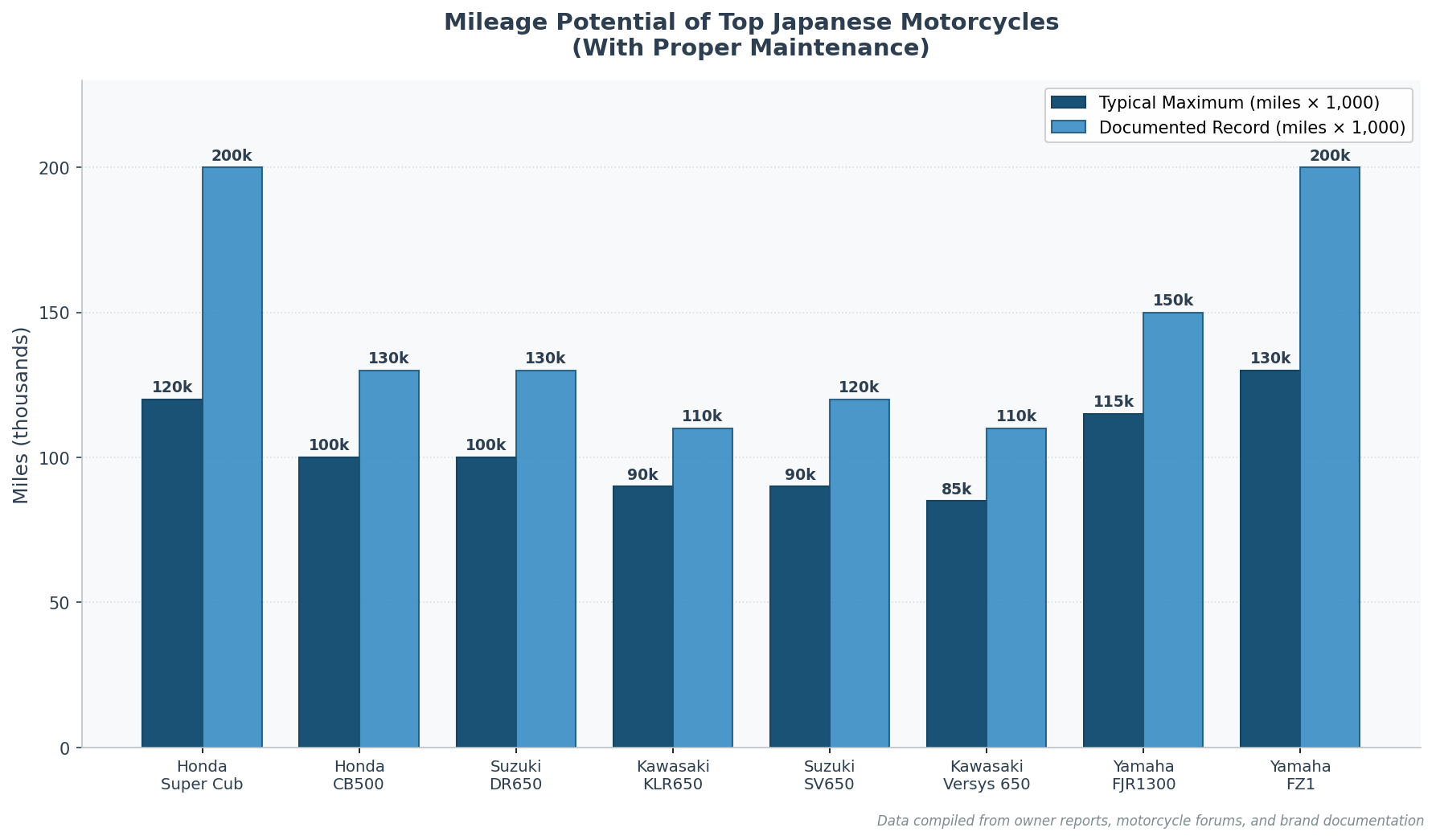
Documented high-mileage examples are common. A Honda CB500 owner in France recorded 100,000 miles on the original engine. CB750s with 80,000 miles and nothing beyond oil changes, tires, and batteries are considered unremarkable by Honda enthusiasts. The NC700X and NC750X models are particularly known for going 100,000+ miles on their parallel-twin engines designed around fuel economy and reliability rather than outright power.
Honda's failure rate in the Consumer Reports study — 12% — sits in the top tier. In practice, the consistency across Honda models is as notable as the average. A random Honda from the auction is unlikely to be a lemon. There are bad ones, but the distribution is narrow.
Yamaha — the performance reliable
Yamaha comes in at 11% in the Consumer Reports data, slightly better than Honda. This surprises people who associate reliability with conservatism, because Yamaha leans more toward performance than Honda does. The FZ-series, the YZF-R series, the MT series — these are sportier bikes with higher-revving engines that should, in theory, be harder on themselves.
They are not, because Yamaha's engineering culture originated in precision manufacturing for musical instruments. That is not a coincidence or a brand story. Yamaha genuinely applies the tolerancing and materials thinking of instrument manufacturing to motorcycle engines. The result is an engine that can rev freely and still last.
A Yamaha FZ1 owner documented 200,000 miles on the original engine — a number that would be implausible for most other brands. The FJR1300 touring bike regularly exceeds 100,000 miles in the hands of adventure and touring riders who put real distance on them. If you want a Japanese bike that is both exciting and durable, Yamaha is a strong first choice.
Suzuki — the honest workhorse
Suzuki sits at 12% alongside Honda and produces bikes that mechanics consistently describe as "honest" — no clever engineering that becomes a maintenance headache, no complicated systems prone to early failure. The SV650 and its derivatives are the canonical example. Mechanics love the SV650 because there is almost nothing to go wrong. V-twin with simple fuel injection, nothing exotic, ridden by people who actually use their bikes rather than garage-queen them.
The DR650 is another benchmark of Suzuki durability. Built for markets with rough roads and limited service infrastructure, the DR650 has been largely unchanged since 1996 because it does not need changing. Owners routinely pass 80,000–100,000 miles on the original engine with nothing beyond basic maintenance.
If you are buying a used bike from Japan for daily use and want the absolute minimum risk of unplanned mechanical drama, Suzuki is worth short-listing alongside Honda.
Kawasaki — slightly more complex, still exceptional
Kawasaki comes in at 15% — the highest of the four, but still dramatically better than any non-Japanese brand in the Consumer Reports survey. The reason Kawasaki sits at the bottom of the Japanese table has less to do with build quality and more to do with their product mix.
Kawasaki leans harder into high-performance. The H2, the Ninja ZX-10R, the Z900RS — these bikes are engineered closer to their limits than a Honda Nighthawk. When you build closer to the limit, the failure rate creeps up, even if the build quality itself is excellent. Kawasaki's simpler models — the Versys 650, the KLR650, the Z650 — have reliability records that look much more like Honda's.
The KLR650 deserves a specific mention. Running almost unchanged from 1987 to 2022, it has been used by overlanders, postal services, military units, and rural riders across the world. Owners regularly put 60,000–80,000 miles on KLRs with nothing beyond oil, filters, and tires. That is a Kawasaki, not a Honda.
The Mileage Question — What Is "High" for a Japanese Bike?
This is where most used-bike conversations go off the rails. Buyers obsess over mileage as though it is the primary signal of value. It is not. Here's the thing nobody in the dealer world wants you to know: mileage is almost irrelevant without the service history behind it. Maintenance history matters more. Storage conditions matter more. Whether the previous owner used the bike or hoarded it matters more.
Here is a rough calibration for Japanese bikes specifically:
Street bikes and naked bikes (Honda CB, Yamaha MT, Suzuki SV650, Kawasaki Z series):
- Under 20,000 miles: low
- 20,000–50,000 miles: medium — still lots of life with good maintenance
- 50,000–80,000 miles: high but fine — check records carefully
- 80,000+ miles: scrutinize carefully, but not automatically bad
Sport bikes (CBR, Ninja, YZF, GSX-R):
- Under 10,000 miles: low
- 10,000–25,000 miles: medium
- 25,000+ miles: high — sport bikes are often pushed harder; check maintenance
Touring and adventure bikes (Honda NC750X, Yamaha FJR1300, Kawasaki Versys):
- These bikes are built for distance. 80,000 miles on an FJR1300 is nothing.
Cruisers (Honda Shadow, Yamaha V-Star):
- These engines are understressed by design. 60,000 miles is medium, not high.
The number that actually matters when buying used is not the odometer — it is whether the oil was changed on schedule, the coolant was flushed every two years, and the valve clearances were checked on bikes that specify it. A 35,000-mile Honda with a service book is worth more than a 15,000-mile Honda with no history and a fresh wash.
Red flags regardless of brand
These apply to any used motorcycle, Japanese or otherwise:
- Blue smoke at startup or under load — oil burning past worn rings or valve seals
- Coolant in the oil (milky texture) — head gasket or worse
- Excessive chain slop or worn sprocket teeth — signals deferred maintenance
- Rust inside the tank visible on fuel inspection — fuel system contamination
- Mismatched panels or fresh paint on certain sections — possible crash history
- Fork seal leaks or oil streaks on fork tubes — front suspension wear
- Corrosion on exposed connectors — electrical issues ahead
The difference between Japanese and non-Japanese bikes is that even with these flags present, the underlying structure is more likely to be sound. A Honda with a worn chain still has a Honda engine. That is worth something.
The Japan Export Advantage — Why Imported Bikes Are Especially Reliable
Buying a used motorcycle sourced from Japan gives you something that is genuinely hard to get elsewhere: independent condition verification at scale.
The shaken inspection chain
As described above, the shaken system forces every roadworthy bike through a certified government inspection every two years. This creates a documented condition history. When a Japanese dealer lists a bike for export auction, the recent shaken record is often part of the documentation. You can see when it last passed inspection, and you know what that inspection actually covers.
This is different from a seller's word in a private market. Shaken is enforced by the government. You either pass or you do not ride.
Why bikes come to auction young
Japan has strict emissions regulations and a cultural preference for new vehicles. Bikes frequently come to auction at 5–10 years old with 10,000–25,000 miles on them — not because they are worn out, but because their owner bought something newer and the regulatory cost of keeping them on the road is not worth it against the trade-in value.
That means the export market gets well-maintained, mid-life Japanese bikes from owners who had strong financial incentive to keep them in good condition for resale. Compare that to a country where bikes stay in use until they literally cannot run anymore. The supply is structurally different.
Auction sheets — the thing that separates Japan from everywhere else
Every motorcycle that passes through a major Japanese auction — BDS, USS, JAA — receives a condition report called an auction sheet. An inspector grades the overall bike (typically on a scale of 1–6 with S for like-new), then marks every visible defect on a diagram with standardized damage codes.
You can read an auction sheet and know, before you buy:
- Every scratch, dent, and rust spot
- Whether there is any chassis damage (code B or W)
- Whether the frame has been straightened (code R)
- Engine condition and noise grade
No other used motorcycle market in the world operates with this kind of systematic, independent, pre-sale condition documentation. Private sellers in Australia, the US, or Europe tell you what they want you to know. Japanese auction inspectors tell you what is actually there.
If you want to understand auction sheets in detail, our guide to reading Japanese auction sheets covers every grade and damage code.
The Part Nobody Talks About — Known Weak Points in Japanese Bikes
Japanese bikes are reliable. They are not invincible. There are model-specific failure patterns worth knowing before you buy used.
Regulator/rectifier failures
Several Honda models from the late 1990s to early 2000s — the CBR929RR, the CBR954RR, the early Fireblade models — are known for regulator/rectifier failure. The OEM unit runs hot and eventually fails, which can overcharge the battery and fry electronics. The fix is a replacement unit from a Shindengen or upgraded aftermarket supplier. Cost: under $100. But if the previous owner did not address it, you might be inheriting dead battery and electrical gremlins.
Some early Yamaha R1 and R6 models share similar regulator/rectifier vulnerability. It is a known issue with known fixes, but worth checking the service history on any of these bikes.
Carbureted bikes with stored fuel
Any Japanese bike from the carb era (pre-fuel injection, roughly pre-2005 on most models) is vulnerable to varnish buildup in the carburetors if it was stored with petrol in the system. Japanese domestic market bikes sometimes sat in dealer inventory or private storage for extended periods. Varnished carbs are not a mechanical fault — they are a maintenance issue — but they present as inconsistent idle, hesitation off idle, and fouled jets. Budget $100–$200 for a carb clean if buying a stored bike.
Frame corrosion on coastal-stored bikes
Japan is an island. Bikes stored near the coast are exposed to salt air in ways that inland storage does not replicate. Surface rust on non-structural components is cosmetic. Frame corrosion at welds, swingarm pivot, or steering head is structural. Auction sheet inspection covers this. Grade B means chassis corrosion or impact. Grade W means the chassis was straightened. These are grades to avoid if you want a clean example.
Brake hydraulics on long-stored bikes
Brake fluid absorbs moisture over time. On a bike that sat unridden for two or three years — even a mechanically perfect Japanese bike — the brake fluid may have degraded enough that the boiling point drops. On a new bike you would never notice. On a bike you are pushing hard in the mountains in summer, you would notice. Brake flush is cheap and should be done on any used import.
These are not arguments against buying Japanese used bikes. They are the specific things you need to know. The equivalent list for a 10-year-old European bike is considerably longer.
8 Japanese Motorcycles Built to Run Forever
The most documented long-life bikes from Japan — chosen for real-world mileage records, not just reputation.
Honda Super Cub (all variants) — Over 2 billion Cub series engines produced. The benchmark by which all longevity claims are measured. BAREBONESMC lists the Honda Cub as its top pick for reliability in their most-watched reliability videos, with documented examples running for decades in commercial use across Asia and Africa. The OHC 4-stroke single is the most over-engineered underpowered engine in production history, and it basically never dies.
Honda CB500 / CB500F / CB500X — The CB500 family balances practicality and reliability in a way that touring and commuting riders have relied on for decades. 100,000-mile examples are common enough that they are unremarkable on CB500 forums. The engine design prioritizes low-stress operation over performance.
Suzuki SV650 — The SV650 is the mechanic's friend: simple V-twin, reliable fuel injection on the post-2003 models, no exotic components, no fragile electronics. It is difficult to kill an SV650 with normal use. Owners regularly report 80,000–100,000 miles on the original engine with nothing beyond consumables.
Suzuki DR650 — Built for global markets that cannot guarantee access to parts or skilled mechanics. The DR650 engine is so simple and so over-built that it has barely changed in 30 years because there is nothing to improve. If you want a used Japanese bike that can survive genuine neglect, the DR650 is it.
Kawasaki KLR650 — Nearly unchanged from 1987 to 2022. Used by military units, postal services, NGOs, and overlanders across the world because it works in conditions that would defeat a more complex machine. KLR650s with 60,000–80,000 original miles are considered middle-aged, not worn out.
Kawasaki Versys 650 — The comfortable, practical version of the Kawasaki parallel-twin formula. Lower-stress than the Ninja range, ridden mostly by commuters and tourers who maintain them properly. Documented 100,000+ mile examples exist.
Yamaha FJR1300 — The benchmark for Japanese touring reliability. Adventure riders and long-distance commuters routinely put 100,000 miles on FJR1300s and keep riding. The engine is understressed for a 1300cc unit and designed to run indefinitely at highway speeds.
Yamaha TDM 900 — Listed by BAREBONESMC's 522,000-view reliability video as one of the most reliable motorcycles period. Parallel twin with counterbalancer, smooth power delivery, and a reputation in touring circles for going forever.
Reliability vs. Repairability — One More Thing Worth Knowing
Japanese bikes are reliable. But they are also easy to repair when something does eventually wear out.
Parts availability for Honda, Yamaha, Suzuki, and Kawasaki is global. Third-party aftermarket ecosystems for these brands are enormous. You can source OEM or quality aftermarket parts for a 20-year-old Honda CB750 faster and cheaper than you can source parts for a 5-year-old niche European model. In Australia, New Zealand, and North America, every motorcycle workshop has experience with Japanese bikes. You are not hunting for a specialist.
This is the other side of the reliability equation that buyers underestimate. A reliable bike that eventually needs a part is worth more than a reliable bike where the part costs $800 and takes three weeks to ship. Japanese brands win on both metrics — fewer problems and cheaper to fix when they happen.
FAQ — Japanese Motorcycle Reliability
Are Honda motorcycles the most reliable?
Honda consistently tops reliability surveys alongside Yamaha. The Consumer Reports data shows Honda at 12% failure rate and Yamaha at 11% — effectively tied. For sheer consistency across models and years, Honda has the most documented high-mileage records. However, Yamaha arguably produces more exciting bikes with similar reliability, making it the preferred choice for riders who want performance and durability.
How many miles can a Japanese motorcycle last?
With proper maintenance, most Japanese motorcycles from the Big Four will exceed 100,000 miles. Specific models — the Honda CB500, Yamaha FJR1300, Suzuki DR650, Kawasaki KLR650 — are documented regularly at 80,000–150,000 miles. Exceptional examples have passed 200,000 miles. The limiting factor is almost always maintenance, not the engine.
Are Japanese motorcycles more reliable than European bikes?
Yes, by a measurable margin. Consumer Reports data shows Japanese brands in the 11–15% failure rate range against 25–30%+ for the leading European brands. The gap is consistent across studies, decades, and market conditions. The manufacturing philosophy, tolerancing standards, and production quality of the Japanese Big Four produce measurable reliability advantages.
Is it safe to buy a high-mileage Japanese motorcycle?
Yes, if you check the maintenance history. A well-maintained Honda at 60,000 miles is safer than a neglected Honda at 20,000 miles. For Japanese bikes specifically, look for regular oil changes (every 3,000–6,000 miles), coolant flushes (every 2 years on liquid-cooled models), valve clearance checks (model-dependent), and chain/sprocket replacement history. Full service records from Japanese market bikes are a strong positive signal.
Why are used Japanese motorcycles imported rather than new ones bought locally?
Several reasons. First, Japan offers models that are not officially exported to other markets — domestic-only variants with different specifications, displacement classes allowed under Japanese licensing rules, or simply models discontinued before they reached international markets. Second, pricing: Japanese auction prices for well-maintained used bikes are often significantly lower than equivalent new bikes locally. Third, condition: the shaken inspection system means bikes come to market with verified condition history, reducing buying risk.
What should I check when buying a used Japanese import?
Start with the auction sheet if one is available — it gives you an independent condition grade and maps every visible defect. Then verify the mechanical basics: compression test, oil color, coolant condition, brake fluid age, fork seal condition, tire age (DOT code on the sidewall). For carbureted bikes, check the idle quality as a proxy for carb condition. Any bike with frame damage codes (B or W on the auction sheet) needs a physical inspection by a mechanic before purchase.
Do Japanese motorcycles hold their value?
Better than most. The combination of reliability, parts availability, and strong global demand from buyers who know what they are getting means Japanese bikes depreciate slower than many European alternatives. Certain models — Honda Super Cubs, vintage CB series, early Kawasaki Z900 — have actually appreciated in collector markets. For imported used bikes, the shaken documentation adds a premium that purely domestic market buyers do not always have access to.
Which Japanese brand is best for a first imported motorcycle?
For a first import, Honda or Yamaha are the lowest-risk choices. Honda's broader model range means more options in auction at any given time, and their reputation for never-fail reliability is backed by more documented long-mileage examples than any other brand. Yamaha is a close second, with the MT-07 and MT-09 range offering performance that Honda's middleweight category cannot match at equivalent reliability. Suzuki's SV650 is the specific model most import specialists recommend for first-timers — simple, forgiving, nearly impossible to abuse into an early death.
How AWA Auction Works for Reliability-Focused Buyers
AWA Auction provides direct access to Japanese motorcycle auctions including BDS, USS, and JAA — the same systems that generate auction sheets for every bike. When you browse listings on AWA's motorcycle inventory, you see the auction grades, the condition scores, and the documentation that Japanese inspectors generate for every bike.
You are not relying on a seller's description. You are reading the same independent report that the auction house produced.
For buyers who want Japanese reliability backed by Japanese inspection standards, this is the path. Browse current listings and filter by grade — Grade 4 and above represents bikes in solid condition without significant defects. Grade 5 and S represent bikes that would be considered excellent in any market.
If you have questions about specific models, auction grades for the type of bike you want, or the import process for your country, get in touch with the AWA team. The combination of Japanese manufacturing quality and Japanese auction transparency is a genuine advantage. Use it.
Photos via Pexels — free to use under the Pexels License.
,
alternates: {
canonical: "https://awa.auction/en/blog/are-japanese-motorcycles-reliable"
},
other: {
"schema:type": "Article",
"schema:FAQPage": JSON.stringify({
"@context": "https://schema.org",
"@type": "FAQPage",
"mainEntity": [
{
"@type": "Question",
"name": "Are Honda motorcycles the most reliable?",
"acceptedAnswer": {
"@type": "Answer",
"text": "Honda consistently tops reliability surveys alongside Yamaha. Consumer Reports data shows Honda at 12% failure rate and Yamaha at 11% — effectively tied. For sheer consistency across models and years, Honda has the most documented high-mileage records."
}
},
{
"@type": "Question",
"name": "How many miles can a Japanese motorcycle last?",
"acceptedAnswer": {
"@type": "Answer",
"text": "With proper maintenance, most Japanese motorcycles from the Big Four will exceed 100,000 miles. Exceptional examples have passed 200,000 miles. The limiting factor is almost always maintenance, not the engine."
}
},
{
"@type": "Question",
"name": "Are Japanese motorcycles more reliable than European bikes?",
"acceptedAnswer": {
"@type": "Answer",
"text": "Yes, by a measurable margin. Consumer Reports data shows Japanese brands in the 11–15% failure rate range against 25–30%+ for the leading European brands."
}
},
{
"@type": "Question",
"name": "Is it safe to buy a high-mileage Japanese motorcycle?",
"acceptedAnswer": {
"@type": "Answer",
"text": "Yes, if you check the maintenance history. A well-maintained Honda at 60,000 miles is safer than a neglected Honda at 20,000 miles. Look for regular oil changes, coolant flushes, valve clearance checks, and chain/sprocket replacement history."
}
},
{
"@type": "Question",
"name": "Why are used Japanese motorcycles imported rather than new ones bought locally?",
"acceptedAnswer": {
"@type": "Answer",
"text": "Japan offers models not officially exported to other markets, auction prices often lower than equivalent new bikes locally, and the shaken inspection system means bikes come with verified condition history."
}
},
{
"@type": "Question",
"name": "What should I check when buying a used Japanese import?",
"acceptedAnswer": {
"@type": "Answer",
"text": "Start with the auction sheet for an independent condition grade. Then verify compression, oil color, coolant condition, brake fluid age, fork seal condition, and tire age. Any bike with frame damage codes needs a physical inspection."
}
},
{
"@type": "Question",
"name": "Do Japanese motorcycles hold their value?",
"acceptedAnswer": {
"@type": "Answer",
"text": "Better than most. Japanese bikes depreciate slower than many European alternatives due to reliability, parts availability, and strong global demand. Certain models have appreciated in collector markets."
}
},
{
"@type": "Question",
"name": "Which Japanese brand is best for a first imported motorcycle?",
"acceptedAnswer": {
"@type": "Answer",
"text": "Honda or Yamaha for lowest risk. Honda has the most documented long-mileage examples. The Suzuki SV650 is the specific model most import specialists recommend for first-timers — simple, forgiving, nearly impossible to abuse into an early death."
}
}
]
})
}
}
See Also
Share this article: