
Here's the situation almost nobody spells out for you: the most iconic liter bikes Japan ever built are now old enough to import legally into the United States and Australia — and most riders in those markets have no idea. The 25-year clock has quietly ticked over on the original 1998 Yamaha YZF-R1, the 988cc Suzuki GSX-R1000 K1, the mighty GSX-R1100, the EXUP-equipped FZR1000, and the 175mph Kawasaki ZZR1100. These aren't replicas or restomods. They're the real machines, sitting in Japanese auction halls right now, often with low mileage and a paper trail you can actually read.
If you want the best 1000cc motorcycles to import from Japan, you're in a sweet spot in 2026. The bikes that defined the open class are simultaneously becoming legal, becoming collectible, and still selling for sane money at source. This guide breaks down which liter bikes are worth importing, which ones you can bring in legally today, what each one actually costs landed on your driveway, and how to avoid the traps that catch first-time importers.
We do this for a living. AWA Auction gives English-speaking buyers direct access to the same Japanese auctions where these bikes change hands — so the numbers and grades you'll read below come from the floor, not from a forum guess.
Why the 1000cc class is the smartest import play right now
The liter bike occupies a strange place in motorcycling. It's the class everyone lusts after and the class everyone overbuys. As one rider put it in the comments under Yammie Noob's "So You Want a Liter Bike" video (523,000 views): "Beginners: Liter bikes look like a fun toy. Intermediates: Liter bikes are not toys. Advanced: Liter bikes are toys." That comment pulled 412 likes because it's true. A 1000cc sportbike is either the most terrifying or the most rewarding bike you'll own, depending entirely on which one you pick and how you ride it.
Here's why importing from Japan beats buying local for this class specifically. First, Japan's domestic market babied these bikes. Mild climate, obsessive maintenance culture, low average mileage, and a resale system that rewards honesty through documented auction inspections. Second, the open-class bikes from the late '90s and early 2000s were sold in huge numbers in Japan, so supply at auction is deep. Third — and this is the kicker — the 25-year rule means the legendary first-generation machines are crossing into "freely importable" territory in the US and Australia exactly as they start appreciating as modern classics.
Put bluntly: a clean 1998 R1 that costs a fortune to find unmolested in your home market is sitting in a Japanese auction this week — graded, photographed, and cheaper. That's the whole pitch.
The two worlds of the liter bike: inline-four screamers vs V-twin torque
Before you shop, understand that "1000cc motorcycle" describes two completely different riding experiences, and Japan built icons in both camps.
The inline-four superbikes are the ones you picture: the R1, the GSX-R1000, the air/oil-cooled 1100s, the ZZR. Screaming top-end power, race-bred chassis, and the soundtrack that made a generation fall in love. These are the bikes from the Big St Charles Motorsports clip "THE BIG 4 Japanese LITER BIKES" that pulled over 2 million views — R1, CBR1000RR, ZX-10R, GSX-R1000 lined up like a wish list.
The V-twins are Japan's answer to Ducati: the Honda VTR1000F Firestorm (SuperHawk in the US) and the Suzuki TL1000S and TL1000R. Big midrange punch, a narrower chassis, a lazier and more usable powerband for the street, and a character that inline-four buyers often discover they prefer once the novelty of 14,000rpm wears off. One liter-bike owner gave the inline-four reality check perfectly: "My 1000 is uncomfortable, will never utilize 5 of the 6 gears, too much power for anyone on a bike. Love it though!"
Neither world is "better." But knowing which one you actually want will save you from importing a track weapon when what you wanted was a fast Sunday companion.
The best 1000cc motorcycles to import from Japan, model by model
This is the list. Each of these earned its place either through legend status, value, or both. We've flagged the realistic Japanese auction hammer range (what the bike sells for at source, before shipping and fees) so you can sanity-check any deal.
1. Yamaha YZF-R1 (1998–2001, 4XV/5JJ/5PW) — the one that rewrote the rules
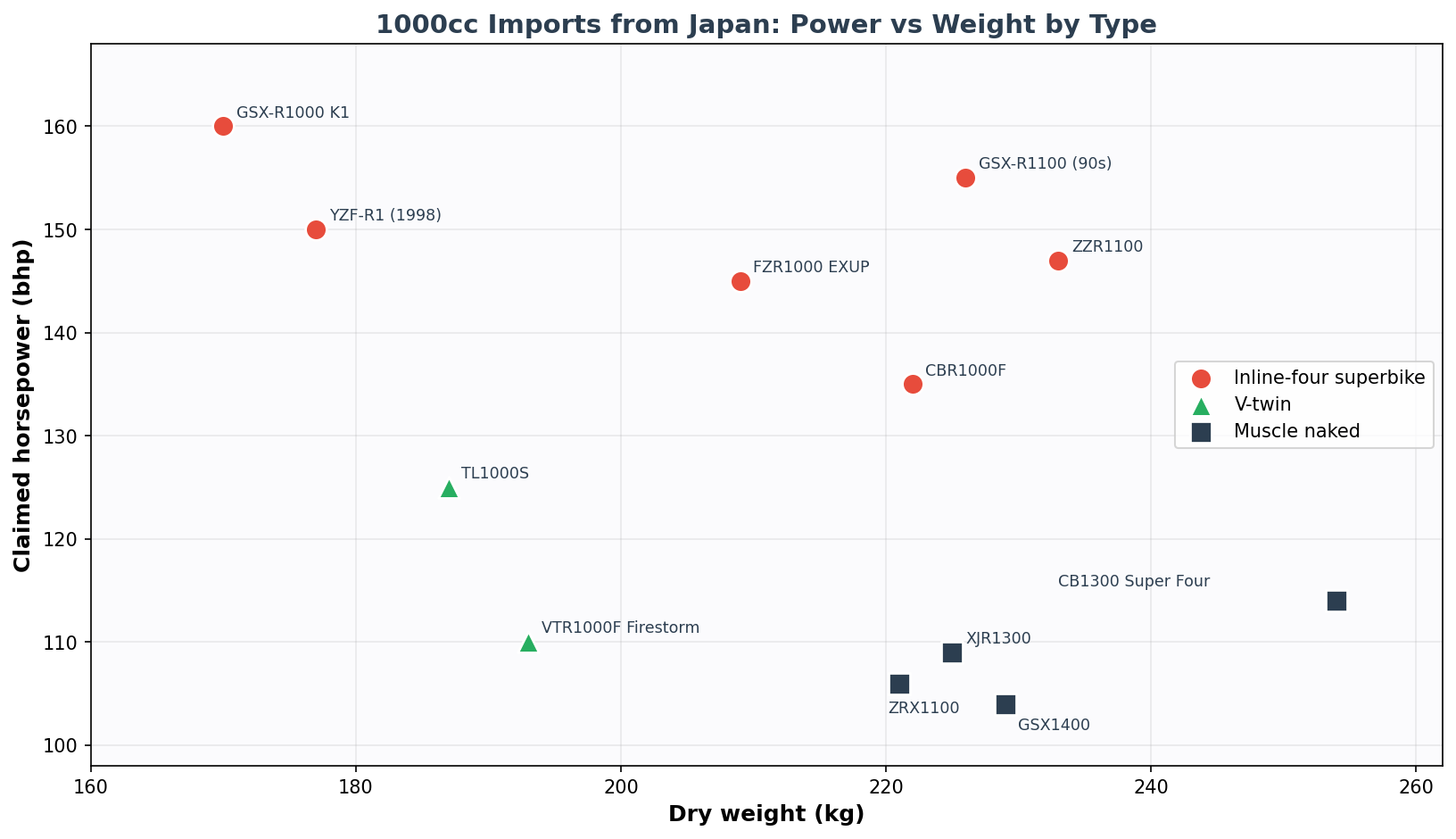
If you import one liter bike from Japan, this is the default answer. The original 1998 R1 claimed 150bhp at just 177kg dry, which made it the fastest production bike of its time and, more importantly, the most usable fast bike anyone had built. Yamaha stacked the gearbox vertically to shorten the engine, pushed the engine forward, and built a chassis that turned. The whole modern superbike template — short, light, sharp — starts here.
WiseTwoWheel's "How the Yamaha R1 Changed Sportbikes Forever" has 518,000 views for a reason. This bike is genuinely historically important, and the market knows it. First-generation 4XVs and their close descendants (the 2000–2001 5JJ and the 2002–2003 5PW) have become the most collectible liter-class bikes of their era, and clean originals are getting hard to find anywhere except Japan.
Auction reality: decent Japanese-market R1s of this era trade in roughly the ¥350,000–¥800,000 hammer range depending on year and condition. For context, in Western markets these now sell anywhere from $4,800 to over $8,000 for good examples, and a pristine low-mileage 1998 went for $17,000 at a US collector auction. Importing a clean one from source is how you stay on the right side of that math.
2. Suzuki GSX-R1000 K1 (2001) — the bike that turned everything up to 11
When Suzuki dropped the GSX-R1000 in 2001, it claimed an extra 12bhp and shed 7kg compared to that year's R1. Suzuki took the brilliant Y2K GSX-R750 and bored-and-stroked it to an odd 988cc — odd because MotoGP's limit was 990cc and Suzuki hedged its bets in case it ran an inline-four in the series. The result was 160hp and a bike that immediately became the benchmark.
The big news for importers: the K1 (2001) hit the 25-year mark in 2026, which means it's now legal to bring into the US and Australia. And originals carry weight — the K1 and K2 command a premium over the later K3–K6 models with collectors, despite the later bikes being technically improved. First-of-type always wins.
Auction reality: roughly ¥300,000–¥600,000 at Japanese auction for honest K1/K2 examples. This is one of the best value-to-legend ratios on the entire list right now.
3. Suzuki GSX-R1100 (1986–1998) — the original muscle bike
Before the 1000 existed, the GSX-R1100 was Suzuki's hammer. Air/oil-cooled, aluminium-framed, and brutally fast for its day, it grew from 1052cc to 1127cc over its life. The later Slingshot and water-cooled WP/WR models are usable classics; the early slabside is pure '80s icon. Every single year of the GSX-R1100 is now past the 25-year line, so the whole production run is fair game for US and Australian importers.
This is the bike for the rider who wants presence and torque over peaky top-end, and who appreciates that a 1990s 1100 will pull from anywhere in the rev range without drama.
Auction reality: ¥250,000–¥700,000 depending heavily on year and originality; clean early slabsides are climbing fast.
4. Yamaha FZR1000 EXUP (1987–1995) — the underrated king
The FZR1000 EXUP is the bike enthusiasts quietly rate above everything else from its era. EXUP stands for Exhaust Ultimate Power valve — a butterfly in the exhaust that broadened the torque curve and gave the 1002cc five-valve-per-cylinder engine genuinely flexible, ferocious midrange. In its day it traded "king of the heap" blows with the GSX-R1100 and many period testers gave the Yamaha the nod.
It's overlooked today, which is exactly why it's a smart import. You get a genuine open-class legend with EXUP tech for less money than the badges that get more hype, and the whole production run is 25-year-rule eligible.
Auction reality: ¥200,000–¥550,000. The value buy of the inline-four world.
5. Kawasaki ZZR1100 / ZX-11 (1990–2001) — the world's fastest, once
Launched in 1990, the ZZR1100 (ZX-11 in the US) took the production top-speed crown, romping to nearly 175mph and eclipsing even the FZR1000 EXUP. It's not a razor-edged track bike — it's a 1052cc continent-crusher with a fairing built for triple-digit cruising. If your idea of a liter bike is effortless high-speed touring rather than knee-down corner carving, this is your machine. Pre-2001 examples are importable to the US and Australia now.
Auction reality: ¥200,000–¥500,000. A lot of fast motorcycle for the money.
6. Honda CBR1000F (1987–1996) — comfort and speed
While the others chased lap times, Honda built the CBR1000F for riders who wanted to go very fast in comfort all day. The 998–1002cc inline-four is smooth, the ergonomics are humane, and the build quality is exactly what you'd expect from Honda in this era. It's the sleeper pick: cheap, reliable, fully legal to import, and shockingly capable as a real-world fast bike.
Auction reality: ¥150,000–¥400,000. The budget entry into open-class importing.
7. Honda VTR1000F Firestorm / Suzuki TL1000S — the V-twin alternative
If the inline-four leaves you cold, Japan's 996cc V-twins are the answer. The Honda VTR1000F Firestorm (SuperHawk) is the friendly one — torquey, characterful, and bulletproof. The Suzuki TL1000S is the wild one — a 996cc V-twin that punches hard and demands respect. Both deliver the big-twin character of a Ducati with Japanese reliability and a fraction of the maintenance cost. Pre-2001 examples are 25-year-rule eligible for the US and Australia.
Auction reality: ¥200,000–¥500,000 for the VTR1000F; the TL1000S is rarer and climbing.
Which liter bikes can you legally import right now? The 25-year rule decoded
This is where most buyers trip up, so read carefully. The rules depend entirely on where you live, and they're the single biggest factor in what you can buy.
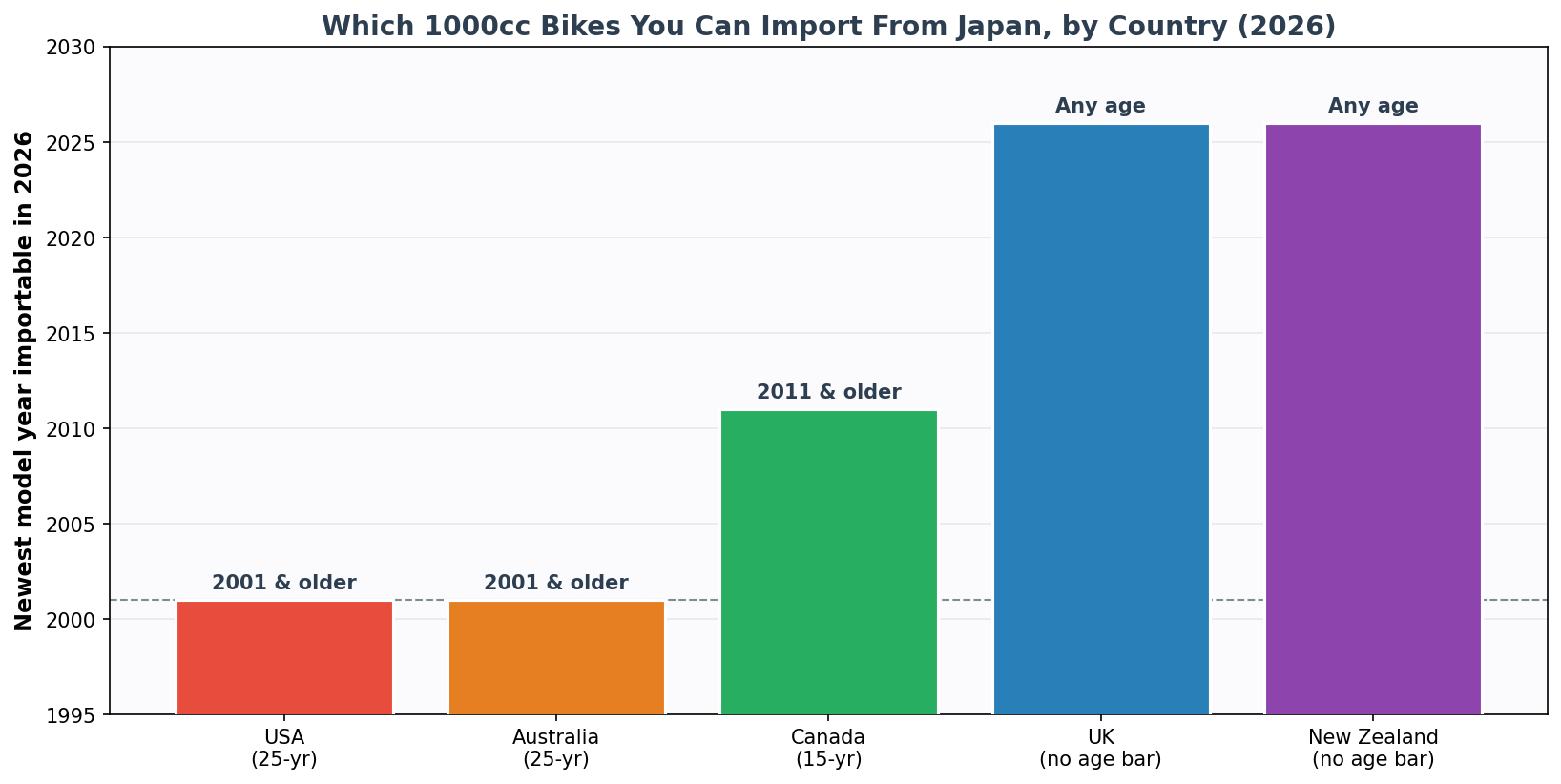
United States: The NHTSA 25-year exemption lets you import any motorcycle 25 or more model years old without federal compliance hassle. In 2026 that means model year 2001 and earlier are clear. So the 1998–2001 R1, the GSX-R1000 K1 (2001), all GSX-R1100s, the FZR1000, the ZZR1100 (pre-2001), the CBR1000F, and the early V-twins are all importable today. The 2004-on ZX-10R, CBR1000RR, and crossplane R1? You wait.
Australia: Australia's 25-year rule works similarly — bikes built before a rolling 25-year cutoff can come in under the older-vehicle scheme. The same late-'90s and 2001 machines qualify. Australia adds an asbestos declaration and biosecurity inspection on arrival, so budget for that.
Canada: Canada's rule is the friendly one — 15 years, not 25. That means 2011 and earlier is fair game in 2026, so Canadians can import not just the classics but the second-generation ZX-10R, the 2004–2011 CBR1000RR, and the crossplane R1 (2009–2011). If you want a modern liter bike from Japan and you're Canadian, you have a decade-wide head start on your American neighbours.
UK and New Zealand: Neither has a blanket age bar. You can import a liter bike of almost any age, subject to registration, emissions/compliance paperwork (the UK's NOVA and, for newer bikes, an MSVA test where applicable), and the usual taxes. For these markets, the question isn't "is it legal" but "is it worth the paperwork" — and for a clean Japanese-market bike, it usually is.
The takeaway: a 2001-and-earlier liter bike is the universal answer — legal everywhere we've listed. Newer machines are a Canada/UK/NZ play until the clock catches up for the US and Australia.
What a liter bike actually costs landed: the real numbers
The auction hammer price is never the number you pay. Here's the honest breakdown for a typical liter bike bought at a Japanese auction with a hammer price around ¥450,000 (roughly $3,000) and shipped to a Western port.
On top of the hammer price you have the auction and agent fees (the service that bids for you and handles export), domestic transport within Japan to the port, export documentation and de-registration, ocean freight, and then your home-country costs: import duty (motorcycles are duty-free or near-zero in most of our markets — the US is 2.4%, Australia 0%, the UK has its own rate), local taxes/VAT/GST, and final compliance or registration.
For most buyers, a ¥450,000 hammer bike lands somewhere in the $5,500–$7,500 range all-in, depending on destination and shipping method (shared container vs RoRo). A cheaper CBR1000F can land under $5,500; a collectible low-mile R1 will run higher because the hammer price itself is higher. The fees are fixed-ish, so the more bike you buy, the better the ratio looks.
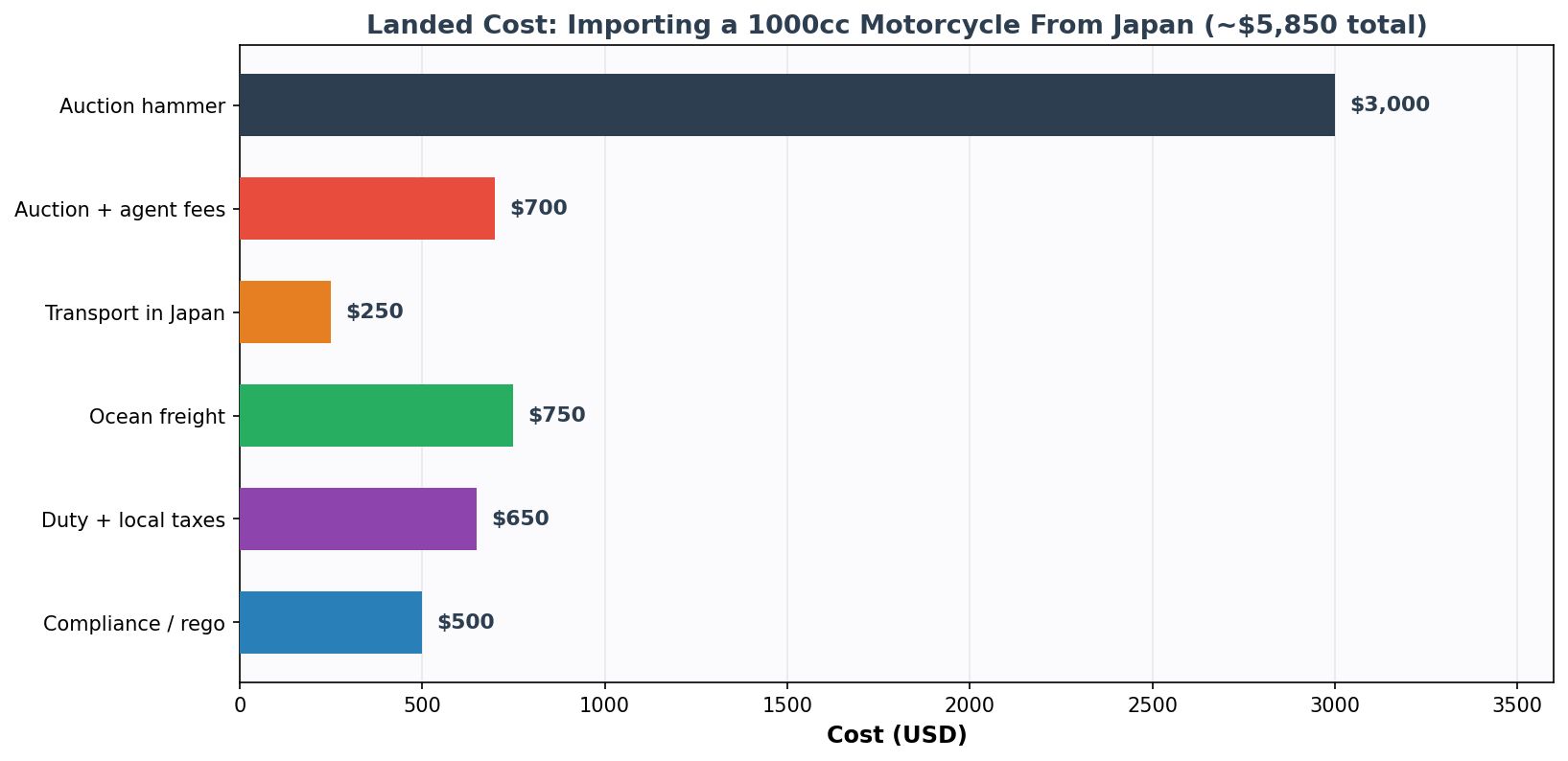
Compare that to your local market. A clean, original first-gen R1 or a genuine GSX-R1100 slabside in the West, when you can even find one, routinely costs more than the landed total above — and you have no inspection report telling you what you're actually buying. That information gap is the entire advantage of importing.
How buying from a Japanese auction actually works
People imagine importing is some shadowy, complicated process. It isn't. Here's the real flow.
Japanese motorcycle auctions (BDS, JBA, and the bike lanes of the big car auction groups) are wholesale-only — you can't walk in off the street and bid. You bid through an export agent who holds auction membership. You browse the upcoming lots, each listed with photos and an inspection sheet, you set your maximum bid, the agent bids on your behalf, and if you win, they handle export paperwork, de-registration, transport to port, and booking your bike onto a ship.
The inspection sheet is your superpower. Every bike is graded by a neutral inspector — an overall grade (commonly S, A, AB, B, C, R for repaired, and X), plus a condition map marking scratches, dents, rust, and repairs. Learning to read that sheet is the difference between a great import and an expensive lesson. A bike graded A or AB with a clean map is exactly what you want; an R-grade (repaired/accident history) needs a sharp discount and open eyes.
This is precisely what AWA Auction handles for English-speaking buyers — membership, bidding, sheet translation, and logistics — so you get the Japanese-market price and inspection transparency without needing to read Japanese or fly to Tokyo. Browse the current listings to see what's crossing the block this week.
The liter-bike buyer's checklist: what to inspect before you bid
A 1000cc bike that's been thrashed or neglected will cost you more in parts than you saved on the purchase. These machines are old now, so condition beats badge every time. Run through this before you commit to any lot.
Regulator/rectifier and charging system. This is the number-one weak point on '90s and early-2000s Japanese sportbikes — Suzuki and Honda V-twins especially. A tired R/R cooks the battery and leaves you stranded. Check the auction sheet notes and budget for a modern MOSFET replacement regardless.
Cam chain tensioner and valve clearances. On high-revving inline-fours, listen (or look for sheet notes) for top-end rattle. The original R1's and the GSX-R's will need periodic valve checks; a bike with a fresh service history is worth paying up for.
Carburettor or early fuel-injection health. Most of these are carbed (the TL1000 and some later models are injected). Carbs that have sat go gummy. A bike that "starts and idles" on the sheet is reassuring; a non-runner is a project, price it as one.
Frame and steering-head straightness. Sportbikes get dropped. The condition map flags frame repairs (look for the W and XX marks). An R-grade overall almost always means accident history — fine if priced right and the repair was clean, a dealbreaker if it's hiding a bent frame.
Originality. For the collectible models (first-gen R1, GSX-R1000 K1, slabside GSX-R1100), original bodywork, exhaust, and paint massively affect future value. A bike with aftermarket everything is fine to ride but won't appreciate like an untouched one.
Mileage versus wear. Japanese bikes are often genuinely low-mileage, but cross-check the odometer against the inspection sheet's wear notes. Honest low miles on a documented sheet is the whole reason you're importing from Japan instead of buying blind locally.
Inline-four vs V-twin: which liter bike fits which rider
Let's make this concrete, because the "best" 1000cc bike is the one that matches how you actually ride.
If you want the legend and the appreciation: the 1998–2001 Yamaha YZF-R1 or the GSX-R1000 K1. These are the blue-chip imports. Buy clean, buy original, ride it, and watch values climb.
If you want maximum bike for minimum money: the FZR1000 EXUP or the CBR1000F. Both are open-class legends trading at a discount because they're not the hype names. The smart-money picks.
If you want effortless speed and distance: the ZZR1100. It'll cruise at speeds that make sportbikes uncomfortable, all day, with a fairing that actually protects you.
If you want torque, character, and a narrow bike: the VTR1000F Firestorm or TL1000S. The V-twin path. Once you ride one, the "I'll never use the top of an inline-four's rev range" comment starts to make a lot of sense.
If you're Canadian, British, or a Kiwi and want modern: your import window is wider. The second-gen ZX-10R, the 2004–2011 CBR1000RR, and the crossplane R1 are all on the table. You can buy a genuinely current-feeling superbike from Japan that your American friends won't touch for years.
Don't sleep on the muscle nakeds: Japan's big-bore standards
Everyone fixates on the faired superbikes, but Japan built a whole category of big-bore naked muscle bikes that make spectacular imports — and they're often overlooked, which keeps prices reasonable. If you want liter-plus grunt without the committed riding position of a race replica, this is your lane.
Kawasaki ZRX1100 / ZRX1200 (1997–2008) is the standout. Styled after Eddie Lawson's superbike racers, the ZRX is a torque-rich, comfortable, gorgeous standard that has a devoted following. The 1100 is fully 25-year-rule eligible; the 1200 is a Canada/UK/NZ play for now. It's the kind of bike you ride every day and never get tired of.
Yamaha XJR1300 (1998–2017) is the air-cooled muscle standard — a big, simple, torquey 1250cc inline-four in a classic naked package. Early examples are importable to the US and Australia now, and the whole run is open to Canada, UK, and NZ buyers. It's the antidote to electronic over-complication.
Suzuki GSX1400 (2001–2008) is the ultimate "because we can" bike — a 1402cc air/oil-cooled monster built for pure low-end torque. The 2001 model is just becoming eligible for US/AU. Rare, characterful, and criminally underrated outside Japan.
Honda CB1300 Super Four (1998–onward) is the refined giant — silky, beautifully built, and a favourite of the Japanese domestic market, which means clean low-mileage examples are plentiful at auction. The bigger brother to the CB400 Super Four that dominates Japan's streets.
These muscle nakeds rarely show up in Western dealerships, so the Japanese auction is genuinely the best — sometimes the only — place to find good ones. brian_636's "Bikes You ONLY See in Japan" video (1.3 million views) is basically a tour of exactly these machines: big standards and oddball domestic-market specials that never officially reached the West.
Should a newer rider import a liter bike at all?
Honest answer: probably not as a first bike, and we'd rather tell you the truth than sell you the wrong machine. The Yammie Noob comment thread is full of riders who learned this the hard way — and one who changed his mind mid-video: "This has actually convinced me to go for a 1000-SX instead of a ZX10r... thank you." That's wisdom. A focused superbike like a GSX-R1000 K1 is a lot of motorcycle for someone still building skills.
But "liter bike" isn't one thing. If you're a competent rider stepping up, the gentler members of this list are genuinely approachable. The CBR1000F, the ZZR1100, the VTR1000F Firestorm, and the muscle nakeds like the XJR1300 deliver their power in a much more usable, linear way than a peaky race replica. You get the open-class character and sound without a bike that's trying to throw you off on every throttle crack.
The trap to avoid is buying the most aggressive bike on the list for the badge. If you've got the experience for a first-gen R1 or a GSX-R1000, fantastic — import the legend. If you're honest that you want the experience more than the lap times, import a ZZR1100 or a Firestorm and enjoy every ride instead of surviving it.
Are imported Japanese liter bikes actually worth it?
Let's total it up. You get a documented, inspected bike from a market that maintains its motorcycles obsessively. You get models — the muscle nakeds, the domestic-spec specials, the unmolested originals — that barely exist in your home market. You get them at the Japanese price, which is frequently below what a worse local example would cost. And for the collectible models, you're buying into appreciation that's already underway.
And the clock matters. Every year, more of these bikes cross the legality line and more of the clean originals get bought, restored, or locked away in collections. The supply of honest, low-mileage examples at the Japanese price is not infinite. Buyers who moved early on the first-generation R1 are already watching values prove them right.
The counterweights are real but manageable: you wait six to ten weeks for shipping, you handle some paperwork, and you recommission an older bike. For a machine you actually want — and the 1000cc class is full of machines people genuinely want — that trade is easy. The riders filling containers from Japan aren't doing it for fun. They're doing it because the math works.
How these engines got so wild: a short history that explains the prices
To understand why Japanese liter bikes are worth importing, you have to understand the arms race that built them. Through the late 1980s and 1990s, Honda, Yamaha, Suzuki, and Kawasaki were locked in a no-holds-barred fight for the open-class crown, and each took a different philosophy to the top of the range.
Suzuki went for raw power and a stiff alloy frame with the GSX-R1100, the bike that arguably created the "race replica you can buy" template. Yamaha answered with the FZR1000 and then sharpened it into the EXUP, using that exhaust power valve to make a thousand cc feel flexible instead of peaky. Kawasaki chased outright speed and won it outright with the ZZR1100. Honda, characteristically, split the difference with the CBR1000F — building for comfort and speed rather than lap records.
Then 1998 happened. Yamaha's R1 didn't just add power; it shrank the whole motorcycle around a vertically stacked gearbox, proving that a liter bike corners as sharply as a 600. Three years later Suzuki's GSX-R1000 trumped it on paper, lighter and more powerful, and the modern superbike was fully born. Everything since — the crossplane R1, the CBR1000RR-R, the ZX-10R — is a refinement of what these bikes established. That's why the originals carry the prices they do. You're not buying an old bike; you're buying the bike that defined the category.
One comment under FortNine's wildly popular JDM video captured the era's mindset perfectly: riders joked that the '90s Big Four behaved like they thought it was "very important that we don't build bikes that exceed certain parameters to prevent government regulation." The unofficial gentleman's agreements and domestic-market quirks of that period are exactly why Japan got special, sometimes wilder versions — and why the Japanese auction is the place to find them.
Container vs RoRo: how to ship a liter bike home
Once you've won your bike, you choose how it crosses the ocean, and the choice affects both cost and risk.
RoRo (roll-on/roll-off) is the cheaper option. Your bike is crated or strapped and rolled onto a dedicated vehicle carrier. It's reliable and economical, and for a single motorcycle it's often the sensible pick. The downside is slightly less protection and fixed sailing schedules.
Shared container means your bike rides in a container alongside other vehicles, professionally tied down. It costs more per bike than RoRo for a single unit, but the protection is better and it's the standard for higher-value or collectible machines. If you're importing a pristine first-gen R1 you intend to keep original, the extra container cost is cheap insurance.
For most single-bike liter imports, expect ocean freight to be a few hundred to around a thousand dollars depending on route and method, already included in the landed-cost ranges above. The Bikes and Beards crew famously filled a 40-foot container with Japanese bikes in a video that pulled tens of millions of views — that economy-of-scale trick (splitting a container across several bikes) is exactly how serious importers drive the per-bike cost down, and something an agent can help coordinate if you're buying more than one.
What nobody tells you: the common liter-bike import mistakes
We see the same avoidable errors over and over. Here's how not to make them.
Buying on badge instead of sheet. A grade-A FZR1000 EXUP is a better buy than a grade-R R1, even though the R1 has the bigger name. The inspection sheet tells you the truth; the badge tells you the hype. Read the sheet first.
Ignoring the model-year cutoff. Americans and Australians: confirm the exact model year qualifies under the 25-year rule before you bid. A 2002 bike that's "basically the same" as a 2001 is not the same to customs. One year can mean a multi-year wait or a seized bike.
Underbudgeting for recommissioning. A bike that's sat in a Japanese warehouse needs fresh fluids, often new tyres (age, not tread), a battery, and a carb clean. Budget a few hundred dollars to make any import road-ready, even a clean one.
Forgetting parts availability. Common-model parts (R1, GSX-R) are everywhere. For rarer bikes like the TL1000S or an early slabside, source a parts contact before you buy. Japanese auctions and breakers are actually a great ongoing parts pipeline once you're plugged in.
Skipping the agent and going it alone. The auctions are wholesale-only and Japanese-language. Trying to bid without membership or translation is how people overpay or buy a misgraded bike. A good agent earns their fee on the first transaction.
Living with an imported liter bike: insurance, registration, and parts
Importing is the start, not the finish. Here's what ownership looks like once the bike lands.
Registration and titling varies by where you are. In the US you'll title through your state DMV using the customs HS-7 and EPA paperwork your import generated; some states are pickier than others about imports, so check yours. In the UK it's NOVA then registration; in Australia, state rego after compliance; in Canada, provincial registration after the federal RIV-exempt 15-year process; in NZ, entry certification then rego. None of it is hard — it's paperwork, and your agent supplies the documents you need.
Insurance on a 25-year-old liter bike is often cheaper than you'd think, because classic and limited-use policies apply. Insurers increasingly recognise imported modern classics; an original first-gen R1 can even qualify for agreed-value classic cover, which protects the appreciation you're banking on.
Parts and reliability are the quiet strengths of this whole plan. These engines were built to last — recall the FortNine commenter who reported a 1991 Japanese inline-four that ran past 200,000km on its original engine and was still going for the next owner. Japanese build quality from this era, combined with a bike that was maintained in Japan's meticulous ownership culture, means a well-chosen import is a genuinely dependable machine, not a fragile museum piece.
Quick verdict: our top liter-bike imports ranked by buyer type
If you want it boiled down to a shortlist, here's where we'd put our own money depending on what you're after.
Best overall import: 1998–2001 Yamaha YZF-R1. The legend, the appreciation, the usability. Buy the cleanest original you can afford and you've made the textbook liter-bike import.
Best freshly-legal buy: Suzuki GSX-R1000 K1 (2001). Just cleared the 25-year line, still affordable at source, already collectible. The timing is perfect.
Best value: Yamaha FZR1000 EXUP. An open-class king trading at a discount purely because it's not the hype name. The connoisseur's pick.
Best for distance and comfort: Kawasaki ZZR1100. Once the fastest bike on earth, now an effortless high-speed all-rounder for sane money.
Best character: Honda VTR1000F Firestorm or Suzuki TL1000S. The V-twin path — torque, narrowness, and a grin every time you twist it.
Best everyday muscle: Kawasaki ZRX1100 or Yamaha XJR1300. Naked, torquey, comfortable, and almost impossible to find in good condition outside Japan.
Best modern superbike (Canada/UK/NZ): a 2004–2011 CBR1000RR, ZX-10R, or crossplane R1. If your country's rules allow it, you can import a bike that still feels current for a fraction of new money.
Whichever way you lean, the principle is the same: buy on the inspection sheet, confirm your country's legality cutoff, and use an agent who lives in these auctions. Do that and a Japanese liter bike is one of the smartest motorcycle purchases you can make in 2026.
Why 2026 is the year to do this
Two clocks are ticking in your favour at the same time. The 25-year legality clock is unlocking the exact bikes that the appreciation clock is making collectible. The 1998 R1 just became a 25-plus-year-old machine that's also been crowned the most collectible liter bike of its generation. The GSX-R1000 K1 is freshly legal and freshly desirable. The window where these are both importable and still affordable at source is open now, and history says it won't stay open.
FortNine's viral video on a high-revving '90s JDM import racked up 2.48 million views, and the top comment — "There goes my hope for finding one of these at an affordable price..." — got 13,500 likes. That's the sound of a market waking up. The riders who imported early got the pick of the litter at the good price. The 1000cc class is at that exact moment right now.
If you've been thinking about it, the move is to learn the auction sheet, set your budget, and start watching lots. Our team does this every week. Contact us and we'll help you find, inspect, and land the right liter bike — or browse what's available now and see how the numbers stack up against your local market.
See Also
Share this article: