
Here's a number that should stop every two-stroke fan mid-scroll. When Bikes and Beards opened a 40-foot container of motorcycles shipped straight from Japan, that single video racked up over 18 million views and nearly 8,000 comments — and a huge share of those comments were people asking the same thing: "How do I get one of the little screamers?" If you want the best 2 stroke motorcycles to import from Japan, you are not chasing a fantasy. You are chasing the last great stockpile of street-legal strokers on the planet.
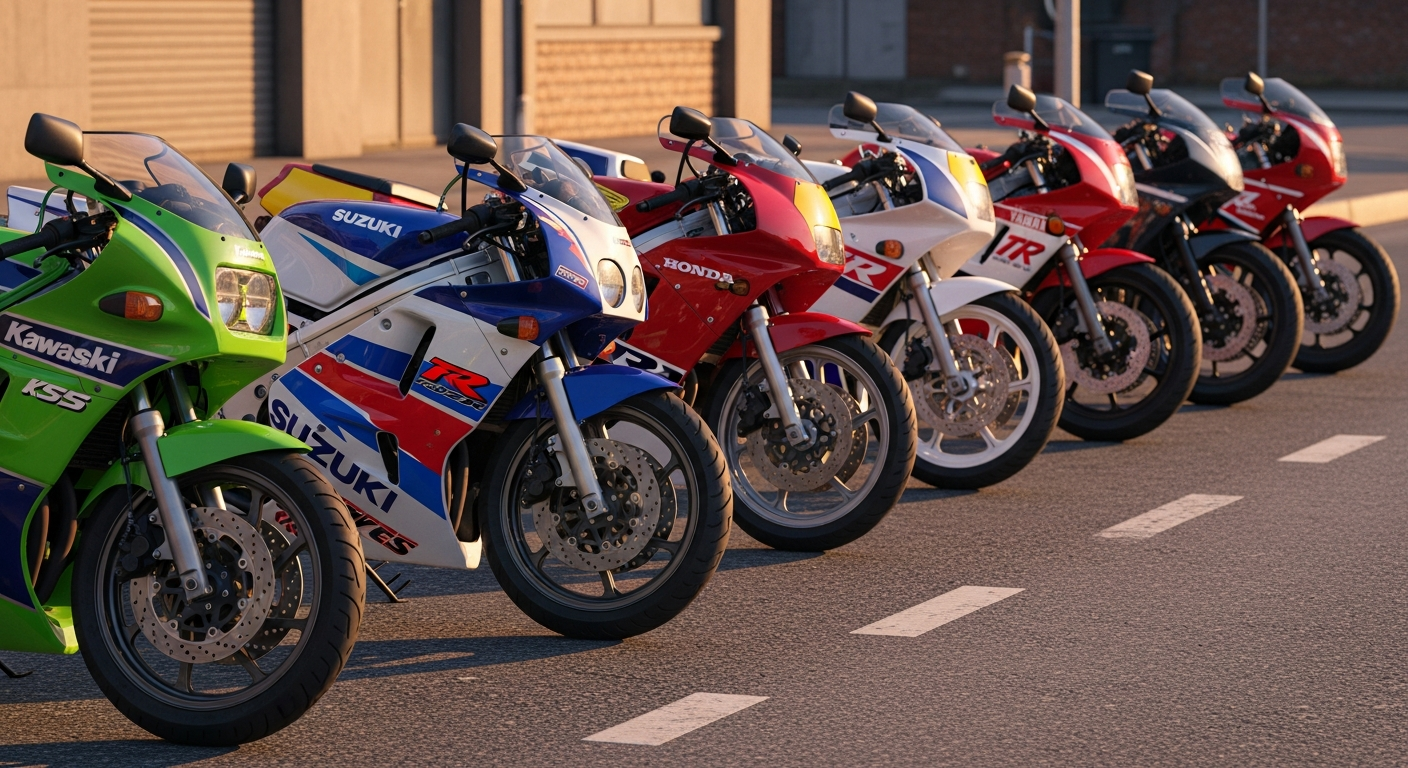
Here's the thing nobody tells you up front: the two-stroke road bike is functionally extinct everywhere except Japan's used market. Emissions law killed it. The EPA phased out highway two-strokes over 50cc, Europe legislated them out, and the factories quietly stopped building them around the turn of the millennium. So if you want an NSR250, an RGV250, or a genuine RD500, you are not buying a bike. You are buying a time machine — and the only working showroom left is Japan.
We do this for a living at AWA Auction, so the numbers below come from real auction sheets and real shipping invoices, not a glossy press kit. Let's get into it.
Why Japan is the last great two-stroke hunting ground
Japan didn't just build the best two-strokes. It kept them. Three forces stacked up to make the country an accidental two-stroke vault.
First, the domestic-only models. Japan's licensing tiers and insurance quirks created a whole class of bikes built for home riders and never officially exported — the NSR250R, the TZR250, the RGV250, the RZV500R, the DT200 and Lanza, the TDR250. The rest of the world either never got them or got watered-down versions. Japan got the real thing.
Second, the way Japanese owners treat machines. Low annual mileage, the shaken inspection culture that forces regular maintenance, covered parking, and a resale market that rewards honesty all add up to bikes that survive in shockingly original condition. A 1994 stroker in Japan often looks like a 2014 bike anywhere else.
Third, the auction system. Japan moves something like 15,000 used motorcycles a week through dealer auctions like BDS, JBA, and the bike lanes at USS. Every bike gets a neutral inspection sheet graded from S down to R. That means you can buy a 30-year-old two-stroke sight-unseen and still know whether the tank has rust, whether the fork seals weep, and whether the odometer has been touched.
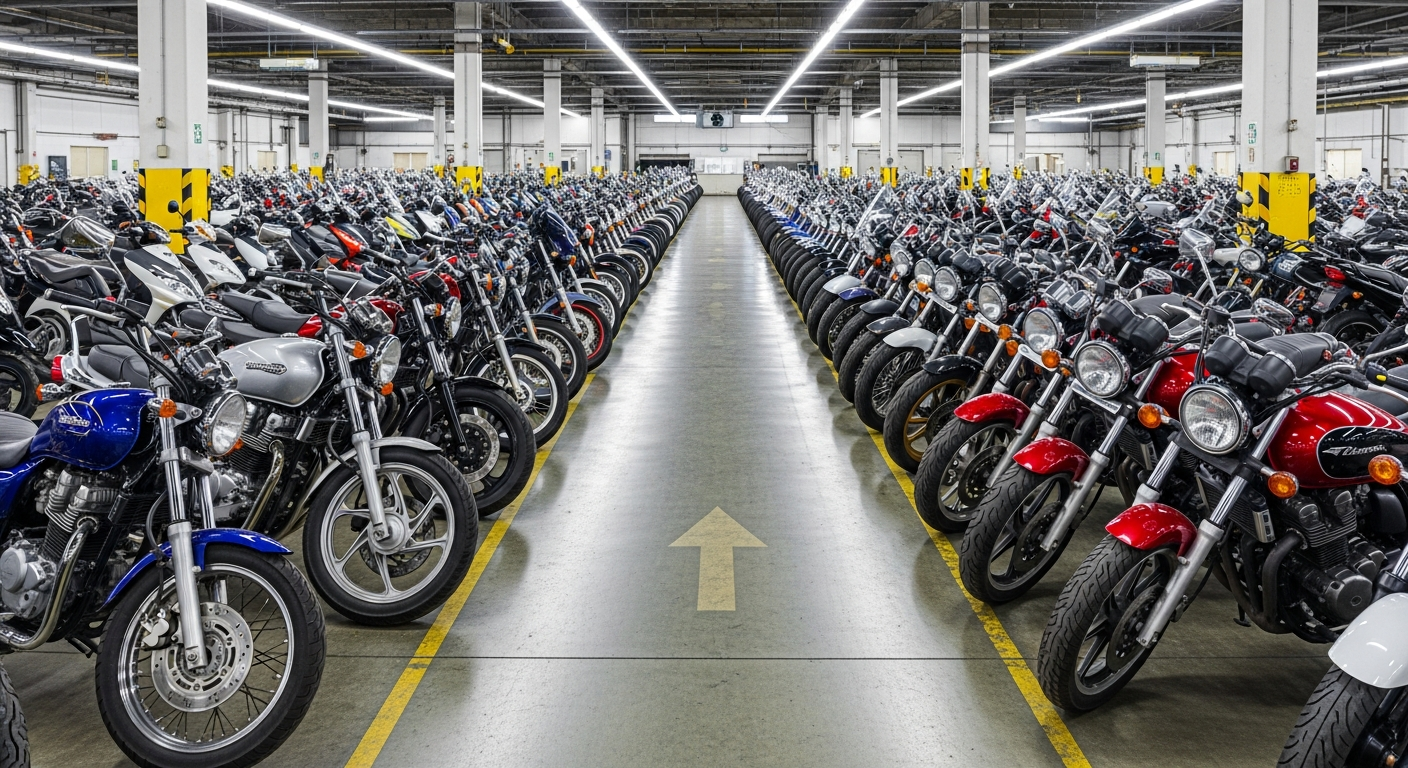
Put those three together and you get the situation we live in today: the cleanest, most original, most complete two-strokes left on Earth are sitting in Japanese warehouses, and the auction system makes them reachable from a laptop in Denver, Manchester, or Auckland.
The legal clock that makes buying a two-stroke from Japan urgent
This is the part most "10 best two-strokes" listicles skip, and it's the single most important thing you need to understand before you fall in love with a bike.
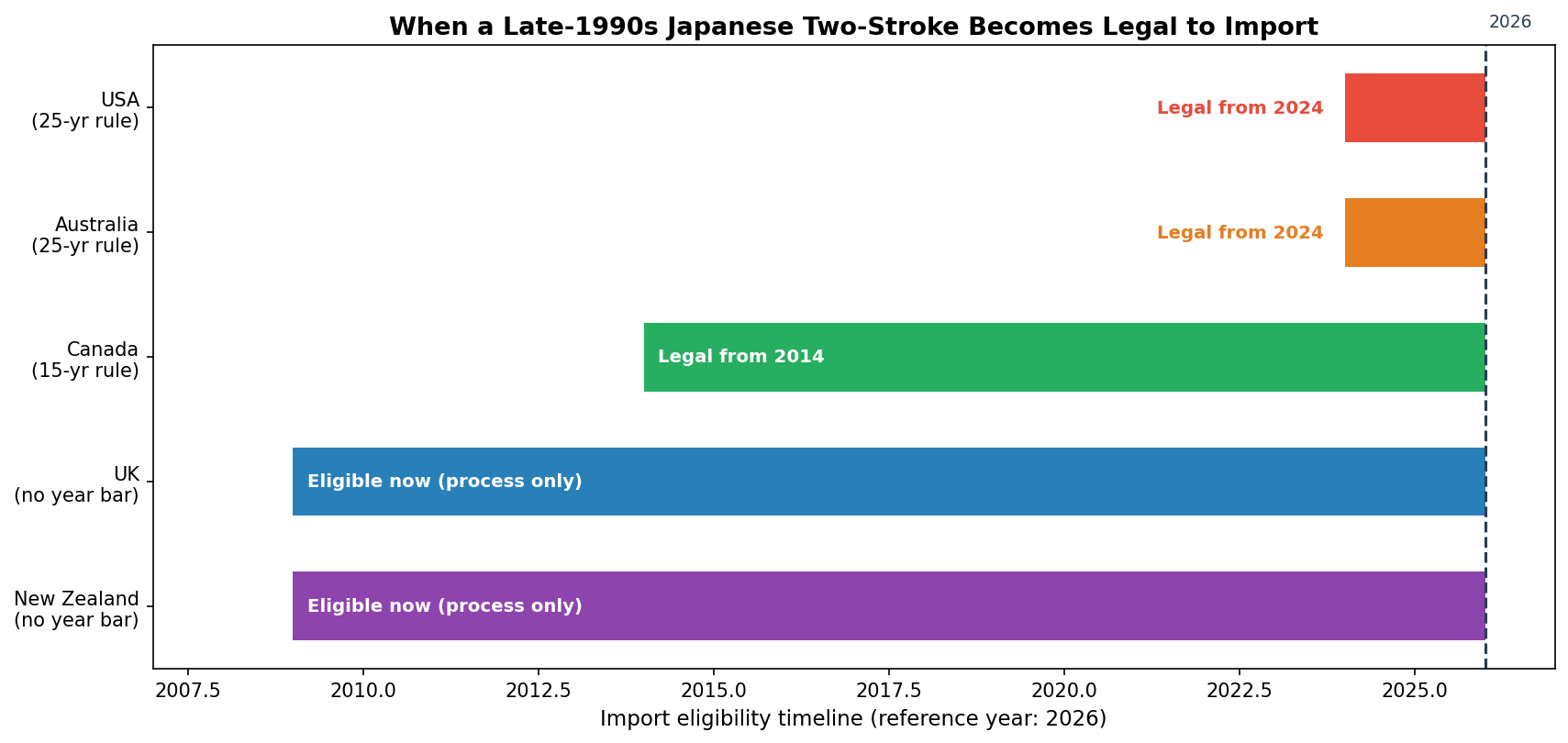
In the United States, a motorcycle built at least 25 years ago is exempt from the federal emissions and safety standards that otherwise make a 250cc two-stroke road bike illegal to import. Bikes that clear that 25-year line import under HTS code 9903.94.04 at a 2.5% duty rate. Translation: the 25-year rule is not a loophole for two-strokes — it is the only legal door. Because the EPA banned highway two-strokes over 50cc, there is no other path to a road-legal stroker in America. None.
Australia runs the same 25-year clock. Canada is more generous: its rule is 15 years, so Canadian buyers can ride bikes a full decade before their American neighbors can. A 2002 RGV that an American can't touch until 2027 is already legal in Ontario today. The United Kingdom and New Zealand don't impose a blanket year bar at all — they have process (NOVA and IVA in the UK, entry certification in NZ) but no "wait 25 years" wall.
Here's why the clock matters for your wallet. Every year, another model year crosses the 25-year line and a new wave of buyers floods in. The late-1990s NSR250 MC28, RGV250 VJ23, and TZR250 3XV are crossing into legality right now in the US and Australia, which is exactly why prices are moving. The bike that's "too new to import" this year becomes legal next year — and so does the bidding war.
The four worlds of Japanese two-strokes
"Two-stroke from Japan" covers wildly different machines. Before you bid, figure out which of these four worlds you actually belong in, because the buying advice, the price, and the maintenance reality change completely between them.
World one: the 250cc GP replicas. The screaming quarter-litre race-reps — NSR250, RGV250, TZR250, KR-1S. Aluminium beam frames, banshee exhaust note, 45 to 65 horsepower in a 130kg bike. These are the icons, and the ones everyone pictures.
World two: the big-bore exotica. The two-stroke unicorns — Yamaha's V4 RZV500R and RD500LC, Suzuki's RG500 Gamma, the old Kawasaki triples (H1 500, H2 750). Rare, expensive, and the kind of bike you trailer to shows as often as you ride.
World three: the air-cooled classics. The bikes that built the legend before water-cooling — Yamaha RD250, RD350, RD400, and the early RZ350. Simpler, cheaper to fix, endlessly tuneable, and the friendliest entry into stroke ownership.
World four: the dual-sport and enduro strokers. The dirt-and-trail two-strokes — Kawasaki KDX200/220, Yamaha DT200 and DT230 Lanza, Suzuki RMX250 and TS200R, and the oddball Yamaha TDR250. Light, torquey, and wildly underpriced compared to the road bikes.
Most buyers think they want world one. Plenty of them are happier, and a lot richer, in worlds three and four. Let's walk all four.
Two-stroke or four-stroke: why this is a different kind of ownership
Before you commit, be honest with yourself about what a two-stroke actually is. This is not a retro four-stroke with a louder pipe. It's a fundamentally different machine, and that difference is the whole reason people import them — and the reason some people regret it.
A two-stroke fires every revolution instead of every other one, so for a given capacity it makes more power and does it higher in the rev range. A 250 race-rep spinning to 12,000rpm makes power a 250 four-stroke twin can only dream about, and it does it with a hit — that famous "coming on the pipe" surge as the expansion chamber starts resonating. Riders who grew up on strokers chase that feeling for the rest of their lives. Brightside's "Two Stroke Tearaways" comment section is full of grown adults mourning the RD they sold in 1991.
The trade-offs are real and you should know them going in. You mix oil into the fuel (or keep an oil-injection tank topped up). You rebuild top ends more often. You'll smell of two-stroke premix and you'll learn to love it. Fuel economy is worse, the powerband is narrower, and the bike demands to be ridden, not lugged around town. None of that is a flaw — it's the texture of the thing. If you want set-and-forget, buy a four-stroke. If you want the most involving, characterful, alive motorcycle ever sold to the public, this is your aisle.
The 250cc GP replicas: NSR250, RGV250, TZR250 and the underdog
This is the holy trinity of Japanese two-strokes, plus a brilliant outsider. Each is a 250cc race replica built for Japan's domestic market, and each has its own personality.
The Honda NSR250R is the technical tour de force. A 90-degree V-twin in a twin-spar aluminium frame, it ran through four major generations: MC16 (1987), MC18 (1988-89), MC21 (1990-93), and MC28 (1994-99). The MC21 with its banana swingarm and the MC28 with its PGM-IV "smart card" ignition are the most coveted. Loris Reggiani and Dominique Sarron made the NSR badge famous on Rothmans and HB Grand Prix bikes in the late 1980s, and the road bikes carry that DNA. WebMagazineTRACTIONS' Honda two-stroke film featuring the NS500, NSR500, and NSR250 has pulled over 4 million views — the nostalgia is real and it's global.
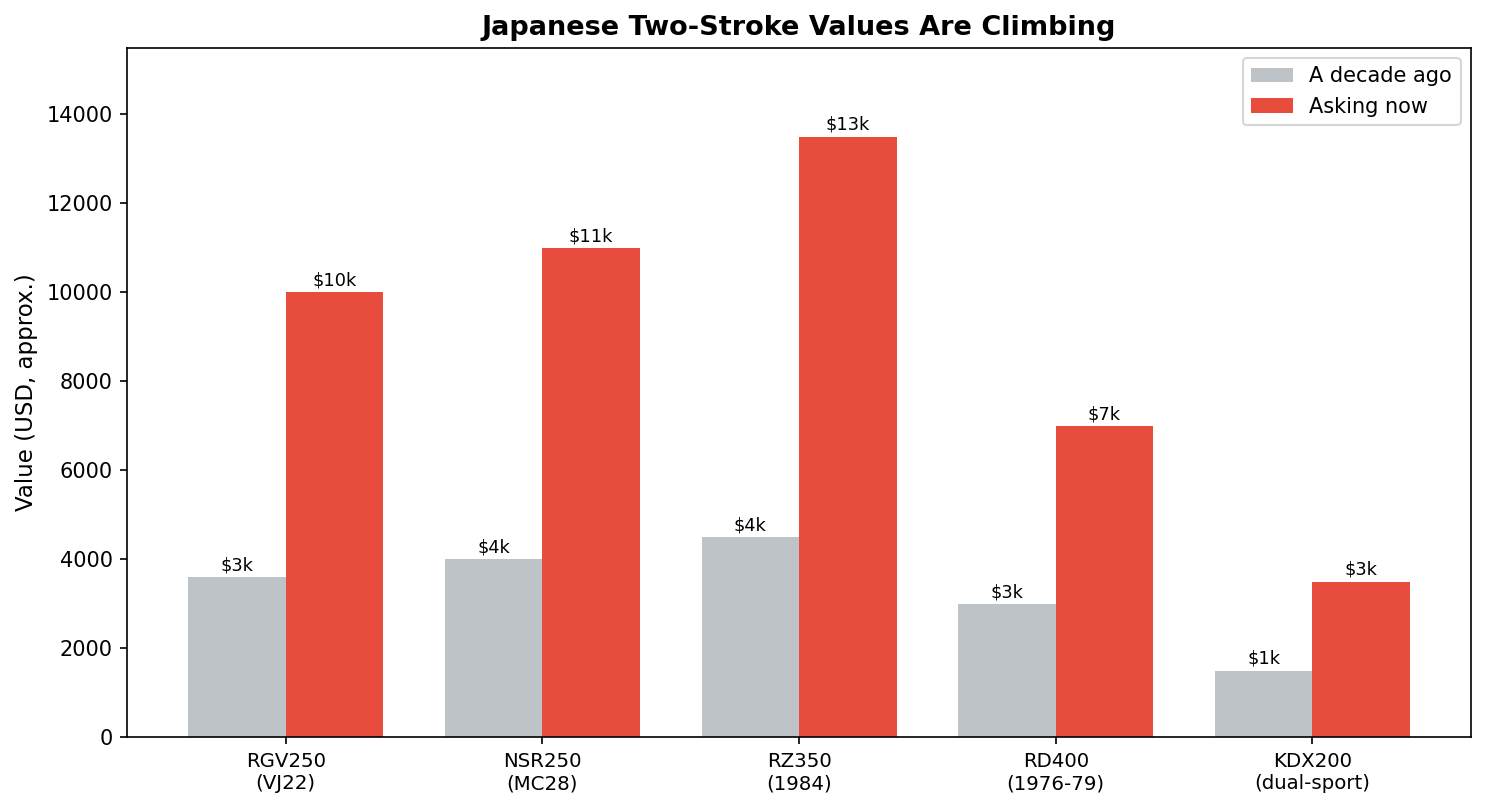
The Suzuki RGV250 is the rawest of the three. Built straight off Suzuki's 250 GP program from 1987 to 1998, it came in VJ21 (1988-89, conventional frame), VJ22 (1990-95, the famous "banana" alloy swingarm) and VJ23 (1997-98, the 70-degree V-twin with upside-down forks) flavours. Motorcycle.com's classic two-stroke shootout pitted the NSR against the RGV for a reason — the Suzuki rewards a rider who likes to be busy. One Australian owner quoted in our research bought his RGV250 in original condition years ago for $3,600 and is now turning down offers above $10,000 AUD. That's the whole story of this segment in one sentence.
The Yamaha TZR250 is the connoisseur's pick. The 1KT (1987) parallel twin started it, the 3MA (1989-90) moved to a wild "reverse cylinder" layout, and the 3XV (1991-95) brought the V-twin and the gorgeous TZR250SP/SPR race-homologation versions. The 3XV in Marlboro or Tech21 colours is one of the prettiest bikes Japan ever made.
The underdog worth knowing is the Kawasaki KR-1S. A parallel-twin 250 that was, in period, one of the fastest of the lot — and because it doesn't carry the NSR/RGV/TZR name recognition, it's still the value buy of the segment. If you want stroker performance without the trophy-tax, the KR-1S is the smart-money bid.
A quick word on reading the generations, because it directly affects what's legal and what's worth chasing. For the NSR250, the MC18 and MC21 are the late-1980s and early-1990s bikes that have already crossed the 25-year line everywhere; the MC28, built from 1994 to 1999, is the one crossing now and the one with the clever PGM-IV card key. For the RGV250, the VJ21 and VJ22 are fully legal in the 25-year markets today, while the rare VJ23 of 1997-98 is the bike Americans and Australians are still waiting on. For the TZR250, the 1KT and 3MA are old enough to import anywhere, and the prized 3XV V-twin (1991-95) is in or near the window depending on exact year and country. The pattern is always the same: the newer and rarer the variant, the later it frees up, and the harder the bidding once it does.
The exotica: RZV500R, RD500LC and the Kawasaki triples
If the 250s are the icons, these are the grails. The Yamaha RD500LC and its lightened, alloy-framed Japan-only sibling the RZV500R packed a 499cc two-stroke V4 — basically a road-legal interpretation of Kenny Roberts' GP bike. The RD500LC sold internationally; the RZV500R was built exclusively for Japan with a hand-built aluminium frame and is the version collectors chase. They listed for around $3,900 in 1984. Today a good one is firmly into five figures and climbing.
Suzuki's RG500 Gamma ("Walter Wolf" editions especially) plays in the same league: a square-four two-stroke 500 that is pure GP cosplay for the road. And for the truly old-school, the 1970s Kawasaki triples — the H1 500 and the brutal H2 750 — are the bikes that earned two-strokes their "widowmaker" reputation. CycleDrag's video of an H1 500 lining up against a Hayabusa has nearly 2 million views, which tells you the appetite for these animals never died.
A word of honesty, because we'd rather you hear it from us: the exotica are not first-import bikes. Parts are scarce, prices are punishing, and a seized RZV500R top end can cost more than a clean RD350. Buy one with your eyes open, or buy it second after you've cut your teeth on something cheaper.
The air-cooled classics: RD250, RD350, RD400 and RZ350
This is where most people should start, and where the smartest money quietly lives. The Yamaha RD series — RD250, RD350, and RD400 — is the bike that defined the affordable, lively, street-legal two-stroke twin. Air-cooled, reed-valve, simple enough to rebuild on your kitchen table, and supported by one of the best parts and aftermarket communities of any classic bike on Earth.
The RD400 (1976-79) is the sweet spot for many: enough torque to be usable, light enough to be a riot, and genuinely rebuildable by a competent home mechanic. European-spec RD400s trade in the $5,000 to $9,000 range. A clean early RD350 can still be found around $3,000. These are not investment-grade prices — they're "buy it and ride it" prices, which is exactly the point.
The RZ350 (the water-cooled evolution, sold in the US only from 1983 to 1985 with the YPVS power valve) is the bridge between the old air-cooled twins and the modern race-reps. The 1983-85 models are the most collectible, and a pristine 1984 RZ350 recently changed hands at $13,500 — proof that even the "cheap" strokers have a ceiling that keeps rising. Brightside Media's "Two Stroke Tearaways" retrospective on the seventies strokers has over a million views, and the comment sections read like a support group for people who sold theirs and regret it.
The dual-sport and enduro strokers: KDX, DT, RMX and the TDR
Here's the segment almost nobody writes about, and it's the best value in the entire two-stroke world. Before KTM, Husqvarna, and the European brands took over off-road, the Japanese Big Four built superb, affordable two-stroke trail and enduro bikes — and Japan's used market is full of them.
The Kawasaki KDX200 and later KDX220 were, for years, the best-value two-stroke woods machines you could buy — forgiving power, bulletproof bottom end, and a cult following among trail riders. The Suzuki RMX250 and Yamaha's WR250 were their period rivals, race-bred enduro bikes detuned just enough for the trail.
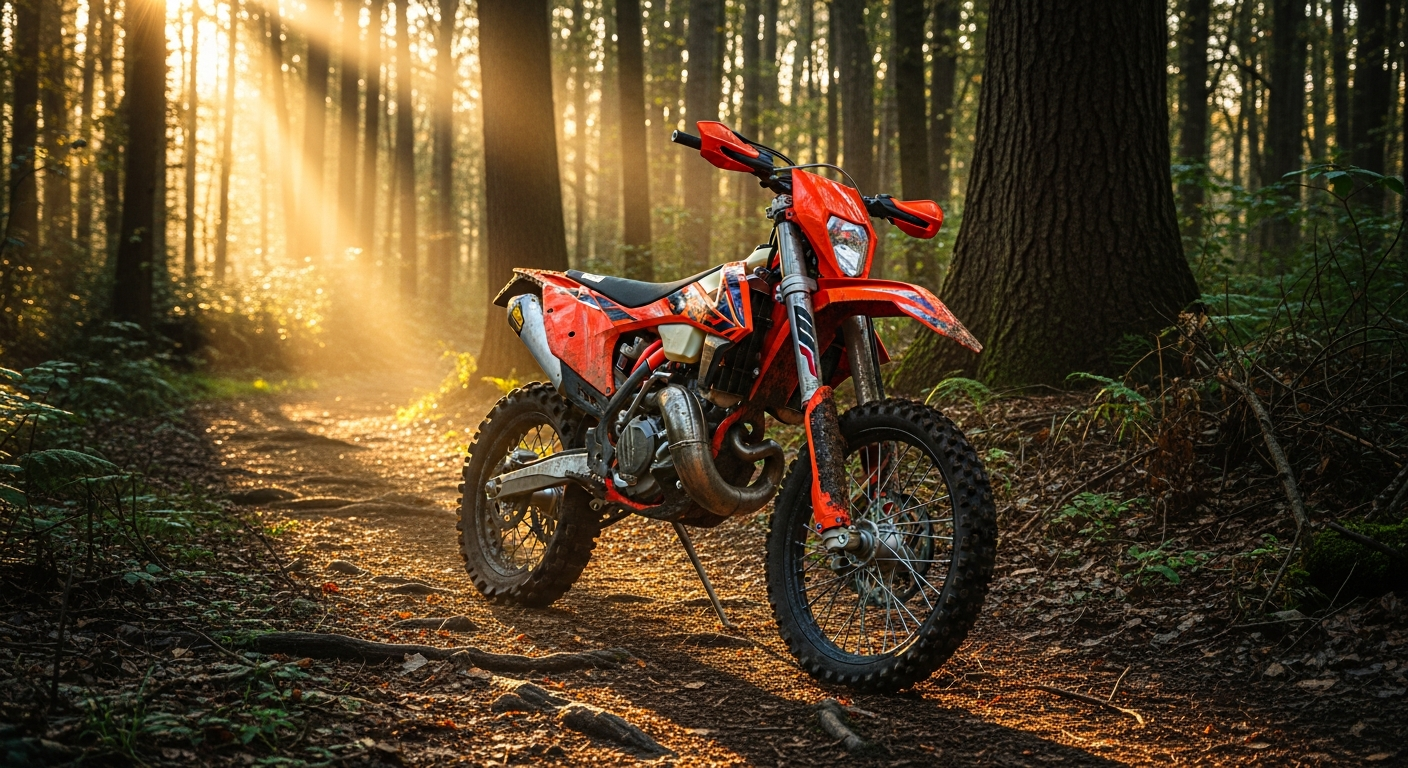
Then there are the Japan-only dual-sports that never officially left home: the Yamaha DT200WR and the later DT230 Lanza, the Suzuki TS200R, and the genuinely weird and wonderful Yamaha TDR250 — a two-stroke parallel-twin on semi-knobbly tyres that was a "supermoto" a full decade before the genre had a name. These bikes are light, torquey, road-registerable in most markets, and a fraction of the price of a clean RGV. If you want a two-stroke you'll actually ride every weekend instead of polishing, start here.
The 125cc strokers: the sleeper gateway
Don't sleep on the little ones. Japan and the wider Asian market produced full-fairing 125cc two-stroke race-reps — the Honda NSR125, Yamaha TZR125, and Suzuki RG125 — that look exactly like their 250 big brothers and cost a fraction to buy, ship, and run. For a younger or lighter rider, or anyone in a market with restricted-licence rules, a 125 stroker is the most fun-per-dollar two-stroke you can import. They're light enough that shipping is cheap, and they scratch the screaming-exhaust itch without the GP-replica price tag.
Best 2 stroke motorcycles to import from Japan, by rider type
Enough history. Here's the blunt version, matched to who you actually are.
If you want the iconic race-rep and have the budget: Honda NSR250R MC21 or MC28. It's the most refined, the most reliable of the screamers, and the values are only going one way.
If you want maximum stroker thrill for the money: Kawasaki KR-1S. The performance of the trinity, without the name-tax.
If you want to ride every weekend and wrench yourself: Yamaha RD400 or RZ350. Cheap parts, huge community, endlessly satisfying.
If you want dirt, trails, and a registerable plate: Kawasaki KDX200/220 or Yamaha DT230 Lanza. The best-kept secret in the whole class.
If you want the grail and you've done this before: Yamaha RZV500R or Suzuki RG500 Gamma. Eyes open, wallet ready.
If you're new, young, or on a restricted licence: Honda NSR125 or Yamaha TZR125. All the fun, none of the fear.
A week in the life of the Japanese two-stroke market
To understand why Japan is the answer, picture an ordinary week at the auctions. Across BDS, JBA, and the USS bike lanes, roughly 15,000 used motorcycles change hands — and in any given week, that haul includes dozens of two-strokes spanning every world we've covered. A clutch of NSR250s in varying grades. A few RGV250s, and a rare VJ23 if you're lucky. TZR250s in faded race colours. A wall of KDX200s and DT200s that nobody outside Japan seems to want yet. The occasional RZ350 or RD400 that drifted east decades ago. And, once in a blue moon, an RZV500R that sets the forums alight.
That volume is the entire point. In your home market, finding a clean, original, running stroker means waiting months for the right ad and then driving four hours to discover it's rougher than the photos. In Japan, the bikes come to you every week, pre-graded by a neutral inspector, with the rust and the dents and the odometer history written on a sheet you can read before you bid. You're not hunting for a needle. You're shopping a catalogue that refills every seven days.
That's also why the prices, even after shipping, often beat the local market. You're buying at the source, before the bike has been marked up by a dealer, a flipper, and a continent of scarcity. The freight is the price of skipping all of that.
What a two-stroke import actually costs
Let's talk real money, because this is where dreams meet shipping invoices. The landed cost of a two-stroke from Japan breaks into five buckets: the auction hammer price, the agent and auction fees, ocean freight, import duty, and local compliance or registration.
For a mid-tier 250 race-rep, a realistic example looks like this: a hammer price around $4,000, agent and auction fees of roughly $700, ocean freight of $800 to $1,200 depending on container versus RoRo and destination, duty (2.5% in the US under the classic exemption, GST/VAT depending on country), and a few hundred for local compliance. All-in, you're typically landing a clean 250 stroker in the $6,500 to $8,500 range.
The air-cooled classics and the dual-sports land cheaper — often $4,500 to $6,500 all-in — because the hammer prices are lower. The exotica run the other way: an RZV500R or RG500 can clear five figures before it's even on the boat.
Here's the honest framing. The cheapest part of importing a desirable two-stroke is often the bike itself. The fees and freight are roughly fixed whether you're shipping a $2,000 KDX or a $12,000 RZV. That math means it rarely makes sense to import the cheapest, roughest bike you can find — the landed cost of a tidy example and a tired one isn't that far apart, and the tidy one won't need a $1,500 top-end the week it arrives.
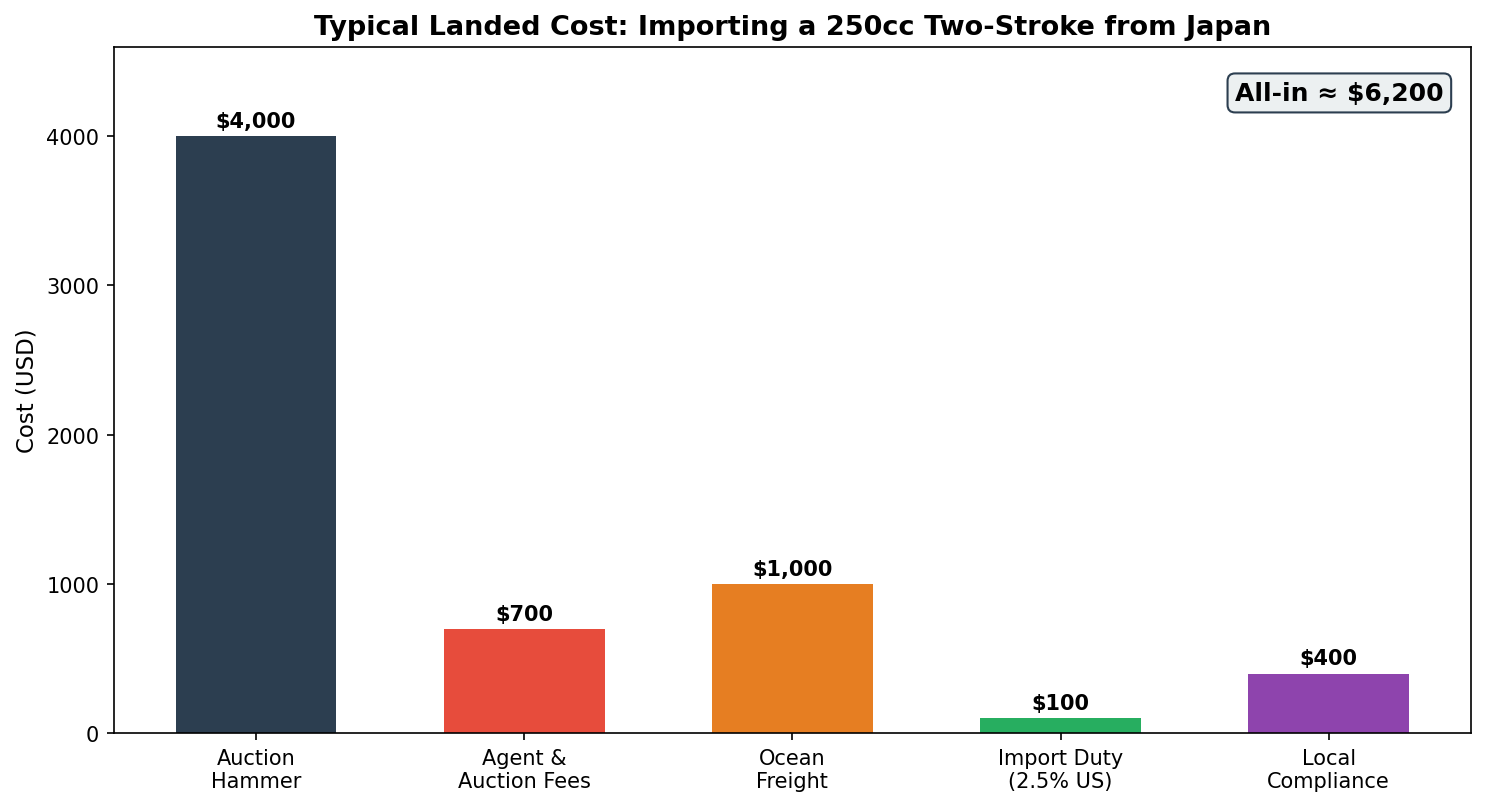
The local taxes are where countries diverge, so plug in your own. In the United States the classic exemption duty is 2.5% and there's no federal sales tax at import, though your state will want its cut at registration. The United Kingdom adds import VAT (currently 20%) plus a small duty, which is why a UK-landed stroker often costs noticeably more than a US one on the same hammer price. Australia charges GST and a modest duty, and New Zealand adds 15% GST. Canada's advantage is the 15-year clock more than the tax rate — getting the bike legal a decade early is worth more than a few points of duty. Always price the bike all-in for your own country before you decide it's a bargain.
The two-stroke buyer's checklist: what actually kills these bikes
Two-strokes fail differently from four-strokes, and the auction sheet won't spell out every risk. Here's what to scrutinise before you bid — the stuff that separates a $1,000 fix from a $4,000 heartbreak.
The top end. Two-strokes wear pistons and rings far faster than four-strokes. A 30-year-old stroker has almost certainly had top-end work — the question is whether it was done right. Ask for compression numbers where possible, and budget for a fresh top end on arrival regardless. It's cheap insurance and a rite of passage.
The power valve. The exhaust power valves — Yamaha's YPVS, Honda's RC valve, Suzuki's AETC/SAEC — are the heart of the modern stroker's midrange. They gum up, seize, and lose their servo motors. A carboned-up or stuck power valve turns a 250 race-rep into a gutless 250 commuter. On the auction photos, this is invisible. Buy through someone who can have it inspected.
Crank seals. Failing crankshaft seals lean out the mixture and can hole a piston in minutes. Idle hunting, rising RPM, and a bike that won't settle are the tells. On the exotic V4s and the RGV V-twins, a crank rebuild is a serious bill.
Originality and completeness. Two-stroke values live and die on the small parts — original expansion chambers, bodywork, decals, and the correct ignition box. A bike with aftermarket pipes and missing fairings can run great but it's worth far less, and the original parts are often unobtainium. The auction sheet's exterior grade and the photos matter enormously here.
The odometer. Japanese inspection sheets flag mileage tampering, but cross-check the wear — grips, pegs, seat, fork stanchions — against the claimed reading. Genuine low-mileage strokers exist in Japan in numbers that don't anywhere else, but verify, don't assume.
How to actually buy a two-stroke at a Japanese auction
You can't walk into a Japanese dealer auction yourself — they're trade-only. You bid through a licensed agent. Here's the flow, start to finish.
First, you pick your targets and set hard ceilings. With two-strokes especially, decide your maximum bid before the auction and stick to it, because the desirable models attract emotional bidding.
Second, your agent pulls the auction listings for matching bikes across BDS, JBA, and the USS bike lanes — often hundreds of two-strokes in any given week — and translates the inspection sheet for you, including the all-important exterior and overall grades.
Third, you bid. The agent places your bid up to your ceiling. If you win, you pay the hammer price plus the auction and agent fees.
Fourth, logistics. The bike is collected, de-registered for export, crated or loaded, and shipped — container if you want maximum protection for a valuable stroker, RoRo if you want to save money on a cheaper one. Reckon on six to ten weeks door to door.
Fifth, on arrival you clear customs, pay duty, and handle local compliance and registration. Then you fit a fresh top end, mix your oil, and go make the best noise in motorcycling.
Container vs RoRo: how to ship a two-stroke home
How your bike crosses the ocean matters more for a two-stroke than for most imports, because so much of a stroker's value sits in its fragile, irreplaceable bodywork and pipes.
Container shipping puts your bike inside a sealed steel box, usually strapped to a pallet or sharing a container with other vehicles. It costs more, but the bike is protected from weather, salt spray, and dock handling. For anything valuable — a clean NSR250, any of the exotica, a numbers-matching RZ350 — container is the only sane choice. You can also fill the rest of the container with spares, which is how the savvy importers amortise the cost.
RoRo (roll-on, roll-off) is cheaper. The bike is wheeled onto a vehicle ferry and lashed on an open deck. It's fine for a cheap KDX or a project RD400 where a bit of sea air won't change the maths. It's the wrong call for a $10,000 race-rep. Reckon RoRo saves a few hundred dollars and costs you a layer of peace of mind — decide accordingly.
Either way, insist the fuel is drained and the bike is properly secured. A two-stroke that arrives with a dented expansion chamber has lost real money, because you can't just order a new one.
Living with an imported two-stroke: parts, premix and resale
Owning one of these is genuinely different from owning a modern bike, so here's the practical reality nobody puts in the sales pitch.
Parts are a tale of two cities. The air-cooled classics — RD250/350/400, RZ350 — have phenomenal aftermarket and community support; you can build one from catalogues. The Japan-only race-reps are tougher: consumables like pistons, rings, gaskets, and reeds are available, but model-specific bodywork, original pipes, and electronics can be a hunt. This is exactly why buying a complete, original bike up front saves you years of searching. The bike that's missing its fairing isn't cheap — it's expensive, you just pay later.
Day to day, you'll manage premix or an oil-injection system, you'll do more frequent top-end checks, and you'll learn the bike's moods. None of it is hard; it's just hands-on. Plenty of owners say that's the best part — a two-stroke makes you a better mechanic whether you wanted to be one or not.
On resale, you're in a rising market. Strokers are appreciating across the board, and an original, well-documented import with its inspection sheet and import paperwork sells faster and higher than a bike with a murky history. Keep the auction sheet. Keep the receipts. Your future buyer will pay for the story.
Which two-strokes are climbing in value
Two-strokes have quietly become one of the strongest corners of the classic motorcycle market, driven by nostalgia, the mechanical purity that modern bikes lost, and the simple fact that they stopped making them. The bikes bridging factory race tech and limited-series availability are climbing fastest.
At the top, the exotica — RZV500R, RG500 Gamma, RD500LC — have moved from "expensive" to "serious money" and aren't looking back. The 250 trinity is next: NSR250 MC28s and clean RGV250 VJ22s that traded for a few thousand a decade ago now ask double or triple. Even the air-cooled classics have firm floors, with collectible RZ350s touching $13,500.
One honest caveat for newcomers: a 250 GP replica is not an ideal first motorcycle. The powerband is peaky, the ergonomics are committed, and the maintenance is hands-on. If this is your first bike, an air-cooled RD or a dual-sport KDX is a far kinder introduction to the breed — you'll learn the rhythm of two-stroke ownership without fighting a 12,000rpm race bike in traffic. Buy the screamer second, once premix runs in your veins.
The value plays right now are the bikes the crowd hasn't fully noticed: the Kawasaki KR-1S among the road bikes, and the entire dual-sport segment — KDX, DT, RMX, TDR — which remains absurdly cheap relative to its fun and rarity. As each model year crosses the 25-year line in the US and Australia, expect another step up.
Common mistakes when importing a two-stroke from Japan
We see the same avoidable errors over and over. Here are the big ones.
Buying on the photos, not the sheet. A two-stroke can look mint and have a seized power valve and tired crank seals. The auction grade and a proper inspection matter more than a glamour shot.
Ignoring the legal clock. Falling in love with a 1999 bike when you live in the US and it won't be legal until 2024-plus, or assuming your state will register a grey-import without the paperwork lined up. Check your country and state rules before you bid, not after the bike's on the water.
Chasing the cheapest example. As we covered, the fees and freight are nearly fixed. A rough bike isn't a bargain — it's a deposit on a restoration.
Underbudgeting the top end. Plan to refresh the top end and inspect the power valve on arrival. If you don't need to, great. If you do — and you probably will — you won't be blindsided.
Forgetting the small parts. Original pipes, panels, and decals make or break the value. Don't dismiss a bike for cosmetics that are unobtainium, and don't overpay for one wearing aftermarket everything.
How AWA Auction gets your two-stroke home
This is the part where we tell you what we do, because it's the natural end of the story. AWA Auction gives English-speaking buyers direct access to the same Japanese dealer auctions — BDS, JBA, USS — where these two-strokes actually live. We translate the inspection sheets, bid to your ceiling, handle export de-registration and shipping, and walk you through customs and compliance on your end.
The two-strokes are out there right now, by the hundreds, every single week. The clock that's making them legal in your country is the same clock pushing their prices up. The riders who move now — while the late-90s bikes are crossing the line and before the rest of the world catches on — are the ones who'll be glad they did.
Ready to find yours? Browse our current listings, or tell our team exactly which stroker you're hunting — the model, the generation, the colour scheme — and we'll set up the search. Your next two-stroke is already in Japan. It just needs a ride home, and a fresh tank of premix.
See Also
Share this article: