
Here's a number that should make you sit up: a clean 1990s Suzuki GSX-R750 sold at a recent collector auction for $12,733, while tidy runners still trade in the $3,000–$8,000 band. That spread is the opportunity. The 750cc class is the sweet spot of the Japanese import world — superbike-grade chassis and inline-four sound, without the lottery-ticket prices that 250cc two-strokes and litre-bike icons now command.
This guide covers the best 750cc motorcycles to import from Japan in 2026: which models to chase, what they cost once landed, whether your country's import rules are on your side yet, and the model-specific gremlins to check before you bid. If you've watched 44Teeth's "Budget Bike Battle: ZX-7R v SRAD" (477,000 views) and thought "I can't stop thinking about getting one" — you're in the right place. That's a real top comment, by the way, with 38 likes agreeing.
Why the 750cc Class Is the Smartest Import Right Now
The 750cc four-cylinder is a uniquely Japanese idea. Suzuki, Honda, Kawasaki, and Yamaha spent the late 1980s and 1990s building 750s that were homologated for World Superbike, then sold to the public barely detuned. You're buying a race bike with a number plate.
Three things make 750s the best-value import in 2026:
1. They're old enough to be legal almost everywhere. The golden run of 750s — 1985 to 2001 — has now crossed the 25-year line that the US and Australia enforce, and is decades past Canada's 15-year rule. A 1996 GSX-R750 SRAD became US-legal in 2021. A 2000 GSX-R750 unlocks in 2025–2026. The clock has done its work.
2. They're still cheap — for now. Recent GSX-R750 SRAD auction results ran from $3,350 to $12,733, with most 1996–1998 bikes landing in the $3,000–$8,000 range. In the UK, decent examples sit at £2,500–£3,000. Compare that to a clean NSR250 two-stroke, which can hit ¥2,500,000 ($16,000+) in Japan, and the 750 looks like free money.
3. They do everything. A 750 has nearly the top-end rush of a litre bike with a lighter, friendlier chassis and a fraction of the running cost. Srkcycles built an entire 1.9-million-view video around the idea that a used Suzuki GSX-R is "the fastest bike you can buy for under $7,000." The market agrees.
Here's the thing nobody mentions: the 750 class sits in a blind spot. Collectors chase 250cc two-strokes and 1340cc Hayabusas. Beginners buy 300s and 650s. The 750 — too "serious" for new riders, too "small" for the litre-bike crowd — gets overlooked. That neglect is exactly why you can still land one for the price of a tired hatchback.
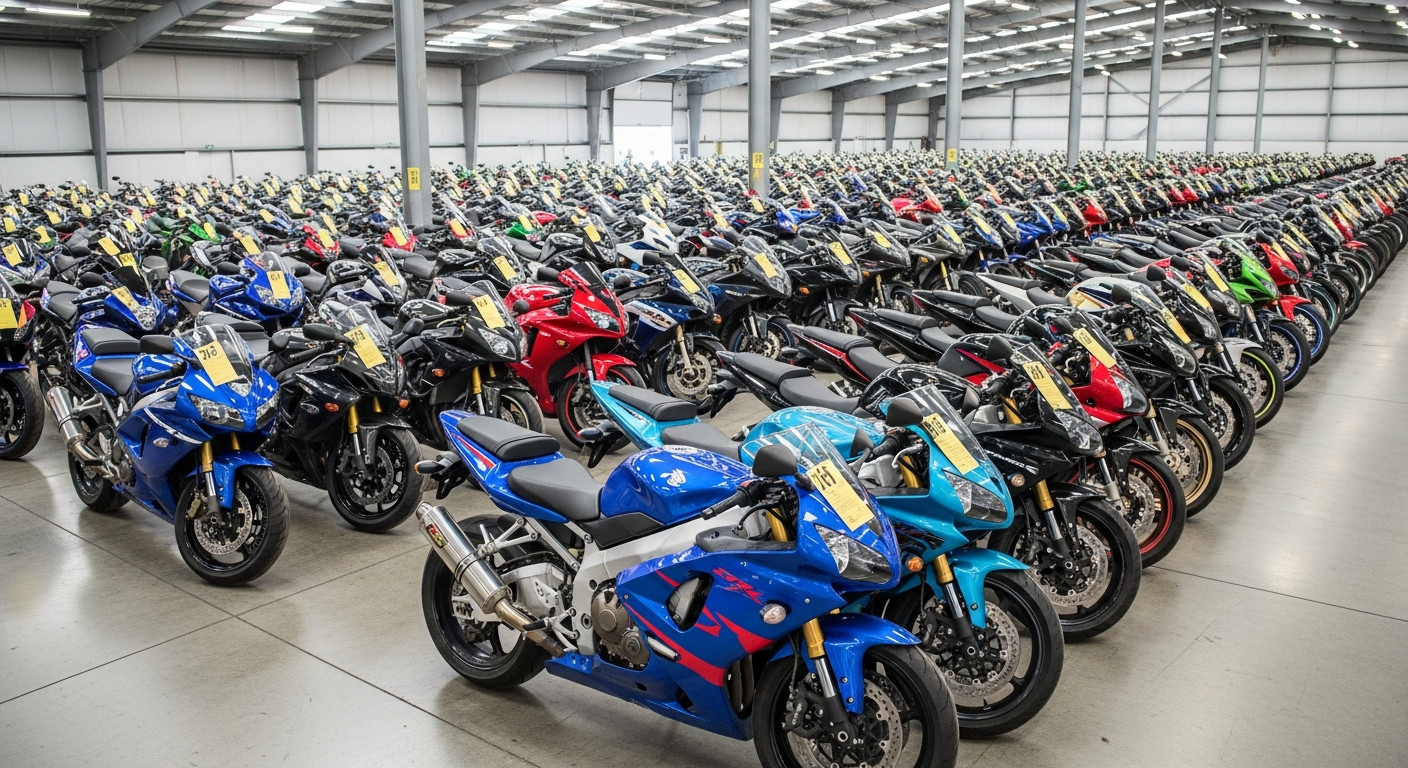
The Two Worlds of the 750: Race Replicas vs. All-Rounders
Before you start bidding, understand that "750" means two completely different bikes, and which one you want changes everything about the buy.
World one: the race-bred supersports. GSX-R750, Kawasaki ZXR750/ZX-7R, Yamaha YZF750, Honda's exotic VFR750R RC30. Clip-ons, full fairings, 100–120+ bhp, built to win Sunday racing. These are the bikes the import market really wants. They're loud, focused, and increasingly collectible.
World two: the all-rounders and muscle bikes. Honda VFR750F, Suzuki Bandit 750, Honda CB750/Nighthawk 750, Kawasaki Zephyr 750, Yamaha XJ750. Upright bars, softer tuning, bulletproof engines. Less glamorous, far more usable, and often half the price of a faired superbike from the same year.
You just need to be honest about how you'll ride it. A ZX-7R is a wrist-killer in town but glorious on a backroad. A Bandit 750 will commute, tour two-up, and never complain. Both are great imports — they're just answers to different questions.
The Best 750cc Superbikes to Import From Japan
These are the faired, race-replica 750s that define the class. Every one of them is a legitimate import target in 2026.
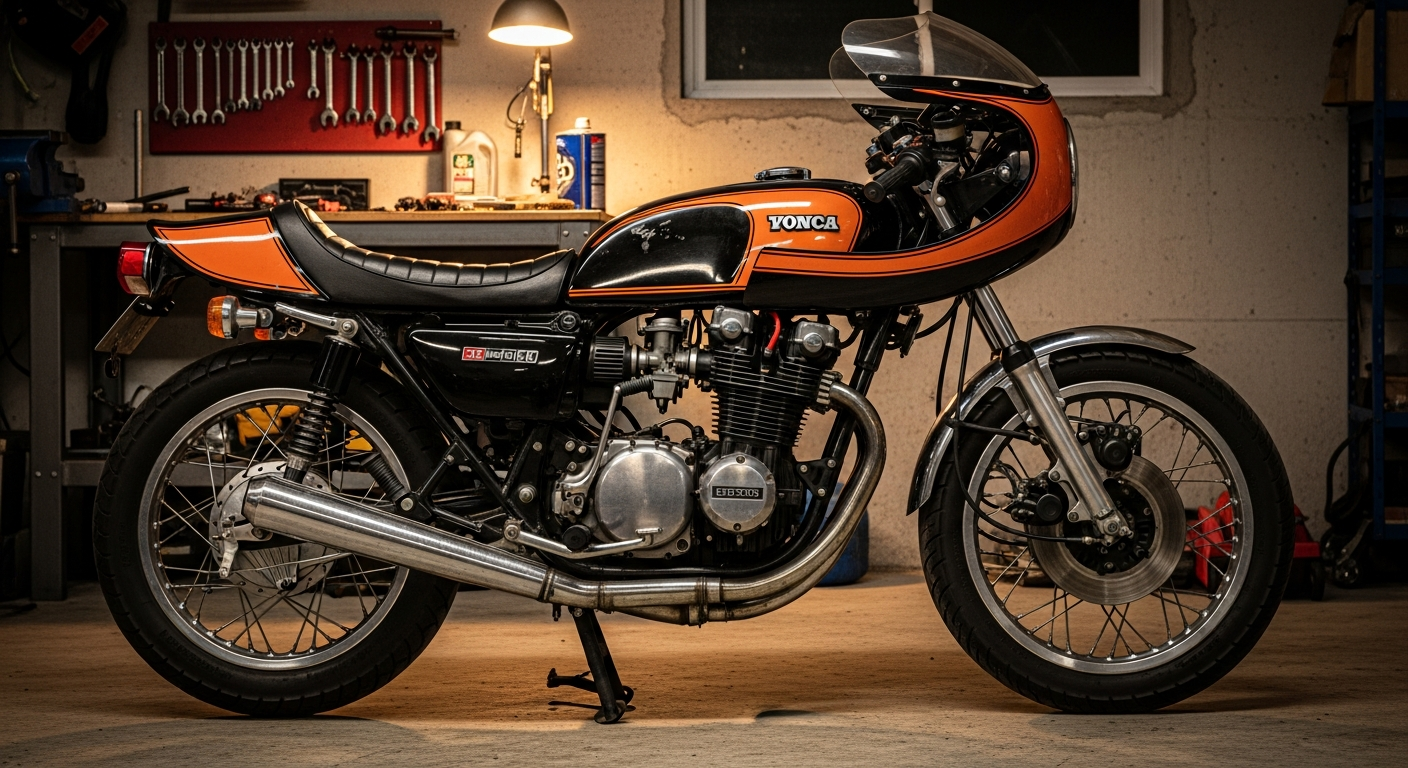
Suzuki GSX-R750 — the one that started it all
The original 1985 GSX-R750 invented the modern race-replica: an aluminium frame, oil-cooled engine, and a dry weight under 180kg when rivals were 30kg heavier. It's been in continuous production ever since, which means a huge spread of importable years and a parts supply that never dried up.
The years to chase: the air/oil-cooled "slabside" and "slingshot" models (1985–1991) for pure 1980s cool; the SRAD (1996–1999), whose marketing literally compared its geometry to Kevin Schwantz's 1993 title-winning RGV500 GP bike; and the gorgeous 2000–2003 fuel-injected generation, widely called one of the greatest sportbikes ever built with around 150 bhp from a featherweight inline-four. Bennetts rates the SRAD a future classic, and the 1996–1997 cars are "starting to become collectable" — original, documented examples command the top money.
Kawasaki ZXR750 / ZX-7R — the underdog with the best silhouette
The ZXR750 (1989–1995) with its trademark twin "hoover hose" ram-air tubes, and the later ZX-7R (1996–2003), were always the value pick against the Suzuki. In 44Teeth's head-to-head budget test, the ZX-7R held its own against the GSX-R SRAD — and the comments were full of riders saying "Always loved the ZX7r" and "look at the silhouette after all these years." The ZX-7R is heavier and less frantic than the Gixxer, but it's arguably the best-looking 750 ever made and still undervalued. Buy now.
Yamaha YZF750 / FZR750 — the forgotten Genesis
Yamaha's FZR750 and later YZF750R brought the five-valve "Genesis" engine and EXUP exhaust valve to the class. They never sold in the numbers of the Suzuki or Kawasaki, which makes a clean one genuinely rare today. The homologation-special OW01 (FZR750R) is six-figure exotica, but a standard YZF750 is an overlooked, fast, beautifully built import that flies under everyone's radar.
Honda VFR750R RC30 — the grail (if your budget is serious)
The 1987–1990 VFR750R, better known as the RC30, is the homologation V4 that won the first two World Superbike titles. It's hand-built, gear-driven-cam exotica, and prices reflect it — RC30s now trade well into six figures. It's here for completeness: if you find a clean one in a Japanese auction and have the budget, it's the blue-chip 750. For mere mortals, the bikes above are where the value lives.
The Underrated 750 All-Rounders and Muscle Bikes
This is where the real bargains hide. None of these will appreciate like a SRAD, but they're cheaper, tougher, and far easier to live with.
Honda VFR750F (1986–1997) — the gear-driven-cam V4 sport-tourer that's regarded as one of the most reliable engines Honda ever built. Smooth, fast enough, and capable of 100,000+ miles. A clean VFR750F is the thinking person's import.
Suzuki Bandit 750 (GSF750) — an oil-cooled GSX-R-derived engine in a comfy steel-tubed naked. Torquey, cheap, and endlessly tunable. The unfaired bodywork means crash damage costs pennies, not thousands.
Honda CB750 / Nighthawk 750 — the spiritual descendant of the original superbike. The 1991–2003 Nighthawk 750 is air-cooled, shaft-free, hydraulic-valve simplicity. Boring? Sure. Unkillable? Absolutely.
Kawasaki Zephyr 750 — the retro-naked that's quietly become a JDM darling. Air-cooled inline-four, classic 1970s styling, and a huge following in Japan. These are appreciating, so a clean import is both fun and a hedge.
Here's the trade-off in one line: the faired superbikes are the investment; the nakeds and tourers are the bikes you'll actually ride 5,000 miles a year without a second thought.
Is the 25-Year Rule on Your Side? A Country-by-Country Reality Check
This is the section that decides whether you can import the bike you want — or have to wait. The rules hinge on the bike's age, and they differ wildly by country.
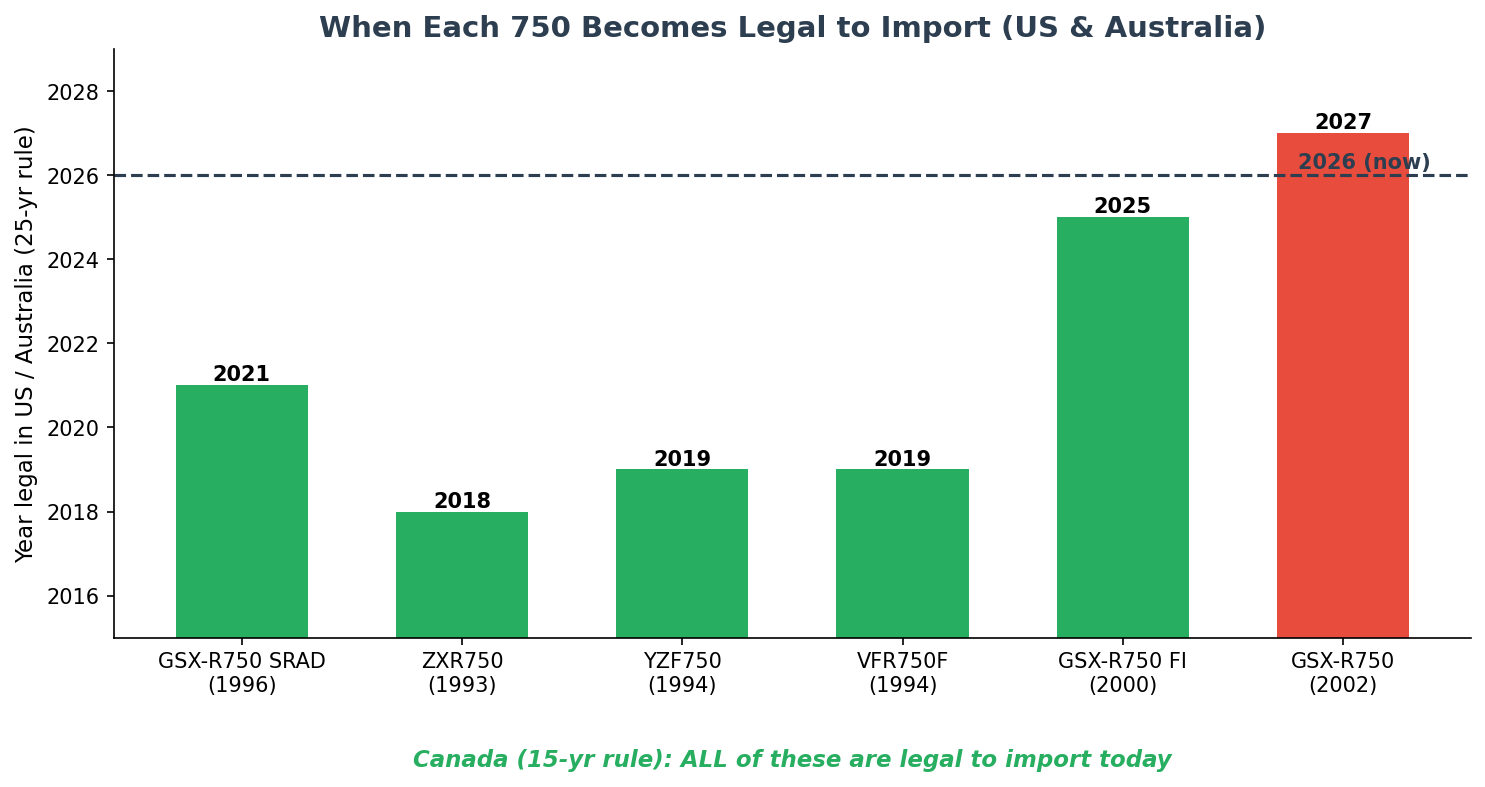
United States & Australia — the 25-year rule. A motorcycle 25 model-years old or older is exempt from federal compliance (NHTSA in the US, the new ROVER scheme in Australia). In 2026, that means anything built in 2001 or earlier is fair game. A 1996 SRAD? Legal since 2021. A 2000–2001 GSX-R750? Unlocking right now. A 2002–2003 model? Wait until 2027–2028.
Canada — the 15-year rule. Canada only requires a vehicle to be 15 years old, which means anything from 2011 or earlier is importable today. Every 750 in this guide qualifies. This is why Canadian buyers get the modern bikes a full decade before their American neighbours.
UK & New Zealand — no blanket age bar. Neither country uses a rolling year cutoff for motorcycles. You can import a 750 of any age, handling registration through the UK's NOVA/IVA process or NZ's entry certification. The clock isn't your enemy here — paperwork is.
The chart below shows when each headline 750 becomes legal in the US/Australia, against Canada's far more generous window.
What a 750 Actually Costs to Land From Japan
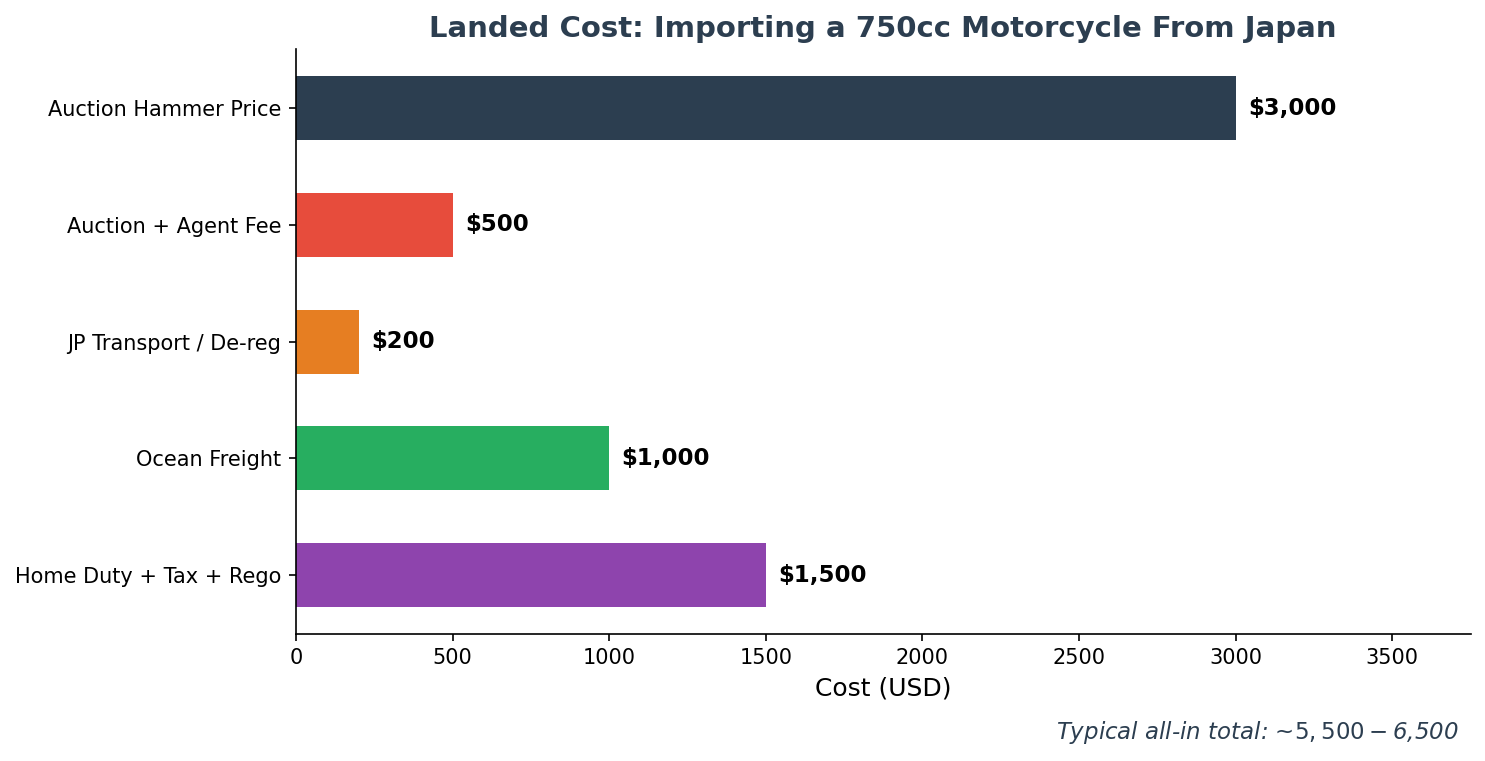
The auction hammer price is the headline, but it's only the start. Here's the honest, all-in math for a typical mid-grade 750 bought through a Japanese auction.
Start with a hammer price of around $3,000 for a clean, auction-grade 4 example. Add the auction and export-agent fees (roughly $400–$600), Japanese domestic transport and de-registration paperwork ($150–$250), ocean freight by container or RoRo ($800–$1,200 depending on destination), and then your home-country costs — customs duty (usually 0% on motorcycles in many markets, but check yours), local tax/VAT/GST, and registration/compliance.
For most buyers in the US, UK, Australia, or Canada, a $3,000 hammer price turns into roughly $5,500–$6,500 landed and on the road. That's still less than a tired modern 650 from a local dealer — and you end up with a homologated 1990s superbike instead.
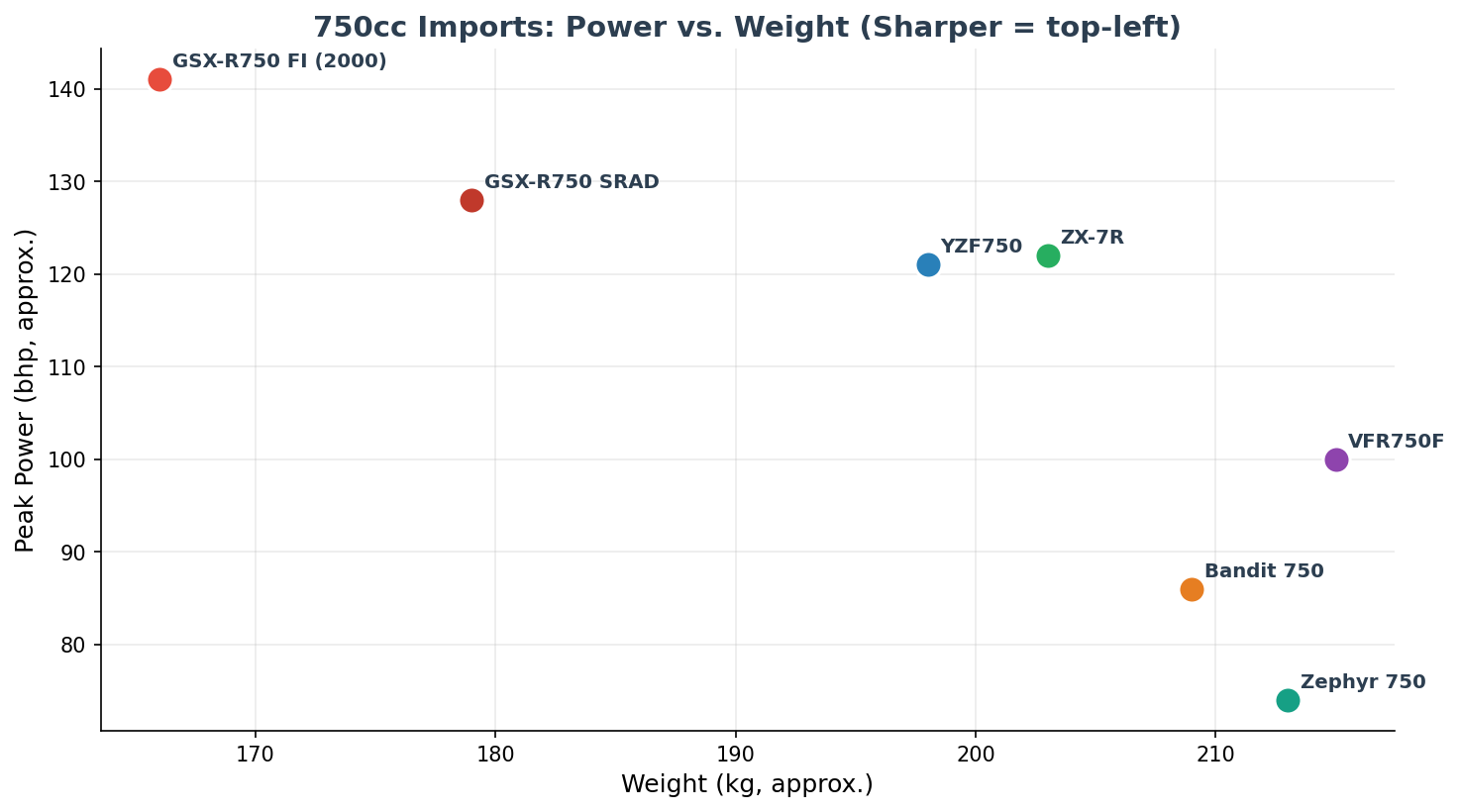
Two-stroke and litre-bike buyers pay a scarcity premium; the 750 buyer doesn't. That's the entire pitch. The bikes below also show how the contenders stack up on power-to-weight — the metric that actually matters once you're moving.
How to Actually Buy a 750 at a Japanese Auction
You can't walk into a Japanese motorcycle auction yourself — they're trade-only, dealer-members-only events. You bid through an export agent. Here's the flow.
Step 1 — pick your agent. A reputable exporter (this is what AWA Auction does) gives you access to the big bike auctions: BDS (Bike Dealer's System, the largest, running ~180,000 bikes a year), JBA (which specialises in classics), and others. They bid on your behalf and handle export.
Step 2 — search the listings. Thousands of bikes cross the block every week. You filter by model, year, mileage, and — critically — auction grade.
Step 3 — read the auction sheet. Every bike gets an inspector's grade (S, A, AB, B, C, R for repaired/accident, down to X). Stick to grade 4/B and above for your first import. The sheet also maps every scratch, dent, and rust spot. Learning to read it is the single most valuable skill in this whole process.
Step 4 — set your max bid. Your agent bids up to your ceiling. Win or lose, you pay nothing on a loss. Build your landed-cost number first, then back out a hammer ceiling from it.
Step 5 — pay, ship, and wait. Container or RoRo, 6–10 weeks door to port depending on destination. Then your home-country compliance and registration.
The 750 Buyer's Checklist: Model-Specific Gremlins
These bikes are 25–40 years old. They're tough, but each family has known weak spots. Check these before you bid — or have your agent's inspector confirm them on the sheet.
All inline-four 750s: carb sync on the carbureted models (a bike that won't idle smoothly usually needs a balance, not an engine). Check for a sticky or noisy cam-chain tensioner — a top-end rattle on cold start is the classic warning. Confirm the regulator/rectifier works; charging-system failure is the most common 1990s Japanese-four fault.
GSX-R750 (SRAD and FI): the SRAD's fairing tabs crack and the original rear shock is usually shot by now — budget for a refresh. The 2000-on FI bikes are largely trouble-free but check for clutch basket rattle.
ZXR750 / ZX-7R: the ram-air ducts and the cam-chain tensioner are the usual culprits. ZX-7Rs are heavy on the front tyre, so check fork seals and steering-head bearings.
VFR750F / RC30: the gear-driven cams are bulletproof, but check the regulator/rectifier (a chronic V4 weak point) and the rear-wheel bearings on the single-sided swingarm models.
Bandit / Zephyr / Nighthawk: oil-cooler or air-cooling fins for damage, carb condition after long storage, and frame rust on bikes that lived through Japanese winters. These are simple bikes — there's little to hide.
One honest warning: a cheap bike with a bad auction grade is not a bargain. It's a project. Pay the extra ¥50,000 for a grade-4 bike and skip the heartache.
Which 750 Should You Buy? A Rider-by-Rider Guide
You want the icon and don't mind a wrist workout: GSX-R750 SRAD or 2000–2003 FI. The benchmark, the soundtrack, the investment.
You want the best-looking 750 and the best value: Kawasaki ZX-7R. Still cheap, still gorgeous, won't stay cheap.
You want something nobody else has: Yamaha YZF750. Rare, fast, overlooked.
You want to actually ride it every day: Honda VFR750F or Suzuki Bandit 750. Comfortable, reliable, cheap to fix.
You want a future classic you can ride now: Kawasaki Zephyr 750. Retro cool that's already appreciating.
You have a serious budget and want the grail: Honda VFR750R RC30. Blue-chip, hand-built, World Superbike royalty.
Is 2026 the Year to Buy a 750?
Yes — and the reason is two clocks ticking at once. The 25-year rule keeps unlocking newer, sharper 750s every year (the 2000–2001 GSX-R750 is crossing the line right now). At the same time, the supply of clean, original 1990s superbikes in Japan keeps shrinking as the good ones get exported and the rough ones get scrapped.
Those two trends point the same direction: the best 750s get more legal and more scarce simultaneously. The riders in 44Teeth's comments asking for "more videos even of bikes for 3,4k" are the leading edge of a wave. Prices for clean SRADs and ZX-7Rs have already started climbing. The window where you can land a homologated 1990s superbike for the price of a used scooter is closing — slowly, but it's closing.
Buy the clean one now. The rough one will always be there.
The 750cc Superbike Wars: A 60-Second History
To understand why these bikes are special, you have to understand why they exist. In the 1980s and 1990s, World Superbike racing ran a class for 750cc four-cylinder machines. To go racing, manufacturers had to sell a road-legal version to the public — "homologation." That single rule turned the 750 into the most hotly contested class in motorcycling.
Suzuki fired first with the 1985 GSX-R750: aluminium frame, oil cooling, sub-180kg dry weight. It was, by the standards of the day, insane — a genuine race bike you could buy on finance. Kawasaki answered with the ZXR750, Yamaha with the FZR750 and its five-valve Genesis engine, and Honda went nuclear with the gear-driven-cam VFR750R RC30, which promptly won the first two World Superbike championships in 1988 and 1989.
For fifteen years these four companies threw everything they had at the 750cc class. Every season brought lighter frames, sharper geometry, more revs. The bikes that came out of that arms race are the ones you're importing today — and they were built to a standard that 1990s budgets and 2026 prices simply don't reflect anymore. You're buying the output of the most expensive engineering war in motorcycling history, at clearance prices.
The class faded after 2002 when World Superbike opened up to 1000cc twins and fours, and the factories shifted focus to the litre bikes. The GSX-R750 soldiered on — it's still in showrooms in 2026 — but the golden, homologation-special era ended. That's why 1985–2001 is the window every serious 750 importer cares about.
750 vs 600 vs 1000: Settling the Eternal Debate
Every motorcycle forum has the same argument on loop: which class is best? Here's the honest answer, because it directly affects what you should import.
The 600 supersport is the track-day darling — screaming, high-revving, and the cheapest faired sportbike to buy. But a 600 has to be wrung out to feel fast, and on the road that means living at illegal speeds to access the fun. ThoughtTaken's "600cc vs 1000cc Sportbikes" video racked up 2.4 million views and 111,000 likes precisely because riders can't agree on this.
The 1000cc litre bike has absurd power — 150 to 200+ bhp — but it's intimidating, expensive to insure, and the modern collectible icons (R1, GSX-R1000 K1) have already started climbing in price. As one famous comment under Srkcycles' GSX-R video put it, the bike is "meant to win races and send people to Jesus." That earned 2,998 likes. Funny because it's true.
The 750 threads the needle. It makes enough torque to be quick without revving its head off like a 600, but it's lighter and friendlier than a litre bike. It's the class that won races for two decades because it was the best balance — and that balance is exactly what makes it the best all-round import. You get 90% of the litre-bike thrill, 110% of the 600's real-world usability, and a price tag that undercuts both.
Put bluntly: if you want a poster, buy a 1000. If you want a track toy, buy a 600. If you want one bike that does everything and still gives you goosebumps, import a 750.
Generation-by-Generation: The GSX-R750 Decoded
Because the GSX-R750 is the model most people import, it's worth breaking down by generation so you know exactly what you're bidding on.
Slabside (1985–1987): the original. Oil-cooled, flat-sided fairing, 16-inch front wheel on early bikes. Pure 1980s. Collectible and increasingly pricey for clean examples — Motorcycle Classics calls the 1986–1987 bikes a genuine "game changer."
Slingshot (1988–1991): revised carbs (the "slingshot" name), 17-inch wheels, sharper looks. The sweet spot for affordable air/oil-cooled cool.
Water-cooled SPR/WN-WT (1992–1995): Suzuki switched to liquid cooling. Heavier and a bit unloved, which means cheap. A smart sleeper buy.
SRAD (1996–1999): the bike that reset the class — Suzuki Ram Air Direct intake, a beam frame, and that RGV500-derived geometry. This is the one most buyers chase, and the 1996–1997 examples are already turning collectible.
Fuel-injected (2000–2003): all-new, lighter, ~150 bhp, and regarded as one of the finest-handling sportbikes of its era. The 2000–2001 bikes are crossing the 25-year line for US/Australian buyers right now.
If you want one number to remember: a clean SRAD is the best blend of icon status, usability, and price in the entire 750 world. Buy that, and you can't really go wrong.
Living With an Imported 750: Parts, Insurance, and Resale
A common worry: "If I import a 30-year-old Japanese bike, can I even keep it running?" For 750s, the answer is reassuringly yes.
Parts. Because these bikes sold in huge numbers across the world, the aftermarket and used-parts supply is deep. Consumables — pads, tyres, chains, filters, fork seals — are off-the-shelf. Bodywork and trim is where you'll hunt, and that's exactly why the auction grade matters: a bike with original, undamaged fairings saves you the one genuinely annoying parts search. The all-rounders (Bandit, Nighthawk, VFR) are even easier — they share components with bikes still on the road today.
Insurance. Here's an upside nobody mentions: a 25-year-old 750 often qualifies for classic or limited-mileage insurance, which can be dramatically cheaper than insuring a modern sportbike. A 1996 GSX-R750 on a classic policy can cost a fraction of what a new one would. Your mileage (literally) varies by country and provider, but it's frequently the cheapest superbike you'll ever insure.
Resale. This is the kicker. A clean, properly imported 750 doesn't depreciate like a modern bike — many are appreciating. The SRADs, ZX-7Rs, and Zephyrs are all trending up. Buy a good one, look after it, and in five years you'll likely sell it for what you paid or more. Try doing that with a new bike off a showroom floor.
Country Paperwork: The Details That Trip People Up
The 25-year (or 15-year) rule gets you to the start line, but registration is where imports actually stall. A few specifics worth knowing before you commit.
United States: the bike clears federal customs on a 25-year exemption (HS-7 form, box 1), but titling is done state by state. Some states are easy; a few demand a bonded title or a VIN inspection if the paperwork is thin. Research your state's process before you import, not after the crate lands.
Australia: the new ROVER system replaced the old import-approval scheme. Bikes 25+ years old go through the concessional pathway, but you still need approval before shipping, plus an asbestos declaration and biosecurity (DAFF) inspection on arrival. Then state-by-state rego.
Canada: the 15-year rule makes Canada the easiest of the big markets. Bikes over 15 years are exempt from the RIV program entirely. CPTPP origin can zero-rate the duty. Then provincial registration (Ontario, BC, Alberta, Quebec each differ).
UK: no age bar, but you'll handle a NOVA notification to HMRC, pay VAT if due, and put the bike through an IVA or use the age-related registration route for older machines. Genuinely older bikes can get a period-correct number plate.
The pattern across every country is the same: the federal/national door is open for these 750s — it's the local registration step that rewards homework. Do it first.
Real Numbers From the Auction Floor
To make the cost section concrete, here's what the data actually shows. Recent GSX-R750 SRAD auction results spanned $3,350 to $12,733, clustering in the $3,000–$8,000 band for honest 1996–1998 bikes. UK private values sit at £2,500–£3,000 for a good rider, £4,000–£5,000 for a minty, original example. ZX-7Rs run slightly behind the Suzuki — often £2,000–£3,500 — which is exactly why the 44Teeth crowd keeps flagging them as the value buy.
The all-rounders are cheaper still. A clean Bandit 750 or Nighthawk 750 can be landed for well under $5,000 all-in. A Zephyr 750 costs a little more because the JDM retro crowd has discovered them, but it's still a fraction of a faired superbike of the same age.
Set against a local dealer's used inventory — where a tired modern 650 commuter often wants $6,000–$8,000 — the imported 750 isn't just more exciting, it's frequently cheaper. That's the part that makes people do a double-take.
Five Mistakes First-Time 750 Importers Make
Importing your first bike from Japan is genuinely straightforward once you know the traps. Here are the five that catch people out — learn them on someone else's dime.
1. Chasing the cheapest bike instead of the best grade. A grade-3 GSX-R for ¥150,000 looks like a steal next to a grade-4.5 for ¥300,000. It isn't. The cheap one needs fairings, a fork rebuild, and probably carbs — and 1990s bodywork is the one part that's genuinely hard to find. Buy the grade, not the price.
2. Forgetting the second half of the cost. The hammer price is often half your total. People budget $3,000, win the auction, then get blindsided by shipping, duty, tax, and registration. Build your full landed-cost number first, then set your bid ceiling by working backwards.
3. Ignoring the registration step until the crate arrives. The federal import door is open for these 750s. Your local DMV/DVLA/state office is the bottleneck. Confirm exactly what your jurisdiction needs before you ship, not while the bike sits in a bonded warehouse racking up storage fees.
4. Picking a model your country can't register yet. A 2002 GSX-R750 is gorgeous and will be US-legal in 2027 — but if you import it to the States in 2026, it's contraband. Match the model year to your country's rule before you fall in love.
5. Skipping the agent and trying to bid solo. Japanese bike auctions are trade-only. You physically cannot register as a private buyer. Every "I'll just do it myself" story ends with the rider going through an agent anyway — start there and save the wasted weeks.
The 750s About to Become Collectible (Buy Before Everyone Else)
If you're importing partly as an investment, these are the 750s the smart money is moving on right now, before the price curve goes vertical.
1996–1997 GSX-R750 SRAD: already flagged as "starting to become collectable." The earliest, purest SRADs in original spec are the ones to grab.
Kawasaki ZX-7R (any year): arguably the best-looking 750 ever built and still cheap because it lived in the GSX-R's shadow. That gap is closing fast.
Yamaha YZF750: rare, overlooked, and never made in big numbers. Clean ones are quietly disappearing.
Kawasaki Zephyr 750: the JDM retro market has woken up. Prices in Japan are already firm and rising.
First-gen GSX-R750 slabside (1985–1987): the bike that started the entire genre. Already a blue-chip classic in mint condition — and history only gets more expensive.
The common thread: original, documented, low-owner bikes. Modified specials are fun but they don't appreciate. A bog-standard, untouched example with a clean auction sheet is the one that pays you back.
What Owners Actually Say About These Bikes
The best research isn't a spec sheet — it's what real owners say after years on a bike. Dig through the comment sections under the big 750 videos and a few themes repeat.
People keep coming back to the looks. Under 44Teeth's ZX-7R test, riders wrote things like "Look at the silhouette after all these years!" and "Always loved the ZX7r" — these are 25-year-old designs that still stop traffic. There's also a clear hunger for exactly this kind of bike: one top comment (122 likes) begged for "a video that is actually of use to someone like me… even of bikes for 3,4k." Translation: there's a whole audience that wants affordable, characterful 750s and feels underserved. That's the demand wave you're getting ahead of.
And there's the reliability story. The GSX-R faithful in Srkcycles' comments include a 59-year-old still riding his and a rider who's owned his K5 from new for nearly 50,000 trouble-free miles. These engines, looked after, simply keep going. That's the quiet superpower of the Japanese 750 — it's a race-bred machine you can genuinely rack up the miles on.
Read the comments, not just the reviews. The riders who've lived with these bikes for decades are the real auction sheet.
Import Your 750 With AWA Auction
AWA Auction gives you direct access to Japan's biggest motorcycle auctions — the same trade-only events where these 750s cross the block every week. We bid on your behalf, read the auction sheets so you don't get burned, and handle export, shipping, and paperwork to the US, UK, Australia, New Zealand, Canada, and beyond.
Browse the current listings to see which 750s are available right now, or contact our team and tell us the exact bike you are hunting — we will find it at auction in Japan.
See Also
Share this article: