
The best touring motorcycles to import from Japan are the bikes nobody fights over at auction — and that's exactly why you should be looking at them. While everyone else bids up race-replica 400s and screaming two-strokes, a clean Yamaha FJR1300 or a shaft-drive Honda ST1300 rolls across the block for money that would make a Western dealer laugh. These are the machines built to cross a continent before lunch, and Japan is full of them: low-mileage, fanatically maintained, and priced like nobody remembers what they cost new.
Here's the thing nobody mentions. When the YouTuber Yammie Noob posted a video literally titled "Why Sport Touring Bikes Suck," it pulled 787,000 views and nearly 3,000 comments — and the comment section turned into a love letter. The top reply, with over 1,600 likes, simply read: "WRONG. Sport Tourers are BOSS. Comfort, performance, fuel range." Another owner chimed in: "Just ticked over 100k miles on my FJR1300. Looking forward to another 100k." That's the touring crowd in a nutshell. They don't argue about it. They just ride further than you.
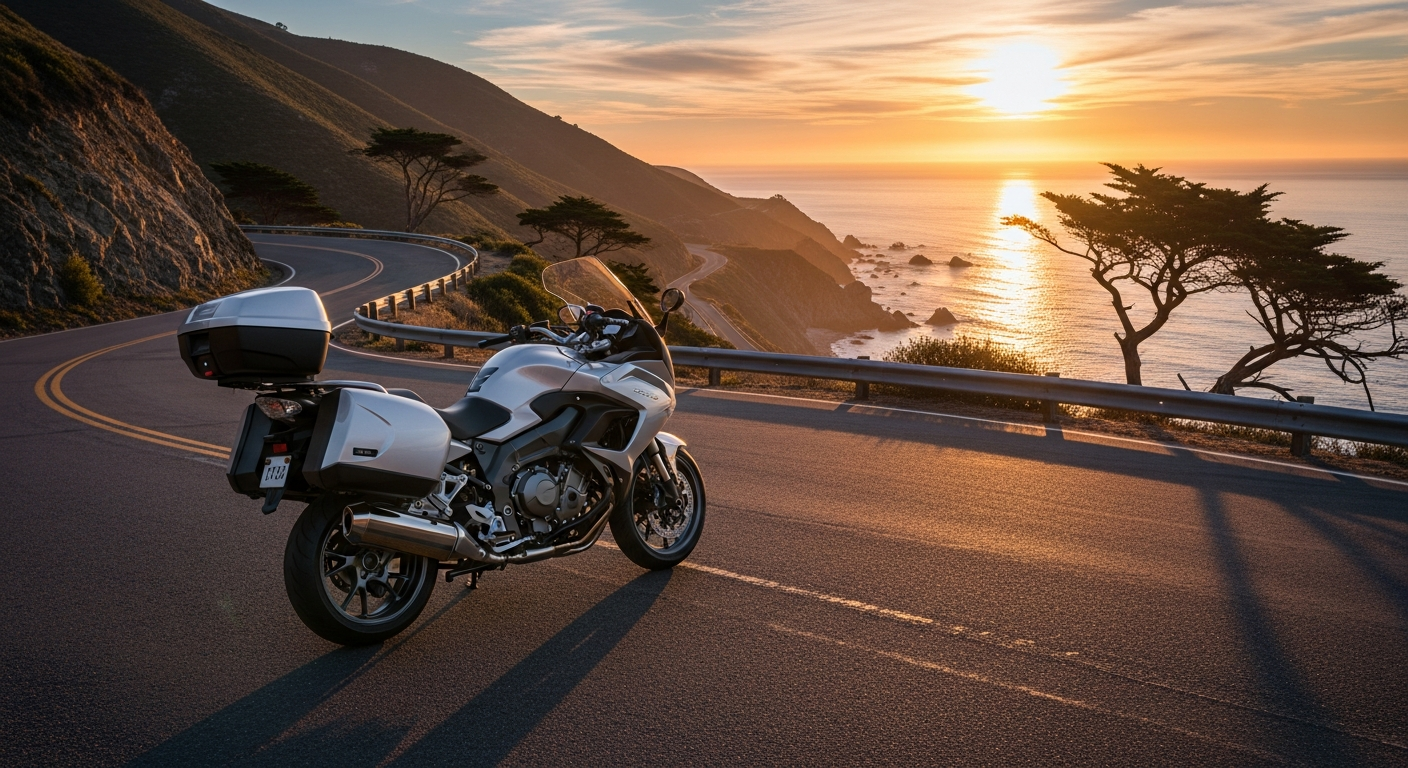
This guide is the one the magazine listicles never write. We'll cover what actually counts as a touring bike, the two distinct families you'll find in Japan, the specific models worth chasing, generation-by-generation buying notes, the 25-year rule by country, the real landed cost, and the checklist that separates a clean import from an expensive headache. By the end you'll know exactly which bike to point us at.
What counts as a "touring" motorcycle — and why Japan is the place to buy one
"Touring" is a slippery word, so let's pin it down before you spend money on the wrong bike. A touring motorcycle is built to carry you (and usually a passenger and luggage) over long distances in comfort. That means wind protection, an upright or mildly forward riding position, a big fuel tank, and an engine tuned for relaxed torque rather than peak-rev drama.
Within that, there are flavors. A grand tourer prioritizes plush comfort and weather protection — think Honda ST1300 Pan European. A sport-tourer keeps the comfort but adds real performance, so you get a Yamaha FJR1300 or Kawasaki GTR1400 that will embarrass a sportbike on a fast road and still do 300 miles without numbing you. An adventure-tourer (covered in our separate adventure guide) trades tarmac focus for dirt capability. This guide is about the road tourers: the sport-tourers and grand tourers that eat highways for breakfast.
So why Japan? Three reasons that compound.
First, the shaken system. Japan's strict biennial roadworthiness inspection means bikes get maintained on a schedule, not when they break. A 20-year-old tourer that lived its life in Japan has a paper trail and a level of mechanical honesty that a Craigslist bike with "ran when parked" energy simply doesn't.
Second, mileage. Japanese riders cover comparatively few miles, and big tourers especially tend to be weekend and touring-season bikes rather than daily hacks. It's normal to find a 15-year-old FJR1300 with under 30,000 km. Try finding that in the US, where these bikes are bought specifically to rack up six-figure mileage.
Third, price. The grand and sport-touring segment is unglamorous in Japan, where the cool kids want supersports and JDM 400 fours. That keeps hammer prices low. A "Top 10 Japanese Motorcycle Engines That Last Forever" video with 143,000 views spends half its runtime on exactly these powerplants — the FJR's inline-four, the ST's V4, the ZZR's bulletproof big-bore. Japan is selling you proven longevity at a discount because the locals are bored of it.
Why a used tourer is the smartest bike to import from Japan
Every other import guide pushes you toward the exciting stuff. Here's the unglamorous truth: a touring bike is the most rational thing you can ship across an ocean, and it's not close.
Start with the drivetrain. Most serious tourers use shaft drive — the FJR1300, ST1300, GTR1400, ZZR1100, GTR1000 and FJ1200 all do. No chain to stretch, no sprockets to wear, no lube every 400 miles. A shaft-driven tourer that's been serviced will hand you 100,000 miles with nothing more dramatic than final-drive oil changes. That FJR1300 owner looking forward to "another 100k" wasn't exaggerating.
Then there's the value gap. A clean ST1300 sells used in the States for around $5,000 and a tidy FJR1300 for under $9,000 — and those are already cheap. The same bikes at a Japanese auction, with lower mileage and better history, can hammer for the equivalent of $3,000 to $4,000. Add shipping, duty and our fee, and you can land a better example than you'd find locally for a comparable, sometimes lower, all-in price. We break the exact numbers down further below.
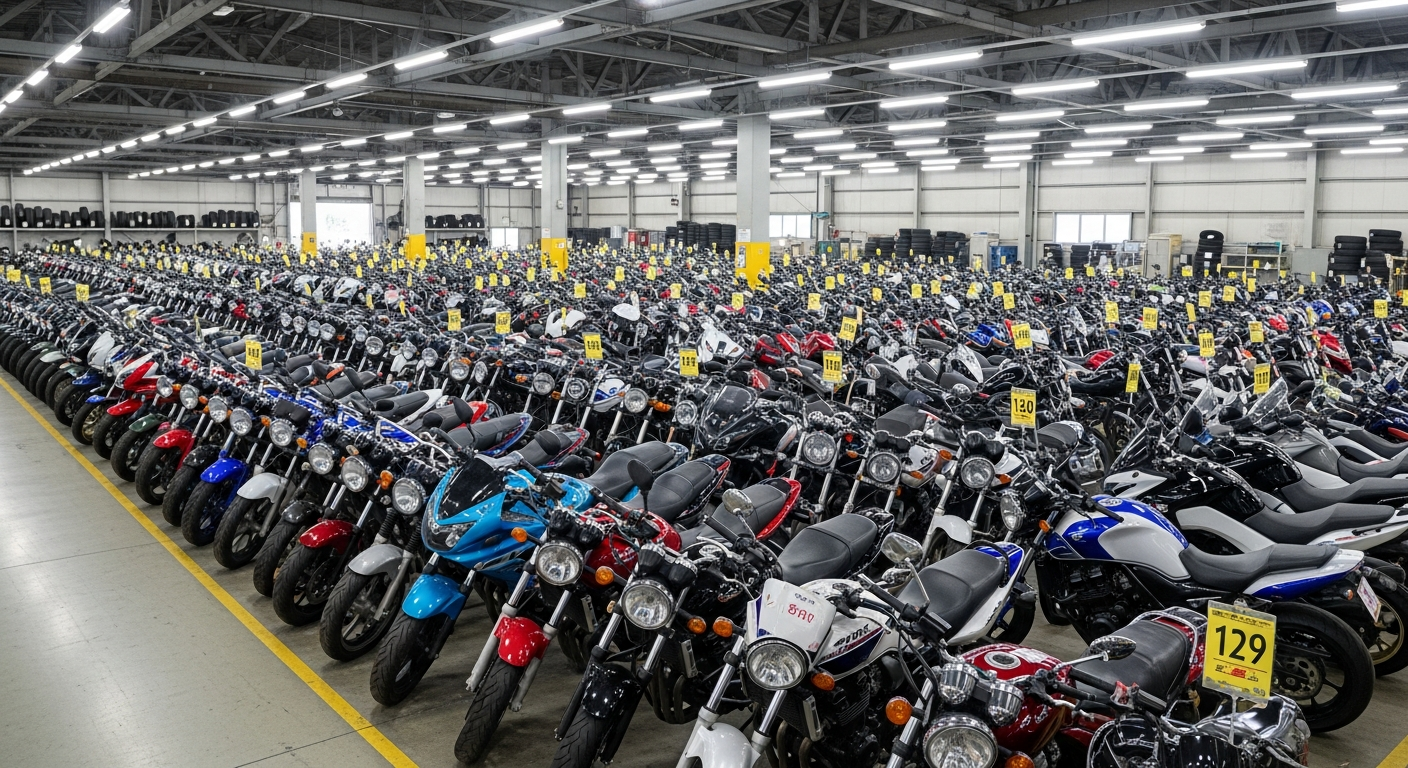
Finally, comfort doesn't depreciate. A sportbike's value lives and dies on the spec sheet, so last decade's superbike feels old. A grand tourer's job — protect you from the wind, carry your stuff, go the distance — was solved years ago and never expires. A 2005 FJR1300 does the touring job about as well as a 2025 one. That's why importing a slightly older, far cheaper example makes so much sense here when it makes no sense for cutting-edge sportbikes.
The two worlds of Japanese touring bikes
Once you start looking, you'll notice Japanese tourers split cleanly into two camps. Knowing which one you want saves you from buying the wrong machine.
World one: the heavyweight grand and sport tourers. These are the big, faired, shaft-drive mile-eaters — FJR1300, GTR1400 (Concours 14), ST1300 (Pan European), and their 90s ancestors the ZZR1100, GTR1000 and FJ1200. They weigh 270–320 kg wet, make serious power, and are happiest two-up with full luggage at autobahn speeds. If your idea of touring is loading a passenger and panniers and crossing three states in a day, this is your world.
World two: the middleweight all-day all-rounders. Lighter, often chain-drive, sometimes naked or half-faired — the Honda VFR800 and VFR750, Suzuki Bandit 1250S and GSX1250FA, Kawasaki Z1000SX / Ninja 1000SX, and the Versys 1000. These give up some weather protection and two-up plushness but reward you with agility, lower running costs, and a bike that's just as happy on a twisty backroad as a highway slog. If you tour solo and want one bike that does everything, look here.
Neither world is "better." They're different jobs. The mistake is buying a 300 kg GTR1400 when you actually wanted a nimble solo bike, or a Versys 1000 when you really needed to carry a passenger across a country. Pick the world first, then pick the bike.
The heavyweight sport-tourers worth importing
This is the heart of the touring world, and Japan built the best of them. Here are the machines worth pointing an importer at.
Yamaha FJR1300. The benchmark. A 1,298cc inline-four with shaft drive, electronically adjustable screen on later models, heated grips, and the kind of high-speed stability that makes 500-mile days feel routine. When a reviewer for Men and Motors road-tested one, an owner in the comments cut straight to it: "0-60 in 2.9, quarter mile 10.7 — what more do you need to know?" It's fast, it's smooth, and it's nearly unkillable. The FJR is the default answer for a reason.
Kawasaki GTR1400 (Concours 14). Take the ZZR1400 (ZX-14) hyperbike engine, detune it for torque, add shaft drive and luggage, and you get a sport-tourer that makes around 100 lb-ft and barely needs gear changes. As one UK road test put it, the GTR is "superb at smashing out the miles" — heavy at a standstill, but once moving the chassis and engine make you forget the bulk. This is the bike for the rider who refuses to choose between touring and outright pace.
Honda ST1300 Pan European. The grand tourer's grand tourer. A 1,261cc V4 delivering a creamy, vibration-free ride, full weather protection, integrated luggage, and a reputation for cracking 100,000 miles on basic maintenance. It's heavier and less sporty than the FJR, but if your priority is arriving fresh after a 600-mile day, nothing does it more serenely. These are bargains everywhere and especially in Japan.
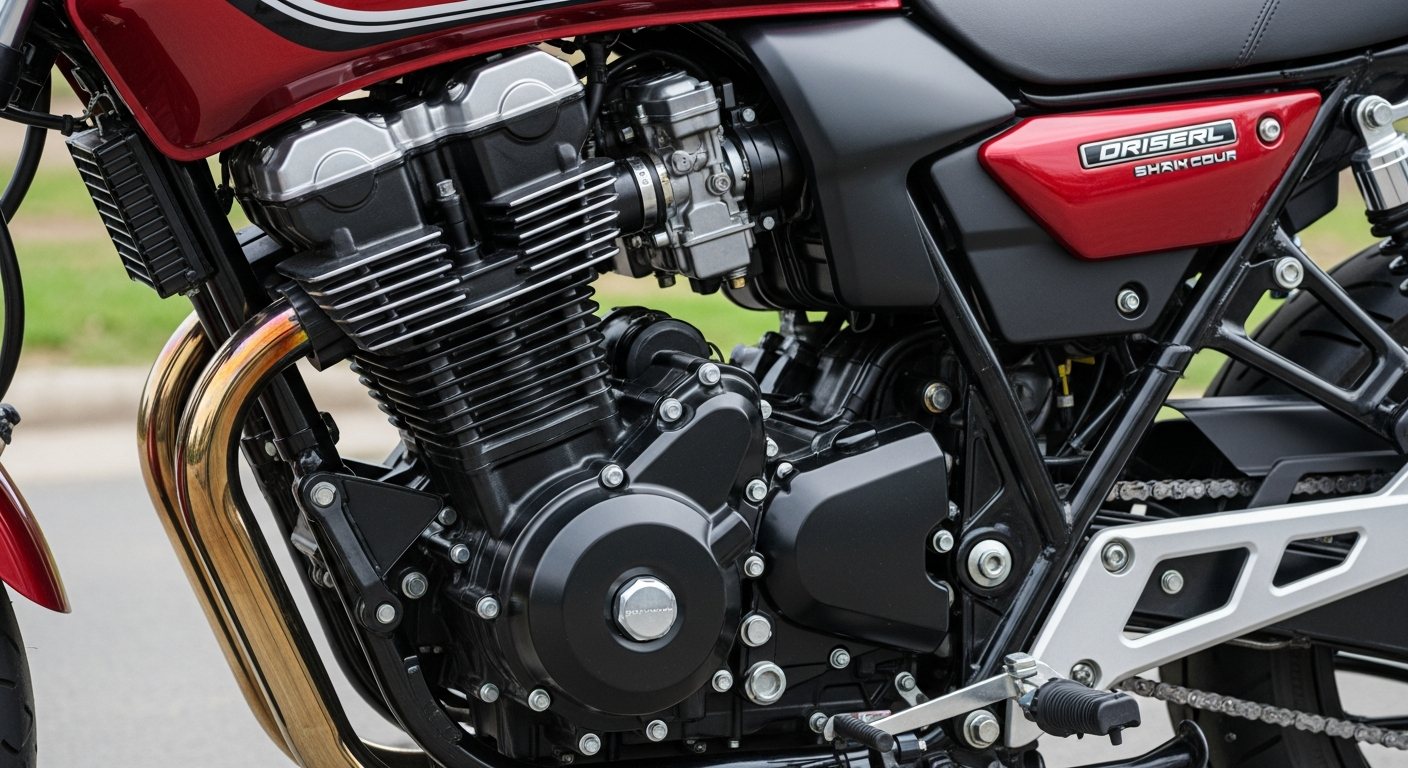
Honda CBR1100XX Super Blackbird. Not a traditional tourer, but hear us out. The Blackbird was the fastest production bike of its day, yet its real-world character is a supremely comfortable, smooth, faired mile-muncher with shaft-smooth manners (it's actually chain drive, but feels otherwise). Fit a screen and bags and it's a devastating sport-tourer that also happens to do 170 mph. A cult favorite that Japan has in abundance.
The 90s classics: ZZR1100, GTR1000, FJ1200. These deserve their own section, and they get one below, because they're the smart-money play under the 25-year rule.
Yamaha FJR1300 generations decoded
The FJR1300 is the bike most readers of this guide end up importing, so it's worth knowing the generations. Buy the right year and you get features that matter; buy blind and you will miss them.
2001–2005 (first generation). The original. Manual-adjust screen, conventional clutch, raw and characterful. These are the cheapest FJRs and, thanks to the 25-year rule, the early ones are now the first to become importable to the strictest markets. A clean first-gen is a lot of touring bike for the money.
2006–2012 (second generation). The big update. Revised fairing, better wind management, electronically adjustable windscreen on many models, improved brakes, and a more refined chassis. The 2006-on AE/AS variants added an automated clutch. This is the sweet spot for most buyers — modern enough to live with daily, cheap enough to make importing obviously worthwhile.
2013–onward (third generation). Ride-by-wire throttle, traction control, cruise control, riding modes, and an LED-lit cockpit. If you want a near-current touring experience at a used price, this is it — though these are still recent enough that only the no-year-limit markets (UK, NZ) can take the latest examples freely.
Whichever generation, the FJR's weak points are well documented and cheap to check: the second-gen had occasional issues with the connecting-rod bolts on very early units (recalled and fixed long ago), and all of them want their final-drive and coolant looked after. Buy on history and condition, which is precisely where a Japanese auction bike with a real service record wins.
The middleweight all-day all-rounders
If a 300 kg grand tourer sounds like more bike than you need, this is your aisle. These do 90% of the touring job at two-thirds the weight and running cost.
Honda VFR800 and VFR750. The gentleman's sport-tourer. Honda's gear-driven and later VTEC V4 is one of the all-time great engines — smooth, soulful, and good for vast mileages. Half-faired, comfortable, and gorgeous, the VFR is the bike for someone who wants to tour without looking like they've given up on fun. The 90s VFR750F is already importable everywhere under the 25-year rule.
Suzuki Bandit 1250S and GSX1250FA. The value champion. A torquey, fuel-injected big four in a comfortable half-faired chassis, built to a price and bulletproof because of it. Parts are everywhere and cheap. If you want a do-everything bike that tours, commutes and carries a passenger without drama or expense, the Bandit/GSX1250 is hard to beat.
Kawasaki Z1000SX / Ninja 1000SX. The modern sharp end. Take a Z1000 superbike-derived engine, add a fairing, panniers and a more relaxed riding position, and you get a sport-tourer that's genuinely quick and genuinely comfortable. Newer examples are creeping into importable territory for the no-year-limit markets and are a brilliant one-bike solution.
Kawasaki Versys 1000 and Honda NT700V Deauville. Two ends of the practical spectrum — the Versys a tall, comfy all-rounder; the Deauville a shaft-drive, weatherproof commuter-tourer beloved of high-mileage riders. Neither is glamorous. Both will serve you for decades.
The smart-money classic tourers: ZZR1100, GTR1000 and FJ1200
Here's where the 25-year rule turns into an opportunity. The 90s heavyweight tourers are now old enough to import almost anywhere, they're absurdly cheap, and they're exactly the kind of overlooked machine that quietly appreciates.
Kawasaki ZZR1100 (ZX-11). The fastest production bike in the world from 1990 to 1996, and a genuinely comfortable two-up tourer underneath the hype. That big-bore four is one of the engines featured in the "lasts forever" longevity videos for good reason. Clean examples turn up at European classic dealers, and the import math from a Japanese auction is even better. A 2001 ZZR1100 is importable to the US and Australia now, in 2026.
Kawasaki GTR1000 (Concours). The original Japanese shaft-drive grand tourer, based on the legendary GPZ900R engine. Slow-selling and unfashionable for thirty years, which means they're almost free — and the riders who own them tour the planet on them. The definition of a smart-money import.
Yamaha FJ1200. An air-cooled, over-built sport-tourer with a reputation for being indestructible. The FJ is the bike old-school tourers swear by, and prices have nowhere to go but up. If you want maximum reliability per dollar, this is the one.
All three are at the 25-year sweet spot: legal to import to the strictest markets, dirt cheap to buy, and built like they were meant to outlive their owners. Buy the cleanest one you can find now, because this window doesn't stay open at these prices.
Best touring motorcycle to import from Japan by rider type
Still deciding? Match the bike to how you actually ride.
The two-up continent-crosser. You ride with a passenger and full luggage, often. Buy the ST1300 for serene comfort or the FJR1300 if you want comfort plus pace. Both are shaft-drive and built for exactly this.
The solo mile-muncher who wants speed. No passenger, just you and a fast road. The GTR1400 or a faired Blackbird will flatten any distance and still terrify a sportbike rider at the lights.
The do-it-all solo rider. One bike for commuting, weekend twisties and the occasional tour. VFR800 for soul, Z1000SX for sharpness, Bandit 1250S for value. You can't go wrong.
The budget-first buyer. You want the most touring bike for the least money. Go straight to the 90s classics — ZZR1100, GTR1000, FJ1200. Cheap to buy, cheap to ship, built to last.
The smart-money collector. You want to ride it and watch it appreciate. The clean, low-mileage FJ1200 or an honest ZZR1100 are the bikes the market is only just starting to notice.
The 25-year rule and import legality by country
This is the single most important thing to get right, because it decides whether you can register the bike at all. The rules hinge on the model year, and they differ sharply by country.
United States. The NHTSA 25-year rule. Once a bike is 25 model years old, it's exempt from federal motor-vehicle safety standards and can be imported freely. In 2026 that means 2001 and earlier models — first-gen FJR1300, ZZR1100, GTR1000, FJ1200, VFR750 and 800 all qualify. Newer bikes must wait their turn.
Australia. Broadly the same 25-year cutoff for the simplest import path, so 2001-and-older bikes are the easy route, with newer machines needing more paperwork.
Canada. The friendlier 15-year rule — anything 15 model years old or older is exempt, which in 2026 means 2011 and earlier. That opens up second-gen FJR1300s, GTR1400s, ST1300s and early Z1000SXs a full decade before the US can touch them.
United Kingdom and New Zealand. No blanket year limit. You can import a modern tourer as long as you handle the registration and compliance steps (NOVA and an MSVA test where required in the UK; entry certification in NZ). This is why UK and NZ buyers can land a current-shape Z1000SX or third-gen FJR1300.
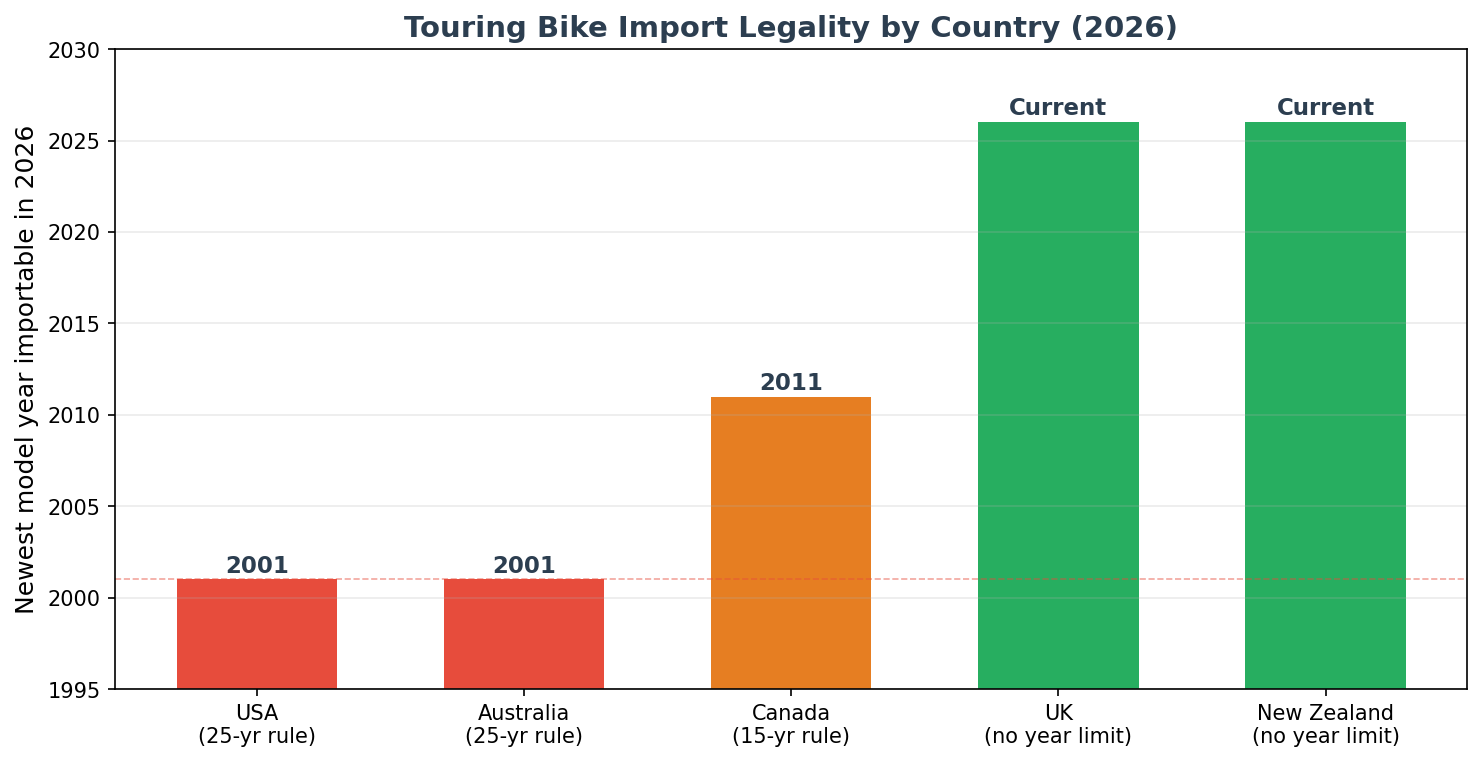
The practical takeaway: check your country's cutoff before you fall in love with a specific bike. There's no point bidding on a 2015 GTR1400 if you're in the US and it won't be legal until 2040. Match the model year to your rule, then shop.
What it actually costs: the landed price breakdown
Let's put real numbers on it. Take a clean FJR1300 that hammers at a Japanese auction for the equivalent of about $3,000 — a completely realistic figure for a mid-generation example. Here's roughly what it costs to land it in your garage.
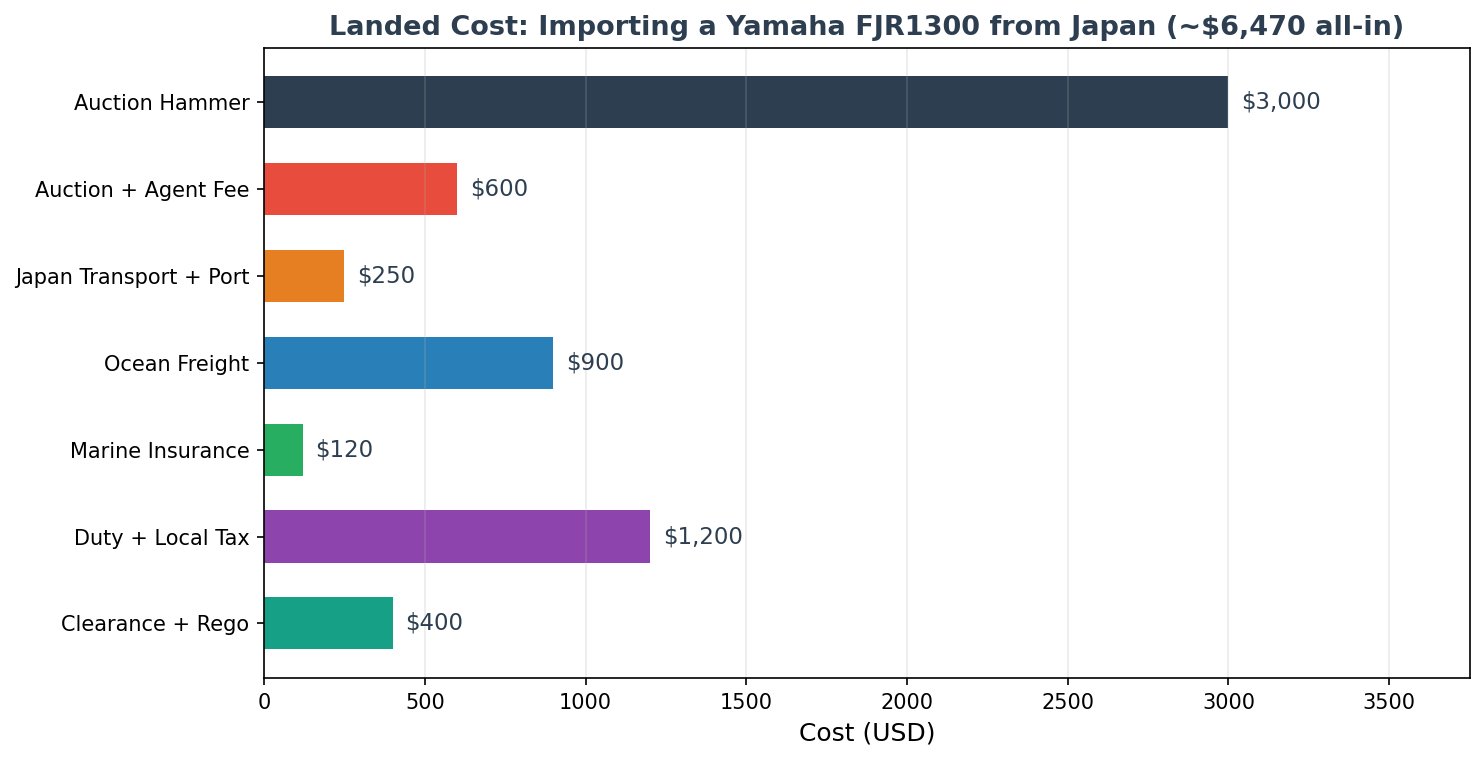
On top of the hammer price you've got the auction and agent fee, domestic Japanese transport to the port, ocean freight (container or RoRo), marine insurance, and then your own country's duty and taxes plus local clearance and registration. For most English-speaking markets, motorcycle import duty is low — often a few percent or, under trade agreements, zero — with the bulk of the "extra" being shipping and your local sales tax.
Add it up and a $3,000 hammer FJR1300 typically lands somewhere in the $5,800 to $6,800 range all-in, depending on your port, shipping method and local taxes. Compare that to paying $8,000-plus for a higher-mileage local example, and the case makes itself. The 90s classics land for even less — a ZZR1100 or FJ1200 can come in well under $5,000 all-in.
One honest note: weight matters for shipping. These are big, heavy bikes, so freight costs more than it would for a 400. The math still works because the bikes are so cheap to buy, but don't expect a 300 kg GTR1400 to ship for the same as a featherweight naked.
Weight versus landed cost: the touring segment map
Because the touring world spans everything from a 200 kg VFR to a 320 kg GTR1400, it helps to see where each bike sits on the two axes that matter: how much it weighs (which drives shipping and how it rides) and what it lands for.
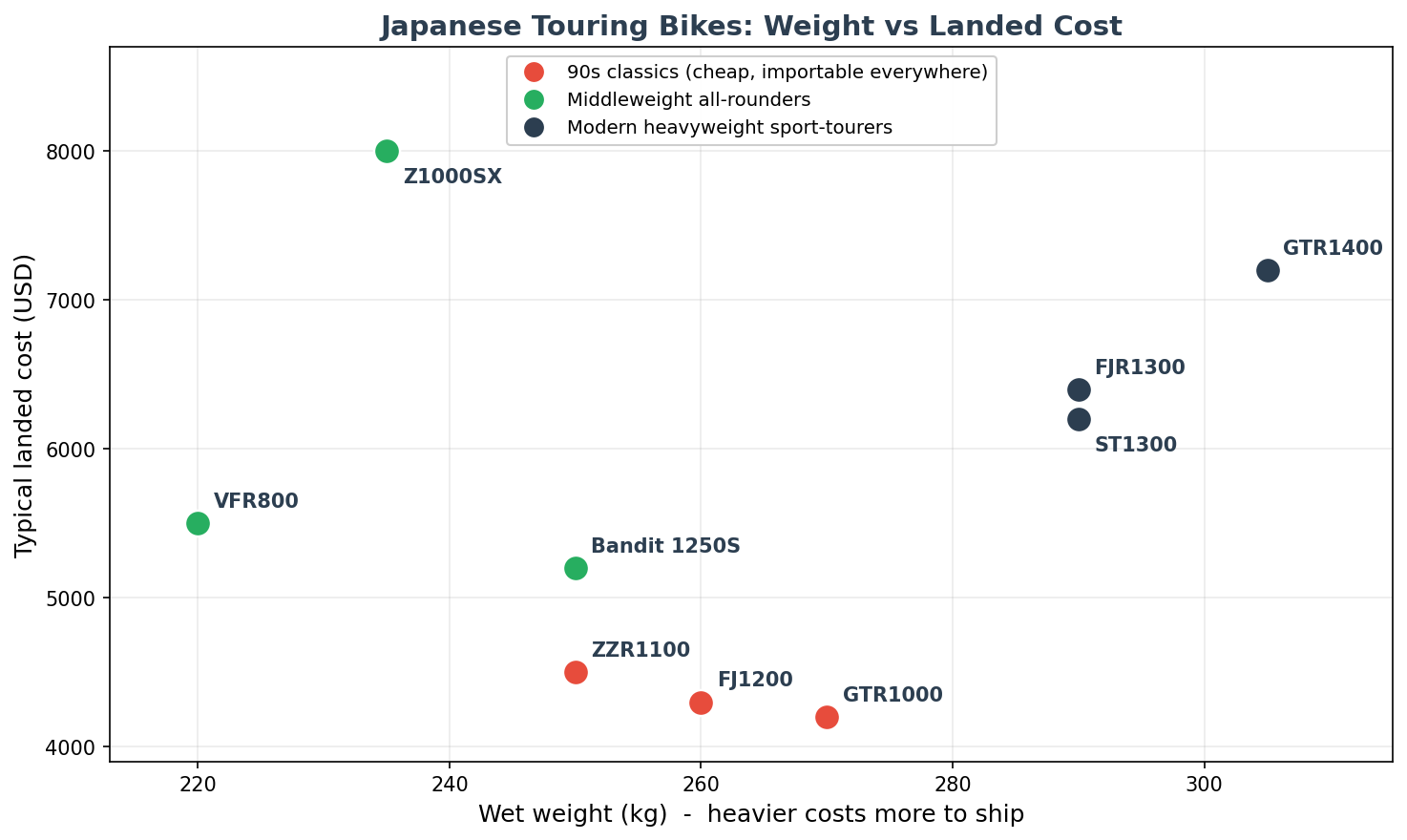
The pattern is clear. The 90s classics cluster in the cheap corner. The middleweights sit in the affordable, lighter zone. The modern heavyweight sport-tourers cost the most to buy and ship but deliver the most capability. There's no wrong answer — just pick the corner that matches your budget and your idea of touring.
How to buy a touring bike at a Japanese auction
You can't walk into a Japanese motorcycle auction yourself — they're trade-only, conducted in Japanese, and you need a registered agent to bid. Here's how it actually works.
The big auction networks are BDS (Bike Dealer System), JBA and the motorcycle lanes of USS. Between them they move thousands of bikes a week, and touring models pass through constantly because they're not the bikes Japanese buyers covet. Your agent — that's us — searches the upcoming lists for the model you want, pulls the auction inspection sheet, and bids to your maximum on auction day.
The inspection sheet is the whole game. Every bike is graded by a neutral inspector on a scale (S, A, AB, B, C, R and so on for the overall grade, plus a condition map marking scratches, dents, rust and repairs). A grade of A or AB on a tourer means a genuinely clean bike. An R means it's been repaired or had an accident. We read these for you and steer you toward the honest examples, because a number on a screen means nothing if you can't interpret the sheet behind it.
Once you win, the bike gets de-registered for export, transported to port, and loaded for shipping. You choose container (safer, slightly pricier, shared or sole) or RoRo (roll-on roll-off, cheaper, the bike rides on its wheels). For a heavy tourer most buyers go container for peace of mind. Total timeline from winning bid to your port is usually 6 to 10 weeks.
The touring-bike buyer's checklist
Touring bikes have their own specific things to check — different from a sportbike. Run through these before you bid, or have your agent confirm them from the inspection sheet.
Final drive (shaft bikes). On the FJR, ST, GTR, ZZR and FJ, ask about final-drive oil history and listen for any clunk. A neglected final drive is rare but expensive, so it's worth confirming.
Fuel pump and injectors. The fuel-injected bikes (FJR, GTR1400, Bandit 1250) can suffer fuel-pump wear with age. A bike that's been ridden regularly is healthier than one that sat — another reason low-but-not-zero mileage is ideal.
Regulator/rectifier and charging. The classic Japanese-bike weak point. On 90s models especially (ZZR1100, GTR1000), check that the charging system is healthy or budget for an upgraded R/R. It's a cheap, known fix — just don't be surprised by it.
Fairing, screen and luggage. Touring bikes live and die on their bodywork. Confirm the fairing is complete and uncracked, the electric screen (where fitted) actually moves, and — crucially — that the original panniers and mounts are included. Replacing a missing OEM luggage set can cost more than the difference between two bikes.
Valve clearances and coolant. The V4s (ST1300, VFR) and big fours want their valves checked at the recommended interval and fresh coolant. A Japanese service record makes this easy to verify.
Tires and fork seals. Heavy bikes are hard on tires and seals. Factor a tire set into your budget if the inspection sheet notes age-hardened rubber, and check the sheet's condition map for fork-seal weeping.
Common mistakes when importing a tourer from Japan
The errors that cost people money are almost always avoidable. Here are the big ones.
Ignoring the year rule. Falling for a 2014 GTR1400 when you live in the US and it's illegal to register for another 14 years. Always check the cutoff first.
Forgetting shipping weight. Budgeting for a 400's freight and getting a bill for a 300 kg GTR1400. Heavy bikes cost more to ship. Plan for it.
Buying without the luggage. A "cheap" FJR1300 with no panniers isn't cheap once you price a genuine luggage set. Confirm the bags are included.
Chasing grade S only. A grade S tourer is museum-perfect and priced accordingly. For a bike you're going to put 50,000 miles on, a clean grade A or AB is the smart buy — honest, sorted, and thousands cheaper.
Skipping the agent's sheet read. The single most expensive mistake is trusting a photo over the inspection sheet. The sheet is where the rust, the repairs and the real mileage live.
Five touring bikes about to take off in value
Most tourers are bought to be used, not collected — which is exactly why a few of them are quietly appreciating as the clean ones disappear. If you want to ride and protect your money, watch these.
Kawasaki ZZR1100. 90s hyperbike status plus genuine touring ability. The good ones are getting hard to find and the market is waking up.
Yamaha FJ1200. The indestructible reputation is finally translating into rising prices. Buy a clean one now.
Honda VFR750F. Gear-driven-cam V4 magic, already a modern classic, already importable everywhere.
Kawasaki GTR1000. Almost free today, but it's the original Japanese shaft tourer and the GPZ900R engine underneath it is iconic. That won't stay unnoticed.
First-generation FJR1300. As the 2001 models cross the 25-year line, the cleanest early FJRs become the entry point to the most respected modern tourer. Smart money is already circling.
Living with an imported tourer
Buying it is one thing; owning it is another, and tourers are about the easiest imports to live with.
Parts. These are mass-market global models, so consumables — filters, pads, tires, fork seals — are available anywhere. The Bandit and FJR in particular have huge parts support. Only the JDM-specific trim bits are occasionally a hunt, and those rarely stop you riding.
Insurance and registration. Once the import and registration paperwork is done (the part we and your local agent handle), an imported tourer insures and registers like any other bike of its age. Older classics often qualify for cheaper classic-bike policies.
Resale. Here's the quiet bonus. A clean, low-mileage Japanese-import tourer with documented history is more desirable than a tired local example, so you tend to recover your money — and on the appreciating classics, you may make some. Touring bikes hold value because they do a job that never goes out of style.
When a Japan-import tourer is the wrong call
We'd rather you buy the right way than buy from us badly, so here's the honest counterpoint. Importing a tourer from Japan is not for everyone.
If you need a bike next week, importing isn't your route — the 6-to-10-week timeline is real. If you want a factory warranty and dealer support, buy new locally. If your budget is genuinely tight and you'd struggle to absorb an unexpected R/R or tire bill on arrival, a sorted local bike you can inspect in person may suit you better. And if you only ride short distances solo, a heavy grand tourer is the wrong tool entirely — you'd be happier on something lighter.
But if you want a proven, comfortable, long-distance machine with honest history at a price the local market can't match — and you can wait a couple of months for it — importing a tourer from Japan is one of the best-value moves in motorcycling.
How AWA Auction helps you import the right tourer
This is what we do all day. We're plugged into the BDS, JBA and USS auction networks, we read the inspection sheets like a second language, we bid on your behalf, and we handle the export and shipping paperwork — with the landed cost laid out up front so there are no surprises when the bike reaches your port.
If you already know the model you want — a second-gen FJR1300, a clean ST1300, a smart-money ZZR1100 — tell us and we'll hunt honest examples on the next auction lists. If you're still torn between a GTR1400 and a VFR800, we'll talk you through it like the bike-obsessed people we are.
Browse our current listings to see what's available right now, or contact our team and tell us which tourer you're chasing. The warehouse is in Japan. We're how you reach it.
See Also
Share this article: