
When you decide to buy a motorcycle from Japan, you enter one of the most rewarding corners of the used motorcycle market anywhere in the world. Japan's domestic market produces a steady supply of well-maintained machines — including models that were never officially exported — at prices that, even after shipping, often come in below what equivalent bikes sell for locally.
But the process has real complexity. Auctions, agents, export paperwork, ocean freight, customs clearance, and compliance requirements all need to be navigated correctly. Done with the right help, the whole thing is completely manageable. Done without preparation, it's expensive and frustrating.
This guide covers everything you need to know to buy a motorcycle from Japan successfully: why the Japanese market is exceptional, how the auction system works, what the real costs look like, how long it takes, and how to choose an agent who won't let you down.
Why Buy a Motorcycle from Japan?
Three things combine in Japan's motorcycle market that don't exist in the same combination anywhere else: exceptional build quality maintained across decades, a selection of models unavailable in other markets, and pricing that still makes financial sense after import costs.
Japanese Motorcycle Culture Produces Better Used Bikes
The condition of used Japanese motorcycles is not accidental — it reflects a national culture around maintenance and presentation. Japanese owners change oil on schedule. Bikes are stored properly. When a machine is no longer wanted, it enters the auction system rather than deteriorating in a garden shed. The result is that a 30-year-old Japanese motorcycle often presents in better condition than a 10-year-old equivalent in a Western market.
This shows up in auction grades consistently. A Grade 4 Japanese bike — the standard "good condition, normal wear" grade — typically arrives in better shape than what many Western dealers would call excellent. Grade 5 examples are genuinely exceptional.
The difference is also visible in parts availability. Because Japanese bikes were maintained properly and parts were replaced when worn rather than ignored until failure, many older machines arrive with largely original components still in working order.
Models You Cannot Find Anywhere Else
Japan built motorcycles for its domestic market that were never released elsewhere through official export channels. These JDM-only models have enormous global followings, but they can only be sourced through Japan.
The Honda CB400 Super Four was never exported to the US. The Honda NSR250R MC21 and MC28 are street-legal GP replicas that collectors worldwide compete for — available only through Japanese auctions. The Kawasaki ZRX400, Honda VFR400R NC30, and numerous others exist only in Japan's domestic market.
Beyond JDM exclusives, Japan's classic bike scene is outstanding. Honda CB750s, Kawasaki Z1s, Suzuki GT750s, and Yamaha RD350s appear regularly at Japanese auctions in condition that makes Western collectors take notice. These machines were cared for and documented across their lifetimes in a way that's uncommon in most markets.
Pricing That Still Works After All Costs
Global demand for Japanese motorcycles has pushed prices up, but the math still works for the right bikes. A Honda CB750 in Grade 4 condition might auction for $3,500 in Japan. After shipping, import duty, and compliance costs in the US, your total landed cost might be $5,500. A comparable bike locally in the same condition would sell for $7,000 to $10,000. For JDM-only models, there is no local equivalent. Japan is the only source.
The calculation is different for common models where local supply is adequate. But for JDM exclusives, classics in exceptional condition, and bikes maintained to Japanese standards, importing from Japan typically beats any alternative.
The 25-Year Rule: The Foundation of the Import Scene
Before you fall in love with a specific bike, understand the import regulations in your country. This is where first-time buyers most often get caught out — and it is also the rule that makes the entire JDM import scene possible.
United States: The EPA and DOT 25-Year Exemption
Under EPA and DOT regulations, a vehicle 25 years old or older is exempt from the emissions and safety standards that normally apply to imported vehicles. This single exemption is why American buyers can legally import Japanese motorcycles for road use.
A motorcycle manufactured in 2001 or earlier (as of 2026) qualifies. It does not need to meet modern emissions standards. It does not require crash certification. It clears customs as a personal import and goes through your state's standard title and registration process.
A 2024 YouTube video showing a container of Japanese motorcycles being unboxed crossed 18 million views. The most-liked comment, with over 1,800 thumbs up, captured the whole logic: the reason these bikes can be imported is because they are over 25 years old. That sentence is the foundation of the American JDM scene.
For bikes that do not qualify — manufactured 2002 or later — the compliance route is available but cost-prohibitive for most individuals. EPA and DOT compliance for a non-exempt vehicle can run $10,000 to $30,000 and takes months. It is not a practical path for a single motorcycle purchase.
Practical implication: if you are based in the US and want to import for road use, target bikes manufactured in 2001 or earlier. The further back you go, the broader the compliance margin.
United Kingdom
UK import rules are more flexible than the US. Japanese motorcycles can generally be registered through the DVLA's standard imported vehicle process. The bike needs a certificate of conformity or, where that is not available, an Individual Vehicle Approval (IVA). An MOT is required before the bike goes on the road. Bikes over 40 years old are MOT-exempt though still require insurance and registration.
Post-2003 bikes may require UK Conformity Assessment marking. Most UK importers who specialize in Japanese bikes handle this routinely.
Australia
Australia operates under the Road Vehicle Standards Act (RVSA). Older motorcycles — generally pre-2000 — can qualify through the Specialist and Enthusiast Vehicle (SEV) concessional register, which is significantly more accessible than trying to get a newer bike through full compliance.
Each state has its own roadworthiness requirements on top of federal import rules. A compliance workshop that specializes in Japanese imports handles the state-level checks. Budget an additional $400 to $700 for compliance in Australia on top of other import costs.
New Zealand
NZTA requires imported vehicles to meet entry certification. For modifications required to meet NZ standards, a Low Volume Vehicle (LVV) certifier may be needed. Pre-1990 bikes are generally straightforward; newer imports require more documentation.
The universal rule of thumb across all markets: the older the bike, the simpler the import. Pre-1995 Japanese motorcycles can be brought into any major English-speaking market with manageable paperwork and predictable costs. Pre-1985 bikes are even simpler.
What Can You Buy? Japanese Motorcycles Worth Importing
The Japanese market covers everything from 50cc folding bikes to 1,200cc superbikes. These are the categories that make the most sense for importers.
JDM-Only Models: The Crown Jewels
These motorcycles were built for Japan's domestic market and never officially exported. The only way to get one is through Japan.
Honda CB400 Super Four: Japan's most-loved all-day motorcycle. Inline-four with VTEC at 6,000rpm, unmatched build quality, and a riding position that works for commuting, touring, and canyon carving equally. Never sold in the US. Hugely popular in Australia and the UK, where it is regarded as possibly the best all-rounder ever made.
Honda NSR250R (MC21/MC28): A street-legal GP replica. Two-stroke V-twin with GP-derived suspension and brakes, a power band that kicks in past 7,000rpm, and a sound that makes experienced riders go quiet. The MC21 is considered by many to be the peak of 250cc two-stroke engineering. Values are rising sharply as the supply of clean examples contracts.
Kawasaki ZRX400: Full-size retro styling on a compact 400cc engine. Built for Japan's licensing system, which incentivizes smaller displacement bikes for newer riders. Has substantially more road presence than its displacement suggests.
Honda VFR400R NC30: A quarter-liter V4 with technology derived directly from Honda's RC30 World Superbike. The RC30 costs $25,000 or more when one comes up for sale. The NC30 scratches much of the same itch for a fraction of the cost.
Honda CB1300: Japan's large-displacement naked, refined across many generations. More torque, more presence, and more engineering than most Western bikes at the same price.
Honda MotoCompo: A folding 50cc bike designed to stow in the trunk of Honda's City commuter car. Completely impractical. Completely irresistible. Values have tripled in five years.
Classic and Vintage: Where the Condition Gap Is Largest
The condition difference between Japanese and Western classics is most pronounced in the pre-1990 segment.
Honda CB750 (K and F series): The motorcycle that created the superbike era. Original K0s from 1969 now command serious collector money. F-series bikes from the late 1970s and early 1980s remain accessible and well-supported. All qualify under the US 25-year rule with substantial margin.
Kawasaki Z1, Z900, Z1000: Japan's flagship muscle bikes of the early 1970s. The Z1 in particular is one of the most collectible motorcycles in history. Grade 5 examples in original colors attract intense competition at auction.
Suzuki GT750: A 750cc two-stroke triple with liquid cooling, unusual for its era. Known as Water Buffalo in the UK. An increasingly sought-after collector bike, especially as interest in two-strokes has grown sharply over the past decade.
Yamaha RD350 and RD400: The definitive two-stroke twin of the 1970s. Light, fast, highly tuneable, and brilliantly engineered. Japan's domestic examples routinely present better than those from export markets.
Honda CB400F: Possibly the most visually perfect motorcycle Honda ever produced. The inline-four with four individual reverse-megaphone exhausts is an icon. Original paint examples are increasingly rare and sought after.
Late-Model JDM (Non-US Markets)
Bikes from the 2000s onward face real barriers for US import but are routinely imported into the UK, Australia, and New Zealand.
Yamaha MT-09 and MT-10 JDM spec: Japanese-domestic tuning, different suspension setup, sometimes different color options than export versions.
Kawasaki Z900RS: The neo-retro Z900RS has become a modern classic. Japan's domestic spec includes equipment and color options not available in other markets.
Honda Super Cub: The best-selling motor vehicle in human history. Japan has examples in original condition, correct colors, and low mileage that are genuinely scarce anywhere else in the world.
How Japanese Motorcycle Auctions Work
Most motorcycles exported from Japan pass through the auction system. Understanding how it functions is essential to working effectively with your agent and setting realistic expectations.
The Auction Networks
Japan runs several major motorcycle auction networks. BDS (Bike Dream Showcase) is the largest and most prominent in the export community. It runs weekly and processes thousands of bikes per event. USS (Up Sell Space) handles large volumes of both cars and bikes. JAA and several regional networks also operate regularly.
These are trade-only events. Private individuals cannot attend or bid. Only licensed dealers and registered agents with established accounts can participate. This structure is why you need an agent. It is not bureaucracy for its own sake — it is how the entire system is built, and it protects buyers from the risks of direct auction access without the expertise to evaluate what you are bidding on.
Auctions run multiple times per week across Japan. Tens of thousands of motorcycles pass through the system every month. For buyers, this means that if you do not win a specific bike this week, a comparable one will likely come up again within a few weeks.
The Grading System
Every motorcycle entering a Japanese auction is assessed by a trained inspector. This is not a casual opinion. Trained professionals examine each bike systematically and document their findings on a standardized auction sheet.
Grade S means new or like-new condition, essentially unridden. Grade 6 is excellent condition with minimal use and no notable marks. Grade 5 is very good with light use and minor cosmetic marks only. Grade 4 is good with normal wear consistent with age and use — this is the standard recommendation for serious buyers who want to ride rather than display. Grade 3 is average with visible scratches, minor dents, or repaired damage. Grade 2 is below average with significant cosmetic or mechanical issues. Grade R means repaired or modified, and the quality depends entirely on the work done.
The auction sheet is the key document. It marks damage locations on a standard motorcycle diagram using coded notation. A means scratch or scrape. B means dent. U means rust. C means crack or chip. W means wave or warp. X means needs replacement. Numbers after the letter indicate severity: 1 is light, 2 is moderate, 3 is significant. The sheet also records current odometer reading, engine running condition, frame integrity, and any modification notes.
Reading an auction sheet accurately is a skill that experienced agents bring to every bidding decision. Knowing when a Grade 4 assessment is being generous versus accurate is part of what you pay for.
Bidding and Post-Win Process
Bidding at Japanese auctions is real-time. Your agent attends either in person or through the auction network's digital bidding platform and bids to your set maximum. Individual lots close in seconds. There is no second chance once bidding ends.
When your agent wins a lot, the bike goes into their custody. They arrange fresh inspection photos separate from the auction intake photos and send these to you as confirmation that what you bid on matches what you are getting. A reputable agent does this as standard, not as an optional add-on.
If the bidding goes above your maximum, the agent reports back and you wait for the next suitable bike to come up. Patience is part of the process, and the frequency of Japanese auctions means the wait is rarely long for popular models.
Step-by-Step: How to Buy a Motorcycle from Japan
Here is the full process from first contact to riding your bike.
Step 1: Know exactly what you want. Come in with a clear brief. Model, year range, minimum grade, maximum auction price. A brief like "Grade 4 or better, Honda CB750 F-series, 1977 to 1982, under $4,000 auction price, prefer original paint" gives an agent something concrete to work with. Vague requests produce vague results and waste everyone's time.
Step 2: Find a specialist agent. You cannot access Japanese auctions without a registered agent. Choose someone who specializes in motorcycles, not a general vehicle importer who handles bikes occasionally. A specialist understands auction sheet codes, recognizes when grades are generous or stingy for specific models, and has relationships with the motorcycle-specific auction networks.
Step 3: Understand the import rules for your country. Before placing your first bid, confirm your target bike is importable where you live. In the US, confirm 25-year eligibility. In Australia, understand the SEV pathway. Know your country's duty rate and compliance requirements before you are committed to a purchase.
Step 4: Set a budget with a buffer. Your agent advises on realistic auction prices. Set a maximum that gives you room to actually win. Popular models at good grades attract competitive bidding from buyers across multiple countries simultaneously. Being inflexible by 10 to 15 percent means losing bid after bid. Build in a buffer above your ideal price.
Step 5: Wait for the right bike. Depending on how specific your requirements are, finding the right bike might take one auction or several weeks. Popular models at popular grades come up regularly. Rare models in specific configurations require patience. Let your agent monitor the upcoming lots and alert you when something suitable appears.
Step 6: Post-auction inspection. After winning, fresh photos of the actual bike are arranged. These are your verification that the auction sheet was accurate. Request photos of any marked damage areas specifically, and check the photos against the auction sheet damage codes before confirming you want to proceed with the purchase.
Step 7: Export documentation. Your agent handles the Japanese side: deregistration from Japanese records, export certificate issuance, customs declaration. This takes one to two weeks. Clean paperwork on the Japan side prevents expensive delays at your end.
Step 8: Choose your shipping method. Roll-on Roll-off (RoRo) is the cheapest option for a single motorcycle. The bike is driven onto a car carrier ship and secured. Container shipping provides more protection and is the right choice for valuable or fragile bikes, or when shipping multiple machines together. For most buyers importing one mid-range bike, RoRo is the practical and cost-effective choice.
Step 9: Import clearance in your country. When the ship arrives, your customs broker or your agent's logistics network files import documentation and pays applicable duties. You will need the commercial invoice, bill of lading, Japanese export certificate, and a completed customs entry form. A broker who handles Japanese motorcycle imports regularly makes this process straightforward.
Step 10: Compliance and registration. This step is country-dependent and age-dependent. For pre-1995 bikes in the US, it is generally a matter of presenting paperwork at your state DMV. Australian buyers need state-level inspections. UK buyers need an MOT. Budget the right time and money for this step: compliance is not optional, and trying to shortcut it creates larger problems later.
Step 11: Ride. Once registered and insured, the bike is yours. The whole process, done right, ends here.
How to Choose the Right Agent
Your agent is the most consequential decision in the entire import process. A good agent saves you money, time, and stress. A poor one costs you all three.
Motorcycle specialization matters. Agents who primarily handle car imports and do motorcycles occasionally do not understand how motorcycle auction grades translate to real-world condition. They are not familiar with which models have known issues or which grade assessments tend to be conservative versus generous for specific bikes. Find someone whose primary business is motorcycles.
Post-win inspection photos should be standard, not optional. Any agent who does not provide fresh inspection photos after winning a bid — before the bike ships — is cutting a corner that protects you, not them. This is non-negotiable.
Fee transparency matters before you commit. The total cost to land a bike should be calculable before you agree to anything. Agents who are vague about their fee structure are either hiding something or disorganized. Either is a problem.
Communication speed is essential. Auctions move fast. An agent who takes 48 hours to respond during auction week is going to miss bids or make decisions without consulting you. Fast, clear communication is a baseline requirement, not a premium feature.
Ask for a verifiable track record. Real agents have examples of completed transactions: photos, delivery records, customer references. If the only evidence of their work is a website with stock photos, proceed carefully.
What Does It Cost to Buy a Motorcycle from Japan?
Here is a realistic breakdown for a typical import.
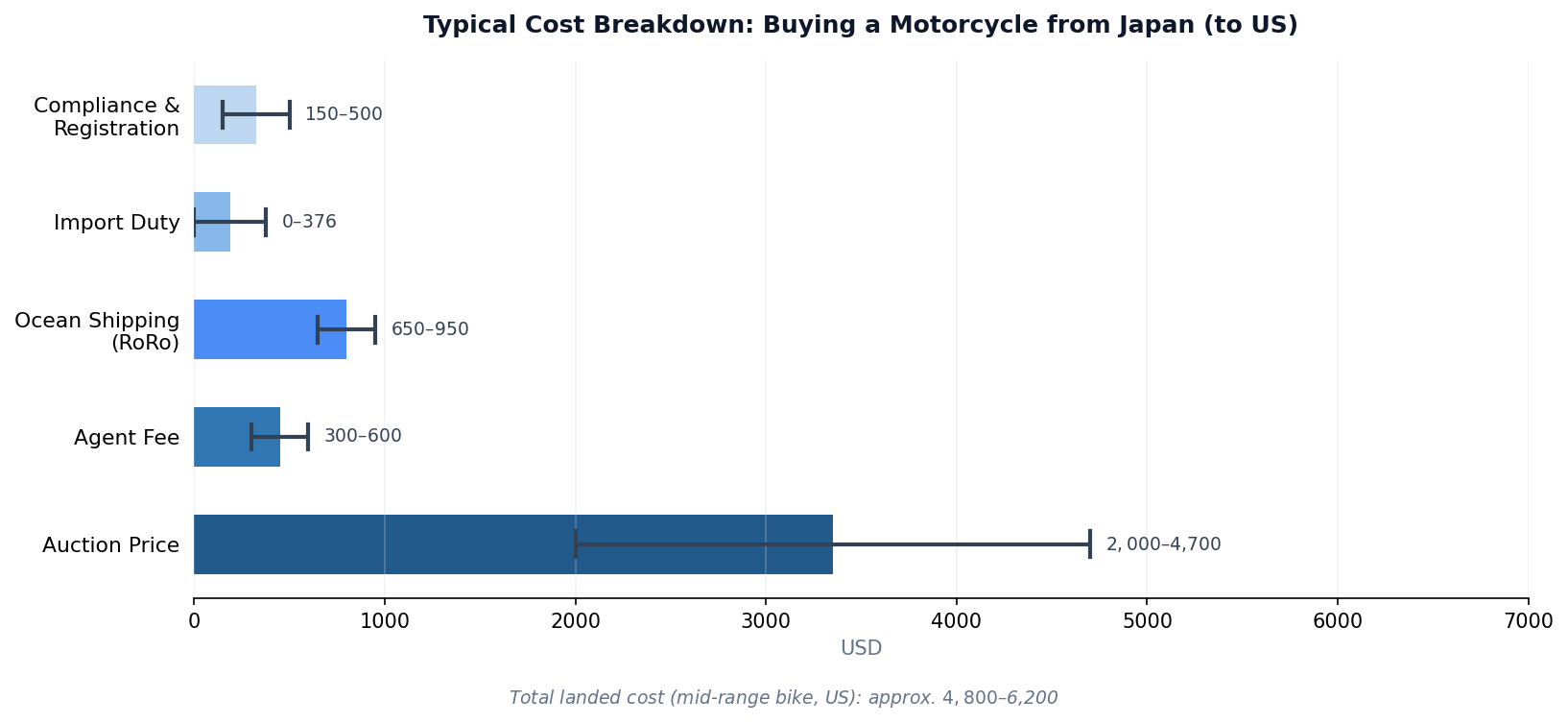
Auction price: For a mid-range classic in Grade 4 condition — CB750 F-series, Z900, SR400 — expect between 300,000 and 700,000 yen, approximately $2,000 to $4,700. Rarer models and higher grades push significantly higher. Grade S machines and sought-after JDM exclusives regularly exceed 1,000,000 yen, around $6,700 or more.
Agent fee: $300 to $600 as a flat fee, or 5 to 10 percent of the auction price, depending on the agent's structure. Understand the fee structure clearly before committing. Some agents build their margin into other charges, which makes comparisons harder.
International shipping via RoRo: Japan to US West Coast runs approximately $650 to $950. Japan to UK runs $800 to $1,100. Japan to Australia runs $700 to $1,000. Container shipping adds $500 to $1,500 depending on what the container is shared with.
Import duty: The US charges 2.4 percent on motorcycles over 700cc and lower rates for smaller bikes. The UK currently charges 6 percent. Australia varies by displacement and country of origin. Budget between 0 and 8 percent of the declared value depending on your country and the bike's specification.
Compliance and registration: $150 to $500 for most older bikes in the US and UK. Australia adds $400 to $700 for state-level roadworthiness inspections. Bikes requiring modifications to meet local standards can be higher.
Realistic all-in total: A bike that wins at auction for $3,000 typically costs between $4,800 and $6,200 to have registered and ready to ride in the US. A $6,000 auction win typically comes in at $8,500 to $11,500 all-in when all costs are accounted for honestly.
The economics work because a well-preserved Japanese classic or JDM-only model in your destination market is worth more than its total import cost — and for JDM exclusives, there is no local equivalent to compare against anyway.
How Long Does It Take?
Plan for 10 to 16 weeks from first contact to riding. Most transactions land in the 12 to 14 week range.
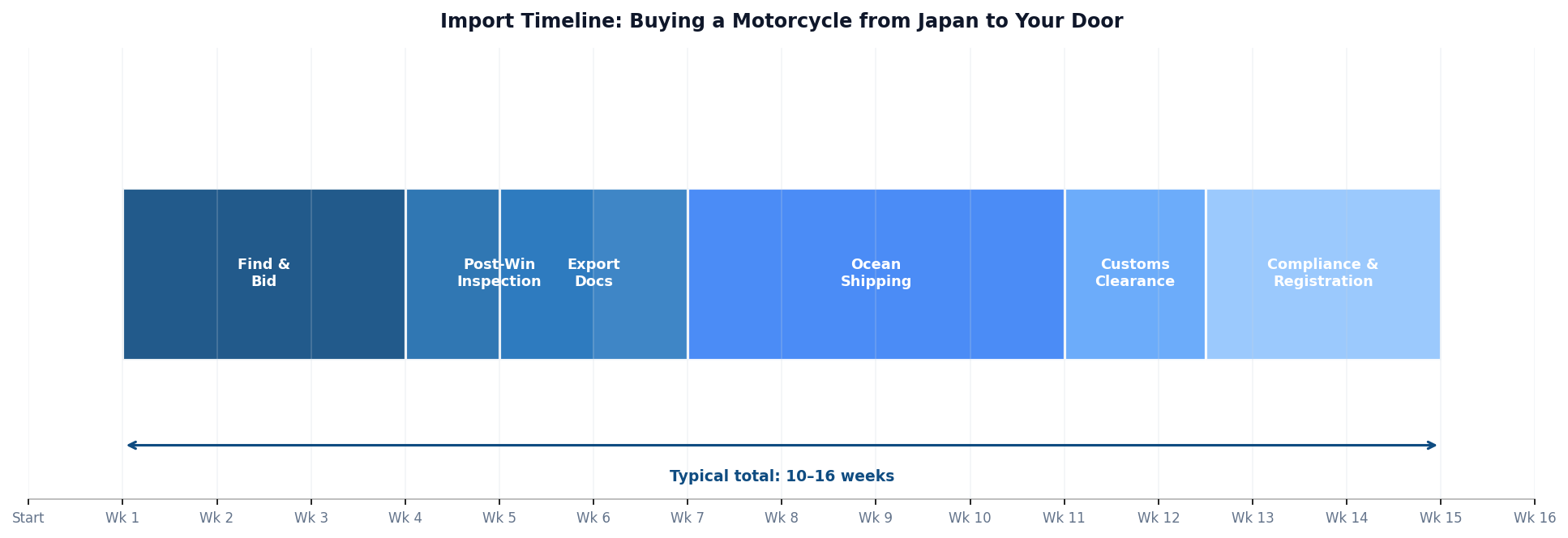
Auction search and winning a bid: 1 to 4 weeks, depending on how specific your requirements are. Popular models at popular grades come up weekly. Rare configurations require more patience.
Post-win inspection and export preparation: 1 to 2 weeks. Your agent coordinates inspection photos, deregistration, and export documentation.
Ocean shipping transit time: Japan to US West Coast, 3 to 4 weeks. Japan to UK, 5 to 6 weeks. Japan to Australia, 3 to 5 weeks. Shipping schedules run on fixed departure dates. Missing one ship means waiting for the next.
Customs clearance: 3 to 10 business days when paperwork is clean. Incomplete documentation can extend this significantly and adds storage costs.
Compliance and registration: 1 to 3 weeks for straightforward older bikes. More time for bikes requiring inspections or modifications.
Rushing any of these stages creates problems downstream. The most common delays are incorrect or missing documentation from Japan delaying customs clearance, compliance inspectors finding discrepancies between declared and actual condition, and buyers underestimating how long state registration takes for imported vehicles. None of these are unavoidable — they are consequences of cutting corners earlier in the process.
Common Mistakes That Cost Money and Time
Not checking import eligibility before falling in love with a bike. The 25-year rule is not flexible. A 2004 Honda CBR600RR cannot be legally imported for road use into the US. Know what you can import before you start shopping.
Setting the budget too tight. Buyers who set their maximum exactly at the expected market price lose bid after bid to buyers from other countries who budgeted more flexibly. Build in 15 to 20 percent above your ideal price so you can actually win when the right bike comes up.
Focusing on auction photos and ignoring the sheet. Intake photos are taken at the auction yard and do not always show damage detail clearly. The auction sheet damage codes tell you what is actually wrong. Always have your agent explain every significant marking before you bid.
Forgetting to budget the full cost chain. Buyers who plan $3,000 for the bike plus $700 for shipping end up shocked when the total lands at $5,800. Budget honestly from the start: auction price plus agent fee plus shipping plus duty plus compliance plus registration.
Using a generalist importer instead of a motorcycle specialist. The difference in expertise between a motorcycle specialist and a general vehicle importer shows up at every stage of the process.
Not building time into your planning. Twelve to fourteen weeks is normal. Buyers who need the bike in six weeks should not start this process. Build the timeline into your planning before you begin.
Frequently Asked Questions
Do I need a special import license to buy a motorcycle from Japan?
No special license is required for the import itself. The importing process — auction, export, shipping, customs — is handled by your agent and customs broker. Once the bike is in your country, you register it the same way you would any other vehicle. Riding it requires a standard motorcycle license for your jurisdiction.
What exactly qualifies under the US 25-year rule?
A motorcycle manufactured 25 or more years before the date of import is exempt from EPA emissions and DOT safety standards. In 2026, that means bikes manufactured in 2001 or earlier. The key is manufacturing date, not model year. Your customs broker confirms eligibility as part of the clearance process.
Can I import any Japanese motorcycle, or are some restricted?
Age restrictions are the main constraint. In the US, the 25-year rule is the line. In the UK and Australia, newer bikes are accessible but require more compliance steps. Some specific models may face additional restrictions based on lighting or emissions standards even under age-exemption pathways. Your agent and a local compliance specialist will advise for specific models.
How do I read a Japanese auction sheet?
Auction sheets use a standardized diagram of the motorcycle with damage locations marked using a coding system. A means scratch or scrape. B means dent. U means rust. C means crack or chip. W means wave or warp. X means needs replacement. Numbers following the letter indicate severity: 1 is light, 3 is significant. Your agent provides a full interpretation as part of their service. Understanding the difference between an A1 and a B2 on a Grade 4 bike is exactly what you are paying a specialist for.
What happens if the bike does not run when it arrives?
For Grade 4 and above bikes, non-starts after transit are uncommon but possible after extended storage and shipping. Most are simple fixes: stale fuel, fouled plugs, or gummed carburetors. An afternoon's work for anyone mechanically inclined. Anything more serious should have been documented on the auction sheet. Reputable agents have dispute procedures with auction houses for material undisclosed damage. Ask about this before committing to an agent.
Is it worth importing a single motorcycle, or do I need to buy multiple?
Single motorcycles ship via RoRo regularly. You do not need to fill a container. A single import is completely practical and is how the majority of individual buyers do it.
What is the best first import for someone new to the process?
Grade 4 or 5, pre-1995, under 20,000km, air-cooled single or twin. The Honda CB750 for US buyers, Honda CB400 Super Four for UK and AU buyers, and Yamaha SR400 are perennial starting points. They are well-supported by global parts networks, have enthusiast communities producing reproduction parts, and they appreciate rather than depreciate when maintained correctly.
How do I know if an agent is legitimate and trustworthy?
Look for: primary business is motorcycles, not cars with motorcycle capability added; post-win inspection photos provided as standard; complete fee transparency before you commit; examples of completed past transactions; reasonable response times during business hours; clear explanation of what happens if something goes wrong. Red flags include pressure to bid quickly, vague fee structures, inability to show past transaction examples, and slow communication.
What if the bike I want goes over my budget at auction?
Your agent bids to your maximum and stops there. If the bike exceeds budget, they report back. You either revise your maximum for the next opportunity or wait for another example. Popular models come up at auction regularly. Adjusting your maximum by 10 to 15 percent is often more effective than waiting months for a slower auction.
How AWA Auction Makes This Easier
The process described above has real moving parts: language barriers, auction timing, export documentation, shipping coordination across multiple providers. Each individual step is manageable, but the complete chain requires someone in Japan who knows what they are doing at each stage and can communicate clearly throughout.
AWA Auction operates as your direct access point into Japan's full motorcycle auction network, including BDS and USS. Every part of the process is handled in English. You tell us what you are looking for and your budget. We handle the auction search, competitive bidding, post-win inspection, export documentation, and Japan-side shipping coordination.
You do not need to navigate Japanese auction websites through machine translation. You do not need to wire money to strangers based on forum recommendations. You do not need to interpret auction sheet damage codes yourself or guess whether a Grade 4 assessment on a 1982 CB750 is accurate.
Browse our current listings to see what is available now, or contact our team to discuss a specific model you are looking for.
See Also
Share this article: