
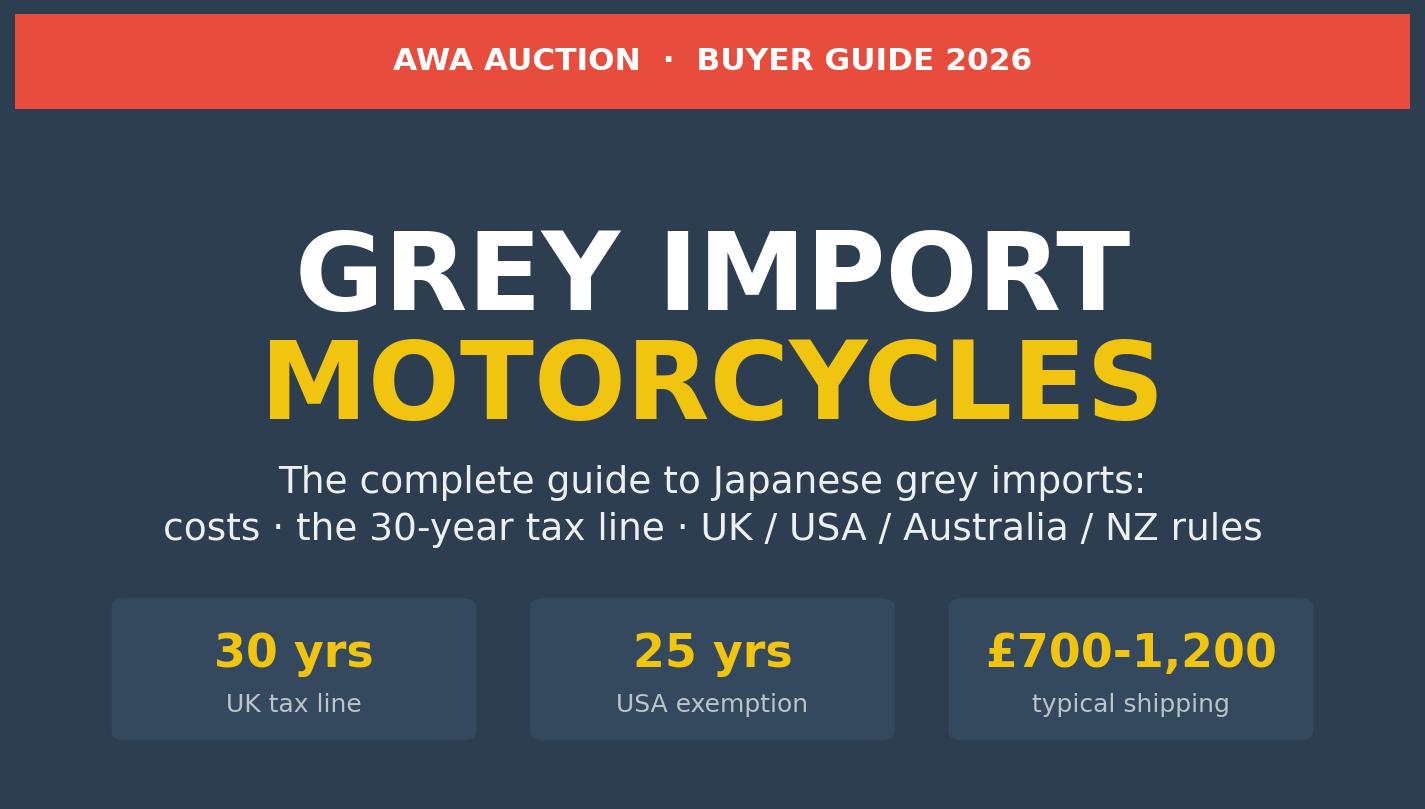
There is a Honda VFR400 NC30 parked in a lock-up in Bristol right now that was never sold in Britain. Same goes for the ZXR400, the FZR400, the RVF400 — a whole generation of screaming, jewel-like Japanese sportbikes that UK, US and Australian dealers simply never stocked. They got here anyway. Quietly, by the container-load, through a back door the industry calls the grey import motorcycle market.
If you have ever scrolled past a bike on a classifieds site and wondered why it has a strange registration plate, no service history from a main dealer, and a price that seems too good, you have met a grey import. And you are not alone in being curious. When the YouTube channel Bikes and Beards filmed themselves buying a 40-foot shipping container of motorcycles straight from Japan, the video pulled over 18.9 million views and nearly 8,000 comments. People want these bikes. Most just have no idea how the grey route actually works — or whether it is a bargain or a trap.
This guide clears it up. We will define what a grey import really is, why Japan flooded the world with them, what one costs to land in 2026, how the rules differ across the UK, USA, Australia and New Zealand, how to register and insure one without losing your mind, and which bikes are actually worth chasing. No fluff, no sales pitch dressed up as advice — just the stuff nobody tells you until after you have wired the money.
What is a grey import motorcycle?
A grey import motorcycle is a bike that was built for one country's market and then imported into another country through channels the manufacturer never officially set up. The "grey" part is the key. It is not illegal — that would be a black market. It is not the factory's official pipeline either. It sits in between: legal, but unofficial.
In practice, almost every grey import you will meet in the English-speaking world came from Japan. The reason is simple. Japan built thousands of models it only ever sold at home, and it built them to a standard of care that the second-hand market elsewhere can only dream about. A grey import is the way those home-market bikes escape.
Here is the distinction that trips everyone up. A grey import is a bike never officially sold in your country. A "parallel import" is a slightly different animal — it is a model that was officially available, but a particular example was brought in outside the official dealer network, often to dodge a price difference. People use the two terms interchangeably, and insurers cheerfully blur the line, but the practical upshot is the same: a bike whose paperwork and parts supply do not match the local norm.
The opposite of a grey import is an officially imported bike — one the manufacturer's national arm homologated, certified, and sold through its dealers with a full local warranty and a parts catalogue to match. That is the "normal" bike. The grey import is the interesting one.
Why Japan flooded the world with grey import motorcycles
To understand why so many of these bikes exist, you have to understand a quirk of Japanese law in the 1980s and 1990s that quietly reshaped global motorcycling.
Japan had brutal vehicle regulations. Any motorcycle over 250cc had to pass the shaken roadworthiness inspection — a test so strict and so expensive that owners often gave up rather than keep an older bike on the road. On top of that, Japanese licensing made anything over 400cc a genuine hassle to ride legally for years, which is exactly why Japan built so many ferocious 400cc machines in the first place. The factories engineered quarter-litre and 400cc bikes that revved to the moon precisely because the home market needed them.
Now combine two facts. First, those high-strung small-capacity bikes were everywhere in Japan. Second, Japan had almost no functioning used-bike market — a near-new motorcycle was worth very little a few years on, because the inspection regime and a cultural preference for new vehicles crushed resale values. The result was a country full of low-mileage, beautifully kept bikes that were nearly worthless at home.
Western dealers and importers in the 1990s spotted the obvious arbitrage. You could buy a two-year-old, immaculate 400cc race-replica in Tokyo for a fraction of what UK riders would happily pay, ship it over, and sell it. The grey import scene exploded. As the UK title Visordown put it, the 1990s grey scene was "massive," and it still rumbles along today, which is why the used market is full of oddities that were never officially on sale.
That is the romance of the grey import: it is a side door into a parallel motorcycling universe Japan kept to itself. The flip side — parts, paperwork and insurance — is where the romance meets reality, and we will get there.
Grey import vs parallel import vs personal import
Three terms, endless confusion. Let me untangle them, because which one your bike falls under changes your paperwork and sometimes your tax bill.
Grey import: a model never officially sold by the manufacturer in your country. The classic Japanese 400s are the textbook example. There is no local homologation, often no local parts catalogue, and the bike may need single-vehicle approval to get a number plate.
Parallel import: a model that was officially sold in your country, but this specific bike was sourced abroad and brought in privately, usually to save money. Paperwork is generally easier because the model is already type-approved locally.
Personal import: a bike you personally owned and used abroad before bringing it home when you relocate. Several countries — Australia most notably — have a dedicated Personal Import Scheme that can sidestep some compliance rules, but it requires that you genuinely owned and used the bike overseas for a set period (typically around 12 months) before importing.
Why does this matter? Because the word an insurer, a shipping agent, or a government form uses will quietly decide how hard your life is about to get. A grey import 400 that needs Motorcycle Single Vehicle Approval is a different bureaucratic experience to a parallel-imported bike that already exists in the type-approval database. Know which bucket your bike sits in before you buy.
Are grey import motorcycles worth it in 2026?
Short answer: sometimes brilliantly, sometimes barmy. The honest answer depends entirely on the bike's age, the model, and how much hassle you can stomach. Let me give you the real version.
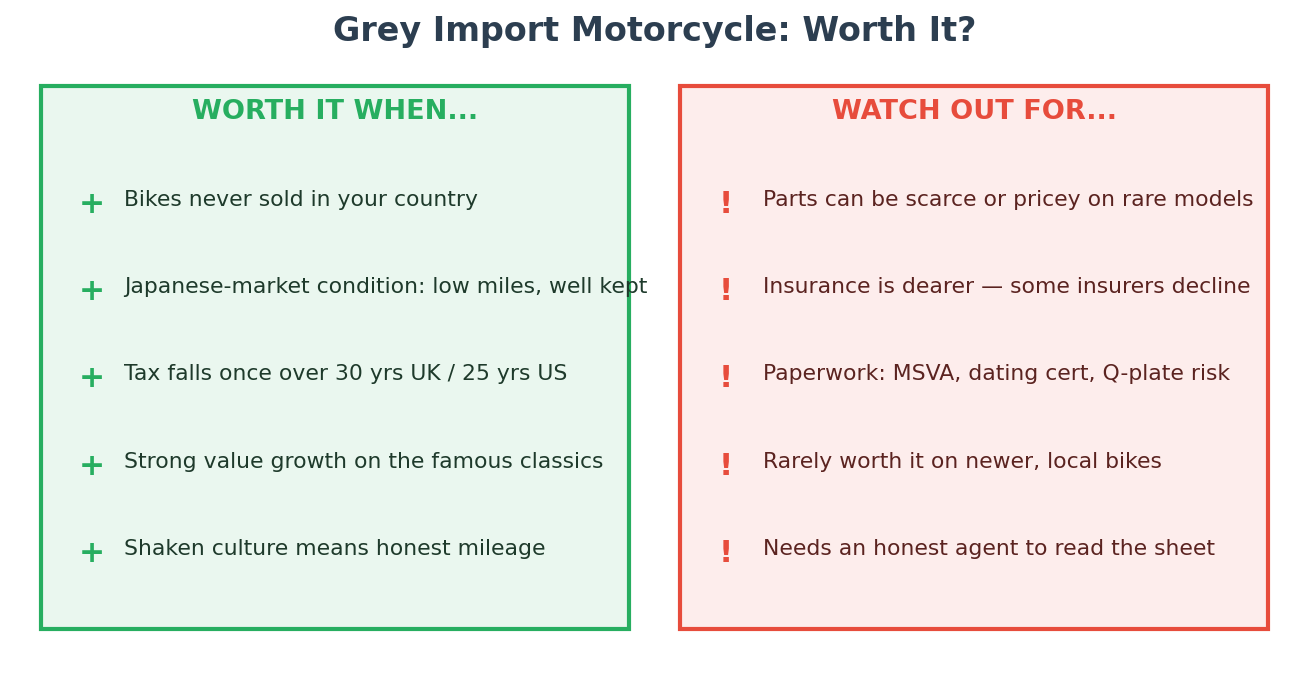
When a grey import is absolutely worth it: you want a specific model that was never sold locally and cannot be bought any other way. The Honda RVF400 NC35, the Suzuki RGV250, the early CBR400RR — if your heart is set on one of these, the grey route is not an option, it is the only route. You also win big on condition. A Japanese-market bike that lived under the shaken regime is usually cleaner, lower-mileage, and better maintained than an equivalent-age Western bike that was thrashed and neglected.
When a grey import makes financial sense: when the bike is old enough to drop into a lower tax band (more on the 30-year line below), or when the exchange rate is in your favour and the bike is genuinely cheap at source. For collectible classics 30 years and older, importing from Japan can make a lot of sense even after you add shipping.
When it is a bad idea: when the bike is newer than 25 to 30 years and freely available locally. As one UK guide bluntly noted, the VAT and duty on a sub-30-year bike usually "renders it financially barmy to import" unless it is a rare model or absurdly cheap. If you can buy the same bike down the road with local paperwork and a local parts supply, the grey route just adds cost and friction for no reward.
So the rule of thumb: grey imports win on rarity and condition, and on tax once a bike is old enough. They lose on convenience, parts, and insurance. Match the bike to the right reason and you will be delighted. Buy one just because it looked cheap on an auction screen and you may regret it.
What a grey import motorcycle actually costs
The sticker price is never the real price. The landed cost — the total to get a grey import on your driveway, legal and rideable — is what matters, and most first-timers underestimate it badly. Here is how it breaks down, using the UK as the worked example.
The bike itself. A clean 400cc grey import from a Japanese auction might cost anywhere from a few hundred thousand yen to well over a million for a sought-after NC30 or NC35. Exchange rate matters enormously here — a weak yen is a grey importer's best friend.
Shipping. Getting a bike from Japan to the UK by sea typically runs somewhere in the region of £700 to £1,200, depending on whether it travels in a shared container or crated solo, plus port and handling fees at both ends.
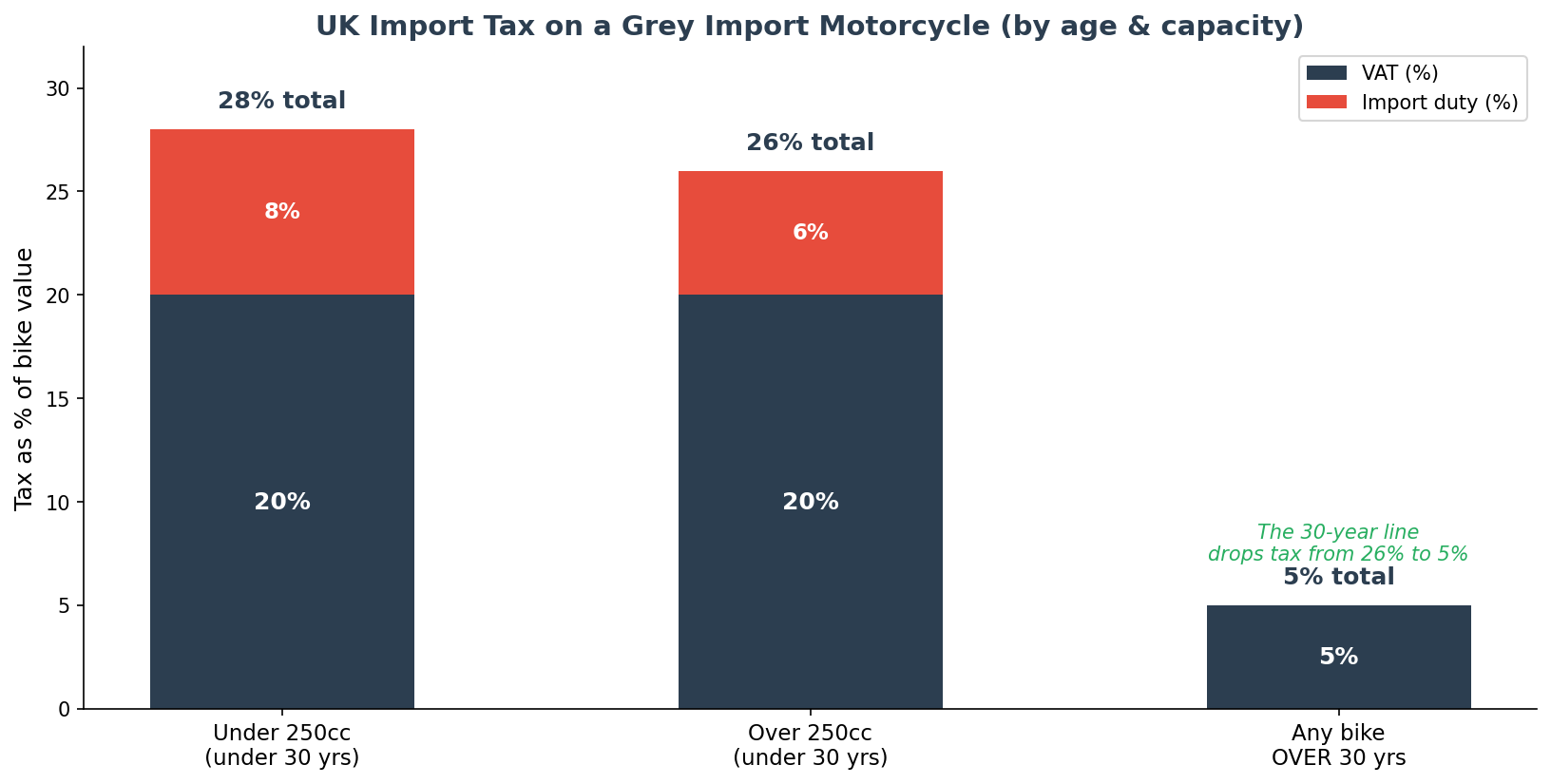
UK import tax — and this is where age changes everything. For a motorcycle over 250cc and under 30 years old, you pay 20% VAT plus 6% import duty. For a bike under 250cc and under 30 years old, it is 20% VAT plus 8% duty. But for a bike over 30 years old, it drops to just 5% VAT and zero duty. That is not a small difference — on a £4,000 bike it is the gap between roughly £1,040 in tax and around £200.
Registration and compliance. Budget for Motorcycle Single Vehicle Approval if required, a dating certificate if the bike has no foreign registration document, and DVLA first-registration fees. Call it a few hundred pounds and a few weeks of paperwork.
The hidden one: getting it roadworthy. A grey import often needs fresh tyres, fluids, a fork seal, maybe a carb clean after sitting. None of it is dramatic, but it adds up. Sensible buyers add a contingency on top of the purchase price for exactly this.
For US buyers the maths is friendlier: import duty on motorcycles is generally low, often around 2.4% or less, and customs broker fees typically land between £300 and £700 equivalent. The big US lever is age, which we will cover in the country section.
The 30-year line: why age changes everything
If you remember one number from this entire guide, make it the age threshold. Across almost every market, the single biggest factor in whether a grey import is a steal or a money pit is how old the bike is. Cross the line and the rules relax dramatically.
In the UK, the magic number is 30 years. Once a motorcycle passes its 30th birthday, VAT collapses from 20% to 5% and import duty disappears entirely. That alone can swing the entire economics of a deal. It is exactly why importing 30-plus-year-old classics from Japan can make sense while importing a 10-year-old bike rarely does.
In the USA, the line is 25 years. A motorcycle at least 25 years old is exempt from the DOT and EPA certification requirements that make newer imports a nightmare. Import a pre-1999 bike in 2026 and you skip the modifications, the third-party approvals, and most of the headache. That is the whole reason the 25-year rule is gospel in the American import scene.
In Australia, the picture is more layered — there is no single clean "25-year rule" for bikes the way there is for cars in some states, and eligibility leans on the SEVS register and Australian Design Rules. We will unpack it below.
The takeaway is universal: before you fall in love with a specific bike, check which side of your country's age line it sits on. A model that is agony to import at 24 years old can become straightforward and cheap at 25 or 30. Sometimes the smartest move is simply to wait a year.
Grey imports by country: UK, USA, Australia and New Zealand
The rules are not the same wherever you live, and getting this wrong is the fastest way to strand a bike at a port. Here is the country-by-country reality for English-speaking buyers.
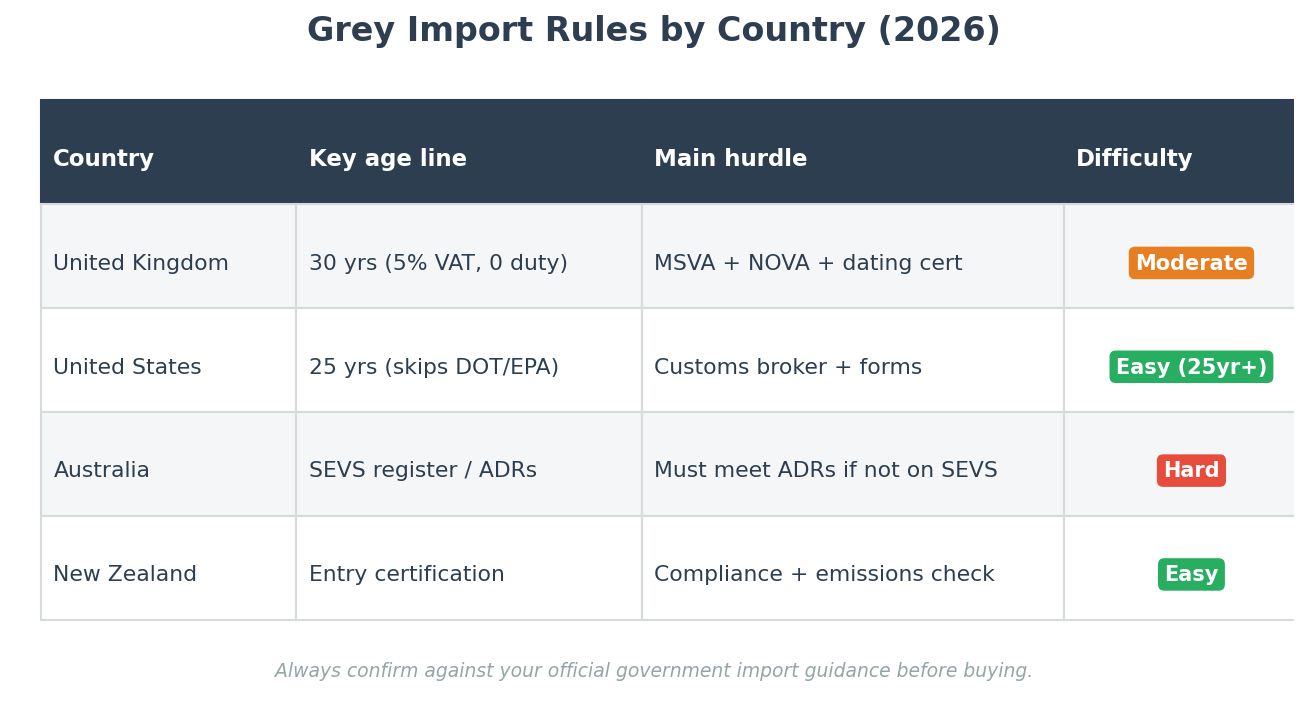
United Kingdom. The UK is the spiritual home of the Japanese grey import. The process: notify HMRC of the bike's arrival via NOVA within 14 days, pay VAT and duty (rates depend on the age and capacity bands above), get Motorcycle Single Vehicle Approval if the model was never type-approved in Europe, supply a dating certificate if you lack a foreign registration document, then submit the V55/5 form to the DVLA for a registration number. Bikes whose age or identity cannot be proven may end up on a Q-plate.
United States. The 25-year exemption is everything. A bike 25 years or older bypasses DOT and EPA certification, making it genuinely easy to import. You will work with a licensed customs broker, file the EPA and DOT exemption forms, pay the modest duty, and clear customs. Newer bikes are a far steeper climb and usually only worth it for specialists.
Australia. Australia uses the Specialist and Enthusiast Vehicle Scheme (SEVS) register plus full Australian Design Rule compliance. If a model is not on the SEVS register, it must meet current ADRs regardless of age — including emissions and other standards that older Japanese bikes were never built for. The Personal Import Scheme is a separate path for people relocating who owned and used the bike abroad for at least 12 months. Rules also vary by state for final registration, so check your state's requirements before committing.
New Zealand. New Zealand has long been one of the most import-friendly countries in the world, which is why its roads are full of Japanese vehicles. Bikes must pass an entry certification and a compliance check, and there are frontal-impact and emissions considerations for some vehicles, but the overall process is comparatively smooth — one reason the country has such a deep used-Japanese-import culture.
One sentence of hard-won wisdom: never start a purchase until you have read your own country's official guidance. In the UK that means the GOV.UK pages on importing vehicles; in the US, the EPA and DOT import rules; in Australia, the federal road vehicle import scheme. The forums are useful, but the government page is the one that decides whether your bike gets a plate.
How to register a grey import motorcycle in the UK
Registration is the step that turns a crate of metal into a road-legal bike, and it is the part that scares people most. It is bureaucratic, not difficult. Here is the sequence, in order.
Step 1 — NOVA. Within 14 days of the bike arriving in the UK, the import must be notified to HMRC through the Notification of Vehicle Arrival system. The DVLA will not register the bike until it can see that NOVA is complete, and your chassis number must match the one on the NOVA submission exactly.
Step 2 — Pay your VAT and duty. This is settled as part of, or alongside, the NOVA process. Get the age and capacity band right (see the cost section) so you pay the correct rate and not a penny more.
Step 3 — Motorcycle Single Vehicle Approval (MSVA). If the bike was never type-approved for the EU — which is true of most genuine Japanese grey imports — you apply for MSVA. It is a safety and construction inspection that confirms the bike meets UK road standards.
Step 4 — Dating certificate. You must prove the year of manufacture. A foreign registration document does the job. If you do not have one, you obtain a dating certificate from a recognised authority — often a marque specialist, an owners' club, or the VMCC for older machines.
Step 5 — V55/5 and first registration. Complete the V55/5 form (the application to register a used imported vehicle), attach your proofs — NOVA confirmation, identity and address documents, the dating certificate or foreign registration, the MSVA certificate, and an MOT if the bike is over three years old — and submit it to the DVLA with the fee.
Get all of that right and a registration number lands on your doormat. Get the dating or identity evidence wrong and you risk a Q-plate, which marks the bike's age or identity as uncertain and can dent its value. The lesson: keep every document, photograph every number, and never throw away the auction sheet.
The insurance problem nobody warns you about
Here is the thing the bargain-hunters discover the hard way: a grey import is usually more expensive to insure than the identical-looking bike that came through official channels — and sometimes you will struggle to get a quote at all.
The reasons are entirely about risk maths. Insurers know that parts for a grey import can be scarce and expensive, which means that after even a modest accident a bike is more likely to be written off than repaired. Many Japanese 400s were built to home-market or US specifications where European parts were never stocked, so a damaged fairing or a cracked engine case can effectively total a bike that is mechanically fine.
There is a paperwork angle too. Bikes on Q-plates, or with gaps in their documented history, are harder for an underwriter to classify, and insurance is nothing but classification of risk. Some mainstream insurers simply decline certain grey models outright, which is why owners often end up with specialist import insurers — Howden, Bennetts, Footman James and similar names come up again and again on the forums.
None of this should scare you off. It should make you do one thing before you buy: get an actual insurance quote for the specific model, year and your postcode before you commit. Riders complain about grey import insurance precisely because they did it in the wrong order — bought first, discovered the premium later. Quote first, buy second. It takes ten minutes and can save you a very expensive surprise.
The best grey import motorcycles from Japan
Now the fun part. If you are going to deal with the paperwork and the insurance, you may as well chase a bike that earns it. These are the grey imports that built the legend, with the 400cc race-replicas leading the charge.
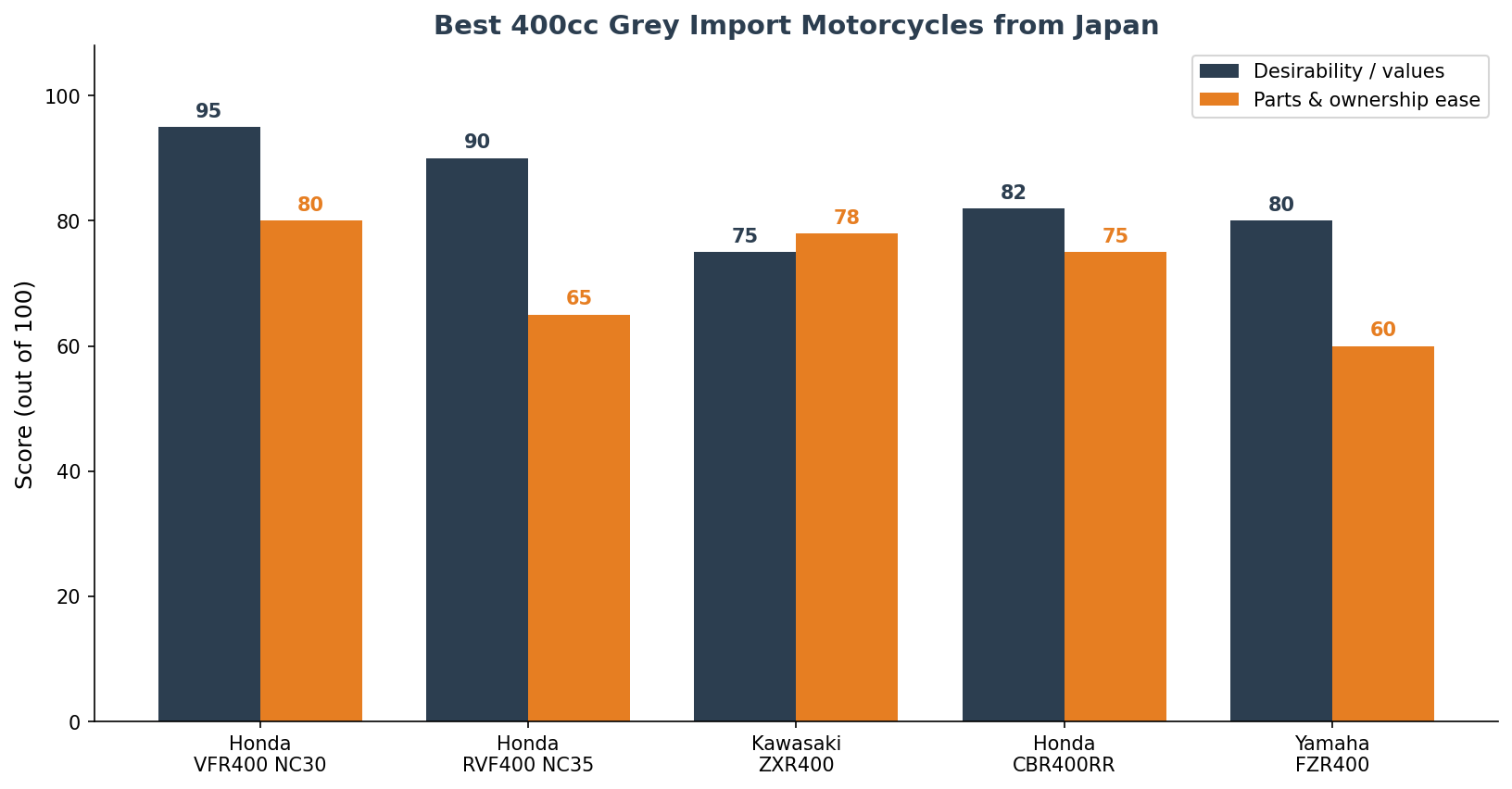
Honda VFR400 NC30. Probably the UK's single favourite grey import, full stop. It is a scaled-down RC30 — same gorgeous single-sided swingarm, same V4 character — with a 399cc engine making around 59 horsepower and spinning to a delirious 14,500 RPM. It looks like a superbike that was left in a hot wash. Values have climbed steadily; clean ones are now genuine modern classics.
Honda RVF400 NC35. The NC30's spiritual successor, sold between 1994 and 1996. More power, sleeker RC45-inspired bodywork, and upside-down forks. If the NC30 is the people's champion, the NC35 is the connoisseur's pick.
Kawasaki ZXR400. The long-lived one, built from 1988 to 1999. Crucially, it was actually officially imported into the UK for part of its life, which makes paperwork and parts a touch easier than the pure greys — it was seen as the least exotic and least terrifyingly priced of the 400 club, which is exactly why it is a sensible entry point.
Honda CBR400RR. Possibly the most popular grey import 400 of all, sold in many guises over the years, right up to the "Baby Blade" of the early 1990s that aped the FireBlade's looks. Never officially UK-imported, pure grey, and beloved for it.
Yamaha FZR400. Small, light, focused and high-revving — one of the best-handling bikes of its era, with the SP version winning the 1992 Supersport 400 TT. A track-day weapon that happens to be road legal.
Beyond the 400s, the grey scene runs deep: the Suzuki RGV250 and Honda NSR250 two-strokes, the Kawasaki GPZ900R that started the modern-classic boom, the legendary Honda RC30 itself, and a whole catalogue of Japanese-market specials. The point is that the grey import market is not a compromise — for these bikes, it is the doorway to the best of Japanese motorcycling.
Parts and maintenance: the real cost of ownership
Let me be the friend who tells you the truth before you buy, not after. The single biggest ongoing reality of grey import ownership is parts. A grey import can turn routine maintenance into a treasure hunt.
For a popular model like the NC30 or a CBR400, the aftermarket and the owners' clubs have you mostly covered — consumables, common service items, and even a lot of cosmetic bits are available if you know where to look. For rarer machines, you may find yourself trawling Japanese parts sites, joining model-specific forums, and occasionally fabricating or adapting. Tyres deserve a special mention: some older grey imports run unusual wheel and tyre sizes that have quietly gone out of production, so check tyre availability for the specific model before you buy, not after.
The flip side is that these bikes often need less remedial work than their Western equivalents to begin with, precisely because they were so well kept in Japan. A low-mileage shaken-maintained bike that arrives needing fluids, tyres and a once-over is a far better starting point than a tired local example with a folder full of bodges. Buy the best-condition bike you can, keep a relationship with a model-specific specialist, and the parts problem becomes an occasional annoyance rather than a constant battle.
How to buy a grey import without getting burned
Most grey import horror stories share a root cause: the buyer could not actually see the bike, could not read the paperwork, and trusted the wrong person with their money. Here is how to not be that buyer.
Learn to read the auction sheet. Almost every quality grey import starts life at a Japanese auction, and every auctioned bike comes with an inspection sheet graded by a neutral inspector. The grade, the mileage, the repair map and the inspector's notes tell you more than a hundred seller photos. A bike graded 4 or above with a clean map is a strong start; a flood of repair marks or a vague grade is a reason to walk. If you cannot read the sheet yourself, work with someone who can.
Verify the real mileage and the real spec. Japanese bikes are usually honest on mileage thanks to the inspection regime, but you still want the auction sheet to back up the odometer. And confirm whether the bike is a home-market or export version — restriction, gearing and even parts compatibility can differ.
Use a reputable exporter or agent, never a stranger with a deposit. The grey market has brilliant, honest operators and a handful of cowboys. The honest ones show you the auction sheet, give you a transparent all-in quote, handle the export paperwork, and tell you when a bike is not worth bidding on. The cowboys want your deposit and go quiet.
Get your landed cost in writing before you bid. Bike price, auction fees, agent fee, domestic transport in Japan, shipping, your country's tax and duty, and registration — all of it, before you commit. If a quote is missing a line, that is the line that bites you later.
How AWA Auction helps you buy a grey import
This is exactly the gap AWA Auction was built to close. We sit on the Japan side of the grey import equation — at the auctions, reading the sheets, in the same language as the inspectors — so you do not have to gamble on a bike you have never seen.
You tell us the model you are chasing, whether it is an NC30 you have wanted since you were fifteen or a clean GPZ900R for a restoration. We hunt it across the Japanese auctions, translate and assess every inspection sheet, give you an honest read on condition, and quote you a transparent all-in landed cost for your country — no mystery fees discovered at the port. When you are ready, we bid on your behalf and handle the export paperwork so the bike arrives clean and documented.
You can browse the bikes currently available through AWA Auction to see what is moving through the auctions right now, and if you have a specific grey import in mind, tell our team exactly what you are looking for and we will start the hunt. The grey import dream is real — we just take the guesswork out of it.
Parts and maintenance reality check
One more honest note before the myths, because it is the question that decides whether you enjoy ownership. Ask yourself how you feel about waiting two weeks for a part to arrive from Osaka. If that is fine, a grey import will reward you for years. If it would drive you mad, pick one of the popular models with strong club and aftermarket support — an NC30, a CBR400, a GPZ900R — rather than an obscure one-year-only special. The bike you can keep running is always worth more than the rare one you cannot.
Grey import motorcycle myths, busted
The grey import scene has collected more folklore than almost any corner of motorcycling, and a lot of it costs people money. Let me knock down the big ones.
Myth: a grey import is automatically dodgy or stolen. Wrong, and it is the most damaging myth of all. Grey simply means unofficial channel, not illegal. A properly imported, NOVA-notified, MSVA-approved bike with a clean dating certificate is exactly as legitimate as any other machine on the road. The "dodgy" reputation comes from a minority of badly documented bikes, not the category itself.
Myth: you can never get parts. Overstated. For the popular models the parts situation ranges from "perfectly fine" to "mildly annoying," not "impossible." Owners' clubs, Japanese parts suppliers and a healthy aftermarket keep most of the famous 400s running happily. It is the genuinely obscure models where the treasure hunt gets serious — so choose accordingly.
Myth: the speedometer reads in kilometres so it is illegal. A Japanese-market bike with a km/h speedo is fine to ride in the UK and most markets; you simply learn to read it, or fit a converted or dual-marked clock. It is a quirk, not a barrier.
Myth: a Q-plate is a death sentence for value. A Q-plate does dent value and signals uncertain age or identity, but plenty of cherished grey imports wear one and ride exactly the same. The goal is to avoid one through good paperwork — but if a bike you love already has one and the price reflects it, it is not the end of the world.
Myth: importing is only for experts. It was, twenty years ago. Today a good agent handles the auction, the export documents and the shipping, and the home-side registration is a known, repeatable process. Thousands of ordinary riders do it every year. You can be one of them.
Frequently asked questions about grey import motorcycles
The questions below come straight from the forums, comment sections and inboxes where grey-import buyers actually live. Short, honest answers.
Final word
A grey import motorcycle is a doorway to bikes the rest of the world never got — engineered with obsessive care, kept in better condition than almost anything local, and often genuinely affordable once the age and exchange rate line up. The catch is never the bike. It is the paperwork, the parts and the insurance, and every one of those is manageable the moment you go in with your eyes open.
Get the right model, on the right side of the age line, with the auction sheet read and the landed cost in writing — and a grey import is one of the most rewarding ways to own a motorcycle. Get it wrong, in a hurry, on trust alone, and it is an expensive lesson. Now you know which one you are going to be.
See Also
Share this article: