
There is a video of a Honda CB400 Super Four riding through the Kaybiang Tunnel in the Philippines that has been watched more than 55 million times. No stunts. No crash. Just a 399cc inline-four climbing past 6,750 rpm, the Hyper VTEC waking up the second pair of valves, and that scream bouncing off the tunnel walls. People watch it on repeat for the sound alone.
That is the bike you are thinking about importing. And here is the catch nobody mentions: if you live in the United States, Honda never sold it to you. The CB400 Super Four is one of the most significant Japanese motorcycles of the last thirty years, and across most of the English-speaking world the only way to own one is to import a Honda CB400 Super Four from Japan directly.
Good news. That is exactly what we do. This guide walks you through the three generations worth knowing, how the famous VTEC trick actually works, what one really costs landed in your driveway, how to read a Japanese auction sheet for a CB400, and the import rules for the US, UK, Australia and New Zealand. By the end you will know which year to chase and which ones to walk away from.
Let's get into it.
What Is the Honda CB400 Super Four (And Why It Never Came to America)
The CB400 Super Four is a 399cc, four-cylinder naked standard that Honda built at its Kumamoto plant from 1992 all the way to 2022. Thirty years. In Japan it became the default motorcycle — the bike your driving school taught you on, the bike the police rode, the bike a salaryman bought because it did everything and never broke.
So why have most Americans never seen one? Money and licensing. Japan has a 400cc license tier, and for decades that tier was a goldmine. Manufacturers poured engineering into 400cc machines that the rest of the world never got, because most other countries jump straight from small bikes to 600cc and up. A four-cylinder 400 made perfect sense in Tokyo and zero sense in a Honda dealer in Texas, where a CBR600 cost about the same.
The result is a JDM-only legend. The CB400SF revs to roughly 14,500 rpm, makes about 53 horsepower, weighs under 200kg, and sounds like a shrunken superbike. It is smooth, friendly at low speed, and savage up top. There is nothing else quite like it sold new anywhere today, which is why demand to import a Honda CB400 Super Four from Japan keeps climbing every year the older models cross the legal-import threshold.
If you want to see what Japanese-market inventory looks like in real time, our current listings are pulled straight from the same auctions we bid in.
The Three Generations: NC31, NC39 and NC42 (Which One to Import)
Buy the wrong generation and you will spend a year chasing parts. Buy the right one and you have a bike that will outlive your interest in it. Here is the family tree, stripped of the trainspotter detail.
NC31 (1992–1998) — The Original
The first Super Four. Carbureted, air-cooled in spirit but actually liquid-cooled, no VTEC. Honest, simple, and the easiest one to legally import into the US right now because every single NC31 is comfortably over 25 years old. If you want a clean, mechanical CB400 with nothing electronic to fail, this is your bike. The trade-off is that it makes its power the old-fashioned way and lacks the party trick the model became famous for.
NC39 (1999–2007) — VTEC Arrives
This is where the Super Four got its signature. Honda introduced Hyper VTEC in 1999, then refined it through Spec I, Spec II and Spec III. Two of the four valves per cylinder stay shut at low rpm for torque and fuel economy, then snap open at higher revs for top-end power. The early NC39s (1999 through 2001) are now old enough for the US 25-year rule, which makes them the sweet spot for American buyers who want the VTEC sound without waiting another few years.
It is worth knowing the sub-versions, because they change how the bike feels. The original 1999 Hyper VTEC (often called Spec I) switched both valves purely on rpm, around 6,750. In 2002 the Spec II revised the switch behaviour, and the 2003 Spec III dropped the switch point lower and sharpened throttle response. Honda also sold trim variations — the plainer "Version S" and the dressier "Version R" with upgraded suspension and brakes on some years. None of this changes the basic recipe, but a Spec III with the better brakes is a nicer bike to live with than an early Spec I, and the price difference at auction is usually small.
NC42 (2008–2022) — Hyper VTEC Revo and Fuel Injection
The final and most refined generation. Fuel injection replaced carbs, and "Hyper VTEC Revo" made the valve switch smarter — it now reads throttle position, not just rpm. In gears one through five the second pair of valves opens at 6,300 rpm at wide-open throttle, otherwise at 6,750 rpm. These are the bikes Australia actually got in dealerships from 2008, and they are the ones that command $4,000 to $6,500 used in good condition. For US buyers, NC42s are not yet 25 years old, so they are import-legal only in countries without that rule.
The Revo system is the clever bit. Instead of switching the valves at a single fixed rpm, it reads how hard you are opening the throttle. Crack it open gently and the switch holds off to 6,750 rpm; pin it wide open and the second pair of valves joins in earlier, around 6,300 rpm, so the surge arrives exactly when you are asking for it. Fuel injection on the NC42 also means no carburettor balancing, easier cold starts, and one fewer maintenance headache than the older bikes — which matters when your nearest CB400 specialist is an ocean away. If you can legally import an NC42 where you live, it is the one to get.
Here is the short version. American buyer who wants legal-now and simple: NC31. American buyer who wants the VTEC scream and legal-now: a 1999–2001 NC39. Australian, Kiwi or UK buyer who wants the best of everything: an NC42. We will come back to why country matters in a moment.
That Inline-Four Sound: How Hyper VTEC Actually Works
Let's talk about the thing that sells these bikes. People do not import a Honda CB400 Super Four from Japan because they need a commuter. They import it because of what happens at 6,750 rpm.
A normal four-valve engine runs all four valves all the time. Honda's engineers looked at the 400cc class and decided that was a compromise: four valves give great top-end breathing but hurt low-rpm torque and economy. So Hyper VTEC keeps two valves per cylinder closed below the switch point. Down low, the engine behaves like a torquey two-valve motor. Then you wind it out, the solenoid fires, the other two valves join in, and the bike transforms — the intake note hardens, the power surges, and the exhaust changes pitch in an instant.
Japanese owners have a word for the addiction. In the comments under that VTEC sound video, riders joke that the bike gets noticeably worse on fuel the more you own it, because you simply cannot stop revving past the switch point to hear it happen. One commenter put it bluntly: the fuel economy on a genuinely economical bike goes to ruin purely because the VTEC is too satisfying to leave alone.
That is the experience you are buying. It is also a useful buying tool, which most guides skip: a healthy CB400 should make that valve transition cleanly and consistently every time, at the same rpm, with no hesitation, misfire or flat spot. If a bike stumbles right at the VTEC point, the solenoid or the valve-side wiring may be tired. Make the seller (or your import agent) rev it through the switch on video before you commit.
Is It Legal to Import? Rules by Country
This is where buyers get burned, so read carefully. The exact same CB400 can be a dream purchase in Sydney and an illegal paperweight in Los Angeles, purely because of where you live and what year it left the factory.
United States — The 25-Year Rule
The US bans most non-compliant foreign vehicles, but there is a giant exemption: under federal law, any vehicle at least 25 years old (counted from its month of manufacture, not its model year) is exempt from FMVSS safety standards. The EPA adds its own exemption for engines 21 years and older. In practical terms for 2026, that means any motorcycle built in 2001 or earlier clears both hurdles.
So for an American buyer: every NC31 (1992–1998) qualifies today, and early NC39s built in 1999, 2000 and 2001 qualify too. An NC42 does not — the newest of those is from 2022, so it stays off-limits in the US until the late 2040s. If a US "importer" offers you a 2015 CB400, walk away. They are either lying or about to import you a bike you cannot register.
Australia and New Zealand — LAMS Friendly
Australia and New Zealand are the easy markets. The CB400 was officially sold in Australian showrooms once the old 250cc learner cap was replaced by the LAMS power-to-weight system, and the Australian-delivered models were set up to be LAMS-approved learner-legal. That means a restricted CB400 is legal for a learner or restricted-license rider, and there is no 25-year wait — you can import a recent NC42. New Zealand runs a similar LAMS approved list.
United Kingdom and Europe — Restrict It for A2
You can ride a CB400 (1992-on) in the UK, but the licensing math matters. The engine makes about 39.5 kW (53 bhp), and the A2 license caps out at 35 kW (47 bhp). So to ride one on an A2 license, the bike must be fitted with a restrictor kit cutting power by at least 10.2%. On a full license, ride it as-is. On import you will also deal with a NOVA notification, import duty, and 20% VAT — budget for those before you fall in love with an auction photo.

The rule of thumb: if you are in the US, you are shopping NC31 and 1999–2001 NC39. Everywhere else with tiered licensing, the whole range is open to you, NC42 included. When in doubt, ask our team for your specific country and year before you bid — it is a thirty-second answer that saves an expensive mistake. Our guide to reading a Japanese auction sheet pairs well with this if you want the full picture.
What a CB400 Super Four Import Actually Costs
Time for real numbers. The auction hammer price is only the start, and anyone quoting you "just the bike price" is hiding the rest. A CB400 Super Four import has roughly five cost layers: the winning bid, the Japan-side fees and domestic transport, ocean freight, your country's duty and tax, and the agent fee.
A clean carbureted NC31 can hammer for surprisingly little at a Japanese auction — these are still everyday bikes in Japan. A tidy VTEC NC39 sits in the middle. A low-mileage late NC42 is the premium pick. Once landed, a good NC42 typically lands in the $4,000 to $6,500 range in countries that allow it, while a solid older VTEC bike can come in well under that.
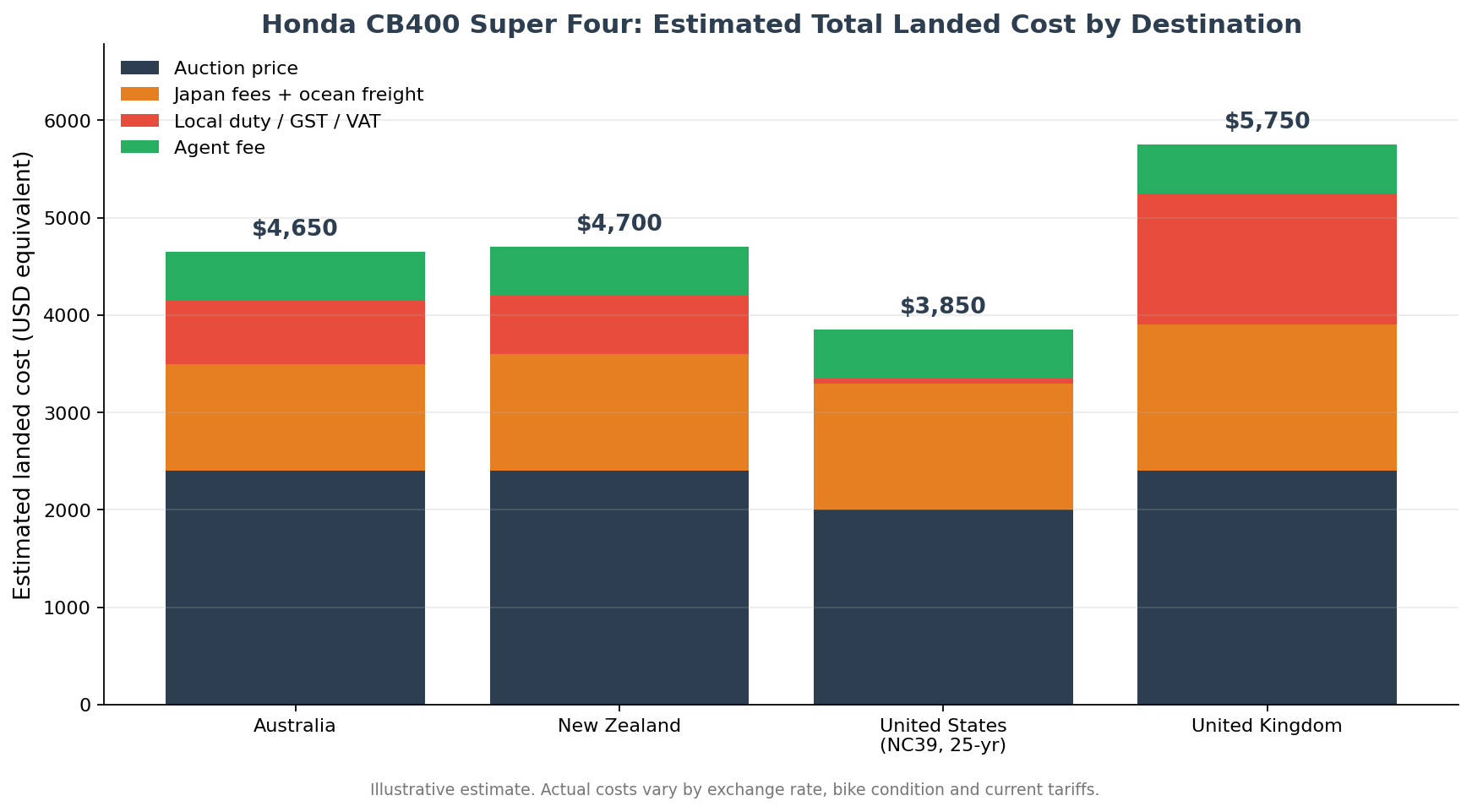
The single biggest variable is your destination. The US has no motorcycle import duty for 25-year-old bikes in most cases, which keeps American landed costs low. Australia adds GST and (for some) Luxury Car Tax thresholds that motorcycles rarely hit. The UK is the most expensive end thanks to that 20% VAT plus duty. Same bike, very different final number.
Here is what the generations tend to cost at auction before fees and freight, so you can set expectations:
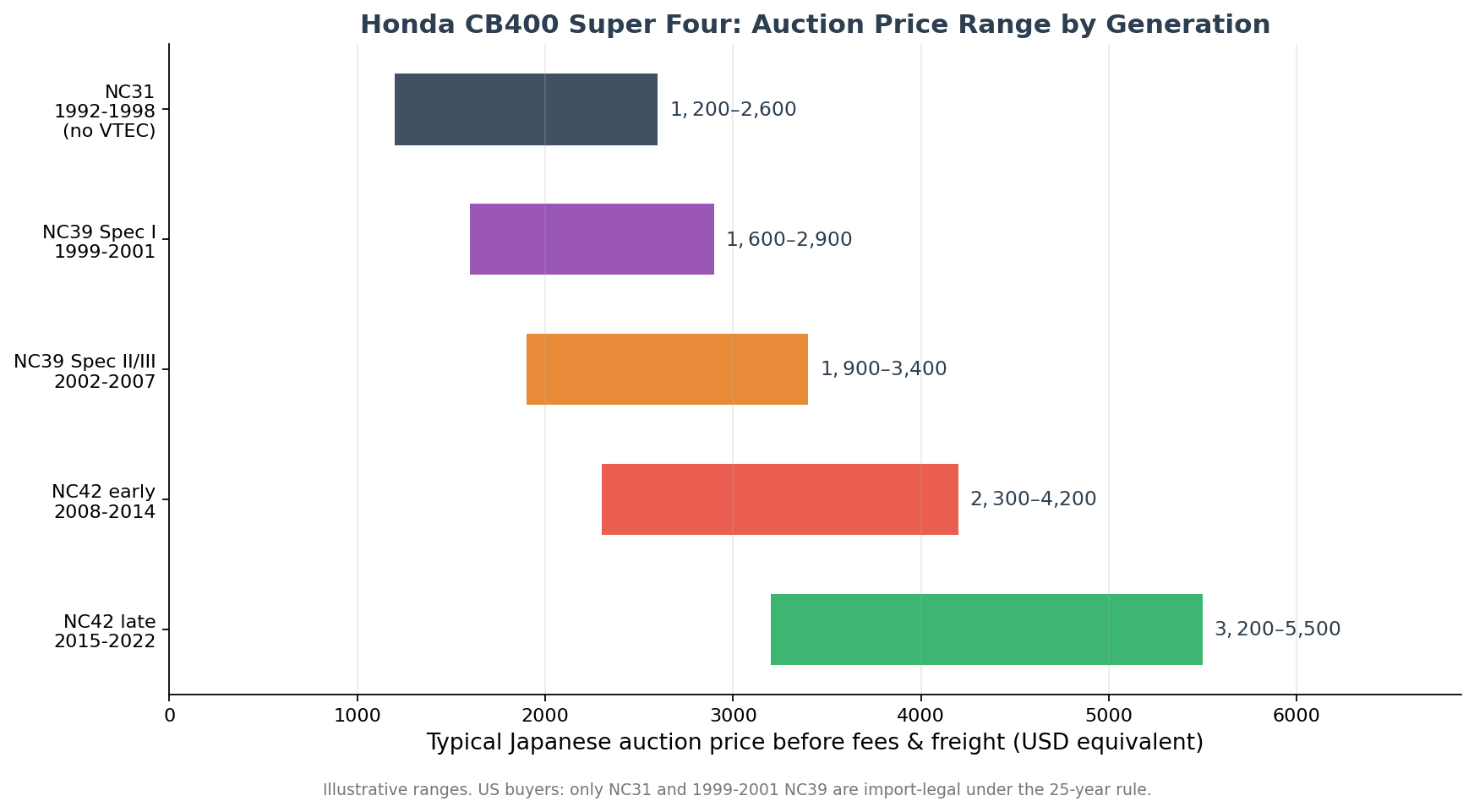
The lesson from the chart: chasing the newest NC42 you can find is not always smart. A well-kept 2001 NC39 gives you the VTEC sound, US legality, and a price that leaves room in the budget for shipping. Spend the money on condition, not on the model year.
Reading the Auction Sheet: What to Check on a CB400
Every bike that crosses a Japanese auction block comes with an inspection sheet graded by a neutral third party. This is the real reason importing from Japan beats buying blind off a classified ad — a stranger in a hi-vis vest already went over the bike and wrote down what is wrong with it. You just have to know how to read it.
For a CB400 Super Four specifically, here is what matters most on the sheet.
Overall grade. Bikes are graded on a scale (commonly 1 to 6, plus S for new). A 4 or 4.5 is a clean, honest used bike. A 3 has visible wear or needs attention. Anything graded R has been in an accident and repaired — for a high-revving four like this, that is a hard pass unless the damage is documented and cosmetic.
Mileage and the meter mark. The sheet records odometer reading and flags whether the reading is believed genuine. A CB400 with 30,000–50,000 km is barely run in — these engines routinely pass 100,000 km. Be more suspicious of a 9,000 km bike with worn grips than a 60,000 km bike that matches its wear.
The frame and corrosion map. The inspector draws a diagram and marks scratches (A), dents (B), corrosion, and repairs with letter-number codes. On a CB400, look hard at corrosion notes around the frame and exhaust, especially on bikes from snowy regions where roads are salted.
Engine and "running" notes. A genuine inspection often notes engine condition and whether it starts and runs. For our purposes, the gold is any note about abnormal sound — which on this model usually points at the cam chain tensioner. More on that next.
If decoding all of this sounds like work, that is the job we do for you on every bike. We translate the sheet, flag the landmines, and tell you honestly when a cheap bike is cheap for a bad reason.
Common CB400 Problems to Catch Before You Bid
No motorcycle is perfect, and the CB400 Super Four has a short list of known weak spots. None of them are dealbreakers if you catch them on the sheet or in pre-bid photos. All of them are expensive surprises if you do not.
The cam chain tensioner. This is the big one. The plastic guides in the cam chain tensioner wear over time, and worn pieces let the chain rattle. On a CB400 the symptom is a metallic rattle from the top end that changes with rpm. It is a known, documented issue across the model's life. A rattle is not always fatal — tensioners are a serviceable part — but it should be a price negotiation, not a surprise after the bike lands.
Regulator/rectifier overcharging. The charging system can fail in a way that overcharges the battery rather than undercharging it. The tell-tale signs are a battery that runs hot, swells, or boils. If an auction sheet or seller mentions a recently replaced battery with no explanation, ask why. A failing reg/rec is cheap to fix once you know, and brutal if it cooks your electrics on the way home.
The VTEC transition itself. As covered earlier, a healthy bike switches valves cleanly and repeatably. A hesitation, flat spot or misfire right at the switch point points to the VTEC solenoid or its wiring. This is unique to the VTEC NC39 and NC42 — the NC31 simply does not have the system, which is one more reason the original generation is the low-stress choice.
Catch these three and you have caught 90% of what goes wrong with a CB400. Everything else is normal wear — tyres, chain, brake pads, fork seals — the same as any used bike anywhere.
The Police Bike and Driving-School Secret Nobody Mentions
Here is a piece of context that genuinely affects what you are buying, and almost no import guide tells you. In Japan, the CB400 Super Four is not just a popular bike. It is institutional.
It is the standard machine at countless Japanese motorcycle driving schools — the bike an entire generation of Japanese riders learned on and took their license test aboard. And it is a patrol bike for the Japanese police, who run them as the nimble "blue bikes" (青バイ) you will see weaving through city traffic. Honda even refiled the CB400 Super Four trademark in 2025, a strong hint that the nameplate is coming back rather than fading away.
Why does this matter to an importer? Two reasons.
First, it tells you the platform is bulletproof. A bike that police forces and driving schools trust to take daily abuse from learners is not a fragile thing. These engines were engineered for hard, repeated, low-speed clutch-slipping abuse and they shrug it off.
Second, it means parts and knowledge are everywhere in Japan. Because millions were sold and used institutionally, the Japanese used-parts market is deep and cheap. When you import a Honda CB400 Super Four from Japan, you are buying into one of the best-supported used platforms in the country — which is exactly why we can source clean examples and the bits to keep them running.
There is also a sister model worth knowing: the CB400 Super Bol d'Or, a half-faired version of the same bike with a small fairing and screen for more comfort on longer rides. Mechanically it is a Super Four. If you see one on an auction list and like the look, it imports the same way.
Step-by-Step: How to Import a CB400 Super Four from Japan
So how does the whole thing actually work, start to finish? Here is the honest sequence, with no mystery.
Step 1 — Confirm legality for your country and year. Before anything, lock down which generations you can legally import. US buyers: 2001 and older. Everyone else: the full range, with restriction where your license requires it. This step takes one message and prevents the only truly unfixable mistake.
Step 2 — Set your budget in landed terms. Decide your maximum out-the-door number, then work backwards. Subtract estimated freight, duty/tax and agent fee, and what is left is your auction ceiling. Bid the bike, not the dream.
Step 3 — Get auction access. Japanese auctions are members-only and conducted in Japanese. You bid through a licensed agent — that is us. You tell us the model, generation, grade and budget, and we watch the auctions you cannot.
Step 4 — Vet the auction sheet. When a CB400 comes up, we translate and read the sheet, check the photos, flag cam chain rattle, accident repairs and corrosion, and give you a straight recommendation. You approve the bid.
Step 5 — Win, settle and prep for export. Once you win, the bike is paid for, de-registered for export, and moved to the port. Japanese export documentation (the export certificate) is prepared.
Step 6 — Ocean freight. The bike is crated or roll-on-roll-off shipped to your nearest port. This is the slow part — typically a few weeks on the water depending on destination.
Step 7 — Clear customs and register. At your end, customs clearance happens, duty and tax are paid, and you complete local registration (NOVA in the UK, state DMV/title in the US, your transport authority in Australia and New Zealand).
Step 8 — Ride it. The bike arrives, you do a first service, and you find the nearest tunnel.
That is the entire process. The hard parts — auction access, reading the sheet, export paperwork, freight booking — are the parts a good agent handles so you do not have to.
A Real CB400 Import, Start to Finish
Numbers in a chart are abstract, so here is how a typical CB400 import actually plays out. Treat this as an illustrative example, not a quote — every bike and every exchange rate is different.
A buyer in Brisbane wants a clean NC42 with the Hyper VTEC Revo and fuel injection. We find a 2010 model on a mid-week auction list, graded 4, with around 28,000 km and a clean corrosion map. The sheet notes nothing alarming — no accident history, no engine warnings. The hammer falls at roughly the equivalent of A$2,400.
On top of the winning bid come the Japan-side auction and handling fees, domestic transport to the port, and the export documentation. Ocean freight to an east-coast Australian port adds a few hundred dollars more. At the Australian end, the buyer pays GST and customs clearance, plus state registration and compliance for LAMS. Add the agent fee, and the bike lands road-ready for noticeably less than a privately advertised local CB400 — and with a documented inspection history a local seller almost never provides.
The same bike sourced for a US buyer would not be legal yet, because a 2010 model is under 25 years old. That American buyer instead chases a 2000 or 2001 NC39 — same VTEC sound, fully import-legal, often a lower hammer price, and no duty on a 25-year-old motorcycle. Two buyers, two countries, two completely different "right" bikes. That is the entire point of matching the generation to the market.
CB400 Super Four vs the Obvious Alternatives
Should you import a CB400 at all, or buy something local? Honest question, honest answer. Here is how it stacks up against the bikes people cross-shop.
CB400 vs a modern Ninja 400 or CB500. A new twin like the Kawasaki Ninja 400 is cheaper to buy locally, comes with a warranty, and makes similar real-world power with less fuss. What it does not have is four cylinders and that VTEC top end. You are not importing a CB400 because it is the rational choice — you are importing it because a 399cc inline-four screaming to 14,500 rpm is an experience a parallel-twin simply cannot reproduce.
CB400 vs the Yamaha SR400. Completely different bikes for completely different riders. The Yamaha SR400 is a single-cylinder, kick-start, retro thumper — slow, simple and full of character. The CB400 is the high-revving, smooth, technical opposite. If you want a relaxed classic, get the SR. If you want a miniature superbike that doubles as a commuter, get the CB400.
CB400 vs a 600cc. This is the one Americans always ask. A used 600 makes far more power for similar money and is everywhere. True. But a 600 is also a known quantity that everyone has ridden, while a CB400 is rare, distinctive, friendlier at sane speeds, and far more usable on a daily basis than a track-focused 600. Rarity has value, and the CB400's blend of approachability and four-cylinder theatre is genuinely hard to find.
CB400 vs a vintage 250cc four. Japan also built tiny four-cylinder 250s, and they sound incredible too. But they are buzzy, fragile in the wrong hands, and genuinely slow. The CB400 gives you nearly the same shrunken-superbike feel with usable real-world performance and far better parts support. For most buyers it is the smarter four-cylinder JDM import.
Bottom line: if you want sensible and cheap, buy local. If you want the bike that makes you grin at every tunnel, the auctions in Japan are where the good ones live.
How AWA Auction Gets You Into a CB400 Super Four
This is what we do every week. AWA Auction is a Japan-based export agent with direct access to the same domestic auctions where tens of thousands of motorcycles change hands. We are not a middleman reselling bikes at a markup — we bid on your behalf, at the real auction price, and charge a transparent agent fee on top.
For a CB400 Super Four specifically, that means we can find you the right generation for your country, read the auction sheet honestly, tell you when to walk away, and handle the export end so the bike shows up legal and ready. We have done it for Ninja 400s, Super Cubs, SR400s and plenty of CB400s, and the playbook is the same: condition first, honesty always.
If you want to see what is on the auction blocks right now, browse our current listings. If you already know you want a CB400 and just want someone to go get you a good one, contact our team with your country and budget and we will start watching for it.
The bike that scored 55 million views on a sound clip alone is sitting in a Japanese auction yard right now. Let's get you on it.
See Also
Share this article: