
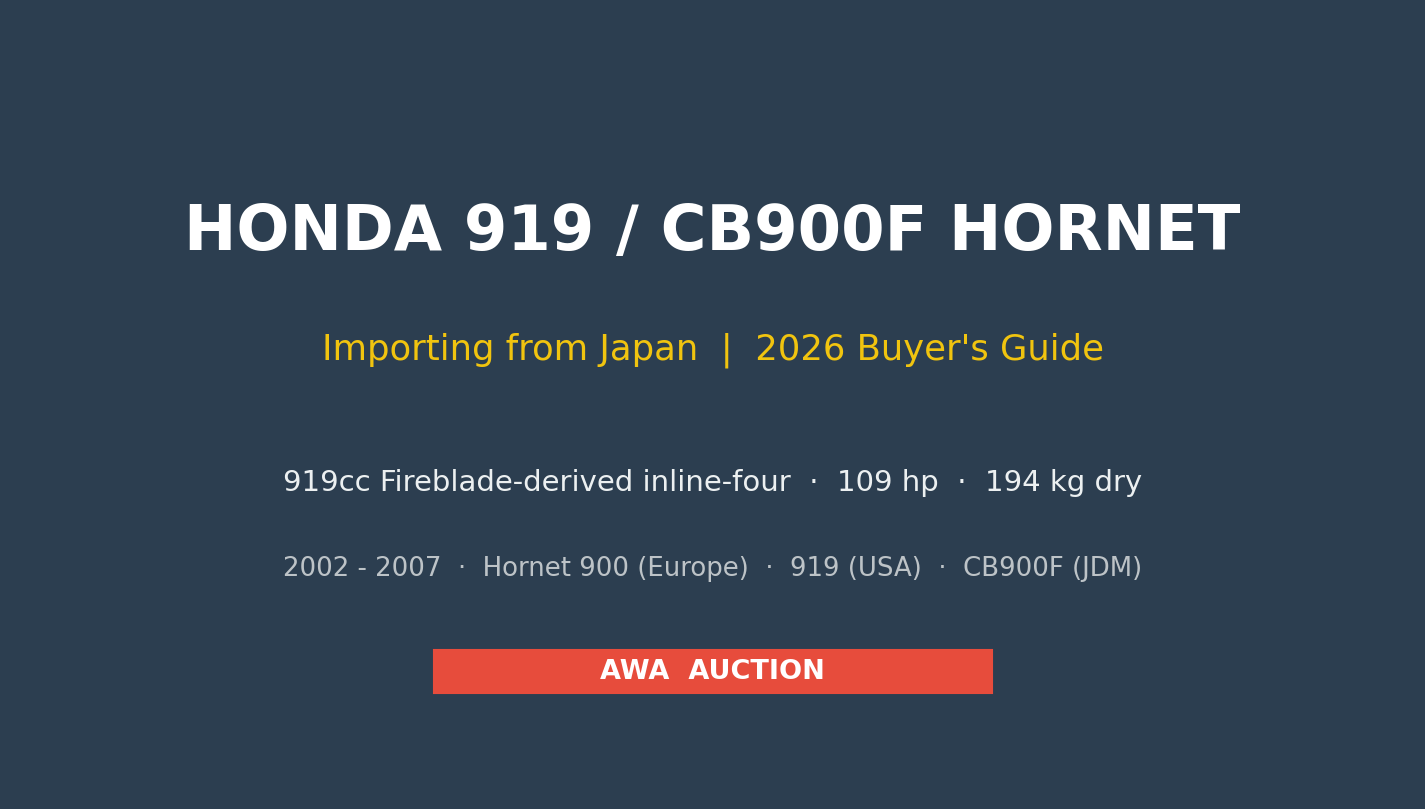
If you want to import a Honda 919 (CB900F Hornet) from Japan, you are hunting one of the great underrated big nakeds: a detuned Fireblade engine bolted into an upright, do-anything chassis that will commute all week and terrorise a mountain road on Sunday. It makes 109 hp, weighs under 195 kg dry, and has one of the most bulletproof inline-fours Honda ever built. Owners routinely clock past 100,000 km on nothing but oil and tyres. One rider in the comments under a popular review summed it up: he bought his 2003 in black, rode it daily for over seven years, and "did practically nothing to it besides oil and tyres."
Here is the thing nobody tells you in the classified ads: this bike wears three different names, and buyers get confused constantly. In Europe it is the Hornet 900. In the United States it was sold simply as the Honda 919. On the Japanese domestic market and on the tank badge it reads CB900F Hornet. Same motorcycle, three identities, one very good reason to buy from Japan: the JDM bikes were ridden gently, serviced at the dealer, and stored in dry garages. This guide walks you through the naming mess, the engine that makes it special, the model-year changes, the exact things to check, what it really costs to land one in your driveway, and the import rules that decide whether you can even register it. By the end you will know which 919 to chase and what to pay.
What Is the Honda 919 / CB900F Hornet (and Why the Three Names)?
The Honda 919 is a naked standard built between 2002 and 2007, powered by a 919cc liquid-cooled DOHC inline-four lifted from the 1998 to 1999 CBR900RR Fireblade. Honda took the last carburettor-era Blade motor, fitted fuel injection, softened the tune for real-world roads, dropped it into a comfortable upright frame, and sold it as an honest, fast, do-it-all street bike. No fairing, no rider aids, no electronic nannies. Just a big four, a wide handlebar, and a grin.
The three-name confusion has a genuinely odd cause. In most of the world Honda called it the Hornet 900, continuing the naming from the popular CB600F Hornet. But in the United States the "Hornet" name was already trademarked in the car world, so Honda dropped the badge entirely and sold the bike as the "919" after its engine capacity. As one American owner put it bluntly in a YouTube comment: "In the USA it was sold as 919 because the Hornet name was already trademarked." Another owner in Europe fired back under the same video: "In my country it is named Hornet 900, it also says it on the bike, CB900F HORNET." They are both right. They own the same motorcycle.
Why import one from Japan? Because Japan is where the clean, low-mileage examples live. Japanese owners tend to ride less aggressively, keep full dealer service history, and store bikes indoors. A 919 that spent its life in Osaka has usually seen fewer harsh winters, less salt, and less abuse than a comparable European bike that lived outside through fifteen British winters. When you buy through a Japanese auction, you also get a graded inspection sheet that tells you the truth about the bike's condition before you ever pay for it. That is the whole point of browsing verified auction stock instead of gambling on a local private sale.
The Engine: A Detuned Fireblade That Refuses to Die
The heart of the 919 is what makes it worth importing. That 919cc four is a direct descendant of the CBR900RR Fireblade, one of the most celebrated superbike engines of the 1990s. Honda did not just bolt the Blade motor in unchanged, though. They retuned it for the street, and the changes are worth understanding because they explain exactly how the bike behaves.
The Fireblade used four 38mm Keihin carburettors. The 919 swapped those for fuel injection running through four 36mm throttle bodies, which is why every 919 and Hornet 900 is fuel-injected, not carburetted. That single fact matters when you are checking classified listings, because plenty of sellers get it wrong. Honda also lowered the compression ratio from 11.1:1 to 10.8:1 with reshaped combustion chambers, and altered the valve timing and lift. The result is less peak power but far stronger low and mid-range torque, exactly what you want on a naked road bike.
The numbers land at 109 hp at 9,000 rpm and 91 Nm of torque at 6,500 rpm. Dry weight is a featherweight 194 kg, the tank holds 19 litres, and it runs a six-speed gearbox with chain final drive. The gearbox internals and primary drive are shared with the Fireblade; Honda only changed the final drive ratio, adding one tooth to the rear sprocket for a punchier 2.688 drive ratio versus the Blade's 2.625. In plain English: it pulls hard from low revs and does not need to be screamed to be fun.
Reliability is the real headline. This engine is widely regarded as one of Honda's most unburstable inline-fours, routinely exceeding 100,000 km on basic maintenance. That reputation is precisely why the 919 is a smart import target: even a high-mileage Japanese example with honest history is likely to have plenty of life left, provided the wear items have been kept up.
Model Year Map: Which Honda 919 to Import (2002-2007)
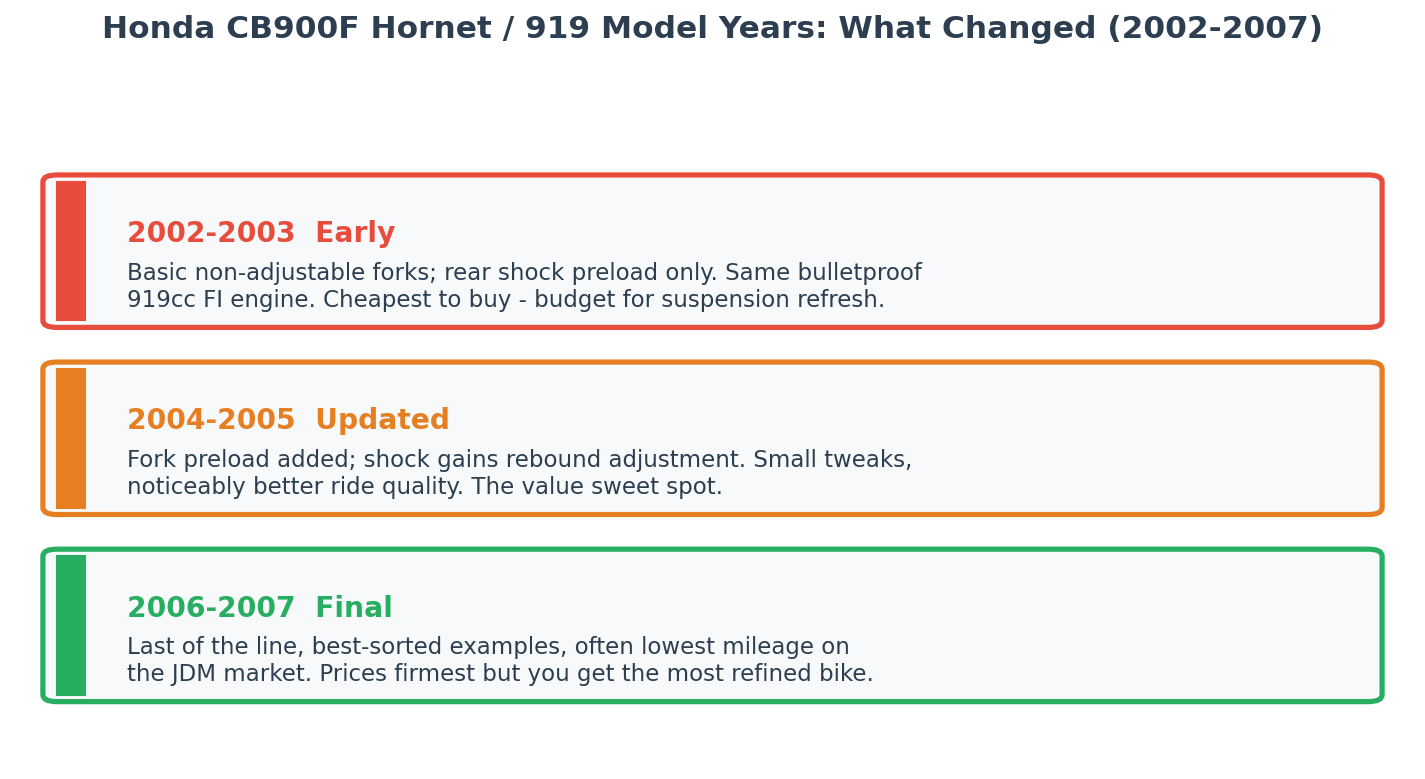
Unlike some bikes where a single bad model year ruins the used market, the 919 changed very little across its life. There is no catastrophic year to avoid. But there are meaningful differences in suspension spec that affect ride quality and price, and knowing them helps you target the right auction lot.
The early 2002 to 2003 bikes came with non-adjustable forks and a rear shock adjustable only for preload. They are mechanically identical to the later bikes where it counts, meaning the same brilliant engine, so they are the cheapest way into 919 ownership. The catch, honestly reported by testers, is that the suspension was merely okay when new and deteriorated quickly once the bikes had a few thousand miles on them. Budget for a fork oil refresh and a shock service and an early bike rides beautifully.
From 2004 Honda upped the spec. The forks gained preload adjustment and the rear shock gained rebound damping adjustment. These are small changes on paper but they noticeably improve the ride, which is why 2004 to 2005 bikes are the value sweet spot: better suspension, still affordable. The final 2006 to 2007 bikes are the best-sorted of the lot and often carry the lowest mileage on the Japanese market, so they command the firmest prices. If you want the most refined 919 and you are importing anyway, hunt a late JDM bike with a clean auction grade.
One more thing the model-year map does not show: colour matters to resale. The black and red 919s are the enduring favourites. As one long-term owner said, the 2003 in black is "still the best colour," and clean examples in the classic hues hold value better than the oddball shades.
Honda 919 vs Hornet 900 vs CB900F: Are They Really the Same Bike?
Yes. Mechanically, the Honda 919, the Hornet 900, and the CB900F Hornet are the same motorcycle sold under different names in different markets. There is no performance difference, no engine difference, no chassis difference worth caring about between a US-market 919 and a JDM CB900F Hornet of the same year. The distinctions are badging, speedometer units (miles versus kilometres), lighting regulations, and market-specific trim.
So if the US got the 919 new, why would an American import a JDM Hornet 900 at all? A few reasons. Low-mileage, dry-stored Japanese examples are often cleaner than tired domestic bikes. Some buyers want a specific colour that never came to their market. And collectors chasing a mint, original bike simply find better stock in Japan. For buyers in the UK, Australia, and New Zealand, importing from Japan is even more natural, because Japan is the largest and best-graded used market on earth and the right-hand-drive, kilometre-spec bikes suit those markets directly.
The practical takeaway: do not overpay for a bike just because the seller insists a Hornet 900 is somehow different from a 919. It is not. Buy on condition, history, mileage, and auction grade, not on the name printed on the side panel. If a listing tries to charge a premium for one badge over another, that is a red flag about the seller, not a feature of the bike.
Known Problems: What to Check Before You Bid
The 919 is genuinely reliable, but "reliable" does not mean "immortal." These bikes are now fifteen to twenty-plus years old, and there are a handful of well-documented weak points. Know them, check them, and you will avoid the expensive surprises.
Cam chain tensioner rattle. This is the classic 919 gotcha. The standard automatic cam chain tensioner is not Honda's finest work and gets less effective with age, producing a telltale rattling noise on start-up. On an auction bike you cannot hear it start, but you can look for a manual cam chain tensioner already fitted, which is a cheap, common, and sensible upgrade that owners install specifically to cure the rattle. A bike that has had this done is a bike whose owner cared. If the auction sheet or photos show the original tensioner, just budget the small cost to swap it.
Regulator/rectifier failure. This is a perennial issue on Hondas of the era, not just the 919. Most original reg/recs have died and been replaced by now. Symptoms are dimming lights, a boiling battery, and eventually a bike that will not charge. The good news: it is an easy and relatively cheap fix, and uprated aftermarket units are plentiful. Ask whether the reg/rec is original; if it is, plan to replace it as preventive maintenance.
Fuel pump and ethanol. Modern ethanol-rich unleaded is unkind to older fuel systems. It can coat the insides of the pump and lines with a varnish-like residue that corrodes components and eventually causes failure. A JDM bike that sat unused for a long stretch is more at risk here, so a fuel system that has been recently cleaned or serviced is a plus.
Suspension wear. As noted, the ride quality drops off once these bikes rack up the miles, especially on early non-adjustable examples. It is rarely a dealbreaker and almost always fixable with a fork service and a shock refresh or upgrade, but factor it into your budget rather than being surprised by a wallowy test ride.
Corrosion. Left outside and ridden through all weathers, certain areas of the 919 rust quickly, particularly fasteners, brackets, and exhaust components. This is exactly where Japanese bikes shine: dry storage and gentle winters mean JDM examples are usually far cleaner underneath than European survivors. Still, check the auction photos for surface rust and study the inspection sheet's condition notes before you commit. Not sure how to read one? Our team can walk you through an auction sheet before you bid.
How the 919 Stacks Up Against the Litre-Naked Rivals
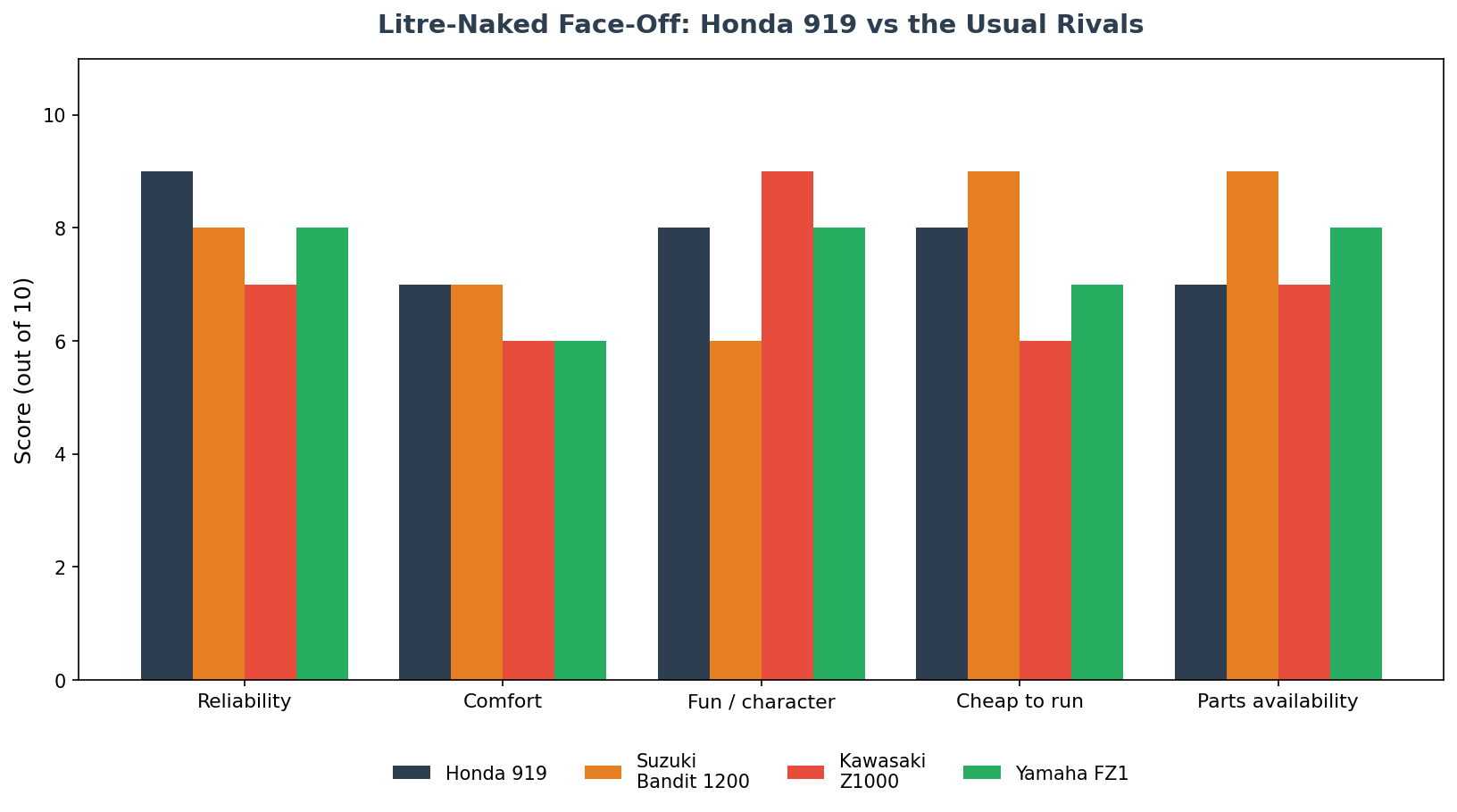
The 919 never sold in huge numbers, and that is part of its charm, but it competed in a golden era of big nakeds. If you are cross-shopping, the usual suspects are the Suzuki Bandit 1200, the Kawasaki Z1000, and the Yamaha FZ1. Each has a personality.
The Suzuki Bandit 1200 is the budget king: cheaper to buy, cheaper to run, and blessed with a massive aftermarket and endless parts. It is a little softer and less special to ride than the 919, but it is the pragmatic choice. The Kawasaki Z1000 is the extrovert: sharper styling, a harder edge, more theatre, but firmer suspension and a thirstier, more highly strung character. The Yamaha FZ1 splits the difference with its R1-derived engine, offering strong performance and a slightly more sporting bias.
Where the 919 wins is the blend. It is the Honda of the group, which means it does everything competently and breaks down rarely. It is not the cheapest to run (the Bandit takes that) and it is not the wildest (the Z1000 wins on drama), but for outright reliability and easy, torquey, real-world usability, the 919 is hard to beat. It is the bike you buy when you want to ride, not fettle. As one owner put it, having come off a supersport: this is a bike you can live with every day and still enjoy on a Sunday.
Importantly, none of these rivals quite matches the 919's provenance story: a genuine Fireblade engine, softened for the street, in Honda's typically over-engineered package. That pedigree is why the 919 has a devoted following despite modest sales.
What It Costs to Import a Honda 919 From Japan
Let's talk money, because this is where imports either make sense or fall apart. A clean, well-graded 919 or Hornet 900 at Japanese auction typically hammers somewhere in the region of the equivalent of 2,000 to 3,500 US dollars depending on year, mileage, and condition. That is the auction price. On top of it you stack Japan-side fees and export paperwork, ocean freight, your destination country's duty and tax, and inspection or agent fees. The chart below breaks down a realistic UK example.
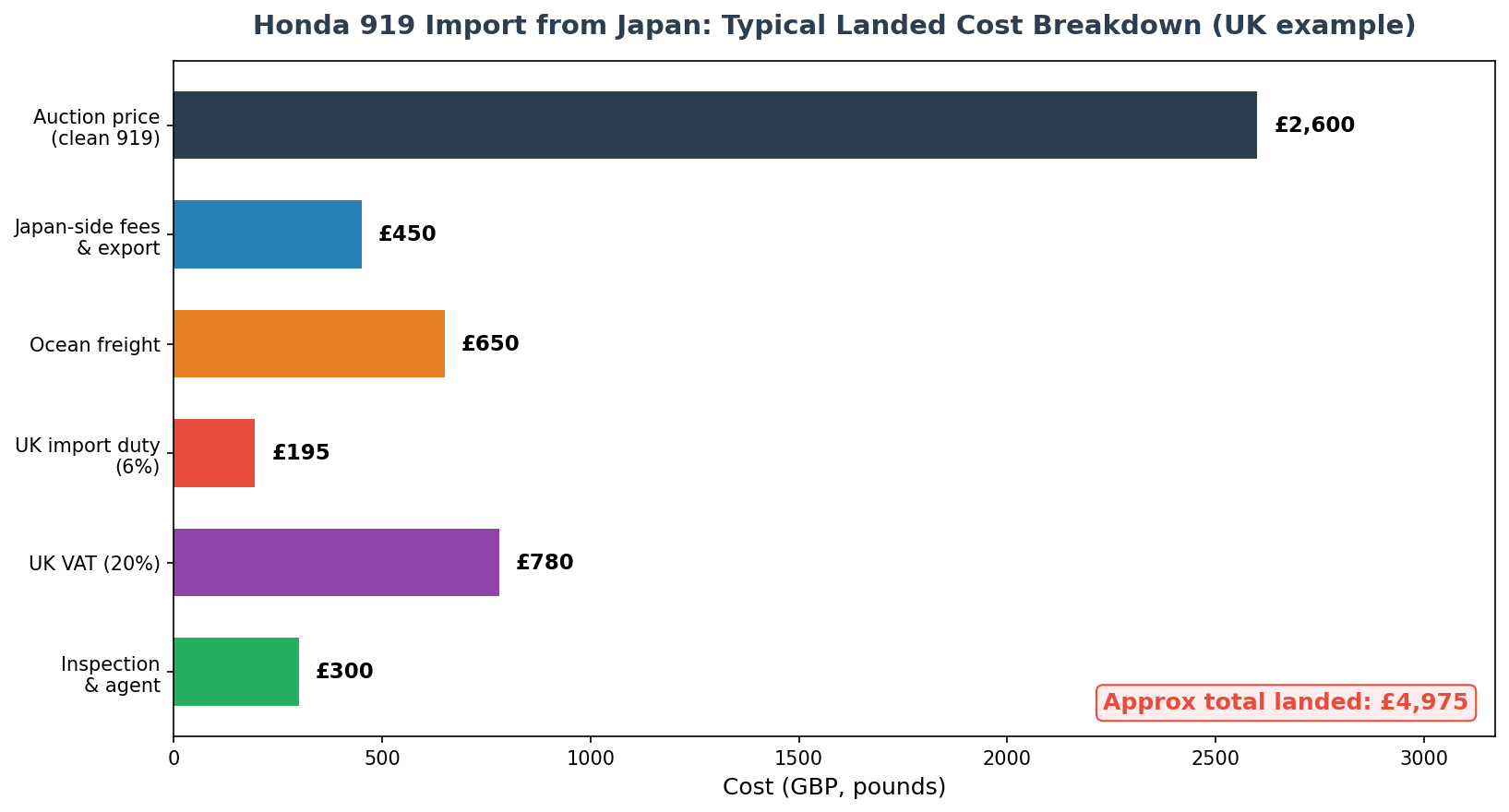
In this UK example, a roughly 2,600-pound auction bike lands at around 4,975 pounds all-in once you add export handling, freight, the 6 percent motorcycle import duty, 20 percent VAT, and inspection and agent fees. That is not pocket change, but for a clean, low-mileage Fireblade-engined naked with honest history, it is competitive with buying a tired local bike and then pouring money into fixing everything the previous owner ignored.
The single biggest variable is your destination country's taxes, so here is a rough comparison of all-in landed cost across the main English-speaking markets.
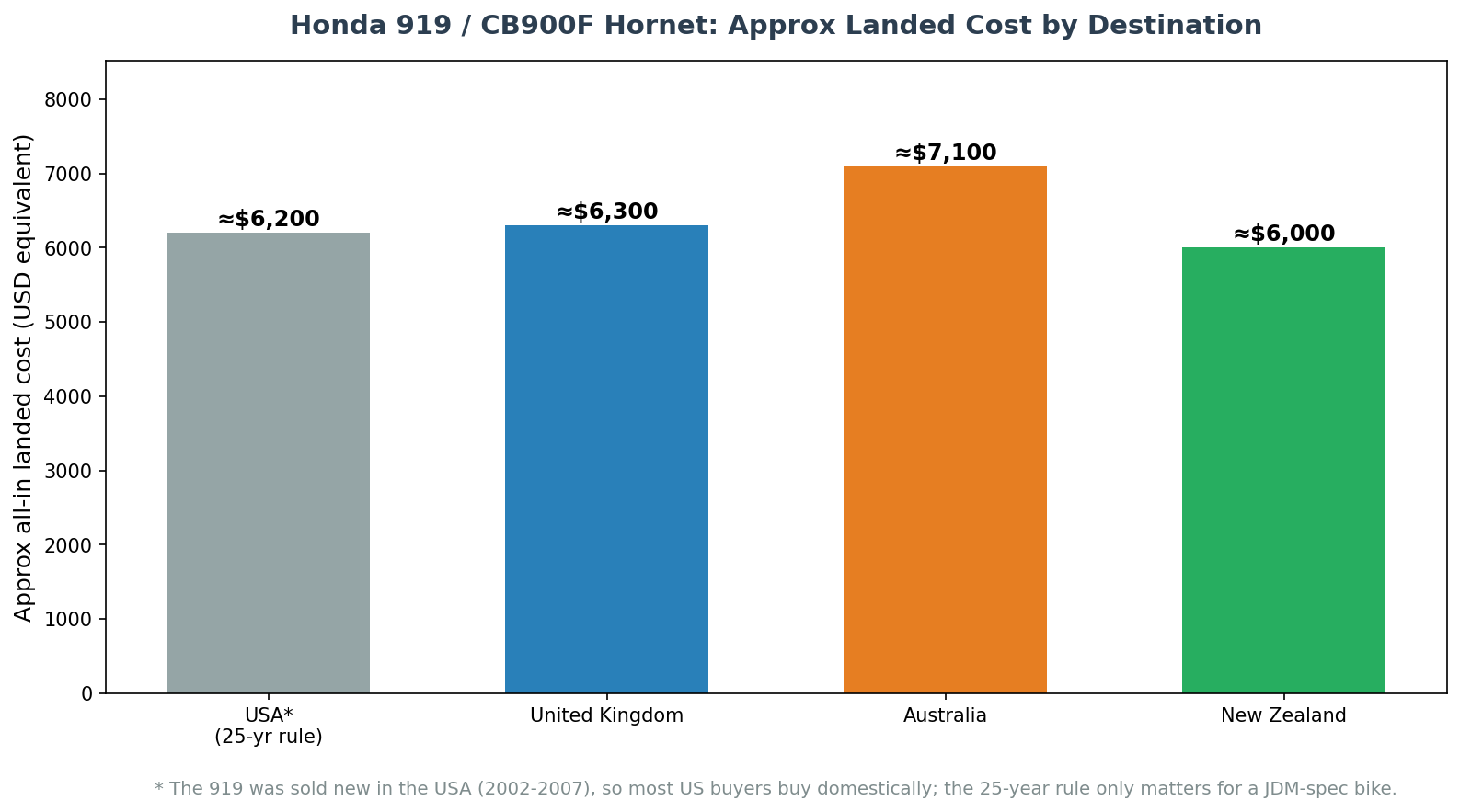
Australia tends to land highest once you factor in GST, the import approval process, and any compliance work, while New Zealand is often the friendliest of the four for a private motorcycle import. The UK sits in the middle thanks to the combination of duty and VAT. These figures are ballpark, not quotes, and exchange rates move, so always get a current all-in estimate before you bid. Our team can give you a landed-cost figure for your exact country before you commit a single dollar.
Import Rules and the 25-Year Question
The rules that decide whether you can register your 919 depend entirely on where you live. This is the part people skip and then regret, so read it carefully.
United States. Here is the wrinkle: the 919 was sold new in the US from 2002 to 2007, so most American buyers simply buy domestically and skip importing altogether. If you specifically want a JDM-spec Hornet 900, the federal 25-year rule applies. Any vehicle not originally sold in the US must be at least 25 years old to be imported without meeting FMVSS and EPA conformity. That clock means a 2002 JDM bike becomes freely importable in 2027, a 2003 in 2028, and so on. In practice, because a US-market 919 already exists, importing an under-25-year JDM example is rarely worth the hassle for Americans. Buy the domestic 919 unless you have a very specific reason.
United Kingdom. No age barrier. You can import a 919 of any year, pay the 6 percent duty and 20 percent VAT on the landed value, get it through the registration and testing process, and ride. The UK is one of the most import-friendly markets for Japanese bikes, which is why so many JDM machines end up on British roads.
Australia. Australia allows road-bike imports but the process is more involved, requiring import approval before the bike arrives and, depending on the pathway, some compliance work. Motorcycles over 25 years old have their own simplified pathway. Budget more time and money here than in the UK or New Zealand, and confirm the current rules before you buy, because Australia's import framework has changed in recent years.
New Zealand. Generally the most straightforward of the four for a used motorcycle, with a well-trodden path for Japanese imports and a compliance and certification process that dealers and agents handle routinely. This is why New Zealand roads are full of JDM machinery.
Whatever your country, the golden rule is the same: confirm eligibility and total cost before you place a bid, not after the bike is on a boat. An import you cannot register is an expensive ornament.
Who Should Buy a Honda 919 (and Who Should Not)
The 919 is a fantastic bike for the right rider, but it is not for everyone. Be honest with yourself here.
Buy one if you want a reliable, characterful, torquey naked that will commute, tour lightly, and carve a back road without drama or a dealer on speed-dial. Buy one if you value Honda build quality, if you like the idea of a Fireblade engine you can actually use on the street, and if you want a modern classic that is still cheap to own. Buy one if you are the sort of rider who does the maintenance and just wants the bike to work. As one owner said of his high-mileage example, he serviced it himself, never saw a dealer, and it just kept going.
Think twice if you are a brand-new rider. With 109 hp, no ABS, and no traction control, the 919 is emphatically not a beginner bike. Multiple experienced owners say exactly that in the reviews: "It's a good example of what is not a beginner bike." The power is accessible and friendly by big-naked standards, but it is still a litre-class machine that will punish carelessness. If it is your first bike, start smaller and graduate to the 919 when your right wrist has learned some manners.
Also think twice if you demand modern electronics, a fairing for motorway wind protection, or long-legged touring comfort. The 919 is a naked standard, honest and analogue. That is the appeal for its fans and the dealbreaker for everyone else. Know which camp you are in.
Common Mistakes When Importing a 919
After years of watching buyers import Japanese bikes, the same avoidable errors come up again and again. Here is how not to be that person.
Bidding without reading the auction sheet. The graded inspection sheet is the single most valuable document in the entire process. It tells you the real condition, the mileage authenticity, the rust, the damage history, and the mechanical notes. Skipping it, or not understanding it, is how people end up with a bike that looked great in photos and turned out to be a rust bucket. If you cannot read the sheet, get help from someone who can.
Ignoring the wear items. A 919 is only as good as its maintenance. Cam chain tensioner, reg/rec, chain and sprockets, fork oil, brake fluid, and tyres all have a service life. Factor a few hundred dollars of freshening into every purchase and you will never be disappointed.
Underestimating the total cost. The auction price is the start, not the finish. Buyers who only budget for the bike itself get a nasty shock when the duty, tax, and freight invoices land. Always work backwards from your all-in landed budget.
Chasing the wrong badge. Do not pay a premium because a seller frames a Hornet 900 as somehow rarer or better than a 919. It is the same bike. Pay for condition and history, full stop.
Rushing. Good auction bikes come up constantly. If a particular lot has a poor grade or a suspicious sheet, let it go and wait for a clean one. Patience is free; a bad import is not.
How AWA Auction Helps You Import the Right 919
This is where working with people who live inside the Japanese auction system pays off. AWA Auction gives you direct access to the same graded auction stock the domestic dealers bid on, with the inspection sheets translated and explained so you know exactly what you are buying before you commit. We check the grade, flag the rust, verify the mileage story, and give you an honest all-in landed cost for your country, so there are no surprises when the bike reaches your driveway.
Whether you want the cheapest running early 919, the value-sweet-spot 2004 to 2005, or a mint late Hornet 900 with the lowest mileage on the market, the right bike is out there in Japan right now. The trick is buying it with your eyes open. Browse the current listings, tell us the exact 919 you are after, and we will help you land it properly graded, properly costed, and properly yours.
Reading a Japanese Auction Sheet for a 919
Every bike sold through a Japanese auction comes with an inspection sheet graded by an independent inspector, and learning to read it is the difference between a great import and an expensive mistake. The overall grade is a single number that summarises condition: grades of 4 and above generally mean a clean, well-kept bike, grade 3 is average with some wear or age, and anything below that signals significant issues or repairs. For a 919 you are ideally hunting a 3.5 or 4-plus with an honest mileage story.
Beyond the headline grade, the sheet carries a condition map with coded notes about scratches, dents, rust, and repairs, plus the inspector's comments. For a bike this age, a little cosmetic wear is normal and honest; what you are watching for is frame damage, accident repair, heavy corrosion, or notes that contradict the photos. The mileage is also verified on the sheet, which matters because a genuine 30,000 km JDM 919 with dealer history is worth chasing, while an unverified odometer reading is a gamble.
Here is the practical part: most first-time importers cannot read these sheets, because they are written in Japanese shorthand. That is precisely the service a good import partner provides. Before you bid, you should have the grade, the mileage verification, and the inspector's notes translated into plain English so you know the bike's real story. Bidding blind on a sheet you cannot read is the number-one way people get burned, and it is entirely avoidable.
Owning a 919: Running Costs and Maintenance
Part of the 919's appeal is how cheap it is to live with once it is in your garage. This is not an exotic machine with exotic bills. It is a Honda four with two decades of proven parts supply and a huge community of owners who have documented every job.
Routine servicing is straightforward: oil and filter changes every few thousand miles, valve clearance checks at the longer intervals (the shim-and-bucket setup rarely needs adjustment, another Honda blessing), and the usual chain, sprocket, brake, and tyre wear items. The fuel injection means no carburettors to balance and no cold-start fussing, which is one practical advantage of the 900 over some carburetted rivals of the era. Fuel economy is reasonable for a litre four ridden sensibly, and the 19-litre tank gives a genuinely useful touring range.
The parts situation is healthy. Consumables and common wear items are cheap and widely stocked, and the shared Fireblade engine internals mean plenty of components cross over. The known weak points, the cam chain tensioner and the reg/rec, both have cheap, well-proven aftermarket fixes. Factor in an annual budget for tyres and consumables and the odd bigger job, and a 919 is one of the most affordable big bikes you can run. That combination of Honda reliability, low running costs, and a genuine superbike engine is exactly why owners hang on to them for years, and why a clean imported example is money well spent.
The 919 in Context: A Modern Classic in the Making
Step back for a moment and the 919 makes even more sense. It arrived in 2002 as the big brother to the wildly popular CB600F Hornet, taking the same friendly-naked recipe and supersizing it with a real superbike engine. It never sold in the numbers of its rivals, partly because it was understated in a market that rewarded flash, and partly because Honda never marketed it hard. That modest sales record is now working in the buyer's favour: these are still cheap, still plentiful in Japan, and increasingly appreciated by riders who have owned everything and come back to the honest ones.
There is a pattern with bikes like this. The unglamorous, over-engineered Hondas that nobody wanted new become the quietly treasured classics a generation later, precisely because they were built properly and refused to break. The 919 is on that trajectory. It has a devoted following out of all proportion to its sales, a genuine Fireblade engine, and the sort of do-anything usability that never goes out of style. Values for clean, low-mileage examples have already firmed up, and the best Japanese-market bikes are exactly the ones collectors and enthusiasts will chase in five years. Buying a well-graded JDM 919 now, while they are still affordable, is as much a smart move as a fun one. You get a brilliant motorcycle to ride today and a modern classic that is only getting harder to find in this condition.
See Also
Share this article: