
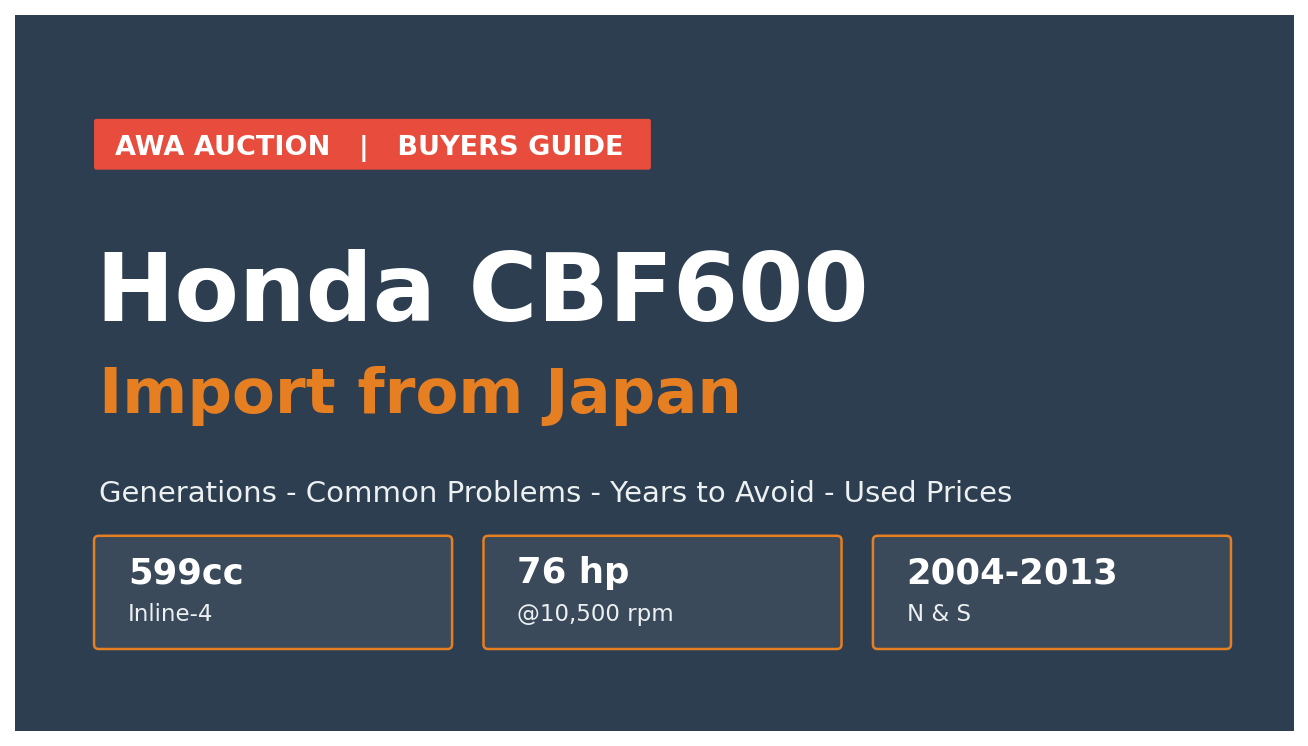
If you want to import a Honda CBF600 from Japan, you are looking at one of the most sensible middleweights Honda ever built: a 599cc inline-four wrapped in friendly, upright bodywork, cheap to run, easy to ride, and almost impossible to break. It is the bike your riding instructor secretly recommends and your bank manager quietly approves of. Nobody ever bragged about owning a CBF600. Plenty of people quietly clocked up 60,000 trouble-free miles on one.
Here is the thing nobody spells out in the shiny brochures. Honda did not design the CBF600 to thrill you. They designed it to never let you down, to carry a passenger and luggage without complaint, and to shrug off British winters and Japanese commutes alike. That is exactly why it makes such a smart used buy — and why a clean, low-mileage example from Japan can be a genuine bargain.
This guide covers everything: the two generations, the difference between the naked N and the half-faired S, the common problems, the years to avoid, real used prices, and the honest truth about whether importing one from Japan actually makes sense for you. Let's get into it.
What is the Honda CBF600?
The Honda CBF600 is a middleweight all-rounder built from 2004 to 2013. Think of it as the practical cousin of the flashier CBR600 and the naked Hornet. Same family, same 599cc four-cylinder heart, but a completely different mission. Where the CBR600RR wants a racetrack, the CBF600 wants a commute, a weekend tour, and a trip to the shops — all in the same day, without drama.
Honda built it for a specific reason. The old CB500 twin no longer met European emissions rules, and Honda needed a friendly, upright middleweight to slot in below the sportier machines. So they took the proven Hornet 600 engine, softened it, and dressed it in bodywork designed to reassure rather than intimidate. The result was aimed squarely at returning riders, newer riders stepping up from a 500, and anyone who wanted a big-bike badge without a big-bike attitude.
The clever party trick is the adjustable ergonomics. The seat moves through three height positions, and on the faired S model the screen adjusts too. That means a 5-foot-4 rider and a 6-foot-2 rider can both get comfortable on the same bike. Very few motorcycles offer that, and it is a big part of why the CBF600 became a favourite of riding schools and rental fleets across Europe and Asia.
Ride one and the character is obvious within a mile. The riding position is upright and roomy. The mirrors actually work. The fuelling is smooth. It is the two-wheeled equivalent of a well-sorted family hatchback — and honestly, that is a compliment when you are spending your own money on something that has to start every single morning.
CBF600N vs CBF600S: naked or half-faired?
Every CBF600 came in one of two flavours, and picking the right one matters more than most buyers realise. The CBF600N is the naked version, with an exposed headlight and no wind protection. The CBF600S is the half-faired version, with a small front fairing, a headlight cowl, and an adjustable screen.
On paper they are mechanically identical — same engine, same frame, same brakes. The only real difference is that fairing. But on a bike you will actually tour or commute on, that fairing changes everything. At motorway speeds the S keeps the windblast off your chest and neck, which turns a tiring two-hour slog into a relaxed one. The N looks a touch cleaner and cooler around town, but you pay for that style with a sore neck on long runs.
Here is the honest steer: if you plan to ride mostly in town and short hops, the N is fine and often a little cheaper. If you plan to do any distance, motorway miles, or two-up touring, buy the S. Most buyers who tour end up wanting the S, which is exactly why faired examples hold their value slightly better on the used market.
One quirk to know when importing from Japan: the naked and faired versions were both sold in various markets, so you will see both on the auction sheets. Confirm which one you are bidding on from the photos and the model code, because a grainy listing photo of a naked bike is easy to mistake for a stripped faired one.
Honda CBF600 generations explained: 2004-2007 vs 2008-2013
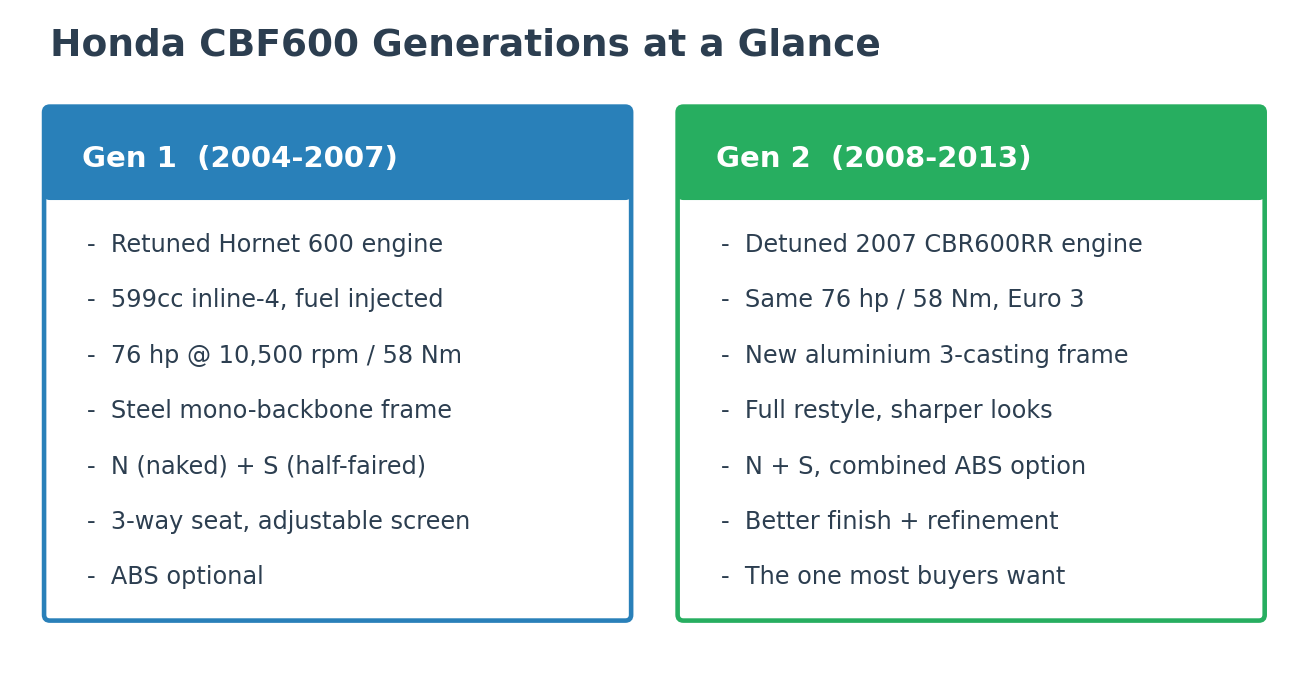
There are two clear generations of CBF600, and knowing which is which will save you money and disappointment.
Generation 1 (2004-2007) used a retuned version of the Hornet 600 engine — the same 599cc inline-four, softened for smoother low-down manners and better economy. It was fuel-injected from the start, which is a real plus over the carburetted middleweights of the same era. The frame was a steel mono-backbone design shared in concept with the Hornet. This generation introduced the three-position seat and the naked/faired split. ABS was an option. It is a solid, honest bike, and it is the cheaper way into CBF600 ownership.
Generation 2 (2008-2013) looked similar but was almost a new bike underneath. Honda swapped in a detuned version of the 2007 CBR600RR engine, still making the same 76 horsepower but with cleaner Euro 3 emissions and slightly smoother delivery. More importantly, the frame changed from steel to aluminium — three large castings welded together — which sharpened the handling and lifted the whole bike a class in feel and finish. The styling was updated, the combined ABS braking system was refined, and the overall quality took a noticeable step up.
If your budget stretches to it, the Gen 2 is the one most buyers want, and for good reason. It feels more modern, it is better finished, and the aluminium-framed chassis is genuinely nicer to ride quickly. But do not dismiss a clean Gen 1 — it does the same job for less money, and the older bikes are getting cheap enough to be almost disposable in the best possible way.
What 76 horses actually feel like: the engine and specs
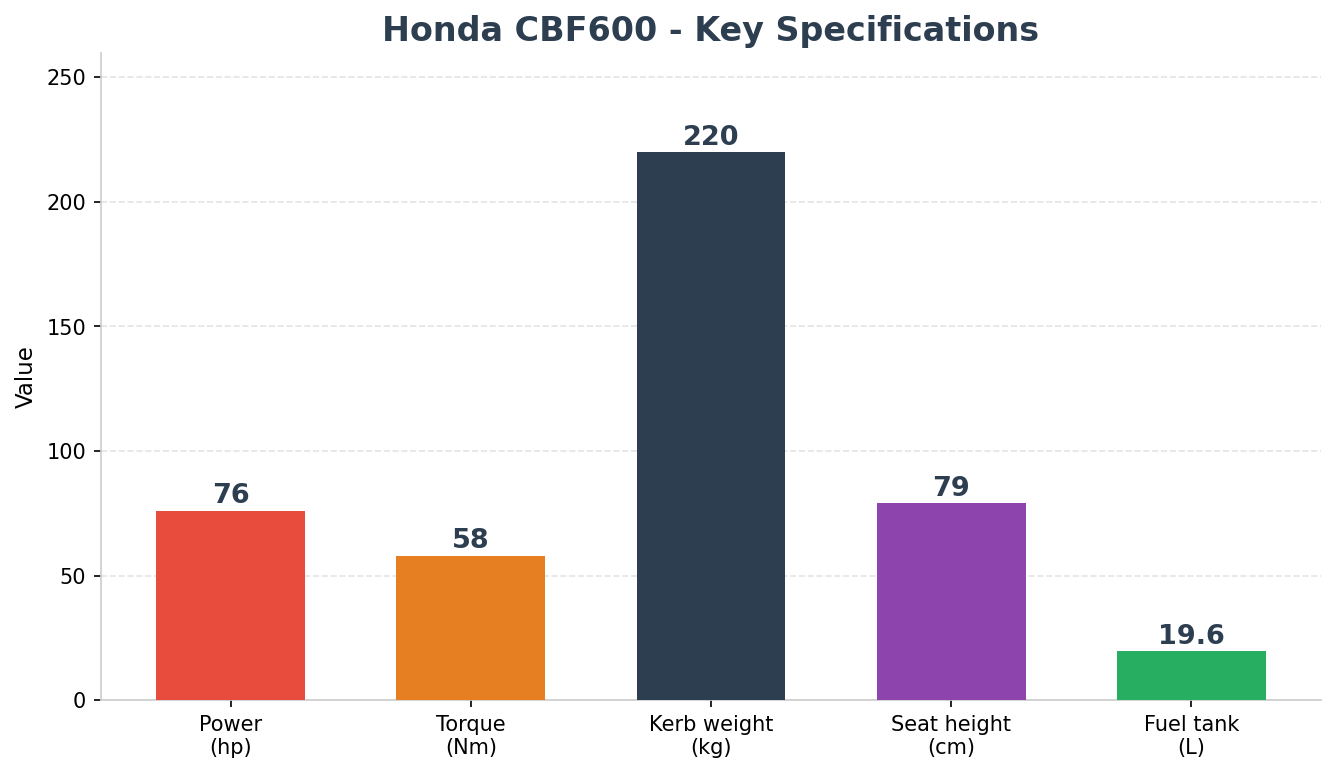
Let's talk about the honest headline number: 76 horsepower at 10,500 rpm, and 58 Nm of torque at 8,000 rpm. On a full-fat CBR600 those figures would embarrass you. On the CBF600 they are exactly right. One of the most-watched CBF600 reviews online is literally titled "where did Honda hide the horses?" — and that is the point. Honda took a screaming sportbike engine and taught it manners.
The engine is the same 599cc DOHC 16-valve inline-four you find across the middleweight Honda range, but the CBF version is tuned for the real world. Peak power arrives high, but there is usable, friendly torque from low revs, so you are not forced to thrash it to make progress. Around town it pulls cleanly from 3,000 rpm. On the motorway it will sit at 80 mph all day with plenty in reserve. Top speed is comfortably over 120 mph, which is far more than anyone sensible needs on the road.
At roughly 220 kg fully fuelled it is no featherweight, but the low-ish seat and neutral balance hide the mass well. The 19.6-litre tank gives a genuine 150-plus-mile range between stops, and mid-40s mpg is easy to achieve. That combination — smooth four-cylinder power, real range, and low running costs — is why so many high-mileage examples exist. People simply ride these bikes and keep riding them.
The gearbox is typical Honda: light, precise, and forgiving. The brakes are more than adequate, and the optional combined ABS is worth seeking out for winter riding. This is not a bike that will scare you. It is a bike that quietly gets on with the job while you enjoy the ride.
Honda CBF600 common problems and what to check
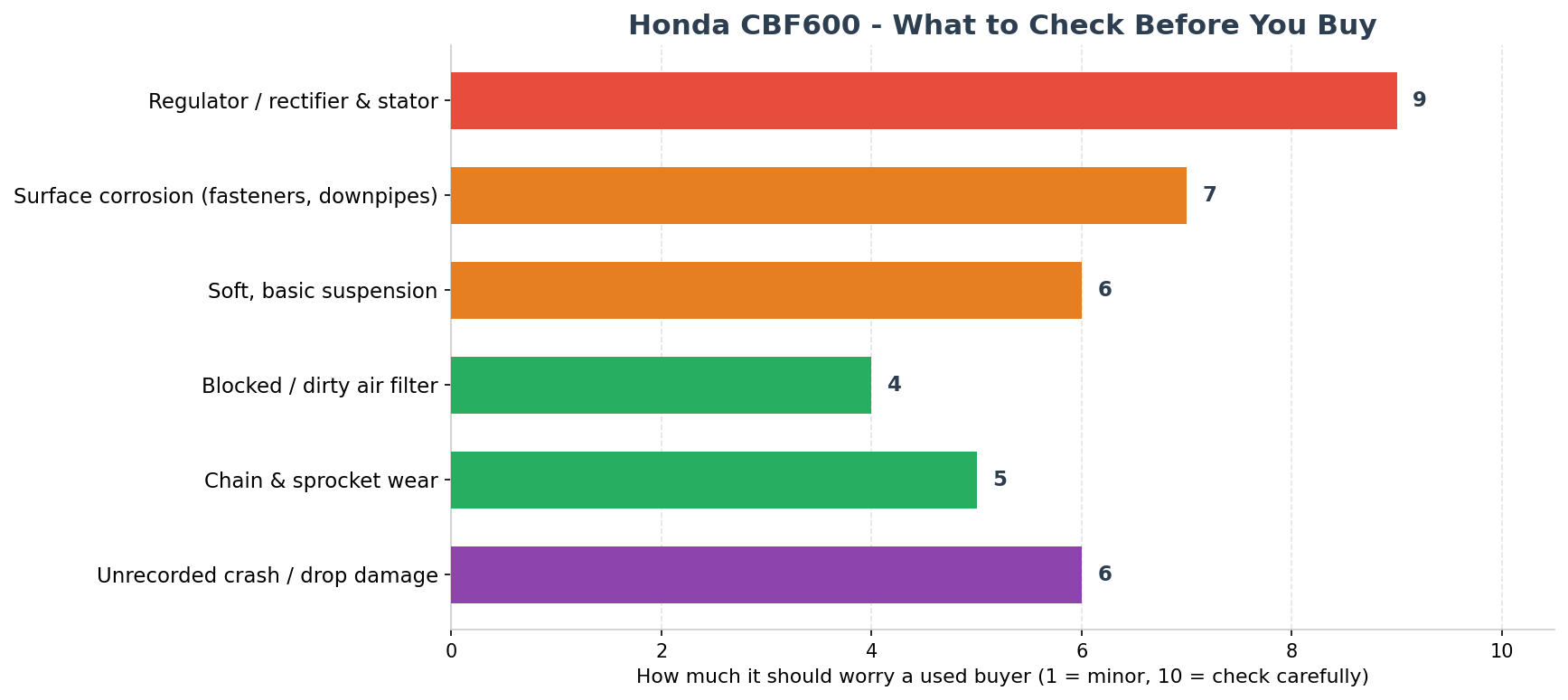
The CBF600 is one of the most reliable middleweights you can buy, but no used bike is perfect. Here is what to actually check, ranked by how much it should worry you.
Regulator/rectifier and stator. This is the big one, and it is shared across the Honda 600 four-cylinder family. Early bikes in this engine family are known for charging-system faults. A failing regulator/rectifier shows up as dimming lights, flickering or erratic meter readings, hard starting, or — in the overcharge failure mode — bulbs that blow at random. Before you buy, put a multimeter across the battery: around 12.5 volts at rest, rising to roughly 14 volts at revs. If it overshoots or stays flat, walk away or budget for the fix. The reassuring part is that this is a cheap, well-understood repair with plenty of upgraded aftermarket parts available.
Surface corrosion. These were affordable bikes, often ridden year-round, so fasteners, downpipes, and fork lowers can look tired. Cosmetic rust is not a dealbreaker, but it is a great bargaining chip — and a bike that has been kept clean tells you a lot about how the rest of it was treated.
Soft, basic suspension. The CBF600 was built to a price, and the suspension is on the basic side. Worn or leaking forks and a tired rear shock are common on high-mileage bikes. Fresh fork oil and a decent rear shock transform the ride, so factor that into your plans if the bike feels vague.
Beyond those, the usual used-bike checks apply: a clean, dirt-free air filter (these share filters across the CB600/CBF600/CBR600 range, so parts are everywhere), chain and sprocket condition, and any sign of unrecorded crash or drop damage. Check the bar ends, lever tips, and fairing edges. A straight, honest CBF600 with a stack of service history is worth paying a premium for.
Honda CBF600 years to avoid, and the best years to buy
Good news: there are no truly disastrous CBF600 years. This is a Honda that was built properly for its entire run. But some years are smarter buys than others.
The earliest 2004-2005 Gen 1 bikes are now the cheapest way in, and they are perfectly good, but they are also the most likely to have a tired charging system and cosmetically rough finish simply because of age. Buy one with eyes open and a multimeter in your pocket, and you can grab a genuine bargain.
The sweet spot for most buyers is a late Gen 2, from roughly 2010 to 2013, ideally with the combined ABS. By this point Honda had ironed out any early niggles, the aluminium-framed chassis was fully sorted, and the finish quality was at its best. These bikes are recent enough to feel modern but old enough to be cheap — the classic used-bike value window.
Whichever year you choose, history matters more than the number on the plate. A well-serviced 2006 with a folder full of receipts will outlast a neglected 2013 every time. Mileage on these engines is almost irrelevant within reason — a CBF600 with 50,000 miles and good history is barely run in. Chase condition and paperwork, not the youngest registration you can afford.
If you are importing from Japan, you have a real advantage here: Japanese-market bikes are often astonishingly clean, low-mileage, and rust-free thanks to the way they are stored and maintained. That is a big part of the appeal of buying at auction rather than settling for a tired domestic example.
What a used CBF600 costs, and what importing adds
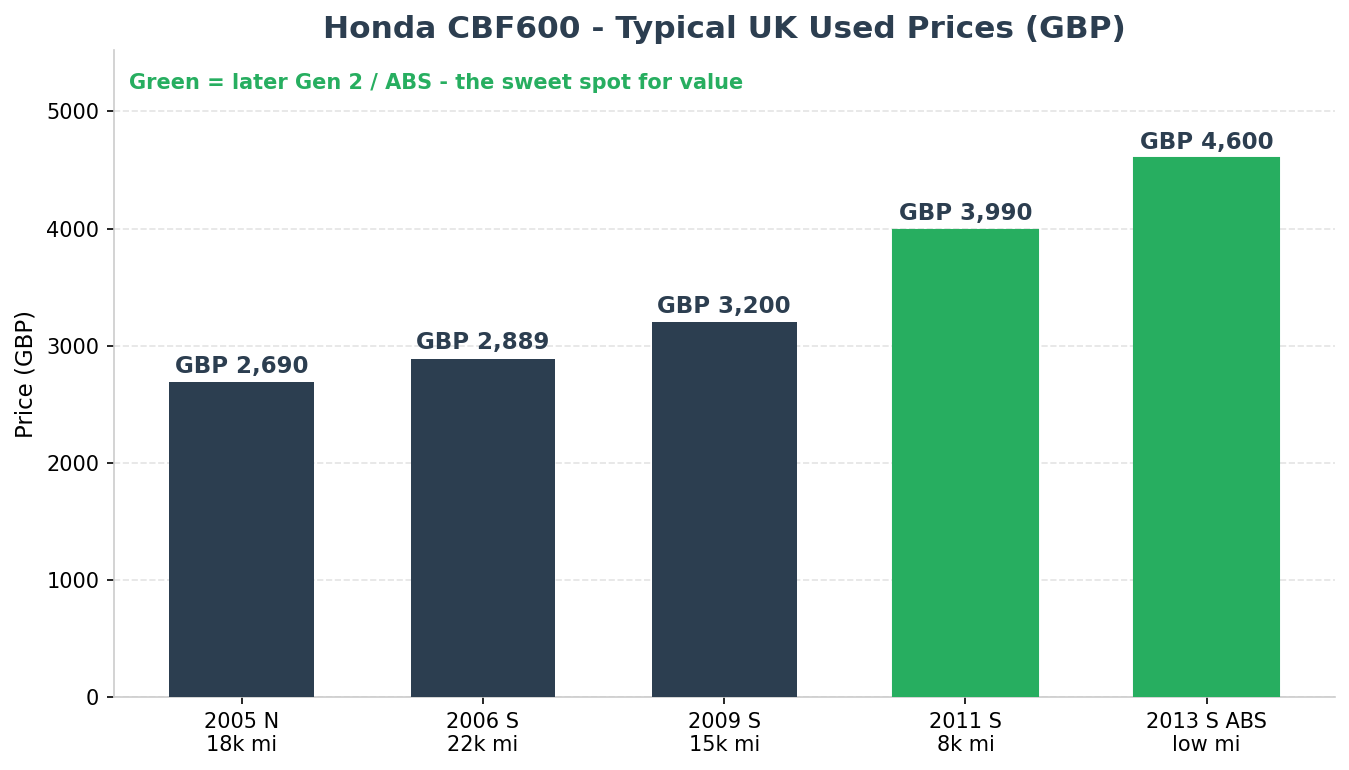
Used CBF600 prices are refreshingly sane. In the UK, an early 2005 naked example with around 18,000 miles sits near GBP 2,690. A 2006 faired S with higher miles is about GBP 2,889. A tidy 2009 S runs around GBP 3,200, a low-mileage 2011 S about GBP 3,990, and a clean late 2013 S with ABS and low miles pushes toward GBP 4,600. In short, you are looking at roughly GBP 2,000 to 4,600 depending on year, model, mileage, and condition.
So where does importing from Japan fit in? On top of the auction price, a realistic budget for shipping, agent fees, duty, VAT, and UK registration is around GBP 1,500 to 2,500. Shipping alone runs about GBP 500 plus port handling, agent or broker fees are typically GBP 200 to 500, and export preparation in Japan adds another GBP 100 to 250.
The tax side depends on age. For a bike under 30 years old — which every CBF600 currently is — expect 20 percent VAT plus 6 to 8 percent import duty. Once a bike passes the 30-year mark it becomes a "historic vehicle" under HMRC rules, dropping to zero duty and a reduced 5 percent VAT. No CBF600 qualifies for that yet, so budget for the full rate today.
The maths only makes sense if you find the right bike. Importing a scruffy CBF600 you could buy down the road is pointless. Importing a genuinely low-mileage, corrosion-free, well-documented Japanese example that simply does not exist in your home market — that is where the value lives. Browse current listings to see what is coming through the auctions right now.
Is the CBF600 actually worth importing from Japan?
Time for some honesty, because we would rather you make a smart decision than an expensive one.
The CBF600 was primarily a European-market bike, so plenty of used examples already exist in the UK, Australia, and New Zealand. If you just want any CBF600, buying locally is quicker and simpler. Nobody should import an average bike from the other side of the world.
The case for importing is condition. Japan's used bikes are frequently kept in remarkable order, with low mileage, full histories, and none of the road-salt corrosion that eats British and Kiwi bikes alive. If you want the cleanest CBF600 on the planet — the one that looks like it rolled out of the showroom last week — Japan is where you find it. For a bike whose main weakness is cosmetic wear and charging-system age, starting with a pristine, low-mileage example is a genuinely clever move.
A word for US readers: the CBF600 was never officially sold in the United States, and because the model only started in 2004, it does not yet qualify under the 25-year import rule for road registration. That means US buyers cannot legally register a road-going CBF600 imported from Japan until the relevant model year turns 25 — 2029 at the earliest for the first bikes. We would rather tell you that up front than watch you buy a bike you cannot ride.
For UK, Australian, and New Zealand riders, though, there is no such barrier. The paperwork is well-trodden, the bikes are affordable, and a clean Japanese import can be the best CBF600 you will ever find. If you are unsure whether your target bike is worth importing, talk to our team before you bid.
How to import a Honda CBF600 from Japan, step by step
Importing sounds intimidating until you see it broken down. Here is the honest sequence.
Step 1: Set your real budget. Add the likely auction price to the GBP 1,500 to 2,500 of import costs. Know your all-in ceiling before you get emotional about a listing.
Step 2: Work with an auction agent. You cannot bid at Japanese motorcycle auctions directly. An agent gives you access to houses like BDS and USS, translates the all-important auction sheet, and bids on your behalf. This is where a trustworthy partner earns their fee.
Step 3: Read the auction grade. Every bike gets a one-page condition report with a grade — S, 6, 5, 4.5, 4, 3.5, 3, 2, 1, and R for repaired. Grade 4 and above is the sweet spot: honest, clean bikes with no nasty surprises. The sheet also flags rust, dents, and modifications, so it is your single most valuable document.
Step 4: Win the bid and pay. Your agent bids to your limit. Win it, settle the invoice, and the bike moves to the export process.
Step 5: Export and ship. The bike is deregistered in Japan, an export certificate is issued, and it is crated and loaded — usually by container or roll-on roll-off vessel. Sea freight to the UK takes several weeks.
Step 6: Clear customs and register. On arrival you pay the VAT and duty, complete the registration and any inspection your country requires, and the bike becomes road-legal. Then you go ride it.
None of these steps is difficult on its own. The value of a good auction partner is that they handle the hard parts — the bidding, the translation, and the export paperwork — so you are not learning Japanese customs law at midnight.
Honda CBF600 vs its rivals: GSX650F, ER-6f, Bandit 650, Fazer 600
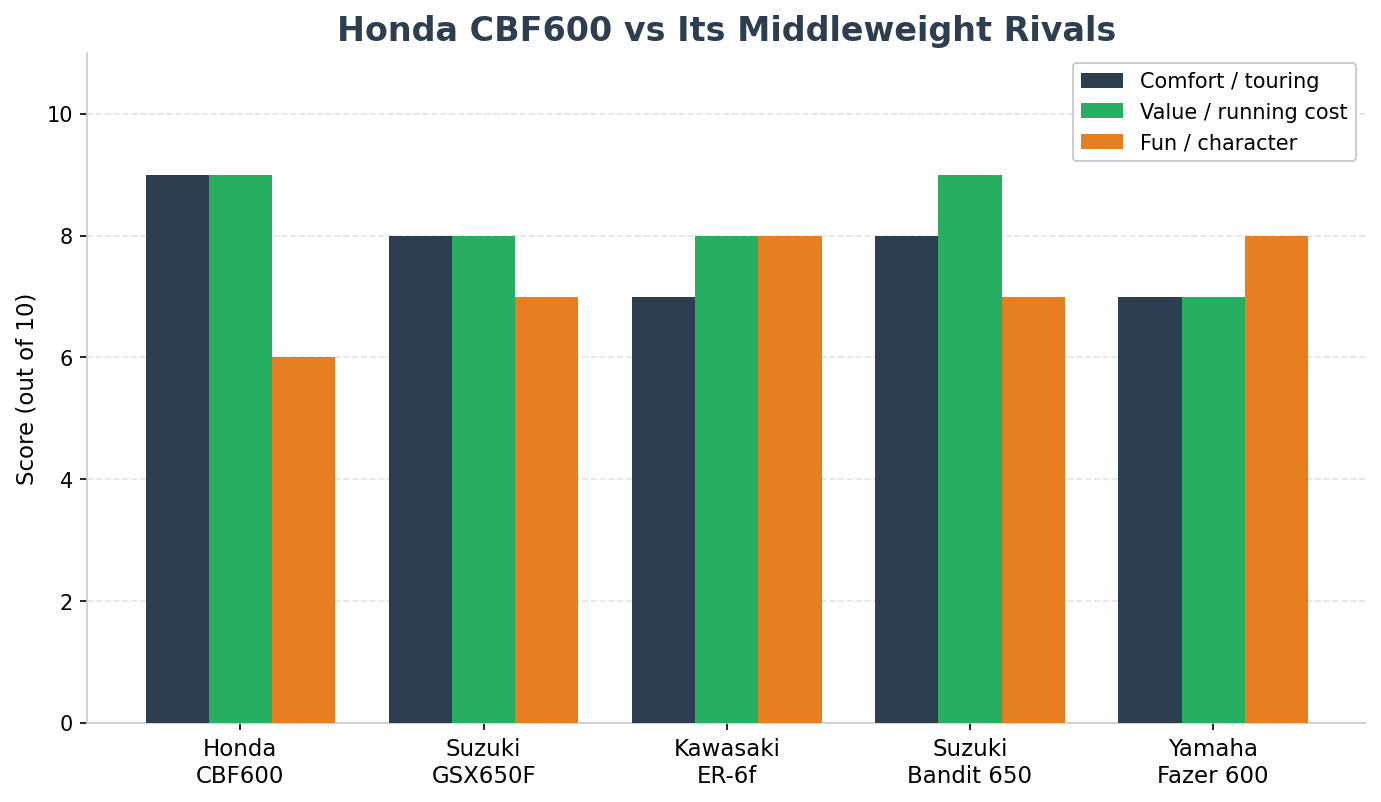
The CBF600 never rode alone. The middleweight all-rounder class was crowded, and one of the most-watched comparison videos of the era put the CBF600S head to head with the Suzuki GSX650F and the Kawasaki ER-6f. Here is how the field stacks up.
The Suzuki GSX650F is the closest rival in spirit — a faired, sensible four-cylinder all-rounder with a bit more low-down grunt from its bigger 656cc engine. It is a touch heavier and less refined than the Honda, but strong value.
The Kawasaki ER-6f takes a different route with a punchy 649cc parallel-twin. It is lighter and more characterful than the CBF600, with a torquier, more entertaining engine, but it lacks the silky top-end rush of the Honda's four and the same sense of unburstable quality.
The Suzuki Bandit 650 is the value king — cheap, tough, and endlessly practical, with a big following and cheap parts. It trades a little polish for a lot of budget appeal.
The Yamaha Fazer 600 (FZ6) is the sportiest of the bunch, with an R6-derived engine that loves revs. It is more fun and more urgent than the CBF600, at the cost of a slightly firmer, less forgiving nature.
Where does the Honda win? Comfort, refinement, and that bulletproof Honda reliability. Where does it lose? Outright character and fun — the CBF600 is the sensible one, and it knows it. If your priority is a bike that just works, year after year, the CBF600 is hard to beat. If you want thrills, look at the Fazer or the ER-6f. You can compare real examples of all of these across our auction listings.
Living with a CBF600: what owners actually say
Spend time in CBF600 owner communities and a clear picture emerges. These riders are not shouting about lap times. They are quietly racking up big miles and reporting almost nothing going wrong.
One of the recurring themes in owner reviews — including the popular budget-bike round-ups that regularly feature the CBF600 among the best used buys under a couple of thousand pounds — is just how little these bikes cost to keep on the road. Owners talk about oil and filter changes done once a year, chains that last, and engines that simply refuse to wear out. The CBF600 has become a fixture on "best cheap first big bike" lists for exactly this reason.
The most-watched CBF600 review online, with hundreds of thousands of views, frames the bike as the best budget road machine in its class, and the comment sections back it up. The common owner verdict: it is not exciting, but it is honest, comfortable, and utterly dependable. Several long-term owners specifically praise the adjustable seat and screen for finally letting them get comfortable after years of ill-fitting bikes.
The criticisms are consistent and minor. The suspension is basic. The looks are inoffensive rather than exciting. And yes, the charging system on the older bikes needs watching. But almost nobody regrets buying one, and a striking number of owners keep theirs for years and hand it down to family members learning to ride. That is about the highest praise a used motorcycle can earn.
Dig into the long-term ownership threads and the pattern repeats across countries and climates. Riders report engines shrugging off 40,000, 60,000, even 80,000 miles with nothing more than routine servicing. Commuters love the weather protection of the S and the sane fuel bills. Tourers praise the roomy ergonomics and the genuine two-up ability. Even the riders who eventually move to something faster tend to speak about their old CBF600 with real affection, the way you remember a dependable first car. It is not a bike that inspires poetry — it is a bike that inspires trust, and on a used purchase, trust is worth more than horsepower.
Is the Honda CBF600 a good first big bike?
Yes — and it is arguably the single best first big bike Honda ever made. Here is why.
The power delivery is smooth and predictable, so it will not spit you off when you get the throttle wrong. The seat drops low enough for shorter riders to get both feet down, which does more for confidence than any rider aid. The upright riding position is natural and unintimidating. And the reliability means a nervous new rider is not also fighting a temperamental machine.
At the same time, the CBF600 is a proper big bike, not a learner toy. It has enough performance to keep you interested for years, enough comfort to tour on, and enough capability to carry a passenger. Plenty of riders buy one as their first big bike and never feel the need to move on — it does everything, and it does it well.
If you are stepping up from a 125 or a smaller twin, the CBF600 is a gentle, forgiving, hugely capable next step. It will teach you good habits, cost you very little, and hold its value while you learn. That is a rare combination, and it is why this unassuming Honda deserves far more respect than it usually gets.
Your Honda CBF600 pre-purchase checklist
Before you commit — whether buying locally or importing from Japan — run through this list:
Charging system: multimeter across the battery, around 12.5 volts at rest and roughly 14 volts at revs. Watch for dimming lights or erratic readings.
Service history: a folder of receipts beats a low mileage number every time. Look for regular oil and filter changes and valve checks.
Corrosion: inspect fasteners, downpipes, fork lowers, and the underside. Surface rust is a bargaining chip, not necessarily a dealbreaker.
Suspension: check for leaking fork seals and a tired rear shock. Bounce the front end and feel for smooth, controlled damping.
Crash damage: check bar ends, lever tips, footpeg feelers, and fairing edges for scuffs. On imports, read the auction sheet for the repaired ("R") grade and any noted damage.
Consumables: chain, sprockets, tyres, brake pads, and discs. These are cheap on a CBF600, but they add up if everything needs doing at once.
Model and generation: confirm N or S, and Gen 1 or Gen 2, so you know exactly what you are paying for.
Tick those boxes and you will end up with a CBF600 that gives you years of cheap, reliable, comfortable riding.
How much does a Honda CBF600 cost to run?
This is where the CBF600 quietly wins your wallet over. Running one is about as cheap as big-bike ownership gets, and that low cost of ownership is a huge part of why so many high-mileage survivors are still on the road.
Fuel first. Ridden sensibly, the CBF600 returns mid-40s to low-50s mpg, and with the 19.6-litre tank that means a genuine 150 to 180 miles between fill-ups. Commute on one and it sips fuel like a much smaller bike while still cruising at motorway speeds without stress.
Servicing is straightforward and cheap. Oil and filter changes are a once-a-year job for most riders, valve clearance checks come around at long intervals, and because the engine is shared across the CB600, CBF600, and CBR600 range, consumables and parts are everywhere and priced to move. Chains, sprockets, pads, and filters all cost buttons. Even the one genuine weak point — the regulator/rectifier — is a cheap, well-documented fix with plenty of upgraded aftermarket options.
Insurance sits in a friendly bracket too, especially for the naked N, and depreciation has already flattened out on these bikes, so a well-bought CBF600 loses almost nothing while you own it. Tyres last, brakes last, and the bulletproof engine simply keeps going. Add it all up and the CBF600 is one of the cheapest ways to own a comfortable, capable four-cylinder motorcycle. If you want a rough running-cost estimate for a specific import, our team can walk you through the numbers before you bid.
How AWA Auction helps you import a Honda CBF600
Finding a genuinely clean, low-mileage CBF600 in Japan is the hard part. Bidding on it from another country, reading the auction sheet, and getting it home in one piece is where most private buyers get stuck. That is exactly what we do.
AWA Auction gives you direct access to Japan's major motorcycle auctions, honest translation of every auction grade and condition report, and a straightforward path from winning bid to your driveway. We help you avoid the tired bikes, target the pristine ones, and understand your all-in cost before you commit a single pound.
If a clean Japanese CBF600 is on your list, start by browsing what is available now, and reach out with the specific model and generation you are after. We will tell you honestly whether importing makes sense for your situation — and if it does, we will help you land the best one.
See Also
Share this article: