
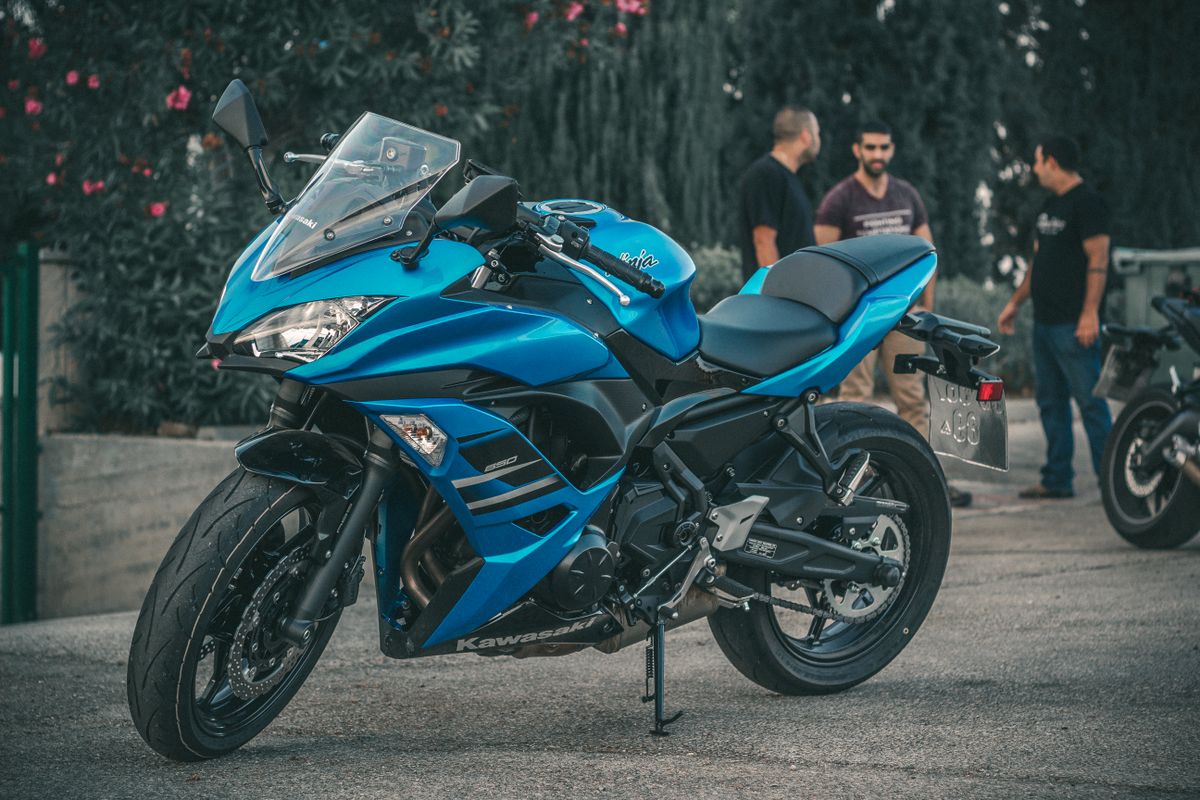
The Honda CBR1000RR has been the bike that quietly outsold the drama for two decades. While its rivals chased headline horsepower and electronic gimmicks, the Fireblade kept doing the thing nobody else could: making a litre superbike that a normal human can actually ride fast. And here's the part most riders in the US, UK, and Australia never figure out — the cleanest, lowest-mileage, most honest examples of every CBR1000RR generation are sitting in Japan right now, waiting to be bought for less than a tired local example costs.
This guide covers everything you need to import a Honda CBR1000RR from Japan in 2026: which generation to chase (SC57, SC59, SC77, or the RR-R), the domestic-spec versus reverse-import trap that catches first-time buyers, what one really costs landed on your driveway, the import rules for your country, and the auction-sheet red flags that separate a gem from a money pit.
We pulled the numbers and the field intel from Japanese auction data, export-spec build records, and the people who actually do this — including the Japanese owners and tuners on YouTube who document exactly what a "逆車" (reverse-import) SC57 looks like next to a domestic one. Let's get into it.
Why the CBR1000RR Is Worth Importing From Japan
Start with the obvious: Japan built these bikes, sold most of them at home, and treats them better than almost anywhere on earth. The domestic market is enormous, the climate in much of the country is mild, and a huge share of sport bikes there are weekend toys that live in a garage and get washed more often than they get ridden hard.
That means the supply of genuinely clean CBR1000RRs in Japan dwarfs what's left in Western classifieds, where a 2008 literbike has usually been through three owners, two track days, and one optimistic "minor cosmetic damage" eBay listing.
Then there's the auction system. Roughly 30,000 to 50,000 used motorcycles move through Japanese auction houses every week, each one graded by a neutral inspector who has zero incentive to flatter the bike. You get a one-page sheet that tells you the truth about a machine you've never seen in person. Try getting that from a guy named Dave on Facebook Marketplace.
Add a weak yen, a deep model catalogue, and the fact that Honda sold special domestic colours and trims that never reached your country, and the math starts to make sense. You're not just buying a CBR1000RR. You're buying the best version of one, at a price your local market can't touch.
CBR1000RR Generations: SC57, SC59, SC77 and the RR-R — Which One to Import
The CBR1000RR badge has covered four very different motorcycles. If you're going to import one, you need to know which chassis code you're chasing, because the price gaps between them are enormous and so are the riding experiences.
SC57 (2004–2007): The Original CBR1000RR
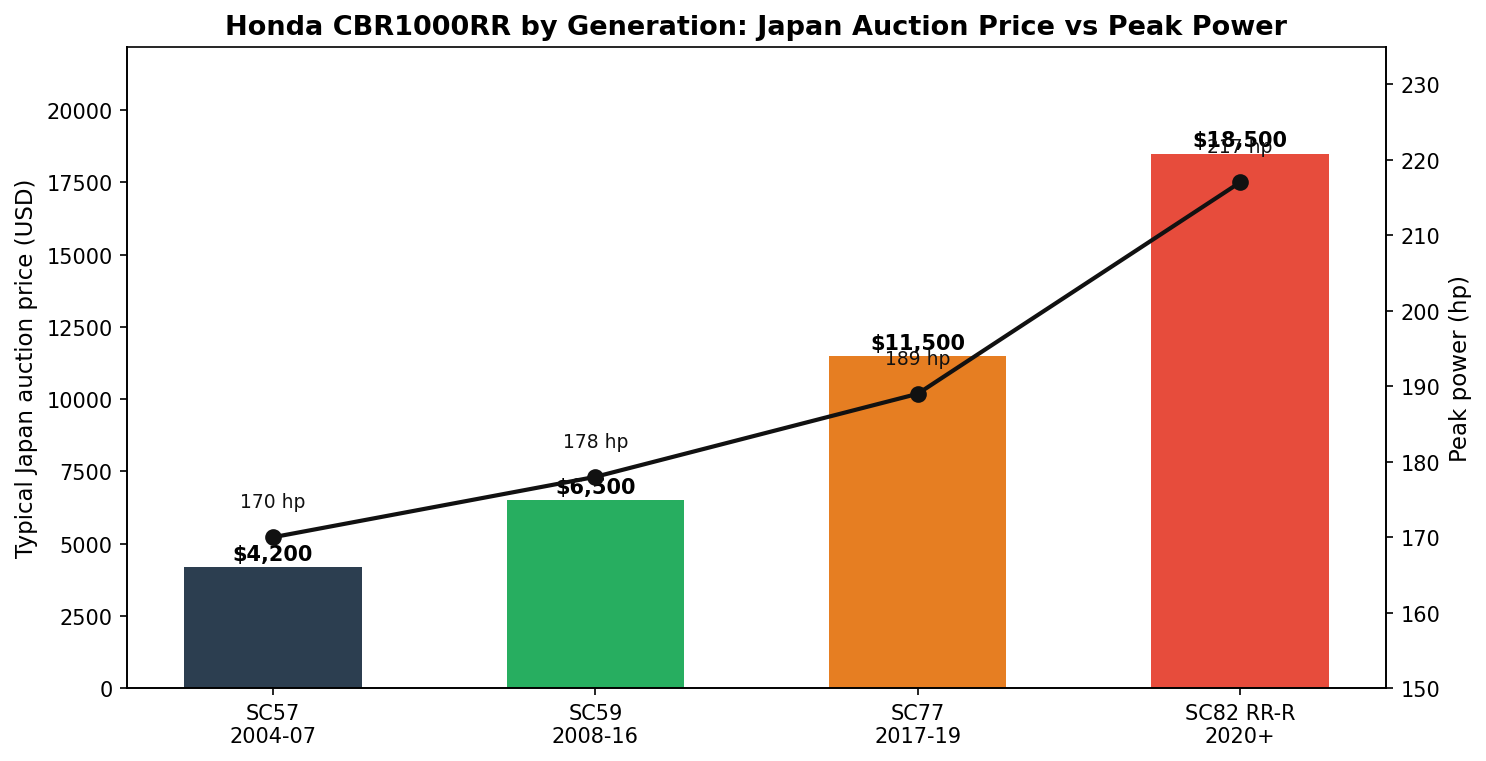
The first bike to wear the "1000RR" name replaced the CBR954RR and brought MotoGP-derived ideas — unit-pro-link rear suspension, an underseat exhaust, and a centralised mass philosophy — to the road. The 2004–2005 SC57 makes around 170 hp; the revised 2006–2007 version got a higher 12.3:1 compression ratio and a redline bumped from 11,250 to 12,200 rpm, plus a lighter swingarm and sharper chassis geometry.
This is the cheapest way into a CBR1000RR from Japan, and it's a future modern classic. The 2006–2007 "後期" (late-model) SC57 is the one collectors quietly hunt for.
SC59 (2008–2016): The Sweet Spot
For most importers, the SC59 is the one to buy. Honda gave it an all-new 999 cc inline-four with titanium valves, a 13,000 rpm redline, and a lighter, narrower die-cast frame built from just four welded castings. From 2009 you could get optional Combined-ABS, the first electronically controlled ABS on a litre superbike.
Nine model years means deep supply, the parts catalogue is bottomless, and a clean Japanese SC59 is still one of the best-handling superbikes you can buy at any price. If you want a do-everything fast bike that won't bankrupt you, this is it.
SC77 (2017–2019): Electronics Arrive
The 2017 redesign — built for the Fireblade's 25th anniversary — finally brought throttle-by-wire, a full IMU-based electronics package, traction control, and selectable ride modes. The revised 999 cc engine makes about 189 hp at 13,000 rpm, and a titanium exhaust trimmed roughly six pounds. The SP version added Öhlins semi-active suspension and Brembo calipers.
An SC77 from Japan gets you modern rider aids for a fraction of new-bike money. It's the value pick for anyone who wants electronics without paying RR-R prices.
SC82 / CBR1000RR-R Fireblade (2020–present): The Hyperbike
The RR-R is a different animal — about 217 hp, MotoGP aero, and a chassis that wants a racetrack. Japanese-market examples are out there, but you're paying near-new money and dealing with the newest, most expensive end of the catalogue. Import one if you specifically want the latest weapon; otherwise the SC59 and SC77 are where the smart money imports.
Domestic-Spec vs Reverse-Import (逆車): The 180 km/h Trap Nobody Warns You About
Here's the single most important thing to understand before you bid on a CBR1000RR in Japan, and almost no Western buyer's guide mentions it.
Bikes built for the Japanese home market are electronically restricted to 180 km/h. It's baked into the ECU, and you'll often spot it on the speedometer, which reads only to 180. Honda and the other Japanese manufacturers agreed to this domestic speed cap decades ago. Full-power, unrestricted versions were built for export only.
So in Japan you'll find two flavours of the same CBR1000RR. The domestic-spec bike is speed-limited. The export-spec bike that was sold abroad and then brought back into Japan is called a "逆車" (gyaku-sha, literally "reverse-import car"). Japanese enthusiasts pay a premium for 逆車 examples precisely because they make full power and aren't capped — search "CBR1000RR SC57 逆車" on YouTube and you'll find owners specifically documenting that distinction.
Why does this matter to you? Because the restriction is real but usually solvable. Riders importing domestic-spec bikes have removed the 180 km/h cap by addressing the ECU and, on some models, the speed signal — owners report reaching well over 215 km/h afterward. But you need to know what you're buying. A domestic-spec bike isn't worse, it's just capped from the factory, and the fix should be priced into your decision, not discovered after the bike lands.
The takeaway: confirm whether the specific CBR1000RR you're bidding on is domestic-spec or 逆車, and budget accordingly. If a listing or agent can't tell you, that's your answer to walk.
Why Japan Still Has the Best CBR1000RRs Left
There's a structural reason Japan keeps producing clean used superbikes, and it's called shaken — the country's strict, expensive periodic vehicle inspection. For larger motorcycles it comes due every couple of years and it isn't cheap, which nudges owners to sell perfectly good bikes rather than keep paying to certify them.
The result is a steady stream of low-mileage, well-documented machines flowing into the auctions. It's common to find an SC59 with under 20,000 km and a complete service history, the kind of bike that simply doesn't exist anymore in Western classifieds at a sane price.
Japanese owners also tend to keep bikes stock, store them indoors, and maintain them on schedule. You'll see far fewer hacked wiring looms, mismatched fairings, and "improved" suspension setups than you'd find buying locally. When a CBR1000RR shows up to a Japanese auction with original bodywork, original exhaust, and a clean inspection sheet, that's the norm, not a lucky find.
What a Honda CBR1000RR Import From Japan Really Costs Landed
Let's talk real numbers, because "cheap bikes in Japan" means nothing until you add the cost of getting one to your door. The bike price is only part of the story — you're also paying an export agent, domestic transport inside Japan, ocean freight, customs duty, and whatever compliance or registration your country demands.
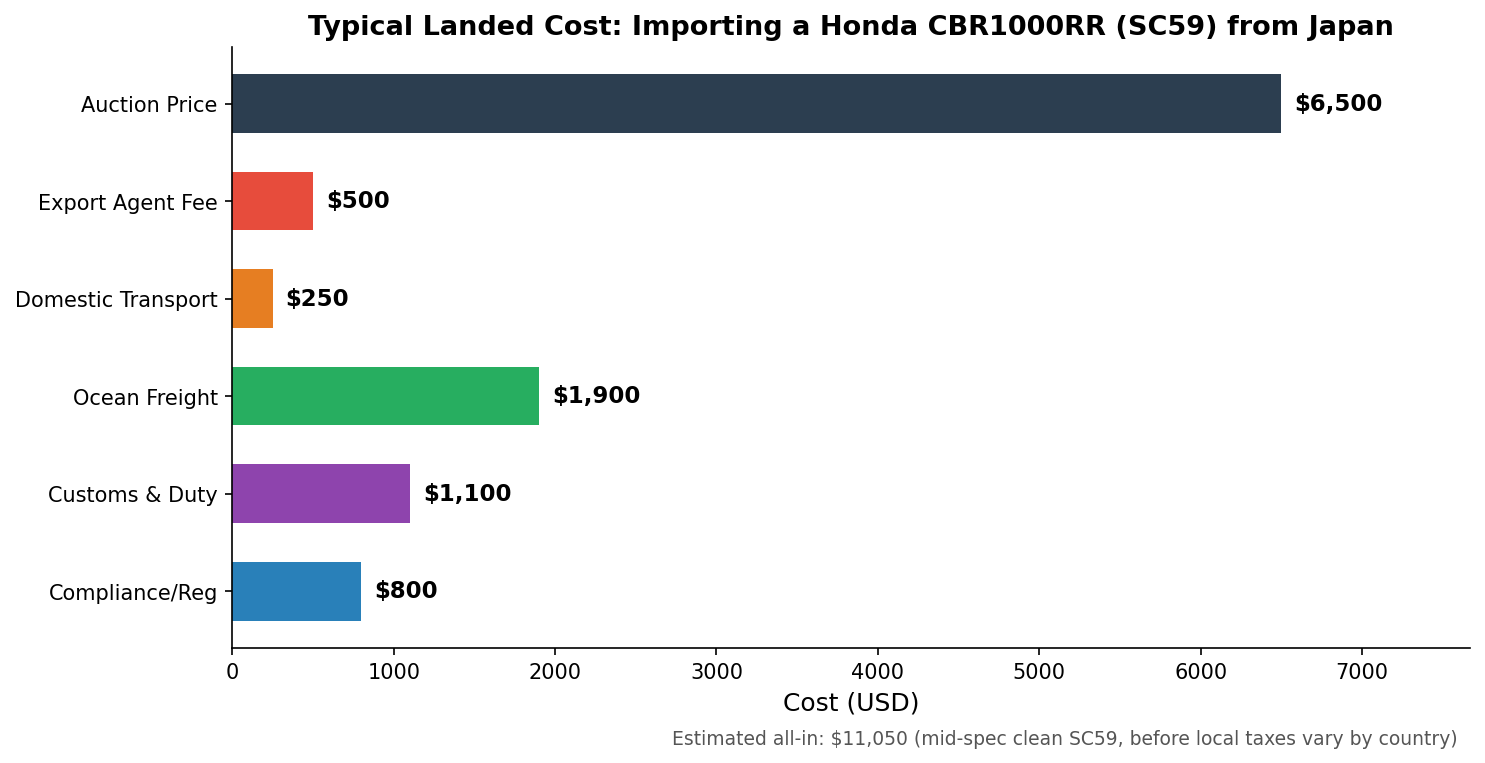
Here's a realistic picture for a clean SC59 in 2026. Expect the bike to hammer somewhere around $5,000 to $8,000 at auction depending on year, mileage, and spec. On top of that, budget roughly:
An export agent fee of around $300 to $600. Domestic transport inside Japan of $150 to $350. Ocean freight of $1,200 to $2,800 depending on whether you ship by container or RoRo and where you live. Customs clearance, duty, and brokerage of $400 to $1,500 depending on your country's rates. And compliance, inspection, or registration costs that vary wildly by destination.
A useful rule of thumb: add about 30% on top of the auction price to estimate the all-in landed cost before local taxes. For an older SC57, a clean example lands in the $6,000–$9,000 range all-in; a tidy SC59 typically lands around $9,000–$12,000; an SC77 climbs from there. Compare that to your local market, where a comparable bike has usually lived a harder life, and the import math starts looking very friendly.
One honest caveat: VAT, GST, or local consumption taxes can add a meaningful chunk depending on where you live. We break the country-by-country rules down below.
How to Import a CBR1000RR From Japan, Step by Step
The process sounds intimidating the first time and routine by the second. Here's how it actually goes.
Step 1: Confirm Your Country's Rules First
Before you bid on anything, know what your country allows. The US 25-year rule, the UK's IVA and registration path, and Australia's import-approval scheme all change which CBR1000RR years you can realistically bring in. Sort this out before you fall in love with a specific bike.
Step 2: Set a Budget With Everything In It
Use the landed-cost breakdown above and set a ceiling that includes freight, duty, and compliance — not just the auction price. The most common rookie mistake is budgeting for the bike and forgetting the other 30%.
Step 3: Partner With an Auction Agent
You can't bid at a Japanese motorcycle auction as a private foreign buyer. You go through an agent who holds auction access, places your bid, and handles export paperwork. A good agent also reads the inspection sheet for you and flags problems before you commit. This is where a specialist like AWA Auction earns its keep — you tell them the spec and the ceiling, they do the bidding.
Step 4: Choose Your Bike and Set a Maximum Bid
Browse upcoming auction listings, narrow to clean examples in your target generation, and confirm domestic-spec versus 逆車. Set a hard maximum bid and stick to it. Auctions reward discipline and punish emotion.
Step 5: Win, Pay, and Arrange Export
If you win, you pay the hammer price plus auction and agent fees. Your agent collects the export certificate (the de-registration document that proves the bike is cleared to leave Japan) and books transport to the port.
Step 6: Ship It Home
Container shipping is more protective and lets you share space to cut cost; RoRo (roll-on/roll-off) is cheaper but the bike is handled more. Transit runs anywhere from two to eight weeks depending on your country and routing.
Step 7: Clear Customs and Make It Road-Legal
On arrival you pay duty and taxes, clear customs, and then complete whatever inspection or registration your country requires before the CBR1000RR can legally hit the road.
CBR1000RR vs the Rivals: Why Import the Honda
The litre-class is a four-way knife fight, so it's fair to ask why you'd import a CBR1000RR instead of a Yamaha YZF-R1, a Suzuki GSX-R1000, or a Kawasaki ZX-10R. The honest answer is that the Fireblade has always been the one you can live with, and that matters more on a used import than raw lap-time bragging rights.
The R1 is the drama queen of the group — the crossplane engine sounds incredible and the bike is thrilling, but it asks more of the rider and the later electronics-heavy versions get expensive to maintain. The GSX-R1000 is the bruiser, brilliant value and brutally fast, but Suzuki's update cycle was slower and the older bikes feel their age. The ZX-10R is the track weapon, razor-sharp and a little single-minded about it. The CBR1000RR sits in the middle of all of them, and that's exactly the point: it's the litre bike that's the easiest to ride fast on a real road, the easiest to own, and the least likely to bite a returning rider who hasn't held a superbike throttle in a decade.
For an import specifically, that balance pays off twice. First, the CBR1000RR's reliability and parts availability mean a Japanese-market example lands and just works, without a shopping list of obscure components. Second, Honda's enormous production numbers mean the auctions are full of them, so you're never stuck overpaying for a rare unicorn — you can hold out for the exact grade, mileage, and colour you want and still find three of them next week.
There's also the resale angle. Hondas hold their value with a stubbornness that frustrates buyers and delights sellers, and a clean imported Fireblade with documented history is the kind of bike that's easy to move on when you're ready. The R1 and GSX-R have passionate followings too, but the CBR1000RR's reputation as the sensible-but-still-savage choice gives it the broadest pool of future buyers.
None of this means the others are bad imports — they're not, and Japan has clean examples of all of them. It means that if you want the litre bike that rewards being imported rather than fights you on it, the CBR1000RR is the safe, smart pick. You get superbike performance, modern-classic upside on the older generations, and an ownership experience that doesn't punish you for buying something built on the other side of the planet.
So who actually should import one? The rider stepping back up to a litre bike who wants capability without intimidation. The collector eyeing a clean SC57 before the good ones disappear. The track-day regular who wants a sorted SC59 for sensible money. And anyone in the US, UK, Australia, New Zealand, or Canada who has looked at their local listings, seen the same tired, crash-repaired bikes at optimistic prices, and realised the better machine was in Japan the whole time.
CBR1000RR Import Rules by Country: USA, UK, Australia, NZ, Canada

This is where importers get tripped up, because every country plays by different rules. Here's the short version for the big five English-speaking markets.
United States
The US is governed by the 25-year rule: any motorcycle 25 model years or older is exempt from EPA and DOT requirements and can be imported freely. In 2026 that opens up SC57 examples from 2004 onward as they cross the line year by year. Newer CBR1000RRs are far harder to register for road use and usually come in as off-road or competition-only machines. If you want a road-legal import without the headaches, chase the years that have aged past 25.
United Kingdom
The UK is one of the friendliest markets for newer imports. You pay import VAT and duty on arrival, then put the bike through registration — which for many machines means an Individual Vehicle Approval (IVA) or the motorcycle equivalent, plus a NOVA notification to HMRC so the tax is settled. There's no 25-year wall, so any CBR1000RR generation is on the table.
Australia
Australia requires an import approval before the bike arrives, and the road-legal path runs through the Register of Approved Vehicles. Older bikes can use the pre-1989 or specialist/enthusiast pathways; newer ones need to meet the relevant standards. You'll also deal with quarantine cleaning (asbestos checks included) and GST on landing. Get your approval lined up first — shipping a bike you can't legally register is an expensive mistake.
New Zealand
New Zealand is relatively import-friendly but strict on compliance. Imported motorcycles go through entry certification and must meet frontal-impact and emissions criteria depending on age, then pass a warrant-of-fitness check. GST applies on the landed value.
Canada
Canada also runs a 15-year rule for vehicles that don't meet domestic standards, which makes older CBR1000RRs straightforward. You'll clear through the CBSA, pay duty and GST/PST, and complete provincial registration and safety inspection.
The honest summary: the US and Canada reward patience (age-based exemptions), while the UK and NZ let you import newer bikes if you're willing to do the compliance paperwork. Always verify the current rules with your national authority before you bid — regulations shift, and an agent who imports daily will know the latest.
Reading the Auction Sheet: CBR1000RR Red Flags
The auction inspection sheet is your single best tool for buying a CBR1000RR you've never seen. Learn to read it and you'll dodge the bikes that look fine in photos and hide their sins in the fine print.
Every bike gets an overall grade. Roughly speaking, grade 4 and above is a solid, honest used bike; grade 3 has some wear or minor history; and anything labelled R or RA means the bike has been in an accident and repaired. For a sport bike that's been ridden hard, you want grade 4 or better and a clean repair history.
On a CBR1000RR specifically, watch for a few things. Crash damage that shows up as scrapes on the fairing edges, bar ends, and footpeg feelers — these bikes get dropped at track days. Aftermarket exhausts and "improved" fueling that may have been tuned by someone who shouldn't have. Mileage that looks too good without a service record to back it up. And on domestic-spec bikes, confirm whether the speed limiter is still in place.
The inspector's diagram marks scratches, dents, and rust with standardised codes, and the corrosion rating tells you whether a bike from a coastal or snowy prefecture has salt damage underneath the shine. A good agent translates all of this for you before you bid — which is exactly why you don't do this alone.
CBR1000RR Known Issues and What to Inspect
The CBR1000RR has one of the strongest reliability reputations in the litre-class, but no twenty-year-old superbike is bulletproof. Knowing the generation-specific weak spots tells you exactly what to ask your agent to check on the auction sheet and in the supplementary photos.
On the SC57, the things to watch are age-related rather than design flaws. Regulator/rectifier units on early-2000s Hondas can run hot and fail, so a bike with fresh charging-system parts is a plus. The cam chain tensioner is worth confirming, and the steering damper on hard-ridden examples can weep. Because these bikes are now old enough to have sat, look for signs of a bike that's been recommissioned after long storage — fresh fork seals and a new battery are good news, gummy carbs aren't an issue here since the SC57 is fuel-injected, but stale fuel and crusty brake fluid hint at a bike that slept for years.
The SC59 is the most refined of the analogue Fireblades and genuinely tough. The known niggles are minor: some owners report the rear shock losing its damping after high mileage, the Combined-ABS system (2009 onward) adds complexity that's worth confirming works, and the regulator/rectifier story carries over, though it's better than the SC57. Check that the bike hasn't been flashed with a sketchy ECU map to defeat the speed limiter in a way that messed up the fueling — a smooth idle and clean throttle response on the auction video tell you a lot.
The SC77 is modern enough that the concerns shift to electronics. Confirm the IMU, traction control, and ride modes function, and on the SP model verify the Öhlins semi-active suspension responds correctly, because replacement parts for that system are expensive. Early SC77s had a few software updates over their life, so a bike that's been dealer-serviced in Japan is worth a small premium.
Across all generations, three checks matter most on a sport bike: the condition of the chain and sprockets, the state of the tyres and their date codes, and whether the fairings hide repaired crash damage. A grade 4.5 bike with a clean inspection diagram and recent consumables will need far less money after it lands than a cheaper bike that arrives needing everything at once. Your agent can request extra close-up photos before you bid — use that, every time.
Best CBR1000RR Years to Buy From Japan in 2026
If you want the short list of standout model years to target at a Japanese auction, here it is, with the reasoning behind each.
The 2006–2007 SC57 is the pick of the first generation. It got the higher compression ratio, the raised redline, and the chassis tweaks that fixed the early bike's few complaints, and as a "後期" late-model SC57 it's the version collectors quietly chase. Buy one of these now, keep it clean, and you're holding a future modern classic that the 25-year rule is steadily making easier to import to the US and Canada.
The 2008–2011 SC59 is the value champion. It's the all-new 999 cc engine in its purest, pre-electronics form, with the optional Combined-ABS available from 2009 if you want it. Supply is deep, prices are reasonable, and the bike's handling still embarrasses machines built a decade later. For a rider who wants one fast, friendly, reliable superbike, this is the bracket to shop.
The 2012–2016 SC59 brought subtle suspension and brake refinements — Big Piston forks and updated Tokico calipers on later examples — making the bike a little more composed without losing its character. If you want the most sorted analogue Fireblade and don't need a full electronics suite, the late SC59 is the sweet spot of the sweet spot.
The 2017–2019 SC77 is the one to buy if rider aids matter to you. Throttle-by-wire, an IMU, cornering-aware traction control, and ride modes for a used-bike price is a strong proposition, and the SP version with Öhlins and Brembo is a genuine bargain compared to its original sticker. Just buy on condition and service history, because the electronics make a neglected example more expensive to put right.
Whatever year you choose, the principle is the same: in Japan you can afford to be picky. There are enough clean CBR1000RRs flowing through the auctions every week that you never have to settle for a tired one. Hold out for the grade, the mileage, and the spec you actually want.
Owning an Imported CBR1000RR: Parts, Servicing, and Resale
Importing the bike is the start; living with it is the part that lasts. The good news is that the CBR1000RR is one of the easiest superbikes to own anywhere in the world, because Honda sold so many of them and the aftermarket never stopped supporting them.
Service parts are everywhere. Filters, brake pads, chains, sprockets, and consumables are stocked by every Honda dealer and a hundred online suppliers in the US, UK, and Australia, so a Japanese-market bike doesn't leave you hunting for unobtanium. The only items worth checking before you import are model-specific electronics — an SC77 SP's semi-active suspension components, for example — and anything that was a domestic-only part. For the SC57 and SC59, parts availability is effectively a non-issue.
Servicing is straightforward for any competent motorcycle mechanic. Valve-clearance intervals are long, the inline-four is famously durable, and there's a deep well of workshop knowledge and owner forums covering every job. A domestic-spec bike's speed limiter removal is a known procedure on these models, so a specialist can sort it as part of your first service rather than it being a mystery.
Resale is where imported Fireblades quietly shine. A clean, low-mileage Japanese example with documented history and a tidy import trail tends to hold value better than a high-mileage local bike, especially as the SC57 ages into modern-classic status and clean SC59s get harder to find in the West. Keep the auction sheet, the export certificate, and your service records together — that paperwork is part of what makes the bike worth more when you sell.
One more practical note: insurance and registration for an imported bike can take a little extra documentation the first time, particularly proving the bike's identity and import status. It's paperwork, not a wall, and an agent who imports regularly can tell you exactly what your insurer and registration authority will want to see.
Mistakes Buyers Make (What Nobody Tells You)
After watching enough imports go right and wrong, the same handful of mistakes come up again and again.
The first is budgeting for the bike and forgetting everything else. A $6,000 hammer price is not a $6,000 motorcycle once it's in your garage — freight, duty, and compliance are real money. Plan for the full landed cost from day one.
The second is ignoring the domestic-spec versus 逆車 question and being surprised by a 180 km/h limiter after the bike arrives. Now you know better.
The third is chasing the cheapest auction grade. A grade 3.5 bike with "minor scratches" can hide a hard life. Spending a little more for a grade 4.5 with a clean sheet is almost always cheaper than fixing a bargain.
The fourth is skipping the agent and trying to DIY the auction access. Private foreign buyers can't bid directly, and the people who "know a guy" usually end up paying more in mistakes than an agent would have charged. The fifth is forgetting parts and timing — confirm that consumables and any model-specific parts are available in your country before you commit, and don't import a bike the week you need it on the road.
Get those five right and importing a CBR1000RR from Japan is genuinely straightforward.
How AWA Auction Gets You a CBR1000RR From Japan
AWA Auction exists to make this whole process boring — in the best way. We hold direct access to the major Japanese motorcycle auctions, so you get the same inventory the domestic buyers see, with someone in your corner who reads the inspection sheets in the original Japanese.
You tell us the generation you want — an SC57 future classic, a sweet-spot SC59, an electronics-equipped SC77, or a full RR-R — along with your spec preferences and your maximum budget. We find clean candidates, confirm whether each is domestic-spec or 逆車, translate the auction sheet, place the bid, and handle export, shipping, and the paperwork to get the bike moving toward your country.
Want to see what's available right now? Browse our current listings to get a feel for the market, and when you're ready to set a target, contact our team and we'll build a landed-cost estimate for the exact CBR1000RR you're after. No pressure, no guesswork — just the bike you want, from the country that kept it in the best shape.
Frequently Asked Questions
How much does it cost to import a CBR1000RR from Japan?
For a clean SC59, expect the bike to hammer around $5,000–$8,000 at auction, then add export agent fees, domestic transport, ocean freight ($1,200–$2,800), and customs duty. A good rule is to add roughly 30% on top of the auction price for everything before local taxes. Most tidy SC59s land in the $9,000–$12,000 range all-in, while older 25-year-eligible SC57s can land closer to $6,000–$9,000.
Is it legal to import a Honda CBR1000RR to the USA?
Yes, most easily under the 25-year rule. Any motorcycle 25 model years or older is exempt from EPA and DOT standards, so SC57 examples become freely importable as each model year crosses 25. Newer CBR1000RRs are much harder to register for road use in the US and typically enter as off-road or competition machines.
What's the difference between a domestic-spec and a 逆車 (reverse-import) CBR1000RR?
Japanese home-market bikes are electronically limited to 180 km/h, often with a speedometer that reads only to 180. Export-spec bikes built without that cap and later brought back into Japan are called 逆車 (gyaku-sha) and command a premium because they make full power. The domestic limiter can usually be removed, but you should confirm which version you're buying and price the fix in advance.
Which CBR1000RR generation is the best to import?
For most riders, the SC59 (2008–2016) is the sweet spot: deep supply, bulletproof handling, optional C-ABS from 2009, and sane prices. Choose an SC57 (2004–2007) for the cheapest entry and modern-classic potential, an SC77 (2017–2019) if you want traction control and ride modes, or the RR-R (2020+) if you specifically want the latest hyperbike.
How long does shipping a CBR1000RR from Japan take?
From winning the auction to the bike arriving usually runs four to eight weeks, depending on your country, the shipping method, and sailing schedules. Container shipping protects the bike better and lets you share space; RoRo is cheaper but involves more handling. Customs clearance and registration add time on arrival.
Can I import a newer CBR1000RR to the UK or Australia?
Yes. The UK has no 25-year wall — you pay import VAT and duty, file a NOVA notification, and complete registration (often via IVA or the motorcycle equivalent). Australia requires an import approval before arrival and a road-legal pathway through the Register of Approved Vehicles, plus quarantine cleaning and GST. Line the approval up before you ship.
Are Japanese CBR1000RRs higher mileage or lower mileage than local bikes?
Generally much lower. Japan's strict shaken inspection regime pushes owners to sell good bikes rather than keep certifying them, so the auctions are full of low-mileage, well-documented, stock examples. Finding an SC59 under 20,000 km with service history is realistic in Japan and nearly impossible at a fair price in Western classifieds.
Do I need an agent to buy a CBR1000RR at a Japanese auction?
Yes. Private foreign buyers can't bid directly at Japanese motorcycle auctions — you need an agent with auction access who places the bid, reads the inspection sheet, and manages export paperwork. A specialist agent like AWA Auction also confirms domestic-spec versus 逆車 and arranges shipping to your country.
What auction grade should I look for on a CBR1000RR?
Aim for grade 4 or above with a clean repair history. Grade 4.5 examples are honest, well-kept bikes; grade 3 and below often hide harder lives, and any R or RA grade means accident repair. On a sport bike that gets dropped at track days, spending a little more for a higher grade is almost always cheaper than fixing a bargain.
See Also
Share this article: