
For two years in the late 1990s, the fastest thing on sale with a number plate wasn't a supercar. It was a Honda. The CBR1100XX Super Blackbird took the production top-speed crown from Kawasaki's ZZR1100 in 1997, held it until Suzuki's Hayabusa arrived in 1999, and then did something far more useful than chase a number — it settled into a decade-long career as the most unburstable fast bike Honda ever made.
Here's the part nobody tells you. The cleanest, most honest, lowest-owner Super Blackbirds left on the planet are sitting in Japan right now, in dehumidified warehouses and at members-only dealer auctions, waiting for someone outside Japan to notice. And because the bike is now old enough to clear the import rules in most English-speaking countries, you can buy one and ship it to your driveway for less than a tired, twice-crashed example costs in your local classifieds.
This guide walks you through exactly how to import a Honda CBR1100XX from Japan in 2026 — which years to chase, what the carb-versus-injection debate actually means for you, the real landed cost, the import rules for the US, UK, Australia and New Zealand, and the auction-sheet red flags that separate a genuine 12,000-kilometre gem from a clocked money pit. Treat it as your starting point, then judge every individual bike on its own sheet. No two Blackbirds have lived the same life.
What Is the Honda CBR1100XX Super Blackbird?
The CBR1100XX arrived in late 1996 as a 1997 model with a single, blunt mission: take the world's fastest production motorcycle title away from Kawasaki. Honda did it the Honda way — not with a peaky, highly-strung engine, but with a 1,137cc inline-four that made its power smoothly, all the way up, and then kept making it.
The name was a borrow from aviation. The Lockheed SR-71 Blackbird was the fastest aircraft ever built, and Honda's marketing department clearly fancied the association. The bike earned it. Period road tests put the Super Blackbird at roughly 178 mph (around 286 km/h), nudging past the ZZR1100 and making every rival look like it was trying too hard.
What made the Blackbird special wasn't just the speed — it was that the speed came wrapped in a bike you can actually live with. Wide bars, a real seat, a fairing that kept the weather off, and a fuel tank that grew to 24 litres on later models so you can ride three hours without thinking about petrol. It was a hyperbike that behaved like a sport-tourer, and that combination is exactly why owners hang onto them for decades.
The frame code, for the buyers who care about getting the right bike, is SC35. You'll see it stamped and referenced on auction sheets and import paperwork. Two broad eras matter: the carburettor bikes from 1997 to 1998, and the fuel-injected bikes from 1999 to the end of production around 2007. More on which one to chase in a moment.
What Is It Like to Ride and Own a Super Blackbird?
Numbers tell you the Blackbird is fast. They don't tell you what makes owners keep them for fifteen years. Spend time around the bike and the same words come up again and again: effortless, unburstable, deceptive.
The deception is the speed. Because the power arrives so smoothly and the fairing is so effective, the Blackbird feels relaxed at speeds that would have you hanging off a modern sportbike like a flag in a gale. Riders describe glancing down at the speedo and finding themselves 30 mph faster than they thought. It's a big bike — wet weight is the wrong side of 250 kg — but the mass disappears once you're rolling, and the long wheelbase makes it rock-steady on the motorway.
For touring it's close to ideal. The riding position is upright enough for a full day, the 24-litre tank on later bikes gives a genuine 200-mile range, and the wind protection means you arrive warm and dry instead of sandblasted. Owners load them with luggage and ride across continents. It is the rare 1990s hyperbike you can honestly commute on.
The flip side is that it's not a back-road scalpel. The weight and the long chassis mean it doesn't flick into corners like a 600, and the linked brakes take some getting used to. Nobody buys a Blackbird to win a track day. You buy it to cover absurd distances at absurd speeds while barely raising your heart rate — and at that, two and a half decades on, almost nothing does it better for the money.
Why Import a Super Blackbird From Japan?
Simple answer: Japan is where the good ones are, and where they were treated properly.
Japan had a thriving big-bike scene through the Blackbird's whole production run, but it also had short riding seasons, expensive parking, strict roadworthiness inspections (the dreaded shaken), and a culture that treats machines as things to be maintained rather than thrashed and forgotten. The result is a national stock of high-end bikes with genuinely low mileage, full service history, and bodywork that hasn't spent ten winters dissolving in road salt.
Then there's the auction system. The overwhelming majority of used bikes in Japan change hands through members-only dealer auctions, where every machine is inspected by a neutral third party and graded on a documented sheet before it crosses the block. That sheet tells you the real condition — mileage verified against the meter, accident history, rust, scratches, mechanical notes — before you ever bid. It's the most transparent used-bike market on earth, and it's the reason importers keep coming back instead of gambling on a local classified ad with three blurry photos.
The money math works too. A clean, documented Super Blackbird at a Japanese auction frequently hammers in the $2,500 to $4,500 range. Add the export and shipping costs and you're often still under what a neglected local example would cost you — except yours arrives with a verified sheet, an honest odometer, and none of the previous owner's "modifications" hiding a crash. You're not just buying a cheaper bike. You're buying a better one with a paper trail.
And the supply at home keeps shrinking. Every rough Blackbird that gets used up, parted out, or written off makes the clean Japanese stock more valuable. Importing now, while the auctions are still full of tidy examples, is how you get ahead of that curve rather than paying for it later.
Super Blackbird Generations: Which Year Should You Buy?
This is the decision that trips up most first-time buyers, so let's make it clear. There are two Blackbirds, and the split is fuel delivery.
Carburettor bikes (1997–1998): The original. A bank of four Keihin carbs, a slightly rawer character, and — this is the one fact the forums will fight you over — better real-world fuel economy than the injected bikes. They're mechanically simple, cheap to keep running if you can balance carbs, and they have a purity the later bikes lost. The catch is that carbs hate sitting. A Blackbird that's been parked for two years will have gummed-up float bowls, and you'll be cleaning jets before it runs right.
Fuel-injected bikes (1999–2007): In 1999 Honda fitted its PGM-FI injection system, enlarged the fuel tank to 24 litres, and tidied the airbox, ram-air ducts, oil cooler and clutch. From 2001 the bikes gained a catalytic converter and a few emissions tweaks to stay legal in a tightening market. The injected bikes are smoother to start cold, need less fiddling, and are the ones to buy if you just want to ride rather than tinker. They make a claimed 164 hp at the crank; period dyno runs typically show around 150 bhp at the rear wheel.
So which one? If you want the cheapest entry and you're handy with a spanner, a tidy 1997–1998 carb bike is a bargain and a future modern classic. If you want a fast, comfortable bike you can buy and simply use, get a fuel-injected 1999-onward example with documented history. For most importers, a 1999–2003 injected Blackbird with under 40,000 km and a clean sheet is the sweet spot: modern enough to be fuss-free, old enough to clear import rules, and still dirt cheap for the performance.
One regional wrinkle: in the UK, anything 30 years old or older slips into the historic-vehicle tax and MOT bracket, so the earliest 1997 bikes are inching toward that bonus. In the US, the 25-year rule already covers every Blackbird up to 2001 and keeps unlocking newer ones each year. Let your country's calendar nudge which generation you hunt — more on that below.
What Does It Really Cost to Import a Super Blackbird?
Let's talk actual numbers, because vague "it depends" answers help nobody. Here's a realistic all-in breakdown for a clean fuel-injected Blackbird landed in the US or UK in 2026. Yours will vary with the exchange rate, the port, and how hard you bid, but this is the shape of it.
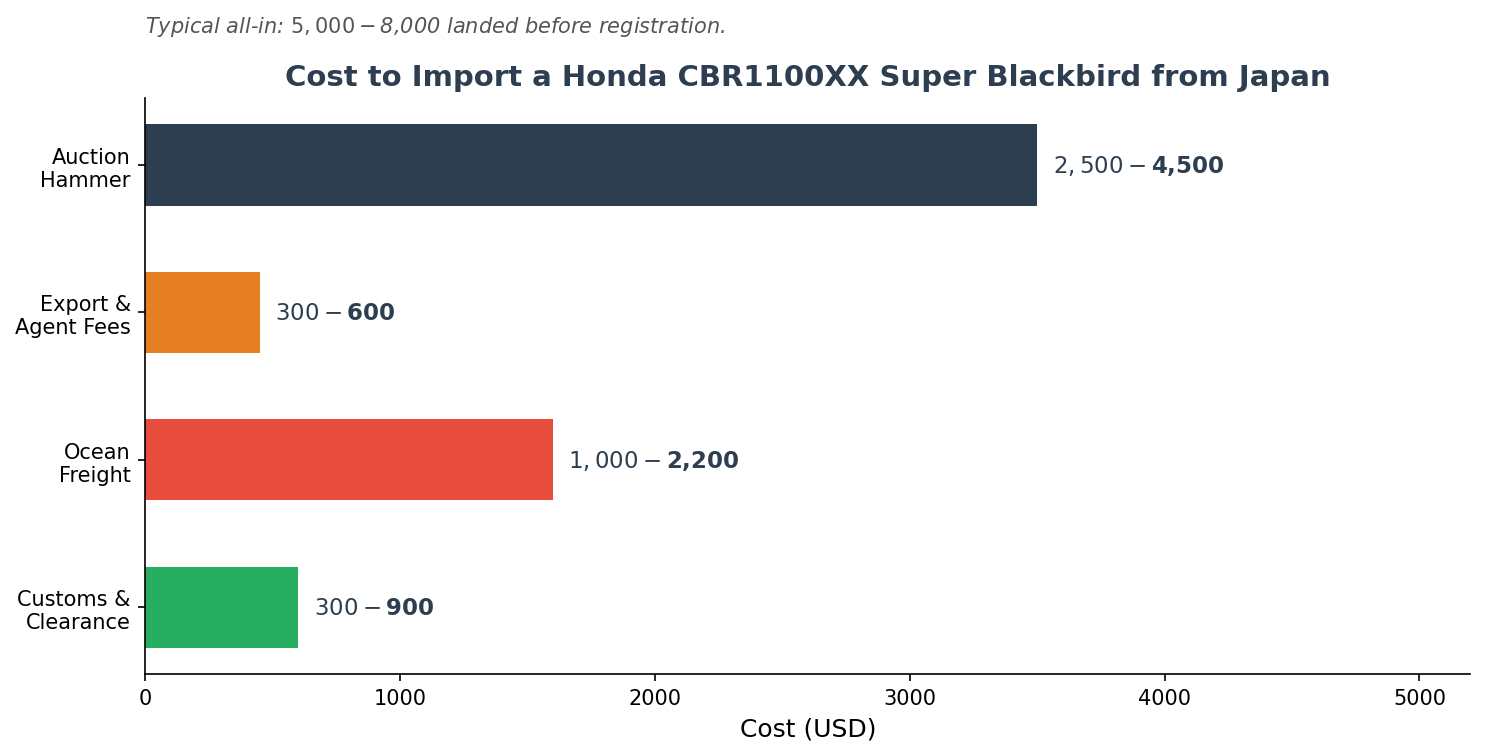
Auction hammer price: $2,500–$4,500 for a tidy, graded example. Mint, low-mileage collector bikes go higher; rough projects go lower.
Export agent and auction fees: $300–$600. This covers your bid agent, the auction's buyer fee, domestic transport to the port, and export documentation (deregistration certificate and export certificate).
Ocean freight: $1,000–$2,200 depending on destination and whether the bike ships in a shared container or crated solo. Australia and New Zealand sit at the higher end; the US west coast and UK are typically cheaper.
Customs, duty and clearance at your end: $300–$900. This is the most country-dependent line on the list. A 25-year-eligible bike entering the US comes in duty-free even with the 2025 vehicle tariff, because the classic exemption overrides it. The UK charges import VAT plus a small duty. Australia adds GST, and luxury car tax doesn't apply to bikes, so it's mostly GST.
Add it up and a typical landed Super Blackbird runs $5,000 to $8,000 all-in, with most clean injected bikes settling around $6,000–$7,000 on your driveway before registration. A useful rule of thumb: take the hammer price and add roughly 80–120% for everything else before the bike is road-legal at home. Compare that to a neglected local Blackbird at $4,500 with a mystery history, and the imported bike with a verified sheet starts looking like the sensible buy, not the exotic one.
A Short History: How the Blackbird Became the World's Fastest
To understand why the Super Blackbird is such a smart import, it helps to know the war it was built to win. In the early 1990s the manufacturers were locked in a top-speed arms race, and Kawasaki's ZZR1100 had been wearing the crown since 1990. Honda wanted it.
Rather than build a stripped-out missile, Honda's engineers chased aerodynamics. The Blackbird's bodywork was obsessively slippery, the headlights were faired flush into the nose, and the whole machine was shaped to slip through air at speeds where drag, not power, is the enemy. When it landed for 1997, the CBR1100XX did exactly what it was designed to do: roughly 178 mph and the title.
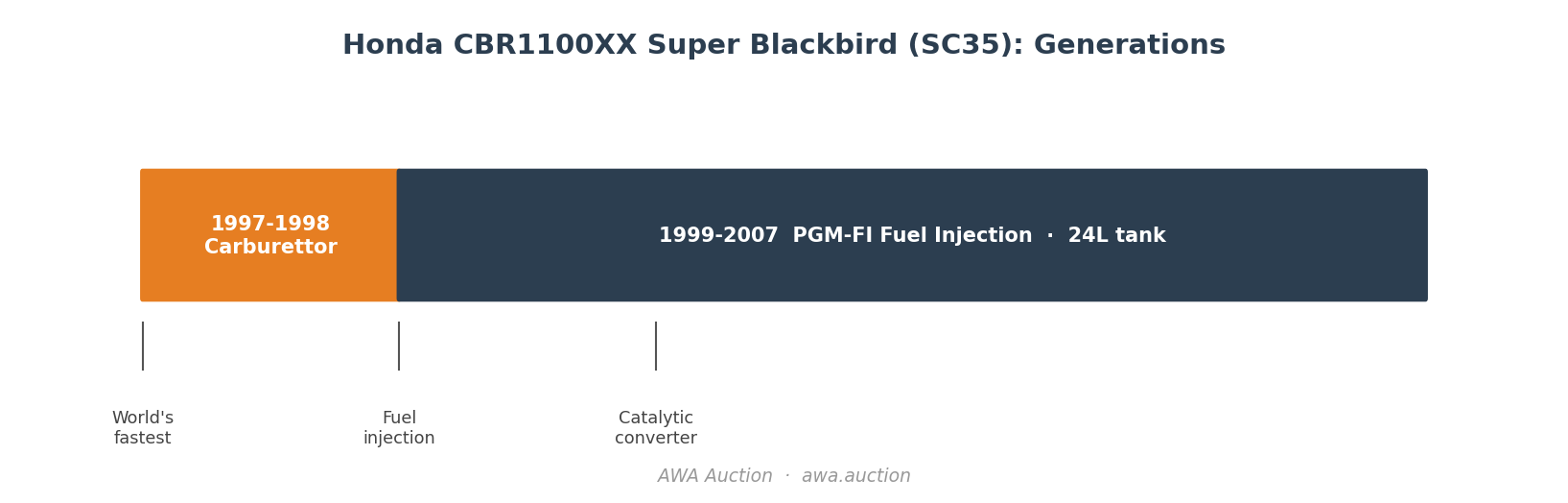
Then Honda kept improving it quietly instead of resting. The 1999 update brought PGM-FI fuel injection and the bigger 24-litre tank that turned the bike into a genuine long-haul tourer. The 2001 model added a catalytic converter and emissions updates to survive a tightening regulatory world. Through all of it the core engine — the 1,137cc inline-four — stayed fundamentally the same, because it was right the first time.
The crown itself didn't last. In 1999 Suzuki's Hayabusa arrived and rewrote the record again, and shortly after that the manufacturers agreed to a voluntary 186 mph limit before governments got involved. But losing the title turned out to be the best thing that ever happened to the Blackbird's reputation. Freed from the spec-sheet war, it became known for what it actually was: the most complete fast bike of its generation. That's the bike you're importing — not a footnote in a speed contest, but the all-rounder that outlived the contest entirely.
Import Rules by Country: USA, UK, Australia and New Zealand
The bike is the easy part. The paperwork is what decides whether your Blackbird ends up on the road or stuck at the dock. Here's where each major market stands in 2026.
United States: The 25-year rule is your best friend. Any motorcycle 25 years or older is exempt from EPA and DOT requirements, which means no compliance headaches. As of 2026 that covers every Super Blackbird from 1997 through 2001, with newer years crossing the line annually. Better still, vintage-eligible bikes come in duty-free despite the 25% vehicle tariff introduced in April 2025, because the classic exemption sidesteps it. You file the EPA 3520-21 and DOT HS-7 forms with the right exemption boxes ticked, and your customs broker handles the rest.
United Kingdom: No age wall here — you can import any year. You'll pay import VAT (currently 20%) and a small duty on the bike's value plus shipping, then put it through the registration process to get a UK plate. Bikes 30 years and older qualify for historic-vehicle status, which brings free road tax and MOT exemption, so the very earliest 1997 Blackbirds are the ones to watch as they age into that bracket. An NOVA notification to HMRC within 14 days of arrival is mandatory.
Australia: This is the strict one. Australia runs an approval system, and for road registration a motorcycle generally needs to be on the Register of Approved Vehicles or imported under a specific option such as the 25-year-or-older rule. The good news is the Blackbird's age makes the older-vehicle pathway realistic for the carb and early injected bikes. You'll pay GST and a duty, and you must arrange an import approval before the bike ships — do not buy first and ask questions later in Australia.
New Zealand: Generally the friendliest of the four. NZ allows used motorcycle imports subject to entry certification (a compliance and safety inspection on arrival). You'll pay GST on the landed value. Most Blackbirds pass entry certification without drama provided the bike is structurally sound and the lighting meets local rules.
The practical takeaway: in the US and NZ you can move fast, in the UK you can buy any year but budget for VAT, and in Australia you sort the import approval before you bid. An experienced export agent will know exactly which forms your country wants, which is half the reason to use one.
How to Read the Japanese Auction Sheet for a Blackbird
The auction sheet is the single most powerful tool you have, and learning to read it is what turns importing from a gamble into a calculated buy. Every bike gets an overall grade and a map of its flaws.
The overall grade runs on a rough scale: 6 and S are essentially new or near-new, 4.5 and 4 are good clean used bikes with minor wear, 3.5 and 3 show real age and use, and anything graded R or RA has a repaired accident history. For a Blackbird you want a 4 or above. A grade 4 bike with honest minor scuffs is the realistic target; chasing a 6 means paying a premium for a museum piece.
Beyond the headline grade, the sheet carries an inspector's diagram with coded notes: A for scratches, U for dents, W for wavy repaired panels, S for rust, C for corrosion, and so on, each with a severity number. On a high-mileage missile like the Blackbird, the notes you really care about are anything suggesting a frontal impact, fork or frame damage, or a tampered odometer. A genuine low-mileage bike will have matching wear — the grips, pegs, seat and switchgear should agree with the number on the meter.
Mileage on these bikes is rarely the problem people fear. A Blackbird engine is barely run in at 40,000 km and will sail past 100,000 miles with basic care. What matters is honesty and history, not a low number, which is exactly why the verified sheet beats a local bike with no records. If a sheet looks too clean for a cheap price, that's your cue to ask the agent for extra photos, not to bid blind. The handful of minutes it takes to study a sheet properly is the cheapest insurance in the whole process.
Common Problems and What to Check Before You Bid
The Super Blackbird is one of the most reliable big bikes ever built — owners routinely report six-figure mileages with nothing more than routine servicing. But it's not immortal, and a 20-plus-year-old bike has age-related gremlins you should price in.
Regulator/rectifier and charging system: The classic Honda weak spot of the era. A failing reg/rec cooks the battery or leaves you stranded. Many bikes have already had an upgraded unit fitted — ask, and treat an original untouched one as a job you'll do soon.
Carburettors on stored bikes (1997–1998): If a carb bike has sat, the float bowls gum up and the bike runs lean, surges or won't idle. Budget for a carb clean and balance on any carb model that hasn't been ridden regularly.
Camchain tensioner: A rattle on the overrun can mean a tired tensioner. It's not catastrophic, but factor it into your offer.
Linked brakes (D-CBS): The Blackbird uses Honda's Dual-Combined Brake System, which links front and rear. It works brilliantly but is more complex to service, and a full overhaul of seized calipers costs more than a conventional setup. Check the brakes feel even and aren't dragging.
Fork seals, fluids and consumables: Standard old-bike checks — weeping fork seals, old brake fluid, perished hoses, a tired chain and sprockets. None are dealbreakers; all are bargaining chips. The bike's strength is that parts are plentiful and cheap because Honda built so many, so even a long to-do list is affordable to clear.
Super Blackbird vs ZZR1100 vs Hayabusa: The Top-Speed Wars
You can't talk about the Blackbird without the rivalry that defined it. Three bikes traded the world's-fastest crown across one decade, and all three are now import-friendly classics. Here's how the Blackbird stacks up against the bike it beat and the bike that beat it.
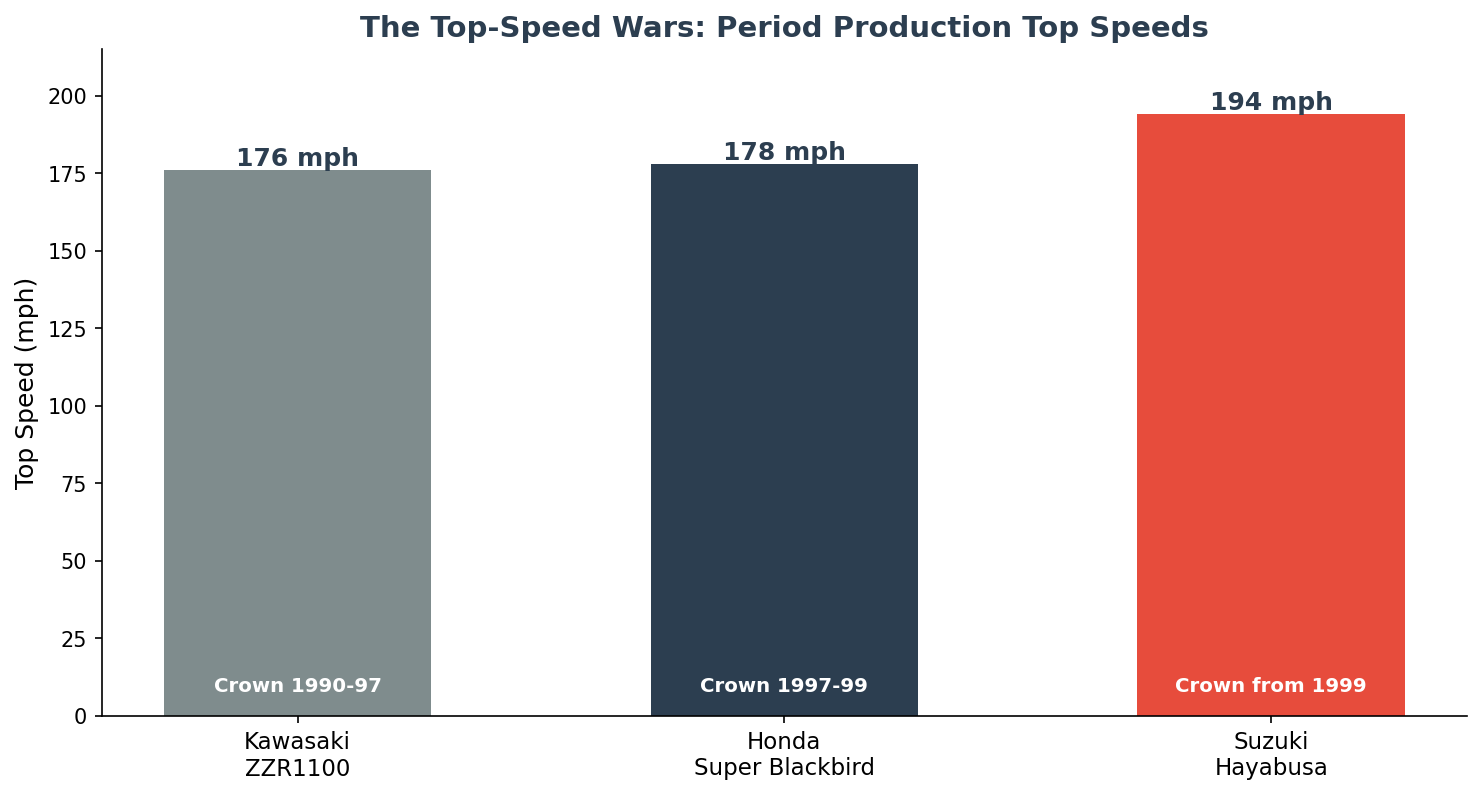
Kawasaki ZZR1100 (ZX-11): The king before the Blackbird. Raw, brawny and a little agricultural next to the Honda, the ZZR held the crown from 1990 until the Blackbird took it in 1997. It's the cheapest of the three to buy today and has a loyal following, but it feels its age more than the Honda does.
Honda CBR1100XX Super Blackbird: The all-rounder. Not the fastest of the three in the end, but the most usable, the most reliable, and the one you'd actually choose for a 500-mile day. It's the Goldilocks bike of the trio — fast enough to win the title once, sane enough to keep forever.
Suzuki Hayabusa: The bike that ended the war. In 1999 the Hayabusa blew past 190 mph and the manufacturers quietly agreed to a 186 mph gentlemen's limit before things got political. The 'Busa is the icon and commands the highest prices, but it's also the one everyone modifies, so clean stock ones are getting rare.
For an importer chasing value and usability, the Blackbird is the smart pick of the three. It carries the same era-defining story as the Hayabusa, rides better than the ZZR, and costs a fraction of either to buy clean from Japan. It's the connoisseur's choice precisely because the crowd is busy chasing the other two.
Finding Parts, Records and a Community
One quiet reason the Blackbird makes such a good long-term import is that you'll never be stranded looking for help. Honda built these in big numbers across a decade, so the parts pipeline and the owner community are both deep and global.
Consumables — filters, pads, chains, sprockets, tyres, fork seals — are off-the-shelf cheap. Even the bike-specific items like the D-CBS brake components and the regulator/rectifier upgrade are well understood and readily available, often from Japanese suppliers who ship worldwide. When you import the bike, you're plugging into the same supply chain Japan has used for 25 years, not orphaning yourself with a rare machine nobody stocks for.
The owner forums and clubs are a genuine asset too. Decades of accumulated knowledge means every common fault — the charging quirk, the carb balance, the camchain rattle — has been diagnosed, documented and solved a thousand times over, with photos. Before you bid, it's worth an hour reading owner threads to learn what a healthy bike looks and sounds like. Many sellers' bikes come with a maintenance trail you can cross-check against that collective wisdom.
Service history is the other thing to hunt for, and Japanese-market bikes are unusually good for it. Because of the shaken inspection regime, many bikes carry a documented maintenance trail. A folder of stamps and receipts isn't just reassuring — it's worth real money at resale, and it's far easier to find on an imported bike than on a local one that's passed through five owners with no paperwork.
Is the Super Blackbird a Good Investment?
Let's be honest about what this is and isn't. The Blackbird is not going to make you rich. But it is the rare fast bike that costs you almost nothing to own once you've bought it — and that's a kind of return the spreadsheet doesn't capture.
The appreciation case is real but modest. Clean, low-mileage, documented examples are slowly drying up as the rough ones get used into the ground. The bike has the ingredients collectors eventually reward: a genuine "world's fastest" claim to fame, a finite production run, bulletproof mechanicals, and a story that sits right alongside the now-expensive Hayabusa. The early 1997 carb bikes in original condition are the ones most likely to climb first, especially as they near the 30-year mark in the UK.
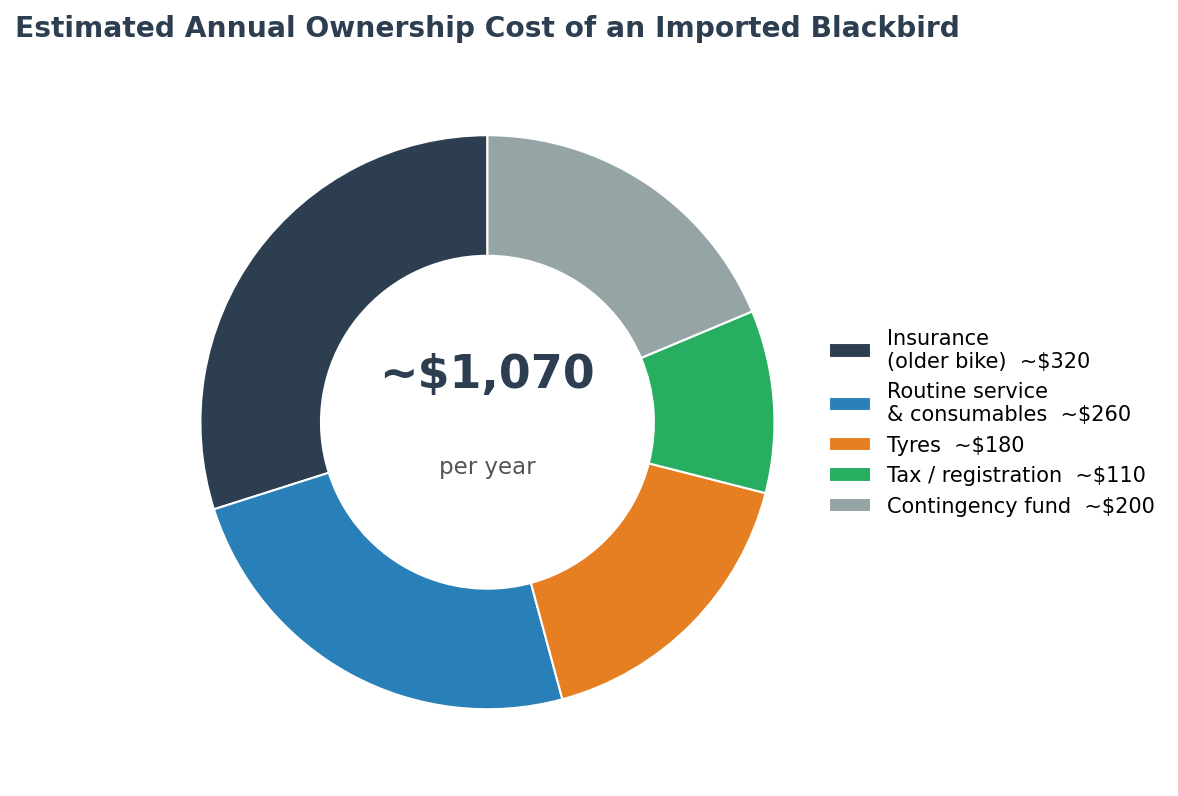
The stronger argument is depreciation that already happened. A Blackbird has shed almost all the value it's going to shed. Buy a clean one for $6,000 landed, ride it for five years, and you'll likely sell it for close to what you paid — try that with a new bike that loses a third of its value before the first service. Add cheap parts, cheap insurance on an older machine, and an engine that won't need rebuilding in your lifetime of ownership, and the running cost is what makes it smart, not speculation.
Buy on condition and history rather than chasing the cheapest example, get a well-graded Japanese-market bike with an honest sheet, and the Blackbird rewards you twice — as a bike to ride hard and as one that holds its money while you do.
Five Mistakes First-Time Blackbird Importers Make
Most import horror stories trace back to the same handful of avoidable errors. Skip these and you're most of the way to a clean buy.
1. Buying before checking the home rules. This is the cardinal sin, and it's costly in Australia especially. Confirm your import pathway and any approval you need before you bid, not after the bike is on a boat.
2. Chasing the cheapest sheet. A grade-3 bargain that needs paint, brakes and carbs isn't a bargain once you add the bills. A grade-4.5 bike at a slightly higher hammer price is almost always the cheaper bike in the end.
3. Ignoring the carb-versus-injection question. Buy a cheap 1997 carb bike that's sat for three years and your "running" import will need the carbs stripped before it idles. Know which bike you're getting and price the work in.
4. Skipping extra photos. The auction sheet is gold, but a good agent can pull additional close-ups of the meter, frame and switchgear. If a price looks too good for the grade, ask for the photos before you trust it.
5. Bidding without a ceiling. The supply is steady — another clean Blackbird lists next week. Set a hard maximum and walk away when it's exceeded. The discipline is the whole reason importing from Japan stays cheap.
Step-by-Step: How to Buy and Import Your Blackbird
Here's the whole process, start to finish, with no mystery steps hidden in the middle.
1. Set your budget and pick your generation. Decide carb or injection, set an all-in ceiling (hammer plus roughly 80–120%), and confirm your country's import pathway before you spend a yen.
2. Get auction access through an agent. You can't bid at Japanese dealer auctions yourself — they're members-only. An import partner gives you access, translates the sheets, and bids to your limit.
3. Hunt the auctions and read the sheets. New stock lists weekly. Your agent sends you graded candidates; you pick the ones that match your year, mileage and grade targets, and request extra photos on anything promising.
4. Bid with a hard ceiling. Set your maximum and don't chase. Another clean Blackbird will be along next week — discipline is what keeps importing cheap.
5. Win, then let the agent handle export. Deregistration, export certificate, domestic transport to port, and booking the ocean freight all happen on the Japan side.
6. Clear customs and register at home. File the right forms for your country, pay any VAT/GST/duty, pass any required inspection, and put it on a plate. Then go ride the fastest bike of 1997 for the price of a clapped-out commuter.
How AWA Auction Makes Importing a Super Blackbird Simple
Bidding at a Japanese dealer auction isn't something you can do from your sofa in Sydney or Seattle. The auctions are members-only, run entirely in Japanese, and move fast. You need someone on the inside. That's exactly what AWA Auction is.
We give you direct access to the same auctions the professionals use, with every auction sheet translated and explained so you know precisely what you're bidding on — grade, mileage, accident history, the lot. We inspect, we bid to your limit, we handle the export paperwork, and we arrange shipping to your port. Then we walk you through your country's registration steps so the bike doesn't get stranded at the dock. No middlemen marking the bike up three times. No guessing.
Want to see what's crossing the block right now? Browse our current listings to see live Japanese-market bikes, and when you're ready to put a Super Blackbird on your shortlist, contact our team and tell us the year, mileage and grade you're after. We'll do the hunting while you get the garage ready.
See Also
Share this article: