
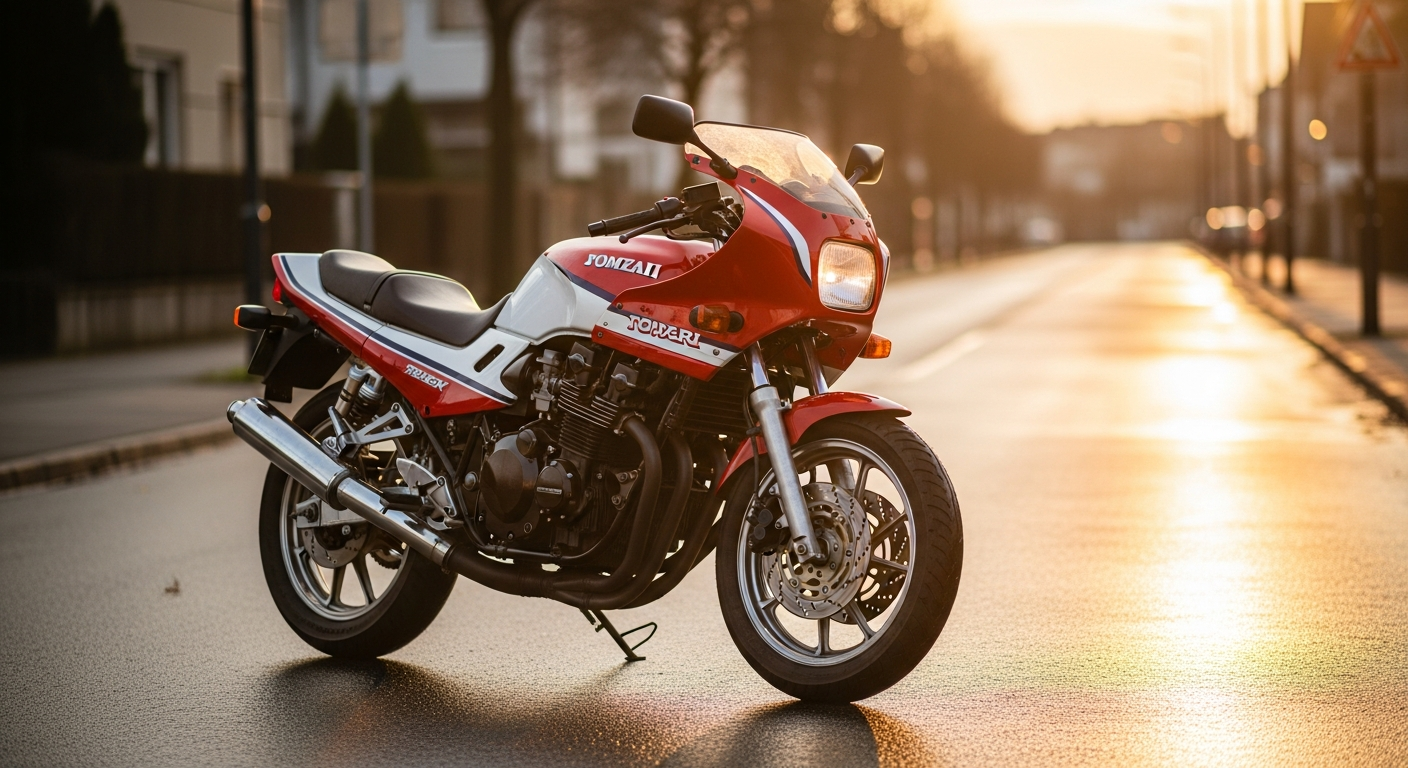
In 1992, Honda did something the rest of the motorcycle industry thought was impossible. It built a litre-class sportbike that weighed about as much as a 600, made nearly 124 horsepower, and turned like a featherweight. The engineer behind it, Tadao Baba, ignored the era's horsepower war and chased one number instead: total weight. The result was the CBR900RR Fireblade, and it didn't just win comparison tests. It rewrote the rulebook every superbike since has been forced to follow.
Here's the part nobody tells you: the cleanest, lowest-mileage, most honest CBR900RRs left on the planet are sitting in Japan right now. And thanks to a 25-year import rule that keeps unlocking new model years, you can buy one and ship it home for less than you'd pay for a tired, crash-repaired example in your local classifieds.
This guide walks you through exactly how to import a Honda CBR900RR from Japan in 2026 — which years to chase, what they really cost landed on your driveway, the import rules for your country, the auction-sheet red flags that separate a gem from a money pit, and the mechanical quirks that are specific to this bike. Treat it as your starting point, then inspect every individual machine on its own merits. Every Fireblade has a history, and that history is written on the bike.
Why the Honda CBR900RR Is Worth Importing in 2026
Most people who want a first-generation Fireblade have already noticed the problem. The good ones have vanished. In the US, UK, and Australia, these bikes were ridden hard, dropped, stunted, track-dayed, and modified into oblivion. Find a clean one locally and the owner knows exactly what they're sitting on, so the price reflects it.
Japan is the opposite world. Bikes there are usually a second or third hobby machine, ridden gently, stored indoors, and maintained on a strict schedule. The roads are smooth, the riding season is short in much of the country, and the inspection culture (shaken) pushes owners to keep everything documented. That's why a 1996 CBR900RR with 18,000 km and a stack of service records is a normal listing at a Japanese auction, not a unicorn.
Then there's the financial angle. The Fireblade holds its value extremely well — it's a genuinely sought-after modern classic, and the early "round eye" 1992 and 1993 models are already turning into collector pieces. Buying from the source, before a bike has passed through two or three middlemen, is how you get ahead of that curve instead of chasing it.
The timing is the last piece. Import rules in most English-speaking countries reward age. The older the Fireblade, the cheaper and simpler it is to land. As each year ticks over, another model year of CBR900RR crosses the magic threshold. 2026 is a sweet spot: the original SC28 generation is comfortably legal everywhere, and the later, faster SC44 is now crossing the line in countries with a 25-year rule.
The CBR900RR Generations Explained (From a Buyer's Point of View)
The "CBR900RR" name covers nearly a decade of very different bikes. If you don't know which generation you're looking at, you can't judge whether a price is fair or whether the bike fits what you actually want. Honda used internal frame codes — SC28, SC33, and SC44 — and those codes tell you more than the model year ever will.
SC28 (1992–1995): The Original 893cc Fireblade
This is the one that started it. An 893cc inline-four making around 124 bhp, wrapped in a chassis so light it embarrassed bikes a class below it. The 1992–1993 models have the distinctive round headlights — the "round eye" or "urban tiger" era — and these are the most collectible. In 1994 Honda switched to the "fox eye" headlights and made small refinements.
What to know as a buyer: the SC28 feels raw and nervous by modern standards, with a famously light front end that wants to wave its hand in the air. That's the charm. It's the purest expression of Baba's weight obsession. These are now the cheapest Fireblades to import legally to the strict-rule countries because they're the oldest, and they're the ones appreciating fastest.
SC33 (1996–1999): The Refined Carburettor Blade
For 1996, Honda bumped the engine to 918.5cc and around 126 bhp, revised the chassis and suspension, and calmed the handling down just enough to make the bike usable without dulling it. The 1998–1999 models got another round of updates. Critically, 1999 was the last year of carburettors before fuel injection arrived, which matters for the simplicity-minded buyer.
This is the sweet spot for most riders. The SC33 keeps the analogue, mechanical character of the original but adds real-world rideability. Parts are plentiful, the community knowledge is deep, and prices are still sane. If you want one Fireblade to actually ride rather than polish, this is usually it.
SC44 (2000–2001): The Fuel-Injected 929cc
The 2000 model — frame code SC44, sometimes called the CBR929RR — was a near-total redesign. An all-new 929cc engine with electronic fuel injection making around 151 bhp, a titanium exhaust, a 17-inch front wheel replacing the old 16-incher, and far sharper, more planted handling. It's the fastest and most modern-feeling of the bikes covered here.
For importers, the SC44's appeal is simple: in countries running a 25-year rule, the 2000–2001 cars are right at the edge of eligibility, so you can now get a genuinely quick, fuel-injected superbike for modern-classic money. The trade-off is that fuel injection and more electronics mean slightly more to go wrong, but it's still a Honda — which is to say, built to outlast its owner.
A Short History: How the Fireblade Changed Everything
To understand why importing a CBR900RR is worth the effort, you have to understand what it did. In the late 1980s, the litre-class superbike formula was simple and stupid: more power, more weight, more everything. Bikes were fast in a straight line and terrifying everywhere else.
Honda's Tadao Baba looked at that and asked a different question. Instead of "how much power can we make?" he asked "how light can we make the whole motorcycle?" His team treated weight as the enemy and chased "total control" — the idea that a rider should feel completely in command, not be hanging on for survival. When the CBR900RR landed in 1992 making big-bike power at middleweight mass, the established order fell over.
The numbers tell the story. The original Fireblade weighed roughly what a 600 weighed while making nearly 124 horsepower, with a wheelbase short enough to make the front wheel light under acceleration. Reviewers were equal parts thrilled and alarmed. The bike was so influential that the entire modern superbike category — the R1, the GSX-R1000, every focused litre bike since — is essentially chasing the template Baba drew.
That legacy is exactly why these bikes are treasured in Japan and increasingly collected worldwide. A documentary on the Fireblade's history has drawn well over 740,000 views, and that audience isn't watching for transport tips — they're watching because this machine matters. When you import a clean CBR900RR, you're not just buying a fast old bike. You're buying the one that started it all.
Why Japan Has the Best CBR900RRs in the World
You can buy a Fireblade anywhere. So why go to the trouble of importing one across an ocean? Because the Japanese used market is structurally different, and that difference shows up in the metal.
Start with how the bikes were used. Japan has a deep, obsessive enthusiast culture — riders there fuss over originality and condition in a way that's almost a sport in itself. A YouTube documentary on the Fireblade's history has pulled over 740,000 views from people who treat these bikes as legends, not transport. That reverence translates into bikes that were cherished, not thrashed.
Then there's the auction system. Japan moves used motorcycles through professional dealer auctions where every bike is inspected and graded by a neutral third party. The inspector notes mileage, mechanical condition, cosmetic faults, and any signs of accident repair on a standardised auction sheet. You're not trusting a private seller's optimism — you're reading an independent report. We'll cover how to actually read one of these sheets shortly, because it's the single most powerful tool you have.
Volume matters too. The sheer number of well-kept Japanese-market bikes means you're choosing from dozens of CBR900RRs at any given time, not settling for the one that happens to be near you. Want a 1996 SC33 in original paint with under 20,000 km? In Japan, you wait a week and three show up. The popular "I bought a 40-foot container of motorcycles from Japan" video genre — one such video has racked up nearly 19 million views — exists precisely because the supply of clean, desirable bikes is that good.
One honest caveat: Japanese-market bikes were sometimes restricted to a lower power output to comply with domestic regulations, and the famous "gentlemen's agreement" capped headline figures for a period. On a Fireblade this is rarely a dealbreaker, but it's worth confirming a bike is making full power, and the origin can be checked against the VIN. A reputable export agent will tell you exactly what you're looking at.
What It Actually Costs to Import a CBR900RR From Japan
This is where most guides go vague. Let's not. Here is a realistic, all-in breakdown for landing a CBR900RR in your driveway, using typical 2026 figures. Your exact numbers shift with the bike, the exchange rate, your port, and your country's taxes, but the shape of it holds.
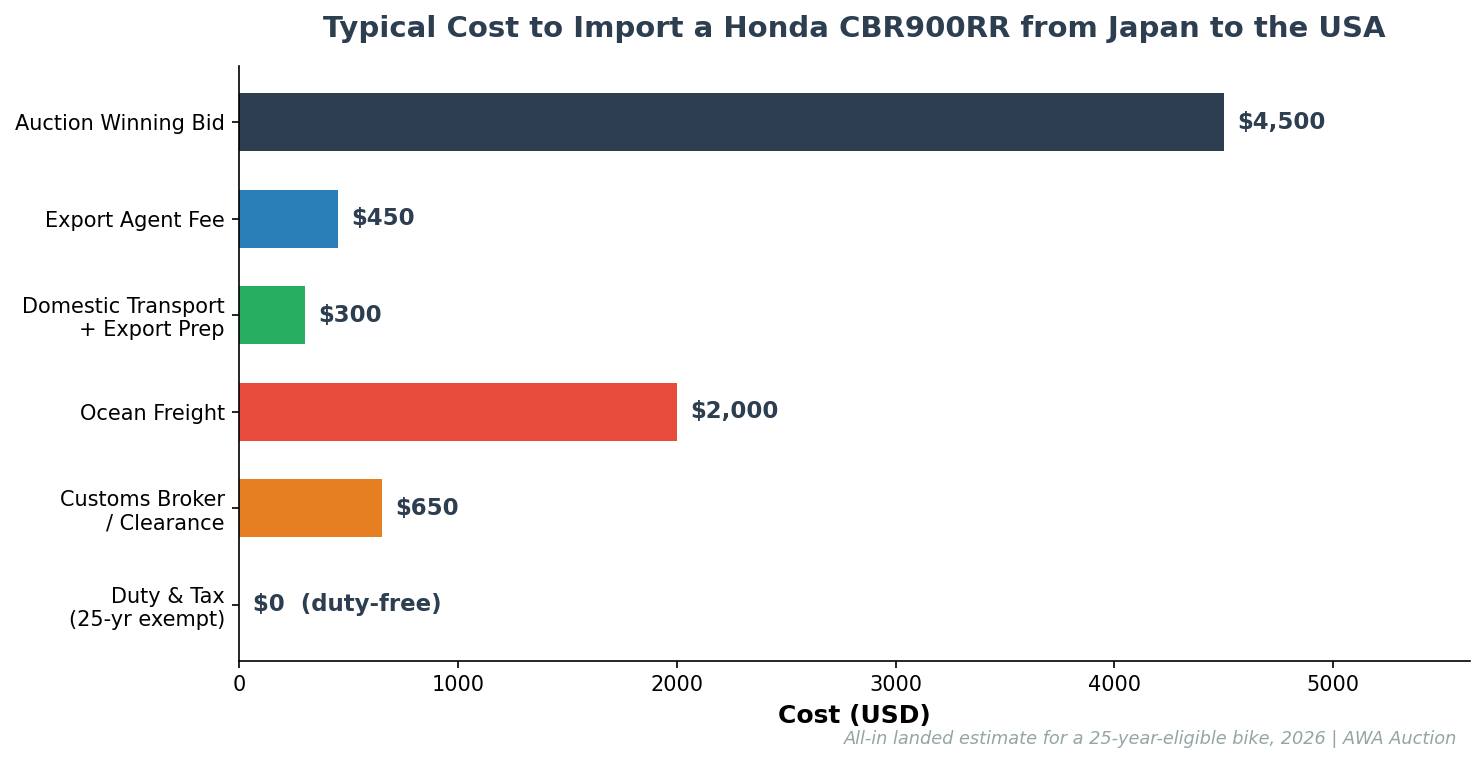
A clean SC33 can hammer for the equivalent of $3,500–$5,500 at a Japanese auction. On top of the winning bid, budget for the export agent's fee, domestic transport to the port, ocean freight, marine insurance, and then your own country's customs clearance, duty, and tax. A useful rule of thumb from seasoned importers: add roughly 30% on top of the purchase price to cover everything before the bike is legally yours and on the road.
Here's the typical cost stack for a US import of a 25-year-eligible bike:
- Auction winning bid: $3,500–$5,500 for a good SC33; less for a rough SC28, more for a collector-grade round-eye.
- Export agent fee: roughly $300–$600, covering bidding, paperwork, and export documentation.
- Domestic transport + export prep: $200–$400 to get the bike to port and cleared for export.
- Ocean freight: $1,200–$2,800 depending on container vs. RoRo and destination port.
- Customs broker / clearance: $400–$900 for full clearance at your end.
- Duty and tax: this is where the 25-year rule changes everything — see the next section.
Add it up and a tidy, vintage-eligible Fireblade often lands in the US for somewhere in the $6,000–$9,000 range all-in. Compare that to what a clean original example costs domestically and the math starts to make sense — especially when the imported bike has lower miles and better records.
The 25-Year Rule and the 2025 Tariff Twist
If you're importing to the United States, this is the section that pays for your whole trip. The 25-year rule lets any vehicle 25 years or older come in exempt from the EPA emissions and DOT safety standards that make newer imports a nightmare. For a motorcycle, that means no federalisation, no compliance retrofits, no headaches. The bike comes in as a collectible.
The math is friendly. As of 2026, every CBR900RR from 1992 through 2001 has crossed or is crossing the 25-year line. The original SC28 is long clear, the SC33 is fully eligible, and the SC44 is now arriving. You get to pick from the entire production run.
Now the twist that catches people out. In April 2025, the US introduced a sweeping 25% tariff on imported vehicles and parts. On paper that sounds like a disaster for importers. But here's what matters for you: vehicles qualifying under the 25-year classic exemption land at a zero-duty outcome on both the base rate and the new measures at the same time. In plain English — a 25-year-old Fireblade dodges the 25% bullet entirely, while a newer grey-market bike would get hammered.
That single rule is the strongest argument for buying older rather than newer right now. A 1999 SC33 and a 2003 model can look similar in a listing, but on import the older bike can save you thousands in tariff alone. The age that makes a bike a "modern classic" is the same age that makes it cheap to bring home.
One practical note: the 25-year clock runs from the actual month and year of manufacture, not the model year on the brochure. A late-2000 build and an early-2001 build can differ by months at the border. Confirm the production date before you bid, because a few weeks can be the difference between a clean entry and a bike that sits in bond.
CBR900RR Import Rules by Country
The 25-year rule is a US thing. Every country handles imports differently, so here's the short version for the main English-speaking markets. Always confirm the current detail with your national authority before you commit, because the thresholds and fees do move.
United States
Use the 25-year exemption and the process is about as simple as importing a vehicle gets: EPA and DOT exempt, and — for now — duty-free under the classic-vehicle carve-out even after the 2025 tariff changes. You'll still file the standard customs entry and your state will want to title and register it, but there's no compliance engineering.
United Kingdom
The UK doesn't use a flat 25-year rule, but age still helps enormously. Bikes over 10 years old that are unmodified and meet basic safety standards are generally exempt from the MSVA (Motorcycle Single Vehicle Approval) test that newer non-EU imports must pass. On the tax side, expect 6% customs duty for bikes over 250cc plus 20% VAT — but bikes over 30 years old are duty-free and attract a reduced 5% VAT. The 1992–1995 SC28 is right at that 30-year line now, which is a serious saving.
Australia
Australia runs its own 25-year rule under a concessional import scheme — as of 2025 that covers bikes built in 2000 or earlier, so the SC28, SC33, and the earliest SC44 are in. The catch is quarantine. The Department of Agriculture is ruthless about cleanliness: drain the fuel tank to under 10%, pressure-wash the undercarriage spotless, and degrease the engine to keep out soil, plant matter, and insects. A bike that fails the biosecurity inspection sits on the dock racking up fees.
New Zealand and Canada
New Zealand is one of the easier markets — it has no blanket age bar, though imported bikes must pass entry certification and the usual compliance checks. Canada, like the US, runs a 15-year rule for vehicles (more generous than the US 25-year rule), so essentially every CBR900RR is eligible; you'll deal with the RIV process and provincial registration. In both cases the Fireblade's age works in your favour.
Which CBR900RR Generation Should You Buy?
The right Fireblade depends on what you want from it and how strict your country's import rules are. Here's the honest guidance, generation by generation.
Buy an SC28 (1992–1995) if you want the original, the collectible, the one with the rawest character. The early round-eye 1992–1993 bikes are the ones to hold for the long term — they're appreciating, they're the cheapest to import to the strictest-rule countries, and they're the purest version of the idea. The trade-off is that the riding experience is nervous and the bike is genuinely old, so condition is everything.
Buy an SC33 (1996–1999) if you actually want to ride it a lot. It keeps the analogue charm but adds enough refinement to be a usable weekend bike. It's the value sweet spot, with the deepest parts and knowledge base. For most importers, this is the smart pick.
Buy an SC44 (2000–2001) if you want speed and modern manners and your rules allow it. Fuel injection, 151 bhp, sharper handling — it's the one that feels closest to a current bike while still qualifying for classic treatment in 25-year-rule countries.
Landed cost climbs with the generation, but so does performance. The chart below shows realistic all-in landed price ranges by generation for a clean, well-graded example in 2026.
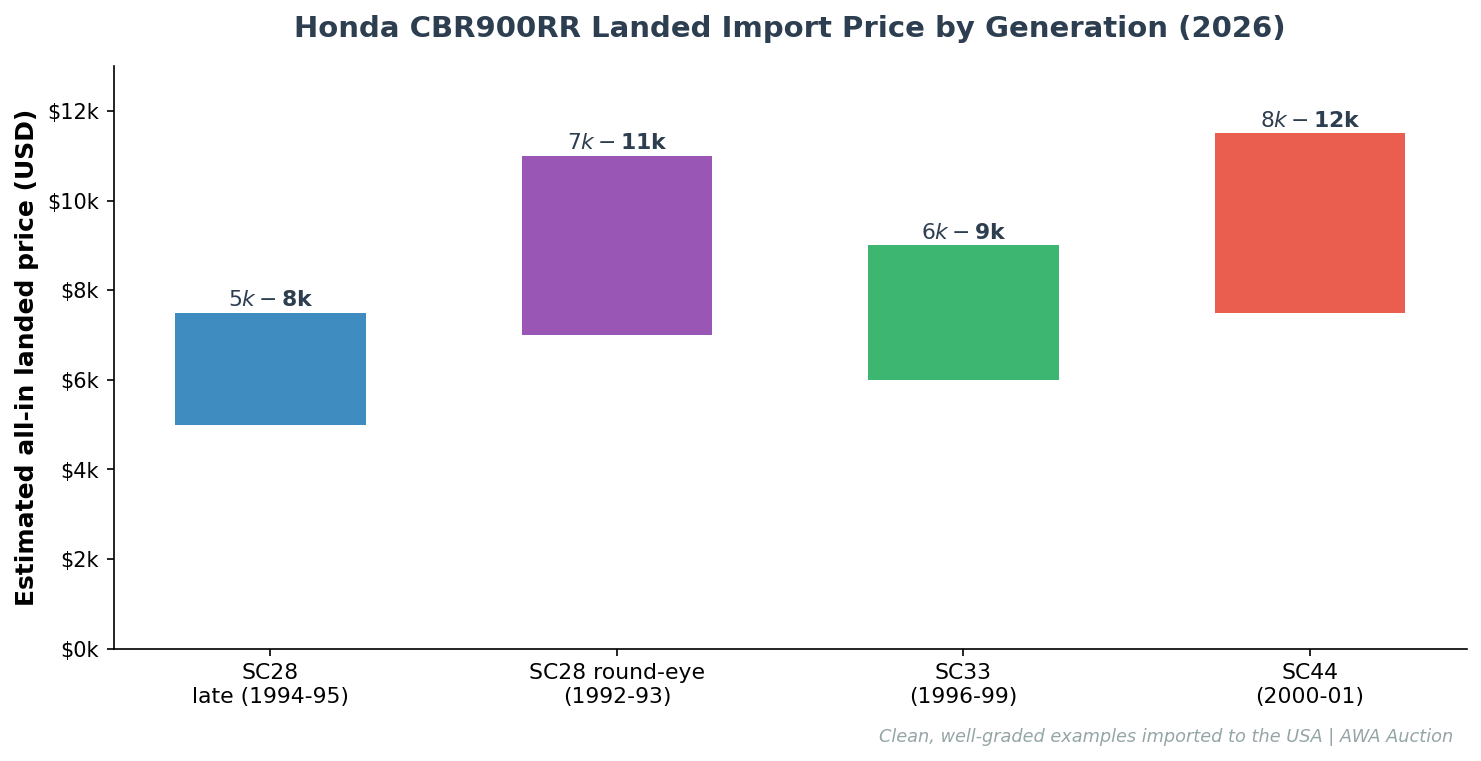
Note how the early round-eye SC28 carries a premium over the later SC28 despite being the oldest — that's collector demand at work. If you're buying to ride, the middle of this range gives you the most bike for the money. If you're buying to keep, the round-eye is the one that rewards patience.
CBR900RR vs the Other Japanese Litre Bikes
The Fireblade didn't exist in a vacuum. It kicked off an arms race, and the bikes it fought are also sitting in Japanese auctions right now. If you're shopping the imported-superbike market, it helps to know where the CBR900RR sits against its rivals. The enduring popularity of the "big four Japanese litre bikes" comparison — one such video has pulled over two million views — tells you these machines still own enthusiasts' imaginations decades later.
Against the early Yamaha YZF-R1, the CBR900RR is the older, more analogue, more forgiving bike. The R1 (from 1998) is sharper and more aggressive but came later, so the Fireblade is usually the cheaper and earlier classic to import. Against the Suzuki GSX-R750 and GSX-R1000, the Fireblade trades outright track focus for everyday usability and that famous low weight. Against the Kawasaki ZX-9R, the Honda is lighter and more nimble where the big Kawasaki is the brawnier, more touring-capable option.
The point isn't that one is "best." It's that the CBR900RR offers something specific: the lowest weight, the most historical significance as the bike that created the class, and — because it came first — generally the earliest import eligibility and the friendliest prices. If you want the bike that started the modern superbike, this is it. If you want the most outright power, you may prefer to cross-shop the others, and a good import agent can pull sheets for all of them so you compare like for like.
What Counts as High Mileage on a CBR900RR?
Riders coming from the car world panic at motorcycle odometers, and they shouldn't. A Fireblade engine is built to a standard that makes a five-figure mileage figure almost meaningless if the bike was maintained.
A CBR900RR with 30,000–40,000 km that's been serviced on schedule is barely run in. These engines genuinely go past 100,000 miles with routine care — oil changes on time, valve checks, chain and sprocket attention, and not being left to rot between rides. What matters far more than the raw number is the pattern of use and the paperwork behind it.
This is another reason the Japanese market wins. A documented 25,000 km SC33 with stamps and an honest auction sheet is a better buy than a "low mileage" local bike with no history and a suspiciously clean speedo. Mileage you can trust beats mileage that's merely low. Buy the records, not just the number.
How to Read a Japanese Auction Sheet (and the CBR900RR Red Flags)
The auction sheet is your eyes on the ground. Learn to read it and you can buy a bike sight-unseen with more confidence than you'd have standing in front of a private seller. Ignore it and you're gambling.
Every bike at a Japanese dealer auction gets an overall grade, usually on a scale where higher is better. A grade of 4 or above generally means a clean, honest bike with no major accident history. Grades around 3 mean cosmetic wear or minor issues. Anything graded R (or with accident notation) has been repaired after a crash — sometimes fine, often not, but always a reason to dig deeper.
The sheet also carries a diagram of the bike marked with symbols showing exactly where the scratches, dents, and rust are, plus the verified mileage and the inspector's notes. A good export agent translates all of it for you. The mileage on a Japanese sheet is generally trustworthy because the inspection happens at a neutral facility, not in the seller's garage.
Now the part general buying guides can't give you — the faults specific to this exact bike. When you (or your agent) inspect a CBR900RR, these are the Fireblade's known weak spots:
- Second gear: This is the big one. Hard-ridden Fireblades — read: bikes that did a lot of wheelies — are notorious for jumping out of second gear into a false neutral under load. Make sure the bike pulls hard in second without slipping. A worn gearbox is an engine-out repair.
- Regulator/rectifier and charging: Honda's charging system on these is a known weak point. The regulator/rectifier burns out, sometimes from age, sometimes because the stator overwhelms it. Check that the battery is charging properly and look for a melted or already-replaced R/R.
- Carburettors (SC28 and SC33): A carburettor bike that's been sitting gums up. Fuel varnishes inside the carbs, blocks jets, and sticks the float valves, causing leaks and rough running. A bike started and ridden regularly is worth far more than a "barn find" that's sat for years.
- Camchain tensioner: A rattle on the overrun when you blip the throttle with the bike on its stand can point to a tired camchain tensioner. Not catastrophic, but factor in the fix.
- Water pump: The water pump tends to start seeping from the weep hole around the 30,000-mile mark. Check underneath for coolant residue.
The reassuring news: a well-maintained CBR900RR will happily run past 100,000 miles. Most problems on these bikes come from neglect, crash damage, or theft recovery — not from the engineering. Check thoroughly for all three and the bike will look after you.
Step-by-Step: How to Import a CBR900RR From Japan
Here's the whole process, start to finish, so you know what you're signing up for before you begin.
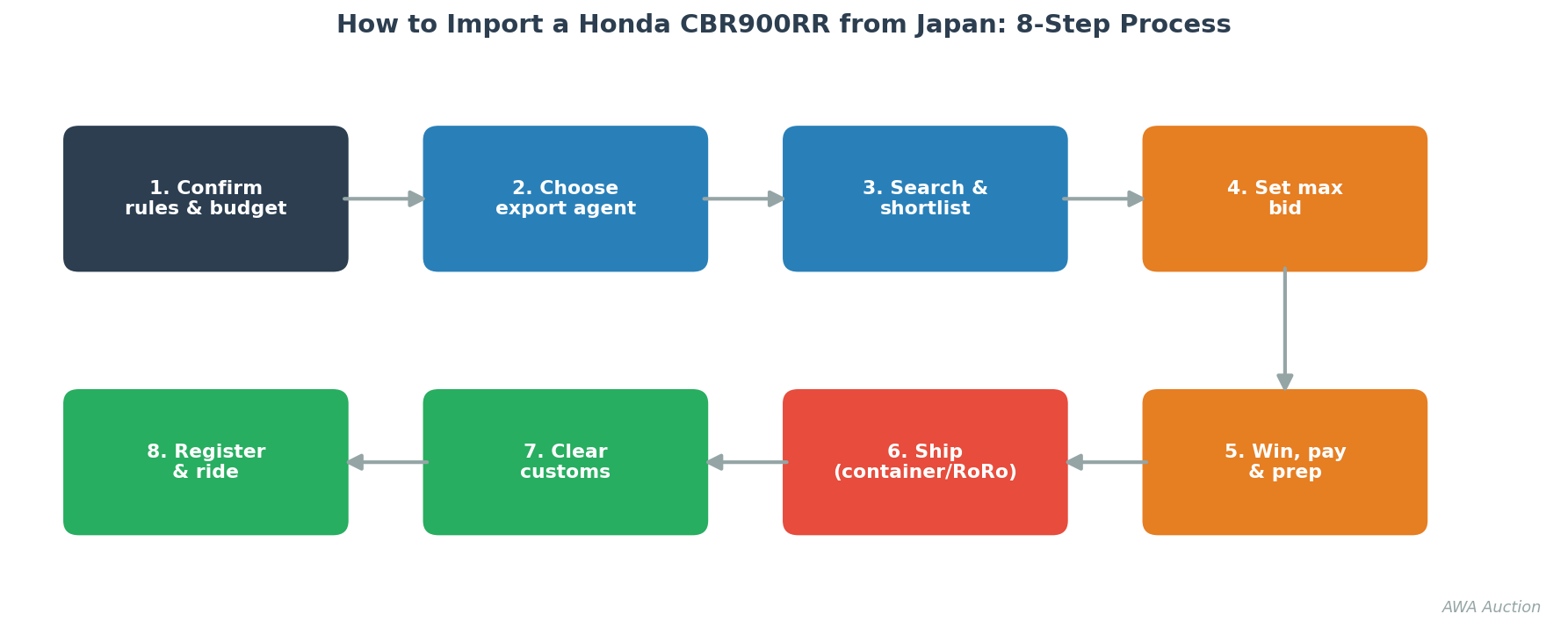
- Confirm your country's rules and your budget. Pin down the eligible model years for where you live and set an all-in number, not just a bike price. Remember the roughly 30% on top.
- Choose an export agent or auction proxy. You need access to the Japanese dealer auctions, which are closed to the public. A good agent bids on your behalf, reads the sheets, handles export paperwork, and arranges shipping. This is where AWA Auction comes in.
- Search and shortlist. Tell your agent the generation, year range, condition grade, and mileage you want. Review the auction sheets together and shortlist a few bikes.
- Set your maximum bid. Decide your ceiling for each bike and let the agent bid. If you lose, you wait for the next one — and there's always a next one.
- Win, pay, and prep for export. Once you win, you pay the bid plus fees. The bike gets transported to port, de-registered for export, and prepared for shipping.
- Ship. Choose container (safer, pricier) or RoRo (cheaper, more exposure). Transit to the US or UK typically runs a few weeks; Australia and New Zealand similar.
- Clear customs and pay duties. Your broker files the entry. Pay any duty and tax — or enjoy the zero-duty outcome if your bike qualifies under the classic exemption.
- Register and ride. Title and register through your local authority, get any required inspection done, insure it, and go.
Is the CBR900RR Reliable Enough to Import?
Short answer: yes, with eyes open. The Fireblade earned its reputation partly because it was a Honda, and Hondas of this era are famously over-built. The bottom end is strong, the engine tolerates abuse, and parts availability is excellent thanks to how many were made and how passionate the community is.
That doesn't mean every example is good. A bike's condition is a story about its previous owner, not its model. The whole reason you import from Japan is to load the dice in your favour — gentler use, better storage, documented service, and an independent inspection before you buy. Enthusiasts who've bought container-loads of Japanese bikes report that the genuine cold-start, runs-perfectly survivors are the rule, not the exception, when you buy on the sheet. There's a popular video of a 1993 CBR900RR firing up on the first cold crank after a long flight across the Pacific — over 400,000 people have watched it precisely because that outcome is so satisfying and so common.
Buy on grade, confirm the second gear and the charging system, make sure a carb bike has been run regularly, and you're getting a 30-year-old machine that behaves like it's barely broken in. That's the trade the Japanese market offers: do the homework, get the gem.
Container vs RoRo: Which Shipping Method for a Fireblade?
Once you've won your bike, you choose how it crosses the ocean. There are two ways, and the right one depends on your budget and your nerves.
Container shipping means your CBR900RR is strapped down inside a steel container, often sharing space with other bikes or vehicles. It's the safer option — the bike is protected from weather, salt spray, and handling damage, and there's far less chance of a scratch or a missing mirror at the other end. It costs more, especially if you don't fill a whole container, but for a collectible Fireblade the peace of mind is usually worth it. If you've ever seen the "40-foot container of motorcycles from Japan" videos that pull millions of views, that's container shipping at scale — and it's popular for a reason.
RoRo (roll-on/roll-off) means the bike is secured on a vehicle deck of a dedicated car-carrier ship. It's cheaper and perfectly common, but the bike is more exposed during the journey and to dockside handling. For a cheaper SC28 project it can make sense; for a pristine round-eye you intend to keep, most importers spend the extra on a container.
Either way, transit to the US East or West Coast or to the UK typically runs a few weeks, with Australia and New Zealand similar. If you want the full breakdown, our guide to container vs RoRo motorcycle shipping goes deeper, and our guide to Japanese auction grades explains exactly what those sheet scores mean before you bid.
How Import Costs Compare by Country
Where you live changes the total bill more than which bike you pick. The same CBR900RR lands at very different prices in different countries once duty, tax, and compliance are factored in. The chart below compares the typical added cost on top of the bike for the main markets in 2026.
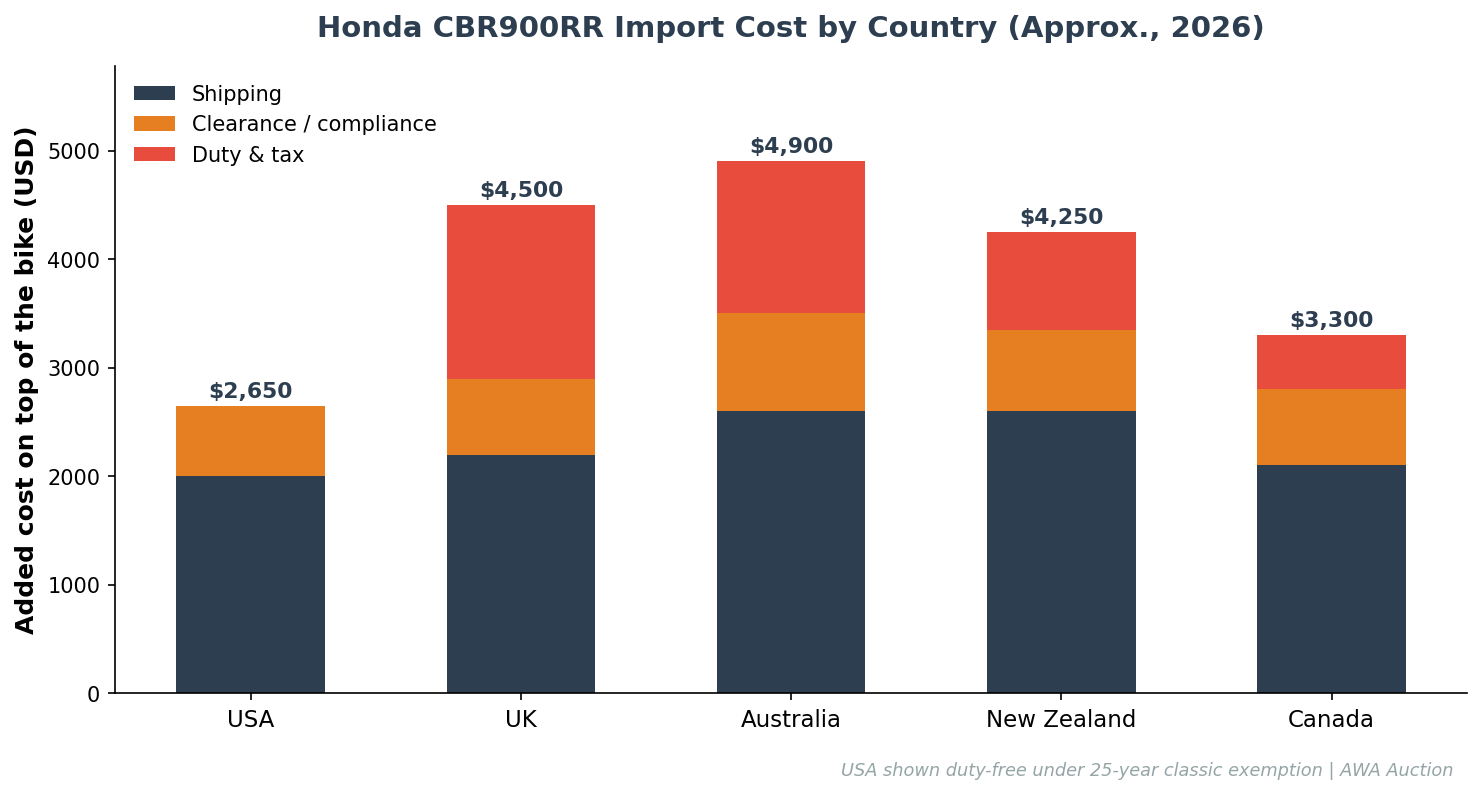
The United States is the cheapest destination for an eligible bike, because the 25-year classic exemption wipes out both standard duty and the 2025 vehicle tariff. The UK costs more thanks to 20% VAT, though a bike over 30 years old drops to a 5% VAT rate and zero duty — which is why the early SC28 is suddenly such a clever UK buy. Australia adds quarantine cleaning and compliance on top of shipping, so its landed figure runs higher, but the bikes available are worth it. New Zealand and Canada sit in between, helped by friendlier age rules.
The practical takeaway: match the bike to your country's rules. If you're in the UK, the 30-year-old SC28 is a tax bargain. If you're in the US, you can chase the faster SC44 without a tariff penalty. The smartest importers let the rules guide which generation they hunt.
When Is the Best Time to Buy and Import a CBR900RR?
Timing works on two clocks: the market clock and the calendar clock. Both are in your favour right now if you move with intent rather than waiting forever.
On the market clock, the trend is one direction — up. The early round-eye SC28 is already a recognised collectible, and clean examples of every generation are getting harder to find as the rough ones get used up or broken for parts. Buying a documented Japanese-market bike today, before another wave of buyers wakes up to the same idea, is how you get in ahead of the appreciation rather than paying for it after the fact.
On the calendar clock, the 25-year and 30-year thresholds keep working in your favour as bikes age into easier, cheaper import categories. A Fireblade that's borderline today becomes fully duty-friendly tomorrow. There's no penalty for the bike getting older — only upside on the paperwork.
Within the year, Japanese auction supply ebbs and flows, and a patient buyer who's set up with an agent in advance can pounce when the right grade-4 bike appears instead of scrambling to arrange access in a hurry. The losing move is to admire these bikes from a distance for five years while prices climb and clean stock thins out. The winning move is to get your access and budget sorted now, then strike when the right sheet lands. The bike you want is in Japan today. The question is whether you're ready to bid on it.
How AWA Auction Makes Importing a CBR900RR Simple
Bidding at a Japanese dealer auction is not something you can do from your sofa in Sydney or Seattle. The auctions are members-only, run in Japanese, and move fast. You need someone on the inside. That's exactly what AWA Auction is.
We give you direct access to the same auctions the professionals use, with the auction sheets translated and explained so you know precisely what you're bidding on. We inspect, bid to your limit, handle the export paperwork, and arrange shipping to your port — and we walk you through your country's registration steps so the bike doesn't get stuck at the dock. No middlemen marking up the bike three times. No guessing.
Want to see what's crossing the block right now? Browse our current listings to see live Japanese-market bikes, and when you're ready to put a Fireblade on your shortlist, contact our team and tell us the year and condition you're after. We'll do the hunting.
See Also
Share this article: