
The Honda NSR250 is the bike that ruined a generation of riders for everything else. It is a 249cc two-stroke V-twin built to mimic Honda's all-conquering NSR500 Grand Prix machine, and Honda only ever sold it in Japan. That single fact is why importing a Honda NSR250 from Japan is not some exotic detour — it is the only honest way to own one. There is no local dealer stock to pick from in the US, the UK, or Australia. Every clean NSR250 on the road outside Japan came off a boat.
And right now, in 2026, the timing has never been better. The US 25-year rule has finally rolled far enough forward that the entire NSR250 family — from the 1987 MC16 to the last 1999 MC28 — is legal to bring in. The bikes that a generation of Western teenagers stuck on their bedroom walls are now landing on American driveways every month.
This guide is the one we wish existed when we started buying these. We will walk through every model generation, the trim levels that actually matter, the restricted-power myth that confuses every first-time buyer, what one truly costs to land in your garage, how the Japanese auctions work, and the exact faults that separate a $4,000 dream from a $12,000 nightmare. By the end you will know precisely what you are looking at, and what the auction sheet is really telling you.
Why the Honda NSR250 Is Worth Importing
Start with the engine, because that is the whole reason this bike exists. The NSR250R runs a 249cc 90-degree V-twin two-stroke with crankcase reed-valve induction and Honda's RC-Valve electronic powervalve system. It revs to the moon, weighs almost nothing, and delivers its punch in a way no four-stroke 250 ever has. A clean one tips the scales around 131 to 140 kg dry depending on the year — less than half what a modern middleweight weighs.
People do not import these because they are practical. They import them because the NSR250 is a road-legal replica of a 500cc GP weapon, sold in an era when Honda, Yamaha, and Suzuki were locked in a domestic horsepower war so intense the government had to step in. The Japanese 250 two-stroke class of the late 1980s and early 1990s produced some of the most focused small-capacity sport bikes ever built, and the NSR sat at the top of the pile.
The cultural pull is real and it is measurable. A single retrospective film on the Honda two-strokes — the NS500, NSR500 and NSR250 — has pulled over 4.1 million views on YouTube. A short clip of nothing but an NSR250R howling on the pipe has racked up 2.26 million. People who will never own one still watch them for hours. That demand is exactly why values are climbing, and why getting in now matters.
Here is the thing nobody mentions: the NSR250 is one of the last genuinely analog sport bikes. No traction control, no ride modes, no fuel injection nannying the throttle. It rewards a rider who knows what they are doing and bites the one who does not. For the right person, that is the entire appeal.
The Four NSR250 Generations: MC16, MC18, MC21 and MC28
You cannot shop for an NSR250 until you can tell the generations apart, because price, parts, and pain all swing wildly between them. Honda built the NSR250R across four chassis codes between 1987 and 1999. Learn these four codes and you are already ahead of half the people bidding against you.
MC16 (1987) — The Original
The first NSR250R. It is the lightest and rawest of the lot, with an almost prototype feel that purists still chase. The MC16 is comparatively rare and uses early-spec parts that can be hard to source, so it is a connoisseur's pick rather than a first-timer's bike. Beautiful, but buy one with your eyes open.
MC18 (1988-1989) — The Sweet Spot for Tuners
The MC18 is where the NSR250 got seriously good. The 1988 MkI and 1989 MkII are the easiest models in the whole range to return to full power, because Honda restricted them with simple tricks — a limited RC-Valve opening and tall final-drive gearing — that bolt off in an afternoon. Derestriction on these bikes is effectively free and adds real horsepower. One Japanese owner's video of a derestricted '88 MC18 making around 70 hp has pulled over 870,000 views, and that is the MC18's whole story: a factory-restricted 45 hp bike hiding a much angrier engine.
MC21 (1990-1993) — The Connoisseur's Choice
The MC21 is, for many, the NSR to own. It brought the distinctive gull-arm swingarm — the right arm bent in a "character" shape to make room for the optimal front-cylinder exhaust chamber — plus twin headlights and the PGM-III ignition. It is still simple to derestrict, parts support is strong, and it handles like the GP refugee it is. If you want one bike that balances usability, value, and that proper NSR experience, the MC21 is the default answer.
MC28 (1994-1999) — The Last and Most Complex
The final generation, and the most technically ambitious. The MC28 introduced the infamous PGM-IV "card key" dash, where a credit-card-sized key plugs into the bike and, on the SP, even alters the ignition map. It looks fantastic and it is the newest, so on paper it is the easiest to import. But the MC28 is significantly more expensive and involved to derestrict than the rest of the range, and a lost or dead card key turns into a genuine headache. Gorgeous bike, deepest wallet required.
R vs SE vs SP: Which NSR250 Grade and the Special Editions
Within most generations Honda sold three grades, and the badge on the tail tells you a lot about what you are paying for. Get this wrong and you either overpay for a sticker or miss the parts that actually matter.
The base R is the standard bike: wet multi-plate clutch, cast wheels, fixed suspension. It is the one most people should buy, and there is nothing second-rate about it. The SE steps up to a dry clutch — that lovely rattling clatter at idle — which is the headline upgrade over the base bike. The SP is the top grade and the collector magnet: a dry multi-plate clutch, lightweight magnesium Magtek wheels, and front and rear suspension with adjustable damping. The SP commands a clear premium, and it is the version speculators chase.
One myth to kill right now: there is no special SP close-ratio gearbox. Every MC21 grade — R, SE and SP — runs the same transmission ratios. People pay SP money expecting a magic gearbox that does not exist. Pay for the dry clutch, the mag wheels, and the adjustable suspension, because those are real. Do not pay for a gearbox fairy tale.
Then there are the livery editions, and this is where the money gets silly. Honda released factory-painted versions in iconic racing colors — the Rothmans schemes on the MC21 and MC28, the HRC-flavored Terra, and others. These were not just stickers; they were genuine factory editions, and a clean, original Rothmans SP is one of the most valuable NSR250s you can buy. If a seller claims a rare livery, the paint and decals being factory-correct is a big part of the value, so verify it.
NSR250 vs TZR250 and RGV250: The 250 GP Class
The NSR did not exist in a vacuum. It was the Honda entry in a three-way war against Yamaha's TZR250 and Suzuki's RGV250 Gamma, and if you are importing a Japanese 250 two-stroke, you owe it to yourself to know what the other two are before you commit. They are all brilliant, and they are not the same bike.
The Yamaha TZR250 evolved from a parallel twin into a reverse-cylinder V-twin (the 3MA and later 3XV), and the 3XV in particular is a jewel — arguably the sweetest-handling of the three for some riders, with a cult following of its own. Parts can be trickier than the Honda in places, but the TZR is a connoisseur's machine.
The Suzuki RGV250 Gamma is the wild child. It is the most aggressively race-focused of the trio, with a peakier delivery and a banana swingarm that looks like it came straight off a GP grid. An RGV will reward an aggressive rider and frustrate a lazy one. It is the one you buy when you want maximum drama.
So why does the NSR usually win the import decision? Three reasons: it has the strongest parts and knowledge base of the three thanks to its huge owner community, the MC18 and MC21 are the easiest to derestrict, and its values are the most stable, which protects your money. The TZR and RGV are fantastic and worth importing in their own right — but for a first Japanese two-stroke, the NSR is the safest brilliant choice. Buy the NSR for the support network; buy the others when you already know what you are doing.
The Restricted-Power Truth: 45 PS, Derestriction and the "70 HP" Myth
Every first-time NSR buyer trips over the same thing. The spec sheet says 45 PS — about 45 hp — and they panic, thinking the bike is gutless. It is not. That number is a polite fiction.
In the late 1980s, Japan's manufacturers agreed to a self-imposed power ceiling. For the 250 class, that meant a domestic limit of 45 PS. Honda did not build a weak engine to hit it; they built a strong engine and then strangled it with a restricted RC-Valve opening, conservative ignition timing, and tall gearing. The horsepower is in there. It is just behind a velvet rope.
Pull that rope and the bike wakes up. On the MC18 and MC21, derestriction is cheap and well-documented: free up the powervalve, sort the gearing, and address the ignition limiter, and you unlock a meaningful chunk of midrange and top end. That is why that derestricted '88 making roughly 70 hp exists and why it went viral — it is the same engine, just allowed to breathe. The MC28 can be derestricted too, but its PGM-IV electronics make the job pricier and more specialized.
What this means for you as a buyer is simple. Do not pay a premium for a bike a seller swears is "already making 70 hp" unless you can verify the work, because half of those claims are pub talk. And do not avoid a clean, honest, restricted bike — derestriction is a known, affordable path, and a tidy original is worth more than a hacked-about one with mystery modifications. Buy the condition, then unlock the power yourself.
Is the NSR250 Legal to Import? The 25-Year Rule in 2026
This is the question that decides everything, and in 2026 the answer is the best it has ever been. In the United States, a motor vehicle that is at least 25 years old can be imported without meeting the federal safety standards (FMVSS) it was never built to, and there is a parallel EPA exemption from emissions rules under the Clean Air Act. Together those two exemptions mean a 25-year-old bike comes in with no modifications at all.
The key detail everyone gets wrong: eligibility runs from the actual date of manufacture, not the marketing model year. As of early 2026, motorcycles built through roughly January 2001 qualify, and that window rolls forward every single month. The NSR250 ran from 1987 to 1999, which means the entire lineage — yes, even the last MC28s — is now comfortably past the cutoff. For the first time, you can legally import any NSR250 Honda ever made.
The paperwork is genuinely light because of those exemptions. Your customs broker files the entry with CBP, submits EPA form 3520-1 for the emissions exemption, and files DOT form HS-7, where the 25-year exemption is box 2A. That is the whole regulatory story for a bike this age. No catalytic converter retrofits, no crash testing, no compliance circus.
The UK and Australia play by different rules, but both have long, well-trodden paths for grey-import bikes — the UK through registration, an NOVA declaration and an MSVA-style check, and Australia through its import approval scheme. The NSR250 has been a grey-import staple in both countries for decades, so the process is mature. You can confirm the US specifics directly with the NHTSA importation FAQ and the EPA import guidance before you commit.
What It Costs to Import an NSR250 from Japan
Let us talk real numbers, because this is where people either get a bargain or get burned. The landed cost of an NSR250 is the auction or sale price plus a stack of predictable fees on top. None of them are mysterious once you have done it a few times.
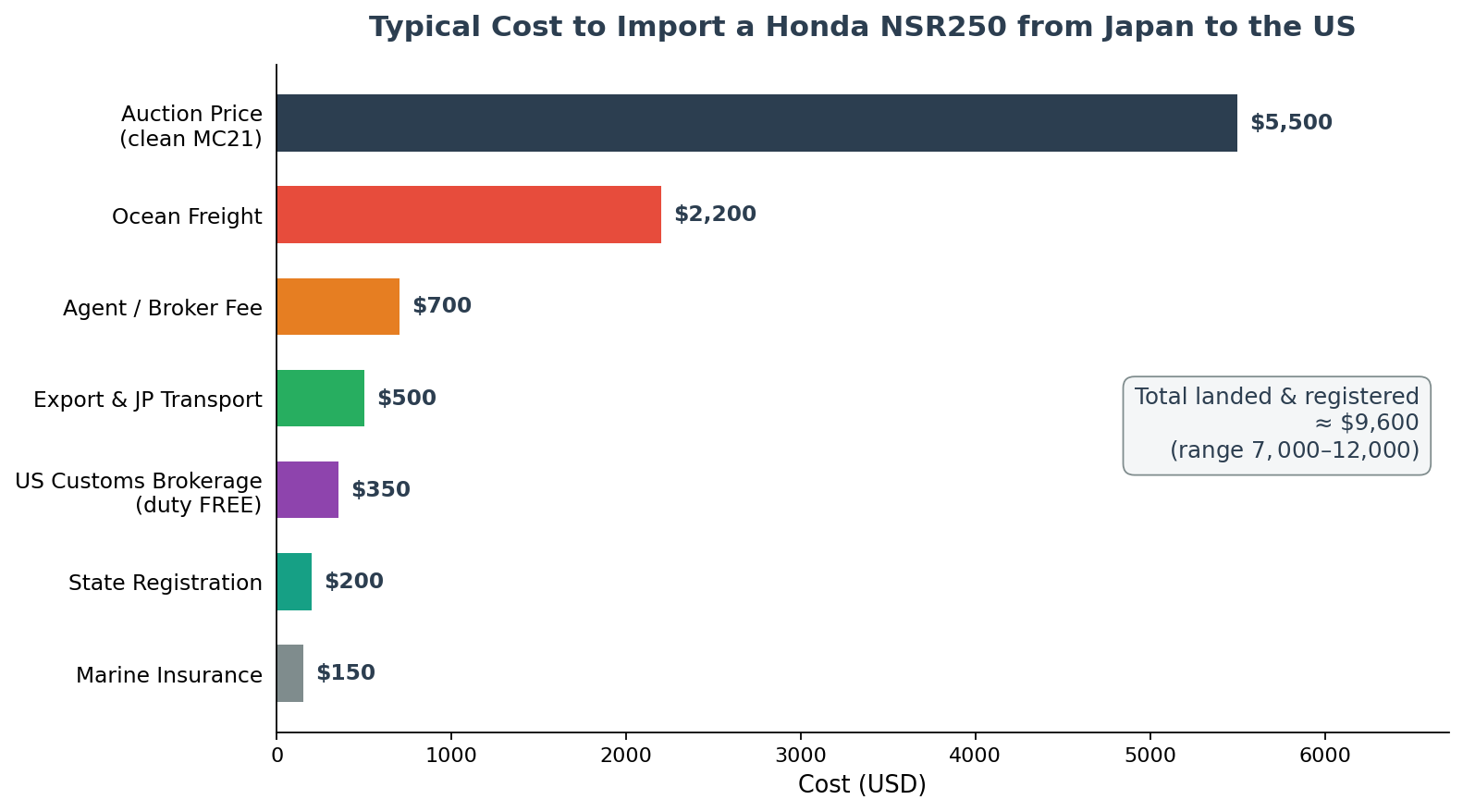
The auction price itself is the biggest and most variable line. A rough but running MC18 can change hands in Japan for the equivalent of a few thousand dollars, while a clean, original MC28 SP in a desirable livery costs several times that before it even leaves the country. On top of the hammer price you have the agent or broker fee, Japanese domestic transport to the port, export de-registration and documentation, ocean freight, marine insurance, US customs clearance, and finally state registration.
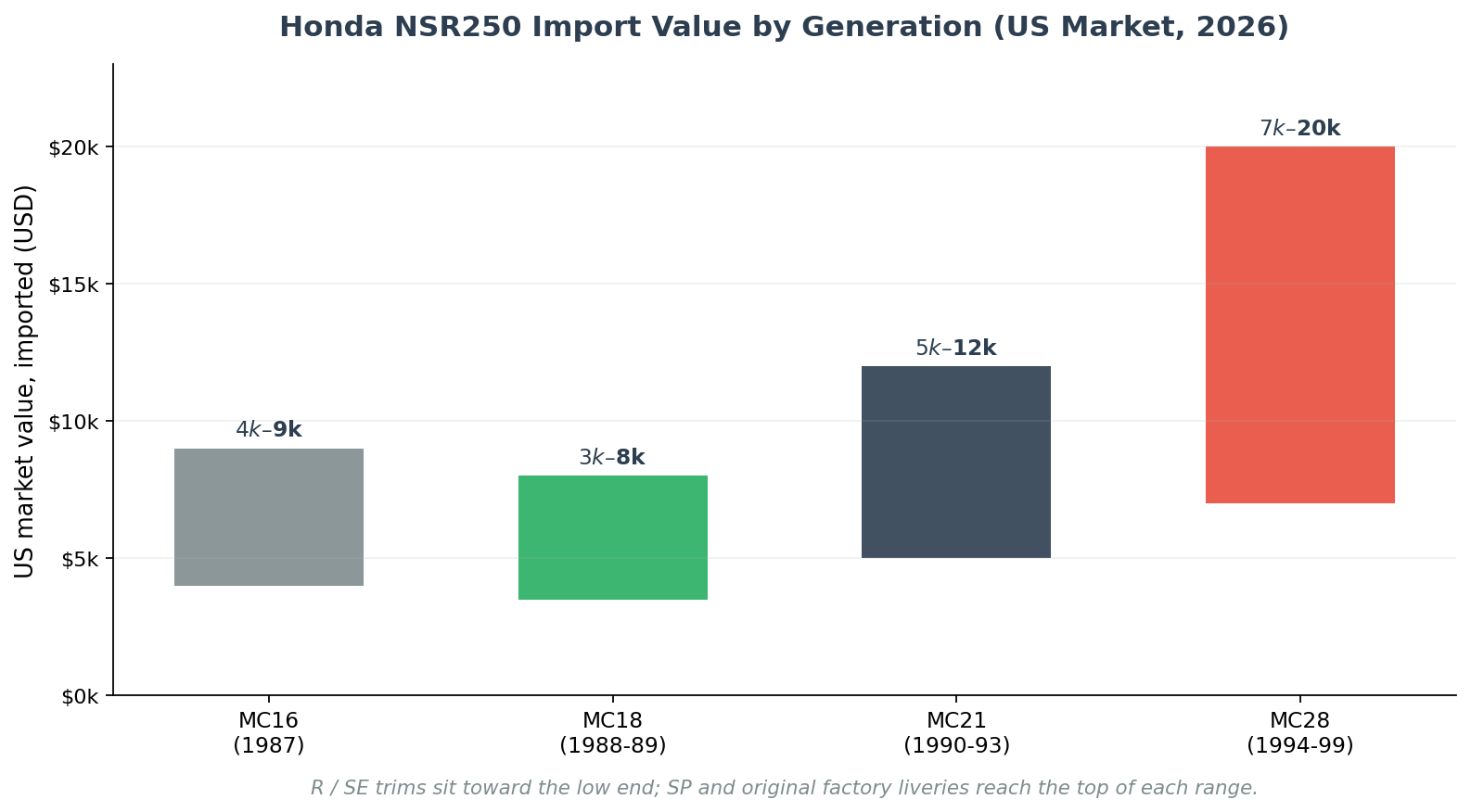
Ocean freight from Japan currently runs roughly $1,500 to $3,000 depending on the port, the vessel service, and fuel surcharges, with 2026 sitting toward the higher end as fuel costs climb. The good news that surprises most first-timers: the base US import duty on motorcycles is free across the board, so there is no tariff to fear on the bike itself. Add it all up and a clean, sorted NSR250 typically lands and registers in the US somewhere in the rough range of $7,000 to $12,000, with rare SP and livery models climbing well beyond that.
For context on the top of the market, US import specialists have listed a low-mile MC28 SE around $20,000 and clean MC21s near $9,900 — and those are retail prices with the dealer's margin baked in. Source the same bike yourself through the auctions and you keep that margin. That gap is the entire reason importing direct makes sense.
How the Japanese Motorcycle Auction Process Works
Most used bikes in Japan never hit a showroom. They move through wholesale auctions run by a handful of big houses — names like USS, BDS, JBA and AUCNET — which are closed to the public and accessible only through licensed members and import brokers. This is where the clean NSR250s actually are, and it is why a good agent is worth their fee.
The mechanics are straightforward. The auction house inspects each bike and issues an auction sheet — a standardized grading document that scores the bike's overall condition, usually on a numeric scale, and notes specific damage, modifications, rust, and mechanical concerns. A skilled importer reads that sheet, in Japanese, and tells you what you are really looking at before a single bid is placed.
Learn the grade scale and the sheet stops being intimidating. The overall grade typically runs from a low of 1 or R up to a high of 6 or S. A grade 4 is a solid, honest used bike with no major issues. A 4.5 is clean and tidy. A 5 is excellent and original. An S or 6 is essentially new or fully restored. Grades of 3 and below signal real wear, damage, or heavy modification, and an R or RA grade means the bike has been repaired after an accident. On a two-stroke that has lived a hard life, that repair history matters enormously. For a first NSR250 import, target a 4 to 4.5 with clean notes and you are buying sensibly; chase a pristine 5 only if originality is your obsession and your budget agrees.
This is the part that protects you. An NSR250 can photograph beautifully and still carry an auction note about a cracked fairing stay, a non-original expansion chamber, or "engine modified" — which on a two-stroke means anything from a tasteful tune to a grenade waiting to go off. The sheet is your X-ray. Bidding without someone who can read it is how people end up with a pretty bike and a wrecked engine.
The flow is simple once you have an agent: you set your target model, spec and maximum bid; they find candidates and translate the sheets; you choose; they bid to your ceiling and no further; and if you win, they handle export and shipping. You are never in the room, and you never need to be. You just need someone trustworthy who is.
The NSR250 Inspection Checklist: What to Check Before You Buy
This is the section that saves you money, so read it twice. A two-stroke that has been neglected is a money pit, and an NSR250 has a few specific weak points every buyer must understand. Whether you are reading an auction sheet or inspecting in person, run this list.
The RC-Valve (powervalve). This is the NSR's signature feature and its most common headache. The electronic exhaust powervalve must move freely, because a seized or coked-up valve kills the midrange the bike is famous for. The assembly is notorious for carboning up if it has never been serviced, and the control cables must be adjusted correctly or it does strange things. If the RC motor does not move when you turn the key on, budget for a strip and clean. It is doable, but it is not a five-minute job.
Compression. Two-strokes lose power fast as rings and bores wear, and a tired NSR will feel flat no matter how clean the bodywork looks. A compression test is non-negotiable. A bike that starts easily, idles steadily, and revs cleanly is worth far more than a showroom-shiny example with soft compression and seized internals.
The frame and swingarm. Inspect closely for cracks around the steering head and the rear axle mounts — these are the classic stress points on a hard-ridden NSR. The gull-arm swingarm on the MC21 and MC28 is gorgeous and expensive, so make sure it is straight and uncracked.
Carbs, lines and chambers. Old fuel turns to varnish and blocks jets, so clean carbs and fresh fuel lines matter. And check that the expansion chambers are correct — original pipes are critical to the powerband, and a cheap aftermarket set can ruin the delivery and the value at once.
Parts before you buy. This is the one nobody says out loud: know where your next piston kit is coming from before you bid. Original Honda parts are increasingly scarce, but specialists like TYGA Performance make excellent reproduction pistons, chambers, bodywork and more. A bike you cannot get parts for is an ornament, not a motorcycle.
Living With an NSR250: Parts, Maintenance and Reliability
Let us be honest about what ownership is actually like, because a two-stroke GP replica is not a Super Cub. The NSR250 is reliable on its own terms — which means it rewards maintenance and punishes neglect, hard.
Two-strokes are mechanically simpler than four-strokes but they wear faster and they need an attentive owner. Expect to mix or meter two-stroke oil, decarbonize periodically, keep the powervalve clean, and rebuild the top end on a schedule measured in tens of thousands of kilometers rather than ignoring it for years. Do that, and the engine is happy. Skip it, and you will be buying that piston kit sooner than you hoped.
Parts availability is better than the doom-mongers claim, but it is not like ordering for a current model. The Japanese forums and specialist suppliers are your lifeline — sites like NSR250.net and NSR-WORLD have decades of accumulated knowledge, part numbers, and tuning data. Consumables and reproduction parts are readily available; certain original-only trim, electronics, and livery panels are where scarcity bites.
The flip side is the part that makes it all worth it. Values are climbing steadily as the supply of clean, original bikes thins out and Western buyers wake up to what these are. A well-kept NSR250 is not a depreciating toy — it is a modern classic the market is quietly revaluing upward. You get to ride a GP replica and watch it appreciate at the same time. That is a rare combination, and it changes the entire math of the purchase.
Common Mistakes Importers Make
We have watched people make the same handful of errors for years. Avoid these five and you are most of the way to a good buy.
Buying on photos, not the sheet. A blurry listing and a seller's promise are worth nothing. The auction grade and inspection notes are the truth. Always get the sheet read by someone who reads Japanese.
Overpaying for "derestricted" claims. As covered above, unverified power claims are mostly noise. Buy condition and originality; unlock the power yourself on an MC18 or MC21 for far less than the premium sellers ask.
Ignoring the powervalve. A coked RC-Valve is the single most common reason an NSR feels flat. Factor an inspection or a clean into your budget on any bike with unknown service history.
Chasing the rarest livery first. A Rothmans SP is glorious, but a first-time owner is better served by a clean, honest base R or SE that teaches them the bike. Buy the experience before you buy the collector piece.
Underestimating the paperwork timeline. The bike qualifies easily under the 25-year rule, but export de-registration, shipping, and customs still take weeks. Plan for it, use a broker who has done it before, and do not book your first ride for next Tuesday.
How Long Does It Take to Import an NSR250?
Set your expectations now and you will not lose your mind later. From the moment you win a bike at auction to the day you can legally ride it, plan on roughly two to four months. The bike qualifies instantly under the 25-year rule, but the logistics do not care how excited you are.
The first week or two covers the auction win, payment, and Japanese export de-registration — the bike has to be legally signed off for export and have its documentation prepared. Ocean freight is the long pole: a container or RoRo sailing from Japan to a US west-coast port typically takes three to six weeks on the water, longer to the east coast or inland. Then customs clearance and the broker's filing of the HS-7 and EPA 3520-1 forms adds a few days to a couple of weeks depending on the port's workload.
The final stretch is getting it road-registered in your state, which varies wildly — some states wave a 25-year import through in an afternoon, others want an inspection and a bonded title that drags on for weeks. The bike itself is the easy part. The paperwork and the ocean are what eat the calendar, so order early, pick a broker who has cleared bikes before, and do not promise anyone a summer of riding before the boat has even sailed.
Which NSR250 Should You Import First?
After all the model codes and grades, here is the straight advice, sorted by who you are.
If this is your first two-stroke, import an MC21 in base R or SE trim, grade 4 to 4.5, with clean auction notes. It is the easiest to live with, the simplest to derestrict, the best supported for parts, and it delivers the full NSR experience without the MC28's electronic complications. This is the default right answer for most people, and there is no shame in the obvious choice.
If you are a tuner who wants to chase that derestricted 70 hp, hunt an MC18. It is the cheapest entry point, the lightest, and the most rewarding to modify, with the freest and cheapest path to full power. You will spend your weekends in the garage, and you will love every minute.
If you are a collector with the budget, go straight for an MC28 SP in an original factory livery — a Rothmans or a clean genuine Terra. It is the newest, the rarest, and the one the market is revaluing fastest. Buy the most original example you can find and verify every panel.
If you want the purest, rawest ride, the MC16 is the connoisseur's pick — just accept the parts hunt that comes with it. Match the bike to your appetite and your skill, and you will not regret the import.
How AWA Auction Gets You a Clean NSR250 From Japan
Here is what we actually do. We have standing access to the Japanese trade auctions where NSR250s surface every week — the same USS, BDS and JBA halls that are closed to the public. When you tell us the generation, grade and ceiling you want, we hunt, we read the auction sheets in Japanese, and we flag the seized powervalves, the frame cracks, the non-original chambers and the vague "engine modified" notes before you ever commit a dollar.
Then we bid to your limit and not a yen more, handle the export de-registration and documentation, arrange shipping in the format you choose, and hand you a graded, inspected bike with a real paper trail instead of a stranger's optimism. You are not gambling on a listing. You are buying a known quantity with someone in your corner who does this every single day.
The NSR250 you want is out there in Japan right now, in better condition than anything you will find locally, at a price that makes the import worth it. Getting one is just a matter of knowing where to look and what the sheet really says — and that part, we already have handled.
See Also
Share this article: