
If you want to import a Honda VFR1200F from Japan, you are chasing one of the most misunderstood motorcycles Honda ever built. It is a 1,237cc V4 sports-tourer that makes 170 horsepower, drives the rear wheel through a shaft, and was Honda's first full-size bike offered with a proper dual-clutch automatic gearbox. It launched in 2010 as the flagship that was supposed to reinvent the sports-touring class, cost as much as a small car, and then quietly flopped in the showroom.
Here is the thing nobody tells you: everything that made the VFR1200F a bad new bike makes it a brilliant used one. It depreciated harder than almost any modern Honda, so a £13,000 flagship now changes hands for the price of a tired hatchback. One of the most-watched reviews on YouTube is literally titled "Fastest sports touring made (170HP)" with over half a million views, and the top comment threads are full of riders working out that the bargain of the decade has been hiding in plain sight. This guide covers the generations, the DCT-versus-manual argument, the fuel-range gripe, the recall you must check, the years to avoid, what a used one really costs, and how to actually get a clean Japanese example home.
What is the Honda VFR1200F?
The VFR1200F is Honda's big V4 sports-tourer, built from 2010 to 2016. It replaced the beloved VFR800 VTEC and moved the game upmarket: a bigger 1,237cc engine, shaft drive instead of a chain, a wraparound fairing, and flagship-level electronics for the era. Honda positioned it against the Kawasaki 1400GTR, Yamaha FJR1300 and BMW's fast tourers, and priced it to match at around £12,000, with the DCT automatic adding roughly another £1,000.
What makes it unusual is the engine layout. It is a 76-degree V4, but Honda staggered the cylinders so the two front pots sit wide and the two rear pots sit narrow. That keeps the motor slim at the back where your legs go, and it gives the bike a firing character that sounds like nothing else in the Honda range: part superbike wail, part muscle-car rumble.
The other headline was the transmission. The VFR1200F was the launch platform for Honda's Dual Clutch Transmission, an actual automatic that shifts itself with two clutches and no lever. In Japan the automatic was badged VFR1200D; in North America you may see VFR1200A. It is the same bike underneath, and the DCT is a big part of why importing one from Japan is interesting, because Japan bought plenty of them.
VFR1200F vs VFR1200X Crosstourer vs VFR800: don't buy the wrong one
Japanese auction listings use "VFR1200" loosely, so learn the badges before you bid.
The VFR1200F is the faired sports-tourer this guide is about: low bars, sporty fairing, 17-inch wheels, the fast road-and-motorway machine.
The VFR1200X Crosstourer is a completely different bike that shares the engine. It is a tall adventure-tourer with long-travel suspension and a beak, tuned softer for torque. If a listing shows a big upright trail-styled bike, that is the Crosstourer, not the F. They are not interchangeable, and the Crosstourer usually costs more used.
The VFR800 is the older, smaller, chain-driven V4 the 1200 replaced. It is lighter, cheaper and more nimble, and it carries a 22-litre tank that gives it far better range. Plenty of import shoppers cross-shop the two, and honestly, if range and agility matter more to you than outright grunt, the 800 is worth a look. We keep clean examples of both moving through the yard, and it is worth browsing the current listings to compare them side by side before you commit to the heavier 1200.
Why import a Honda VFR1200F from Japan?
Three honest reasons, and one honest caveat.
First, condition. Japan's strict shaken inspection regime and low average mileage mean a fifteen-year-old VFR1200F from Japan can look and ride like a five-year-old bike from a rainy Western market. The VFR's brakes and finish suffer in salt and damp, so a dry-climate, garage-kept Japanese bike sidesteps exactly the corrosion problems that plague European examples.
Second, the DCT. Japan bought the automatic in real numbers, so if your heart is set on a low-mileage VFR1200D, a Japanese auction is often the fastest route to one at a fair hammer price. Western forecourts frequently skipped the DCT, so clean used ones are thin on the ground.
Third, the low-mileage flagship effect. Big, expensive flagships often lived a pampered life as a second or third bike. Plenty of Japanese VFR1200Fs show five-figure kilometre readings, not miles, because the owner had three other machines in the garage.
The caveat: the VFR1200F was sold new in the UK, the US (2010-2013), Australia and New Zealand, so you are not importing something unobtainable. On the cheapest tired examples, shipping and duty can wipe out the saving. The win is a genuinely clean, low-mileage, rust-free bike, or a spec like the DCT you cannot find locally. We will do the honest maths later.
The engine: the 1237cc V4 Honda over-engineered on purpose
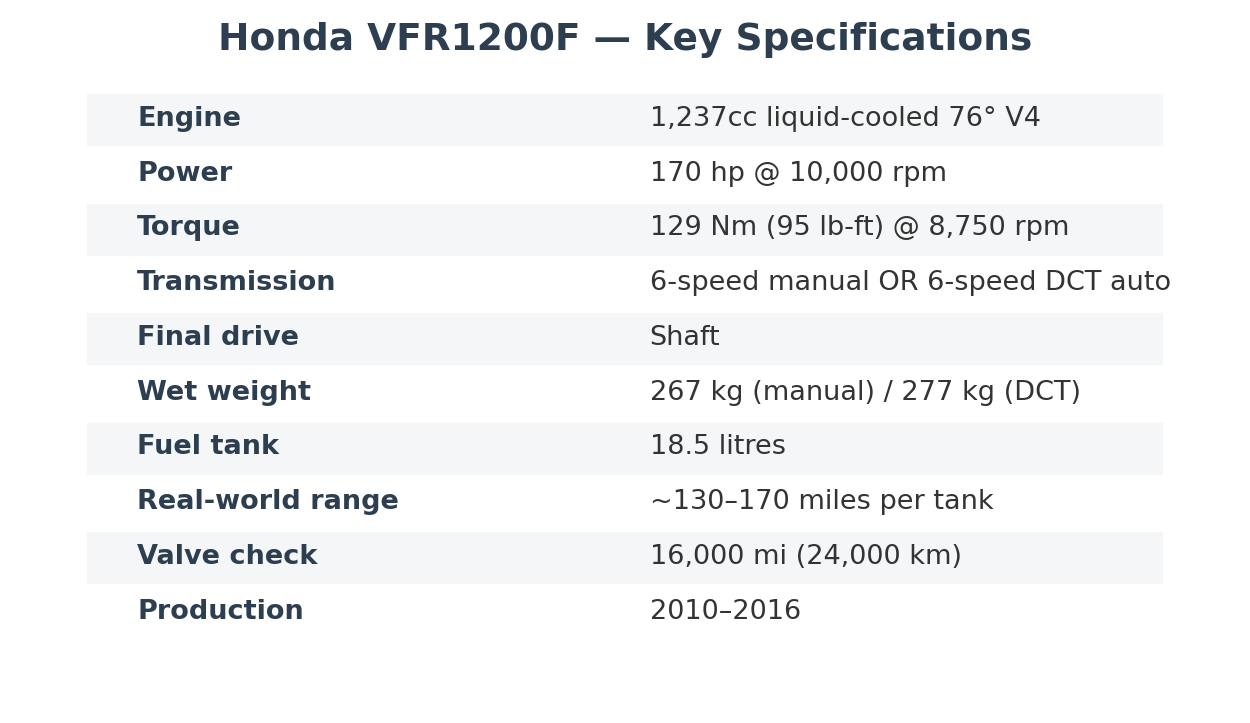
The 1,237cc V4 makes 170bhp at 10,000rpm and 129Nm (95 lb-ft) of torque at 8,750rpm. Those are strong numbers, but the character matters more than the peak. This engine is brutally smooth, pulls hard from low revs, and delivers its punch in a long, muscular surge rather than a peaky top-end hit. A French Moto Journal test with nearly half a million views summed it up in its title: "172 CH sur une sport-GT" — flagship power wrapped in a touring bike.
Honda threw its engineering budget at this motor. Offset cylinders to keep it narrow, a slipper clutch, throttle-by-wire, and a counterbalancer arrangement that makes it feel almost turbine-like at a cruise. Reviewers who rode it back to back with the old VFR800 always said the same thing: it feels like it has an extra dimension of shove.
The downside is heat and thirst. That big V4 works hard and pumps warmth toward the rider in traffic, and the fuel economy is nobody's favourite subject, which gets its own section below. But mechanically the engine is tough. It is the same basic unit used in the Crosstourer, and long-term testers, including a Cycle World bike that ran a full season, reported the motor itself shrugging off hard miles.
There is a sound to it, too, that owners fall for. The offset firing order gives it a deep, slightly uneven V4 note that a Russian flagship test on YouTube, badged simply "ФЛАГМАН," racked up over 325,000 views and 576 comments dissecting. Roll it on hard from 4,000rpm and it changes character from a smooth cruiser to something that genuinely growls. It is not a sportsbike scream, and it is not a cruiser thud; it is its own thing, and it is a big part of why people who buy one keep it far longer than they planned.
DCT vs manual: the honest breakdown
This is the single biggest decision when you import a VFR1200F, so let's be straight about it.
Honda's DCT is a true automatic with two clutches and no clutch lever. One clutch handles first, third and fifth; the other handles second, fourth and sixth. It shifts itself in D or Sport mode, or you flick buttons in manual mode. The VFR1200F was the first bike Honda ever launched it on, and MCN's DCT review of the bike has pulled over a quarter of a million views precisely because riders wanted to know if the gimmick worked. It does. On a heavy sports-tourer it removes clutch fatigue in traffic and makes smooth, unhurried progress on a long haul genuinely relaxing.
The honest gripes: early DCT software can be hesitant at very low speed, hunt between gears in stop-start traffic, and occasionally pick a shift you did not want mid-corner if you leave it in D. None of it is dangerous. Sport mode and the manual paddles solve most of it. But when a DCT unit does need attention, it is not a cheap fix, so buy on service history.
The manual is about 10kg lighter (267kg wet against 277kg for the DCT), cheaper to buy, cheaper to fix, and gives you full control. Its own quirk is a gearbox that can feel a touch notchy and throw the odd false neutral if the linkage is neglected. Interestingly, the DCT "seldom adds to used value," which means a clean automatic can be a smart used buy: you pay little or no premium for a feature that cost £1,000 new.
Buy DCT if you tour two-up, ride a lot in traffic, or simply want the novelty done properly; it is the version most import shoppers hunt for out of Japan. Buy manual if you want lighter weight and lower running costs. Both are reliable when serviced.
Generations explained: 2010-2011 versus 2012-2016
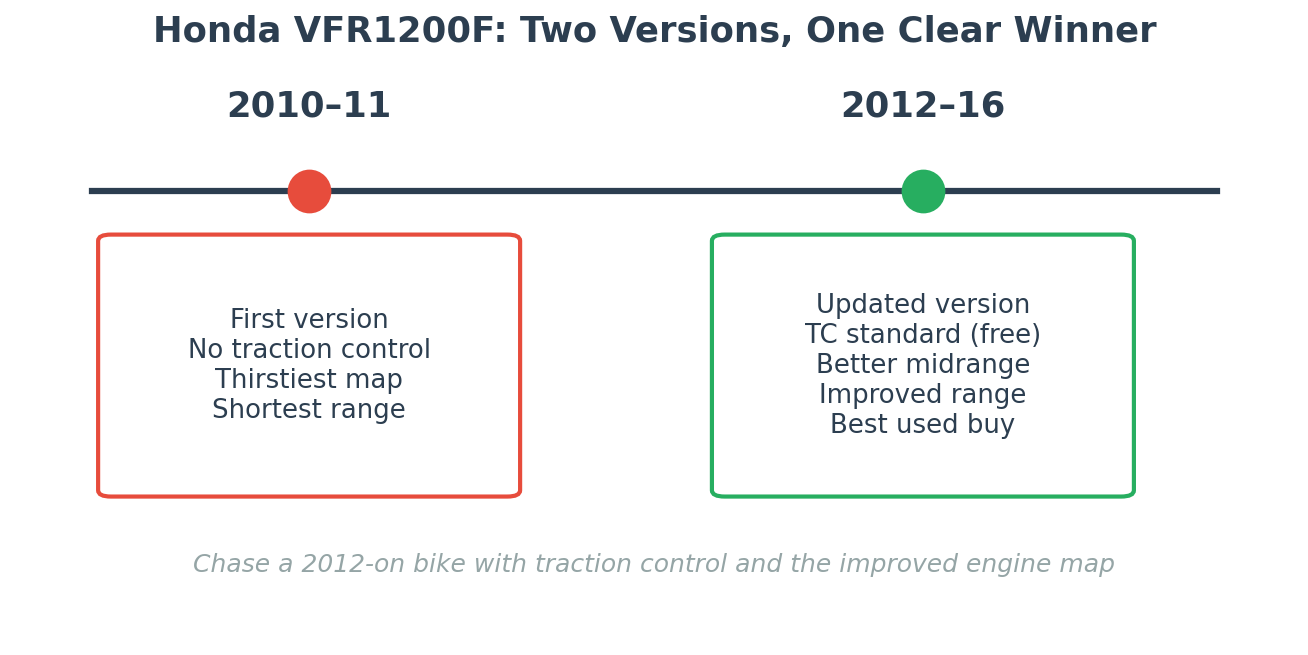
There are effectively two versions of this bike, and the difference matters more than the tiny styling tweaks suggest.
The 2010-2011 first version is the original launch bike. It has no traction control, the thirstiest engine map, and the smallest real-world range. It is the model that earned the VFR1200F its reputation for poor economy and disappointing sales. It is not a bad bike, but it is the one you buy on price, not preference.
The 2012-2016 updated version is the one to chase. For 2012 Honda added traction control as standard at no extra cost, remapped the engine for better midrange and improved fuel consumption, tweaked the styling, and improved comfort. The range issue eased, the throttle response smoothed out, and the bike simply became the machine it should have been at launch. As the used market puts it bluntly, the VFR1200F "is better as a used buy than it was a new one," and the 2012-on cars are the reason.
Production wound down around 2016-2017 as tastes shifted to adventure bikes, and the Crosstourer outlived the F. That means the newest VFR1200F you can find is roughly a 2016 machine, which is worth remembering when you plan the import timing and, if you are in the US, the 25-year rule.
The fuel range problem everyone warns you about
Let's deal with the elephant. The single most common complaint about the VFR1200F is the fuel range, and it is a fair one. Honda dropped the tank from the VFR800's generous 22 litres to just 18.5 litres, then bolted it to a thirstier 1,237cc engine. The maths was never going to be kind.
On the 2010-2011 bikes, owners routinely report a low-fuel warning at 130 to 160 miles, which on a bike sold as a tourer is genuinely annoying. You plan your day around fuel stops. The 2012 remap improved things, and careful riders on later bikes see 160 to 170 miles before the gauge drops to its last bar, working out to roughly 50 mpg on a gentle cruise. Ride it hard and that falls fast.
Here is the honest framing: if you buy a VFR1200F expecting FJR1300-style 250-mile tanks, you will be disappointed. If you accept it as a fast, comfortable bike that wants a splash-and-dash every couple of hours, it stops being a problem and starts being a coffee schedule. Many owners fit a larger aftermarket screen and a comfier seat and simply make the fuel stop part of the rhythm. Know this going in, because no import bargain fixes a design decision.
Common problems and what to check
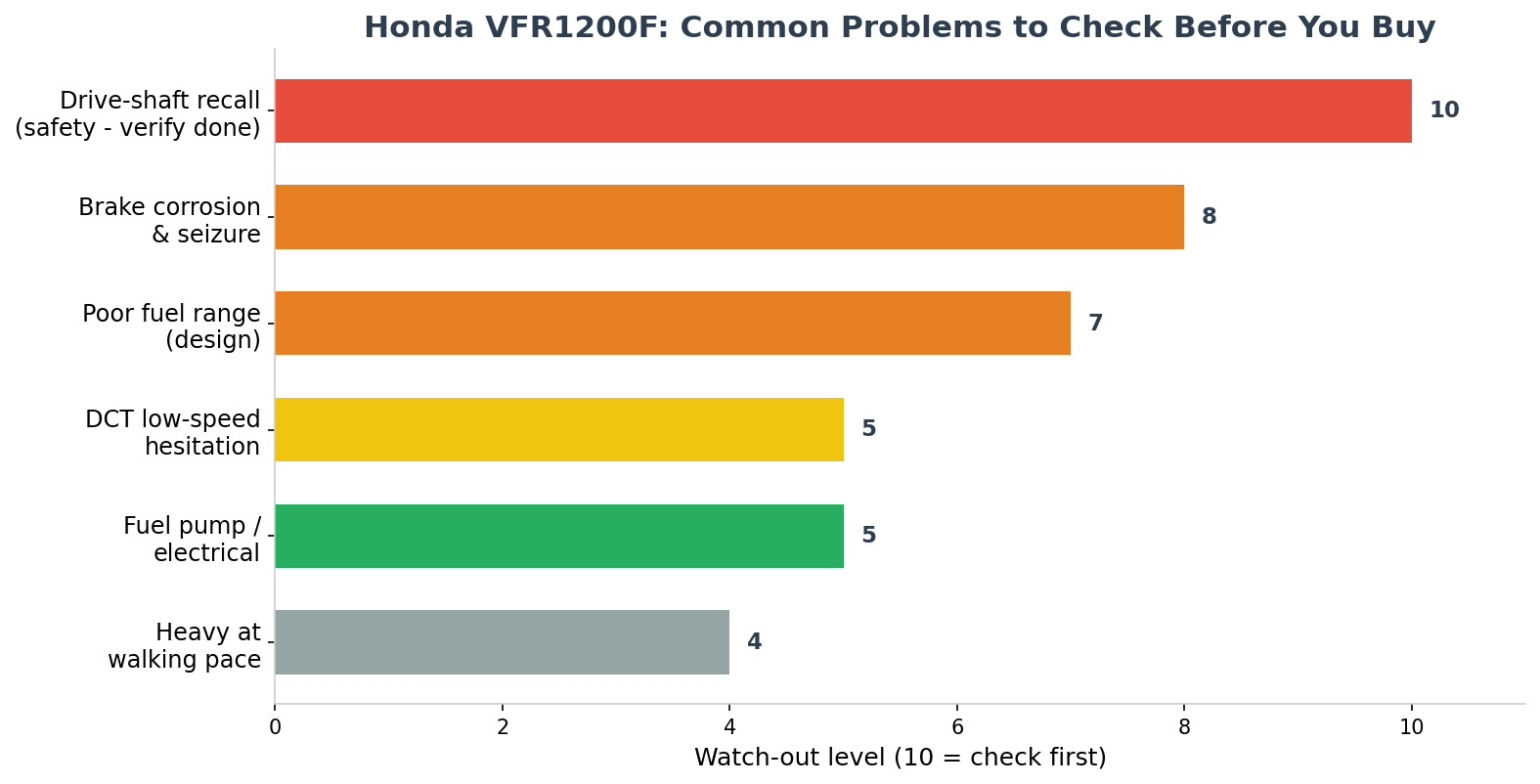
The VFR1200F is a fundamentally tough bike, but a heavy, complex flagship has specific weak spots. Check these before you bid.
The drive-shaft recall. This one is critical and gets its own section below. Early bikes were subject to a recall for the drive-shaft universal joint bearing, which in the worst case could seize and cause loss of drive or a rear-wheel lock-up. Confirm it was done.
Brake corrosion and seizure. The VFR's combined braking system uses multiple pads per front caliper, and the whole setup dislikes damp, salty conditions. Sticking pistons, corroded discs and dragging calipers are the classic neglected-bike faults. This is exactly the problem a dry Japanese bike tends to dodge, which is a real argument for importing.
Transmission niggles. On the manual, listen for a notchy box and false neutrals. On the DCT, test every mode and feel for hesitation or harsh low-speed shifts beyond the normal software behaviour.
Fuel pump failures and electrical glitches. A weak or failed fuel pump shows as hard starting or cutting out under load. Check the dash for gremlins and confirm all the warning lights behave on the ignition cycle.
Weight at walking pace. This is not a fault, it is physics. At 267 to 277kg it is a handful in a car park and drops easily if you are careless. Inspect bar ends, mirrors, fairing lugs and engine cases for the scuffs of a low-speed tip-over.
Suspension and consumables. The stock suspension has limited adjustability and tired shocks are common on high-mileage bikes. Budget for tyres, brake refurbishment and fluids on any bike that has been sitting.
The drive-shaft recall you must verify
This deserves emphasis because it is a safety item, not a niggle. Honda issued a recall covering faulty drive-shaft universal joint bearings on affected VFR1200F machines. A failure could cause a sudden loss of drive or, in the worst case, a rear-wheel lock-up at speed. That is not something to gamble on.
Before you buy, get the VIN and confirm the recall work was carried out. In the US you can check the VIN against the manufacturer's recall database through the NHTSA recalls tool; in other markets a Honda dealer can confirm against the frame number. A reputable import agent handling a Japanese auction bike should be able to check this for you as part of the pre-purchase inspection. If nobody can confirm the recall was done, price in getting it verified and rectified before the bike turns a wheel.
Years to avoid and the best year to buy
There is no truly bad VFR1200F, but there is a clear pecking order.
Approach 2010-2011 with your eyes open. These are the cheapest and the thirstiest, with no traction control and the original engine map. Buy one only if the price reflects it and the recall and servicing are spotless. As a bargain first big V4, fine. As the one you keep forever, less ideal.
Buy a 2012-2016 bike if you can. Traction control as standard, the improved map, better midrange, slightly better range and a nicer ride make this the sweet spot. A well-kept 2013-2015 example with full history and the recall done is the smart import target. Later bikes also tend to have been ridden less as the model faded from fashion, so low-mileage examples are easier to find.
On the DCT question by year: because the automatic barely affects used value, do not overpay for it, but do not avoid it either. A clean late DCT bike is arguably the best-value VFR1200F on the planet right now.
What a used VFR1200F costs
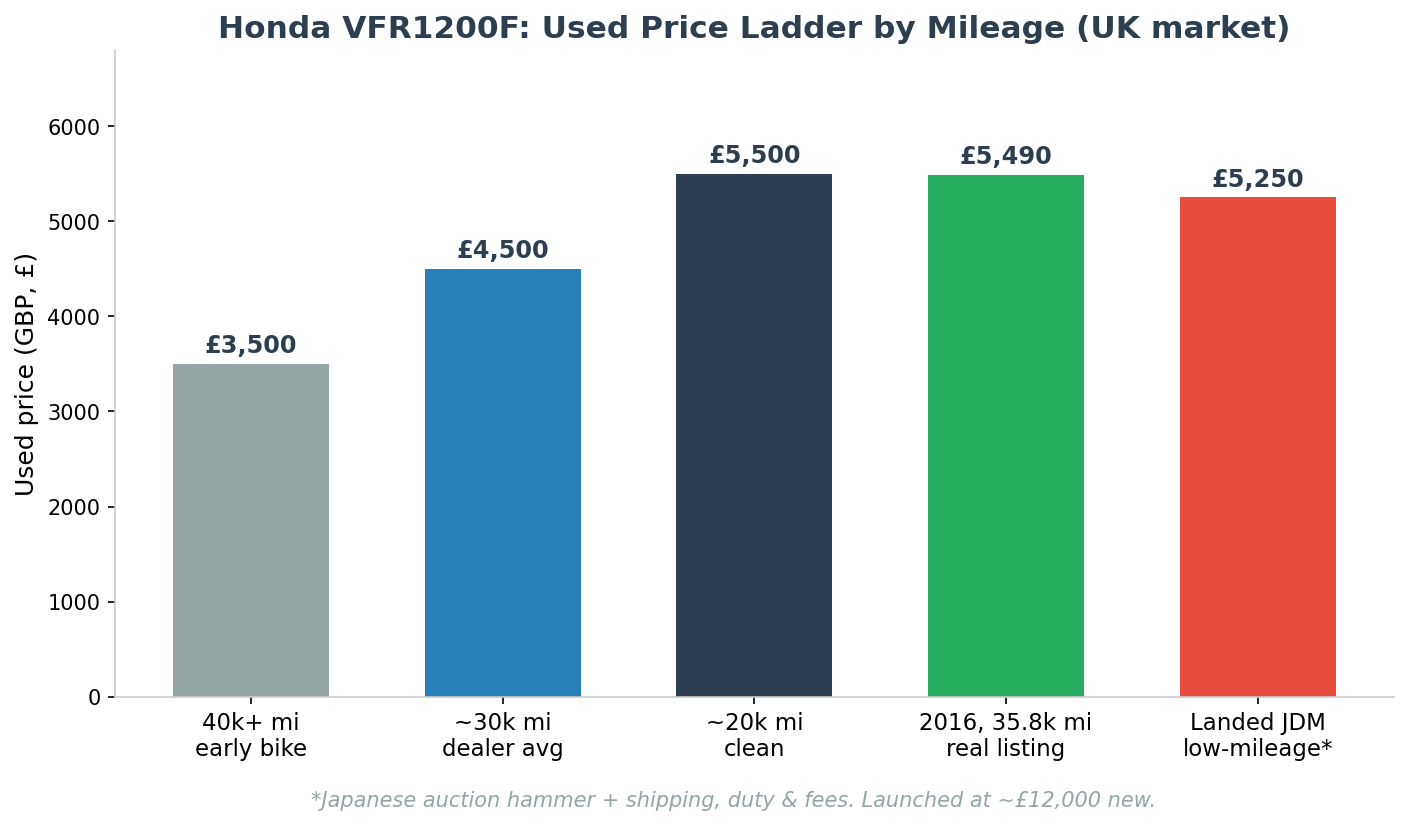
This is where the story gets fun, because the VFR1200F is one of the great depreciation bargains in modern motorcycling. It launched at around £12,000, or £13,000 for the DCT, and it has fallen off a cliff.
In the UK used market, high-mileage early bikes with over 40,000 miles can be found for as little as £3,500. Dealers typically ask £4,000 to £5,000 for a bike with around 30,000 miles, and roughly £5,500 buys one that has just crossed 20,000 miles. Real listings back this up: a 2016 example with 35,769 miles at £5,490, and a 2010 model with 21,890 miles at £3,999. A bike that cost £13,000 new is now close to a quarter of that.
For an import, the calculation is different. You are not paying a UK dealer's forecourt price; you are paying a Japanese auction hammer price plus the cost to land the bike. A clean, low-mileage Japanese VFR1200F often hammers for less than a tired UK bike costs, and you add shipping, duty and agent fees to get your landed total. The chart above shows the rough UK used ladder by mileage so you have a benchmark to beat.
The key insight: on this bike, condition and mileage swing the price far more than the year does. A genuine 15,000km Japanese bike with a clean auction sheet is worth chasing even if the landed cost lands near a scruffy local example, because you are buying the good one.
Is it worth importing from Japan? The honest maths
Let's not pretend. Because the VFR1200F was sold new across the UK, US, Australia and New Zealand, there are local used bikes about. So the import only makes sense if you win on condition, spec or price, and often all three.
Start with a Japanese auction hammer price for a clean, low-kilometre bike. Add shipping to your port, then import duty and taxes, then the agent or auction fees and local compliance or registration costs. For a bike from a market like the UK, that added cost typically lands somewhere in the region of £1,500 to £2,500 on top of the hammer price, depending on the port, the bike's age and the paperwork.
Now compare. If a local scruffy high-miler is £4,000 and a genuinely clean, low-mileage Japanese bike lands at £5,000 to £5,500, the import is the better bike for slightly more money. If you specifically want a low-mileage DCT that barely exists locally, the import may be the only way to get exactly what you want. That is the whole game with the VFR1200F: you are not importing to save a fortune, you are importing to get the good example instead of the tired one. If you want us to run the numbers on a specific bike, contact our team and we will give you an honest landed total before you commit a penny.
How to import a VFR1200F from Japan, step by step
The process is more straightforward than most first-timers fear.
Step 1: Set your budget as a landed total. Decide the maximum you will pay with the bike in your garage, registered, not just the hammer price. Work backward from there.
Step 2: Get access to the auctions. The big Japanese motorcycle auctions are trade-only, so you bid through an agent. This is where you browse what is passing through and set your targets on specific lots.
Step 3: Read the auction sheet. Every bike is graded and annotated by an independent inspector. Learn to read it, or use an agent who translates it honestly. More on this below.
Step 4: Bid and win. Your agent bids to your limit. If you win, you pay the hammer price plus the auction and agent fees.
Step 5: Export and ship. The bike is de-registered for export, crated or roll-on-roll-off shipped, and sent to your port. This is where the drive-shaft recall check should be confirmed.
Step 6: Clear customs and register. Pay duty and taxes, complete any compliance inspection your country requires, and register the bike. Then you ride.
Official import rules vary by country. UK importers should check the government's guidance on importing vehicles into the UK before starting, and US buyers must remember the 25-year federal rule, which means a 2010 VFR1200F is not freely importable until 2035.
How to read a Japanese auction sheet
The auction sheet is your best friend and it is why buying from Japan is safer than people assume. Each bike is inspected by a neutral third party and given an overall grade, usually on a scale where 4 to 4.5 is a clean, honest used bike, 5 and 6 are exceptional or nearly new, and anything at 3 or below signals wear, damage or high mileage that you should scrutinise hard.
Beyond the overall grade, the sheet carries a diagram of the bike with coded notes: scratches, dents, rust, replaced parts and corrosion are all marked with symbols. On a VFR1200F, pay special attention to any notes around the front brakes and the wheels, because brake corrosion is this bike's classic weak spot, and to the drive-shaft area at the rear.
Do not fear high mileage on the sheet if the grade and condition notes are clean. The V4 engine is tough, and a well-maintained higher-mileage bike with a spotless sheet is often a better buy than a low-mileage bike covered in corrosion symbols. A good agent will photograph the exact areas you care about and tell you the truth. That honesty is worth more than any grade number, and it is exactly what we build our reputation on.
VFR1200F versus the rivals
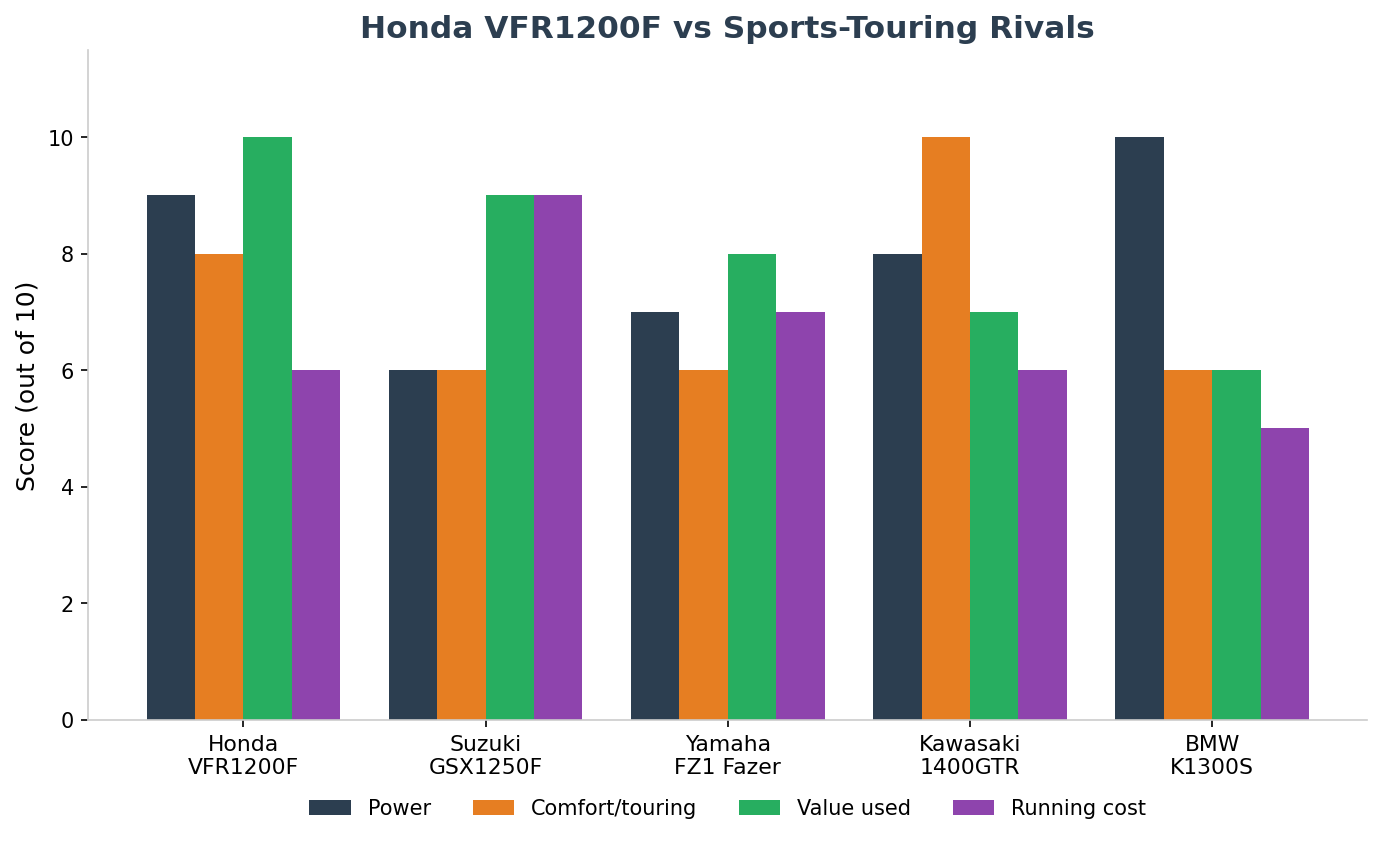
The VFR1200F sits in a busy class, and the used-bargain angle changes the calculus. MCN's group test pitting the "Suzuki GSX1250F v CBF1000GT v VFR1200 v FZ1 Fazer" has drawn well over 400,000 views because these are exactly the bikes cross-shoppers weigh up.
Versus the Suzuki GSX1250F and Bandit-derived tourers: the Suzuki is cheaper to run, simpler and chain-driven, with a torquey old-school engine. The VFR out-classes it on refinement, shaft drive and outright power, but the Suzuki is the easier bike to live with cheaply.
Versus the Yamaha FZ1 Fazer: the Yamaha is sharper, lighter and more of a sports bike with a fairing. The VFR is the plusher long-distance tool with a smoother engine and shaft drive.
Versus the Kawasaki 1400GTR and Yamaha FJR1300: these are the dedicated heavyweight tourers with bigger tanks and more luggage. They out-tour the VFR on range and load capacity, but they are bigger, softer and less sporting. The VFR splits the difference between a sports bike and a tourer, which is exactly what it was designed to do.
Versus the BMW K1300S: Motorcycle.com's shootout between the two, with over 400,000 views, framed them as "the sportbikes of sport-tourers." The BMW is faster and more focused; the Honda is smoother, better built in the long term and, used, dramatically cheaper.
The honest verdict: nothing else gives you a 170bhp shaft-drive V4 with an optional true automatic for hatchback money. That is the VFR1200F's unique corner of the market, and it is only obvious on the used market.
Running costs and maintenance
Budget realistically and the VFR1200F is not scary to own. The valve-clearance check falls at 16,000 miles (24,000km), which is a reasonable interval for a bike of this complexity, though the check itself is labour-heavy because it is a V4, so an independent specialist is your friend here.
Shaft drive removes the chain-and-sprocket cost and mess entirely, which is a genuine long-term saving and one of the reasons tourers love it. Set against that, tyres on a 170bhp bike are not cheap, the brakes reward proper servicing to avoid the corrosion problem, and DCT fluid and filter changes must be done on schedule if you have the automatic.
Fuel is the ongoing tax. Plan for roughly 45 to 50 mpg in mixed use, worse if you enjoy the top end. Insurance sits in the sensible-tourer bracket rather than the superbike bracket, which helps. Overall, a well-bought VFR1200F is cheaper to keep than its flagship price tag once suggested, and the shaft drive quietly claws back what the fuel bill takes.
Popular modifications
Owners tend to fix the VFR1200F's two real weaknesses first: wind protection and comfort. A taller aftermarket screen from the likes of the touring-screen specialists transforms motorway refinement, and a reshaped or gel seat makes the range issue feel less like a punishment because you actually want to stop and stretch anyway.
Beyond that, luggage is the obvious upgrade: Honda's own panniers or a quality aftermarket set turn it into a proper two-up tourer. Many riders add heated grips if the bike does not already have them, a slip-on exhaust to wake up that V4 soundtrack without the weight of the heavy stock can, and adjustable levers. Suspension upgrades, particularly a better rear shock, address the stock setup's limited adjustability on higher-mileage bikes. None of it is essential; all of it is cheap relative to the bike's original price.
Who should buy a VFR1200F, honestly
Buy one if you want a smooth, powerful, beautifully built sports-tourer for astonishingly little money, and you value shaft-drive convenience and long-haul comfort over outright range and low weight. It rewards riders who do real distance, who appreciate engineering, and who would rather have last decade's flagship than this decade's midweight.
Think twice if your riding is mostly short blasts on tight roads, if you cannot lift a heavy bike confidently, or if you genuinely need 200-plus-mile tanks between fills. And if you are a nervous first-big-bike rider, the weight and power are a lot to learn on; a VFR800 or a middleweight is the wiser first step, and we can point you to those too. The VFR1200F is a connoisseur's bargain, not a beginner's default.
Pre-purchase checklist
Before you commit to any VFR1200F, Japanese import or local, run through this:
Confirm the drive-shaft recall was completed against the VIN. Check the front brakes for corrosion, sticking pistons and dragging calipers. Test every gear, and on a DCT, ride through all modes feeling for hesitation or harsh low-speed shifts. Start it cold and listen for hard starting or fuel-pump weakness. Inspect fairing lugs, bar ends, mirrors and engine cases for tip-over damage. Verify the service history, especially the 16,000-mile valve checks and any DCT fluid changes. Look for a 2012-or-later bike with traction control if you can. And on an import, insist on clear auction-sheet photos of the brakes, wheels and rear drive before you bid.
How AWA Auction helps you import a VFR1200F
Importing a big, complex flagship from a Japanese auction is exactly the situation where a good partner earns their keep. We bid on the trade-only auctions on your behalf, translate the auction sheet honestly rather than talking up a bike to make a sale, and photograph the specific weak spots this model has, the brakes, the wheels and the rear drive, before you ever commit.
See Also
Share this article: