
There is a YouTube restoration series called "Restoration Of A Ruined Legend" that has pulled over 1.4 million views watching one man drag a rotten Honda VFR400 NC30 back from the dead. People do not spend that kind of attention on a 400cc commuter. They do it because a clean Honda VFR400 NC30 import from Japan is one of the most charismatic small bikes ever built — a gear-driven, single-sided-swingarm V4 that looks like Honda shrank an RC30 in the wash.
Here is the catch nobody softens for you: Honda never officially sold the VFR400 in the United States, and it barely touched most of Europe. It was built for the Japanese home market. So if you want one, you are not "buying" an NC30 — you are importing one. And the cleanest, best-documented examples in the world are still sitting in Japan, going through the same auctions we bid in every week.
This guide is the one we wish existed when we started sourcing these. Real landed costs. The faults that actually matter on an NC30 versus the ones forums panic about. The difference between the NC24, the NC30 and the NC35. And exactly how the import works, country by country. Let's get into it.
What Is the Honda VFR400 NC30 (And Why It's a Japan-Only Legend)
The VFR400R NC30 is a 400cc, liquid-cooled, 90-degree V4 sports bike Honda built from 1989. Think of it as the baby brother to the legendary RC30 (VFR750R) — same twin-headlight face, same single-sided Pro-Arm swingarm, same race-bred attitude, scaled down to fit Japan's 400cc licensing class.
The engine is the party trick. Instead of cam chains, the NC30 drives its camshafts with a stack of straight-cut gears. That is why every road test from the last 30 years describes the noise the same way: an irate sewing machine. There is a video on YouTube — just the original exhaust and that gear whine at idle — with nearly 190,000 views. People watch a parked bike make noise. That is the kind of bike this is.
The numbers are honest 400cc numbers. Around 59 horsepower at a screaming 12,750 rpm, about 35 Nm of torque at 9,700 rpm, roughly 130 mph flat out, and close to 40 mpg if you can keep your wrist calm. You cannot. The whole point of the NC30 is that it begs to be revved to the moon, and unlike a literbike it will not turn you into a statistic for doing it.
The NC30 also got the "big bang" 360-degree crank, sharper styling than the earlier model, and the silencer moved to the left. Honda made it from 1989 into the early 1990s, and you will see model years quoted anywhere from 1989 to 1994 depending on how dealers date the last of the stock. The important part for you: every single one of them was a Japanese-market bike. There is no "US-spec" NC30. There never was. You can read the full model history on Wikipedia's VFR400 page if you want the chassis-code rabbit hole.
What the VFR400 NC30 Is Actually Like to Ride
Specs do not explain why people obsess over this bike. The ride does.
Below about 6,000 rpm, an NC30 feels almost polite. There is gentle drive, a smooth throttle, and that gear whine humming away under you. It is easy to think you have bought a slightly slow 400. Then the tacho needle swings past 9,000, the V4 changes its voice from sewing machine to muffled jet, and the bike lunges for the 14,000 rpm redline like it has been waiting all day for you to stop being cautious. That top third of the rev range is the whole bike. Riders who only ever short-shift it never understand what the fuss is about.
The chassis is the other half of the magic. The NC30 weighs a hair over 160 kg, carries a proper twin-spar frame and that single-sided swingarm, and steers with the kind of precision that flatters you into thinking you are better than you are. One long-time owner summed it up perfectly: a bike that flatters good riding and forgives bad. You can carry silly corner speed, brake late, and the NC30 just shrugs and does it, because there is no terrifying surplus of power waiting to spit you off when you get greedy with the throttle.
That is the real argument for a small V4 over a modern literbike. A 200-horsepower superbike is faster everywhere and usable almost nowhere on the road. An NC30 you can actually wring out, legally-ish, on a back road, and walk away grinning instead of banned. It is the rare fast bike that rewards skill more than bravery.
Why Import a VFR400 NC30 From Japan Specifically
Because Japan is where the good ones live. Simple as that.
Every NC30 already outside Japan was privately imported at some point, often decades ago. That means the ones for sale in the UK, Australia or the US have usually been around the block — re-registered, re-fettled, sometimes crashed and rebuilt, frequently sitting in a damp garage between owners who "meant to get to it." The home-market cars-and-bikes culture in Japan is different. Bikes get stored properly, serviced on schedule, and moved on through a transparent auction system that grades condition honestly.
That auction grading is the real reason to go to the source. When you buy a local NC30, you are trusting a stranger's description and a few phone photos. When you buy through the Japanese auctions, you get an inspector's sheet: a graded score, an interior grade, and a literal map of every scratch, dent and rust spot on the bike. We will come back to reading those sheets, because for a bike this old it is the single most valuable document you will ever see.
There is also a quiet performance argument. One of the most-watched NC30 videos on YouTube — over 470,000 views — is a flat-out run where a tuned NC30 hangs onto a CBR1000 Fireblade on a real road. A 35-year-old 400 keeping a modern-ish literbike honest. That is the kind of giant-killing reputation that keeps demand high and clean examples scarce. If you want to see what fresh Japanese-market stock actually looks like before it is tidied up and marked up locally, our current listings come straight from those same auctions.
Mileage is the other Japan advantage. Japanese riders cover fewer miles on average and store bikes carefully over winter, so a home-market NC30 often shows genuinely low, believable mileage backed up by the auction inspection. Compare that with a bike that has been shuffled across three countries and four owners, each one swearing it was barely ridden. The paper trail in Japan is simply better, and on a 35-year-old machine, provenance is most of the value. You are not just buying fewer miles; you are buying proof of them.
NC24 vs NC30 vs NC35: Which VFR400 Should You Import?
"VFR400" is not one bike. There are three chassis codes that matter, and importing the wrong one for your goal is an expensive mistake. Here is the honest breakdown.
NC24 (VFR400R, 1987–1988). The first proper VFR400R. It runs a conventional twin-sided swingarm and a 16-inch front wheel, and it looks softer and more 1980s than what came after. It is the cheapest way into a V4 400, and it rides beautifully, but it does not have the RC30 face or the single-sided arm that collectors chase. Tire choice for that 16-inch front is also getting genuinely annoying.
NC30 (VFR400R, 1989–1992ish). The one everybody actually means. RC30 looks, single-sided Pro-Arm, gear-driven cams, big-bang crank, 17-inch front. It is the sweet spot of price, parts, looks and that iconic shape. This is the bike this guide is about, and the one we import most often.
NC35 (RVF400, 1994 on). The final evolution, restyled to mimic the RC45 with projector headlights and upside-down forks. It is sharper, rarer and noticeably pricier. If the NC30 is the baby RC30, the NC35 is the baby RC45. Lovely bike. Just be ready to pay a premium and wait longer for a clean one to surface.
Our blunt advice: for most people, the NC30 is the right buy. It has the looks, the cult status and the best parts availability of the three, and it sits below the NC35 on price. Go NC24 if you want the cheapest V4 experience and do not care about the RC30 face. Go NC35 only if you specifically want the prettier, rarer one and have the budget to chase it.
The NC30's Racing Bloodline
The VFR400 was not a styling exercise with an RC30 costume. It came out of Honda's V4 racing obsession of the 1980s, the same program that produced the RC30 and, later, the RC45 homologation specials that won World Superbike and the Isle of Man.
In Japan, the 400cc class was deadly serious. The All Japan road race championship had a thriving 400 category, and the showroom bikes that fed it — the NC30, Kawasaki's ZXR400, Suzuki's GSX-R400, Yamaha's FZR400 — were built to be raced by ordinary club riders on a budget. That is why the NC30 has real race-bred parts: the gear-driven cams borrowed straight from Honda's racing thinking, the single-sided arm for quick wheel changes, close-ratio gearing. It is a genuine baby race bike, not a 400 dressed as one.
This bloodline is exactly why the NC30 has aged into a collectible instead of a forgotten commuter. It shares DNA with bikes that now sell for the price of a house. The RC30 is unobtainable for most of us; the RC45 even more so. The NC30 is the attainable entry into that exact V4 lineage — the same engineering philosophy, the same look, for the price of a used hatchback. That is a big part of why demand keeps climbing and clean Japanese examples keep getting harder to find.
NC30 vs a Modern 400: Is a 35-Year-Old V4 Worth It?
Fair question. You can walk into a dealer and ride out on a new Kawasaki Ninja 400 or a Honda CBR500R with a warranty, ABS, fuel injection and zero drama. So why import a bike older than most of the people who want one?
Because they are different tools for different jobs. A modern 400 twin is the sensible choice: cheaper to run, easier to live with, faster to insure, and genuinely brilliant value. If you want a no-fuss bike to commute and learn on, buy one of those and never look back. We have whole guides on importing clean used examples of exactly those bikes.
The NC30 is not a sensible choice. It is an emotional one. A modern parallel twin makes its power low and pulls cleanly, which is easy and a little boring. The NC30 makes you earn it, screams to 14,000 rpm, sounds like nothing else on the road, and looks like a miniature works racer. It is slower in a straight line than a new 400 and infinitely more special. One is transport; the other is an event every single time you thumb the starter.
Then there is the money, which we keep circling back to for good reason. A new 400 loses value the moment you ride it off the forecourt. A good NC30 is doing the opposite. So here is the honest answer: if you have to ask whether it is worth it, buy the modern bike. If reading this far only made you want the V4 more, you already know the answer, and no spreadsheet is going to talk you out of it.
Is the VFR400 NC30 Legal to Import? Rules by Country
This is where most "should I import an NC30" dreams either take off or stall. The bike is the same everywhere; the paperwork is not. Always confirm the current rules with your own authority before you bid, but here is the lay of the land.
United States. The magic words are the 25-year rule. Motorcycles 25 years and older are exempt from the NHTSA safety standards and EPA emissions rules that block newer JDM imports. An NC30 built in 1989 to 1992 is comfortably past that line in 2026 — in fact, this is the year 2001 builds are rolling into eligibility, so the NC30 is not even a close call. That exemption is exactly why grey-import 400s are suddenly all over US enthusiast forums. You still file the customs and exemption paperwork, but the federal door is open.
United Kingdom. There is no blanket age ban, so an NC30 can be imported and registered. Expect to pay import VAT and duty on the way in, then go through registration to get an age-related plate, with the relevant inspection where required. The UK has the deepest VFR400 scene outside Japan, which means parts knowledge and specialists are easy to find. Bennetts BikeSocial has a solid used-buying writeup if you want a second UK opinion.
Australia and New Zealand. Both allow older bikes in, but the compliance and entry-certification steps are stricter and more paperwork-heavy than the US route, and the exact age thresholds and schemes change, so this is the one to verify line by line before committing. New Zealand in particular has entry certification that any imported bike must pass. The NC30's age works in your favour in both countries; the admin is just heavier.
The pattern across every market is the same: the NC30's age is an asset, not an obstacle. The work is in the documentation, not in qualifying the bike. That is precisely the part a good exporter takes off your plate.
What an NC30 Actually Costs: Landed Price Breakdown
Let's talk money, because the auction hammer price is only the beginning. People see a 400 sell in Japan for the price of a used scooter and assume that is the cost. It is not. You are paying for a bike, an export process, an ocean, and a registration.
First, the bike itself. Condition is everything on a 35-year-old V4. Here is roughly what NC30s trade for by condition once landed, in US dollars:
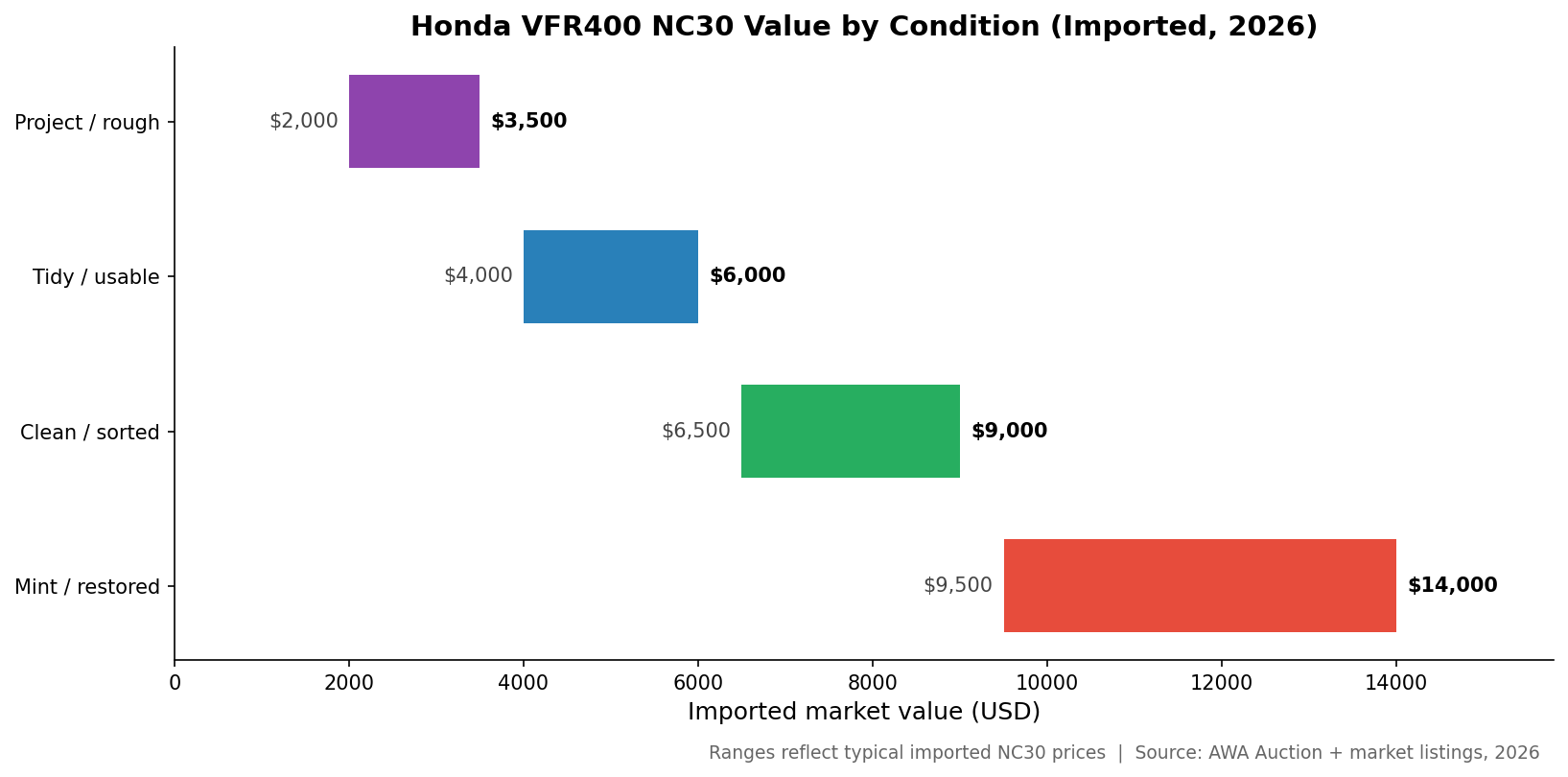
A rough project bike can be had cheap, but "cheap" is a trap on an NC30 — restoration can quietly add $2,000 to $4,000 once you start buying V4 parts. A tidy, sorted, honest example is the value sweet spot. Mint and fully restored bikes are now genuinely collectible and priced like it.
Now the import itself. On top of the auction price you have a bidding/agent fee, domestic transport to the port and export de-registration in Japan, the ocean freight, then customs clearance and registration at your end. Here is how a realistic landed cost stacks up for a clean NC30 going to the United States:
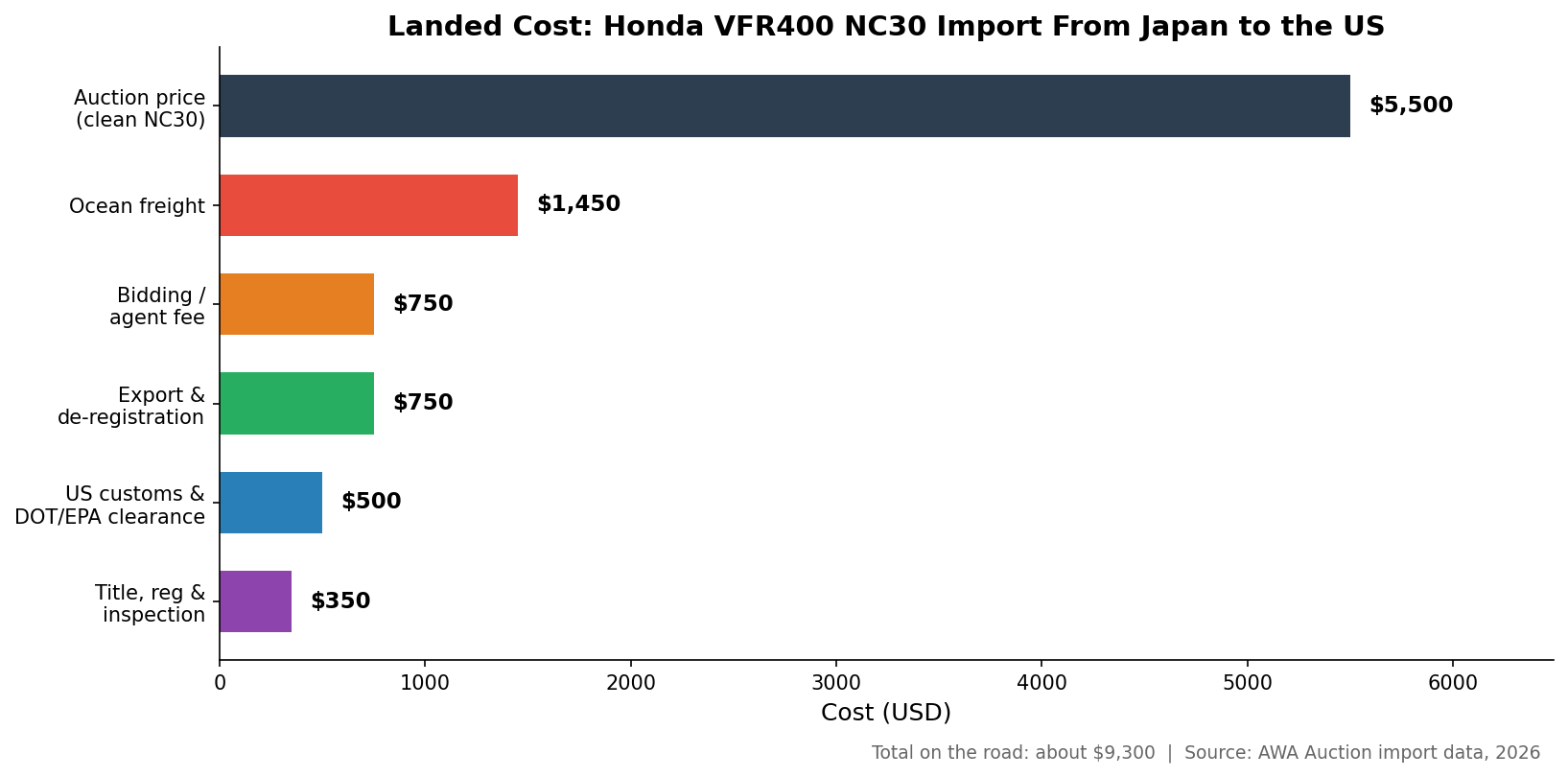
Add it up and a clean, on-the-road NC30 in the US lands somewhere around $9,000 to $11,000 all-in, which lines up with what imported examples actually change hands for. In the UK, a well-sorted NC30 typically sits in the £4,500 to £7,000 window. If a seller is quoting you well under those numbers for a "minter," your scam radar should be screaming — that is almost always a rough bike wearing a good description.
UK buyers do the same maths in a different currency. A typical NC30 landed in Britain works out to the auction price plus shipping, then import VAT at 20 percent and a small duty on the combined value, then registration to get an age-related plate. That is how a bike that looked cheap at the Japanese hammer price ends up at four to seven thousand pounds on the road. The good news for UK and Australian buyers is depth of community: decades of grey imports mean specialists, parts knowledge and club support are a forum post away, which takes a lot of the fear out of running a 35-year-old Japanese V4.
How to Import a VFR400 NC30 From Japan, Step by Step
The process sounds intimidating the first time and boring the third time. Here is the whole thing, start to finish.
1. Lock your spec and budget. Decide NC30 versus NC35, your absolute ceiling, and your non-negotiables (stock exhaust? unmolested carbs? specific colour?). Write them down. Auctions move fast and emotions are expensive.
2. Work with an exporter who has auction access. The big Japanese auctions — USS, JBA, BDS and the rest — are trade-only. You cannot walk in off the street and bid. You bid through a licensed agent, which is the part we handle. They translate the listings and the inspection sheets, and they bid to your limit.
It is worth knowing how the bidding itself works, because it is not eBay. The big halls run live, in-person trade auctions where hundreds of bikes cross the block in a single day, each one selling in seconds. Your agent places a maximum bid on your behalf and the system bids up to that ceiling, exactly like a proxy bid. You will not win every lot — clean NC30s draw attention and sometimes go over budget — so the game is patience. The right bike comes around every few weeks, and chasing one over your limit because you got emotional is how people overpay. A good agent will talk you out of that, not into it.
3. Find the bike and read the sheet. This is the step that separates a great NC30 from a heartbreak. More on the auction sheet in the next section — it is the most important paragraph in this whole guide.
4. Win it, then de-register and export. Once you win, the bike is de-registered for export in Japan, paperwork is prepared, and it moves to the port. You will choose roll-on/roll-off or a shared container; a container is safer for a tidy classic, RoRo is cheaper.
5. Ship and wait. Sea freight to the US, UK or Australia generally runs about four to eight weeks door-to-port depending on route and sailing schedule. This is the slow part. Make peace with it.
6. Clear customs and register. At your end you pay any duty and tax, file the import and exemption paperwork, and put it through whatever inspection or certification your country requires. Then you get a plate, and the NC30 is finally yours to rev to 14,000.
None of these steps is hard on its own. The skill is in doing them in the right order with the right documents, which is exactly why people use an exporter instead of fighting customs forms in a language they do not read.
The NC30 Buyer's Inspection Checklist: What Nobody Tells You
Generic "check the tyres and brakes" advice is useless on a bike this specific. These are the NC30 faults that actually matter, in priority order.
Front engine mounts. Start here. The mounts between the front cylinder head and the frame are known to crack on hard-used NC30s. It is the one structural gotcha on the bike and the first thing a knowledgeable buyer checks. A cracked mount is not a deal-breaker if priced in, but it must be priced in.
Regulator/rectifier. The reg/rec is a classic NC30 weak point, prone to cooking itself from heat or a tired battery. Many bikes have an upgraded unit already; if the charging system looks original and untouched, budget to replace it on principle.
Carburettor sync. Those four tiny carbs are fiddly to balance, and out-of-sync carbs give a flat spot in the midrange and rough, hesitant running. A bike that will not idle cleanly or stumbles off a closed throttle usually just needs a proper sync — but confirm that is all it needs.
Valve-train noise. The gear-driven cams are described as nigh-on bulletproof by long-term owners, and the whine is normal. What is not normal is uneven ticking or a metallic knock at idle. That points to valve-clearance neglect. Service history showing valve checks is gold.
Tuned engines. An NC30 that has been hard-tuned can develop crank problems. A standard, well-serviced engine is the reliable one. For a bike you are importing sight-unseen, boring and stock beats modified and "built" every time.
The 18-inch rear wheel. The NC30 runs an 18-inch rear, while almost everything modern is 17-inch. Tyre choice is narrower and you cannot always grab a rear on a Saturday afternoon. Not a fault — just a running-cost reality to know before you fall in love.
Grey-import rust and crash history. Check frame welds, the subframe and behind the fairing panels for rust and filler. Look for mismatched paint and lazy bodywork that hides a previous off. This is where the Japanese auction sheet earns its keep, because the inspector has already mapped most of it for you.
Fairings and fasteners. Original NC30 bodywork is expensive and increasingly rare, so check panel fit, look for cracks around mounting points, and be suspicious of cheap aftermarket plastics hiding damage underneath. Mismatched or missing fasteners are a tell that the bike has been apart in a hurry.
Clocks and electrics. Confirm the speedo and tacho work and that the mileage is believable for the bike's condition. Check that the indicators, lights and the temperamental charging warning all behave. Japanese-market wiring is fine, but 35 years of damp storage is not, so wiggle the connectors.
History over cosmetics. A slightly scruffy NC30 with a folder of service records beats a shiny one with no paperwork every time. On a bike where the engine rewards exact maintenance, proof that someone actually did it is worth more than fresh paint. This is the single biggest mistake first-time importers make: buying the prettiest photo instead of the best-documented bike.
How to Read an NC30's Japanese Auction Sheet
For a 35-year-old bike bought from the other side of the planet, the auction inspection sheet is your eyes. Learn to read it and you will buy better than people standing right next to the bike.
The headline is the overall grade, scored roughly 1 to 6. For a classic NC30, a grade 4 or 4.5 is a strong, honest used bike; a grade 5 is exceptional and priced accordingly. Anything at 3 or below is a project, and the photos had better back up the price. There is usually a separate interior/condition letter grade too, but on a bike it mostly tells you about overall care.
Then there is the map — a diagram of the bike with codes marking every flaw. A scratches, U dents, W means repaired or wavy panel, and so on. A clean map with a couple of minor A marks is exactly what you want on an NC30. A map covered in W marks means a bike that has been apart before.
The inspector's written notes are where the model-specific gold hides. For an NC30, you are hunting for words that flag a non-standard exhaust, modified carbs, or any mention of engine noise — because on this bike, "noise" could be the normal gear whine, or it could be the valve-clearance knock you do not want. A good agent reads those notes in Japanese and tells you which it is. That translation is half the value of importing through people who do this every week, and it is the core of what our team does on every bike.
Living With an NC30: Problems, Parts and Running Costs
So you have imported your NC30. What is ownership actually like? Better than the internet panic suggests, with a couple of honest caveats.
The maintenance rhythm is straightforward but non-negotiable. Fresh semi-synthetic oil at least every 4,000 miles, and valve clearances checked around every 16,000. Skip these and the gear-cam V4 will eventually let you know, expensively. Keep to them and owners genuinely describe the engine as bulletproof.
Parts are the running-cost sting. Many NC30 bits have to come from Japan or the UK, and V4 parts were never cheap to begin with. Consumables are fine; model-specific items take patience and money. Factor that into your budget rather than discovering it the first time you need a fairing bracket.
Now the honesty: the NC30 is not a commuter and not a beginner bike. Weather protection is minimal, the seat is a track-day seat, first gear is comically tall so launching takes deliberate clutch slip, and the whole bike comes alive above 9,000 rpm where a sane commute never goes. As a daily, it is a compromise.
As an object of devotion, though, it is unmatched in its class. One long-term owner put 23,000 km on his in nine months — commuting, sport riding and weekend track days — with religious oil changes. Another described selling his, then grieving for four years before buying another. That is not how people talk about appliances. That is how they talk about an NC30. The full ownership picture is well covered in MCN's VFR400 review if you want more road-test detail.
One more thing worth saying plainly: the NC30 is appreciating. Clean examples have climbed steadily as the 25-year rule opened the US market and the supply of good bikes thinned out. Buy a tidy, honest, well-documented NC30 at a fair price and look after it, and you are not throwing money at a depreciating toy the way you would with a new bike. You are buying a modern classic that the market is quietly revaluing upward. That changes the whole calculation. The import cost is not money burned; it is the price of getting into an asset before everyone else catches on, on a bike you actually get to ride and love in the meantime.
How AWA Auction Gets You a Clean NC30 From Japan
Here is what we actually do. We have standing access to the Japanese trade auctions where NC30s surface every week — the same USS and JBA halls that are closed to the public. When you tell us your spec and your ceiling, we hunt, we read the sheets in Japanese, and we flag the front-mount cracks, the cooked reg/recs and the "modified" notes before you ever commit a dollar.
Then we bid to your limit, handle the export de-registration and documentation, arrange shipping in the format you choose, and hand you a bike with a paper trail instead of a stranger's promise. You are not gambling on a blurry listing. You are buying a graded, inspected machine with someone in your corner who does this daily.
The NC30 is out there in better condition than anything you will find locally, at a price that makes the import worth it. Getting one is just a matter of knowing where to look and what the sheet really says — and we already do.
See Also
Share this article: