
Over 18 million people have watched a guy load a 40-foot container full of motorcycles from Japan. What that video doesn't show you is the part that actually matters: how the bidding works, what everything costs, and why most first-time buyers get it wrong.
Japanese motorcycle auctions are the most efficient used bike market in the world. BDS — Japan's largest exclusive motorcycle auction house, founded in 1983 — moves 180,000 motorcycles per year through a network of 5,000 licensed Japanese dealers. The quality is routinely higher than anything you'll find at a comparable price point from a domestic dealer in the US, UK, or Australia, because Japan's shaken vehicle inspection system forces owners to trade in well-maintained bikes at the first sign of expensive future maintenance.
Here's the catch: you cannot just show up and bid. The system is dealer-only, entirely in Japanese, and access requires a registered Japanese business entity. But it's absolutely accessible to overseas buyers if you understand the architecture.
This guide covers everything: the major auction houses and their differences, why direct access isn't available to you (and what that actually means in practice), the full step-by-step bidding process, how to read an auction sheet before you commit, how to calculate your maximum bid from landed cost backwards, common mistakes that cost buyers money, and how to vet an agent so you know you're working with someone who has your interests in mind.

What Japanese Motorcycle Auctions Actually Are
When people say "Japanese motorcycle auction," they usually mean one of three distinct systems. Understanding the difference will matter when you start working with an agent.
BDS (Bike Dealer System) is the one you need to know first. Founded in 1983, BDS is Japan's largest exclusive motorcycle auction network, processing over 180,000 bikes per year through its membership of 5,000 licensed Japanese dealers. The flagship event is BDS Kanto, held every Wednesday in Tokyo, where approximately 4,000 motorcycles go under the hammer in a single session.
BDS members bid through a proprietary internet platform called JUPITER — a live auction system that handles bid submission, lot management, and buyer records in real time. You can't access JUPITER as an individual overseas buyer; only licensed BDS member dealers can. That's the first wall you'll encounter.
What makes BDS special isn't just the scale. It's the inspection standard. Every motorcycle that enters a BDS auction is physically examined by a trained inspector who has no financial stake in the sale price. The grade and damage code documentation that comes out of that inspection is the foundation of Japan's auction market credibility. When an auction sheet says Grade 4, it means something specific and consistent across 180,000 bikes per year.
JBA (Japan Bike Auctions) is the second-largest dedicated motorcycle auction network, operating through the ASNET system. JBA uses the same grading standards as BDS, so a Grade 4 at JBA translates directly to a Grade 4 at BDS. For buyers working with agents who access multiple networks, JBA gives you additional lot volume and occasionally better pricing on specific models that are overrepresented in BDS inventory.
USS (Used Car System) is best known as Japan's largest car auction but also handles motorcycles. USS bike lots tend to skew toward older machines, more eclectic inventory, and occasionally rare collector pieces that don't move through BDS's structured dealer trade. Pricing can be interesting — fewer motorcycle-specialist bidders means less competition on some lots.
Aucnet is an online-only auction system with no physical viewing location. Photos and auction sheets are the only inspection available. Aucnet pricing often runs slightly below BDS for equivalent grades, because the format attracts fewer participants. Experienced buyers who know exactly what they're looking for and can read an auction sheet confidently can find value here.
The practical choice for a first-time buyer: BDS Wednesday. Four thousand bikes every week, standardized inspection, the largest pool of Grade 4 and 4.5 clean used stock in the world. Start here before you explore other options.

Why You Can't Bid Directly (and What That Actually Means)
This is the part that surprises most people when they first start researching Japanese auction imports. You cannot register directly with BDS, JBA, or USS as an overseas individual buyer. These are dealer-only markets that require a Japanese business registration, a physical Japanese address for administrative processing, and ongoing compliance with auction house membership rules — all of which exist entirely within the Japanese legal framework.
This isn't bureaucratic gatekeeping designed to exclude foreigners. The system works because accountability flows through the dealer network. When a bid is placed through JUPITER, a registered Japanese dealer entity is legally and financially on the hook for that transaction. Payment terms, dispute resolution, lot handling, export paperwork — all of it runs through that registered entity.
What this means practically: you participate through a Japanese auction agent. This is a licensed company — sometimes called an export agent, sourcing agent, or purchasing agent — that holds auction house membership and can bid on your behalf according to your explicit instructions.
The agent relationship is less "give me your money and I'll find something" and more "you tell me the exact lot you want, the price you'll pay, and I'll execute it." The best agents send you the full auction sheet before placing a single bid. They'll tell you when a specific lot is overpriced relative to the grade, flag damage codes you've misread, and point out when the bidding activity on a popular model has pushed prices past the point where the deal makes sense.
You're paying for two things: execution and market intelligence. A good agent provides both. The fee is not just a transaction cost; it's the cost of having someone who knows the BDS market sit next to you at the auction.
The Wednesday vs Friday Difference (This Matters More Than You Think)
Most first-time buyers don't know that BDS has two distinct weekly auction types, and they don't know because most agent websites don't explain it clearly.
BDS Wednesday Auction (the main event): Inventory here is primarily trade-in stock from Japan's dense retail dealer network. These are bikes that came in because their owners upgraded to something newer, couldn't face the shaken renewal cost for an older machine, or simply moved on. Condition grades cluster strongly around 3.5 to 5, with a good supply of clean 4 and 4.5 bikes — meaning cosmetically excellent, mechanically sound, minor wear only. This is the inventory most overseas buyers are targeting. The Wednesday auction at BDS Kanto is what OK Moto documented in their "Inside Japan's Biggest Motorcycle Auction House" video, which has accumulated over 174,000 views and includes footage that shows the scale and organization of the operation better than any text description can.
BDS Friday Auction (a different market entirely): Friday lots lean toward older machines, project bikes, bikes from estates and private sellers, machines that didn't move through the Wednesday dealer network because they needed work. Grades run a wider range — you'll see genuine Grade 6 pristine machines and R-grade (accident repaired) bikes in the same session. For buyers who are mechanically confident, know exactly which model they're hunting, and understand what the damage codes mean at the R and RA level, Friday can be genuinely excellent. For buyers who want a reliable, ride-ready machine without uncertainty, stay on Wednesday.
The mistake that burns people: they find a great-looking bike at a low price in a Friday BDS listing without realizing the inventory pool they're looking at is fundamentally different from Wednesday. A Grade 3 bike at BDS Friday is not the same as a Grade 3 bike listed at BDS Wednesday in terms of what you can reasonably expect to receive.
Step-by-Step: How to Place Your First Bid
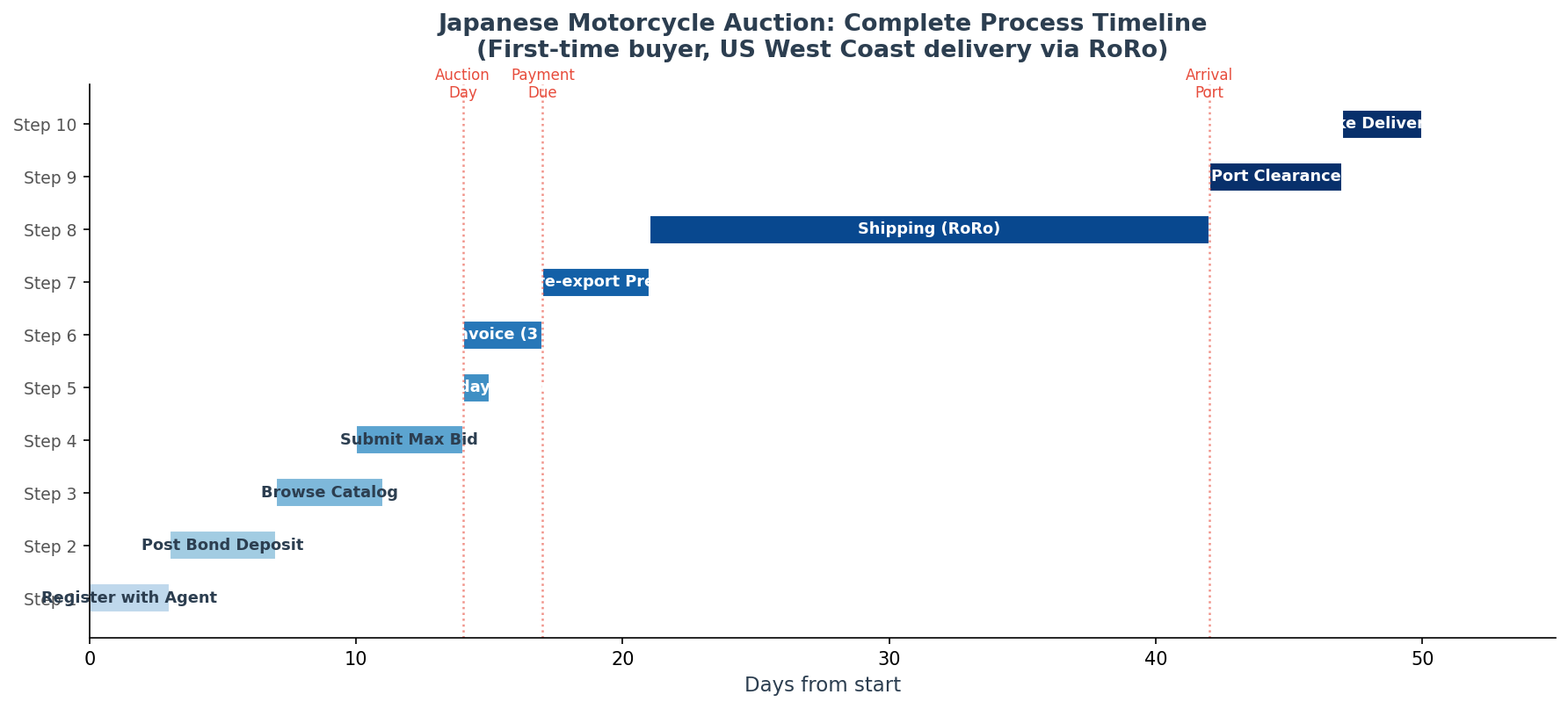
Here's the complete process from registering with an agent through winning your first lot.
1. Find and Vet Your Agent
The most important decision in the entire process. Everything downstream depends on the agent you choose. Here's what to evaluate:
Full auction sheet access before bidding — Non-negotiable. Any agent that won't provide the complete damage code breakdown from the auction sheet before placing your bid is not operating in your interest. The sheet is your pre-purchase inspection. Without it you're bidding on photographs.
Transparent, published fee structure — Fees should be listed explicitly before you register: agent service fee per bike, auction house fee (paid to BDS or JBA directly), any storage or handling fees, what's included in shipping coordination. Hidden fees that appear at invoice stage are a red flag.
Track record with real examples — Ask to see documented examples of bikes they've sourced, imported, and delivered to customers with similar specs to what you're looking for. Vague testimonials are not enough.
Communication speed — In a weekly auction market, communication delays matter. If your agent takes 48 hours to respond to a question about a lot you want to bid on, you may miss the session. Assess their response time during the pre-sales process.
Dispute handling policy — What happens if a bike arrives with damage not disclosed on the auction sheet? This occurs rarely but it does happen. An agent with clear procedures for escalating disputes with the auction house is worth more than one who has never thought about it.
Typical cost structure to verify against:
- Agent service fee: ¥45,000–¥50,000 per motorcycle (~$285–$315 USD)
- BDS/JBA auction house fee: ~¥12,000 per transaction
- Both in addition to the winning bid price
2. Register and Post Your Bond Deposit
Before any bids can be placed, your agent requires a bond deposit. Standard industry practice is 50% of your intended spend. If you're targeting bikes in the ¥500,000 range ($3,200 USD at current rates), expect to deposit approximately ¥250,000 (~$1,600 USD) before your first auction session.
This is not a fee. It's credited directly toward your first purchase. The purpose is to confirm that you have the financial capacity to complete the transaction if your bid wins. Agents that let overseas buyers bid without any deposit upfront are extending credit to strangers in a foreign country — that's a structural signal worth noting.
Registration typically requires: completed forms, passport or ID copy, and a bank transfer for the deposit. Some agents also require a brief phone or video call to walk through how the bidding process works and confirm your purchase intent.
3. Submit Your Target Lots at Least 48 Hours Out
The BDS Kanto auction runs weekly. Lots are listed in the catalog in the days before each Wednesday session. Your job in this window:
- Browse the catalog through your agent's platform or via the auction sheets they send you
- Identify bikes matching your model/year/grade/budget criteria
- Review every auction sheet on your target lots (not just the photo)
- Confirm your maximum bid for each target lot
Most agents require your completed target list and maximum bid amounts at least 48 hours before the auction session. This gives them time to review the sheets themselves, flag anything they'd recommend changing, and ensure all bids are submitted through JUPITER correctly before the session opens.
If you're asking your agent to find bikes within your brief (rather than targeting specific lots yourself), provide as much detail as possible: model family, year range, grade minimum, maximum damage codes you'll accept, and your absolute maximum bid in JPY. The more specific your brief, the less time gets wasted on lots that don't fit.
4. Set Your Maximum Bid Using Landed Cost Math
This is the number that defines everything. The right maximum bid is calculated backward from your total landed cost budget, not forward from what the bike is listed at.
Work through this before each auction session:
| Item | Typical Cost |
|---|---|
| Winning bid (target) | Variable |
| Agent service fee | ¥45,000–¥50,000 |
| BDS/JBA auction house fee | ~¥12,000 |
| Pre-export prep & storage | ¥20,000–¥50,000 |
| RoRo shipping (Japan → US West Coast) | ~$900 |
| RoRo shipping (Japan → UK) | ~$1,200 |
| Import duty (US: 2.4%; UK: 6%) | Variable |
| Port clearance & delivery | $150–$300 |
Add up everything except the winning bid. Subtract that from your total landed cost budget. What remains is the maximum you can pay at auction to hit your target.
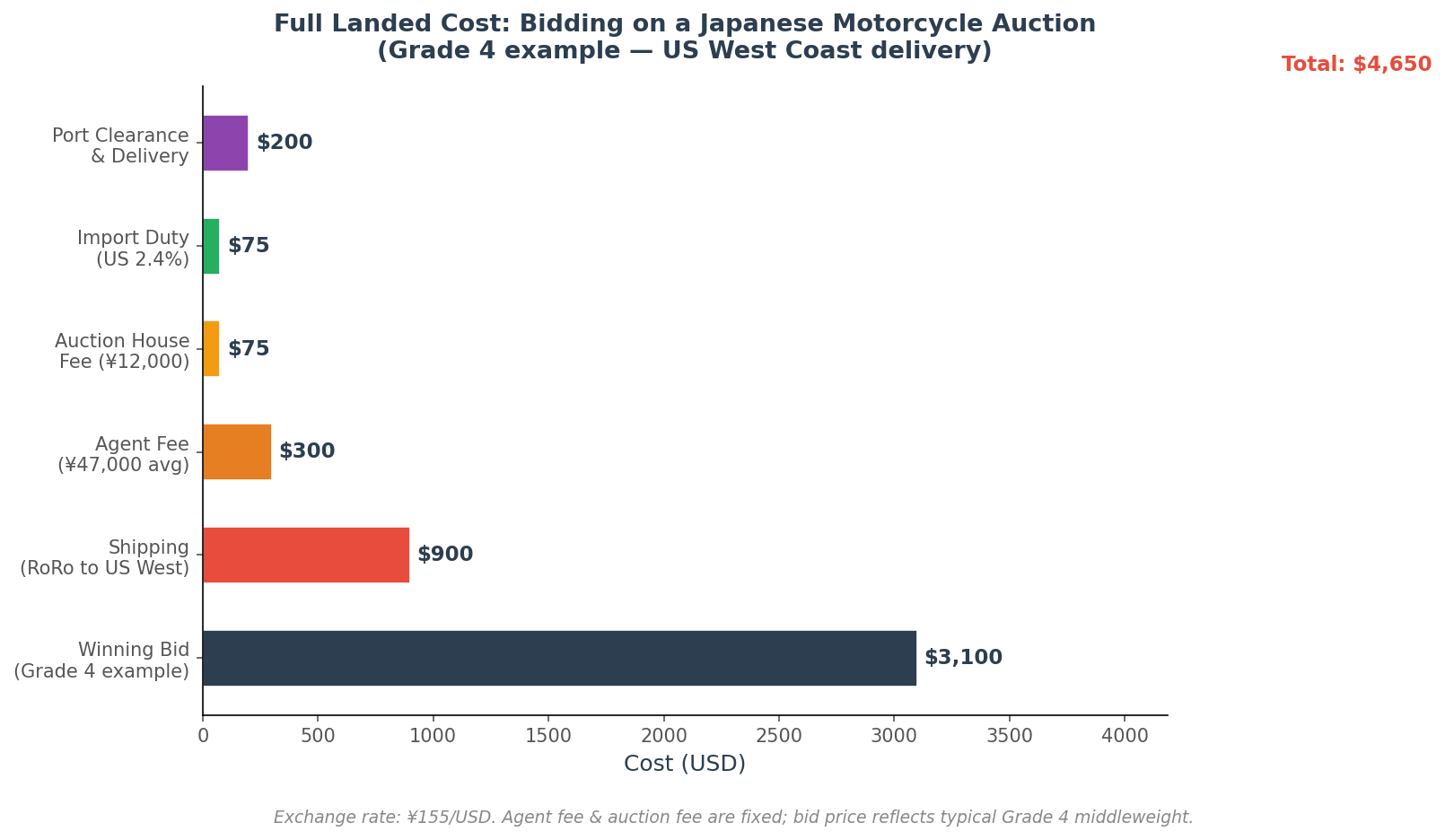
Set this number before the session opens. Tell your agent. Hold to it.
The psychology of auction bidding works against you if you don't pre-commit to a number. When you're watching the price tick up on a bike you've already mentally pictured in your garage, "just a little more" feels reasonable in the moment. It's not. The bike that sold for ¥10,000 over your max is not a loss — it's a discipline that keeps your landed cost inside budget.
5. The Auction Session and Outcome Notification
BDS Kanto Wednesday sessions typically run through the morning and into early afternoon Japan Standard Time. Your agent submits your bids through JUPITER before and during the live session. Depending on the agent's platform, you may be able to track bid status in near-real time or receive post-session notification of outcomes.
For each lot you targeted, you'll receive one of three outcomes:
- Won — your bid was the highest at or below your maximum
- Lost — another bidder went higher than your maximum
- Reserve not met — the reserve price (set by the lot owner) wasn't reached at the end of bidding
None of these outcomes are disasters. If you lose a lot, BDS Kanto runs again in seven days with comparable inventory. Fixating on one specific bike in a market that moves 180,000 units annually is the surest way to overpay.
6. Payment Within Three Business Days
If your bid wins, full payment is due within three Japanese business days. This is strict — late payments incur penalty fees, and repeated late payments can impact your agent's relationship with the auction house, which ultimately affects your access.
Payment covers the complete invoice: winning bid price, auction house fee, and agent service fee. All in Japanese Yen. Factor in your bank's wire transfer processing time and currency conversion spread when timing your payment.
Reading the Auction Sheet Before You Bid
The auction sheet is your pre-purchase inspection. A photo shows you how a bike looked from seven specific angles on the day of the auction. The auction sheet tells you what the inspector found when they physically examined every surface.
Core auction sheet elements:
Grade — The overall condition rating assigned by the auction house inspector:
- Grade 6 — New or essentially unused
- Grade 5 — Near-new, minimal use
- Grade 4.5 — Excellent used condition, minimal wear
- Grade 4 — Good used condition, minor cosmetic issues only
- Grade 3.5 — Average condition, visible wear and minor issues
- Grade 3 — Below average, noticeable defects
- Grade R — Repaired accident damage
- Grade RA — Significant accident history, repaired
Damage codes — Letter indicates damage type, number indicates severity (1 = minor, 2 = moderate, 3 = significant):
- A — Paint work required
- U — Dent or deformation
- B — Chip or crack
- W — Rust or rust staining
- X — Corrosion requiring replacement
- S — Scratches
A code of A1 means a small area needing minor paint touch-up. An X3 code means significant corrosion requiring part replacement. The numeric scale matters as much as the letter.
Odometer reading — Self-reported from the bike's display at inspection. Odometer manipulation is rare in Japan given the documentation trail created by mandatory shaken inspections, but cross-reference against the service history noted on the sheet.
Registration and inspection history — How many previous owners, when the last shaken was issued, and how long the bike has been out of active registration. A bike deregistered in 2022 now appearing at auction in 2026 has sat unused for four years — that's a detail worth investigating before you bid.
Engine and equipment notes — Whether the engine number matches the frame record, factory equipment present vs absent, non-stock modifications noted. A bike listed without its original tool kit or with a non-matching seat is a minor detail; a bike listed with a replacement engine number is not.
Spend real time on the auction sheet. If something looks unusual, ask your agent before the session, not after.
What Popular Models Actually Clear For
First-time buyers often have no frame of reference for what prices are realistic. Here's a general picture of what Grade 4 examples of common models have been clearing at BDS Wednesday auctions:
These are auction-only prices in JPY, before any agent fees, shipping, or duties. They shift with market conditions, yen exchange rates, and seasonal demand — but they give you a calibration point.
Kawasaki Ninja 400 (2018–2021, Grade 4): ¥350,000–¥480,000
Honda CB500X (2019–2022, Grade 4): ¥380,000–¥520,000
Yamaha MT-07 (2016–2019, Grade 4): ¥450,000–¥620,000
Kawasaki Z900 (2017–2020, Grade 4): ¥520,000–¥720,000
Honda CBR600RR (2007–2012, Grade 4): ¥380,000–¥580,000
Yamaha YZF-R1 (2015–2019, Grade 4): ¥750,000–¥1,100,000
Honda Super Cub 110 (2019–2022, Grade 4.5): ¥90,000–¥150,000
The pre-2001 JDM-only models (Kawasaki ZRX1200R, Honda CBR929RR, Yamaha R7 OW-02) that became 25-year-rule legal for US import in recent years trade at premium to grade — collector demand for these specific models consistently pushes final prices above what a Grade 4 label would otherwise suggest.
Red Flags When Choosing an Agent
You can tell a lot about an agent's reliability before you commit any money by how they handle specific questions.

They won't send you the auction sheet before bidding. This is the single biggest red flag. The auction sheet is not proprietary to the agent — it's produced by the auction house. Any agent who won't share it is either concealing information or doesn't understand why it matters. Either is disqualifying.
Their fee structure isn't published. Legitimate agents publish their complete fee structure because transparency is a competitive advantage. If you have to ask specifically to get a fee breakdown, and the answer is vague, that's a signal.
They guarantee specific prices. Nobody can guarantee what a specific lot will sell for. Market prices reflect active bidding from 5,000 registered dealers. An agent who promises they can "get you a Grade 4 Ninja 400 for ¥300,000" is either working from outdated data or making promises they can't keep.
They respond very slowly before you've given them money. Pre-sales communication speed predicts post-sales communication speed. If they take three days to answer an initial inquiry, imagine how they'll handle a question about a lot that closes in 48 hours.
No track record they can actually document. "We've helped hundreds of customers" with no specific examples is not a track record. Ask for photos and documentation of completed imports. A real operation has these readily available.
The Auction Calendar and Planning Ahead
One of the underappreciated advantages of the Japanese auction system is its regularity. Unlike one-off or regional auctions in other countries, Japanese motorcycle auctions run on fixed weekly schedules.
BDS Kanto (Tokyo) runs every Wednesday. BDS has regional branches — Chubu, Kansai, Kyushu, Tohoku — each running on their own weekly schedule. JBA events are spread through the week at various venues. Aucnet runs its online sessions on a separate calendar.
For planning purposes, this means:
- If you miss the Wednesday session, the next one is in seven days with fresh inventory
- You can plan your research and budget work around specific auction dates
- You're not competing against unpredictable demand spikes around one-off events
The practical rhythm for most overseas buyers is: browse catalog Tuesday or early Wednesday → review sheets and confirm maximum bids with agent → receive results Wednesday afternoon or evening Japan time → if won, initiate payment Thursday.
How AWA Auction Simplifies the Process
AWA Auction is a Japan-based exporter with direct access to BDS, JBA, and Aucnet auctions every week. The service is built specifically for overseas buyers who want the quality and pricing of Japanese dealer auctions without navigating a system designed for licensed Japanese dealers.
Here's how we work:
Full auction sheet before any bid — You see the complete damage code documentation before we submit anything. If we see something on the sheet that we think is understated in the grade, we tell you. Nothing moves without your explicit approval.
Clear weekly schedule — We bid at BDS Kanto every Wednesday. You can plan your purchase timeline around a consistent cadence rather than chasing unpredictable availability.
Published fee structure — Agent fee, auction house fee, what's included and what isn't. All visible before you register.
End-to-end export handling — From winning bid through departure documentation, we manage the complete Japanese side of the process. You handle import compliance in your country; we handle everything from here to the port.
Browse current inventory available through our sourcing network, or contact our team to discuss a specific model you're targeting — including models we can proactively watch for at upcoming Wednesday sessions.
Understanding Auction Photos: What to Look For and What to Ignore
Japanese auction houses photograph every motorcycle before it enters the system, and the photo sets are more full than you'll find at a typical used bike dealer. But photos have limits, and knowing those limits before you bid matters.
What auction photos show well:
- Overall body panel condition from multiple angles (front, rear, left side, right side, often overhead)
- Tank and seat surface condition
- Wheel condition and tire wear stage
- Windscreen and fairings condition on sport bikes
- Visible rust or corrosion on chrome and steel components
What auction photos don't show reliably:
- Frame condition underneath bodywork
- Engine case scratches hidden by factory covers
- Brake fluid condition and hydraulic component health
- Electrical system issues
- Fork seal condition when forks are clean
- Internal damage from a past tip-over that left no obvious external marks
This is exactly why the damage code section of the auction sheet exists. The inspector physically touches panels, checks seals, examines the frame, and records findings that a photograph can't communicate. When the photo looks flawless but the sheet shows an A2 code on the tank and a U1 on the left panel, that tells you the photo was taken at a flattering angle or in lighting that minimized the visible wear.
Use the photos to get a general sense of the machine. Use the auction sheet damage codes to understand what the inspector actually found. If these two sources of information contradict each other — if the bike looks spotless in photos but has three damage codes — trust the sheet.
One more thing about photos: they're taken on the auction day, not necessarily the day you're reviewing the catalog. A bike photographed in the lot on Tuesday may be in a different position by Wednesday morning's session. The condition documented on the sheet is the authoritative record.
Currency Risk and Timing Your Purchase
Bids at Japanese dealer auctions are placed in Japanese Yen. For buyers in the US, UK, Australia, or New Zealand, this introduces currency risk that most guides don't bother mentioning until it's already affected someone's budget.
The yen-dollar exchange rate has moved substantially in recent years — a 10% swing in the USD/JPY rate changes your landed cost on a ¥500,000 motorcycle by roughly $320 at current rates. That's not trivial when you've budgeted carefully.
Practical approaches to manage this:
Set your max bid in JPY, not in your home currency. Do the landed cost math with a currency conversion buffer built in — assume the rate is 5% worse than the current mid-market rate when calculating your budget. If the rate is better when you actually pay, that's a positive surprise; if it's worse, you're still inside budget.
Pay quickly after winning. You have three business days before late fees apply. Don't let exchange rate speculation push you toward the deadline. Transfer as soon as the invoice is received and cleared.
Use a specialist currency transfer service for large transactions. The exchange rate difference between a bank wire and a specialist transfer service on a ¥500,000 transaction can be ¥10,000–¥20,000 — real money that you're either keeping or giving away based on which payment method you use. Services like Wise, OFX, or a local equivalent typically offer rates significantly closer to mid-market than standard bank international wire rates.
If you're purchasing a higher-value bike (¥1,000,000+), forward contracts from currency specialists let you lock in an exchange rate for a future transaction — useful if you're planning to bid over several weeks while watching inventory.
The Japanese yen has historically been one of the more volatile G10 currencies relative to the dollar and pound during periods of interest rate divergence. If you're budget-sensitive, build in the buffer and don't let currency speculation make your bidding decisions.
Frequently Asked Questions
Can I bid on Japanese motorcycle auctions directly without an agent?
No. BDS, JBA, and USS are dealer-only auctions requiring Japanese business registration. As an overseas individual buyer, you cannot register as a member or access the JUPITER bidding system directly. You participate through a licensed Japanese export agent who holds auction house membership and bids according to your explicit instructions.
How much does a Japanese auction agent charge?
Standard agent fees run ¥45,000–¥50,000 per motorcycle (approximately $285–$315 USD), plus an auction house fee of approximately ¥12,000 paid directly to BDS or JBA. These are separate from the winning bid price and from shipping costs.
How often do BDS auctions happen?
BDS Kanto (Tokyo) runs every Wednesday with approximately 4,000 motorcycles. Regional BDS branches run on different days. JBA and Aucnet run on separate schedules. There is a major Japanese motorcycle auction happening somewhere in Japan on most weekdays.
What deposit do I need before an agent will bid?
Industry standard is a bond deposit of 50% of your intended spend, credited toward your first purchase. For buyers targeting ¥500,000 bikes, expect to deposit approximately ¥250,000 (~$1,600 USD) before the first bid is placed. This is not a fee — it confirms you have the capacity to complete the transaction.
What is the JUPITER bidding system?
JUPITER is BDS's proprietary internet auction platform used exclusively by registered member dealers. It handles live bid submission, lot management, and buyer records in real time. Overseas buyers don't access JUPITER directly — their licensed Japanese agent uses their dealer account to bid through the system on your behalf.
What's the difference between BDS Wednesday and Friday auctions?
Wednesday BDS features primary trade-in inventory from Japan's dealer network — clean, driveable bikes typically graded 3.5 to 5. Friday BDS features restore-base machines, older models, and bikes requiring work. First-time buyers should focus on Wednesday. Experienced buyers hunting for specific project machines can find value on Fridays.
How do I know the auction sheet grade is accurate?
BDS and JBA grades are produced by trained inspectors employed by the auction house — not by the seller. The inspector has no financial stake in the sale price. This structural independence is why Japanese auction sheet grades carry genuine credibility in the export market: the person writing the grade has no reason to inflate it.
What is the 25-year rule and how does it affect my bidding strategy?
The 25-year rule (US EPA/DOT law, with equivalents in other markets) exempts vehicles over 25 years old from certain emissions and safety compliance requirements. For buyers in 2026, motorcycles manufactured in 2001 or earlier can be imported to the US without EPA compliance documentation. This opens up a substantial pool of JDM-only models never sold in Western markets — some of which carry significant collector value. Pre-2001 bikes at auction may be worth more to you than their grade alone suggests, especially for models like the CBR929RR, ZRX1200R, and early Hayabusa variants.
Can I inspect the bike in person before bidding?
Not as an individual overseas buyer. You work from auction sheet documentation and photos. Some agents will visit the auction venue before the session and send additional photos on request, but the standard process is remote. This is why being able to read an auction sheet accurately matters so much — it's your closest equivalent to a hands-on inspection.
What happens if the bike arrives with undisclosed damage?
This is uncommon but not impossible. Japanese auction grades carry industry credibility, but inspection is not perfect. Work with an agent who has clear procedures for raising disputes with the auction house when damage not disclosed on the sheet is discovered at the destination. Agents with established auction house relationships are better positioned to escalate these cases than new entrants to the market.
How long does the full process take from first bid to bike in my garage?
Roughly 8–14 weeks for US buyers, 10–16 weeks for UK and European buyers. The timeline depends on how quickly you win a lot (you may lose a few sessions before winning), how fast your agent's storage fills for container shipping or when the next RoRo vessel departs, and how smoothly import clearance goes at your destination port.
*Photos via Pexels — free to use under the Pexels License.*
See Also
Share this article: