
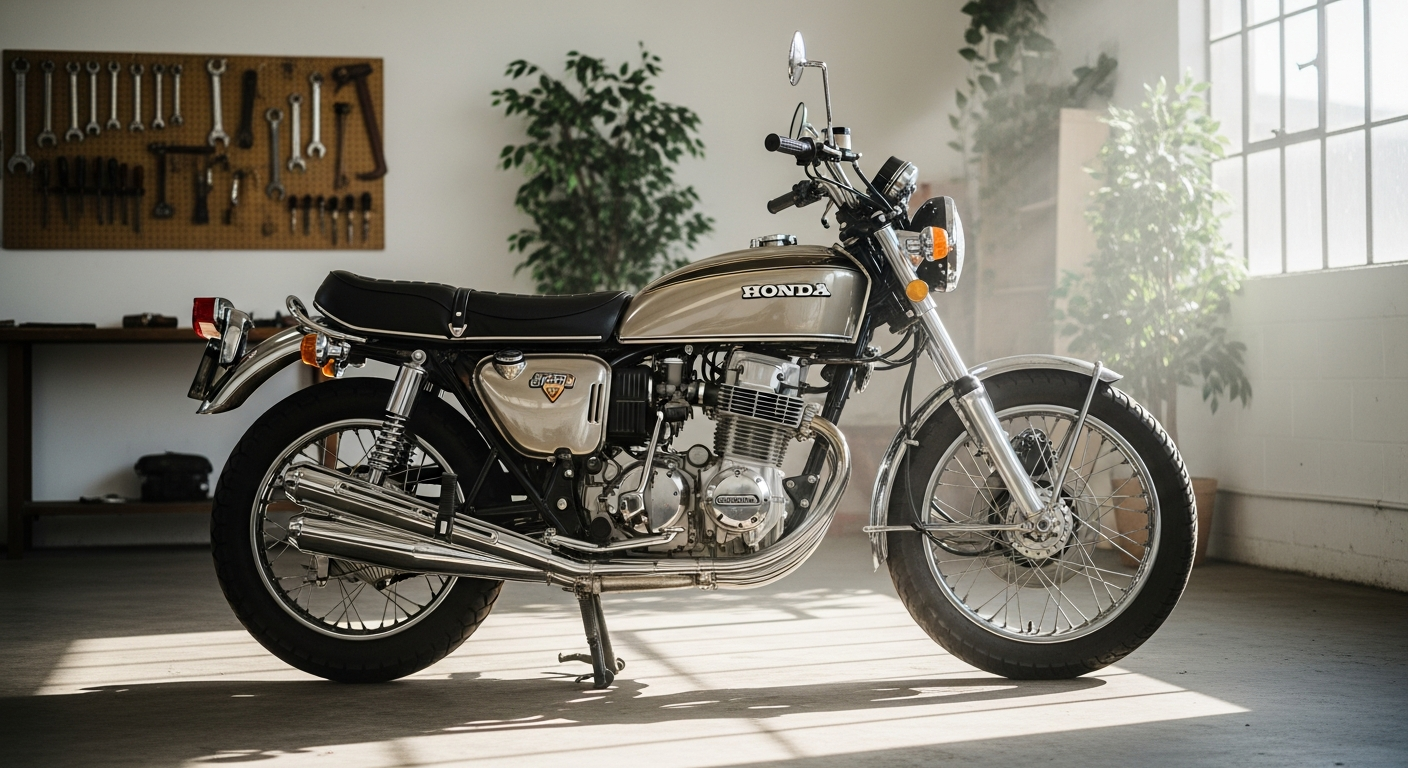
There's a YouTube video with over three million views where a guy named Bikes and Beards cracks open a 40-foot shipping container fresh off the boat from Japan and tries to start every motorcycle inside. The whole internet watched because that container is the American dream for anyone who has ever drooled over a bike they were never allowed to buy new. JDM two-strokes. 400cc race-replicas. Naked retros that never crossed the Pacific. They're all sitting in Japan right now, cheap, clean, and legal to bring home — if you know the rules.
Here's the thing nobody mentions: importing a motorcycle from Japan to the USA is not the legal minefield people make it out to be. It's mostly paperwork, patience, and one number you have to get right. Mess up that number and Customs can literally seize your bike at the dock. Get it right and you can land a bike in your garage for thousands less than the same machine costs on Craigslist.
This guide walks you through all of it — the 25-year rule (and the 21-year rule almost everyone confuses it with), which bikes are actually worth importing in 2026, the real landed cost from auction hammer to your driveway, every federal form, and the state-by-state titling mess that trips up first-timers. By the end you'll know exactly what to do, what to budget, and where the traps are.
Can You Actually Import a Motorcycle from Japan to the USA?
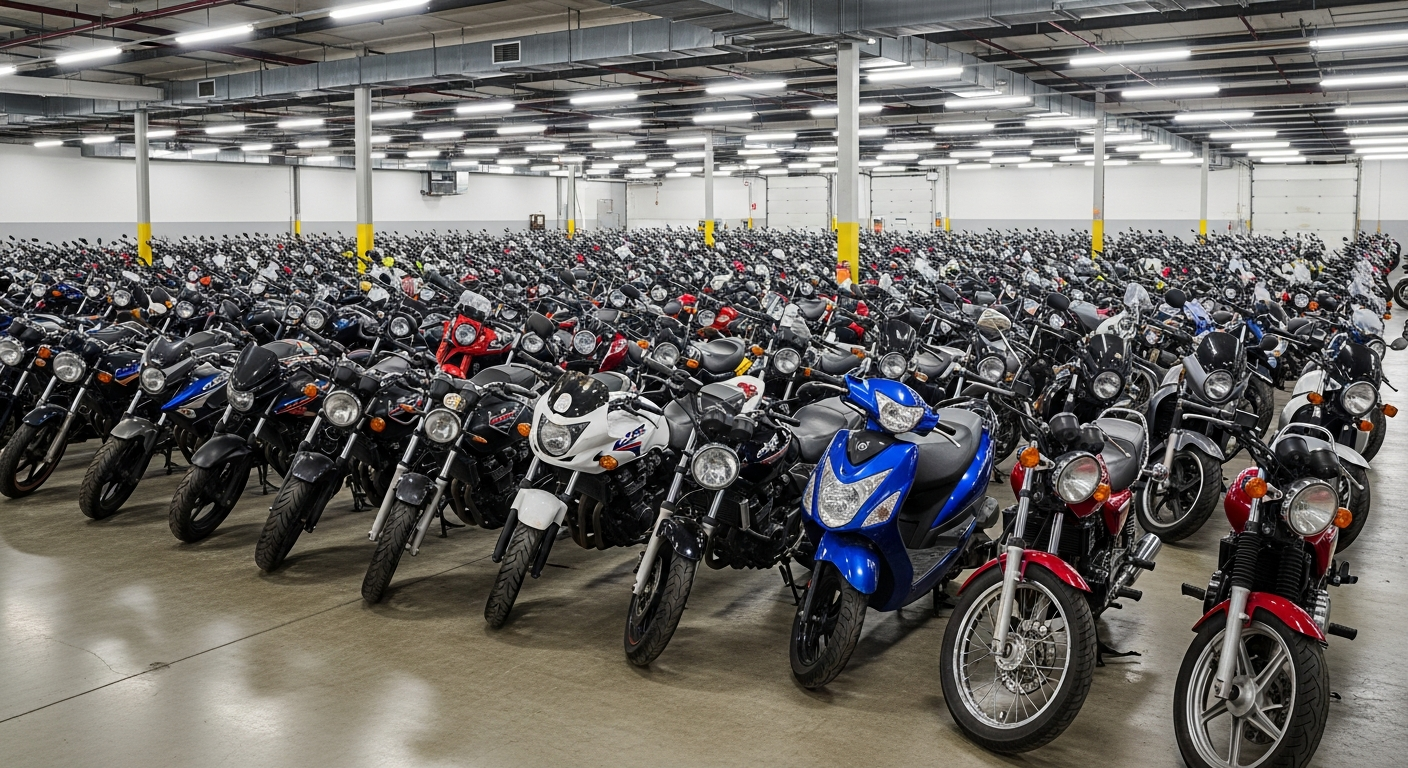
Yes. Full stop. The United States lets you import a foreign motorcycle, and Japan is the single best place to buy one because of the sheer volume and condition of bikes flowing through its domestic auctions every week. Around 200,000 used motorcycles change hands at Japanese auctions annually, and most of them are graded, photographed, and described in obsessive detail before they ever go under the hammer.
The catch is that the U.S. has two federal agencies that care about what you're bringing in: the EPA, which regulates emissions, and the Department of Transportation through NHTSA, which regulates safety. A brand-new motorcycle built for the Japanese market does not meet U.S. emissions or safety standards, so in theory you can't just ship a 2024 bike over and ride it.
But there's a door, and it's a wide one. Once a motorcycle is old enough, both agencies stop caring. That's the "25-year rule" you've heard about — and it's the reason the JDM import scene exists at all. The bikes Americans were forbidden from buying in the '90s are now legal to import, and a whole generation of riders is bringing them home.
If you're shopping for a bike to import right now, you can browse machines that are already eligible and auction-ready on our current listings page — every bike there is sourced from the same Japanese auction network the importers in those YouTube videos are pulling from.
The 25-Year Rule vs the 21-Year Rule — What Most Guides Get Wrong
Almost every "import a bike from Japan" article online tells you the same thing: wait until the bike is 25 years old and you're golden. That's mostly true, but it's sloppy, and the sloppiness is exactly what gets people confused at the port. There are actually two separate clocks ticking, run by two different agencies, with two different ages.
NHTSA's 25-year rule (safety)
NHTSA — the safety side — says a motor vehicle that is at least 25 years old can be imported without meeting any Federal Motor Vehicle Safety Standards. No headlight conformance, no DOT-approved tires, nothing. You declare it under Box 1 on the HS-7 form and you're done. The age is measured from the actual date of manufacture, not the model year, and it rolls forward continuously. In 2026, that means a bike built before roughly mid-2001 clears the safety side.
EPA's 21-year rule (emissions)
Here's what the other guides skip: the EPA uses a different, earlier cutoff. A motorcycle that is at least 21 years old, in its original unmodified configuration, is exempt from EPA emissions requirements. You declare that under code "E" on EPA Form 3520-1. So a bike can clear the emissions hurdle four years before it clears the safety hurdle.
Why does this matter? Because the binding constraint is always the 25-year safety rule. The emissions door opens earlier, but you still can't legally title and ride the bike on the road until it satisfies NHTSA's 25 years. Knowing both numbers stops you from buying a 22-year-old bike thinking you've cleared everything, then discovering you're stuck for three years. When in doubt, count 25 years from the build date and you'll never be wrong.
Which Japanese Motorcycles Are Worth Importing to the USA in 2026?
The whole point of importing from Japan is getting a bike you couldn't otherwise have — or getting a known-good one for less than the rough U.S. examples. With the 25-year line now sitting around 2001, an enormous catalog of legendary JDM machinery is fair game. These are the bikes the import community actually fights over.
The two-stroke 250 race-replicas
The Honda NSR250R, Yamaha TZR250, and Suzuki RGV250 Gamma were never sold new in the U.S., and they are the holy grail for a lot of importers. These are 45-plus-horsepower, sub-300-pound GP bikes for the street, and clean ones now bring serious money. Because they're all well past 25 years old, every generation is legal. If you've ever wondered why a 250 from the '90s sells for more than a modern 600, ride one and you'll understand.
The 400cc four-cylinders
The Honda CB400 Super Four, CBR400RR, and VFR400 NC30 are Japan-only middleweights that scream to 14,000 rpm and sound like a liter bike shrunk in the wash. America never got them because of how the displacement classes worked out, which makes them pure JDM exotica here. The NC30 in particular — a baby RC30 with a single-sided swingarm — is a genuine collector piece.
The hyperbikes and retros
The Suzuki Hayabusa, Kawasaki GPZ900R (the original Top Gun "Ninja"), and the Zephyr and Z-series retros all have strong followings. Japanese-market versions often came with a 180 km/h speed limiter and lower mileage than their hard-ridden American cousins, thanks to Japan's tight inspection culture.
The everyman classics
Not everything has to be exotic. The Honda Super Cub — the best-selling motor vehicle in history — and the Yamaha SR400 thumper are cheap, charming, endlessly fixable, and easy to land for well under what a hipster café-racer shop charges. These make fantastic first imports because the stakes are low.
One word of warning, straight from the gray-market history Yammie Noob covered in his "Secret World of Gray Market Motorcycles" video: in the '80s and '90s, importers brought bikes in legally, then federal rules tightened and a lot of those machines got stranded in regulatory limbo. The 25-year rule is the clean, legal path today — don't try to shortcut it with a newer bike and a creative story.
Step-by-Step: How to Import a Motorcycle from Japan to the USA
Here's the actual sequence, start to finish. None of these steps is hard on its own. The skill is in doing them in the right order so nothing stalls at the dock.
Step 1: Confirm the bike is 25+ years old
Before anything else, verify the manufacture date — not the model year, the build date — from the frame number or the Japanese registration documents. This is the single most important step. Twenty-five years and one month is fine. Twenty-four years and eleven months is a seized bike.
Step 2: Buy the bike at a Japanese auction
You don't fly to Japan and bid in person. You work through an export agent with access to the auction houses — BDS, USS, JBA and the rest. You pick a bike from the auction listings, set your maximum bid, and the agent bids on your behalf. Every bike comes with an auction inspection sheet grading its condition, which is the closest thing to an honest used-bike report you'll ever get. If you can't read one, our guide on how Japanese auction grades work breaks down what the numbers and letters mean.
Step 3: Get the export certificate
Once you win, the bike has to be de-registered for export in Japan, which produces the export certificate (the deregistration certificate). This document proves the bike's identity and history and is non-negotiable for U.S. Customs. No export certificate, no clean entry.
Step 4: Book shipping (container or RoRo)
The agent arranges ocean freight from a Japanese port — usually Yokohama, Nagoya, Osaka, or Kobe — to a U.S. port. You choose container (crated, protected, shared or sole) or RoRo where applicable. More on the trade-offs below.
Step 5: File the federal forms
While the bike is on the water, your customs broker prepares EPA Form 3520-1 (declaring the exemption) and DOT Form HS-7 (declaring the safety exemption under Box 1). These are filed at entry.
Step 6: Clear U.S. Customs and pay duty
At the port of entry, the broker submits the entry, you pay the duty (2.5% for a qualifying historic motorcycle), plus any port and broker fees, and Customs releases the bike.
Step 7: Transport the bike home
From the port, you either pick the bike up yourself or hire a domestic carrier to deliver it to your door. Budget for this — it's easy to forget the last 500 miles.
Step 8: Title and register in your state
Finally, you take your stack of documents to your state DMV to get a title and plate. This is where the process gets weird, and it's covered in its own section below because no two states do it the same way.
What It Really Costs to Import a Motorcycle from Japan to the USA
This is the number everyone gets wrong, usually because they only count the auction price and the shipping and forget the rest. Let's build the landed cost honestly, from hammer price to your garage floor, using a clean mid-tier example: a JDM 400 four-cylinder that wins at the equivalent of about $3,200.
The auction price is just the start. On top of it you've got the agent's commission, domestic transport to the Japanese port, ocean freight across the Pacific, the U.S. customs duty, your customs broker, port handling, and finally domestic delivery to your home. Here's how a realistic bill looks:
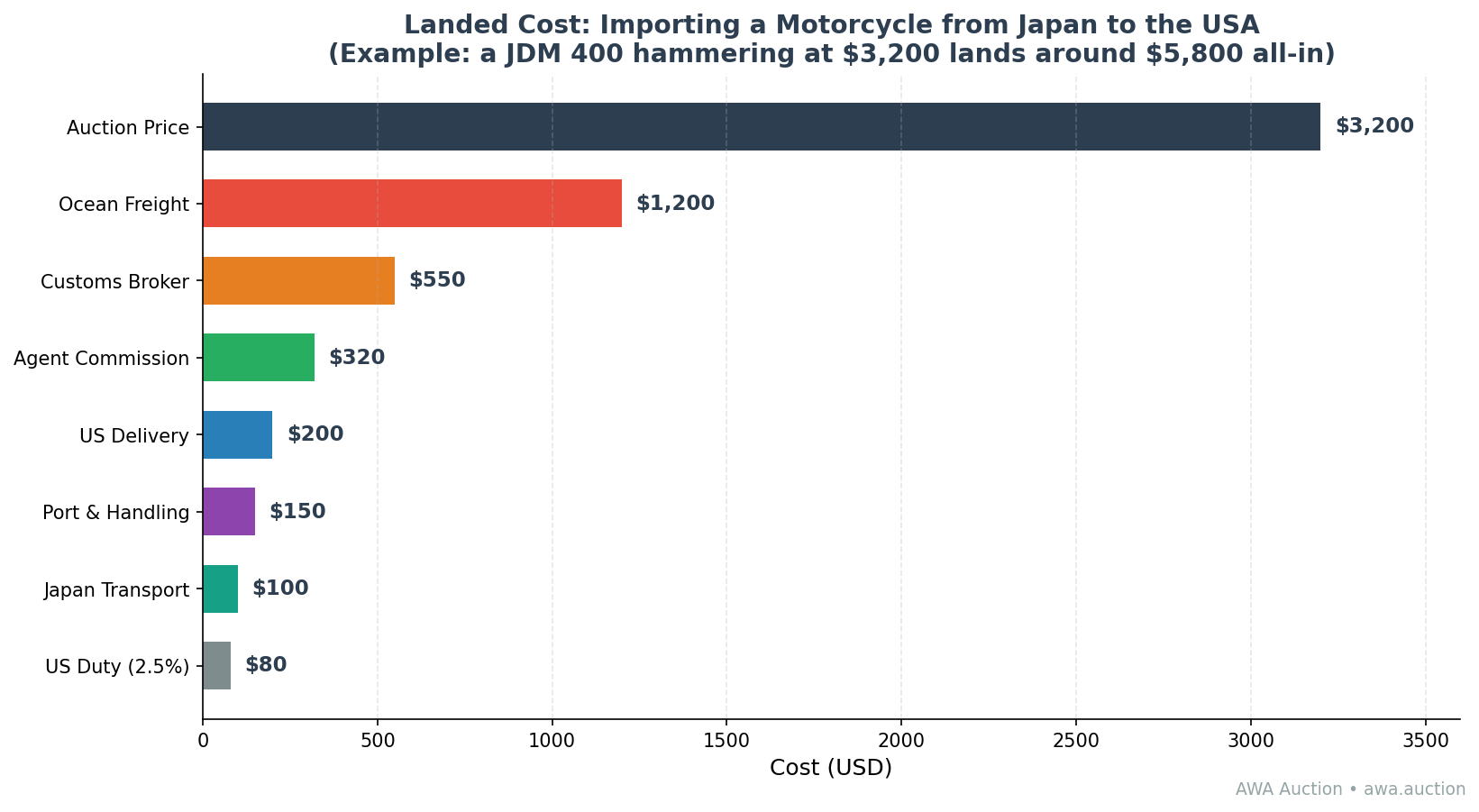
For this example bike, the landed total lands around $5,800 — roughly $2,600 on top of the auction price. That ratio holds reasonably well across the middleweight range: expect the all-in cost to run $2,200 to $3,200 above whatever the bike hammers for, depending on shipping method and how far you are from the port.
The good news on duty: a motorcycle that qualifies as a 25-year historic vehicle is classified under HTS heading 9903.94.04 and carries just a 2.5% duty rate. Properly coded, it sidesteps the 25% Section 232 tariff that can hit some modern finished vehicles. That's a deliberate carve-out for old vehicles, and it's a big part of why the math works.
To put the savings in perspective: one Texas collector who imported a Suzuki GSX-R1100 under the 25-year rule worked out that he saved roughly $9,375 versus the compliance route — about $3,750 in avoided duties and $5,625 in avoided modification and certification costs. The old-vehicle exemption isn't a loophole; it's the whole economic engine of importing.
The hidden costs people forget
Budget a cushion for the things that don't show up in the headline quote: a possible state inspection fee, a fresh set of tires (Japanese bikes often arrive on hard, aged rubber), and the near-certainty that you'll want to flush every fluid and replace the battery on a bike that's been sitting. None of these are large, but together they add a few hundred dollars you should plan for.
Shipping from Japan: Container vs RoRo, Ports, and Timeline
You've got two main ways to get a motorcycle across the Pacific, and the right choice depends on how much you care about protection versus price.
Container shipping
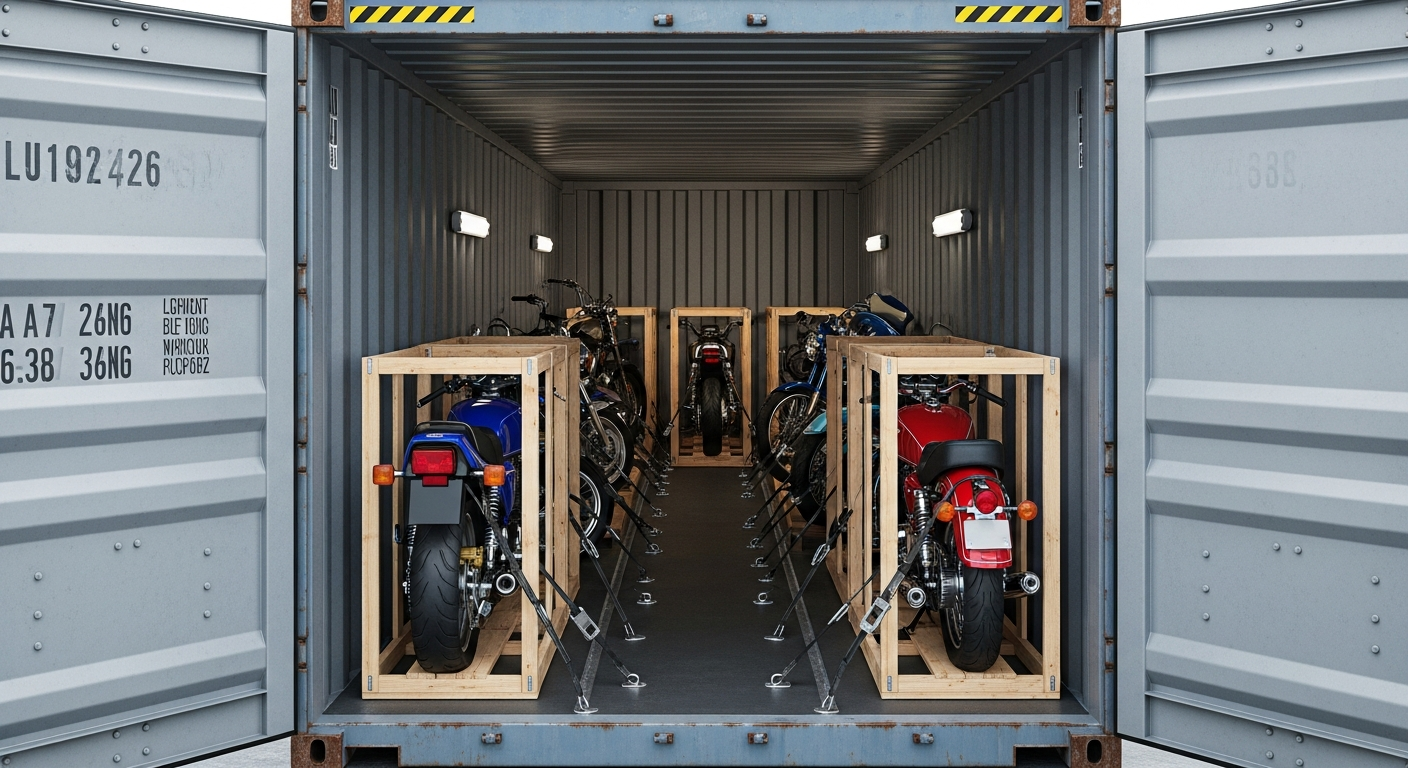
The bike is strapped and often crated inside a steel container, sealed, and shipped. It's protected from weather, salt spray, and prying hands. You can ship sole-use (your bike alone, more expensive) or consolidated (sharing the container with other bikes, cheaper). For anything valuable or pristine, container is the move. This is what the big import channels use, and it's why the bikes in those 40-foot-container unboxing videos come out clean.
RoRo shipping
Roll-on/roll-off means the vehicle is driven or rolled onto a vessel and secured on a deck with other vehicles. It's generally cheaper and simpler, but the bike is exposed to the elements and handled more. Contrary to popular belief, RoRo isn't always the budget option — depending on the lane and season, RoRo rates can sit above or below consolidated container rates. Get both quotes.
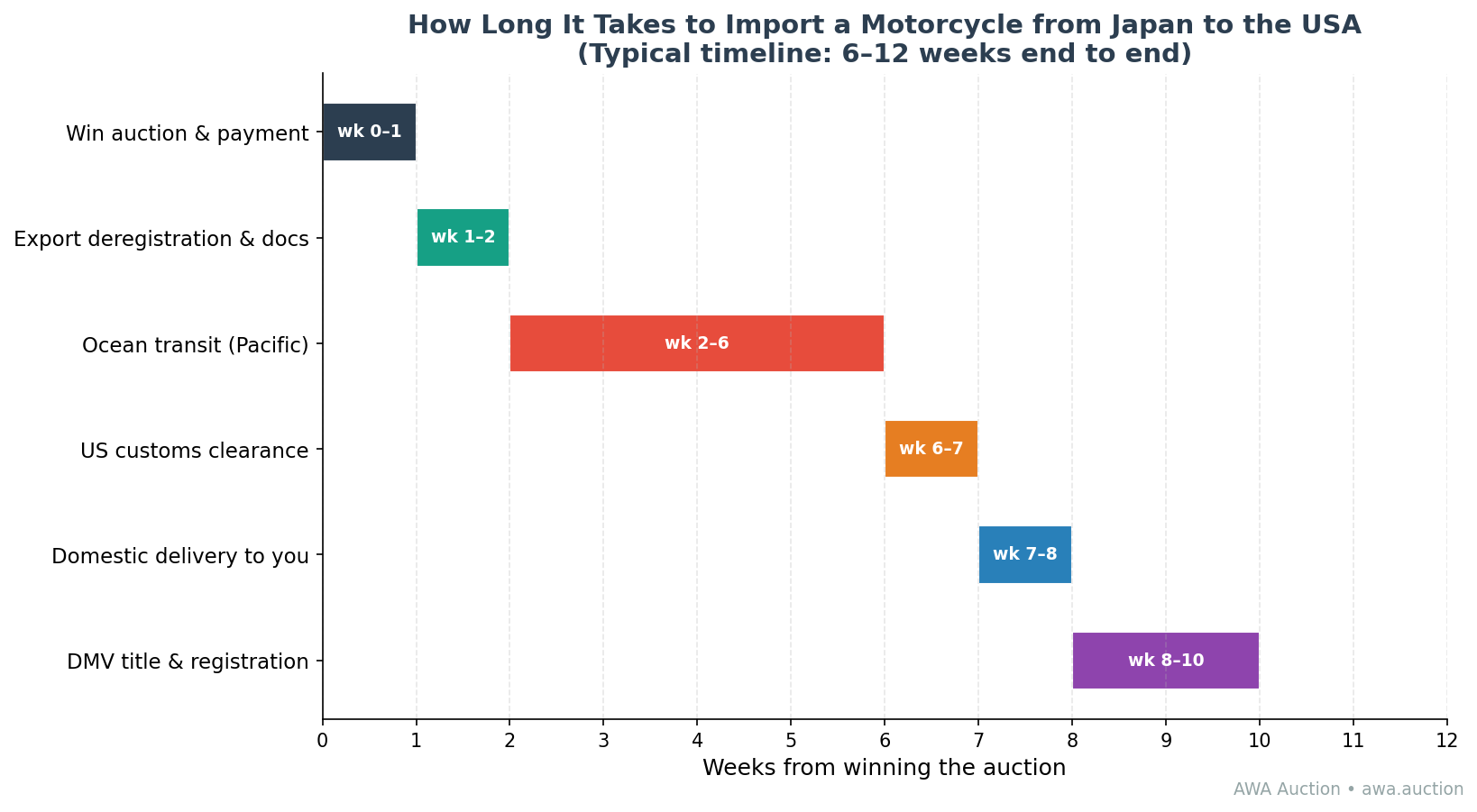
Ports and timing
Bikes leave from Yokohama, Nagoya, Osaka, or Kobe and typically arrive at West Coast ports like Los Angeles/Long Beach (fastest) or East Coast ports like Newark or Savannah (longer transit). Ocean transit runs about 2 to 6 weeks depending on the lane and method. Add a week or two on each end for export processing in Japan and customs clearance in the U.S. Realistically, from winning the auction to riding the bike, plan on 6 to 12 weeks. Air freight exists and takes 5 to 10 days, but it costs a multiple of ocean and almost nobody does it for a bike.
Shipping cost itself typically runs $1,000 to $2,800 depending on port pairing, method, and bike size. That's the single biggest variable in your landed cost, so it's worth getting two or three real quotes rather than trusting a forum estimate.
The Paperwork: EPA 3520-1, DOT HS-7, and the Export Certificate
Forms are where importing feels intimidating and where it actually isn't. There are really only three documents that do the heavy lifting, plus a few supporting papers. A customs broker fills out the federal forms for you — that's literally their job — but you should understand what each one says, because you're the one signing.
EPA Form 3520-1 (emissions)
This is your declaration to the EPA about why the bike is allowed in. For a motorcycle 21 or more years old in original configuration, you claim the exemption with code "E." That single code is what tells the EPA "this is an old vehicle, hands off." Attach it at entry and the emissions question is settled.
DOT Form HS-7 (safety)
This is the NHTSA declaration. For a bike 25 or more years old, you check Box 1, which states the vehicle is exempt from Federal Motor Vehicle Safety Standards because of its age. Box 1 is the magic box — it's the simplest, cleanest entry path there is, and it's available to you precisely because you waited for the 25-year mark.
The Japanese export certificate
This is the deregistration certificate produced when the bike is removed from Japan's registry for export. It proves the bike's identity, displacement, and that it's legitimately yours to export. U.S. Customs wants to see it. Make sure your agent provides it along with an English translation — DMVs love asking for that translation later.
The supporting stack
Round it out with the bill of sale (proof of purchase and value), the bill of lading (the shipping document), and the auction inspection sheet. Keep digital and paper copies of everything. The number one cause of titling headaches isn't a missing bike — it's a missing piece of paper.
Titling and Registering Your Imported Bike State-by-State
Here's the part the shipping companies conveniently skip: clearing federal Customs gets your bike into the country, but it does not get you a license plate. That happens at your state DMV, and the difference between a smooth afternoon and a three-month saga comes down to which state you live in.
Some states are import-friendly and process a foreign bike with a customs clearance document and the export certificate in one visit. Others treat any vehicle without a U.S. title as guilty until proven innocent and route you through a bonded title, a VIN verification by a state inspector or police officer, and sometimes a brand-inspection appointment that's booked weeks out.
The bonded title
If your state can't reconcile the foreign documents with its system, it may issue a bonded title — you post a surety bond (usually a small multiple of the bike's value) that protects against any future ownership dispute. After a few years with no claims, it converts to a clean title. It sounds scary; it's mostly just an extra fee and some patience.
The 17-digit VIN problem
Older Japanese bikes don't have a 17-character VIN like U.S. vehicles — they have a shorter frame number. Some DMV computer systems literally can't accept fewer than 17 characters, and the clerk has no idea what to do with a Honda frame stamped "NC30-1003xxx." The fix is usually a state-assigned VIN, but knowing this is coming saves you from a frustrating counter standoff. Call your DMV's title division before you import and ask specifically how they handle a 25-year exempt import with a non-standard frame number.
Our team has shepherded bikes into garages in dozens of states, so if you're unsure how yours handles imports, reach out and ask us — we'll tell you what your specific DMV is going to want before your bike is even on the boat.
Is Buying a Motorcycle from a Japanese Auction Safe?
This is the fear that stops most people: how do you buy a bike you've never seen, in a country you've never been to, in a language you don't read? The honest answer is that Japanese auctions are arguably the most transparent used-bike market on earth — once you understand the inspection sheet.
Every motorcycle that crosses a Japanese auction block gets inspected by a neutral third party who has no stake in the sale. They assign an overall grade, usually on a scale where higher numbers mean better condition, plus separate notes on the frame, engine, and cosmetics. A grade of 4 or higher generally means a genuinely good bike. They photograph it from every angle and mark damage on a diagram with a shorthand of letters: "A" for a scratch, "U" for a dent, "C" for corrosion, and so on.
That sheet is more honest than almost any private listing you'll find on an American classifieds site, because the inspector doesn't profit from making the bike sound better than it is. The catch is that it's written in Japanese auction shorthand, which is why working with an agent who reads these fluently is worth far more than the commission they charge. Misread a single mark and you can bid on a bike with a bent frame thinking it's mint.
Here's the practical rule: never bid on a bike whose inspection sheet you don't fully understand. If you're learning, lean on your export agent to translate and interpret every notation before you set a maximum bid. The grade tells you the headline; the diagram tells you the truth.
US vs UK vs Australia: How the American Import Path Compares
If you've read about importing Japanese bikes elsewhere, a lot of what's online is written for British or Australian buyers, and their rules are different enough to trip you up. It's worth knowing where the U.S. path is easier and where it's stricter.
The United States is, in one big way, the friendliest of the three: the flat 25-year exemption. Hit that age and the federal safety and emissions requirements simply evaporate. There's no roadworthiness test mandated at the federal level, no equivalent of a compliance plate scheme. Compare that to the United Kingdom, where an imported bike has to pass an MSVA or IVA-style test and register through the NOVA system to settle VAT, regardless of age. Or Australia, with its own import approval scheme and asbestos-inspection requirement on older vehicles. Our separate guides on importing to the UK and to Australia cover those routes in detail if you're shopping from outside the States.
Where the U.S. is stricter is the under-25 bikes: America's ICI pathway for non-exempt vehicles is so costly it's effectively a wall, whereas some countries have more workable compliance routes for newer machines. The takeaway for an American buyer is clean and simple — the system practically pushes you toward bikes that are 25-plus years old, and those are exactly the JDM legends worth importing anyway. The rules and the fun line up.
One more practical note: because the U.S. has no federal roadworthiness test, the quality burden shifts entirely onto you and the auction inspection sheet. There's no government safety check to catch a tired bike, so your due diligence at the auction is the only safety net. That's a feature, not a bug — but only if you actually read the sheet.
Before You Bid: A Quick Pre-Import Checklist
Run through this short list before you set a maximum bid on any Japanese auction bike. Each item maps to a mistake that has stranded someone else's import, and checking them takes minutes.
First, confirm the manufacture date puts the bike at 25-plus years old by the time it lands — not the model year, the actual build date. Second, ask your agent to translate the full auction inspection sheet, grade and damage diagram included, so you know the true condition. Third, get a written all-in landed-cost estimate that includes agent commission, shipping, the 2.5% duty, broker, port fees, and domestic delivery, so the final bill doesn't surprise you. Fourth, confirm the seller can produce the Japanese export/deregistration certificate — no certificate, no bid. Fifth, call your state DMV's title division and ask exactly how they handle a 25-year exempt import with a non-standard frame number, so titling is a known quantity before the bike ships.
Do those five things and you've eliminated the overwhelming majority of import horror stories. The buyers who get burned almost always skipped one of them — usually the DMV call or the date check. The buyers who end up with a clean title and a grin did the boring homework first. Be the second kind.
Importing a motorcycle from Japan to the USA isn't a gamble when you treat it as a process. Pick an eligible bike, read the sheet, keep the paperwork, mind your DMV, and you'll join the growing club of American riders pulling their dream machines straight out of a container.
What Nobody Tells You: 5 Ways Motorcycle Imports Go Wrong
Most imports go fine. The ones that don't usually fail for the same handful of reasons, and every one of them is avoidable if you know to look.
1. Buying a bike that's 24 years old
It bears repeating because it's the costliest mistake: a bike one month shy of 25 years is not exempt, and Customs and the EPA can seize and even export or destroy a non-conforming vehicle that shows up without proper ICI arrangements. "Close enough" doesn't exist here. Verify the build date in writing.
2. Falling into the ICI trap on a modern bike
If you fall in love with a bike that's under 25 years old, the only legal road import path is through an Independent Commercial Importer who modifies, tests, and certifies it to U.S. standards. For a motorcycle, that's wildly expensive — often more than the bike is worth — and the ICI won't release it to you until the work is done. For 99% of buyers, the answer is simple: pick an eligible bike instead.
3. No export certificate
If the seller or a sketchy agent can't produce the Japanese deregistration certificate, walk away. Without it, you may get the bike into the country but never get it titled. The paperwork is the asset as much as the bike is.
4. Forgetting the bike will need recommissioning
A bike that's been sitting in a Japanese warehouse or hasn't run in months will need fresh fluids, a battery, probably tires, and a careful once-over before it's road-safe. That famous container video exists precisely because "will it start?" is a real question. Budget time and a few hundred dollars for recommissioning.
5. Underestimating your own DMV
The federal side is predictable. Your state DMV is the wild card. People who research the 25-year rule for weeks often spend zero minutes on titling and then get blindsided. Flip that. The bike is the easy part; the plate is the hard part. Call your DMV first.
How AWA Auction Makes Importing from Japan Simple
Everything above is doable on your own. The reason most people don't go it alone is that the chain has a dozen links — auction access, bidding in Japanese, the export certificate, ocean freight, the federal forms, the customs broker, the last-mile delivery — and a single weak link strands your bike at a dock racking up storage fees.
AWA Auction plugs into the same Japanese auction network that feeds those famous import containers, so you get direct access to roughly the same 200,000-bike annual flow that the pros pull from. We help you read the auction inspection sheets so you know exactly what you're bidding on, bid on your behalf, handle the export paperwork and shipping, and hand you the document stack your customs broker and DMV will ask for. You pick the bike; we manage the boring, breakable middle.
The bikes in our current inventory are already filtered for import eligibility, so you're not gambling on whether a machine clears the 25-year line — that's checked before it ever reaches your screen. Start by seeing what's available right now, and if you've got a specific dream bike in mind, tell us and we'll hunt it at auction.
Importing a motorcycle from Japan rewards the person who does their homework. Get the 25-year date right, keep every document, call your DMV before the bike ships, and the rest is just patience while a great bike makes its way across the Pacific to you.
See Also
Share this article: