
When researching Japanese motorcycle brands for import, picking the wrong one means three years chasing obscure parts. Picking the right one means still riding trouble-free at 80,000 miles.
If you're importing a motorcycle from Japan, that decision matters more than most buyers realize. The bike you're considering was built by one of the Big Four — Honda, Yamaha, Kawasaki, or Suzuki — and each of those brands tells a very different story once it's off Japanese soil and sitting in your garage.
Every article online will tell you "they're all reliable, just pick the one you like." That's technically true and completely useless advice for an import buyer. What you actually need to know is: which brand has the deepest stock in Japanese auctions right now? Which one will your local mechanic actually know how to work on? Which has the lowest repair costs when something eventually does go wrong?
This guide answers all of that — with actual data, not brand loyalty.
Why the Big Four Japanese Brands Dominate the World
Before we get into the comparison, it's worth understanding why these four brands sit in a category by themselves.
Japan's postwar motorcycle industry grew up with a brutal domestic market. The roads were dense, the regulations were tight, and the mandatory vehicle inspection system — called shaken — required bikes to pass a stringent government roadworthiness test every two years after the third year of ownership. A motorcycle that couldn't survive repeated shaken inspections didn't survive the market.
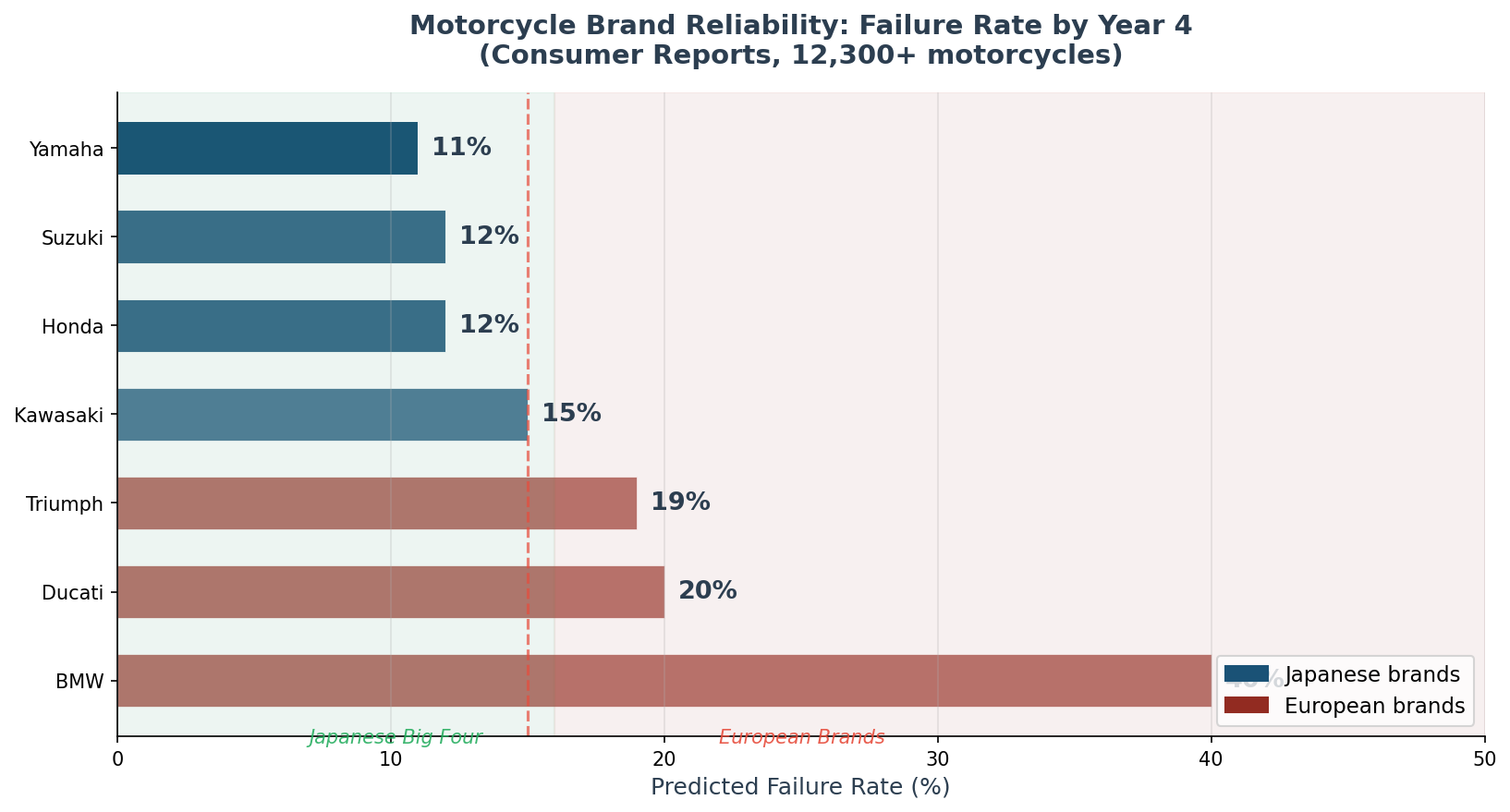
That pressure produced engines that simply don't break the way European or American bikes break. The Consumer Reports motorcycle reliability survey — covering more than 12,300 motorcycles from model years 2008 to 2014 — found that Yamaha had a predicted failure rate of just 11%, Suzuki 12%, Honda 12%, and Kawasaki 15%. For context, BMW came in at around 40% failure rate by the fourth year. Can-Am was similarly unreliable.
All four Japanese brands outperformed virtually every European manufacturer in that study. The gap isn't close.
The global numbers reflect this trust. Honda holds more than 20% of worldwide motorcycle sales — more than any other brand on the planet. Yamaha is the most recognized Japanese motorcycle brand in Europe. And in 2025, Kawasaki overtook Honda to become the #1 selling motorcycle brand in the United States, driven by strong demand for the Ninja 500 and Z650 — roughly 14% growth in a single year.
They didn't get there by accident. They got there by building machines that work.
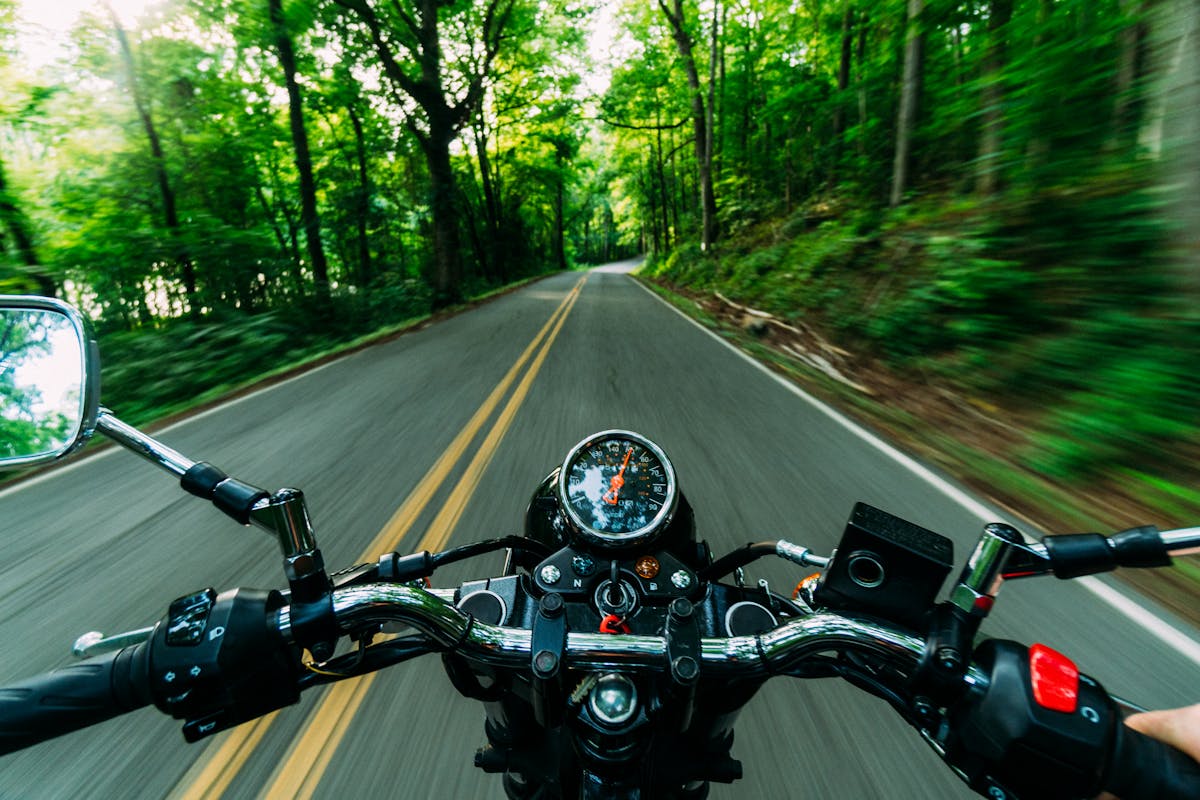
Honda Motorcycles — The Reliability Benchmark
Honda is the default. That's not an insult — it's an acknowledgment of what Honda has spent 70 years building.
The Numbers
Honda sold more than 20 million motorcycles globally in 2024. Their lineup spans from the 98cc Super Cub — still the best-selling motor vehicle in human history with over 100 million units produced — to the 1,800cc Gold Wing. Between those extremes sits virtually every segment: adventure, sport, naked, cruiser, trail, commuter.
The 12% failure rate in the Consumer Reports study places Honda in a statistical tie with Suzuki and just one percentage point behind Yamaha. In practice, this means that out of 100 Honda bikes of a given model year, roughly 12 needed significant unplanned repairs within four years. That's exceptional by any standard.
What Honda Looks Like From Japan
In Japan's domestic market, Honda's most common auction inventory includes:
- CB series (CB400SF, CB500F, CB500X) — commuter-sport bikes that rarely see hard use
- NC750X — long-distance tourers with Honda's DCT dual-clutch transmission, typically with careful ownership history
- CB1000R — naked sport, popular with Japanese urban riders
- CBR series (CBR250R, CBR400R, CBR600RR, CBR1000RR-R) — sports bikes from entry-level to full superbike
The CB400SF deserves a special mention. This 400cc inline-four is one of the most popular bikes in Japan — and one of the most underappreciated import opportunities for buyers in markets where it was never sold. Generations of Japanese riders learned on CB400SFs; the result is a large pool of well-maintained, lightly-used examples cycling through auction — a modern classic that's been sold continuously since 1992 — and is not available new in most Western markets. When it shows up at auction, it goes fast. It's the kind of bike that runs forever on basic maintenance and makes every mechanic who works on it say "this is a nice engine."
Who Honda is Best For
Honda is the right choice if: you want a motorcycle with a massive parts network, you're nervous about long-term maintenance costs, you value resale value, or you want something your local mechanic has actually seen before.
One honest observation: Honda's engineering is occasionally so conservative it can feel underpowered compared to Kawasaki or Yamaha at a similar displacement. If excitement is the priority, Honda will probably serve you well but won't surprise you. That's not a bug for everyone — it's precisely the quality that makes Honda the go-to recommendation for riders who want to focus on the road rather than the machine.
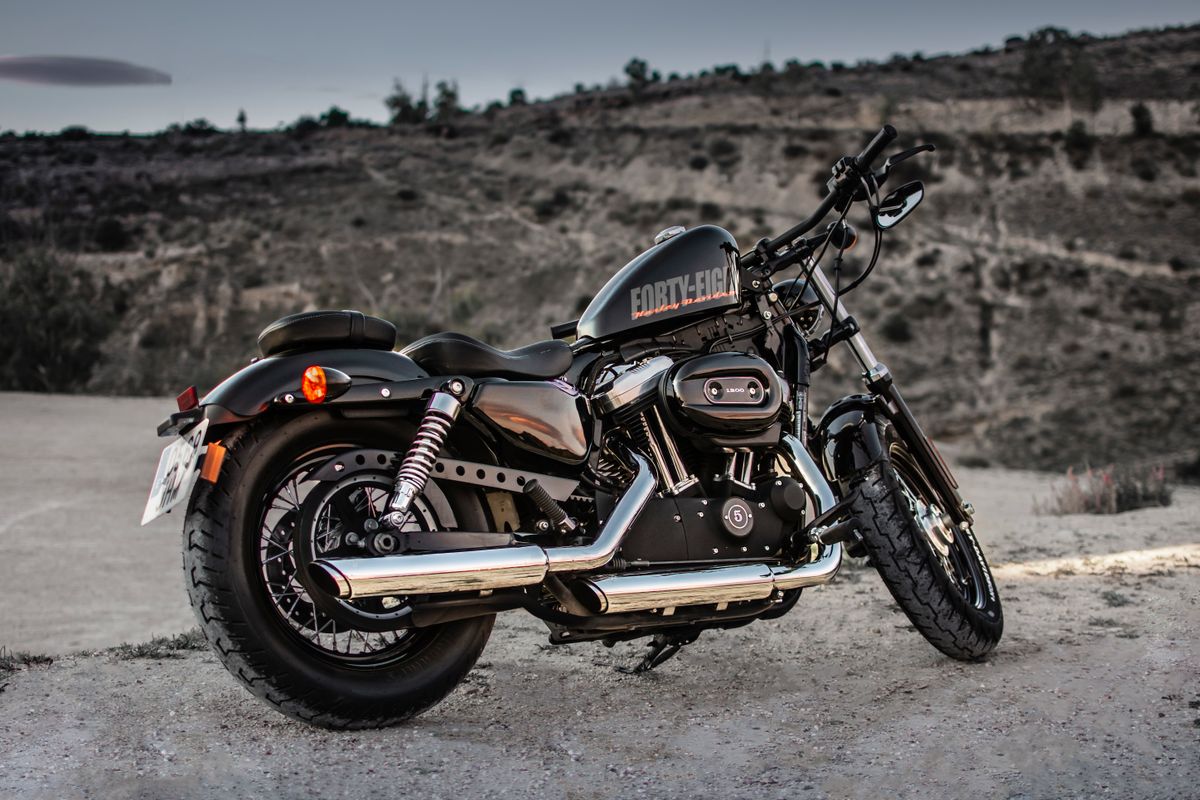
Yamaha Motorcycles — The Rider's Brand
Yamaha does something Honda doesn't quite manage: makes you feel like the bike is on your side.
The Numbers
Yamaha's 11% failure rate in Consumer Reports data makes it the statistically most reliable major motorcycle brand surveyed. That's the headline number. But the more interesting Yamaha story is how they achieve reliability while simultaneously building some of the most engaging bikes in every category.
The MT-09 — Yamaha's 119hp CP3 triple-cylinder naked — consistently tops road test rankings while returning ownership costs comparable to Honda. The YZF-R series has been refined over decades to the point where the R1 feels genuinely tractable as a road bike, not just a track weapon with turn signals bolted on.
What Yamaha Looks Like From Japan
Yamaha's Japanese auction inventory is deep and diverse:
- MT series (MT-03, MT-07, MT-09) — the naked middleweight lineup that's defined Yamaha's modern identity
- YZF-R series (R3, R25, R6, R1) — sports bikes with a wide range of capability and displacement
- TMAX — Yamaha's premium maxi-scooter, enormously popular in Japan and increasingly desirable overseas
- Tracer series (Tracer 7, Tracer 9) — adventure-sport tourers with genuine long-distance capability
- SR400 — the single-cylinder classic that was discontinued in Japan in 2021 after 43 years of production
The Yamaha MT-07 is one of the most popular import choices for good reason. It's light, simple, genuinely fast in a real-world way, and the CP2 parallel-twin engine has a character that's hard to describe without riding one. Owners report 80,000+ kilometer lifespans with nothing more than oil changes and chain maintenance.
If you're looking at a Yamaha from Japan, the MT-07 at 15,000–30,000km in good auction condition is probably the best value-per-experience motorcycle available in the world right now.
Who Yamaha is Best For
Yamaha suits riders who want the handling of a sports bike without the track-only compromise, anyone who values chassis tuning and rider feedback, and people who want a motorcycle that ages gracefully. The parts network is extensive globally, and Yamaha's engineering tends toward fewer complicated systems than Honda's latest generation — which means less can go wrong.
Yammie Noob's "Motorcycle Brand Tier List" — one of the most-watched motorcycle brand comparisons on YouTube with over 1 million views — consistently places Yamaha at the top of reliability discussions, with his community noting "it's so easy to find their spare parts" as a key reason for the brand's popularity.
Kawasaki Motorcycles — America's New #1, Japan's Power Brand
In 2025, something happened that would have seemed impossible five years ago: Kawasaki overtook Honda to become the best-selling motorcycle brand in the United States. The company posted roughly 14% growth, driven by the Ninja 500 and Z650 hitting exactly the right price point for new riders who didn't want to start on something underpowered.
The Numbers
Kawasaki's 15% failure rate in the Consumer Reports data is the highest of the Big Four — but there's a nuance worth knowing: Kawasaki had the lowest median repair cost at $269. This tells you something real about how Kawasaki engineering fails: infrequently, and cheaply when it does.
Kawasaki bikes tend to be mechanically simple in ways that matter for repairability. The Ninja 400 (no longer sold new in the US as of 2026, making Japanese imports the primary source) uses a straightforward parallel-twin with conventional electronics. The Z series runs similar architecture. Even the high-performance ZX-6R and ZX-10R share a design philosophy that prioritizes mechanical robustness over electronic complexity.
What Kawasaki Looks Like From Japan
Kawasaki's Japanese domestic lineup runs heavier toward sports and naked machines than Honda or Yamaha:
- Ninja series (Ninja 400, Ninja 650, Ninja ZX-4R, ZX-6R, ZX-10R) — from beginner sports to full-on superbike
- Z series (Z400, Z650, Z900, Z900RS) — the naked counterpart to the Ninja lineup
- Versys (Versys 650, Versys 1000) — adventure touring, less common but well-regarded
- H2/H2R — the supercharged outlier, genuinely exotic, rarely seen at auction in clean condition
The Z900RS deserves attention. It's Kawasaki's retro-styled modern classic — a 948cc in-line four wrapped in 1970s Z-series styling — and it has a strong collector following in Japan that keeps examples in excellent condition. Import demand for the Z900RS is high globally, partly because it occupies a unique style niche that no one else fills well.
One detail most guides miss: the Kawasaki Ninja 400 is not sold new in North America as of 2026. Kawasaki replaced it with the Ninja 500 in that market. If you want the Ninja 400 — which many experienced riders consider the better bike for technical riding — importing from Japan is now the only option. This creates genuine import demand that doesn't exist for Honda or Yamaha equivalents.
Who Kawasaki is Best For
Kawasaki suits riders who want power-to-weight performance at mid-range budgets, anyone specifically after the Ninja 400 or Z900RS (Japanese imports only), and buyers who are comfortable with sports motorcycle ownership. The lower repair cost data is reassuring — if something does fail, Kawasaki parts tend to be straightforward to source and not expensive to replace.
Suzuki Motorcycles — The Value Champion With a Secret
Suzuki is the brand that motorcycle forums recommend unanimously and marketing departments seem to have forgotten exists.
The Numbers
Suzuki's 12% failure rate matches Honda exactly in the Consumer Reports data — placing it among the most reliable brands in the world. What Suzuki adds on top of pure reliability is mechanical simplicity. Their most popular models — the SV650 and the GSX-S series — run conventional electronics, uncomplicated fuel injection, and engine designs that have been refined over decades without the addition of elaborate electronic rider aids.
Fewer systems means fewer things that fail. The SV650's V-twin has been in continuous production in various forms since 1999. Owners routinely report 100,000+ kilometer lifespans on the original engine with no major work. That's not marketing copy — that's Suzuki forums. And they tend not to lie about it.
What Suzuki Looks Like From Japan
Suzuki's domestic Japanese lineup is smaller than Honda or Yamaha, but the key models are genuinely excellent:
- SV650 — the universal recommendation for a reason; 645cc V-twin, lightweight, forgiving, virtually indestructible
- GSX-S series (GSX-S750, GSX-S1000) — naked bikes derived from the GSX-R superbike platform
- GSX-R series (GSX-R600, GSX-R750, GSX-R1000) — the sport bikes that defined a generation
- Hayabusa — the iconic 1340cc hypersport with a dedicated global following; the third-generation model (2021-present) is increasingly available at Japanese auctions
- V-Strom series (V-Strom 650, V-Strom 1050) — adventure touring, underappreciated but extremely capable
The Hayabusa is worth a separate mention. It occupies a unique position in motorcycle culture — designed to be the fastest production motorcycle in the world (a crown it held from 1999 to 2000), it has evolved into a grand tourer for speed enthusiasts. Used Hayabusas from Japan carry an unusual ownership profile: they're often lightly used despite being capable of extraordinary speeds, because the owners tend to be serious enough about motorcycles to understand what they have.
Who Suzuki is Best For
Suzuki is the right choice if: you want maximum reliability at minimum cost, you're worried about long-term parts availability (Suzuki is well-supported globally), you specifically want the SV650, or you're after a Hayabusa or GSX-R that's been maintained in Japan's inspection-heavy environment.
The honest trade-off: Suzuki's lineup is narrower than Honda or Yamaha. You won't find a Suzuki adventure-sport that competes with the NC750X or Tracer 9 at the same price point. If your riding involves specific categories — trail, touring, premium adventure — Honda or Yamaha probably has a better specialist option.
Reliability Compared: What the Data Actually Says
Let's be specific about the Consumer Reports data, because it gets misquoted constantly.
The survey covered 12,300+ motorcycles from model years 2008–2014, adjusted for annual mileage. "Failure" was defined as a problem requiring repair not covered under warranty. Here are the headline numbers:
| Brand | Failure Rate (4-year-old bikes) | Median Repair Cost |
| Yamaha | 11% | Not separately reported |
| Suzuki | 12% | Not separately reported |
| Honda | 12% | Not separately reported |
| Kawasaki | 15% | $269 |
| Triumph | ~19% | Higher than Japanese |
| Ducati | ~20% | Significantly higher |
| BMW | ~40% | Significantly higher |
A few important caveats: this data covers bikes from 2008–2014, and electronics have become significantly more complex across all brands since then. Modern Kawasaki H2 bikes with supercharger systems are not comparable in complexity to a 2012 Ninja 650. The broad reliability advantage of Japanese brands over European ones almost certainly persists — but the specific ordering among the Big Four may have shifted.
What hasn't changed: all four Japanese brands are dramatically more reliable than the European alternatives, and all four benefit from shaken-driven maintenance discipline in their Japanese domestic market. A Honda CB500F with 25,000km in Japan has been through at least two shaken inspections — meaning it's had its engine, brakes, lights, tires, and exhaust checked by a licensed mechanic twice. The same bike with 25,000km from a US private seller has... whatever history the seller tells you.
Auction Availability: Which Brand Has the Most Stock in Japan?
This is the question no other guide answers, and it's the one that matters most for import buyers.
Japan's auction system — primarily BDS (Bike Dealer System), USS, and regional networks — moves approximately 180,000 motorcycles per year. The BDS alone runs approximately 4,000 units through its Kanto facility every Wednesday. The brand breakdown of that inventory reflects Japan's domestic market preferences.
Honda has the deepest stock. Japan's commuter-heavy market means Honda's CB series, PCX scooters, and NC750X are constantly cycling through auction in large numbers. If you want a clean CB500X or CB400SF, there will be multiple examples available at any given auction date. The challenge is that popularity means competition — other buyers, including Japanese dealers and overseas agents — also know Honda stock is reliable. Yamaha runs close behind Honda in volume. The MT-series and TMAX are particularly well-represented. Yamaha R-series sports bikes appear regularly, though clean examples of the R6 and R1 are rarer because sports bikes in Japan tend to be ridden harder than commuters. The SR400 (discontinued 2021) is increasingly scarce — prices for clean examples have risen sharply. Kawasaki inventory is focused on the Ninja and Z lines. The Ninja 400 and Z400 appear frequently at auction, as does the Z900RS. The H2 and ZX-10R appear, but in smaller numbers — they're expensive new, which means fewer were sold. When a clean H2 does show up, it tends to go at significant premium. Suzuki has the thinnest auction stock of the Big Four by volume. The SV650 is the most common Suzuki at auction, followed by the GSX-S series. The Hayabusa appears regularly, and third-generation examples (2021+) are increasingly available. If you want an obscure Suzuki model — a V-Strom 650 XT, for example — you may need to wait for the right auction cycle. The practical implication: Honda and Yamaha offer the easiest buying experience because stock depth means more choice and more pricing competition. Kawasaki has strong stock in popular models but can be tight on specific variants. Suzuki requires patience for anything outside the SV650 and Hayabusa.Parts Availability After Import — The Question Nobody Asks Until They Need To
Here's something that almost no import guide mentions: the availability of parts in your country matters as much as the bike's reliability.
When an import motorcycle needs a part — whether it's a brake caliper, a clutch slave cylinder, or an ECU — you have three options: OEM from the manufacturer's regional parts network, aftermarket suppliers, or direct import from Japan. The costs and wait times vary dramatically by brand.
Honda has the strongest parts network globally. OEM Honda parts are stocked by dealers in virtually every market where Honda sells motorcycles, which is essentially everywhere. Aftermarket support (Barnett, EBC, K&N, Renthal) covers essentially every Honda model ever made. Lead times for non-stocked items are typically measured in days, not weeks. Yamaha is similarly well-supported. Yamaha's parts distribution through their dealer network is efficient, and the aftermarket covers everything from the MT-07 to the R1 extensively. The CP3 engine in the MT-09 is popular enough internationally that specialized parts are readily available through performance suppliers. Kawasaki parts availability varies more by market. In the US and Australia, Kawasaki maintains strong dealer networks with good OEM parts stocking. In some markets — parts of Southeast Asia, for example — Kawasaki coverage can be thinner. If you're in a country where Kawasaki isn't heavily represented, factor in the possibility of sourcing from Japan or specialist importers. Suzuki presents the most nuanced picture. Suzuki's US dealer network contracted following financial difficulties in 2012, when the company withdrew from the US car market. Motorcycle dealers remain, but in smaller numbers than Honda or Yamaha. The SV650 and GSX-R are well enough supported by aftermarket specialists that OEM dealer availability matters less — but for less popular models, expect longer wait times.For import buyers specifically: parts availability in Japan is uniformly excellent for all four brands, and the AWA Auction team can source and ship parts internationally. But the practical reality of day-to-day ownership in your home market is shaped by your local dealer network — and Honda and Yamaha lead that comparison in most Western markets.
Choosing Your Brand as an Import Buyer: A Practical Framework
After all the data, here's how to actually make the decision.
If you want maximum reliability with minimum ownership complexity: Honda. The CB500F, CB500X, or NC750X represent the best of Honda's engineering applied to real-world use. They're not exciting, but they're exceptional at what they do. If you want the best riding experience in the middleweight class: Yamaha MT-07 or MT-09. The 11% failure rate is real, the parts network is strong, and the riding character is worth paying for. A clean 20,000km MT-07 from Japan is one of the best deals in motorcycling right now. If you specifically want the Ninja 400 or Z900RS: Kawasaki, and Japanese import is the only way to get a new or near-new Ninja 400 in North America. The $269 median repair cost data is reassuring. The Z900RS is the best-looking retro motorcycle available at its price point, full stop. If budget is the main constraint and you want 100,000km without drama: Suzuki SV650. It's not complicated, not flashy, and absolutely will not let you down. The used market from Japan gives you a well-maintained example at a price that makes the import cost look reasonable.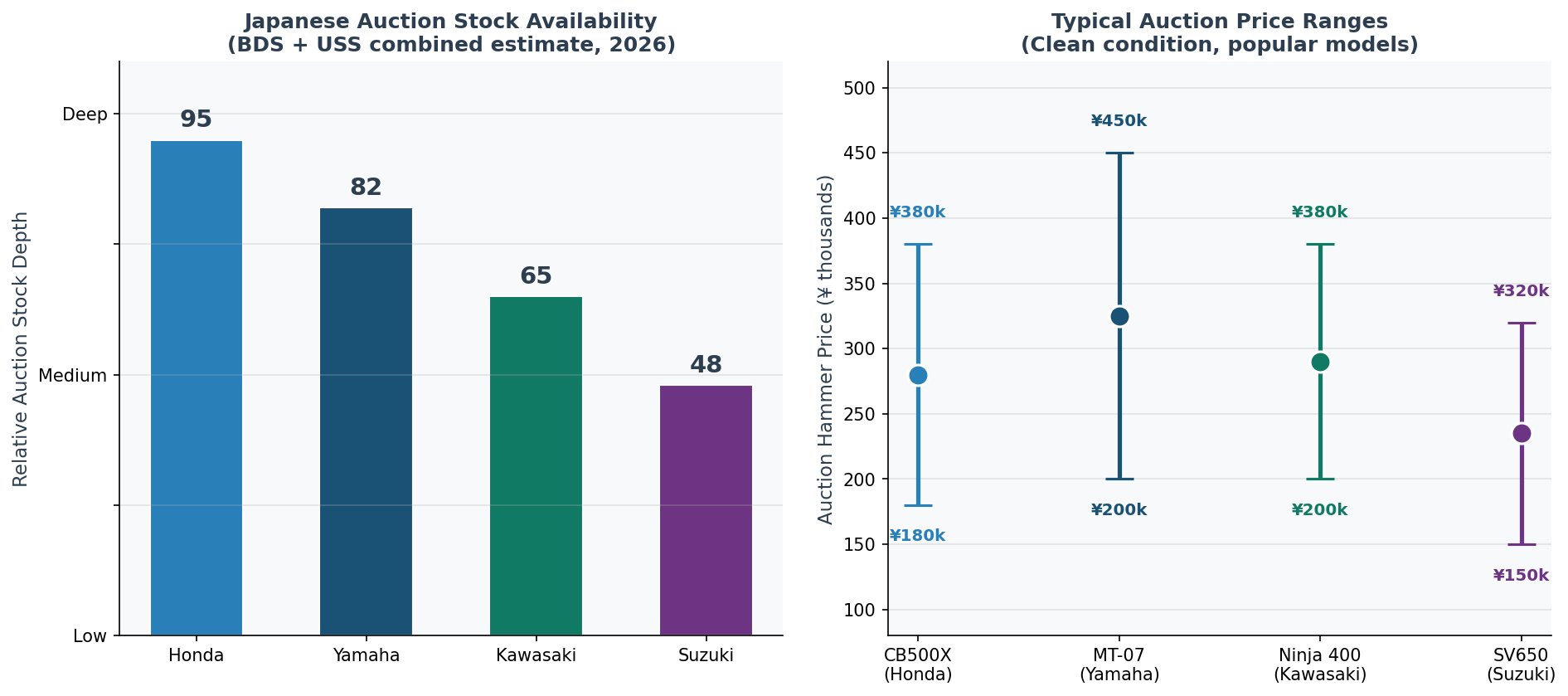
How AWA Auction Helps You Find Any Japanese Brand
The challenge with importing from Japan isn't deciding which brand you want. It's finding the right example — the right mileage, the right auction grade, the right price point — and navigating the paperwork between the Japanese auction and your garage.
AWA Auction provides direct access to BDS and other Japanese motorcycle auctions, with English-language support across the entire process: bidding, inspection report review, export documentation, and shipping coordination.
Every bike comes with its auction inspection sheet — the same document Japanese buyers use to assess condition before bidding. You can see the grade, the mileage, and the specific damage codes before any money changes hands. That's the transparency that makes importing from Japan work when it's done properly.
Whether you're after a Honda CB400SF that isn't sold in your country, a Yamaha MT-07 at 30% below local dealer pricing, a Kawasaki Ninja 400 that's no longer available new, or a Suzuki Hayabusa with full maintenance history — the stock exists in Japan's auction system. The question is finding the right one.
The 25-Year Import Rule: Which Models Are Coming Eligible Right Now?
For buyers in the United States, Canada, and Australia, the 25-year import rule is a critical variable in brand selection — and it's particularly relevant right now.
The US 25-year rule (under NHTSA regulations) exempts vehicles 25 years old or older from compliance testing requirements, making them legal to import as-is. For 2026, that means bikes from 2001 and earlier are freely importable regardless of whether they were sold new in the US.
This matters because each brand's 2001 lineup was exceptional:
Honda (2001 models): The Honda CBR954RR FireBlade — a 1,000cc production superbike that was genuinely exotic for its era. The CB400SF continued its unbroken domestic run. The VFR800 was in its beloved fifth generation, widely considered the best touring-sport motorcycle Honda ever built. Any of these are legally importable to the US from Japan right now. Yamaha (2001 models): The Yamaha YZF-R1 second generation — the "banana swingarm" R1 that defined the superbike era. The XJR1300 cafe racer. The R6 in its carbureted first generation. The FZS600 Fazer. Japan's domestic market had unique variants of all of these that weren't sold overseas, and 25-year eligibility means clean examples can now come straight from Japanese auctions. Kawasaki (2001 models): The ZX-9R in its fourth generation. The Z1000 MkII. The GPZ900R — the original "Ninja," the bike that Tom Cruise rode in Top Gun — was still being sold in Japan through 2003, meaning the earliest examples are now over 25 years old and fully eligible. For collectors, a clean GPZ900R from Japan is a genuinely rare find. Suzuki (2001 models): The GSX-R750 in its Y-model generation, widely considered the purest expression of the GSX-R concept before electronic rider aids became standard. The Hayabusa first generation (1999–2007) is now fully eligible across most markets. The SV650S with its half-fairing is increasingly collectible.The 25-year pipeline delivers a fresh wave of eligible classics from Japan every year. In 2027, 2002 models become eligible; in 2028, 2003 models. The Honda CBR600F4i, the Kawasaki ZX-6R Ninja, the Yamaha R6 carb model — these are all coming into eligibility over the next few years.
If you're a collector or enthusiast buyer, Japan's auction system has deep stock of exactly these bikes, maintained to the standard that shaken enforces. You're not buying a bike that's been sitting in a barn — you're buying one that passed government inspection multiple times before landing at auction.
Price Ranges: What to Expect From Japanese Auction
This is what the numbers actually look like. These are approximate auction hammer prices (before shipping, duties, and agent fees) for clean-condition examples in each brand's key models as of mid-2026:
Honda:- CB400SF (popular domestic classic): ¥250,000–¥550,000 (~$1,700–$3,700)
- CB500F/X: ¥180,000–¥380,000 (~$1,200–$2,600)
- NC750X DCT: ¥200,000–¥450,000 (~$1,350–$3,050)
- CBR600RR: ¥150,000–¥400,000 (~$1,000–$2,700) depending on year and condition
Yamaha:- MT-07 (2014–2021): ¥200,000–¥450,000 (~$1,350–$3,050)
- MT-09 (2014–2021): ¥250,000–¥500,000 (~$1,700–$3,400)
- YZF-R6: ¥150,000–¥500,000 (~$1,000–$3,400) — wide range due to condition variation
- SR400 (pre-2021): ¥180,000–¥400,000 (~$1,200–$2,700) and rising
Kawasaki:- Ninja 400 (2018–2023): ¥200,000–¥380,000 (~$1,350–$2,600)
- Z900RS: ¥400,000–¥700,000 (~$2,700–$4,750) — strong collector demand
- ZX-6R: ¥200,000–¥450,000 (~$1,350–$3,050)
- H2 (supercharged): ¥700,000–¥1,200,000 (~$4,750–$8,100) — rare and expensive
Suzuki:- SV650 (2016+): ¥150,000–¥320,000 (~$1,000–$2,150)
- GSX-S750: ¥200,000–¥380,000 (~$1,350–$2,600)
- Hayabusa (2021+ Gen 3): ¥600,000–¥900,000 (~$4,050–$6,100)
- GSX-R1000R: ¥300,000–¥600,000 (~$2,000–$4,050)
Add to these prices: shipping ($800–$2,500 depending on destination), import duty (varies by country), compliance costs if applicable, and agent fees (typically ¥45,000–¥60,000). The full landing cost for a mid-range import is typically 1.5–2x the auction hammer price.
But compare that to the local new price for an equivalent bike, and for many models — especially the ones that aren't sold new in your market at all — the economics work out clearly in favor of importing.
Frequently Asked Questions
Which Japanese motorcycle brand is the most reliable?By the Consumer Reports data — the largest independent motorcycle reliability survey conducted, covering 12,300+ bikes — Yamaha edges ahead at an 11% failure rate for 4-year-old bikes, followed by Suzuki and Honda both at 12%, and Kawasaki at 15%. In practical terms, all four are dramatically more reliable than European brands. The difference between Yamaha and Kawasaki is real but modest — a few percentage points, not a fundamental quality gap.
Which Japanese brand is best for a first motorcycle?Yamaha MT-03, Honda CB300R, Kawasaki Ninja 400, or Suzuki SV650 — any of the four Big Four entry-level options are genuinely good beginner bikes. The Ninja 400 is particularly popular for being forgiving at low speeds while remaining engaging at higher speeds. The SV650 is universally recommended by experienced riders for its 100,000km durability.
Why did Kawasaki become #1 in the US in 2025?The Ninja 500 and Z650 hit the right price-to-performance ratio for the current US market at exactly the moment when Honda and Yamaha equivalents were priced slightly higher. Kawasaki also benefited from strong in-stock availability during a period when some competitors had inventory constraints.
Is it worth importing a Japanese motorcycle brand that isn't sold locally?For specific models — the Honda CB400SF (not sold in most English-speaking markets), the Kawasaki Ninja 400 (no longer sold new in North America), or the Yamaha SR400 (discontinued globally 2021) — Japanese import is the only way to own a new or near-new example. The import cost is justified by the uniqueness of the product.
How does the shaken inspection system affect auction quality?Shaken — Japan's mandatory vehicle inspection every two years after the third year — means any auction motorcycle has been through at least one independent government-licensed inspection. This catches brake, engine, emission, and safety problems. It's not a guarantee of perfection, but it creates a maintenance baseline that private sellers in other markets don't have to meet. Combined with the auction inspection sheet, you have two independent quality assessments before you bid.
Do Japanese motorcycle parts work on bikes imported overseas?Yes, with minor exceptions. The bikes themselves are mechanically identical to their global counterparts in most cases. The exceptions are market-specific: the Honda CB400SF uses a Japan-only power restriction that differs from the European version, and some emissions systems vary by market. For most Big Four models, OEM parts from any regional distributor will fit the Japanese-specification bike.
Which brand has the best resale value after import?Honda typically holds value best globally due to brand recognition and parts availability. Yamaha MT-series bikes retain value well in most markets. Kawasaki Z900RS has appreciated significantly since introduction. Suzuki's resale value is lower in some markets partly due to thinner dealer networks — but this also means you can buy used Suzukis at lower prices, which changes the value equation if you're buying rather than selling.
How long does it take to import a Japanese motorcycle?From auction win to delivery: shipping to the US West Coast takes approximately 2–3 weeks, East Coast 5–6 weeks, UK and Europe 6–8 weeks, Australia and New Zealand 2–4 weeks. Add 2–4 weeks for customs clearance and compliance modifications if required. Total timeline is typically 6–12 weeks depending on destination, with Australia and the US West Coast at the faster end.
Are Japanese motorcycles more expensive to insure after import?
Insurance costs for imported Japanese motorcycles depend on your local insurer and the specific model. In most markets, insurers use the bike's specifications and category — not its country of origin — to calculate premiums. A Yamaha MT-07 imported from Japan is insured identically to an MT-07 purchased locally. The exception is if the bike is modified for compliance (altered emissions systems, different lighting), which can complicate insurance classification. Your insurer will need the VIN, engine specs, and sometimes photos. Most Big Four Japanese bikes are straightforward to insure because the models are familiar globally.
Which Japanese brand is the easiest to sell after owning an import?Honda imports resell most easily in most Western markets because the brand recognition is universal and parts anxiety is lowest. Yamaha MT-series bikes have strong resale markets online. Kawasaki's Z900RS has appreciated since launch, making clean examples easy to sell at a premium. Suzuki's resale is lower in markets with thin dealer networks — which is actually useful for buyers, since you can purchase used imports at better prices. The honest advice: if resale matters, buy Honda or Yamaha in a popular configuration. If you want value and don't care about resale optimization, Suzuki is the best deal.
See Also
Share this article: