
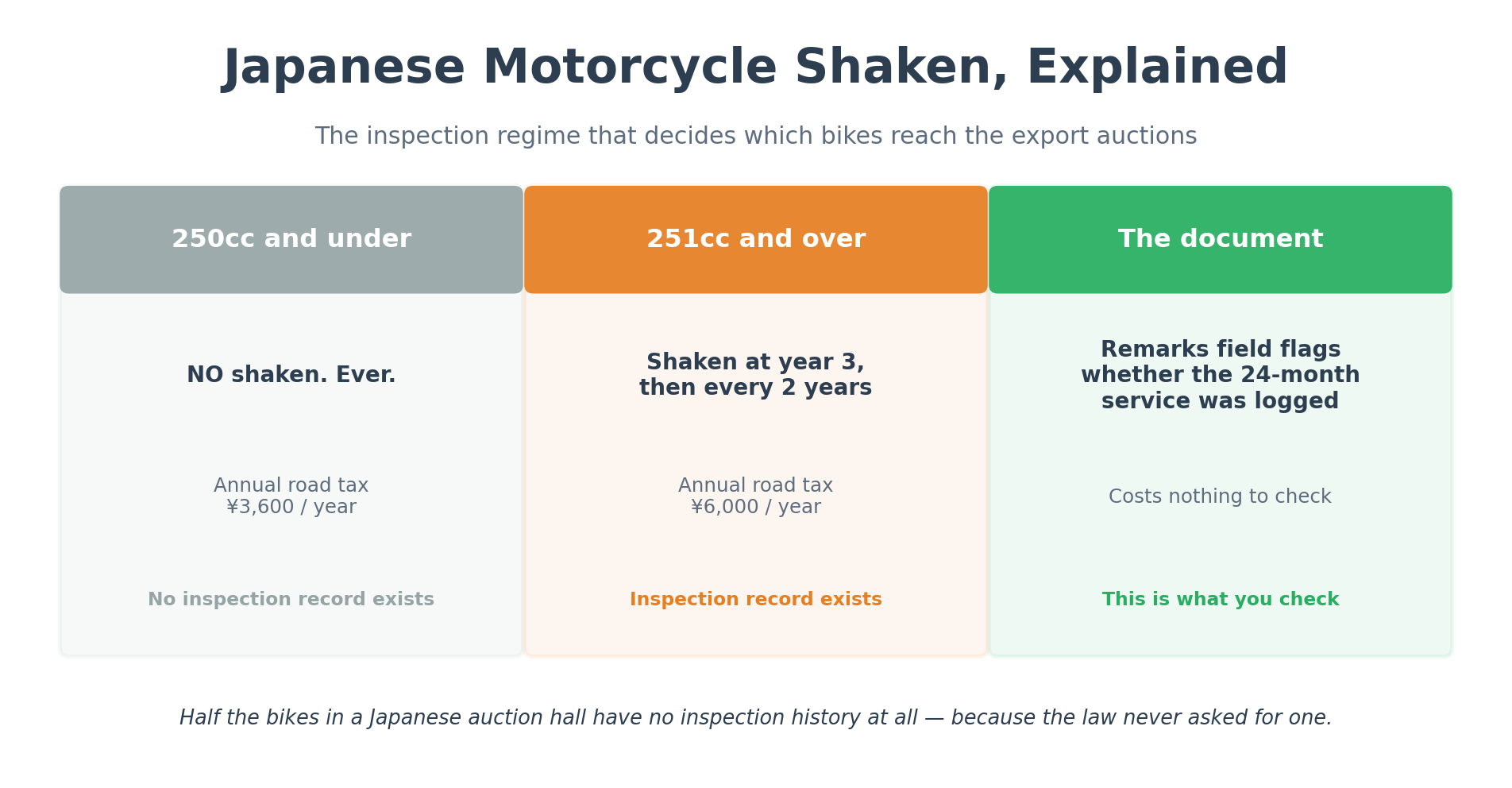
Shaken is the Japanese motorcycle inspection system, and it is the single most misunderstood thing in the JDM import world. Every English-language guide tells you the same comforting sentence: Japan has strict inspections, so Japanese bikes are well maintained, so buy with confidence. That sentence is half true, and the half that is false will cost you money.
Here is what those guides leave out. Shaken does not apply to bikes of 250cc or less — not at three years, not ever. So a huge slice of the machines in any Japanese auction hall have precisely zero inspection history, and no amount of reassurance about Japanese standards changes that. For the bikes shaken does cover, a pass certificate proves the brakes worked and the headlight pointed the right way on one particular Tuesday. It does not prove a single drop of oil was ever changed. And the certificate itself carries a printed field that tells you which of those two situations you are looking at — a field that no English-language import guide mentions.
This guide fixes that. You will learn exactly which bikes get inspected and which are exempt, what one shaken cycle costs a Japanese owner in 2026 down to the yen, what the inspection actually tests, how to read the one line on the certificate that reveals whether the bike was serviced or merely tested, why shaken is the economic engine that pushes clean low-mileage bikes onto the export market in the first place, and what happens to all of it the moment the bike is deregistered for export.
What shaken actually is, and what the word means
Shaken (車検) is short for jidōsha kensa — literally "motor vehicle inspection." Its formal legal name is keizoku kensa, the "continuing inspection." It is a government roadworthiness test administered by the transport bureaus, and passing it is what makes a vehicle legal to use on Japanese public roads.
The word trips up English speakers constantly. It is pronounced roughly shah-ken, two flat syllables, and it has nothing to do with the English verb "shaken." One commenter under a Japanese motorcycle inspection video summed up the entire confusion in a single line: "I thought 'shaken' as in English but it was a Japanese word." Another, watching bikes being wheeled onto a test lane, wrote: "May I ask, all those bikes are going inspection? I'm curious." That curiosity is the reason this article exists — the system is genuinely opaque from the outside.
The closest analogue depends on where you live. A German viewer nailed it: "Shaken is like the German Car Check from TÜV." UK riders will recognise it as an MOT, though as one commenter pointed out, the comparison flatters Japan on frequency and not on price: "2 years, uk is every year and is like 100 bucks, failure means getting it fixed then retested for another 100." Americans stationed in Japan know it by a different name entirely — "It's called a JCI inspection. And you need both JCI insurance AND liability insurance" — because on US bases the compulsory insurance and the inspection get bundled under one acronym.
All of those comparisons are useful and all of them are slightly wrong, because shaken bundles three separate things that most countries keep apart: a safety and emissions test, a compulsory insurance renewal, and a tax payment. You cannot pass one without settling the other two. That bundling is why shaken feels so expensive to Japanese owners, and it is why understanding it explains so much about what ends up in the export market.
Shaken is not the same as the annual road tax
Two different bills confuse newcomers. The light vehicle tax (軽自動車税種別割) is an annual levy every registered motorcycle owner pays in May, regardless of engine size and regardless of whether shaken applies. For 2026 the standard annual rates are ¥2,000 for mopeds up to 90cc, ¥2,400 for 90–125cc, ¥3,600 for 126–250cc, and ¥6,000 for anything over 250cc.
Shaken is separate, comes around every two years, and carries its own set of charges. When Japanese owners complain about the cost of keeping a big bike, they are usually adding both together — plus the voluntary insurance most of them also carry.
The 250cc line: why half the bikes you are bidding on have no inspection history
This is the fact that reframes everything, and it is the fact English-language shaken guides skip most often — largely because most of them were written about cars, where no such exemption exists.
Shaken applies only to motorcycles over 250cc. The threshold is precise: 250cc and under is exempt, 251cc and over is not.
| Displacement class | Japanese class name | Shaken required? | Annual tax (2026) |
|---|---|---|---|
| Up to 125cc | Gensuki / kogata | No | ¥2,000–¥2,400 |
| 126cc – 250cc | Kei-nirin | No — never | ¥3,600 |
| 251cc and above | Kogata-nirin | Yes | ¥6,000 |
Look at what that exemption swallows. A Kawasaki Ninja 250, a Honda Rebel 250, a Yamaha MT-25, every Honda CBR250RR, the entire two-stroke 250 canon — NSR250, TZR250, RGV250 — plus the whole 250cc trail and dual-sport world. None of those bikes has ever been through a government inspection in Japan. Not one. There is no inspection certificate to request, no odometer reading logged by an inspector, no roadworthiness pass to reassure you.
Now consider what that means for the standard reassurance you have read on a dozen exporter websites. When somebody tells you "Japanese bikes are well maintained because of strict shaken inspections," and the bike you are looking at is a 250, the sentence is not merely optimistic. It is describing a legal regime that does not apply to your purchase.
The exemption also explains a market pattern you have probably already noticed without knowing why: Japan's used 250cc supply is extraordinarily deep and extraordinarily cheap. A 250 costs its owner ¥3,600 a year and never faces a ¥55,000 inspection bill. Keeping one is nearly free, so people keep them, ride them lightly, and eventually sell them on. The bikes accumulate in the used market instead of being scrapped.
The flip side is what happens above the line. Once a bike crosses 251cc it acquires a recurring bill that arrives every two years for the rest of its life in Japan, and that bill is the reason the export auctions exist at all.
The shaken calendar: three years, then every two
The timing matters more than most buyers realise, because it sets the clock on when a bike is likely to be sold.
A new motorcycle over 250cc gets its first shaken three years after registration. Every subsequent inspection is due every two years. So the schedule runs year 3, year 5, year 7, year 9, and onward. You can present the bike from one month before the expiry date, which is why Japanese transport bureaus are busy in the weeks preceding month-end.
Note the language trap here. Several English guides describe shaken as "biannual," which is ambiguous at best and wrong at worst — the interval is every two years (biennial), not twice a year, and the first one is at three years, not two. If you have read that Japanese bikes are inspected twice annually, discard it.
Riding on expired shaken is not a parking-ticket-grade offence. The penalty runs to six months' imprisonment or a fine up to ¥300,000, six licence demerit points, and licence suspension. There is no grace period and no "I'll sort it next week." That severity is exactly why an owner facing a bill they do not want to pay has a very short list of options: pay it, deregister the bike, or sell it.
Guess which option feeds the export market.
What one shaken costs a Japanese owner in 2026
Here are the real numbers, and the structure of them is more revealing than the total.
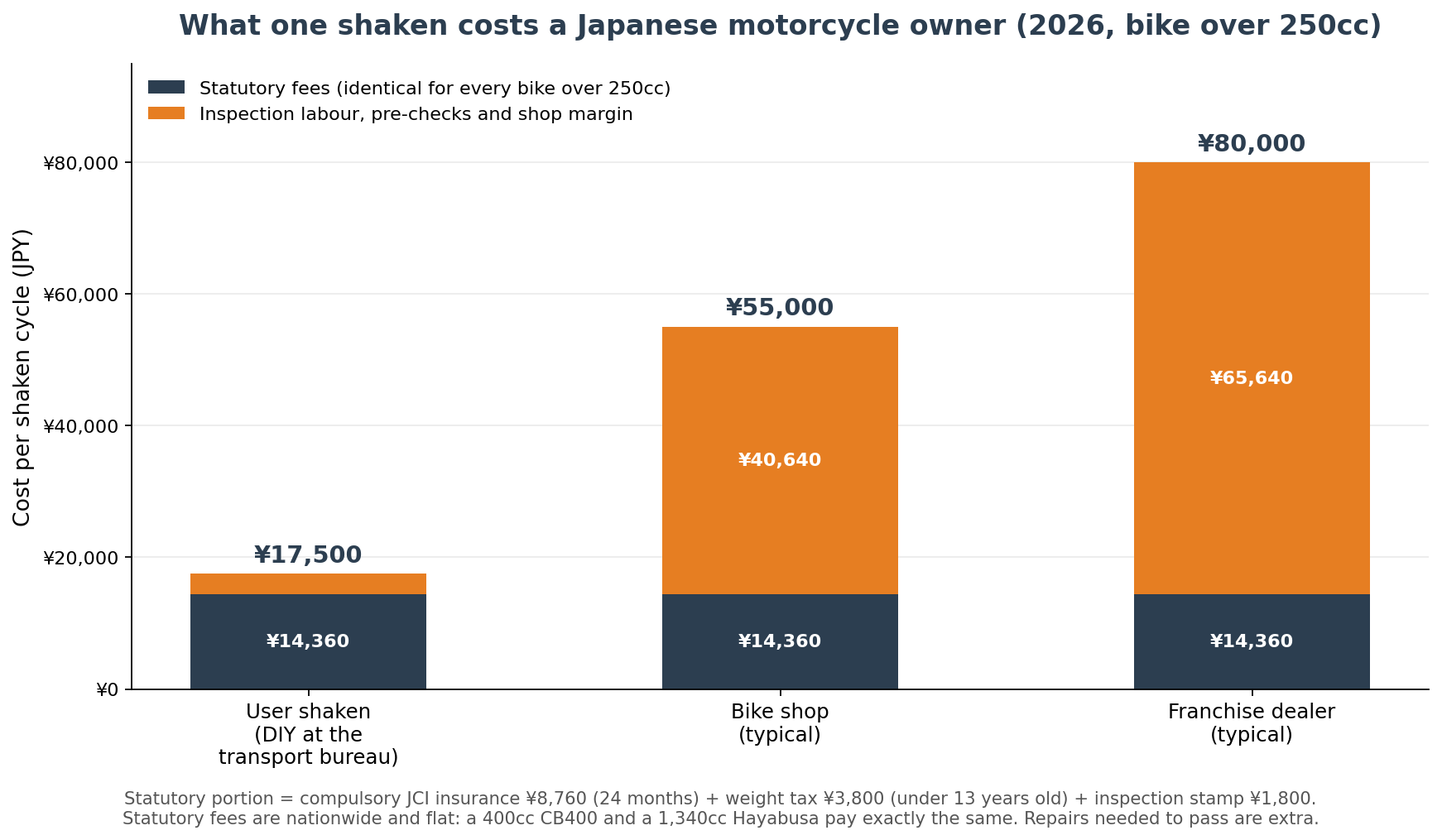
The statutory portion is fixed by law, identical nationwide, and identical for every bike over 250cc. Three components:
- Compulsory JCI insurance (jibaiseki), 24 months — ¥8,760. This is the mandatory third-party bodily injury cover. No insurance, no inspection.
- Weight tax (jidōsha jūryōzei) — ¥3,800. For a bike under 13 years old. This rises with age, and we will come back to that.
- Inspection stamp fee — ¥1,800 for a bring-it-yourself inspection.
That totals ¥14,360 in unavoidable statutory charges. Now note something counter-intuitive: the statutory portion does not scale with engine size. A 400cc CB400 Super Four and a 1,340cc Hayabusa pay exactly the same ¥14,360. Japan taxes the inspection, not the displacement.
What varies enormously is who does the work:
| Route | Typical total per cycle | What you are paying for |
|---|---|---|
| User shaken (DIY) | ¥15,000 – ¥20,000 | Statutory fees, plus your own weekday off work |
| Bike shop | ¥40,000 – ¥70,000 | Statutory fees plus pre-checks, adjustment and labour |
| Franchise dealer | ¥60,000 – ¥100,000+ | The above, plus dealer overhead and a thorough service |
Two things follow from that table. First, the DIY route is dramatically cheaper — roughly a third of shop pricing — which is why "user shaken" is a whole genre of Japanese YouTube content, and one such 2026 walkthrough guide has drawn nearly 39,000 views from owners trying to avoid a shop bill. Second, and this is the part that matters to you as a buyer, the gap between ¥17,500 and ¥55,000 is almost entirely labour and inspection prep. A bike that went the cheap route is a bike where nobody was paid to look at it closely.
And note what none of these figures include: actual repairs. Every cost guide lists tyres, brake pads, chain and oil as separate line items on top. If the bike needs a tyre to pass, that is your money, not the inspection fee's.
One fee is going up, and one insurance rate is going up
Two 2026 changes are worth knowing because they push in the same direction. The inspection stamp fee rose by ¥300 from April 2026. More significantly, Japan's Financial Services Agency council formally approved an average 6.2% increase in compulsory JCI insurance premiums on 30 April 2026, taking effect from 1 November 2026 — roughly ¥1,000 more on a two-year contract.
Neither number is large on its own. Both push marginal owners of older big bikes toward the same conclusion, and that conclusion is a listing in an auction catalogue.
What the inspection actually tests — and what fails
Shaken is a compliance test, not a health check. Understanding precisely where that line falls is what separates a buyer who reads a shaken pass correctly from one who over-trusts it.
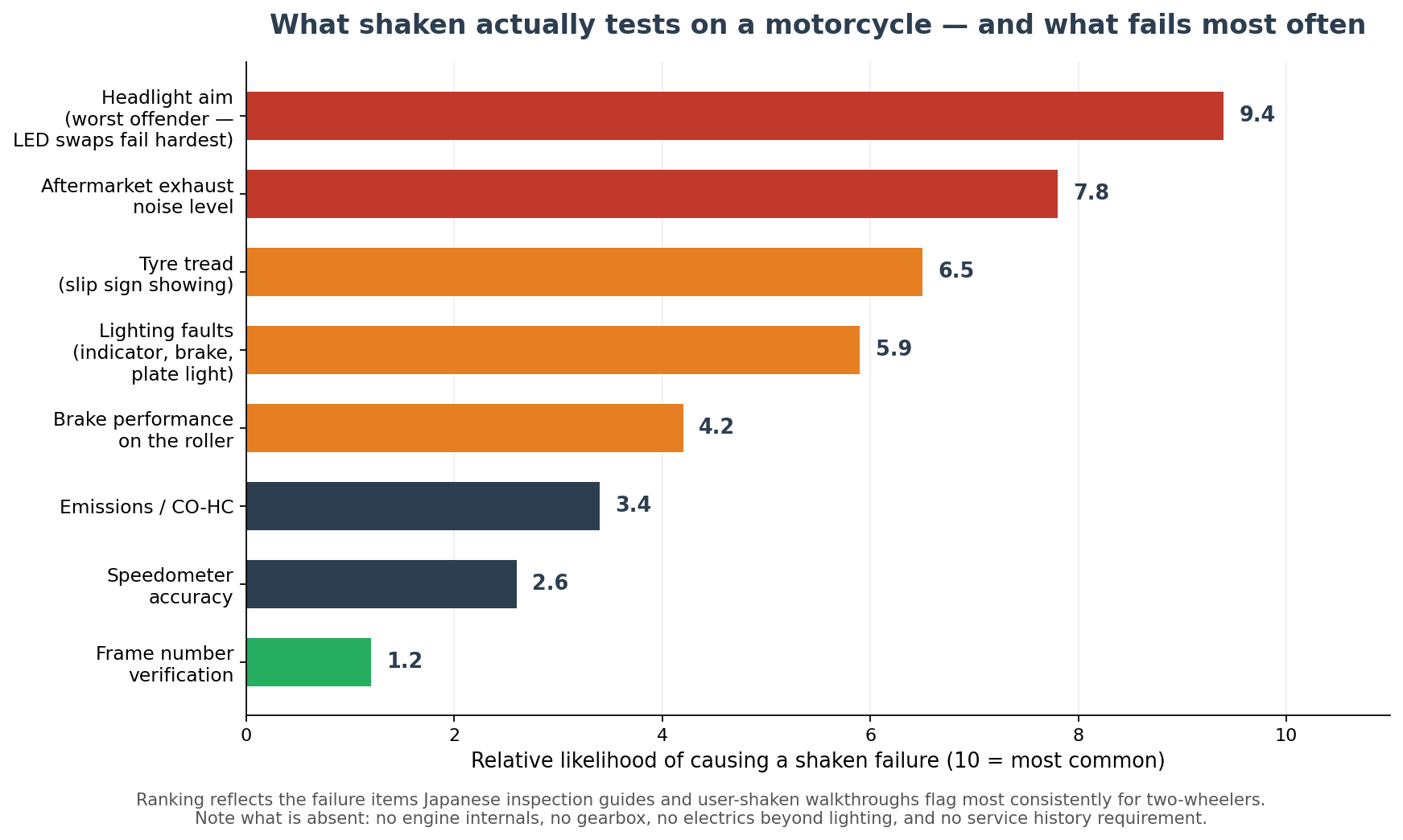
The inspection covers brake performance on a roller, tyre condition, all lighting, exhaust noise and emissions, handlebars and suspension, speedometer accuracy, and verification of the frame number against the register.
The failure list is dominated by two items, and neither is what a nervous buyer expects.
Headlight aim is the number one killer. Japanese inspection guides flag it as the most common failure by a wide margin, and it has become worse as riders swap halogen bulbs for LED units that scatter light differently than the reflector was designed for. A bike can be mechanically perfect and fail on a beam pattern.
Aftermarket exhaust noise is second. Here is the detail that should interest anyone buying a modified bike: a "shaken-compliant" aftermarket exhaust can drift over the noise limit purely through age, as packing material degrades. The part was legal when fitted. It may not be legal now. So a bike wearing a slip-on and a fresh shaken pass tells you the exhaust was within limits at test time — which is genuinely useful information, and also perishable.
Then tyres with the slip sign showing, blown indicator or brake or plate bulbs, brake performance, emissions, and speedometer accuracy.
Now read the list again and notice what is not on it. No engine internals. No compression test. No gearbox. No clutch. No electrical diagnostics beyond whether the lights illuminate. No frame straightness assessment beyond the number check. No service history requirement whatsoever.
A bike with a tired top end, a notchy gearbox and 40,000km of neglected valve clearances will pass shaken all day long, provided the lights work and the tyres have tread. That is not a flaw in the system — shaken was never designed to certify mechanical condition. It is a flaw in how the import industry describes the system to you.
The remarks field: how the certificate tells you whether the bike was serviced
This is the section no English-language import guide has written, and it is the most useful thing in this article.
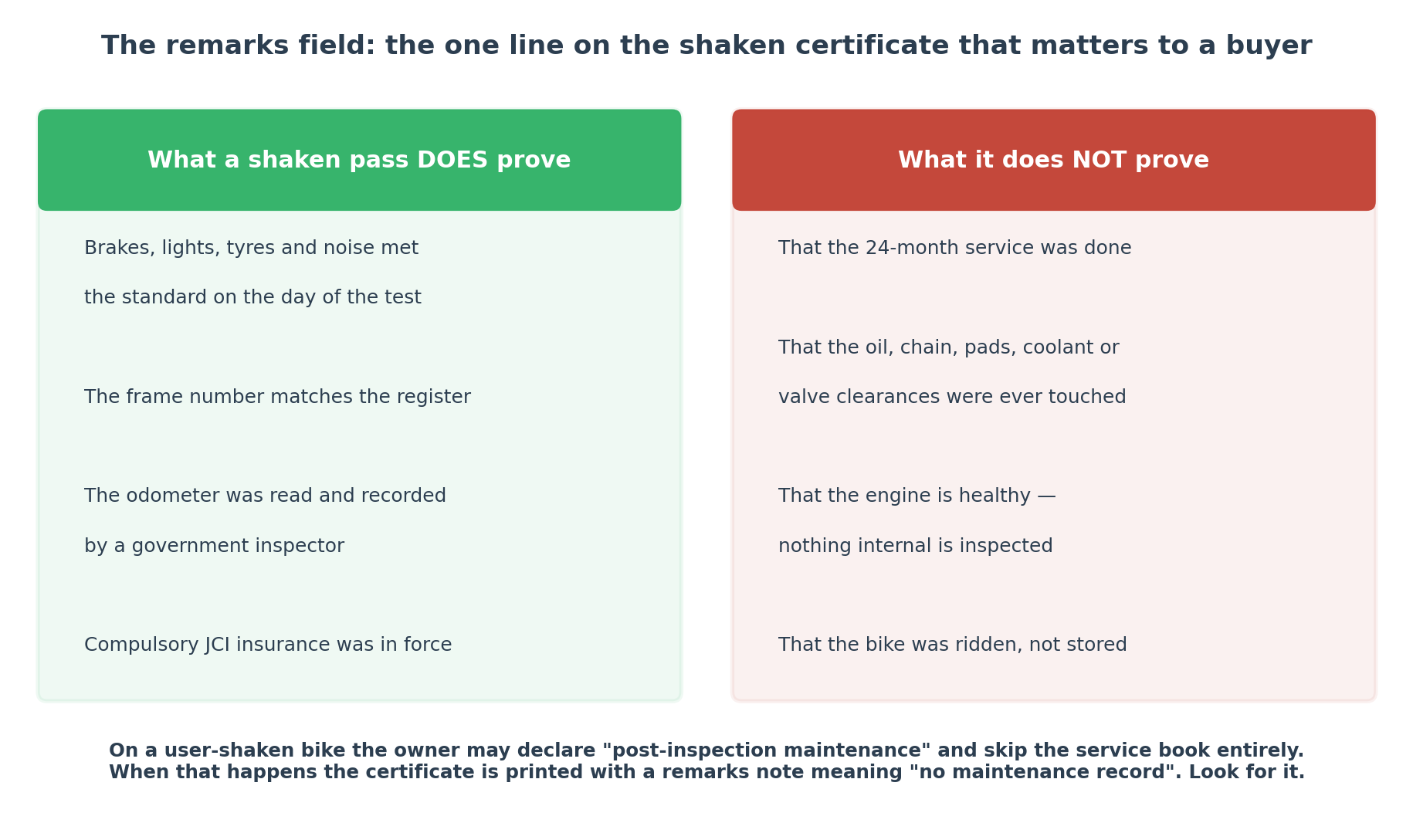
Japanese law requires more than passing the inspection. The owner must also carry out a statutory 24-month periodic maintenance inspection (24ヶ月定期点検整備) and record it in a maintenance record book — the tenken seibi kirokubo. That book is the real document you want as a buyer. It lists inspection items, the servicing facility, and the technician, and Japanese used-vehicle guidance is blunt about its value: a properly kept record book raises appraisal value, because it shows how much money the previous owner actually put into the machine.
So far, so reassuring. Here is the loophole.
On the user-shaken route, an owner may elect kō-seibi — "maintenance afterwards." They present the bike, pass the inspection lane, and tell the counter they will perform the 24-month service later. No record book required. Japanese guidance on this is explicit and slightly resigned: say "it's post-maintenance" at the window and the process goes through smoothly.
The owner is still legally obliged to perform that 24-month inspection and keep the record. But there is no penalty for never doing it. The practical consequence, per Japanese sources, is a postcard reminder mailed to the address on the certificate. That is the entire enforcement mechanism.
And here is the payoff for you. When an owner takes that route, the inspection certificate itself is annotated in the remarks field to the effect of "no maintenance record" (点検記録簿なし).
Read that again, because it changes how you evaluate a listing. The document that the entire English-language import industry cites as proof of good maintenance contains a printed field that sometimes says, in so many words, that the maintenance was never documented. It is right there on the paperwork. Nobody tells foreign buyers to look for it.
So the practical instruction is straightforward. When an auction listing includes a photograph of the inspection certificate — and good exporters can obtain one — do not simply confirm that shaken is valid. Read the remarks field. A certificate with a clean remarks field and a maintenance record book behind it is a genuinely different proposition from a certificate annotated "no maintenance record," even though both represent a bike that passed.
Ask your agent for two things by name: the inspection certificate (車検証) and the maintenance record book (点検整備記録簿). If the second one exists, the bike was looked after by someone who paid a shop to look after it. If it does not, you are buying a machine that cleared a lighting and brake test, and you should budget accordingly.
Why shaken is the engine of the entire JDM export market
Everything above is background. This is the part that explains why you can buy a 12,000km Japanese bike for less than a thrashed local example.
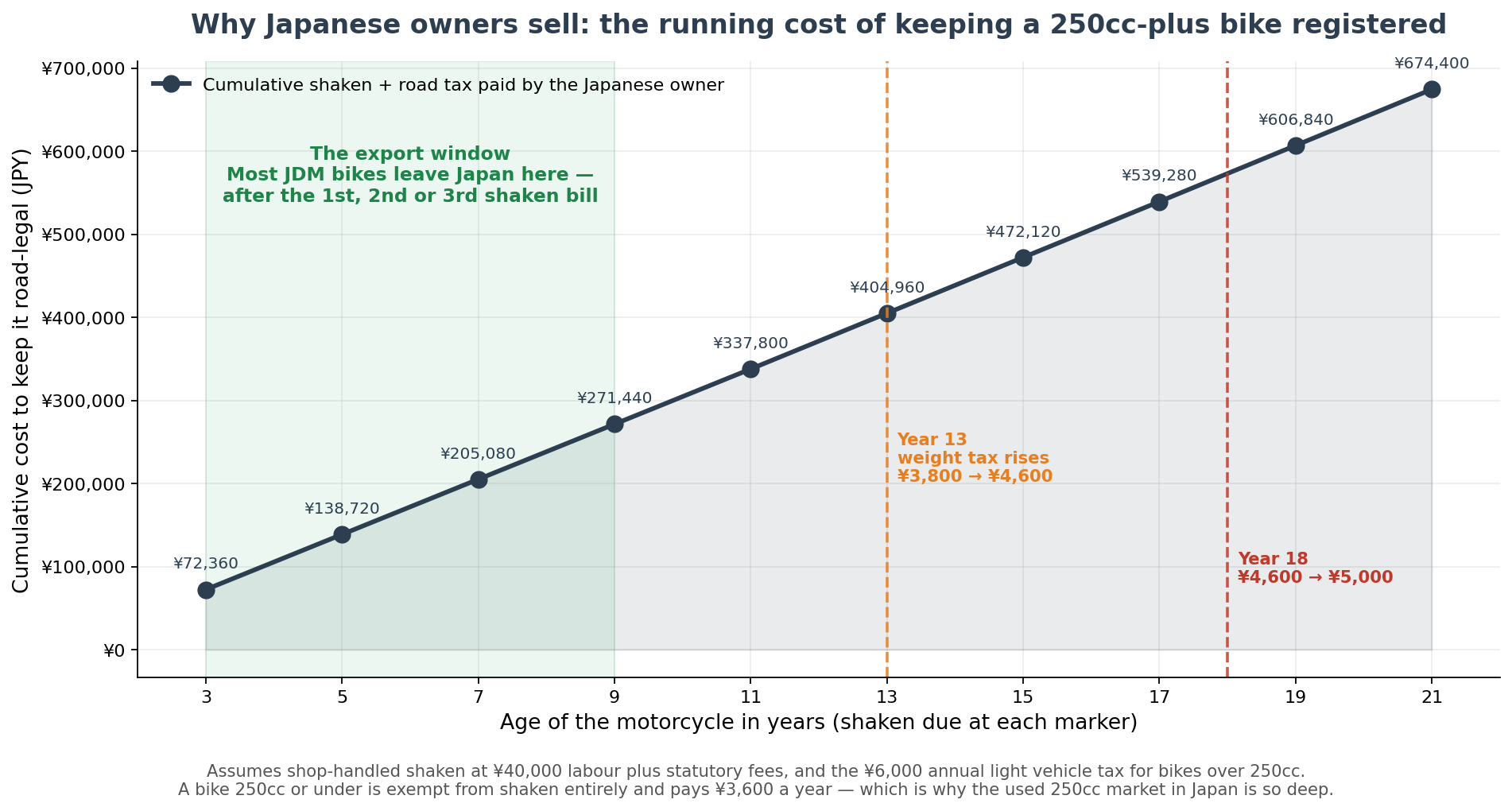
Follow the money over a bike's life in Japan. Using shop-handled shaken at ¥40,000 labour plus the ¥14,360 statutory portion, and adding the ¥6,000 annual road tax, a bike over 250cc has consumed roughly ¥72,000 by its first inspection at year three, about ¥205,000 by year seven, and comfortably over ¥400,000 by year thirteen. None of that is purchase price, insurance beyond the compulsory minimum, fuel, tyres, or a single repair. It is purely the cost of remaining legal.
Then the tax structure adds insult. The weight tax is not calculated on displacement — it is calculated on age since first registration, and it steps up twice. At 13 years the two-year weight tax goes from ¥3,800 to ¥4,600. At 18 years it goes to ¥5,000. Japan deliberately taxes old vehicles harder to push them out of the fleet, and a Japanese commenter put it plainly when listing the costs of car ownership: the tax on vehicles over 13 years old goes up too.
Now stack that against Japanese conditions. Rider demographics skew older, urban parking is scarce and expensive, and public transport is superb enough that a bike is often a hobby rather than a necessity. A 45-year-old in Osaka with a 9-year-old 600cc sportbike he rides eight times a year is facing another ¥55,000 shaken bill for a machine he barely uses. He is not being irrational when he decides to stop.
The result is a market where a genuinely good bike becomes surplus for reasons that have nothing to do with its condition. One motorcycle-focused video sums up the extreme end of this with a title that is only slightly hyperbolic — "Why Japan Throws Away Perfectly Good Motorcycles!" — and its own description gets to the mechanism: inspections, taxes and strict regulations can cost more than the motorcycle itself, so some owners simply abandon older bikes. That clip has drawn over 32,000 views, largely from riders outside Japan who cannot believe the arithmetic.
And there it is. The bikes leave Japan not because they are worn out but because the ongoing compliance cost exceeds what a lightly-used older machine is worth domestically. Look again at the timeline chart and the green band: the concentration of exports sits between year three and year nine, immediately after the first, second or third shaken bill lands.
One commenter watching a video about Japanese vehicle ownership costs drew exactly the right conclusion in seven words: "Explains why motorcycles are so huge in Japan." He was talking about why people ride bikes instead of driving cars. But it works just as well as an explanation of why the world's best supply of low-mileage used motorcycles happens to sit on one archipelago.
The shaken paradox for import buyers
Here is the honest version of the "Japanese bikes are well maintained" claim, with the nuance restored.
Shaken does not make Japanese bikes well maintained. Shaken makes Japanese bikes lightly used and then sold. Those are different things, and the second one is worth more to you than the first.
A bike sold at year seven because its owner did not want to pay another inspection bill has typically covered low annual mileage, been garaged in a country where garaging is standard practice, and been ridden on well-surfaced roads with minimal road salt outside the snow regions. That is a genuinely superior starting point. It just is not the same as a documented service history, and you should stop treating a shaken pass as though it were one.
The user-shaken tell: what the cheap route reveals about a bike
Worth one more section, because once you know what the DIY route involves you can read a bike's history from its cost profile.
A Japanese owner taking a bike through user shaken needs four things at the counter: the inspection certificate, proof of compulsory JCI insurance, a tax payment certificate where required, and photo ID. The maintenance record book sits on that list as optional — one popular 2026 Japanese walkthrough for motorcycle user shaken lists it with a note attached meaning, roughly, "not needed if you say you'll do the inspection afterwards."
Before presenting the bike the owner checks tyre tread, brake pad thickness, lights, horn and mirrors, then books a slot through the transport bureau's reservation system and runs the lane: visual inspection, emissions, brakes, speedometer, headlight. Pass all of it and a new certificate is issued the same day.
The whole exercise takes a weekday morning and about ¥17,500. That is a rational choice for a mechanically competent owner who genuinely maintains their own bike, and Japan has plenty of those. It is an equally rational choice for an owner who has done nothing to the bike in two years and wants the cheapest possible route to legality.
The certificate cannot tell those two owners apart. The record book can. Which is the entire argument of this article, arriving from a different direction: the document that costs nothing to request is the one carrying the information you actually want.
What happens to shaken when the bike is exported
Short answer: it evaporates, and there is money on the table that most buyers never collect.
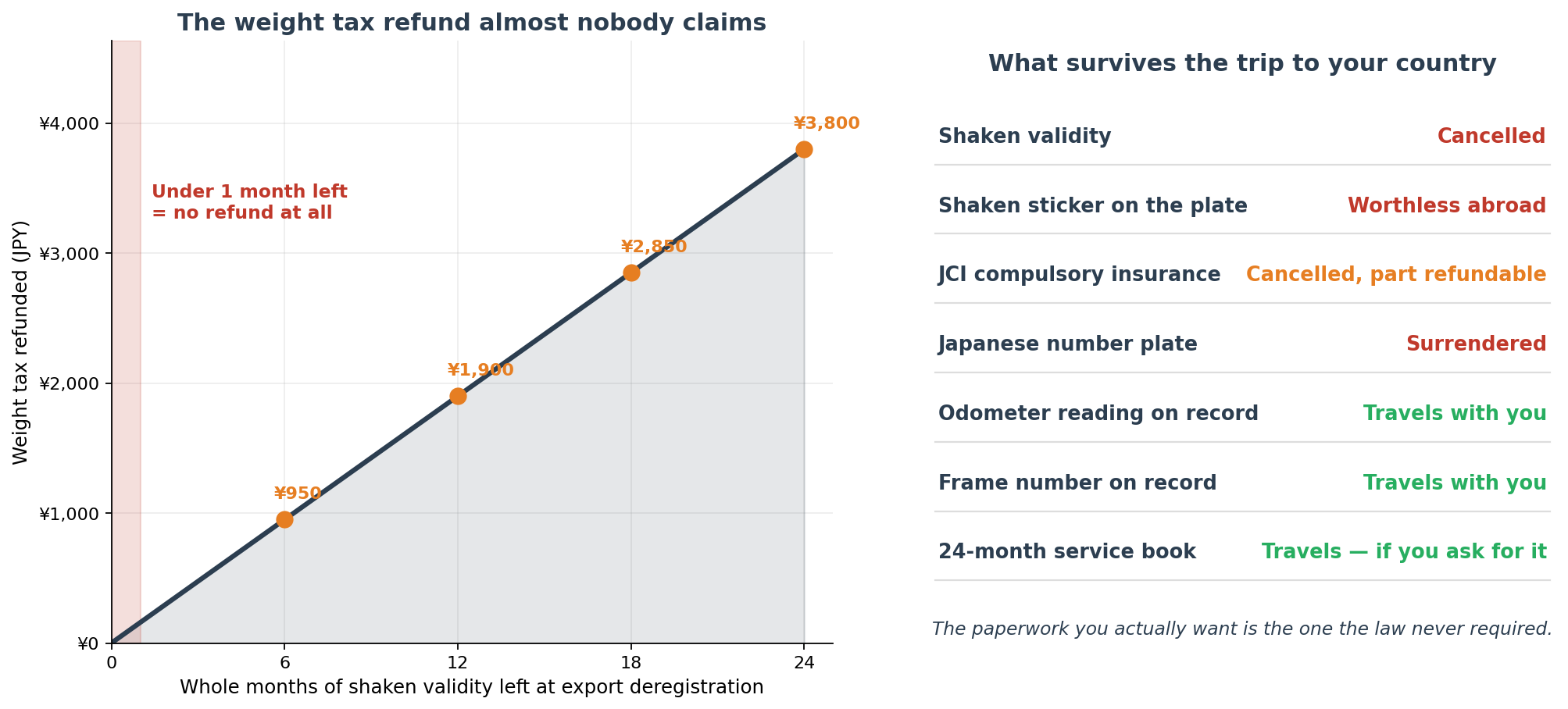
To leave Japan legally the bike goes through export deregistration (輸出抹消登録) at the transport bureau. The registration is cancelled, the number plate is surrendered, and the shaken validity ends with it. The inspection sticker on the plate becomes a souvenir. Whatever remaining months of shaken the bike had are worth nothing to you in the UK, the US, Australia or New Zealand, because your country will apply its own test — an MOT, an MSVA or IVA, a roadworthy, a WOF, a state safety inspection. None of them accepts a Japanese pass as a substitute.
So do not pay a premium for "long shaken remaining." Domestic Japanese buyers rationally will, because it saves them a real bill. As an exporter of the bike, you are buying something that gets cancelled at the docks. If a seller prices in fresh shaken, that is a domestic-market feature you are being charged for and will never use.
There is one exception worth knowing, and it is genuinely useful. Long remaining shaken means the bike passed an inspection recently. That is a dated data point on brakes, tyres, lights and noise, plus a government-recorded odometer reading. Value the information. Do not value the validity.
The weight tax refund almost nobody claims
Because the weight tax is paid upfront for the full two-year period, cancelling the registration early means part of it was never used — and Japan refunds it. The formula is simple: refund equals weight tax paid multiplied by remaining inspection months divided by total validity months. With ¥3,800 paid and 12 months remaining, that is ¥1,900 back. With 18 months remaining, ¥2,850.
Two conditions. The refund application must be processed alongside the deregistration itself, with a filing deadline, so it cannot be chased afterwards on a whim. And if fewer than one whole month remains, there is no refund at all. Japan's National Tax Agency publishes the weight tax refund rules directly, and the compulsory insurance base rates that feed the other half of the bill come from the General Insurance Rating Organization of Japan.
The compulsory JCI insurance is also partly refundable on the unused portion. The annual road tax is generally not refunded month-by-month for the lighter motorcycle classes.
These are small sums — a few thousand yen. Mention them anyway when you discuss deregistration with your agent, because it tells you something about how the agent operates. An exporter who handles the refund as routine is an exporter paying attention to the paperwork. An exporter who has never heard of it is telling you something too.
How to read shaken evidence in an auction listing
Concrete checklist. Work through it before you bid, in this order.
1. Establish whether shaken applies at all. Check displacement first. Over 250cc, an inspection history should exist. At 250cc or under, none exists and you should stop looking for it — pivot entirely to the auction inspection sheet and photographs.
2. Read the remarks field on the inspection certificate. Ask for a photograph of the 車検証 and have your agent tell you exactly what the remarks field says. This is the step that distinguishes a serious buyer from a hopeful one.
3. Ask for the maintenance record book by name. Request the 点検整備記録簿. If it exists, ask how many entries it contains and what the most recent one covers. A book with four dated shop entries is worth real money.
4. Cross-check the odometer against the shaken interval. Inspectors record the odometer at every test. Divide the total mileage by the bike's age. Under about 3,000km a year is genuinely low use — the classic Japanese profile. But be alert to the opposite problem: a bike that has covered almost nothing has been sitting, and sitting destroys fuel systems, fork seals, tyres and batteries far more effectively than gentle riding. Our guide to reading the auction sheet covers how the graders flag storage damage.
5. Check the shaken expiry date against the sale date. A bike sold one month before expiry is a bike whose owner did the arithmetic and declined. That is not a red flag — it is the single most common and most benign reason a good Japanese bike enters the export market. A bike sold with 20 months remaining was sold for a different reason, and it is worth asking what that reason was.
6. Treat a fresh shaken pass as perishable, not permanent. Fresh pass plus an aftermarket exhaust means the noise level was legal at test date. Fresh pass plus LED headlight conversion means the beam pattern was acceptable at test date. Both can drift. Neither carries over to your country's test.
7. Do not pay for remaining validity. Covered above, worth repeating, because it is the most common way import buyers hand over money for nothing.
Five things English-language guides get wrong about shaken
Collected corrections, since you will read all five of these elsewhere.
"Shaken is biannual." No. It is every two years, and the first is at three years. "Biannual" reads as twice a year and has propagated across import blogs unchecked.
"Every registered bike must pass shaken or be deregistered." Only bikes over 250cc. This claim appears verbatim on exporter sites and it silently misdescribes the entire 250cc segment — which is a large share of what most first-time importers actually buy.
"Shaken proves the bike is well maintained." Shaken proves compliance on the test date. The maintenance record book proves maintenance, it is legally skippable, and its absence is printed on the certificate.
"Shaken is one of the most expensive inspections in the world." For motorcycles this is overstated by writers extrapolating from cars. The statutory portion is ¥14,360 and the DIY route lands under ¥20,000. It is the shop labour, the two-yearly cadence and the age-based tax escalation that make it burdensome — not a single eye-watering fee.
"Buy a bike with long shaken remaining." Correct advice for someone buying a bike to ride in Japan. Wrong advice for an exporter, because export deregistration cancels it.
Shaken compared: Japan, UK, Australia, New Zealand, USA
Useful for calibrating what your bike faces after it lands.
| Country | Test | Frequency | Accepts a Japanese shaken pass? |
|---|---|---|---|
| Japan | Shaken (over 250cc only) | Year 3, then every 2 years | — |
| UK | MOT, plus MSVA/IVA on import | Annual after 3 years | No |
| Australia | State roadworthy / rego inspection | Varies by state | No |
| New Zealand | WOF, plus entry certification | Annual or 6-monthly by age | No |
| USA | State-dependent; several states none | Varies widely | No |
Two practical consequences. First, budget for your own country's test as a separate line item — it is not covered by anything the bike arrives with. UK buyers should read our MSVA test guide before bidding, because the modifications that pass shaken are not the same modifications that pass an MSVA. Second, the exhaust question bites twice. A slip-on that satisfied a Japanese noise meter may not satisfy a British one, and a headlight aimed for left-hand traffic is aimed correctly for the UK, Australia and New Zealand — and incorrectly for the United States and Canada.
That last detail is a small gift of geography. Japan drives on the left. If you are importing to the UK, Australia or New Zealand, the headlight beam pattern is already correct, which removes one of the more annoying import compliance jobs before you start.
What to do with all of this before your next bid
Compressed to the essentials.
If the bike is 250cc or under, there is no shaken history and there never was. Put your entire evaluation weight on the auction inspection sheet, the photographs and your agent's physical assessment.
If the bike is over 250cc, shaken history exists. Get the certificate photographed, read the remarks field, ask for the maintenance record book by name, and cross-check the recorded odometer against the bike's age.
In both cases, treat "it passed shaken" as evidence about brakes, lights, tyres and noise on one specific date — real evidence, worth having, and much narrower than the import industry implies.
And remember why the bike is available at all. Somewhere in Japan, someone looked at a ¥55,000 bill for a machine they ride a handful of times a year and decided it was not worth it. Their reluctance is your opportunity. You just need to know which parts of the paperwork tell you the truth.
How AWA Auction handles shaken and maintenance records
We bid on Japanese motorcycle auctions on behalf of buyers in the US, UK, Australia, New Zealand and the Gulf, and the shaken paperwork is part of what we check before a bid goes in — not after.
For every bike over 250cc, we obtain the inspection certificate details and tell you what the remarks field says, including when it indicates no maintenance record. We ask for the maintenance record book and tell you plainly whether one exists, because that single document changes what a bike is worth. We read the recorded odometer against the bike's age and flag the storage-damage profile that very low mileage implies. For bikes at 250cc and under, we say so directly rather than letting a generic reassurance about Japanese inspection standards do work it cannot do. And we handle export deregistration, including the weight tax refund where months remain.
You can browse current listings to see what is available now, or contact our team with a specific model in mind and we will tell you what its paperwork actually shows before you commit a yen.
The short version
Shaken is Japan's roadworthiness inspection, required only above 250cc, first at three years and then every two. It costs a Japanese owner roughly ¥17,500 done properly by themselves or ¥40,000 to ¥70,000 through a shop, on top of ¥6,000 a year in road tax, with the weight tax stepping up at 13 and 18 years. That recurring cost — not mechanical failure — is what pushes clean, low-mileage bikes onto the export market between years three and nine.
A shaken pass proves compliance on the test date and nothing more. The maintenance record book is the document that proves maintenance, it is legally optional, and when it is missing the certificate says so in the remarks field. Read that field. It is the most valuable line of Japanese text in the entire transaction, and almost nobody importing a motorcycle knows it is there.
See Also
Share this article: