
The Kawasaki GPZ900R import from Japan route is the only sensible way to land a clean one in 2026. Here's the thing nobody tells you when you start chasing the original Ninja: the bike that Maverick rode in Top Gun was built in Japan longer than anywhere else on earth, sold there until 2003, and most of the tidiest, lowest-mileage survivors never left the country. If you want a GPZ900R that wasn't ridden hard through thirty British winters, you buy it where it was loved — at a Japanese auction.
This is a 908cc piece of motorcycling history. It was the first production bike to break 150 mph. It invented the word "Ninja." And four decades later, a Japanese auction house will sell you one with a graded inspection sheet that tells you more about its condition than most dealers will admit out loud.
This guide covers the whole thing: which of the sixteen A-models to chase, why JDM examples beat export bikes, what it's actually legal to import to the US, UK, and Australia, what the landed cost really comes to, the faults that will bite you, and how to read a forty-year-old Ninja's auction sheet before you spend a yen.
What Is the Kawasaki GPZ900R? The Ninja That Started Everything
The GPZ900R landed in 1984 and rewrote the rulebook. Kawasaki's engineers spent six years in secret developing a liquid-cooled, 16-valve, DOHC inline-four at a time when nearly every rival superbike still ran air cooling. The result was a 908cc engine that made 115 bhp and pushed the bike to 151 mph — the first stock road bike to clear 150.
What made it special wasn't just the top speed. Kawasaki used the engine as a stressed member of the chassis, hanging it from a slim steel frame with no front downtubes. That cut weight and tightened the handling in a way nothing else in the class could match. A 16-valve head, a balancer-shaft-smooth motor, and an aerodynamic full fairing meant the GPZ900R could do something genuinely new: cross a continent at three-figure speeds without shaking your fillings loose.
In the US and parts of Asia it wore the name "Ninja" — the first motorcycle ever to carry it. Everything from the ZX-6R to the H2 traces its surname back to this one bike. That lineage is exactly why a YouTube retrospective on the "Kawasaki Ninja Evolution (1984–2025)" still racks up over 11 million views: people want to see where it all began.
The numbers that mattered in 1984
- Engine: 908cc liquid-cooled DOHC 16-valve inline-four
- Power: 115 bhp (export); JDM versions were restricted, more on that below
- Top speed: 151 mph — a world first for a production bike
- Weight: around 228 kg dry, light for a litre-class bike of the era
- Frame: steel diamond frame using the engine as a stressed member
What it's actually like as an engine
Numbers on a spec sheet don't tell you why people stay loyal to this bike for thirty years. The GPZ900R's motor is the reason. It uses a jackshaft-driven layout with the cam chain on the left side rather than down the middle, which let Kawasaki make the engine narrower and run a balancer. The upshot is an inline-four that's eerily smooth for its age, pulls hard from low revs, and doesn't need to be screamed to make progress.
Riders who put real-world miles on a GPZ900R — and there's a popular "Real Life 1985 Kawasaki GPZ 900 R test drive" video with over 800 comments where you can hear exactly this — describe a bike that's torquey, planted, and genuinely fast even by modern road standards once it's wound up. It was built as a sport-tourer that happened to be the fastest thing on the road, and that dual personality is exactly what makes it usable today. You don't ride a GPZ900R; you cover ground on it.
Top Gun, Maverick, and Why This Ninja Became a Legend
Let's be honest about why half the people reading this want a GPZ900R: Top Gun. In 1986, Tom Cruise's Maverick blasted down a runway on a GPZ900R while an F-14 screamed overhead, and the bike became cinema's most famous motorcycle overnight. A single clip titled "Top Gun bike and fit" has pulled over 4 million views on YouTube; another Top Gun GPZ900R tribute sits at 2.5 million. The bike is genuinely a movie star.
That cultural weight is doing real things to the market. The GPZ900R has crossed the line from "old sportbike" to "appreciating classic," and the cleanest examples are increasingly hard to find outside Japan. When a forty-year-old bike is famous enough to be name-checked in a 2022 sequel, the survivors get cherished — and cherished bikes don't come cheap.
The flip side: there's a difference between a movie-poster fantasy and a road-going reality. A GPZ900R is heavy by modern standards, the brakes are from another era, and the riding position is a long-distance sport-tourer's, not a track weapon's. People who buy one expecting a modern superbike are disappointed. People who buy one understanding what it is fall in love. We'll get to whether it's still genuinely rideable later.

The A1 to A16 Timeline: Which GPZ900R Should You Buy?
The GPZ900R was in production from 1984 to 2003 — an astonishing twenty-year run. Across that span there were sixteen official versions, each prefixed with the letter "A" and a number, from the 1984 A1 to the 2003 A16. Knowing which is which is the single biggest advantage you can have at a Japanese auction, because the sheet will list the model code and most overseas buyers have no idea what it means.
Here's the production reality that shapes the entire import decision: the GPZ900R was discontinued in Europe in 1993, in the US around 1996, but Kawasaki kept building it in Japan all the way to 2003. That's the whole reason Japan is the place to buy. The freshest, latest, lowest-mileage GPZ900Rs on the planet are JDM bikes that never had an export market to leave for.
The generations, simplified
- A1–A2 (1984–1985): The originals. 18-inch front wheel, the purest "first Ninja" look. Most collectible, hardest to find clean. The Top Gun bike was an A2.
- A3–A6 (1986–1989): 16-inch front wheel, revised forks and brakes. The sweet spot for riders — better stoppers, still period-correct.
- A7 onward (1990–2003): The long JDM-focused run. Detail revisions to forks, wheels, brakes, and airbox. JDM riders on X specifically flag "A7以降" (A7 and later) as the versions with the updated running gear. These are the bikes with the best parts availability and the lowest miles.
- A16 (2003): The final edition — and a unicorn. Just 161 units were built, all for Japan. If you ever see one on an auction sheet, that's a genuine collector piece.
For a first GPZ900R you'll actually ride, an A7-or-later JDM bike is the smart play: newer metal, the improved chassis updates, and a parts ecosystem that's still alive in Japan. For a collector chasing the icon, an early A1/A2 in honest condition is the trophy. The A16 is for people who already own three of them.
One practical note on the early-versus-late question: the front wheel size changed from 18-inch to 16-inch after the first couple of years, and tyre choice follows. Modern rubber is plentiful for the 16-inch bikes and a little more specialist for the 18-inch originals. If you plan to ride hard and want the widest tyre selection, that nudges you toward an A3-or-later. If you want the exact silhouette of the 1984 launch bike, you accept a narrower tyre shelf as part of the deal. Neither is wrong — just know which camp you're in before you bid.
JDM vs Export Models: Why Japan Is the Best Place to Buy
You could buy a GPZ900R in the UK or Australia. You'd be buying a bike that's typically older, higher-mileage, and that has lived its whole life in a salt-and-rain climate. JDM bikes are a different animal, and it comes down to three things.
Climate and roads. Japanese riders garage their bikes, ride them in dry conditions, and the roads aren't gritted with corrosive salt every winter. A 1995 JDM GPZ900R routinely shows less corrosion than a 1990 UK example, even though it has fewer years on it. Aluminium and fasteners that look chalky and pitted on a Western bike are often still bright on a JDM one — and on a forty-year-old machine, that surface condition is a window into how the whole bike was treated.
Maintenance culture. Japan's restoration scene for this bike is intense. Spend five minutes on X and you'll find owners documenting "忍者復活への道" (the road to reviving the Ninja), agonizing over brake-line routing and chasing originality down to the fastener. Specialist shops like those listed on Webike Japan stock custom and OEM parts specifically for the GPZ900R. That ecosystem means JDM bikes were kept right, and it means you can keep yours right after it lands.
Power restrictions — the one catch. Here's the part you need to know: JDM-market GPZ900Rs were sold under Japan's voluntary power cap and made less than the 115 bhp export figure. Early JDM bikes were limited to around 86 bhp. Many were de-restricted by their owners over the years, but you should assume a JDM bike needs the restrictor work checked or done. It's a well-understood job and parts are everywhere — but factor it in if you want the full-fat output.
Net result: a JDM GPZ900R gives you a better-preserved bike with stronger parts support, at the cost of checking the power restriction. For most buyers that's a trade worth making ten times out of ten.
Is It Legal to Import a GPZ900R? US, UK, and Australia Rules
Good news first: the GPZ900R is one of the easiest interesting bikes to import legally, precisely because it's old. Here's how it breaks down by country.
United States — the 25-year rule is your friend
The US 25-year rule lets any vehicle 25 or more years old come in without meeting current EPA emissions or DOT/FMVSS safety standards. In 2026, that means every GPZ900R built through roughly 2001 is fully exempt — and since the bike ran from 1984, the overwhelming majority of examples qualify with room to spare.
One detail that catches people out: the 25-year clock runs from the actual manufacturing date, not the model year. A bike built in December 2000 clears the rule before a near-identical one built in January 2001. For a bike that's mostly 1980s and 1990s, this is rarely an issue — but if you're chasing a late JDM A14/A15, check the build date on the documents.
There's a tariff bonus, too. US import duty on motorcycles with engines over 700cc is zero. The GPZ900R's 908cc motor means you pay no duty — just shipping, broker fees, and your state's registration costs. The paperwork is a DOT HS-7 form, an EPA 3520-1 form (claiming the 21-year-plus exemption), the Japanese export certificate, and the bill of lading.
United Kingdom — straightforward but paperwork-heavy
The UK has no 25-year barrier; you can import a GPZ900R of any age. You'll pay import VAT and duty on arrival (historic/classic bikes can qualify for a reduced rate), then register it through the DVLA. Older imports like this usually need an MOT and, depending on age and originality, may sidestep the full IVA test. The GPZ900R is so well-known to UK importers that the process is well-trodden.
Australia and New Zealand — check the date and the scheme
Australia's rules favour older bikes through eligibility schemes for vehicles over 25 years old, and New Zealand is famously import-friendly. Both want compliance and entry certification, but a 1980s–1990s GPZ900R is exactly the kind of bike these systems were built to wave through. Confirm the current scheme with your customs broker before you bid — rules shift, and your broker earns their fee here.
Across all four countries the pattern is the same: because the GPZ900R is old, the legal path is open. The work is paperwork and shipping, not fighting regulators.

What a GPZ900R Import Actually Costs
This is where people either get excited or get scared, usually because they've only counted the auction price. Let's count all of it. The chart below shows a realistic landed cost for a tidy mid-spec JDM GPZ900R delivered to a US or UK port.
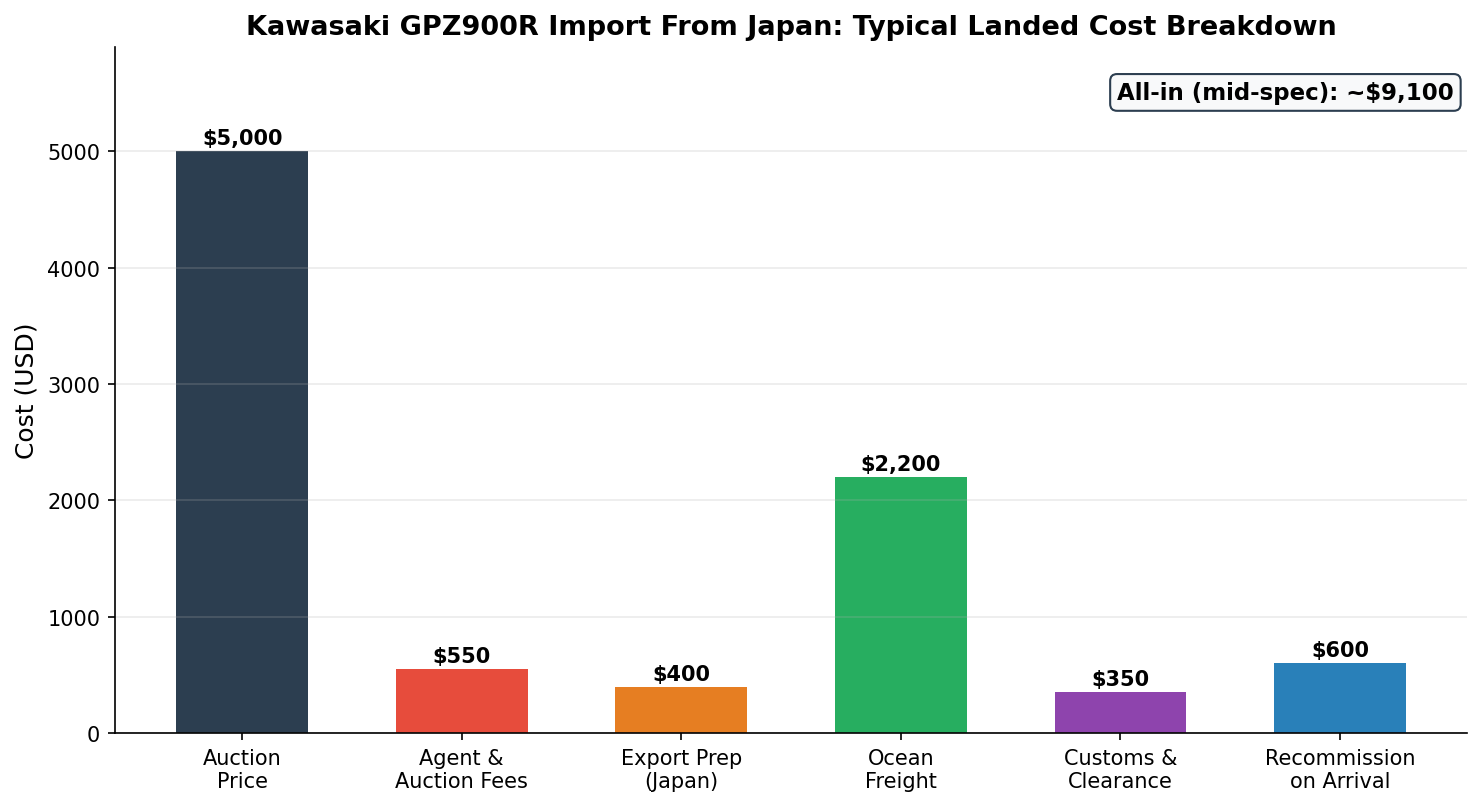
Here's how the typical numbers shake out for a clean, running JDM example:
- Auction hammer price: $3,500–$6,500 for a solid, honest A7-era bike; more for early A1/A2 or mint examples
- Auction and agent fees: roughly $400–$700, covering the bidding service and Japan-side handling
- Export prep and domestic transport in Japan: $300–$500 (de-registration, transport to port, export certificate)
- Ocean freight: $1,500–$3,000 depending on RoRo versus container and destination port
- Destination duty: $0 in the US (over-700cc bikes are duty-free); VAT/reduced duty in the UK
- Customs broker and local clearance: $200–$500
Add it up and a tidy JDM GPZ900R typically lands somewhere between $6,000 and $10,000 all-in — and you've got a bike that clean dealers in the US and Western Europe ask $10,000 or more for, with museum-grade examples pushing toward $20,000. The import math works precisely because the JDM market still has supply that the West has run dry of.
The mistake to avoid: chasing the cheapest hammer price. A $2,000 project that needs a starter clutch, a cooling system rebuild, and a respray will cost you more than a $5,000 honest runner once you're done. On a forty-year-old bike, condition is the whole game.
The costs people forget to count
Two line items ambush first-time importers. The first is currency and timing: you're paying in yen, and exchange-rate swings between the auction win and the final settlement can move your total by a few hundred dollars either way. A good agent locks costs down clearly so you're not guessing. The second is the on-arrival recommissioning. Even a clean JDM GPZ900R that's sat in a Japanese garage wants fresh fluids, a battery, tyres if the date codes are old, and a careful once-over of those forty-year-old brake and cooling components before you ride it in anger. Budget $400–$800 for sensible recommissioning on top of the landed price, and you'll never be unpleasantly surprised.
Done right, the all-in figure still beats the local market — but counting only the hammer price is how people end up over budget and grumpy. Count everything from the start.
Step-by-Step: How to Import a GPZ900R From Japan
Here's the actual sequence, start to finish. None of it is hard if you go through an export agent who handles the Japan side for you.
Step 1 — Set your target
Decide which generation you want (early icon vs A7+ rider) and your absolute ceiling, including all the costs above. Write the number down. Auctions are designed to make you forget it.
Step 2 — Get auction access
You can't bid at Japanese bike auctions like USS, BDS, or JBA as a foreigner directly — you bid through a licensed proxy or export agent. They give you access to the live auction listings and inspection sheets.
Step 3 — Read the inspection sheets
Every bike gets a graded sheet. This is the single most valuable document in the whole process, and we'll break down how to read one for a forty-year-old Ninja in the next section.
Step 4 — Bid
Your agent places bids on your behalf up to your maximum. Most bikes sell in seconds. You'll often need to be patient across several auctions to land the right example — don't overpay for the first one you see.
Step 5 — Pay and prep for export
Once you win, you pay the hammer price plus fees. Your agent de-registers the bike, gets the export certificate, and moves it to the port.
Step 6 — Ship
This is a real decision, not a formality. For a motorcycle you have two routes. A shared container means your bike is strapped and crated inside a sealed steel box, protected from weather and handling — the safer choice for a valuable classic like a clean GPZ900R, and usually only a few hundred dollars more once you share the container with other vehicles. RoRo handling for bikes means the machine is crated and rolled aboard a vehicle carrier; it's cheaper but involves more handling at both ports. For a forty-year-old icon you've spent weeks hunting down, the container premium is cheap insurance. Transit to the US west coast runs two to four weeks; to the UK and Europe, four to six. If you've also browsed our current listings, you'll notice condition-grade bikes move fast — so have your shipping plan ready before you win, not after.
Step 7 — Clear customs and register
File your country's import forms, pay any duty/VAT, and register. For the US, that's HS-7 and EPA 3520-1 under the 21-year exemption; for the UK, DVLA registration after clearance.
Reading the Auction Sheet on a 40-Year-Old Ninja
Japanese auction houses grade every bike, and the inspection sheet is where you win or lose. A grader physically inspects the machine and assigns an overall grade plus notes on specific areas. For a modern bike this is straightforward. For a forty-year-old GPZ900R, you have to read it differently.
Overall grade. Bikes are typically graded on a numeric scale (often 1 to 6, sometimes with S for nearly new). On a GPZ900R you should not expect a high grade — these are old bikes. A 3.5 or 4 on a 1990s Ninja can be an excellent, honest machine. Chasing a "perfect" grade on a forty-year-old bike usually means you're looking at a restored or modified example, which has its own questions.
The notes are everything. The grader marks corrosion (サビ), scratches (キズ), dents (へこみ), and modifications. On an old GPZ900R, you're reading these for two things: originality and honesty. Aftermarket exhaust, non-standard paint, and "custom" notes are common and not automatically bad — but they affect value and tell you the bike has been apart.
What a good agent adds. A grade tells you the bike's cosmetic and structural state. It does not tell you whether the starter clutch is on its way out or whether the cooling fan works. A specialist agent who knows the GPZ900R can flag the model-specific risks that a generic sheet won't — which is exactly why you don't import one of these blind.
Known Faults: What to Check Before You Bid
The GPZ900R is genuinely reliable for its age — Kawasaki over-engineered it — but four decades is four decades. These are the specific things owners and specialists flag again and again. Know them before you bid, because the auction sheet won't.
The starter clutch
This is the big one. The GPZ900R's starter clutch can fail, and replacing it is a serious engine-out job. A bike that's slow to crank, makes a whirring or slipping noise on the starter, or that the seller "always bump-starts" is telling you something. Budget for it on any high-mileage example, and treat a known-good starter clutch as a genuine value-add when you find one.
Cooling system and the fan
Liquid cooling was cutting-edge in 1984; the parts are now forty years old. Overheating is a known watch item. The classic test, exactly as long-time owners describe it: run the bike on its stand until it's hot and confirm the cooling fan actually kicks in. A dead fan plus city traffic equals a cooked engine. Radiators, hoses, and the thermostat are all age-related consumables here, and a tired cooling system is one of the most common reasons an otherwise-clean GPZ900R runs hot.
Cam chain tensioner and top-end noise
Listen for cam chain rattle. The tensioner can need attention, and a noisy top end on a cold start that doesn't settle is worth investigating. It's not usually catastrophic, but it's a bargaining point and a job worth costing into your offer.
Frame, fasteners, and originality
Check for frame corrosion and, critically, mismatched VINs or a sketchy restoration. A GPZ900R with a respray hiding filler, mismatched panels, or numbers that don't add up is a bike to walk away from. Originality is increasingly what the market pays for, so a bike with honest, documented history beats a glossy mystery every time.
Parts availability — the good news
Unlike many bikes of its era, the GPZ900R has a living parts supply, largely because Japan built it until 2003 and the restoration scene keeps demand high. Consumables, gaskets, and many OEM and pattern parts are still obtainable through Japanese suppliers. You're restoring an icon, not chasing unobtainium.
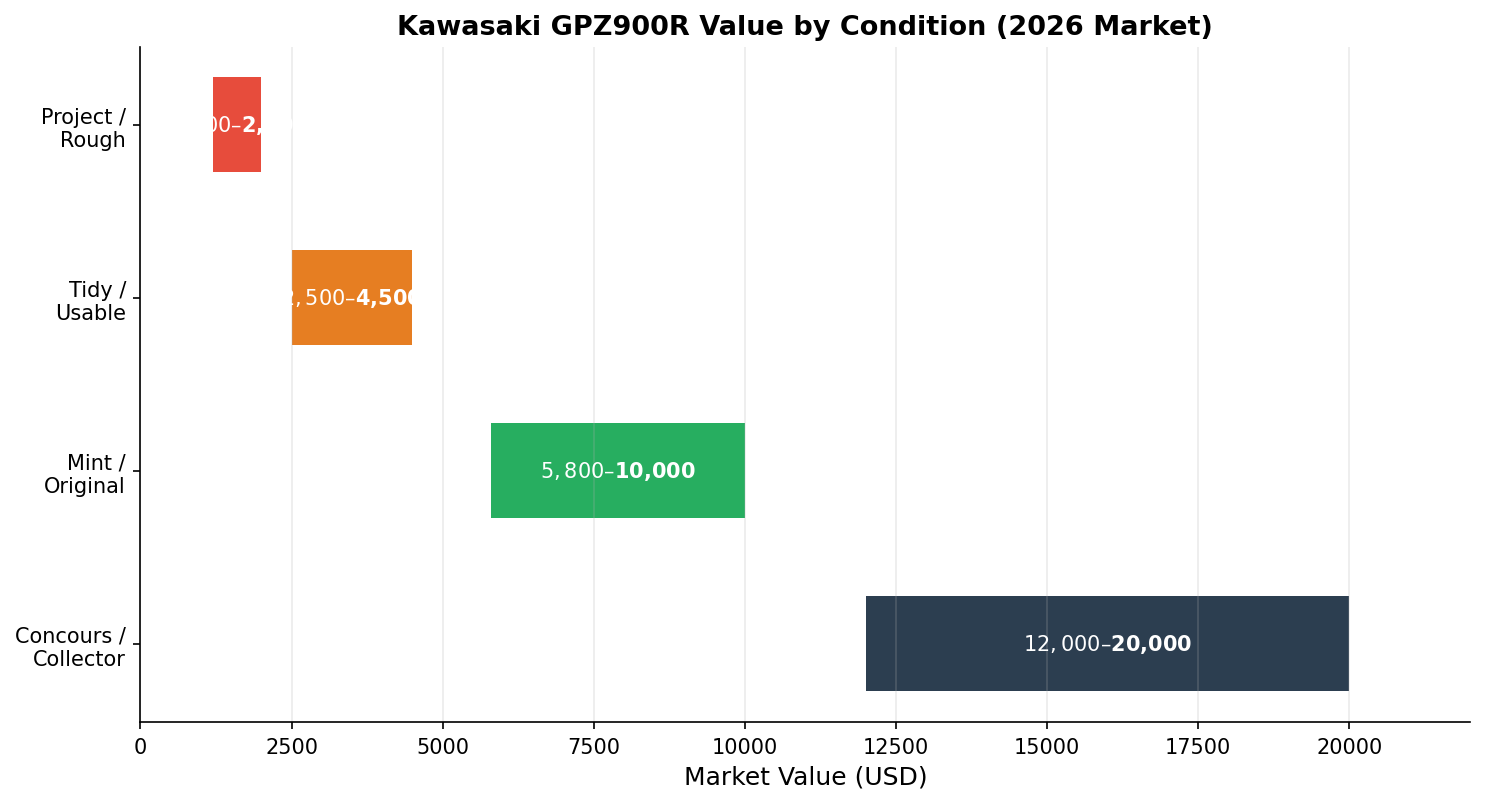
What GPZ900Rs Are Worth Right Now
Values have moved, and they're still moving up. The value-by-condition chart above lays out the current market spread. Here's the plain-language version, drawn from current UK and US listings.
- Project / rough: roughly £900–£1,600 ($1,200–$2,000) for a runner that needs everything. These eat money — go in with your eyes open.
- Tidy / usable: £2,000–£3,500 ($2,500–$4,500) for an honest bike you can ride and enjoy.
- Mint / original: £4,500–£5,500 ($5,800–$7,000) in the UK; clean US runners commonly start around $10,000.
- Concours / collector: museum-grade and rare early or A16 examples approach $20,000.
The trend line matters more than any single number. A bike with Top Gun fame, genuine historical significance as the first Ninja and first 150-mph production motorcycle, and a shrinking pool of clean survivors is not getting cheaper. JDM imports are currently the value play because Japan still has the supply — but that gap closes a little every year. Buying a clean one now and looking after it is closer to a sensible classic-bike decision than a gamble.
How the GPZ900R Compares to Its 1980s Rivals
To understand why importing a GPZ900R specifically is worth the effort, it helps to see what it was up against — and why it's the one that became a legend instead of just an old bike. The mid-1980s was a brutal arms race in the litre-and-up class, and the survivors people chase today are a small club.
The Yamaha FZ750 arrived in 1985 with its own five-valve genius and is a fine bike, but it never had the cultural moment the GPZ900R got. Suzuki's GSX-R750, launched the same year, took the sportbike in a different direction entirely — race-replica, aluminium-framed, uncompromising — and it's collectible too, but it's a track-focused tool where the GPZ is an all-rounder. Honda's VF and later VFR V4s were technically brilliant and are wonderful imports in their own right, yet none of them carry the "first Ninja, first 150-mph production bike, Top Gun star" trifecta.
That's the GPZ900R's unique position: it sits at the exact intersection of historical significance, cultural fame, real-world usability, and — crucially for an importer — a Japanese supply of clean, late-production examples that the rivals simply don't have in the same numbers. Kawasaki built this one until 2003. Most of its 1985 competitors were long gone from showrooms by the early 1990s. When you import a GPZ900R from Japan, you're buying into the one bike from that golden era that's both iconic and genuinely available in good condition. That combination is rare, and it's exactly why values are climbing.
If you're cross-shopping other Japanese classics before you commit, watching what's currently coming through the auctions is the fastest way to see how the GPZ900R stacks up against its peers in real listings rather than nostalgia.
GPZ900R vs Modern Retro: Is It Still Rideable?
A fair question, and the honest answer is: yes, but know what you're getting. One X post recently ran a "1985 GPz900R vs 2025 S1000RR" head-to-head — and that comparison tells you everything. The GPZ900R was the fastest thing on the road in 1984. By 2026 standards, a modern litre bike will embarrass it on outright numbers.
But that misses the point entirely. The GPZ900R isn't bought to beat an S1000RR. It's bought because it's a 908cc, balancer-smooth, surprisingly torquey inline-four with a riding position you can actually use across a country, and because no modern bike has its history or its soul. Owners consistently describe it as comfortable, stable, and addictively characterful — a bike you ride for the experience, not the lap time.
Compared to a modern retro like Kawasaki's own Z900RS — which deliberately echoes this era's styling — the GPZ900R gives you the real thing: the actual machine the tributes are imitating, with the patina and the story to match. If you want fuel injection, ABS, and a warranty, buy the new one. If you want the bike that started the bloodline, you import the original.
How AWA Auction Helps You Land a GPZ900R
Importing a forty-year-old icon from Japanese auctions is exactly the kind of job that goes well with the right people on the ground and badly without them. That's the gap AWA Auction fills. We give English-speaking buyers direct access to Japan's motorcycle auctions — the same USS, BDS, and JBA listings the bike never left Japan to escape — without needing to speak Japanese or hold a Japanese auction licence.
For a bike like the GPZ900R, that means we read the inspection sheet with model-specific eyes, flag the starter-clutch and cooling-system risks a generic grade won't mention, confirm whether a JDM bike has been de-restricted, and handle the export paperwork, de-registration, and shipping to your port. You set your target and your ceiling; we do the hunting and the legwork.
You can browse our current listings to see what's coming through the auctions right now, or contact our team with the exact GPZ900R spec you're chasing — generation, condition, budget — and we'll watch the auctions for the right one. Importing the original Ninja shouldn't be a leap of faith. With the right agent reading the sheets, it's just a smart classic purchase.
See Also
Share this article: