
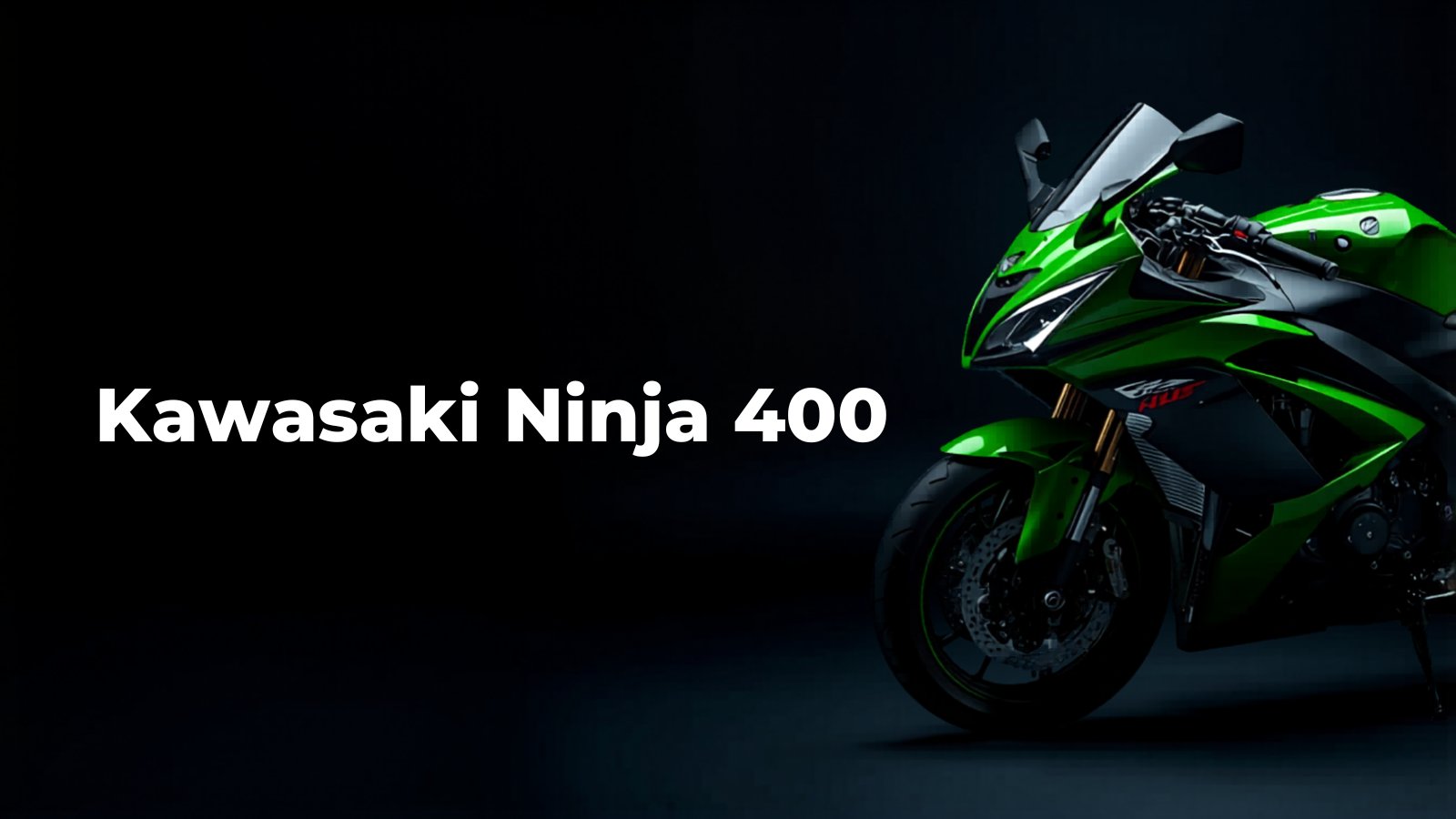
When Kawasaki launched the Ninja 400 in 2018, the reaction from the motorcycle press was unusually uniform: this is the best A2-licence sports bike ever built. The combination of a lightweight trellis frame, a rev-hungry 399cc parallel twin, and sharp supersport styling put it in a class of its own for riders on or approaching an A2 licence.
In Japan, the Ninja 400 has been one of the strongest-selling sports bikes in the middleweight category since its launch. Thousands of well-maintained examples pass through Japanese domestic market auctions every year — and for UK buyers who want this bike without paying UK new or dealer prices, Japan is the obvious route.
This guide covers everything: why the Ninja 400 makes such a strong import case, what total costs actually look like, how MSVA applies, and what to check on the auction sheet before you bid.
Why the Ninja 400 Is the Import Buy for A2 Riders
The A2 licence creates a difficult problem. The 35 kW (47 PS) power limit eliminates most sports bikes from the full-licence world. Restricted versions of larger bikes feel compromised — power delivered in a way the engine wasn't designed for, often with ugly restrictor kits that need removing before a full licence upgrade.
The Ninja 400 sidesteps this entirely. It was engineered from the outset as a 45 PS machine. The engine character, gearing, braking, and chassis geometry are all designed for this exact power output. The result is a motorcycle that feels complete — not limited — and that remains genuinely rewarding to ride after you upgrade to a full licence.
The Japanese import argument adds a further layer:
- Price gap: A 2020 Ninja 400 at UK dealers lists at £5,500–£7,000. A comparable Japanese auction example lands in the UK for £4,000–£6,000 fully registered — typically £1,000–£1,500 less for the same bike.
- Supply depth: Japan sells large volumes of Ninja 400s, meaning BDS and other auctions carry consistent supply across all model years and grades.
- Condition: Japanese owners maintain their bikes meticulously. Grade 3.5 and Grade 4 examples with under 10,000 km are common.
- SE variant: The Ninja 400 SE (with Öhlins rear shock and premium colour) is available in Japan and commands only a modest premium over the standard model.
The Ninja 400 doesn't become irrelevant after you pass your full licence test. Many experienced riders choose it as a second bike, a commuter, or a track day tool precisely because its 45 PS in a sub-170 kg package creates a riding experience that rewards skill in a way that bigger, heavier bikes can't replicate.
Model Year Guide: Ninja 400 Updates and Variants
The Ninja 400 has been in production since 2018 with relatively few changes — a sign that Kawasaki got it right from the start.
| Year | Key Changes | Notes for UK Buyers |
|---|---|---|
| 2018 | Launch model. 399cc parallel twin, 45 PS. Trellis frame. Assist and slipper clutch. Three colour options. | Oldest available. Lowest prices. All mechanicals identical to later models. |
| 2019 | SE variant introduced (Öhlins rear shock, premium colour). Minor colour updates on standard. | SE becomes available. Good value on both variants. |
| 2020–2021 | Colour updates. Continued SE production. No mechanical changes. | Recommended sweet spot. Low mileage examples plentiful at this age. |
| 2022–2024 | Euro 5 compliance (minor fuelling revisions). New colour options. SE continues. | Newest available. Higher hammer prices. Very low mileage on recent examples. |
For most buyers, 2019–2021 examples at Grade 3.5 or 4 represent the best value. The SE is worth the premium for riders who plan to keep the bike for several years — the Öhlins rear shock is a meaningful upgrade that transforms the ride quality on UK roads.
What to Check on the Auction Sheet
The Ninja 400 is a reliable machine with no major known mechanical issues. Auction sheet scrutiny focuses primarily on crash evidence and cosmetic condition.
Frame and trellis structure
The Ninja 400's exposed trellis frame means any frame damage is visible on the bike — and visible in the auction photography if present. Any condition code (A, B, or C) plotted on the frame section of the damage diagram warrants careful evaluation. Low-speed drops on Japanese roads are common; the key question is whether any frame contact occurred.
Fairing condition
The full-fairing bodywork is one of the Ninja 400's strongest visual assets. Multiple condition codes spread across the fairings — particularly the lower front sections, screen, and mirror stalks — suggest a slide or drop. Individual marks are normal; clustered marks on one side indicate a specific incident.
Exhaust and headers
Check for U codes (rust) on the exhaust headers. The Ninja 400's parallel twin runs a 2-into-1 arrangement with exposed pipes. Surface corrosion (U1) is cosmetic; U2 on header pipes suggests more significant attention is needed. Aftermarket exhausts (Y codes) are common — verify the system is a road-legal type, not a race-spec unit, for MSVA and MOT purposes.
Mileage and condition cross-check
A Ninja 400 claiming 5,000 km should show very little tyre wear, a clean chain, and minimal brake disc wear. If the auction sheet shows these consumables in poor condition relative to the stated mileage, treat the reading with caution. BDS electronically verifies mileage where the instrument cluster allows — a verified reading (確認) carries more confidence than an unverified one.
The Ninja 400 is a popular track day and circuit novice bike in Japan. Auction sheets will disclose circuit use history (サーキット走行あり) if the seller declares it. Track-used bikes may have higher wear on consumables and warrant closer scrutiny of the frame and fork legs for stress marks. Always factor potential track history into your maximum bid calculation.
Total Cost Breakdown: Ninja 400 Import to the UK
Here is a realistic cost model for a 2020 Ninja 400 import from Japan to a UK registration plate.
| Cost Component | Typical Range | Notes |
|---|---|---|
| Auction hammer price | ¥350,000–¥550,000 | £1,900–£3,000 at current rates |
| Japanese agent / AWA fee | £300–£500 | Bid management and export handling |
| Japan export costs | £200–£350 | Deregistration, export certificate |
| Shipping (RoRo) | £450–£650 | Japan to UK, 4–6 week transit |
| UK import duty (6.7%) | £185–£280 | On CIF value |
| UK VAT (20%) | £560–£850 | On CIF value + duty |
| Customs clearance | £150–£250 | Agent handling at UK port |
| MSVA test + prep | £300–£500 | £136 test fee + speedometer swap |
| MOT + UK registration | £100–£150 | MOT, DVLA V55/5 fee |
| Total estimated | £4,145–£6,530 | Fully registered, on UK plates |
Compare this to UK dealer prices of £5,500–£7,000 for equivalent models, and the import route delivers a consistent £1,000–£1,500 saving on the same bike — with the quality assurance of Japan's auction inspection process.
For a full explanation of every cost component, see our complete import cost breakdown guide.
MSVA: Every Ninja 400 Needs One
The Ninja 400 was launched in 2018. This means every example — without exception — is a post-2016 motorcycle and requires an MSVA test before UK registration.
The good news: the Ninja 400 is one of the more straightforward MSVA passes among modern Japanese imports. Kawasaki built it to relatively conservative standards, and the main preparation item is the speedometer.
Speedometer preparation
JDM Ninja 400 instruments are km/h only. UK MSVA requires mph (or dual mph/kph) display. The most common solution is fitting the UK-market Ninja 400 instrument cluster — same part, mph calibrated. This is a direct swap. Alternatively, a dual-reading aftermarket instrument fits without modification and is widely available at £80–£150.
Other MSVA checks
Ninja 400 indicators in standard JDM specification are typically UK-compliant. If the auction sheet shows aftermarket indicators (Y code), verify compliance before the test. Standard OEM mirrors comply with UK sizing requirements.
Allow 4–8 weeks from port arrival to MSVA test completion, including booking wait times at DVSA centres. For a complete guide to the MSVA process, see our MSVA Test Guide.
Ninja 400 vs the Competition: Why This Import Wins
In the A2-licence category, several other Japanese bikes are worth comparing to the Ninja 400:
| Bike | Power | UK Landed Cost | MSVA Required | Verdict |
|---|---|---|---|---|
| Kawasaki Ninja 400 | 45 PS (A2-legal) | £4,000–£6,500 | Yes (2018+) | Best A2 sports bike, period |
| Yamaha MT-07 | 74.8 PS (full licence) | £4,700–£7,200 | Yes (2016+) / No (2014–15) | More power, different use case |
| Honda CBR500R | 47 PS (A2-legal) | £3,800–£6,000 | Yes (2013+) | More relaxed, good value |
| Kawasaki Z400 | 45 PS (A2-legal) | £3,800–£6,000 | Yes (2019+) | Naked version of Ninja 400 |
For A2-licence buyers who want the sports experience — full fairing, race-derived ergonomics, track capability — the Ninja 400 has no serious competition in its price bracket.
Ready to Source Your Ninja 400
The Kawasaki Ninja 400 represents one of the most compelling reasons to use the Japanese import route. It is the best A2-licence motorcycle on the market, available at lower prices than UK dealers through Japanese auction channels, and the import process is well-established for this model.
AWA monitors BDS and other major Japanese motorcycle auctions to source Ninja 400 examples across all model years. Whether you want a 2018 base model at the lowest total cost, a 2020–2021 in premium condition, or a rare SE with Öhlins suspension, the Japanese auction market has the depth to find it.
Browse current Ninja 400 listings on AWA or contact AWA to discuss your requirements before the next auction session.
Related guides: MSVA Test Guide · Total Import Cost Breakdown · Import Timeline Guide
See Also
Share this article: