
A Kawasaki W800 import from Japan is the quiet way to own the most convincing retro twin the Japanese ever built, without paying the "modern classic" tax that dealers slap on these bikes everywhere else. The W800 looks like a 1965 machine because it basically is one, engineered again with fuel injection and a warranty. And the country that designed it, sold it new, and rode it politely on smooth roads is sitting on the cleanest low-mileage examples on earth.
Here is the thing nobody at your local dealer will tell you: the W800 was never a big seller in the West, so the used market outside Japan is thin and picked over. Inside Japan it is a different story. These bikes were bought by older, careful riders, serviced on schedule, and stored indoors. That is exactly the profile you want when you are buying a bike whose value lives entirely in its condition.
This guide walks through the whole W-series family, the W650 versus W800 question everyone gets wrong, every generation worth knowing, the real faults to hunt for, the honest landed cost to your door, and the import rules for the US, UK, Australia and New Zealand. No fluff, no hedging, just what a mate in the trade would actually tell you.
Why import a Kawasaki W800 from Japan instead of buying local
Three reasons, and they all point the same way.
Condition. The W800 is a bike you buy with your eyes. There is no clever electronics package, no rare limited trim that changes the value. What changes the value is whether the chrome is mirror-clean or pitted, whether the engine cases are unmarked, and whether it has been dropped. Japanese-market bikes, on average, win every one of those checks. A W800 with 12,000 km that has lived in a Japanese garage its whole life is a genuinely different object from a 12,000 km bike that spent British winters outside under a cover.
Price. You buy at wholesale Japanese auction prices, not retail. Even after the agent fee, the ocean freight, and your own country's duty and tax, a clean W800 frequently lands for less than an equivalent local bike, and you get the paperwork proving its condition before you ever commit a cent.
Choice. Japan runs the biggest used-motorcycle auction network in the world. In any given week there are more W650s and W800s crossing the block in Japan than sit for sale in an entire country like New Zealand. When you are hunting for one specific colour, one specific year, in one specific condition, that supply is the whole game.
Marlon, whose blunt Australian W800 review has pulled well over half a million views, summed the bike's whole appeal up in one line his viewers still quote back to him years later: it is basically a "triumphaski" — a Bonneville built by people obsessed with getting the small things right. That reputation is precisely why the good ones get snapped up, and precisely why going to the source pays.
The W-series story: from the 1965 W1 to the W800
You cannot judge a W800 without knowing what it is copying, because almost every design decision on the bike is a deliberate callback.
Kawasaki's W story starts in 1965 with the W1, a 650cc vertical twin that was, at the time, the largest-displacement motorcycle built in Japan. It was openly based on the British BSA A7, because in the mid-sixties "British twin" was the target every Japanese factory was aiming at. The W1, W2 and W3 ran from roughly 1966 to 1975, and then the badge went quiet for a quarter of a century while Kawasaki got busy inventing the superbike with the Z1.
In 1999 Kawasaki brought the W back as the W650. This was the clever one. Instead of faking a vintage look with a modern engine, the engineers built an air-cooled 676cc parallel twin with a genuine bevel-gear driven overhead cam — the camshaft is turned by a vertical shaft and bevel gears rather than a chain, exactly like the original W1 and the old British machines it worshipped. That single detail, visible as the chromed tower on the right of the engine, is why the W feels honest where rivals feel like costume jewellery.
The W650 ran until 2007, when tightening emissions rules killed the carburettors it depended on. Kawasaki went away, enlarged the engine to 773cc, added fuel injection, and returned in 2011 with the W800. Same bevel-drive soul, cleaner emissions, no more kickstart. That is the bike this guide is really about, though almost everything here applies to a W650 too.
W650 vs W800: which one should you actually import
This is the question that trips up first-time buyers, so let's settle it.
The W650 (1999–2007) is the purist's pick. It is a little lighter, it still has a kickstarter alongside the electric start, and to a lot of riders its carburetted throttle feel is sweeter than fuel injection. It is 676cc, makes around 50 bhp, and it is the bike that proved the concept. The catch: carbs need occasional fettling, parts for some trim pieces are getting scarce, and every W650 is now old enough that condition varies wildly.
The W800 (2011 onward) is the one to buy if you want to ride, not fiddle. Fuel injection makes it start on the button on a cold morning and hold a steady idle without thought. It is 773cc, makes roughly 47–48 bhp but with noticeably more low-down torque, and it is genuinely hassle-free in a way the carb bikes are not. You lose the kickstarter and a few grams of purity; you gain a bike you can simply use.
For most importers, the honest answer is: buy the W800 unless you specifically want a project or a kickstart. The exception is American buyers, where the 25-year rule flips the maths completely — more on that below.
W800 generations decoded: every year that matters
The W800's history has two clear chapters with a gap in the middle. Knowing which chapter a bike belongs to tells you almost everything about what you are buying.
First run — 2011 to 2016 (the EU/global carryover era). This is the original fuel-injected W800, launched to replace the W650. Mechanically it is the definitive article: 773cc, bevel-drive OHC, spoked wheels, chrome everywhere, a proper analogue tacho and speedo. These bikes were sold across Europe, Australia and Japan and then quietly dropped around 2016 when Euro4 emissions rules made the old air-cooled engine too dirty to certify without work. A clean first-run W800 is arguably the most "1965" of the lot and often the cheapest way in.
The gap — 2017 to 2018. No new W800 in most markets. If you see a bike titled these years it is usually old stock or a grey-market Japanese-spec machine. Nothing wrong with them, just know the calendar.
Second run — 2019 onward (Street, Cafe, and the standard return). Kawasaki re-engineered the W800 to pass Euro4: a new frame, disc brakes front and rear, ABS as standard, and revised fuelling. It launched in two flavours — the W800 Street (blacked-out, low bars, a slightly bobbed look) and the W800 Cafe (clip-ons, a nose fairing and a seat cowl). In 2020 Kawasaki added back a chrome-heavy W800 standard for people who wanted the full classic look with modern brakes and ABS.
The Final Edition. Kawasaki has since wound the W800 down in several markets and marked the moment with a Final Edition in special paint. If you care about long-term collectability, the bookends of the story — a minty first-run 2011 or a Final Edition — are the two versions most likely to hold value.
Which generation to import comes down to taste and rules. Want the purest vintage feel and the lowest price? First run. Want ABS and disc brakes for daily use? 2019-on. Want a collectable? The first year or the last.
The engine: what the 773cc 360-degree twin actually feels like
Numbers first, because they explain the character. The W800 runs a 773cc SOHC eight-valve air-cooled vertical twin, 77mm bore by 83mm stroke. That is an undersquare, long-stroke layout — the opposite of a screaming sportbike engine — and it is tuned for low-end pull rather than top-end horsepower. Peak power is a modest 47 to 48 bhp, arriving low, with torque you can lug around town in a tall gear.
The magic is the firing order. The crankshaft is a 360-degree design, meaning both pistons rise and fall together and both cylinders fire on alternate revolutions. That gives the W800 an exhaust beat much closer to a vintage British Bonneville than to the offset 270-degree thrum every other modern retro twin uses. Stand next to one at idle and it sounds old in the best possible way.
Then there is the bevel drive. Where a normal engine spins its camshaft with a chain or belt, the W800 uses a vertical shaft and bevel gears — that chromed tower on the right-hand side of the motor is functional, not decoration. It is more expensive to build, it is why the top end has that distinctive mechanical whir, and it is the single detail that separates the W from every pretender. Owners routinely report the engine itself shrugging off 50,000 km and more on nothing but regular oil changes.
What it is not: fast. This is a bike that "couldn't pull a fat kid across greased linoleum," as Marlon put it to roars from his comment section. You do not import a W800 to win traffic-light drags. You import it because 60 mph on a back road, with that off-beat twin thumping under you, is one of the nicer things two wheels can do.
Known problems and the years to avoid
The W800's bottom end is close to bulletproof, but it is not faultless, and a few issues are specific enough that you can inspect for them directly. Hunt for these before you bid.
The intake manifold / throttle-body holder crack. This is the big one and it triggered a recall. The rubber-and-composite holder that joins the throttle body to the cylinder head sits right in the engine's heat. Over years of heat cycles the material hardens, and once hard it becomes brittle enough that vibration cracks it. A cracked holder lets in unmetered air, which shows up as a rough or hunting idle and a stutter under acceleration. Check whether any recall work has been done and inspect the holder for fine cracks. It is a known, fixable fault, but you want it found before you pay, not after.
Charging system and regulator/rectifier. On higher-mileage and earlier bikes the reg/rec can weaken, which either fails to charge the battery or cooks it. This is cheap to fix but easy to check: measure charging voltage at the battery with the engine revving. Anything meaningfully below the mid-14-volt range is a flag. Always do this on a used W-series bike.
Cam-cover oil weep. The cam cover sits on top of the engine and is sealed with a rubber gasket. Heat and age harden that gasket and it starts to seep oil down the fins. It is not catastrophic — a gasket is a modest job — but oil down the barrels is a bargaining chip and a sign of an older, hotter-run motor.
Chrome, horns and small stuff. The W800 lives or dies on its chrome, and neglected examples pit and bubble around the mudguards and exhaust; restoring chrome adds up fast. A weak or dead horn is a common niggle. Some owners report a stutter on part throttle that usually traces back to the manifold issue above or to fuelling. None of these are engine-killers, but together they separate a loved bike from a tired one.
So, years to avoid? There is no single bad year — the W800 never had a lemon generation. The rule is condition over calendar: avoid any bike with pitted chrome, a weeping top end, an unaddressed manifold recall, or evidence of a drop (cracked engine cases, scuffed bar ends and levers). A well-kept first-run 2011 will outlast a neglected 2020 every time.
What a clean W800 costs to land from Japan
Let's talk real money. The number that matters is not the auction hammer price — it is the landed cost, everything included, sitting in your garage. Here is how it breaks down for a typical clean W800 bought at Japanese auction.
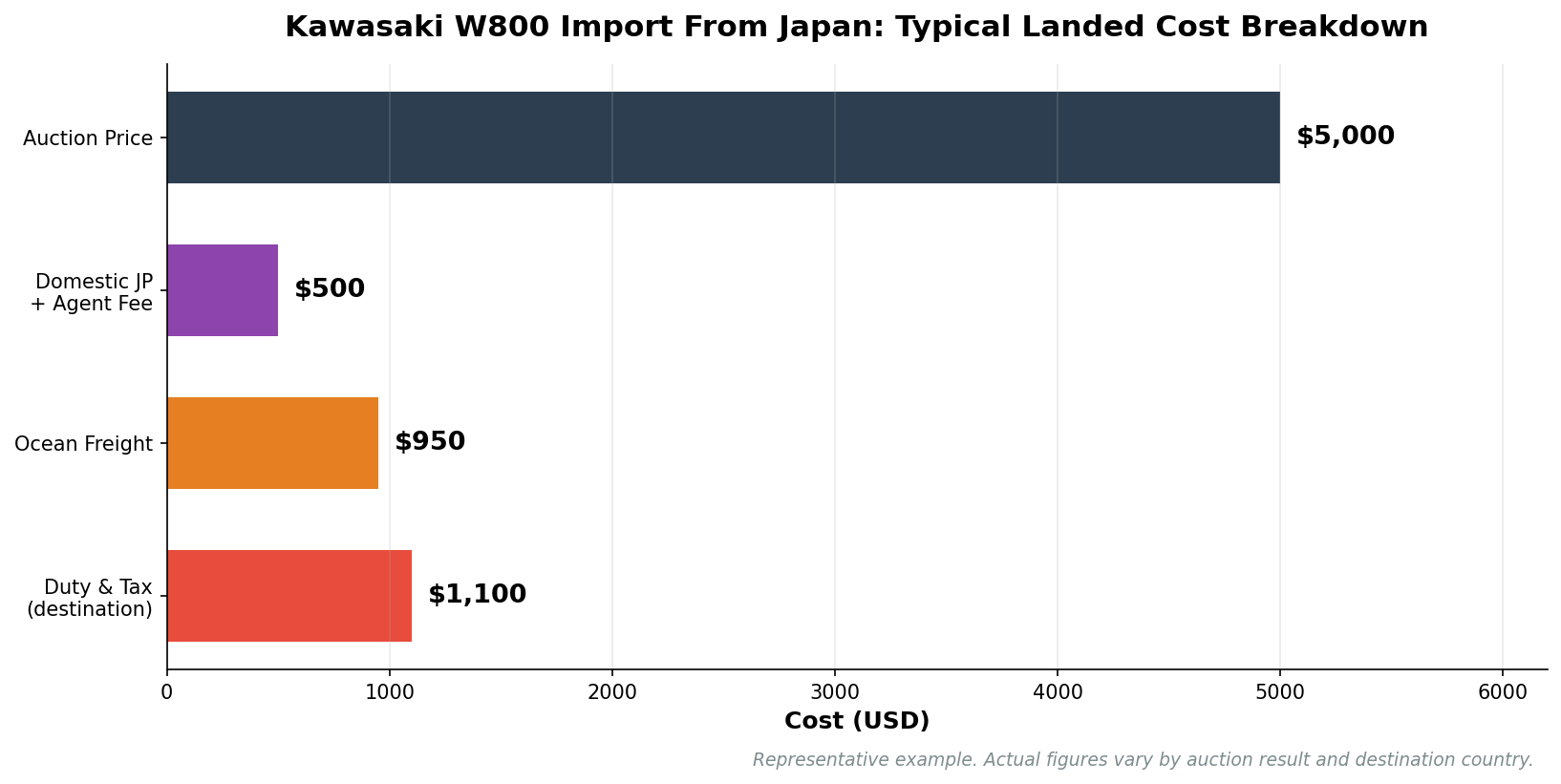
Auction price. Clean, sensible-mileage W800s tend to hammer somewhere around 4,000 to 6,000 USD in Japan depending on year, condition and which run they are from. First-run bikes sit at the lower end; late Cafe and Final Edition models pull more.
Domestic Japan costs and agent fee. Getting the bike from the auction hall to the port, plus your import agent's commission, typically runs a few hundred dollars. This is the fee that buys you a bilingual buyer, an honest reading of the auction sheet, and someone who has actually stood next to thousands of these bikes.
Ocean freight. Crated sea freight from Japan to a major port in the US, UK, Australia or New Zealand generally lands in the 700 to 1,200 USD range depending on destination and whether the bike shares a container.
Duty and tax at home. This is the part that varies most by country, and it is covered in detail in the next section. As a rule of thumb, budget another 10 to 30 percent of the bike's value depending on where you live.
Add it up and a clean W800 commonly lands for meaningfully less than a comparable-condition bike bought retail in a thin local market — and you got to see its condition documented before committing. The chart above shows a representative breakdown; your exact numbers move with the auction result and your destination.
Import rules by country: US, UK, Australia and New Zealand
This is where you have to be honest with yourself about which W you can actually register, because the single most important variable is your country's age rule.
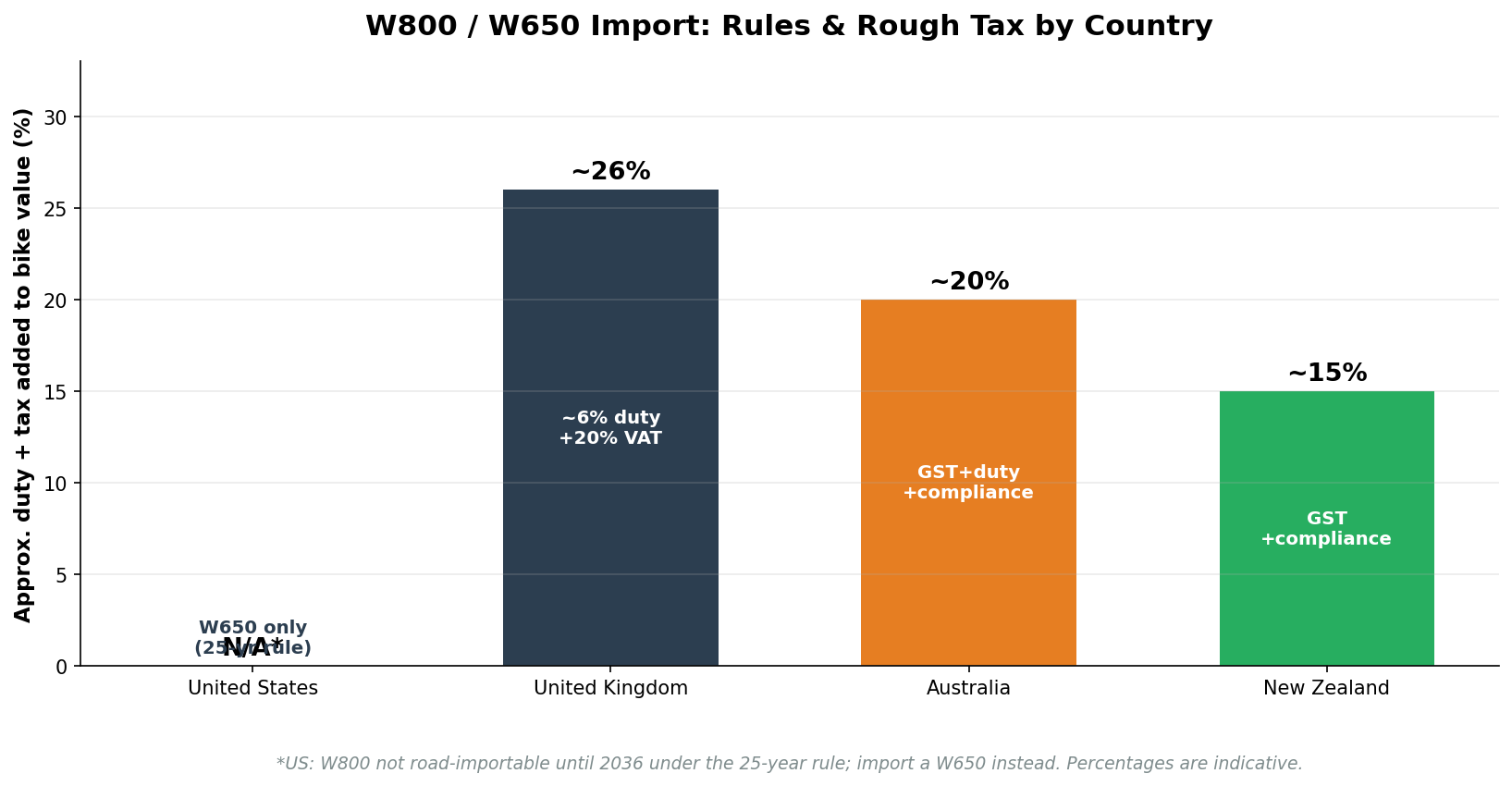
United States — read this carefully. The US 25-year rule is the one that changes everything for W buyers. A motorcycle can be imported freely for road use once it is 25 years old. That means the W650 is your bike: 1999, 2000 and 2001 models are now over 25 years old and fully importable, with later W650 years crossing the line each passing year. The W800 (2011 on) is not US-legal to import for the road until 2036. If you are American and you want a W now, you import a W650, not a W800. Anyone telling you otherwise is selling you a headache.
United Kingdom. No age barrier. Both the W650 and W800 import freely. You will pay import duty (typically around 6 percent on motorcycles) plus VAT at 20 percent on the total, then register through the standard DVLA process with an MOT and, for older machines, potentially an age-related plate. The W is a popular modern classic in Britain, which is exactly why importing a clean Japanese one undercuts the local market.
Australia. Australia allows road bikes over 25 years old in through the simplest pathway, and newer machines through the personal-import and registered-automotive-workshop schemes with more paperwork. In practice a W650 is straightforward; a newer W800 is doable but you will want an agent who knows the current rules and compliance plating. Budget for GST, duty and compliance on top of the bike.
New Zealand. One of the friendliest destinations for Japanese imports, which is why so many JDM bikes end up there. Any age is importable subject to compliance and a certification check for entry. You will pay GST on the landed value and go through a straightforward compliance inspection. The W800 is an easy, popular import here.
The takeaway: UK, Australia and New Zealand buyers can chase the W800 directly. US buyers should target the W650 until 2036. Match the bike to your rules first, then go shopping — not the other way around.
W800 vs Royal Enfield Interceptor 650: the honest verdict
Every single person shopping for a W800 also looks at the Royal Enfield Interceptor 650. So let's have the argument properly, because they are not really the same bike.
On paper the W800 has the bigger engine — 773cc against the Interceptor's 648cc — and about 4 horsepower more, so in a straight line the Kawasaki edges ahead on a highway overtake. The Interceptor fires back on weight: it is roughly 8 kg lighter, which you feel instantly in slow traffic, car parks and tight corners, where it is the friendlier machine.
On price the Interceptor wins outright when both are bought new — Royal Enfield undercuts almost everything. But that is exactly the point of importing. The value case for a used W800 from Japan is that you close the price gap while getting the more expensively engineered bike: real bevel-drive OHC, deeper chrome, and that unmistakable 360-degree beat.
The character split. The Interceptor is the honest budget hero — buy it new, ride it hard, worry about nothing. The W800 is the connoisseur's choice — a bike built with details that cost money and that a spec sheet will never show you. The ZigWheels crew filed the whole thing under a perfect headline when they called the W800 "the best non-British British twin," and that is the nub of it. If you want the most bike for the least money, the Interceptor is unbeatable. If you want the bevel-drive twin that feels like a restored 1965 machine you can actually rely on, only the W will do — and importing is how you get one at a sane price.
How to read a Japanese auction sheet for a W800
The auction sheet is your superpower, and it is the reason importing beats buying blind off a classifieds site. Every bike that crosses a Japanese auction block is graded by an independent inspector, and once you can read the shorthand you know more about the bike than most sellers ever tell you.
The overall grade runs on a rough scale where 4 and above is a solid, honest used bike, 4.5 and 5 are genuinely excellent, and 6 or S means nearly new. Anything at 3.5 or below deserves real scrutiny — it is not automatically bad, but something pulled the grade down and you want to know what. On a value-by-condition bike like the W800, chasing a 4.5 or 5 is money well spent.
The condition map is a little diagram of the bike with letter-and-number codes marking every scratch, dent and corrosion spot. For a W800 the map is gold, because it tells you exactly where the chrome or paint has suffered — the very thing that decides this bike's value. A clean map on the tank, mudguards and exhaust is what you are hunting.
The notes are inspector shorthand, often needing translation, covering things like whether the bike has been modified, whether there is rust or oil weeping, and mileage verification. This is precisely where a good agent earns their fee: they read the Japanese, flag the manifold and oil-leak risks from this guide, and tell you honestly whether to bid.
Step-by-step: importing your W800 from Japan
Here is the whole process, start to finish, so nothing surprises you.
1. Fix your target and your rules. Decide W650 or W800, decide your generation, and confirm what your country will actually let you register. US buyers: W650. Everyone else: your pick.
2. Set a realistic total budget. Work backwards from landed cost, not hammer price. Use the breakdown above to know your ceiling before you get excited about a listing.
3. Partner with an import agent. You need someone with access to the Japanese auction network who can bid on your behalf, read sheets, and handle export paperwork. This is what AWA Auction does.
4. Watch the auctions and read the sheets. Multiple W-series bikes come up every week. Be patient, wait for a high-grade example with a clean condition map, and don't fall for the first one you see.
5. Bid with a maximum. Set your top price including all fees and hold to it. There is always another W next week — the supply is deep.
6. Pay, then ship. Once you win, the bike goes from auction hall to port, gets export-cleared and de-registered, and is loaded for sea freight. Crated transit typically takes a few weeks depending on destination.
7. Clear customs and register at home. Pay your duty and tax, complete any compliance or certification your country requires, and title it. Then it is yours.
Pre-purchase inspection checklist
Whether your agent inspects for you or you are reading the sheet yourself, these are the W-specific things that matter most:
Charging voltage — measured at the battery with the engine revving, in the healthy mid-14-volt range. Intake manifold / throttle-body holder — no cracks, recall addressed, idle steady with no hunting. Cam cover — dry, no oil weeping down the fins. Chrome — mudguards, exhaust and tank trim bright and un-pitted, because this is where value lives. Engine cases and bar ends — unmarked, no evidence of a drop. Idle and throttle response — clean pickup with no stutter. Original spec — factory exhaust and airbox unless you specifically want a modified bike, since originality holds value on a classic.
Tick those boxes and you have the bike you actually wanted, not a project that photographed well.
Common mistakes importers make with a W800
Most import horror stories are not bad luck — they are the same handful of avoidable errors. Sidestep these and the process is genuinely smooth.
Buying on the photos, not the sheet. A W800 can be styled to look immaculate in a listing and still hide pitted chrome, a weeping top end or a dropped side. The auction sheet's condition map and grade tell the real story. Never bid on looks alone when a documented inspection is sitting right there.
Ignoring the age rule until it is too late. The number of American buyers who fall in love with a 2019 W800 Cafe before discovering they cannot register it for another decade is depressing. Confirm what your country allows before you shop, not after you have wired a deposit. For US buyers that means W650, full stop.
Underbudgeting the landed cost. The hammer price is maybe two-thirds of the story. People who budget only for the auction result get an unpleasant surprise at the customs and shipping stage. Work from the total landed number from day one.
Chasing the cheapest bike. On a value-by-condition machine, the cheapest W800 at auction is cheap for a reason. Spending a little more for a grade 4.5 example with a clean map is almost always cheaper than "saving" money on a tired bike and then paying to re-chrome, re-gasket and sort the fuelling.
Going it alone. The Japanese auction system is built for the domestic trade, in Japanese, with rules and etiquette outsiders do not know. Trying to bid directly without an agent is how people overpay, misread sheets, or win a bike they did not fully understand. A good agent is not a cost — they are the thing that makes the wholesale price safe to access.
What it is like to live with a W800 day to day
Spec sheets and auction grades tell you what to buy. This tells you what you are actually signing up for.
Around town the W800 is one of the easiest big bikes you can own. The seat is low, the weight carries down low, and the fuelling on the injected bikes is faultless from cold. That fat wedge of low-rev torque means you rarely need to stir the gearbox — pick third and let the twin lug you between lights. It is a genuinely relaxing commuter that happens to look like a museum piece.
On the open road it settles into a cruise around 60 to 70 mph with the twin thrumming happily beneath you. Push past that and the flat handlebars turn you into a sail, and the modest power runs out of enthusiasm, so this is not a motorway missile. Riders who understand what they bought do not care. The W800 rewards B-roads, coast roads and unhurried Sunday miles, not autobahn sprints.
Servicing is refreshingly old-school. Air-cooled means no radiator or coolant to worry about. Valve clearances are checked with the top end accessible, oil changes are simple, and the whole bike is built to be worked on with hand tools in a home garage. Owners regularly report fuel economy in the region of 55 to 65 mpg, which combined with a sensible tank gives a usable touring range. Running costs are low, insurance is gentle, and the parts you replace most are consumables, not engine internals.
The ownership community matters too. The W650 and W800 have a devoted following in the UK, Australia and New Zealand, with active forums and specialists who know every quirk in this guide. When you own one you are plugging into decades of shared knowledge — which is exactly why buying a clean, honest example from the start pays off for years.
Modifying a W800: what works and what to leave alone
The W800 is a favourite base for restomods and cafe builds, and Japan is full of tastefully modified examples that come up at auction. A little guidance before you get carried away.
What works. A quality aftermarket exhaust wakes up the 360-degree soundtrack without hurting reliability, provided the fuelling is set up to match. Bar swaps, seat changes and small cosmetic touches are easy and reversible. Uprated shocks and fork springs genuinely improve a bike whose stock suspension is built for comfort over sport. These are the changes owners rarely regret.
What to think twice about. Aggressive engine tuning fights the whole point of the bike — the W800 was never meant to be fast, and chasing horsepower from an undersquare air-cooled twin is throwing money at the wrong problem. Heavy modification also dents resale, because the buyers who want a W want the classic look. And a poorly fuelled aftermarket exhaust can introduce exactly the part-throttle stutter you were trying to avoid.
Buying a modified W800 from Japan. Plenty of clean, well-executed customs cross the auction block. The rule is simple: a reversible, quality build by a known shop is fine and can be a bargain; a hacked-about bike with cut wiring and mystery parts is a trap. This is another place where reading the auction sheet notes — and having an agent translate them — keeps you out of trouble.
Is a W800 a good long-term investment
Modern classics are a mixed bag as investments, but the W800 sits on the sensible end of it. It is not a speculative asset that will double overnight, and anyone selling you one on that promise is dreaming. What it is, though, is a bike that holds its money unusually well because the thing that drives its value — genuine bevel-drive engineering and honest vintage looks — cannot be faked by rivals and does not go out of fashion.
Two versions stand out for value retention: a mint first-run bike, prized for being the purest, and the Final Edition, prized for being the last. Low-mileage, unmodified, original-spec examples in strong colours are the ones collectors will still want in a decade. Because these bikes were never mass-market hits, clean survivors are genuinely uncommon, and scarcity plus a devoted following is a recipe for stable prices.
Buy a well-kept Japanese-market W800 at a wholesale auction price, keep it standard, keep the chrome perfect, and you own something you can ride for years and sell without losing your shirt. That is about as good as motorcycle economics gets.
W800 buying at a glance
If you remember nothing else, remember this. Buy on condition, not year. Chase a high auction grade with a clean condition map. Check charging voltage, the intake manifold holder, the cam-cover gasket and the chrome. US buyers import a W650, not a W800, until 2036. Everyone else can chase either. And go to Japan for it, because that is where the clean ones are.
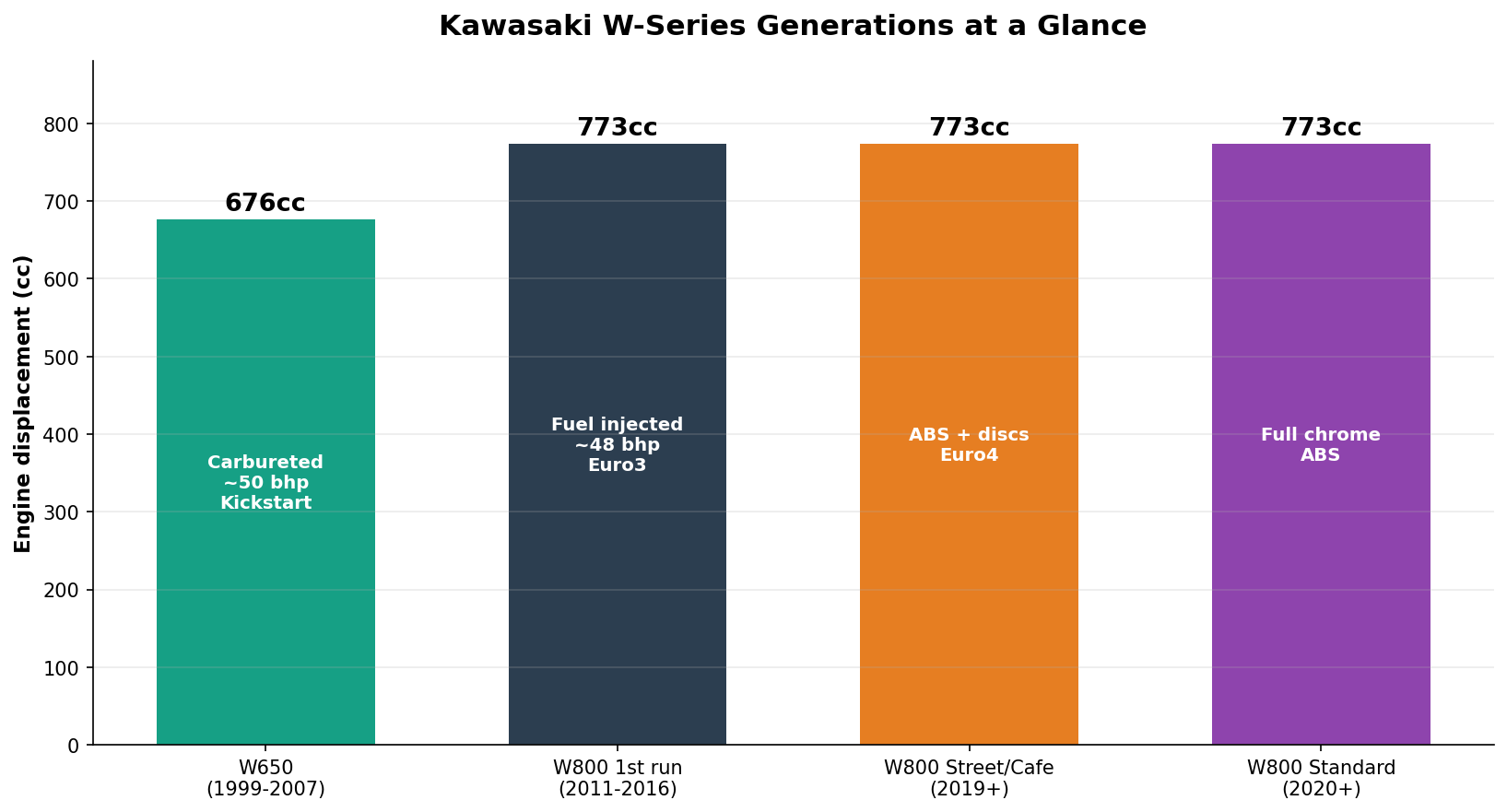
The chart above lays the W-series family out side by side so you can see at a glance where each bike sits on engine size, era and importability. Whichever one matches your rules and your taste, the winning move is the same: buy the best-condition Japanese-market example you can find, at a wholesale auction price, with its condition documented before you commit.
Why import your Kawasaki W800 through AWA Auction
Buying a bike you cannot stand next to, in a language you do not read, from an auction system built for the domestic trade, is exactly where most people get burned. It is also exactly the problem AWA Auction exists to solve.
We give English-speaking buyers direct access to the same Japanese auction network the local dealers use, without the markup and without the guesswork. We read the auction sheets for you, flag the W800-specific risks in this guide, bid to your maximum, and handle export and shipping to your door in the US, UK, Australia or New Zealand. You get the clean, low-mileage Japanese-market W you actually want, at a wholesale price, with its condition documented before you commit.
Browse the W650 and W800 examples crossing the block right now, or tell our team the exact bike you are hunting and we will find it, inspect it, and land it at your door.
See Also
Share this article: