
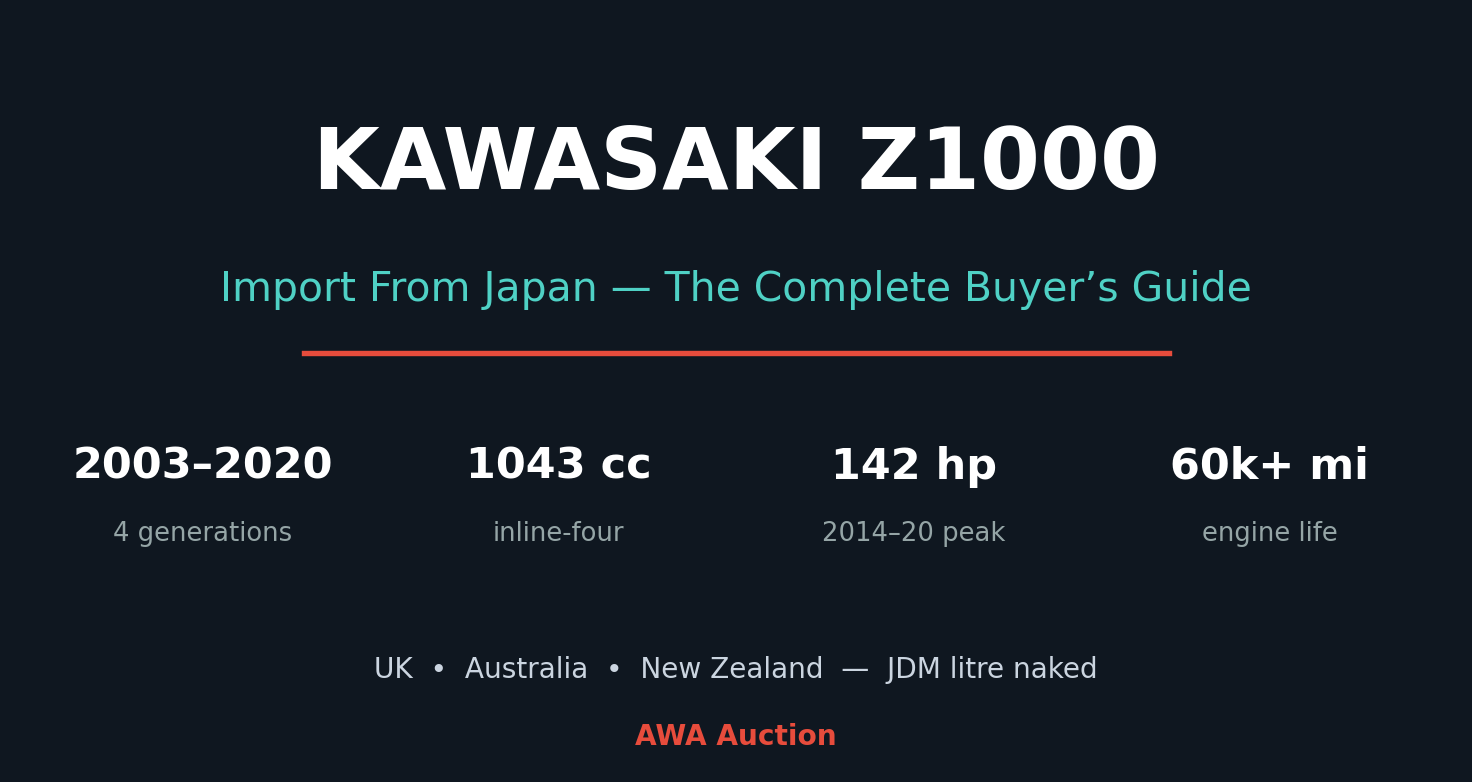
If you want a Kawasaki Z1000 import from Japan, you are chasing one of the most honest big nakeds ever built: a raw, four-cylinder streetfighter with no traction control to hide behind, a snarling 1,043cc motor, and a used price that shames almost everything else in the litre class. Japan is where the cleanest examples live, and this guide walks you through every generation, every known fault, and exactly what it costs to land one on your driveway.
Here is the thing nobody tells you: the Z1000 was Kawasaki's answer to a simple question — what happens if you take a superbike engine, strip off the fairing, and tune it for the real world instead of a lap time? The answer has been on sale since 2003, and the early ones are now absurdly cheap.
One YouTube reviewer, Free Miles MC, literally titled his walkaround of a 2003 car "The King of Used Motorcycles." That video has picked up thousands of views and dozens of comments from riders agreeing that a tidy first-generation Z1000 is one of the best-value big bikes you can buy today. He is not wrong, and by the end of this guide you will understand why.
Who this guide is for: riders in the UK, Australia and New Zealand who can register a modern Japanese import right now, plus US readers who want to understand the 25-year clock before they get their hopes up. We will be honest about that clock later — it is not good news for Americans yet.
Why a Kawasaki Z1000 import from Japan makes sense right now
The litre-naked market is a buyer's market, and the Z1000 sits near the bottom of it on price while sitting near the top on character. That gap is your opportunity.
Think about what you are actually getting. A 1,043cc inline-four that will happily run past 60,000 miles on basic servicing. A chassis that was designed to be hooligan-friendly, not razor-sharp. And a bike that Kawasaki deliberately kept simple — no rider modes, no traction control on most years, just you, a throttle, and a lot of midrange. The reviewer Kwackajack called his Z1000 review "Unfiltered Exhilaration," and that phrase sums up the whole appeal.
Japan is the right place to hunt for one. The domestic market bought these bikes in real numbers, Japanese riders cover low annual mileage, and the country's inspection culture (the shaken system) means machines get looked after. A JDM Z1000 with a genuine 18,000km on the clock and a stack of service stamps is a normal find over there, not a unicorn.
You also dodge the rot. Bikes that have spent their lives being salted through European winters corrode; a garaged Osaka commuter that only saw dry roads does not. When you browse current listings from Japan, you are shopping from a pool that has, on average, been treated far better than the equivalent home-market bike.
Kawasaki Z1000 generations explained: 2003 to 2020
Before you bid on anything, you need to know which Z1000 you are looking at, because "Z1000" covers seventeen years and four very different bikes. Get this wrong and you will pay 2017 money for a 2004 motor. Here is the map.
2003–2006: the original 953cc streetfighter
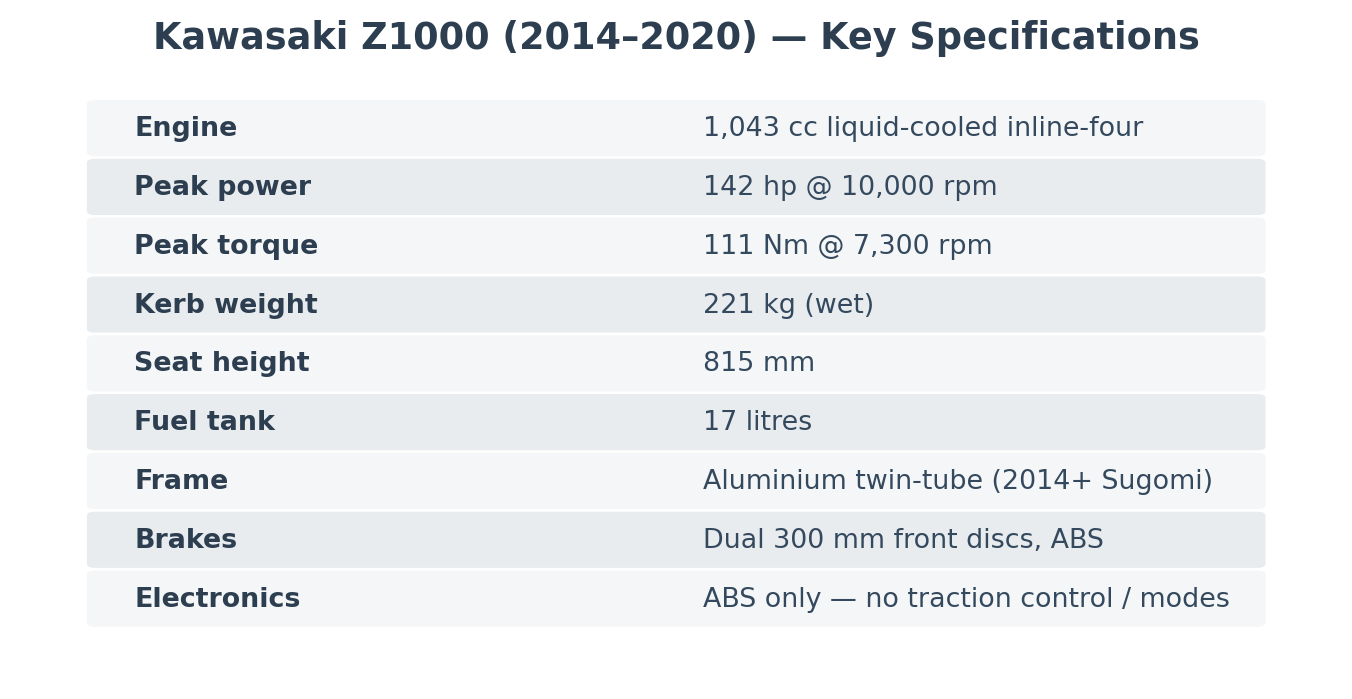
The first Z1000 launched in 2003 to mark 30 years since the legendary Z1. Its 953cc four came from the earlier ZX-9R superbike, retuned for the street to make 127 hp at 10,000 rpm and 96 Nm of torque. Dry weight was around 198kg, seat height 820mm. Those four gun-barrel exhaust cans and the insect-eye twin headlights are unmistakable.
This is the bargain era. Clean examples change hands for the price of a good scooter, and the motor is tough. Just go in with your eyes open about the known faults, which we cover below.
2007–2009: the refined second look
In 2007 Kawasaki gave the Thou slicker bodywork and dialled in more low-end torque without chasing a bigger peak number. Power stayed around the mid-120s but the bike felt fuller lower down. This generation is the sweet spot for buyers who want first-gen prices with fewer teething niggles.
2010–2013: bigger engine, standard ABS
2010 was the big one. Kawasaki ditched the 953cc ZX-9R-based motor for a fresh 1,043cc engine with a 5.1mm longer stroke, lifting output to 138 hp at 9,600 rpm and 110 Nm at 7,800 rpm. The styling got pumped up on steroids, and ABS became standard. This is where the Z1000 became a genuinely modern big naked.
2014–2020: the Sugomi era
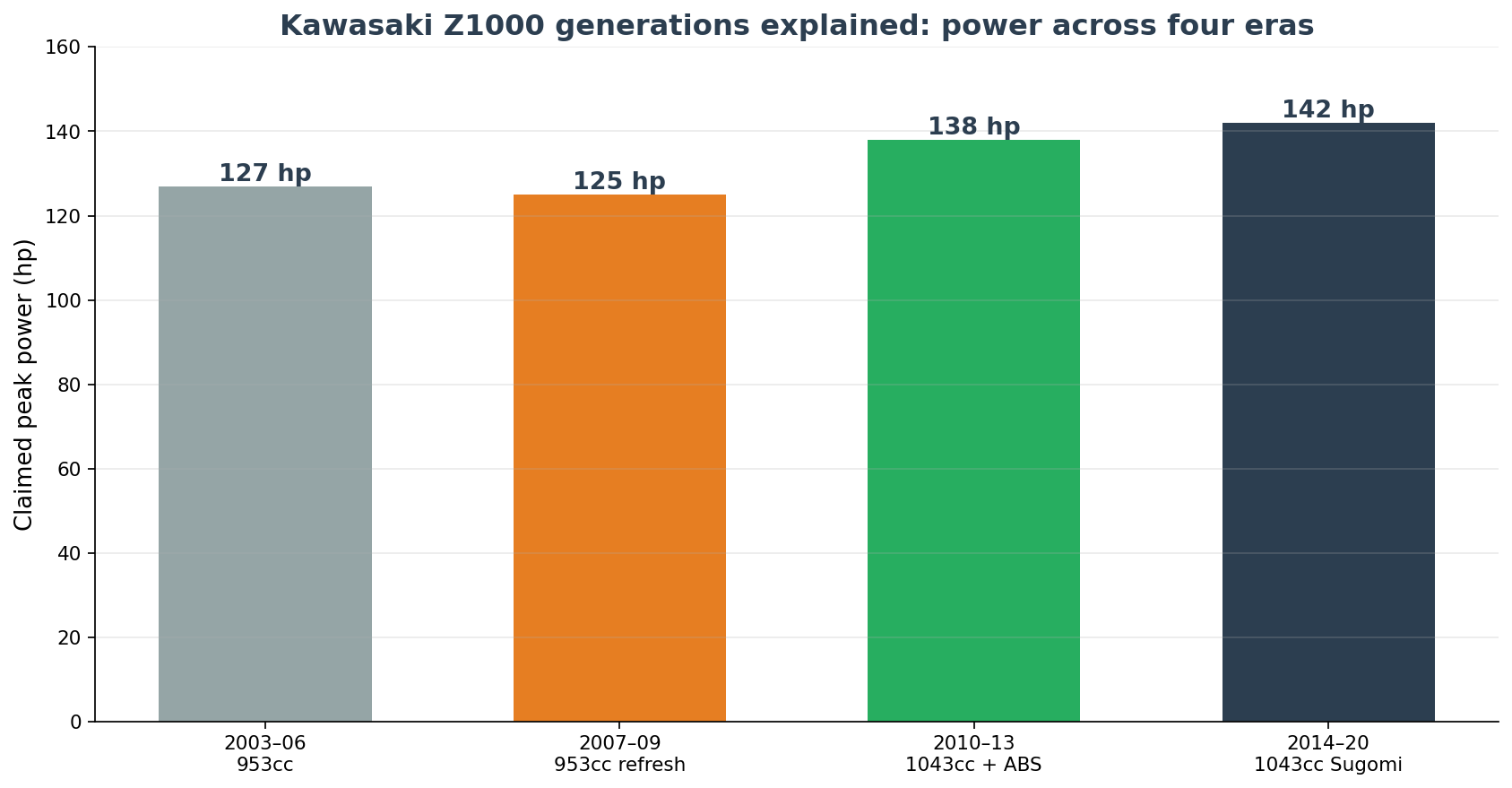
The 2014 redesign gave the Z1000 its aggressive "Sugomi" styling, a new aluminium twin-tube frame, revised engine tuning worth around 142 hp, and a hunched, predatory stance. Kawasaki pitched it as a deliberate statement against the electronics arms race — a characterful four with mechanical directness and, tellingly, still no traction control. You either love that purity or you want the safety net. There is no wrong answer, but know which camp you are in before you buy.
Which Z1000 engine you are actually buying: 953cc vs 1043cc
People obsess over year, but the engine tells the real story. There are two distinct motors in Z1000 history, and they feel different on the road.
The 953cc unit (2003–2009) is descended from the ZX-9R. It is revvy, a little peaky, and rewards you for keeping it spinning. It makes its 127 hp near the top of the tacho, so if you short-shift everywhere it can feel flat. Ride it the way it wants and it sings.
The 1043cc unit (2010 onward) is the one to have if you value real-world punch. That extra stroke fattens the midrange so much that the bike pulls hard from 4,000 rpm without needing a downshift. In group tests against the Suzuki GSX-S1000 and Triumph Speed Triple, testers consistently noted that the Kawasaki had the strongest low-end grunt of the bunch, even if it gave away outright top-end to the Suzuki. That low-down shove is exactly what makes a naked bike fun in the real world, where you rarely see 10,000 rpm anyway.
So the honest summary: if budget rules, the 953cc bikes are a steal and mechanically stout. If you want the definitive Z1000 experience, spend a little more and get a post-2010 1043cc bike. Neither is a mistake.
Kawasaki Z1000 common problems and the years to avoid
No bike is perfect, and pretending otherwise is how people get burned at auction. The Z1000 is fundamentally reliable — that 1043cc four regularly clears 60,000 miles on basic maintenance — but each generation has its party tricks. Here is what to actually check.
Charging system (2003–2006 especially)
The early bikes have a known weakness in the stator and regulator/rectifier. A tired charging system will cook a battery and eventually leave you stranded. On any first-generation Z1000, test the battery health and measure the charging voltage at the terminals before you commit. A healthy system reads around 14 volts at a fast idle. This is the single most important check on an early car.
Loose exhaust headers and stick coils
Owners on the Kawasaki forums repeatedly flag two small gremlins on the 953cc bikes: the header nuts work loose (so check every one is present and tight), and the stick coils built into the spark plug caps can pop loose and cause a misfire. Both are cheap fixes, but a misfiring test ride can scare a buyer off a perfectly good bike — now you know the likely cause.
Headstock and subframe cracks (pre-2014)
There are scattered reports of small cracks around the headstock on early bikes, and the subframe welds are worth inspecting on anything built before the 2014 redesign. This is not an epidemic, but a torch and two minutes looking at the welds is free insurance.
Cam cover oil weep
Some 953cc engines develop a minor oil leak on the left-hand side of the engine from the front of the cam cover. It is usually just a gasket, but factor it into your haggling if you see oil residue there.
The 2010 fuel-injection quirk
A well-viewed YouTube diagnosis by a mechanic called Jeff — "2010 Kawasaki Z1000 Engine Management / FI Issues" — walks through a fuelling and engine-management fault on the first year of the new 1043cc bike. It is not a widespread killer, but the 2010 model year was the debut of a brand-new engine and injection setup, so buy one with a clean fault-code history. If a seller cannot clear the check by showing you the dash lights cycling properly on start-up, walk.
The 2010 front brake hose recall
Kawasaki issued a factory recall in 2010 to replace the front brake hose, because under extreme suspension compression the line could contact the brake disc. Any bike from that era should have had the recall work done years ago — but confirm it, because an unrectified safety recall is a genuine red flag, not a bargaining chip.
Valve clearances and gummy throttle bodies
Across all generations, the valve clearances need checking around the 15,000-mile mark, and throttle bodies gunk up if the previous owner ran a lot of ethanol-blended fuel and never cleaned them. A bike with a documented valve-clearance service is worth paying more for; a bike that stumbles at small throttle openings probably just needs the bodies balanced and cleaned.
So which years do you actually avoid? There is no cursed model year. The honest answer is that the 2003–2006 bikes demand a charging-system check, and the 2010 model deserves an extra look at its fuelling and recall history. Everything else comes down to how the individual bike was maintained — which is exactly why buying from Japan, with its paper-trail culture, tilts the odds in your favour.
Don't buy the wrong Kawasaki: Z1000 vs Z1000SX vs Z900
This section will save you from the most expensive mistake in the whole Z range: buying a bike that shares a name but is not the machine you actually wanted. Three models get muddled constantly, so let us untangle them.
The Z1000 is the naked streetfighter this guide is about — bars-up, no fairing, raw and simple.
The Z1000SX (sold as the Ninja 1000 in some markets) is a completely different proposition: same engine family, but with a full fairing, a taller screen, pannier mounts, and a sport-touring focus. It also got traction control and rider modes years before the naked did. If your plan involves motorways, luggage and long days, the SX is the bike you want — do not accidentally buy the naked Z1000 and then complain about wind blast. They look similar in a thumbnail; they are not the same bike.
The Z900 is the smaller, newer sibling. It arrived in 2017 with an 948cc four making around 125 hp, and it is lighter and cheaper to insure. Plenty of riders cross-shop a late Z900 against an early 1043cc Z1000 at similar money. The Z1000 gives you more midrange muscle and that flagship feel; the Z900 gives you lower weight and lower running costs. If you want to weigh those two directly, our Kawasaki Z900 buying guide covers the smaller bike in the same depth.
Here is the rule of thumb: naked and simple, you want the Z1000. Faired and touring, you want the Z1000SX. Lighter and cheaper, you want the Z900. Confirm the exact model in the auction sheet photos before you place a single bid — the fairing, or lack of it, is the giveaway.
Can you import a Kawasaki Z1000 to the US, UK, Australia or NZ?
This is where honesty matters more than hype, because the answer depends entirely on where you live.
United Kingdom
The UK is the easiest big market for this. There is no age bar. You can import any Z1000, pay the duty and VAT, get it through an IVA or registration inspection where required, and ride it. A JDM Z1000 with mph-friendly work and a UK registration is a straightforward project.
Australia and New Zealand
Both countries allow motorcycle imports, and New Zealand in particular has a long, well-trodden path for Japanese bikes with established compliance workshops. You will deal with compliance and roadworthy checks rather than a blanket age ban, so a clean Z1000 of almost any year is realistic. Rules do shift, so confirm the current compliance requirements before you buy.
United States: the bad news
Here is the part American riders do not want to hear. The US 25-year rule means a bike can only be federally imported for road use once it is 25 years old. The very first Z1000 is a 2003 model, so it does not become eligible until 2028. In 2026, that means no Z1000 can be legally imported for US road use yet — not one year of it. You can bring one in as a track-only or off-road machine, or wait for the 2028 window, but the honest position is that the road-legal import route is still a couple of years away for US buyers. We would rather tell you that now than after you have wired a deposit.
If you are in the UK, Australia or New Zealand, though, the door is wide open — and the bikes waiting behind it are cheap. When you are ready, our team can help you check import eligibility for your country before you commit, and you can always browse the current Kawasaki stock while you decide.
What a JDM Kawasaki Z1000 costs to import from Japan
Let us talk real numbers. The auction price is only the start; the landed cost is what matters. For a clean 2010–2013 1043cc Z1000 bought at a Japanese auction, a worked UK example looks roughly like this.
- Auction hammer price: the bike itself, often £2,500–£4,000 for a tidy 1043cc car
- Japan-side fees: auction fees, domestic transport and export paperwork
- Sea freight: shipping the crate to your nearest port
- Import duty and VAT: calculated on the bike value plus shipping when it lands
- Registration and compliance: inspection, any mph work, and plating
Add it all up and a first-generation 953cc bike can land in the UK for a shade over the price of a good used commuter, while a clean Sugomi-era 2014+ bike sits higher up the range. The price chart below shows the typical used values by generation to help you judge whether an auction result is a bargain or a bidding-war casualty.
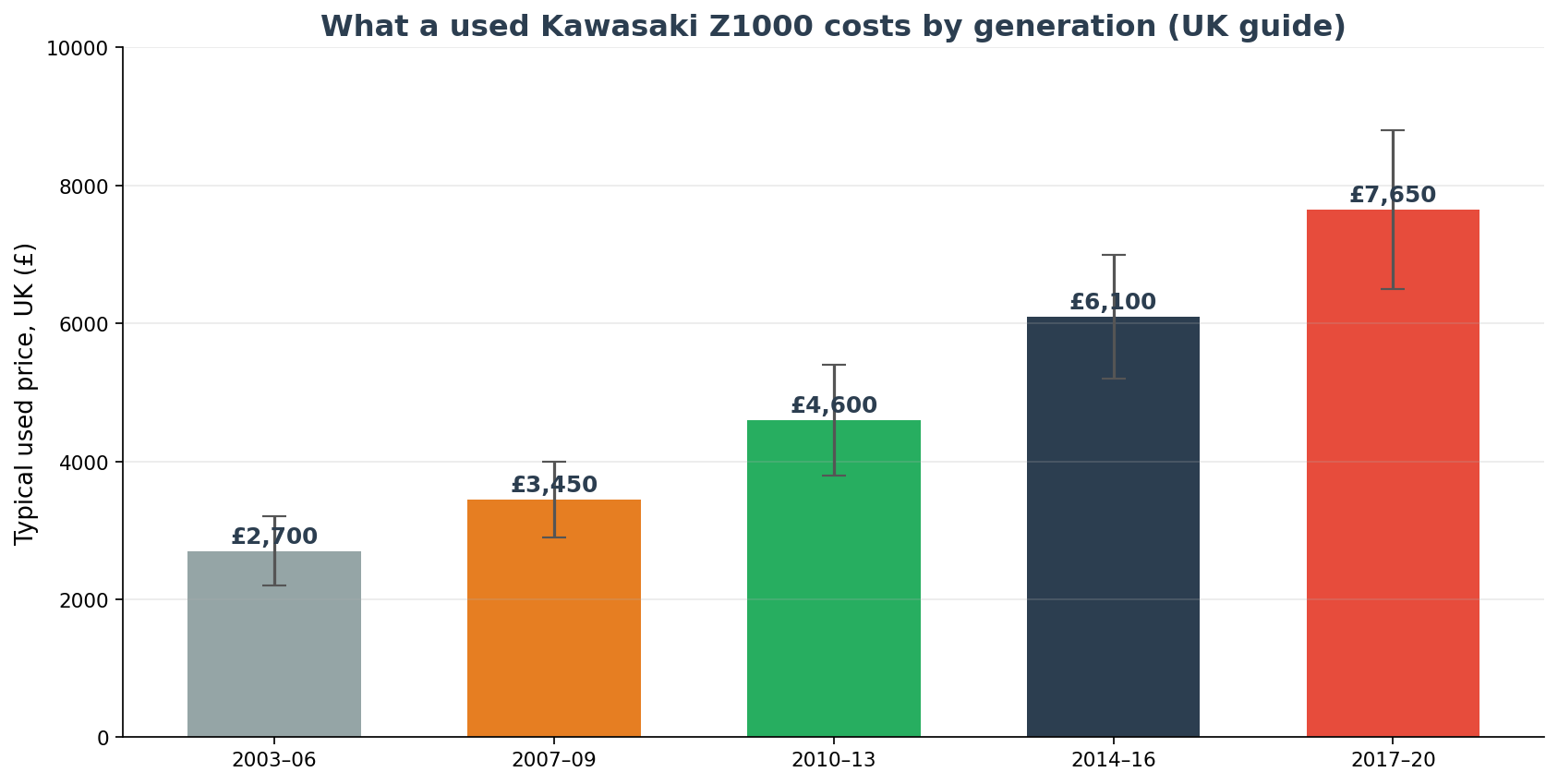
The trick is discipline. Set your maximum landed budget before the auction, work backwards to a hammer-price ceiling, and stick to it. The whole reason to import a Z1000 is value; overbidding in the heat of a live auction throws that advantage away.
How the Z1000 stacks up against rival litre nakeds
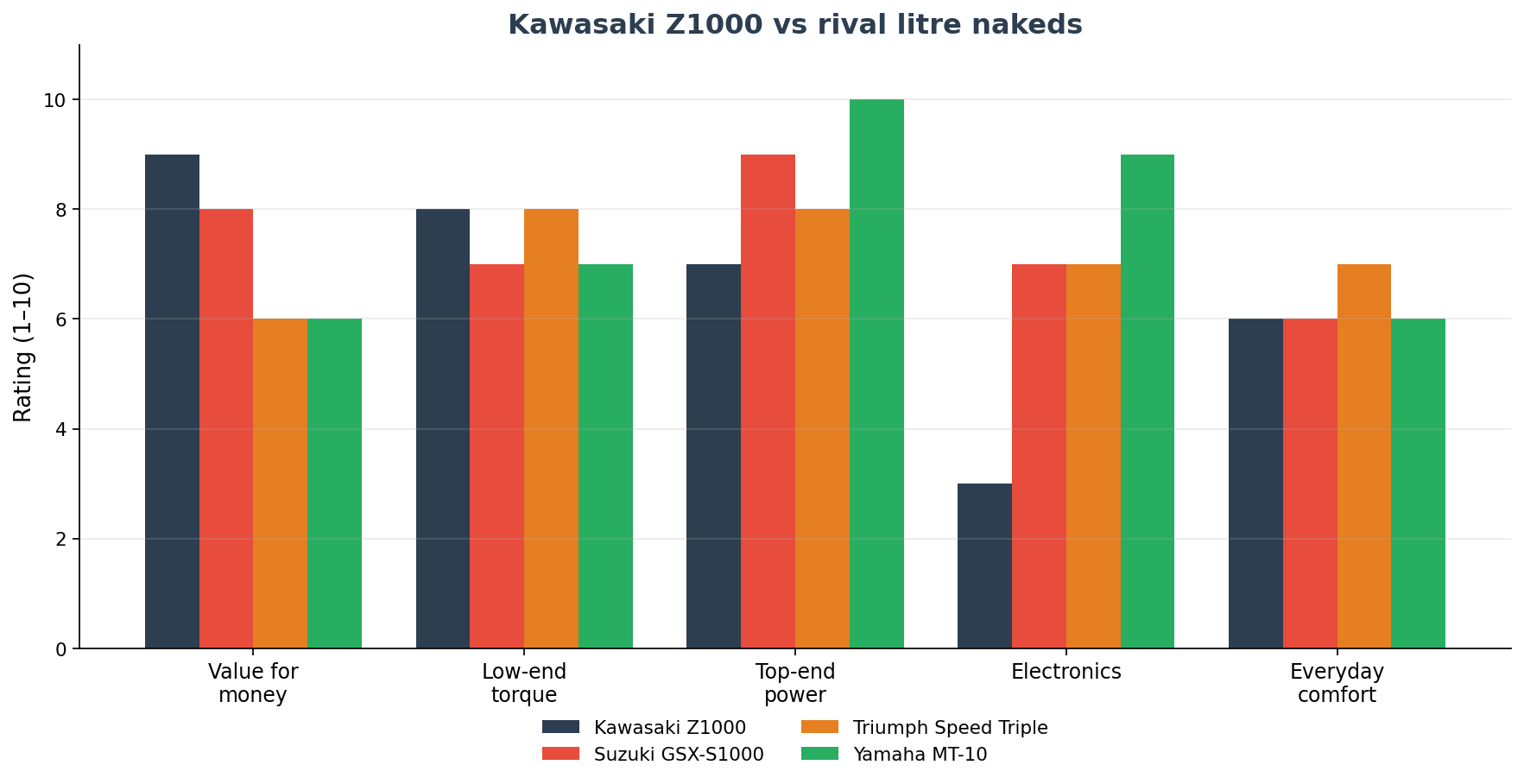
You are not buying in a vacuum. The Z1000's natural rivals are the Suzuki GSX-S1000, the Triumph Speed Triple and the Yamaha MT-10, and each has a clear personality. Group tests over the years land on a consistent story.
The Suzuki GSX-S1000 has the sharper handling and the stronger top-end rush — its K5-derived motor makes real power up high. The Yamaha MT-10 is the technology and top-end king, with the crossplane crank drama and the most electronics. The Triumph Speed Triple splits the difference with its three-cylinder surge and a plusher ride.
Where does the Kawasaki win? Two places: value and low-end torque. The Z1000 undercuts all three on the used market, and its 1043cc four delivers the fattest midrange of the group. What it gives up is electronics — most years have ABS and nothing else, where the MT-10 and later Suzukis pile on traction control and modes. If you want a rider aid to catch you, the Z1000 is not your bike. If you want an honest, muscular four for streetfighter money, it is the value pick every time. The scorecard below lays it out.
Popular Kawasaki Z1000 modifications and upgrades
Most competitor buying guides stop at the spec sheet. That is a mistake, because the Z1000 is a modding icon, and knowing the popular upgrades helps you both spot a well-sorted used bike and plan your own build. Here is what the community actually fits.
Exhaust. The aftermarket loves this bike. Slip-ons from Akrapovic, SC-Project and Yoshimura are everywhere, waking up the four-cylinder howl and shedding weight. A tidy slip-on on a used bike is a plus; a cheap no-name can with a hacked baffle is a bargaining point.
Suspension. The single most common owner complaint across every generation is the suspension and the seat. Riders routinely fit uprated fork internals, aftermarket rear shocks and a gel or reshaped seat. If the bike you are eyeing already has quality suspension work done, that is real money you are not spending later.
Ergonomics and screens. Owners frequently add a small flyscreen to cut wind blast, plus bar risers or heli-bars for comfort. Because the naked Z1000 has zero wind protection, these tweaks transform a longer ride.
Protection. Tail tidies, frame sliders, radiator guards and levers are near-universal. Frame sliders in particular are a good sign — they tell you the previous owner cared about protecting the bike from a low-speed tip-over.
The lesson for a buyer: sensible, quality modifications are a green flag that an enthusiast owned the bike. Wild, cheap, badly-fitted mods are the opposite. Judge the taste of the modifier, not just the mod.
Mileage, longevity and running costs
Forget the myth that a big four is worn out at 30,000 miles. The Z1000's inline-four is one of the tougher motors in its class, and well-kept examples routinely pass 60,000 miles with nothing more than regular oil changes, chain care and valve checks.
What actually matters is not the odometer number but the service history behind it. A 40,000-mile Z1000 with a full stack of stamps and a recent valve-clearance service is a better buy than an 12,000-mile bike that has sat neglected in a shed with old fuel turning to varnish in the throttle bodies. This is precisely why Japanese auction bikes, with their documented histories and inspection culture, are such a smart hunting ground.
Running costs are reasonable for a litre bike. Expect mid-40s mpg if you are not permanently pinned, chain-and-sprocket sets at the usual intervals, and tyres that last a sensible distance because the Z1000 is a torque-led bike, not a rev-happy tyre-shredder. Insurance sits below the more exotic nakeds because the Z1000 is seen as a sensible, established model rather than a hyper-naked.
How to inspect a used Z1000 before you bid
You will usually be buying at auction from photographs and an inspection sheet, not a test ride, so your eyes and the paperwork do the work. Run this checklist on every bike.
- Charging system: on 2003–2006 bikes, treat the stator and reg/rec as guilty until proven innocent. Look for a fresh battery and any mention of charging work.
- Exhaust headers: confirm all header nuts are present, especially on the 953cc bikes.
- Frame and subframe: on pre-2014 bikes, check the headstock area and subframe welds for cracks in the sheet photos.
- Oil weep: look for residue on the left front of the engine near the cam cover.
- Recall and fault history: for the 2010 bike, confirm the brake-hose recall was done and the FI history is clean.
- Service records: the shaken and maintenance stamps are gold. A documented valve-clearance service near 15,000 miles is worth paying for.
- Crash and mod evidence: mismatched bodywork, scraped bar ends and cheap exhaust hacks tell a story. Frame sliders and quality parts tell a better one.
If reading a Japanese auction sheet feels like decoding hieroglyphs, that is normal — the grades and inspector notes take practice. This is exactly the kind of thing a good agent handles for you, translating the sheet and flagging the risks before you bid.
How AWA Auction helps you import a Kawasaki Z1000
Bidding at a Japanese auction from another country is not something you want to do blind. That is where we come in.
AWA Auction gives you access to the same Japanese auction houses the domestic dealers use, with English support at every step. We translate the auction sheets, inspect condition, bid on your behalf to your ceiling, handle export paperwork and freight, and get the bike moving toward your port. You get the value of buying at source without the language barrier or the guesswork.
Ready to find yours? Browse current Kawasaki listings to see what is coming through the auctions, or contact our team to set your budget and let us hunt down a clean Z1000 for you. Bring us the generation you want and the landed price you can stomach, and we will do the rest.
What the Kawasaki Z1000 is actually like to ride
Specs on a chart only tell you so much. What you really want to know is how the bike feels when you turn the key, and here the Z1000 has a distinct personality that separates it from its rivals.
Fire up a 1043cc bike and the first thing you notice is the induction snarl. This is a proper inline-four with attitude, and Kawasaki tuned the airbox and intake to make sure you hear it. Kwackajack's review channel racked up nearly 50,000 views on a single Z1000 walkaround precisely because the sound and the delivery are the story. Riders do not buy this bike to be sensible; they buy it because it makes them grin at 5,000 rpm in second gear.
The riding position is aggressive-upright. You sit in the bike with a slight forward lean over wide bars, which gives you real command for muscling it through town and backroads. It is not a sport-tourer stretch and it is not a cruiser slouch — it is the classic streetfighter stance that makes the bike feel like a weapon at commuting speeds.
The trade-off, and every honest owner mentions it, is comfort on longer runs. With no fairing and a firm stock seat, motorway miles beat you up. Wind pressure at 80 mph pulls at your chest and the seat starts to make itself known after an hour. This is not a criticism of the bike so much as a reminder of what it is: a fast, raw naked, not a mile-muncher. If you want to cover 300-mile days, you either fit a screen and a better seat, or you buy the faired Z1000SX instead. We told you that distinction would matter.
On a good road, though, the Z1000 is in its element. The fat midrange means you can leave it in a tall gear and surf the torque out of corners without constant gear changes, and the chassis is stable and confidence-inspiring rather than nervous. It flatters an average rider and still entertains a fast one. That breadth is a big part of why the model survived for seventeen years.
Who should buy a Kawasaki Z1000, and who should not
Let us be blunt, because a buying guide that pretends every bike suits everyone is useless.
Buy a Z1000 if you want a characterful, torquey litre naked for the least money in its class; if you value a bombproof engine and simple mechanicals over a screen full of electronics; if most of your riding is commuting, backroad blasts and the occasional weekend away; and if you like the idea of a bike that rewards throttle discipline rather than doing the thinking for you. It is a superb second big bike, or a first big bike for a rider who already has real experience and respects the power.
Think twice if you are a brand-new rider stepping straight onto a 140 hp naked with no traction control — that is a lot of bike to manage in the wet, and a Z650 or Z900 is a smarter starting point. Think twice too if your riding is dominated by long motorway slogs, where the lack of wind protection will wear you down and the Z1000SX or a dedicated sport-tourer will serve you far better. And if you specifically want the latest rider aids, cornering ABS and a colour TFT dash, the Z1000's deliberately analogue nature will frustrate you.
Match the bike to your riding and the Z1000 is one of the most satisfying value buys in motorcycling. Force it into a role it was never built for and you will be the owner writing a grumpy forum post about the seat.
Buying steps: from auction to your driveway
Here is the whole process in plain order, so you know what you are signing up for when you import a Kawasaki Z1000 from Japan.
- Step 1 — Decide the generation and budget. Pick your engine (953cc bargain or 1043cc muscle) and set a firm landed-cost ceiling.
- Step 2 — Get access to the auctions. You need an agent with membership at the Japanese auction houses; you cannot bid directly from abroad.
- Step 3 — Shortlist and read the sheets. Filter for the years and grades you want, and have every auction sheet translated and assessed.
- Step 4 — Bid to your ceiling. Your agent bids on your behalf. Discipline wins here; walk away from bidding wars.
- Step 5 — Pay, export and ship. Settle the invoice, and the bike is de-registered, crated and loaded for sea freight.
- Step 6 — Clear customs and comply. Pay duty and taxes on arrival, then complete the inspection and registration your country requires.
- Step 7 — Ride. Fit that flyscreen and better seat you were warned about, and enjoy one of the best-value big nakeds on the road.
None of this is hard when someone who does it every week is handling the Japan side for you. The value is real, the bikes are clean, and the only genuine barrier — for anyone outside the US — is simply knowing where to look. If you want a hand, talk to our import team and we will point you at the right bikes.
See Also
Share this article: