
There is a YouTube short with 4.6 million views of a 70-year-old Japanese TV legend, Tokoro George, climbing onto a Kawasaki Zephyr 750RS and grinning like a teenager. He waves off the fancy talk about tank badges and original paint with one line: ride what you think looks cool. Scroll the comments and the same sentence shows up over and over from people who actually owned one — light, easy, faultless, and "this was my big-bike license training bike." That is the bike a Kawasaki Zephyr import from Japan puts in your garage, and it is the reason this 1990s air-cooled standard refuses to die.
Here's the thing nobody tells you up front: outside Japan, the Zephyr was always a bit-part player. Kawasaki sold a few in Europe and a handful elsewhere, but the deep inventory — the clean 750RS models, the twin-plug 1100s, the home-market 400s — all stayed in Japan. So if you want a good one, you import a Kawasaki Zephyr from Japan, from the same weekly auctions where these bikes have been trading hands for thirty years.
That's exactly what we do. This guide covers the whole family (400, 550, 750 and 1100), which one is actually worth chasing, what it's like to live with, what one really costs landed in your driveway, the faults that separate a clean bike from a corroded money pit, and the import rules for the US, UK, Australia and New Zealand.
Let's get into it.
What Is the Kawasaki Zephyr (And Why It's Back)
The Kawasaki Zephyr is a range of retro-styled, air-cooled, naked standard motorcycles that Kawasaki launched in 1989. No fairing, no liquid cooling, no plastic — just an upright bike with a round headlight, a teardrop tank and an air-cooled inline-four hanging out in the wind. Kawasaki named it after Zephyrus, the Greek god of the west wind.
To understand why the Zephyr matters, you have to remember what 1989 looked like. The whole industry was drowning in race-replica plastic — fully faired rockets covered in decals. Kawasaki zigged. They reached back to the 1972 Z1 and the air-cooled Z-series that built the company's name, and built a modern bike that looked and felt like that golden era. The press in Japan literally called it "the rebirth of the air-cooled Z," and it became a runaway hit. The Zephyr is widely credited with kicking off the entire Japanese "neo-retro" naked boom of the 1990s — every modern retro standard you can buy today traces a line back to this bike. The full model history is well documented on the Kawasaki Zephyr Wikipedia page if you want the deep lore.
Here's the irony. The Zephyr was a neo-classic — a new bike dressed as an old one. Now it's just a classic, full stop. As one Japanese commenter put it under a restoration video, "when the Zephyr came out it was a neo-classic, now it's a proper classic… which means I'm old too." These bikes are 25 to 35 years old. They have crossed the line from "used bike" to "modern classic," and the prices, the demand, and the import rules all reflect that.
If you want to see what clean Japanese-market stock looks like right now, our current listings come straight from the auctions we bid in every week.
The Zephyr Range: 400, 550, 750 and 1100 (Which One to Import)
Buy the wrong Zephyr and you'll be hunting parts on Japanese auction sites at 2am. Buy the right one and you've got one of the great air-cooled nakeds ever built. Here's the family, stripped of the trainspotter detail.
Kawasaki Zephyr 400 — The Original (and the JDM One)
The 400 came first, in 1989, and it's the purest expression of the idea. A 399cc air-cooled inline-four built for Japan's 400cc license tier, it makes around 46 bhp and revs hard for its size. In 1996 it became the Zephyr χ ("Chi"), upgraded from a two-valve to a four-valve head for a bit more punch and a longer life — the χ stayed in Japanese showrooms well into the 2000s. The 400 was a Japan-only bike, which makes it the most authentically JDM Zephyr you can buy, and because Japan's 400 class was fiercely competitive, these are jewel-like little machines built to a standard the rest of the world never got.
For US buyers it's a 25-year-old import that's now fully legal. For Australia and New Zealand, a 400 is the one to look at if you're on a learner license, because the bigger Zephyrs are well outside LAMS power limits. The catch: a 400 inline-four is busy on the motorway and needs revving to feel quick. In town and on back roads it's a delight; on a long highway slog it asks you to work for it.
Kawasaki Zephyr 550 — The Forgotten Middle Child
The 550 arrived in 1991 with a 553cc version of the air-cooled four, making around 50 bhp. It was aimed mostly at European markets as a do-everything middleweight, and it's genuinely good — light, friendly, cheap to run. But it sold in smaller numbers and was discontinued by the late 1990s, so it's the rarest to find at auction and has the thinnest parts support. A lovely bike, but not the one most importers should chase first.
Kawasaki Zephyr 750 — The Sweet Spot
This is the one most people mean, and the one we import most. The Zephyr 750 uses a 738cc air-cooled DOHC inline-four descended directly from the legendary Z650/Z750/Z900 engine family. It makes a genuine 72 bhp at 9,500 rpm and 54 Nm of torque, which in a light, simple naked is plenty for real-world riding. According to Motorcycle News' Zephyr 750 review, it's the Zephyr that best balances character, usability and that classic Z silhouette.
The 750 also had the longest life of the lot — it went into production around 1990 and Kawasaki built it all the way to 2006, roughly seventeen years. The version to know is the 750RS, which swapped the cast wheels for classic wire-spoke rims and leaned even harder into the old-Z look. That's the bike Tokoro George was raving about, and it's the connoisseur's pick.
Kawasaki Zephyr 1100 — The Flagship
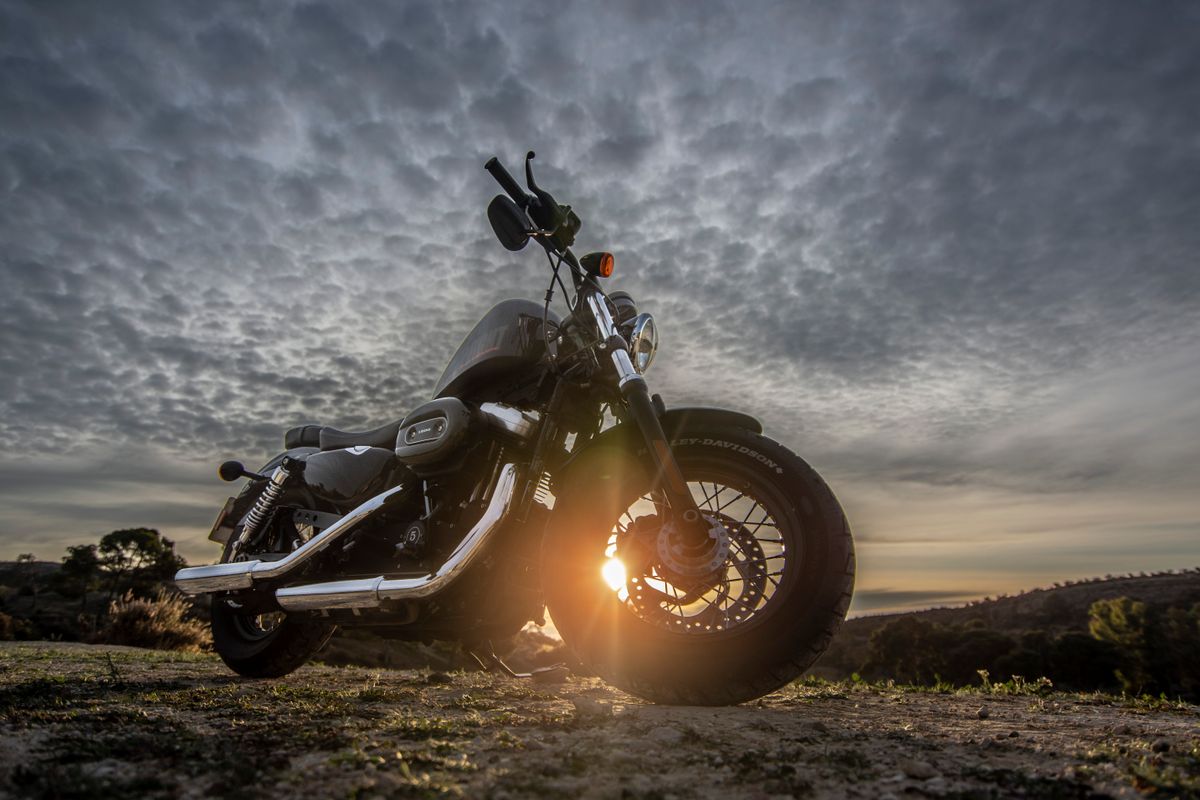
If the 750 is the sweet spot, the 1100 is the statement. Launched in 1992 after the 550 and 750 proved there was an appetite for air-cooled nakeds, the Zephyr 1100 runs a 1,062cc air-cooled DOHC inline-four whose roots trace back through the GPz1100 to the original Z1000. It makes around 93 bhp and a fat 89 Nm of torque, and it's the only Zephyr built with two spark plugs per cylinder for cleaner, smoother combustion.
The 1100 is the bike for riders who want the full big-air-cooled-Z experience — lazy torque, that deep four-cylinder thrum, and presence for days. It's heavier and thirstier than the 750, and production ended around 1996, which means every single Zephyr 1100 is now old enough to import into the US with zero federal drama. For a lot of buyers chasing that 1970s superbike feeling with 1990s reliability, the 1100 is the holy grail of a Kawasaki Zephyr import from Japan.
One more name to know: when the Zephyr era wound down, Kawasaki replaced it with the ZRX line (ZRX400, ZRX1100 and later ZRX1200), the Eddie Lawson-inspired bikes with the bikini fairing. If you cross-shop a Zephyr against a ZRX at auction, remember the Zephyr is the purer naked-retro statement; the ZRX is sportier and a few years younger.
The short version: learner or pure-JDM collector, get a 400. Best all-rounder, get a 750 (and pay extra for a clean 750RS). Maximum presence and torque, get an 1100. Almost everyone is happiest on the 750.
What a Kawasaki Zephyr Is Actually Like to Ride and Own
Spec sheets don't explain why people fall this hard for a 1990s standard, so let the owners explain it. That 4.6-million-view clip of Tokoro George isn't popular because of the riding — it's popular because a wealthy 70-year-old gets on a 30-year-old Kawasaki and is visibly, uncomplicatedly happy. The most-liked comment underneath says it best: it's not about showing off, it's about riding the bike you think looks cool.
Dig through the rest and a consistent picture emerges. Owners describe the Zephyr as light, easy to handle, and forgiving — one rider who kept a 750RS for years called it "faultless" and pointed out that you can legally use all of its performance on a public road, which you can't say about a modern superbike. Several mention that the 750 was a common big-bike license training machine in Japan, which is the highest praise a bike can get for being approachable: instructors trusted nervous beginners on it all day long.
That's the riding character — a torquey, mechanical, analog experience with no electronics between you and the engine. You feel the air-cooled four warm up, you hear the cam chain and the intake, you shift because you want to, not because a computer told you to. For riders coming off plastic-wrapped modern bikes, it's a revelation. For riders who remember the 1970s and 1980s, it's a time machine.
The ownership side is more honest. These are old bikes, and the enormous restoration videos — a three-hour, 2.8-million-view full rebuild of a Zephyr 400, plus a 1.3-million-view engine teardown — exist precisely because condition is the whole game now. One Japanese owner summed up classic-bike ownership with a line that translates perfectly: "old bikes and mistresses both cost money." A clean, sorted Zephyr is cheap to run and a joy to own. A neglected one is a hobby with a fuel tank. Which is exactly why where and how you buy matters so much.
Why Import a Kawasaki Zephyr from Japan?
Simple: Japan is where the good ones are. Kawasaki built the Zephyr primarily for the home market, sold the most there, and Japanese owners kept them in a way that still surprises foreign buyers.
Three reasons Japan beats your local classifieds. First, volume and choice. On any given week there are dozens of Zephyrs flowing through the Japanese auction system — every variant, every color, every condition tier. Your local market gets one tired 750 a year, if that. Second, condition. Japan's strict shaken inspection regime, lower average mileage, and a culture of meticulous maintenance mean home-market bikes are often dramatically cleaner than the same model that's been rotting in a British shed since 1998. Third, originality. Because the Zephyr is a cult bike in Japan, a lot of them have been preserved or sympathetically restored rather than chopped up — exactly what you want in a modern classic.
There's a fourth reason that's less obvious: the auction sheet. Every bike that goes through a Japanese auction gets inspected and graded by a neutral third party, with a condition score and a diagram showing every scratch, dent and rust spot. For a 30-year-old air-cooled bike where condition is everything, that independent inspection is worth its weight in gold — it's the difference between buying blind off a blurry photo and buying with a professional's eyes on the metal. We'll come back to how to read one.
The flip side is that bidding at a Japanese auction is not something you can do from your sofa in Sydney or Seattle. The auctions are trade-only, conducted in Japanese, settled in yen, and they require a registered bidder, export paperwork, and a freight chain. That's the gap an export agent fills. Talk to our team and we handle the bidding, the paperwork and the shipping; you pick the bike.
How a Kawasaki Zephyr Import from Japan Actually Works
People imagine importing is some mysterious black art. It isn't. It's a sequence of steps, and once you've seen the whole chain laid out it stops being scary.
Step 1: Find the Bike
You tell us the target — say, a 1996 Zephyr 750RS in green, under 30,000 km, auction grade 4 or better. We watch the auction feeds (USS, BDS, JBA and the rest) and flag candidates as they come up. Hundreds of bikes list every week, so the right one usually appears within days.
Step 2: Read the Auction Sheet and Bid
Before bidding we translate and assess the auction inspection sheet — the grade, the corrosion map, the notes about originality and modifications. If the bike checks out, we set a maximum bid with you and bid on your behalf at the live auction. You only pay if we win, so there's no risk in chasing the right bike rather than settling for the first one.
Step 3: Pay and Collect Export Documents
Once we win, you settle the invoice (winning bid plus auction fees, our agent fee, domestic transport and export prep). The bike is de-registered for export and we obtain the export certificate — the document that proves the bike legally left Japan and gives its build date, which matters enormously for your country's age-based rules.
Step 4: Ship It
The Zephyr is crated and loaded, either in a shared container or RoRo (roll-on roll-off). Container is more protective and usually the choice for a clean classic; RoRo is cheaper for a project bike. Sea freight to the US west coast runs roughly two to four weeks; the UK, Australia and New Zealand a bit longer.
Step 5: Clear Customs and Register
At the destination port your bike clears customs — you (or your broker) pay the import duty and any tax, present the export certificate, and complete your country's compliance and registration process. Then it's yours, on your plates, legal to ride.
Total time from winning bid to riding is typically six to twelve weeks depending on country and shipping schedule. None of it is hard. It just has to be done in the right order, by someone who's done it before.
What a Kawasaki Zephyr Really Costs (Landed Price Breakdown)
This is where most guides wave their hands. Let's use real numbers.
Start with the bike. Used Zephyr 750 values sit roughly between €1,400 and €5,700 in Europe, around $2,500 to $3,700 in the US, and a typical UK reference price of about £3,500 — call it $2,000 to $4,000 for a solid runner, with mint 750RS examples and clean 1100s climbing higher. The 400 is usually cheaper; pristine, low-mileage collector bikes of any variant can go well past these figures.
Now stack everything on top. A Kawasaki Zephyr import from Japan isn't just the auction price — it's the auction price plus fees, plus shipping, plus duty and tax, plus compliance. The fees themselves are predictable: the auction house takes its cut, the export agent charges a flat service fee, then there's domestic transport to the port, export documentation, and the sea freight itself. Here's how a realistic landed cost breaks down for a roughly $3,000 auction-won Zephyr 750, by country:
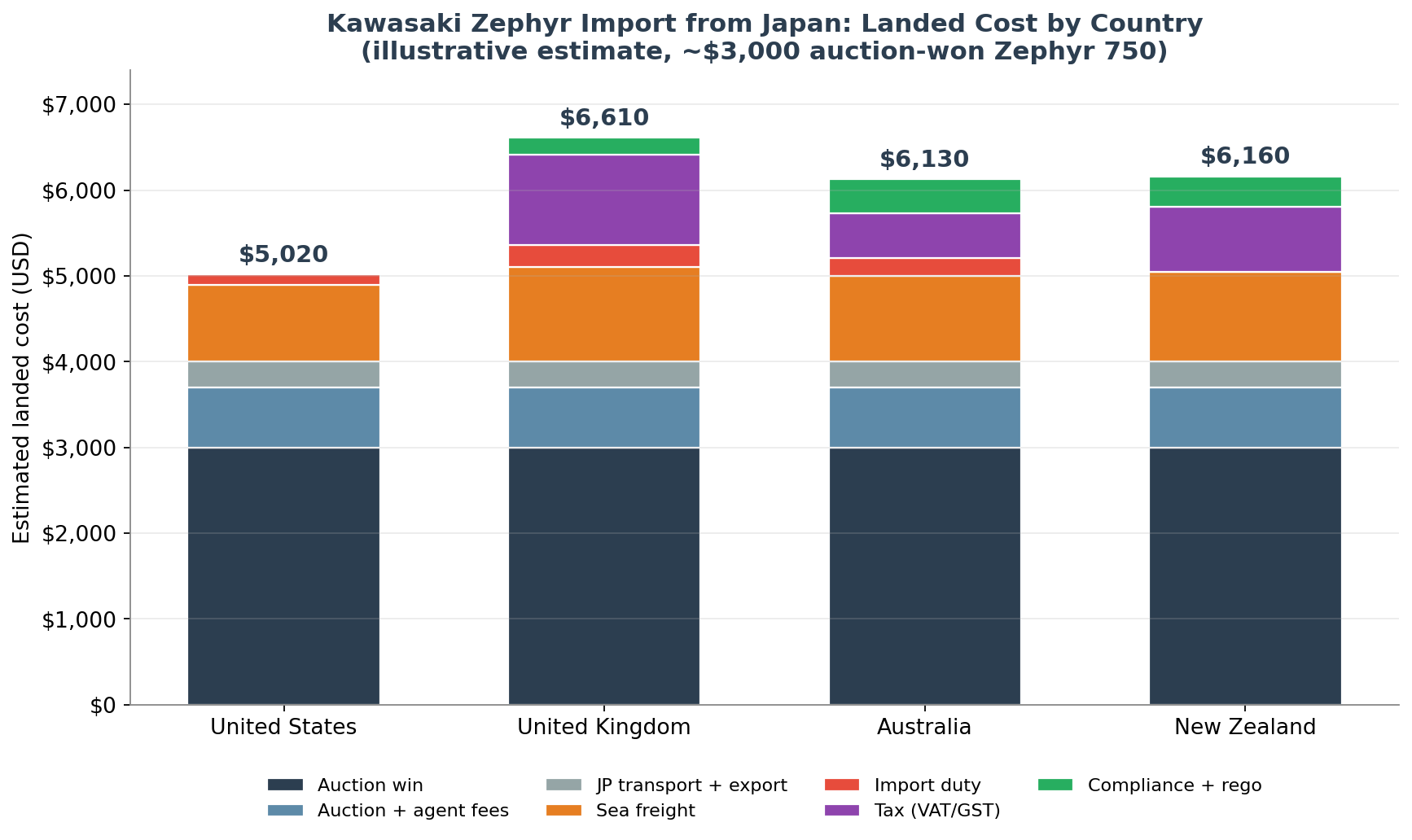
The single biggest variable isn't the bike — it's your country's tax and compliance regime. A 25-year-old Zephyr into the US gets a flat 2.5% duty and skips EPA and DOT compliance entirely. The same bike into the UK gets hit with import duty plus 20% VAT. That's why a price that looks insane in Britain is a bargain in America.
The second lesson: condition beats everything. Here's how typical used prices spread across the four Zephyr variants once a bike is landed and sorted, so you can set expectations before you fall in love with an auction photo:
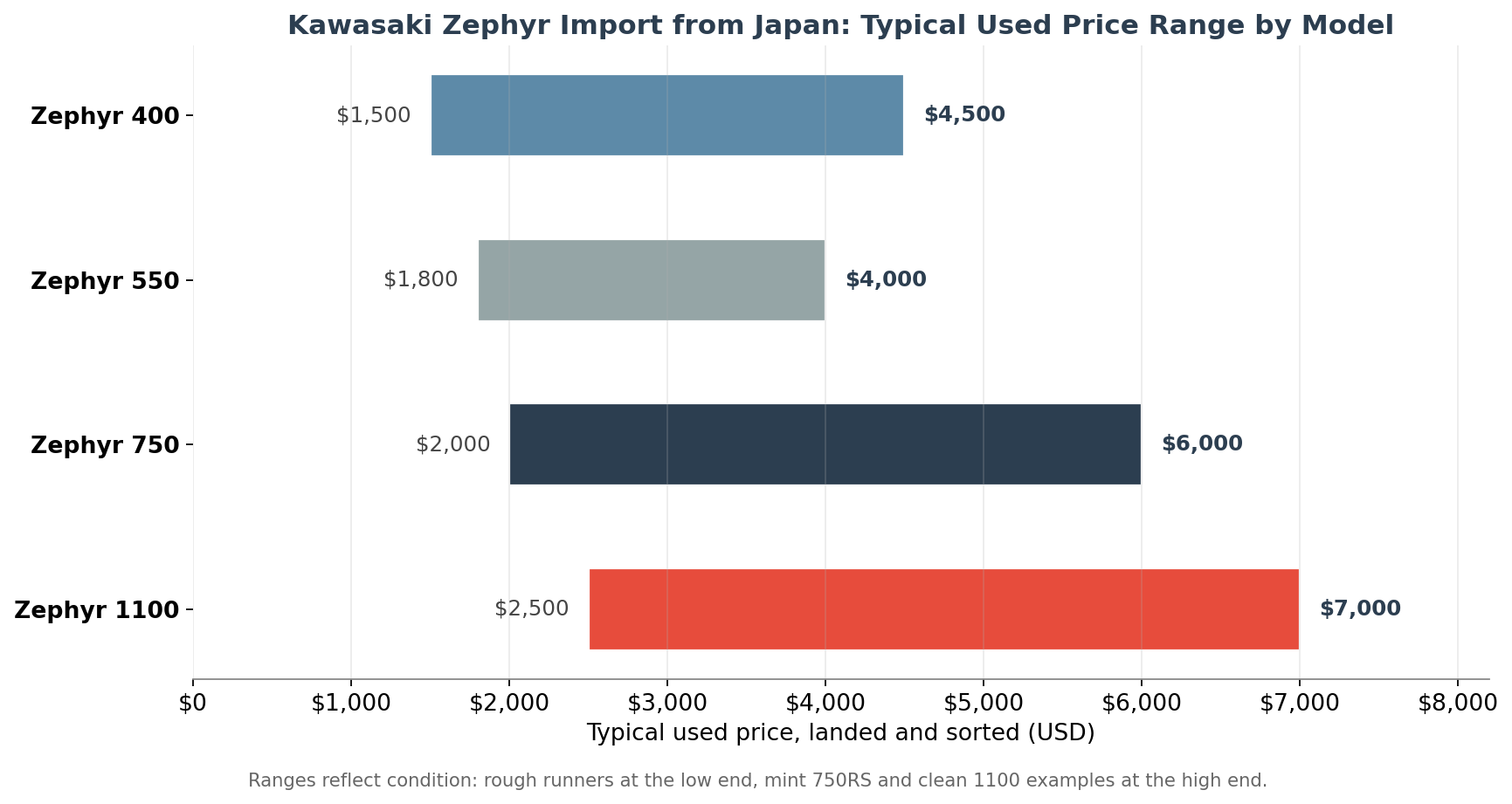
A clean, original, well-documented bike at the top of its range will cost you more up front and save you a fortune in restoration. A cheap corroded one is never actually cheap. More on that in a minute.
One factor that quietly moves a Zephyr's value more than mileage does: originality and color. A bike wearing its factory paint in a sought-after scheme — the green-and-silver 750RS, a clean two-tone 1100 — commands a real premium over a resprayed or cafe-racered example, because collectors want the bike Kawasaki built, not someone's weekend project. Aftermarket exhausts, drilled fenders and swapped switchgear all chip away at the price too. When you bid through an agent you can hold out for an original bike with a documented history instead of grabbing the first runner you see, and on a modern classic that patience pays for itself the day you decide to sell.
Import Rules by Country: US, UK, Australia, New Zealand
Rules change, and the details below are the lay of the land for 2026. Always confirm current requirements with the official agency before you commit money — but here's what you're dealing with.
United States — The 25-Year Rule Is Your Friend
The US is the easiest place on earth to import a classic Zephyr, thanks to the 25-year rule. A motorcycle that's 25 or more years old (counted from month of manufacture) is exempt from FMVSS safety compliance, and the EPA exempts engines 21 years and older from emissions compliance. In 2026 that means anything built in 2001 or earlier qualifies — which covers every Zephyr 1100 (production ended around 1996), every 400 and 550, and most 750s. You file EPA Form 3520-1 and DOT Form HS-7, pay a flat 2.5% duty, and you're done. No registered importer, no expensive conversions. The official ground rules are spelled out on the NHTSA importing FAQ. One trap to avoid: NHTSA uses the actual build date on the documents, not the model year, so a "2001" bike built in early 2002 needs to wait — confirm the month of manufacture before you bid.
United Kingdom — NOVA, VAT and the IVA/MSVA Question
The UK is straightforward but not free. When the bike lands you notify HMRC through NOVA (Notification of Vehicle Arrivals) within 14 days, then pay import duty (typically around 6% on a motorcycle) plus 20% VAT on the bike-plus-shipping value. After that you register with the DVLA. A bike of the Zephyr's age usually goes through the simpler MSVA (Motorcycle Single Vehicle Approval) inspection rather than full type approval, and as long as it's complete and roadworthy that's a formality. Budget for the tax, not just the bike — VAT alone can add a four-figure sum.
Australia — The 25-Year Concession and LAMS
Australia allows road motorcycles 25 years and older to come in under a concessional pathway, processed through the federal import approval system and the Register of Approved Vehicles, after which you comply and register in your state. The bike must be inspected and meet your state's roadworthy standard. The big thing for Australian riders is LAMS: the 750 and 1100 are firmly off the learner-approved list, so if you're on a restricted license, the Zephyr 400 (and possibly the 550) is the one to check against the current LAMS register.
New Zealand — Entry Certification and LAMS
New Zealand requires imported bikes to pass entry certification (a compliance and safety check), after which you register and get a warrant of fitness. NZ also runs an LAMS scheme, so learner riders should confirm a 400 is on the approved list before importing. NZ's process is well-trodden — plenty of Japanese imports already roll on Kiwi roads — but factor the certification cost into your budget.
The Faults That Separate a Bargain from a Money Pit
Every Zephyr is now old enough to have problems. The trick is knowing which ones are cheap annoyances and which ones are wallet-emptiers. There's a famous German repair video titled, roughly, "where all the pros failed" — about a Zephyr 750 that defeated multiple shops. Air-cooled engines with bank-of-four carburetors are simple in theory and fiddly in practice, and a neglected one will humble you. Here's what to watch for.
Corrosion is the number one killer. The Zephyr has a deserved reputation for rotting faster than you'd like — chrome, fasteners, fork lowers, the exhaust, and especially anything that sat through Japanese winters near salted roads. Surface fizz on bolt heads is normal and cosmetic. Deep pitting on the fork stanchions, a flaking exhaust, or rot blooming under the chrome of the tank and mudguards is expensive. This is the single most important thing the auction sheet tells you.
The carburetors and cold starting. The CV carbs need to be clean and balanced. A Zephyr that's been sitting will have gummed jets, and the classic symptom is a bike that won't idle cold and takes a good fifteen minutes of riding to come good, or a cylinder that drops out entirely because one carb is blocked. A proper carb clean and balance fixes it, but factor that into a project bike's budget.
The cam chain tensioner. The automatic tensioner can misbehave, and a rattly top end on startup is the tell. Left alone it affects valve timing and running. It's a known, fixable item, but a noisy one needs sorting before it does damage.
Soft suspension. Even when new, the Zephyr's forks dived and the twin rear shocks were on the mushy side. Thirty years later they're worse. Fresh fork oil, decent springs and a pair of quality shocks transform the bike — most enthusiasts treat this as a planned upgrade rather than a fault.
Brakes and the usual 30-year-old stuff. Caliper seals need periodic refreshing, and you should assume perished rubber lines, tired fork seals, and an aging regulator/rectifier on any bike that hasn't been recently gone through. None of it is catastrophic. All of it adds up if you ignore it.
The pattern across all of this is the same one those huge restoration videos make obvious: these are old bikes, and condition is the entire ballgame. A clean, sorted Zephyr is a joy. A cheap corroded one is a project whether you wanted one or not. Buy the condition, not the bargain.
Reading the Auction Sheet on a 30-Year-Old Zephyr
This is the part almost no other guide bothers with, and it's the most valuable. When a Zephyr goes through a Japanese auction, an inspector grades it and marks up a sheet. Learning to read that sheet is how you buy a good one sight-unseen.
The overall grade runs on a scale where roughly 4 and up is a genuinely good used bike, 3.5 is average with some wear, and anything below 3 is a project or a parts bike. S and 6 are essentially new or fully restored; 5 is excellent. For a modern classic like the Zephyr, hold out for 4 and above unless you're specifically buying a restoration candidate.
The condition map is the gold. It's a diagram of the bike with codes marking every flaw the inspector found — A1, A2, A3 for scratches by severity, W for wavy or repaired panels, S for rust, C for corrosion, and so on. On a Zephyr, you're hunting the S and C marks: a sheet covered in corrosion codes means a bike that looks fine in photos but is fizzing underneath. A clean map on a grade-4 bike is exactly what you want.
Then there are the notes — mileage verification, whether the bike is original or modified, aftermarket exhausts, and any mechanical observations. For a Zephyr, "original condition" with a believable low odometer and a clean corrosion map is the trifecta. We translate and assess all of this before you ever commit to a bid, because on a bike this age the sheet matters more than any seller's description.
How AWA Auction Gets You a Zephyr from the Source
Here's where we come in. AWA Auction is an export agent plugged directly into the Japanese motorcycle auction system — the same trade-only auctions where every clean Zephyr in this guide is changing hands every week.
You don't need a Japanese bidder's license, you don't need to read the auction sheets yourself, and you don't need to wrangle freight forwarders in a language you don't speak. You tell us the bike you want — a 750RS in original green, an 1100 with a clean corrosion map, a JDM 400 for the collection — and we find it, vet the sheet, bid to your limit, handle the export paperwork, and ship it to your nearest port. You get a transparent, all-in quote up front, so there are no nasty surprises when the bike lands.
Browse our current listings to see what's available right now, or contact our team with the exact Zephyr you're chasing and we'll start watching the auctions for it. The bikes are out there. Getting one is just a matter of knowing where to look — and we already do.
See Also
Share this article: