
A Kawasaki ZRX1200 import from Japan is the smartest way to buy the green muscle bike the rest of the world quietly fell in love with. The ZRX is the machine that took a big-bore inline-four, dressed it in a bikini fairing and a banana seat straight out of the 1980s superbike paddock, and somehow made all of it feel modern. And here is the part the classifieds never tell you: the cleanest, lowest-mileage, most original ZRX1200s on the planet are not in California or Kent. They are sitting in Japanese auction halls this week, waiting for someone who knows how to buy them.
You want one of those bikes. Not a tired grey-import that has been crashed, rewired by three different owners, and "restored" with a rattle can. This guide walks you through exactly how to get a proper one, what it costs to land on your driveway, and the ZRX-specific traps that separate a great buy from an expensive headache.
What the Kawasaki ZRX1200 actually is (and why people obsess over it)
The ZRX is Kawasaki's love letter to the Eddie Lawson era. Back in the early 1980s, Lawson won AMA Superbike titles on a green-and-white Kawasaki, and that paint scheme burned itself into a generation of riders' brains. When Kawasaki built a retro muscle-naked in the late 1990s, they gave it that same lime-green livery, a small headlight cowl, and a stance that says "I will pull a third-gear wheelie if you so much as breathe on the throttle." Enthusiasts still call the green ones the ELR, short for Eddie Lawson Replica.
The lineage is simple once you see it. The ZRX1100 arrived in 1997 with a 1052cc air- and oil-cooled inline-four loosely based on the legendary ZZR1100 (the GPZ900R bloodline, in other words). In 2001 Kawasaki bored it out to 1164cc and called it the ZRX1200, sold around the world as the half-faired ZRX1200S and the cowl-only ZRX1200R. North America got the ZRX1200 until around 2005. Then, in 2008, the rest of the planet lost it to emissions rules, but Japan kept it alive as the fuel-injected, six-speed ZRX1200 DAEG right through to 2016.
That last fact is the whole reason this guide exists. The best later ZRXs were a Japan-only model. If you want a DAEG, importing from Japan is not the clever option. It is the only option.
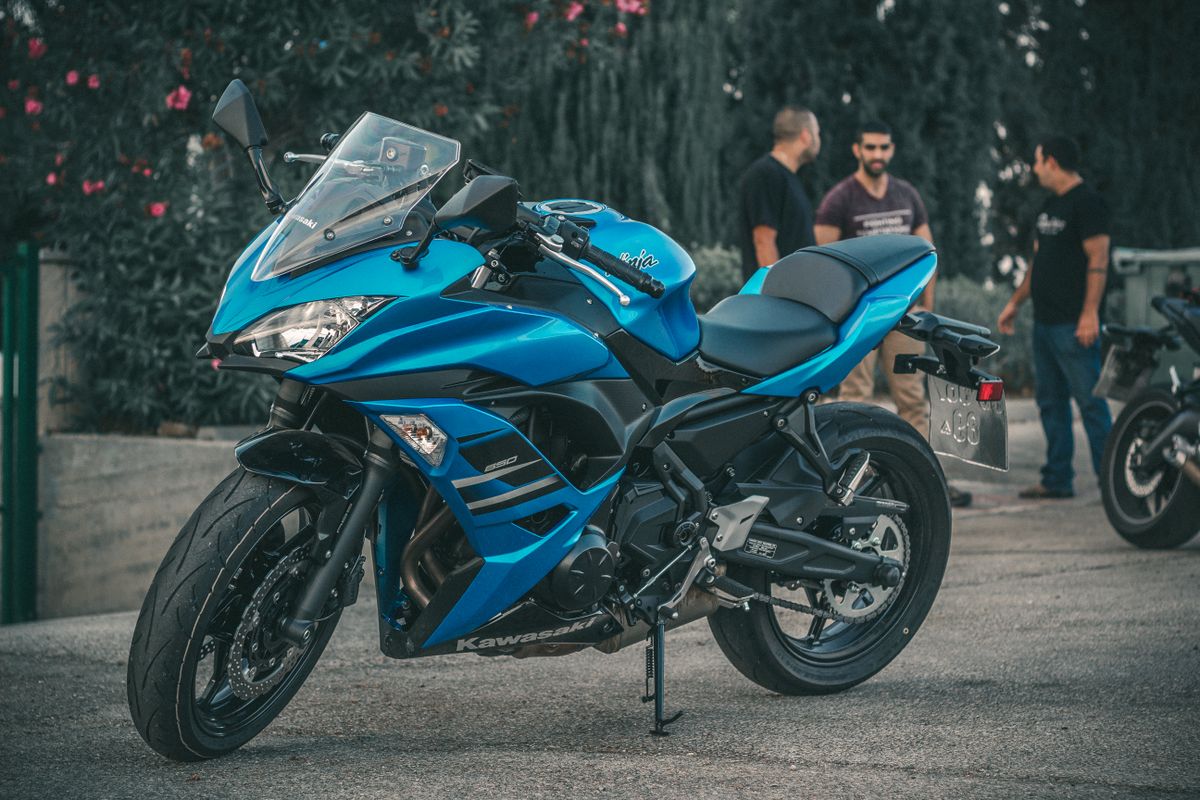
Mechanically the ZRX is gloriously old-school. Big torquey four, a steel double-cradle frame, twin rear shocks instead of a monoshock, and a riding position that lets you actually see over traffic. It makes around 106 bhp in 1100 form and roughly 120 bhp as the carb-fed 1200R, which sounds modest until you remember the thing weighs a sensible amount and delivers its punch from 3,000 rpm. This is a bike built for real roads, not lap times. That is exactly why used values have stopped falling and started climbing.
A short history of the ZRX: from Eddie Lawson to the DAEG
To understand why this bike inspires such loyalty, you have to go back to 1981. A young Californian named Eddie Lawson started winning AMA Superbike races on a Kawasaki KZ1000-based machine in green and white. He took the title in 1981 and 1982, then went on to win four 500cc Grand Prix world championships. That green Kawasaki Superbike became one of the most recognisable race bikes in American motorcycling, and the colour scheme turned into shorthand for "fast Kawasaki."
Fast forward to 1997. The retro-naked craze was in full swing, and Kawasaki wanted a bike that nodded to its glory days without being a soft cruiser. The answer was the ZRX1100: a muscular standard with a small bikini fairing, twin shocks, and — for the bikes that mattered — that Lawson green paint. It was an instant cult hit, even if it never sold in huge numbers.
The 2001 jump to 1164cc created the ZRX1200, and this is the bike most people picture when they hear the name. The half-faired 1200S and the cowl-faced 1200R covered both the touring-minded rider and the boulevard brawler. North America kept the bike into the mid-2000s before tightening emissions rules pushed it off the showroom floor.
But Japan was not done. In 2008 Kawasaki re-engineered the bike into the DAEG, with fuel injection, a six-speed gearbox and a sharper chassis, and sold it domestically for another eight years. By the time the Final Edition rolled out in 2016, the ZRX had run for nineteen years across two displacements and three major generations. Almost none of that final, best chapter was ever officially exported. That is why, two decades on, the phrase "ZRX1200 import from Japan" is not a niche search — it is the only way most of the world can buy the bike Kawasaki saved for itself.
Why import a Kawasaki ZRX1200 from Japan instead of buying local
Here is the thing nobody mentions at the bike night: a domestic-market ZRX has usually lived a hard life. These bikes attract riders who like to ride. Local examples in the UK, US or Australia tend to come with worn chains, aftermarket exhausts fitted badly, crash damage hidden under fresh plastics, and a service history that amounts to "yeah mate, I did it myself."
Japan is different, and it is not a stereotype. Japanese owners cover low annual mileage, store bikes indoors, and feed them through a strict roadworthiness system. Many ZRXs that surface at auction are one- or two-owner bikes with genuine 8,000 to 20,000 km on the clock and a stack of dealer stamps. The domestic market also had the widest choice of colours, the factory Ohlins-equipped Final Edition DAEG models, and the cleanest unmolested ELR green bikes.
The famous YouTube importer Bikes and Beards made the point vividly when they bought an entire 40-foot container of motorcycles from Japan and filmed every machine firing up after the ocean crossing. The takeaway from that series was not "imports are a gamble." It was the opposite: bike after bike started on the button because they had been looked after in a way that local used stock simply is not. That is the quiet advantage you are buying.
There is also the money. A genuinely clean, low-mileage ZRX1200R that would command serious cash on a local forum can often be landed from Japan for less, even after shipping and duty, because you are buying at wholesale Japanese auction prices rather than retail dealer prices. You pick the exact bike, you see its real condition graded by an independent inspector, and you skip the middleman markup. That is not a compromise. That is the entire pitch.
One more thing worth saying plainly: buying from Japan removes the single biggest risk in any used-bike purchase — not knowing what you are really getting. An independent inspector has already been over the machine, graded it, and written down its flaws before you commit a penny. Try getting that from a stranger on a classifieds site.
ZRX1100 vs ZRX1200R vs ZRX1200 DAEG: which one to import
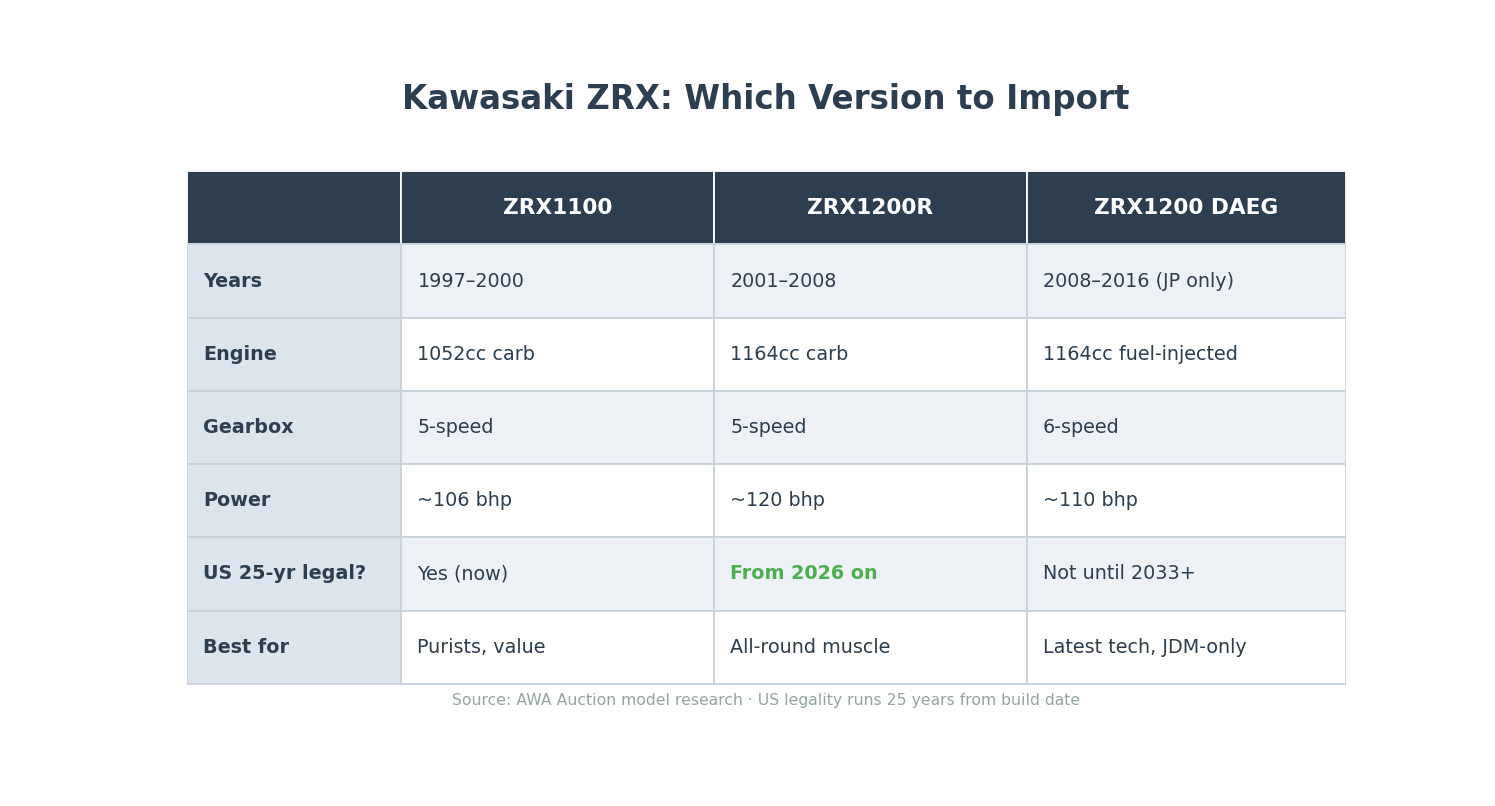
People agonise over this, so let me make it simple. All three are brilliant. They just suit different buyers and, crucially, different import laws.
ZRX1100 (1997 to 2000) — the purist's value pick
The 1100 is the lightest-feeling and, to a lot of riders, the prettiest. The 1052cc carb engine revs hard and the bike has a wiry, eager character. Because it sold in smaller numbers it is now the connoisseur's choice, and clean green ELR examples are genuinely sought after. The bonus for American buyers: every ZRX1100 is already over 25 years old, so it sails through US import rules today.
ZRX1200R (2001 to 2008) — the all-rounder most people should buy
The 1200R is the sweet spot. The extra capacity adds a fistful of midrange torque, the chassis is unchanged in the good ways, and there are simply more of them about, which keeps parts cheap. The carbed engine is bulletproof and dead easy to tune. If you want one ZRX to ride hard for the next decade, this is it.
ZRX1200 DAEG (2008 to 2016) — the Japan-only flagship
The DAEG (pronounced "dieg", from the German for "to last") is the grown-up ZRX. Kawasaki fitted fuel injection, a slick six-speed gearbox, a revised chassis, better brakes and updated styling. It is smoother, cleaner and easier to live with day to day. MotorStation TV and MotoBasic, two of Japan's biggest bike-review channels, both rate the DAEG as one of the last great air-cooled Japanese fours, and the Final Edition with its gold Ohlins shocks has become a modern collectible. The catch: it was never sold outside Japan, so importing from Japan is the only way to get one, and its newer age means it is not yet US-legal (more on that below).
What a Kawasaki ZRX1200 import from Japan actually costs
Let's talk real numbers, because vague answers help nobody. The price you see on a Japanese auction listing is just the start. You then add the agent's fee, domestic transport inside Japan, export paperwork, ocean freight, and finally your own country's duty, tax, inspection and registration. Stack it all up and a clean ZRX1200R lands somewhere in the region shown below.
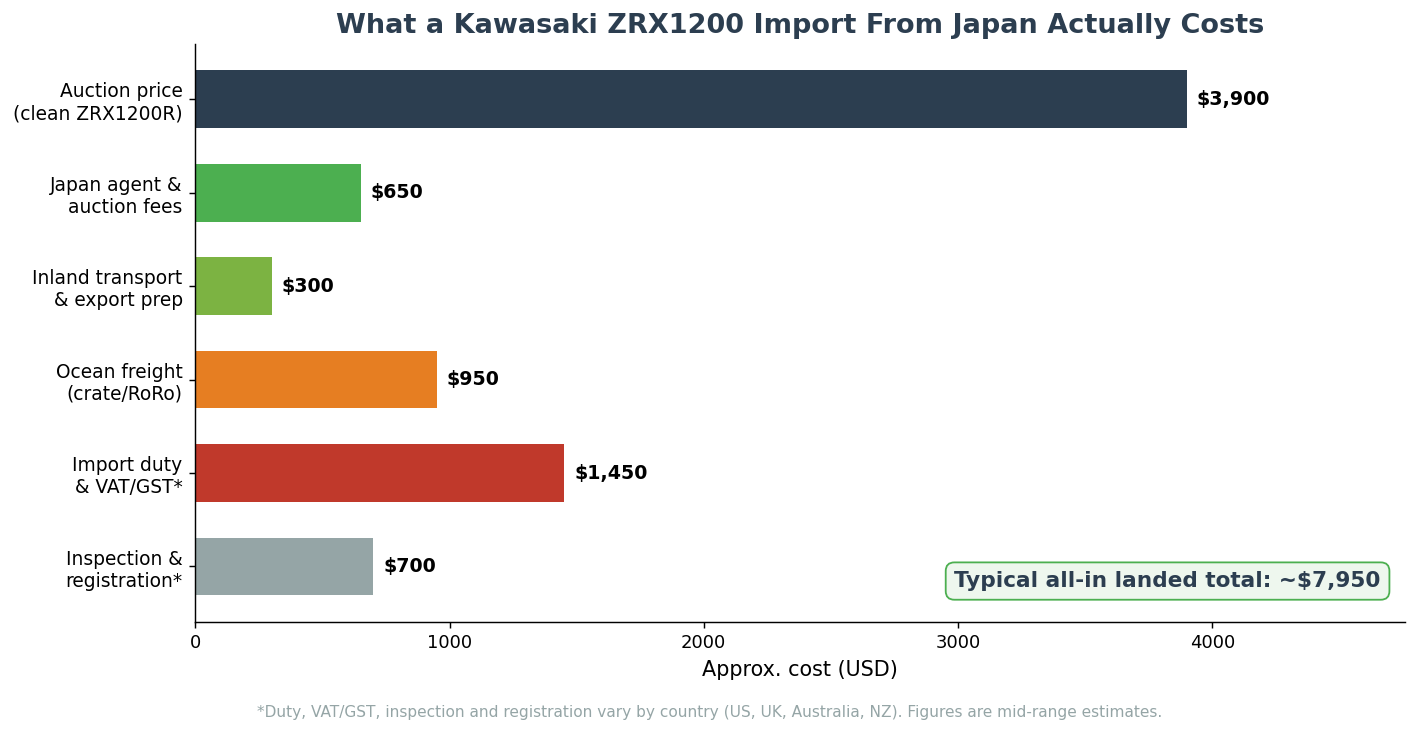
A few honest notes on those figures. The auction price swings with condition and model: a rough ZRX1100 project might hammer for under $2,500, while a mint DAEG Final Edition can clear $9,000 on its own. Ocean freight depends on whether the bike travels crated in a shared container or RoRo, and on your destination port. And the duty and tax line is the big variable, because it changes completely depending on where you live.
As a rough rule of thumb, budget an all-in landed total of roughly $7,000 to $9,000 for a tidy, ready-to-ride ZRX1200R, and a bit more for a low-mileage DAEG. That still tends to undercut what an equivalent-condition bike costs through a local dealer, and you end up with a documented, inspected machine instead of a mystery.
For a deeper line-by-line breakdown of shipping methods and per-country tax, our team can put together a no-obligation quote on any specific bike you are watching. Just send us the auction listing and we will tell you the real number.
How the duty and tax line changes by country
That single "import duty and tax" bar on the cost chart hides very different realities. In the United Kingdom you pay import duty plus VAT on the bike-plus-shipping value, which is the biggest single add-on for British buyers. In Australia you face GST and potentially a small duty, plus the cost of the Vehicle Import Approval and the biosecurity cleaning standard. In New Zealand it is GST plus the entry-certification compliance check. In the United States, an over-25-year bike is exempt from EPA and DOT requirements, so the federal tax burden is comparatively light, though your state still wants its registration and sales tax. The lesson is simple: get a country-specific quote before you bid, because the same bike can land at noticeably different totals depending on which flag flies over your garage.
Step-by-step: how to import a ZRX1200 from Japan
The process sounds intimidating until you see it laid out. Here is exactly how it goes, in order.
Step 1 — Decide your exact bike and your ceiling
Pick the variant (1100, 1200R or DAEG), the colour you actually want, and the maximum you will pay all-in. Write that number down. Auctions are emotional; your budget should not be.
Step 2 — Get access to the auctions
You cannot bid at Japanese motorcycle auctions as a random foreigner. These are trade-only halls — USS, BDS, JBA and others — open to registered members. This is where an export agent like AWA comes in: we are members, we bid on your behalf, and we handle the language and the logistics. You tell us the bike and the ceiling; we do the bidding.
Step 3 — Read the auction sheet before you bid
Every bike is graded by an independent inspector and given a condition score plus a written sheet with a map of every scratch, dent and rust spot. Learning to read these sheets is the single most valuable skill in importing, and we cover the ZRX-specific traps in the next section. If you have never seen one, our guide to reading Japanese auction sheets is worth ten minutes of your life.
Step 4 — Win the bid
On auction day we place your bid up to your ceiling. If we win, the bike is yours and the clock starts. If we do not, nothing is lost and we wait for the next one. ZRXs come through the halls constantly, so patience costs nothing.
Step 5 — Domestic logistics and export prep
The bike is collected, moved to the export yard, deregistered from the Japanese system, and prepared for shipping. Engines are drained to safe fuel levels and the machine is cleaned for biosecurity — Australia and New Zealand in particular are ruthless about a single speck of dirt.
Step 6 — Ocean freight
Your ZRX crosses the water, crated in a shared container or shipped RoRo. Sailing times run anywhere from about three weeks to the US west coast to ten weeks or more to the UK, Australia and New Zealand. You get tracking and an estimated arrival.
Step 7 — Customs clearance, inspection and registration
At your end the bike clears customs, you pay the duty and tax, and it goes through whatever roadworthiness check your country requires. Then you register it, insure it, bolt on a plate, and ride. This last stretch is country-specific, so let's break it down.
The auction sheet and the ZRX faults that actually matter
This is the section that saves you money, so read it twice. A ZRX is a tough old thing, but every model has its known weak spots, and a good auction sheet plus a few targeted questions will flush them out before you spend a yen.
Cam chain tensioner rattle. The automatic cam chain tensioner is the ZRX's best-known weak point. On a cold start, listen for a rattling or slapping noise from the top of the engine. A healthy bike is quiet; a clatter means the tensioner is on its way out. It is a cheap fix, but use it to negotiate.
Starter and alternator chain tensioner. Worse than the cam chain issue, the alternator/starter chain tensioner can fail and actually strike the clutch pressure plate, leaving visible clutch-side damage. A rattle or tap from the left side of the motor is the giveaway. On a high-value DAEG this is the first thing to check.
Exhaust rust (pre-2005). Early ZRX1200s left the factory with mild-steel exhaust systems that rust from the inside out. Most have been patched or replaced by now. Kawasaki switched to stainless on later bikes, and many Japanese owners fitted quality aftermarket systems anyway, which is often a plus.
Radiator cracks. The OE radiators have a habit of cracking near the top mounts. A close look at the auction photos and a question to the inspector will tell you whether it is original and sound.
Rear shocks. The standard piggyback rear shocks wear out and go bouncy. Many imported ZRXs already wear aftermarket Ohlins or Nitron units, which is a genuine upgrade — just confirm they are not leaking.
Notchy gearbox. Some bikes are clunky on the 1-to-2 shift. On the DAEG's six-speed this is rarely an issue, but on the older five-speeds it is worth a mention. A graunchy box can hint at a hard life.
Here is what nobody tells you: the auction grade matters less than the sheet's detail map and the inspector's notes. A grade 4 bike with a fully documented, honest sheet is a far safer buy than a glossy grade 4.5 with vague comments. Read the map, count the repair marks, and when in doubt, ask us to translate the inspector's handwriting. That is literally our job.
Is the Kawasaki ZRX1200 legal to import where you live?
This is where dreams meet paperwork. The good news: the ZRX is legal to import almost everywhere that matters. The detail depends on your country, and for the United States it depends on the exact year.
United States — mind the 25-year rule
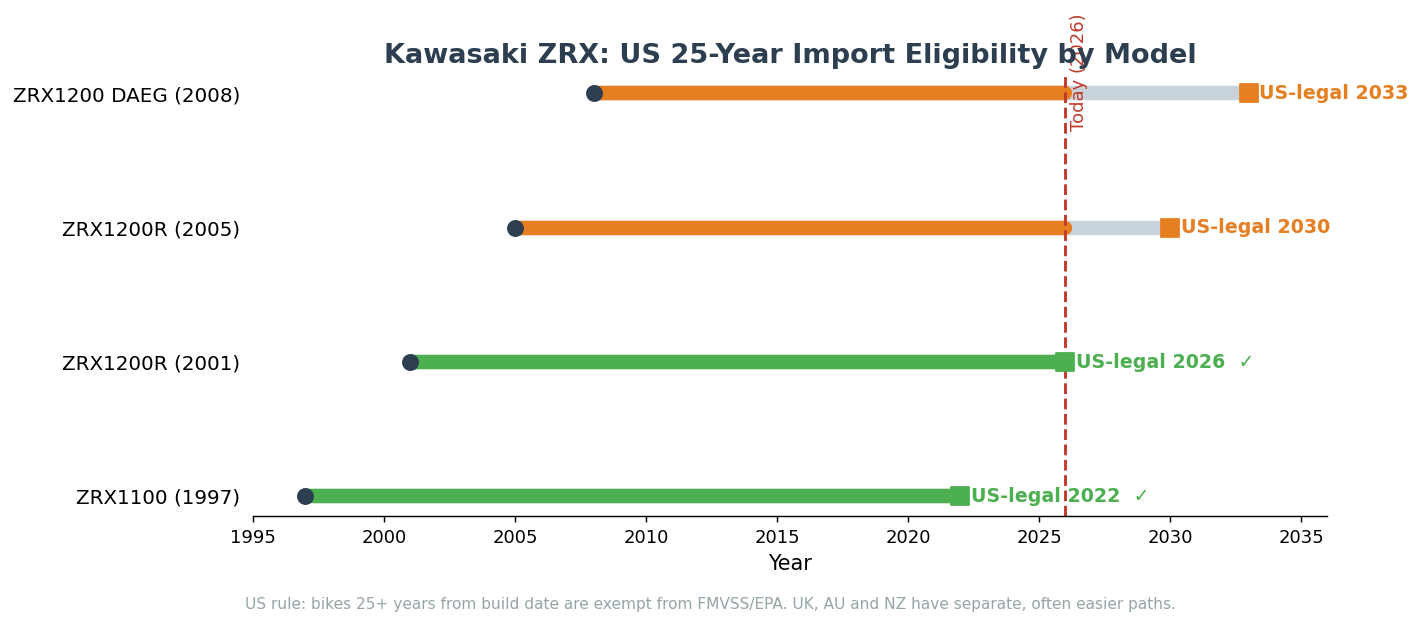
The US lets you import any motorcycle that is at least 25 years old free of FMVSS and EPA restrictions, measured from the build date. So the ZRX1100 (1997 to 2000) is fully importable today, and early ZRX1200R models roll into eligibility year by year — a 2001 bike qualifies in 2026. The fuel-injected DAEG, built from 2008, will not be US-legal until the 2030s. If you are American and you want a ZRX now, buy an 1100 or an early 1200R. The federal rules are spelled out by the NHTSA importation FAQ.
United Kingdom — the easiest big market
The UK has no age bar. You can import any ZRX, new or old. You will pay import duty and VAT on arrival, declare the vehicle through the NOVA system within 14 days, and put it through an MOT. Older bikes may need basic lighting and speedo checks, but a ZRX is a known quantity and registration is routine.
Australia — over-25 is the magic number
Australia's personal-import and concessional schemes make motorcycles over 25 years old straightforward, while newer bikes need to fit an approved pathway. You will need a Vehicle Import Approval before the bike ships, pay GST and any duty, and meet the biosecurity rules to the letter. The official source is the Australian Border Force. An older ZRX1100 or 1200R is one of the cleaner bikes to bring in.
New Zealand — friendly, but fussy about compliance
New Zealand happily takes used Japanese bikes — half the country's roads are full of them — but every import goes through entry certification for safety, and you will need to satisfy the frontal-impact and emissions rules or qualify for an exemption by age. A ZRX clears easily; just budget for the compliance check and the cleaning standard NZ demands.
Whatever your country, the smart move is to confirm eligibility before you bid, not after the bike is on the water. We check it for every customer as a matter of course.
ZRX1200 vs the Bandit 1200, XJR1300 and CB1300: why pick the Kawasaki
The ZRX did not exist in a vacuum. The late-1990s and 2000s were the golden age of the big retro muscle-naked, and Japan built four genuine icons in the class. If you are importing one of these bikes, you should know why the ZRX keeps winning hearts.
Suzuki Bandit 1200. The Bandit is the value champion and a brilliant bike, but it was built to a price. The suspension is softer, the finish is plainer, and it never had the Eddie Lawson aura. The Bandit is the sensible shoes of the group. The ZRX is the same idea with better suspension, sharper styling and more soul.
Yamaha XJR1300. The XJR is the ZRX's closest rival and arguably its only equal. Bigger air-cooled lump, gorgeous twin shocks, lovely fit and finish. Pick the Yamaha if you want torque and chrome; pick the Kawasaki if you want the sportier chassis and the racing heritage. Many riders own both over a lifetime.
Honda CB1300 Super Four. The CB1300 is the heavyweight, smoothest and most refined of the bunch, but it is also the biggest and most expensive, and it feels more like a muscle tourer than a hooligan. The ZRX is lighter on its feet and far more playful.
Here is the honest summary: all four are worth importing from Japan, and all four are best bought from Japan because that is where the cleanest examples live. The ZRX wins for buyers who want the most character, the strongest motorsport story, and a chassis that still feels eager on a good road. It is the enthusiast's pick, which is exactly why values are climbing fastest on clean ZRXs.
The special editions worth importing: DAEG Final Edition and the green ELR
Most of the time, the best ZRX to import is simply the cleanest one in the colour you want. But a few special versions justify hunting for specifically, and a couple of them are Japan-only, which makes importing from Japan the only route to them.
ZRX1200 DAEG Final Edition. When Kawasaki retired the DAEG in 2016, they sent it off with a Final Edition wearing gold Ohlins rear shocks, special paint and badging, and a few premium touches. It was a Japanese-market send-off for the last great air-cooled Kawasaki four, and it has already become a modern collectible. Values are firm and rising. If you want one, you are buying it out of Japan or not at all.
The Eddie Lawson Replica green bikes. Across every generation, the lime-green-and-white ELR livery is the one that defines the ZRX. It is not a separate model so much as a colour with a legend attached, and clean original green bikes pull a premium. The earliest ZRX1100 ELRs in unmarked paint are the purist's grail.
Low-mileage one-owner survivors. Less glamorous but arguably the smartest buy: a bog-standard black or silver 1200R with genuine low mileage, a full Japanese service record, and an honest auction sheet. These do not make magazine covers, but they make the best long-term ownership, and they are exactly the kind of bike that surfaces in the Japanese halls and almost never in your local classifieds.
The point of working through Japan is choice. You are not stuck with the two tired examples within driving distance of your house. You are shopping the entire Japanese market, week after week, until the precise bike you want rolls across the block.
What nobody tells you about importing a ZRX
A few hard-won truths that do not appear in the glossy listings.
Green is not just a colour, it is a price bracket. The lime-green ELR bikes command a premium over the black, blue and silver ones, sometimes a big one. If you love the Lawson look, fine, pay for it. But if you just want the best riding ZRX for the money, a black 1200R in mint condition is the value buy of the decade.
Originality beats bling. A ZRX with a tasteful aftermarket exhaust and good shocks is great. A ZRX with a billet everything, a loud slip-on, and mystery wiring is a project pretending to be a finished bike. Japanese auction sheets are brutally honest about modifications, which is exactly why buying from the source beats buying a "done" bike locally.
Low mileage is real here. A 15,000 km ZRX from Japan is not a fantasy or a clocked odometer. The roadworthiness paper trail makes mileage fraud hard, and genuine low-use bikes are common. That is the whole reason savvy buyers look to Japan first.
Parts are not a problem. Because Kawasaki sold the ZRX for nearly two decades and kept the DAEG alive until 2016, consumables and most service parts are easy to find. This is not some unobtainium exotic. It is a sensible big four that happens to be cool.
Patience is the cheat code. ZRXs flow through the Japanese halls every single week. If you miss one, another clean example is days away. The buyers who overpay are the ones in a hurry. Set your ceiling, wait for the right sheet, and let the auctions come to you.
What a ZRX1200 is like to ride
Numbers only tell you so much, so here is the character. Thumb the starter and the inline-four settles into a deep, even idle that turns into a proper howl as the revs climb. The ZRX makes its torque low and wide, which means you do not have to thrash it to make rapid progress — a roll-on in third gear covers most overtakes without a downshift.
The riding position is the secret weapon. You sit up and forward, wrists relaxed, eyes above the car roofs, with just enough lean to load the front wheel through a fast corner. The twin-shock rear and conventional forks feel old-school in the best way: planted, communicative, and happy to be ridden hard on a back road. It is not a track weapon and it never pretended to be. It is a road bike that makes ordinary journeys feel like an event.
Long days are comfortable thanks to a roomy seat and that small cowl taking the worst of the wind. Two-up, the ZRX shrugs off a passenger and luggage. And then there is the noise — even a stock ZRX with a healthy exhaust delivers one of the great air-cooled-four soundtracks, the kind that makes you take the long way home for no reason at all. This is the bike's real party trick: it is fast enough to thrill, easy enough to relax on, and characterful enough that you never get bored. That blend is rare, and it is why owners hold onto them.
Living with an imported ZRX1200: running costs and upgrades
Buying the bike is one thing; owning it is another, and the ZRX is refreshingly cheap to keep on the road. This is a mainstream Kawasaki four, not a fragile exotic, and that shapes everything about ownership.
Servicing. Valve clearances, carb balancing on the older bikes, oil and filter changes — all of it is standard fare that any competent home mechanic or independent shop can handle. The carbed 1100 and 1200R are about as simple as a modern-classic four gets. The DAEG's fuel injection is reliable and needs even less fiddling.
Consumables and parts. Because Kawasaki built the ZRX for nearly twenty years, tyres, brake pads, chains, sprockets, filters and gaskets are all easy to source and cheap. Even cosmetic and engine parts are widely available used, and Japan itself is a goldmine of secondhand ZRX spares that travel well with the bike.
Sensible upgrades. Most imported ZRXs benefit from a few well-chosen tweaks: quality rear shocks if the bike still wears tired originals, fresh fork oil, braided brake lines, and a good aftermarket exhaust if it does not already have one. Many Japanese bikes arrive already fitted with premium Ohlins or Nitron suspension and a quality pipe, because Japanese owners look after their toys. That is found money.
Fuel and comfort. Expect real-world fuel economy in the region of 40 to 45 miles per gallon ridden sanely, a comfortable upright seat for long days, and enough wind protection from the cowl to keep motorway stints bearable. It is a genuine do-everything big bike, which is precisely why owners keep them for years.
Insurance and value. As a modern classic with rising values, a clean imported ZRX is increasingly an appreciating asset rather than a depreciating one. Insure it on an agreed-value classic policy where you can, keep the auction sheet and import paperwork in a folder, and you protect both the bike and its resale story.
The paperwork that arrives with your imported ZRX
One of the quiet joys of buying through the Japanese auction system is the trail of documents that comes with the bike, and it is worth knowing what you are getting.
The auction sheet. This is the independent inspector's report: the overall condition grade, an interior and exterior breakdown, a diagram mapping every blemish, and written notes on modifications and faults. Keep it. It is proof of the bike's condition at sale and a powerful resale asset.
The export certificate and deregistration paper. When the bike leaves the Japanese system it is formally deregistered, and the export certificate (often with an official English translation) records the chassis number, engine details and date of manufacture. That manufacture date is exactly what customs in your country uses to confirm the bike's age — vital for any over-25-year exemption.
The bill of lading and shipping documents. These track the bike across the water and are what your customs broker needs to clear it. We provide them as the shipment progresses, so you always know where your ZRX is.
Your country's entry documents. Depending on where you live, this is the UK NOVA confirmation, the Australian Vehicle Import Approval, the New Zealand entry certificate, or the US customs and EPA/DOT exemption paperwork. We line these up alongside the bike so that registration is a formality, not a fight.
A folder full of honest paperwork is part of what you are buying. It is the difference between "trust me, it is a good one" and a documented machine whose history you can actually prove. That is the whole reason serious buyers go to the source.
How AWA Auction gets you onto a ZRX1200
This is the part we are built for. AWA Auction is a Japan-based export specialist with direct membership at the major motorcycle auction houses. We are not a classifieds site reselling bikes at a markup — we bid for you, at the source, at real auction prices.
Tell us which ZRX you want and your all-in ceiling. We watch the halls, translate and check the auction sheets, place the bids, win the bike, handle the export paperwork and biosecurity prep, and arrange shipping to your port. We confirm your country's import rules before you commit a single dollar, so there are no nasty surprises at customs. You get a documented, independently inspected machine and a paper trail to prove it.
The ZRX1200 was always the smart-money muscle bike — a proper inline-four with real-world torque and a face only an Eddie Lawson fan could love at first, then never stop loving. Importing one from Japan is just the smart-money way to buy it. You get the best examples on earth, you choose the exact bike, and you often pay less than you would for a tired local one. That is the whole point.
Whether you are chasing a green ELR, a low-mileage black 1200R, or the Japan-only DAEG Final Edition, the path is the same: pick the bike, set your ceiling, and let us bring it home. The ZRX is not getting any cheaper, and the clean ones are not getting any more common. The time to buy the best example is while they are still flowing through the Japanese halls.
Ready to start? Browse the bikes we can access or tell our team which ZRX you are hunting, and we will go and find you a clean one.
See Also
Share this article: