
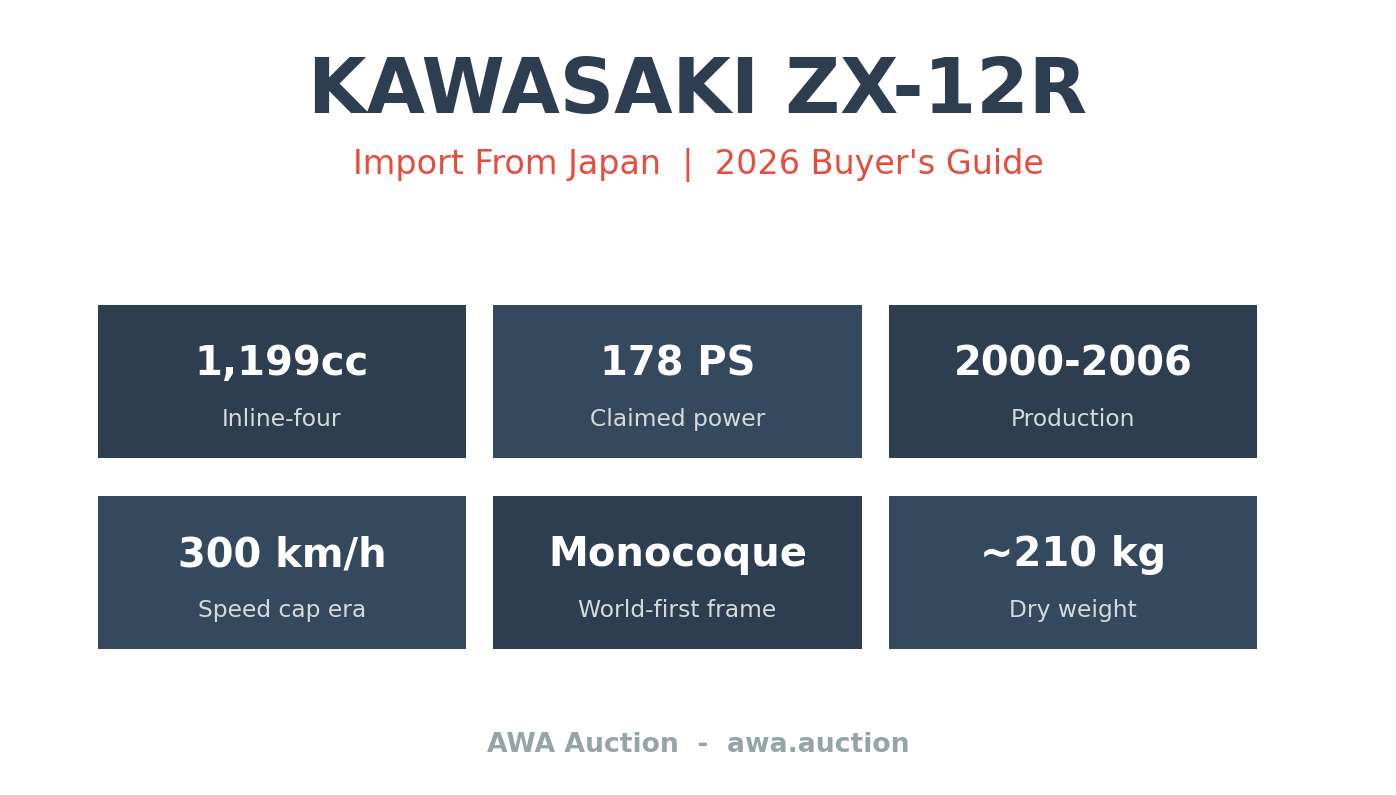
A Kawasaki ZX-12R import from Japan is how you buy one of the wildest chapters in motorcycle history for the price of a mid-range used commuter. The ZX-12R was Kawasaki's answer to the Suzuki Hayabusa, a 178-horsepower hyperbike built around a frame no mass-produced motorcycle had ever used, and it arrived carrying a genuinely mad ambition: to be the first production bike to hit 200 mph. It never got the chance. But the machine Kawasaki actually sold is still one of the most usable, most under-appreciated fast bikes you can put in your garage.
Here is the thing nobody at a Western dealer will tell you. The ZX-12R spent its whole life in the shadow of the Hayabusa, and that is exactly why it is a bargain now. One long-term owner put it perfectly: "a great bike that stayed in the shadow of the Busa." He kept his for four years and rode it daily, in Paris traffic, and called it "a treat every single day." That reputation gap is money in your pocket.
This guide covers the whole story: how the ZX-12R was born out of the late-90s speed war, how it really compares to the Hayabusa and the old ZZR1100, every generation from the A1 to the final B6, the years to approach with caution, the known problems, what one actually costs landed at your door, and the import rules for the United States, United Kingdom, Australia and New Zealand. Everything here is checked against people who own these bikes, not marketing copy.
What Is the Kawasaki ZX-12R (and Why It Still Matters)
The Kawasaki Ninja ZX-12R is a hyperbike built from 2000 to 2006. At its heart is a 1,199cc liquid-cooled inline-four making a claimed 178 PS, wrapped in bodywork designed in a wind tunnel and hung off a frame Kawasaki had never tried before on a road bike.
That frame is the whole point. While almost every other sportbike of the era used a twin-spar aluminum perimeter frame that wraps around the engine, the ZX-12R uses a monocoque aluminum frame — a single large-diameter backbone that arcs over the top of the motor. Cycle World described it in 2000 as a "monocoque backbone, a single large-diameter beam" fabricated from castings and sheet-metal stampings. It was the first use of this type of frame on a mass-produced motorcycle. The goal was more chassis stiffness than a conventional perimeter frame and a narrower bike that punched a smaller hole in the air. You can read the full technical background on the ZX-12R's Wikipedia page.
So the ZX-12R is not just "another fast Kawasaki." It is a genuine piece of engineering history, and unlike a lot of historically important bikes, it is still fast enough today to embarrass most modern traffic and cheap enough to actually ride.
The Speed War: How the ZX-12R Was Born to Beat the Hayabusa
To understand why this bike exists, you have to understand 1999. Suzuki dropped the GSX1300R Hayabusa and it stunned everyone — CycleWorld testing put it at around 194 mph. Nothing on two wheels had done that from the factory. The bragging rights, and the sales that came with them, went to Suzuki.
Kawasaki was not going to let that stand. Rumors, then pre-release numbers, pointed to a ZX-12R that would make even more power and finally crack 200 mph. The speed war was escalating fast, and the press loved it.
Then the manufacturers blinked. Facing the very real threat that European regulators would ban fast bikes outright, the industry quietly agreed to a "gentlemen's agreement" — a voluntary cap limiting top speed to roughly 300 km/h, or about 186 mph. The timing could not have been worse for Kawasaki. As one history of the era put it, they "had built a 200-mph bike but could only sell a 186-mph one."
Here's the twist that still stings ZX-12R owners: even though the ZX-12R made more horsepower than the Hayabusa, the electronically restricted version could not beat the Suzuki in top-speed tests. The bike that was engineered to win the war showed up right as the war was called off. That is the single biggest reason the ZX-12R never got the credit its hardware deserved — and the single biggest reason it is cheap today.
ZX-12R vs Hayabusa: The Honest Comparison
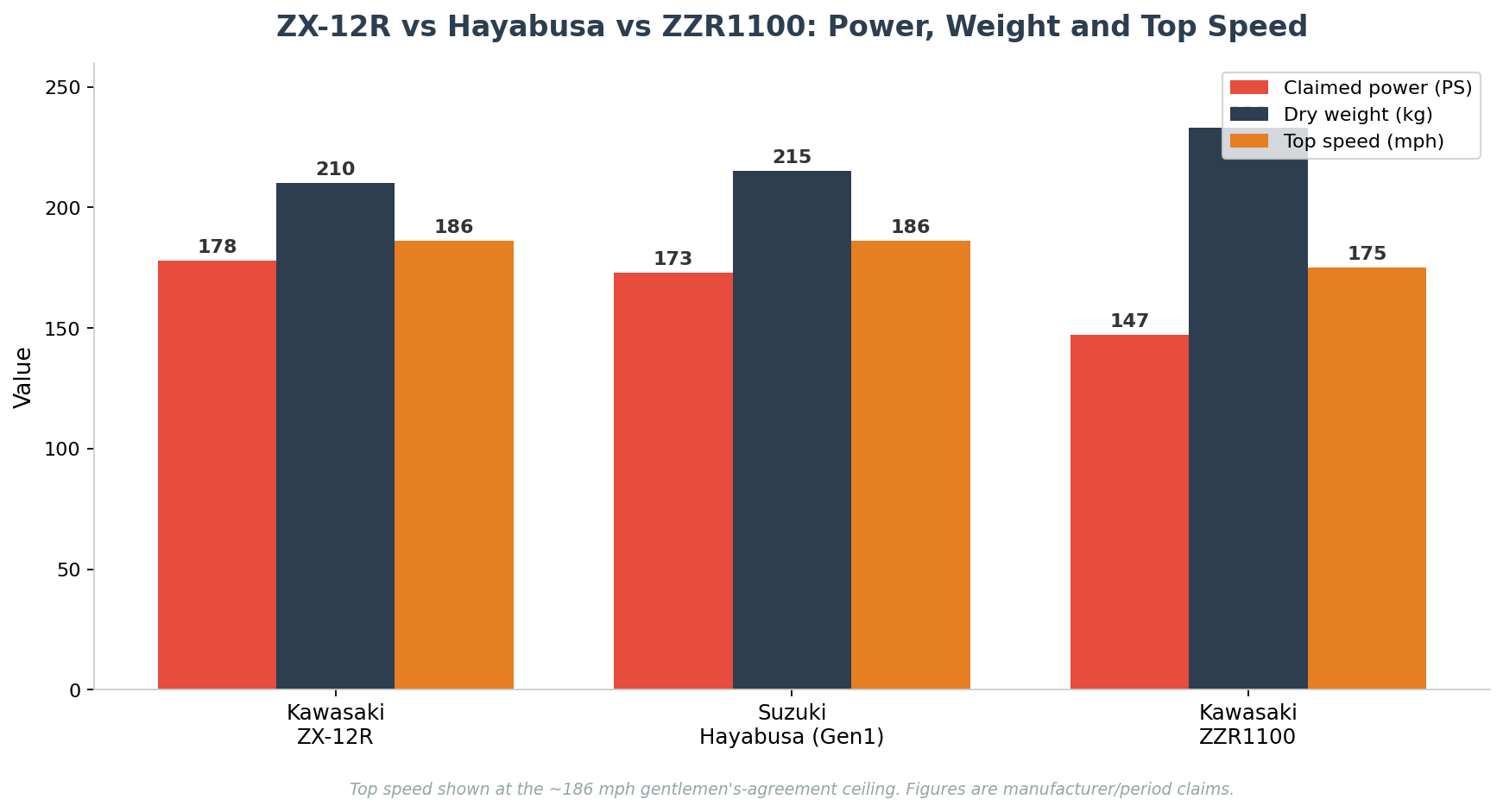
Let's settle this properly, because it is the question every buyer asks. The chart above lines up the ZX-12R against its arch-rival Hayabusa and the bike that started the whole 300 km/h obsession, the Kawasaki ZZR1100.
On paper the ZX-12R wins the power fight: roughly 178 PS versus about 173 PS for the first-generation Hayabusa. It is also the sharper-handling of the two. The monocoque frame and slightly shorter wheelbase make the ZX-12R feel more like a big sportbike, while the Hayabusa feels more like a colossal sports-tourer that happens to be violent.
But the Hayabusa won the war for three reasons: it got there first in 1999, it wore its restriction better (it was still the top-speed king in back-to-back tests), and it built a monster aftermarket and turbo culture that the ZX-12R never quite matched. Search YouTube today and you will find dozens of "Hayabusa Turbo vs ZX-12R" drag videos with millions of views — the ZX-12R is almost always cast as the challenger.
The practical takeaway: if you want the badge, the resale and the endless parts catalog, buy the Hayabusa. If you want more power, sharper steering and a bike that costs meaningfully less to buy because nobody talks about it, the ZX-12R is the smart-money pick. That's the arbitrage an import from Japan lets you exploit.
ZX-12R Generations Decoded: A1 to B6
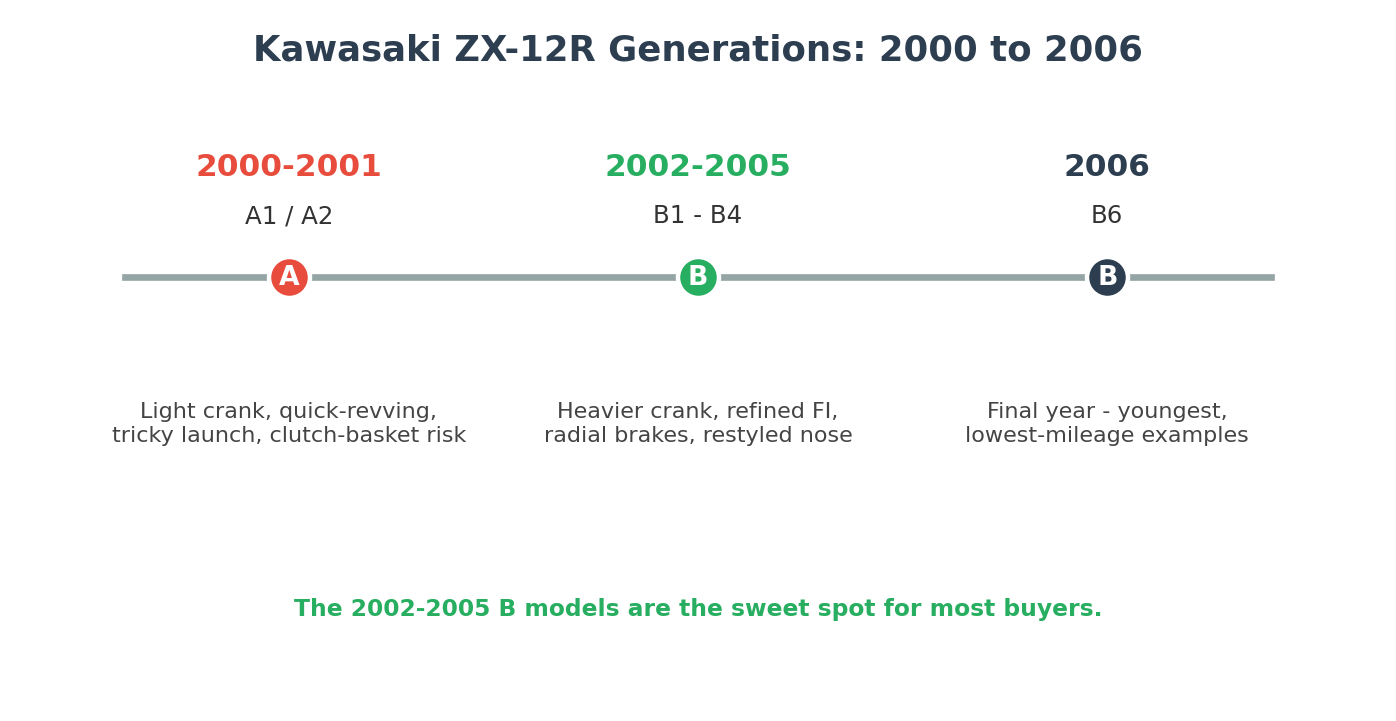
Kawasaki squeezed three distinct phases of ZX-12R into just six years, so knowing which one you are looking at matters more than the odometer. Here is the decoder.
2000-2001: A1 and A2 (the originals)
The launch bikes. These have a lighter crankshaft than the later models, which makes the engine spin up faster and feel more urgent — but it comes at a cost. The light crank makes launching from a standstill genuinely difficult and produces heavy engine braking when you close the throttle. It is the most "raw" ZX-12R to ride, and the one that most rewards an experienced rider.
2002-2005: B1 to B4 (the refined ones)
This is where the ZX-12R grew up. Kawasaki fitted a heavier crankshaft for easier launches and calmer throttle response, refined the fuel-injection mapping and fuel delivery, and added radial-mount front brakes for stronger, more consistent stopping. There were also styling tweaks — a revised upper fairing nose, new snorkel, different mirrors and reshaped ram-air tube covers. For most buyers this is the sweet spot: nearly all the drama, far fewer of the rough edges.
2006: B6 (the send-off)
The final year. Mechanically almost identical to the late B models, the 2006 bikes are the youngest ZX-12Rs you can find and therefore usually the lowest-mileage and cleanest — which matters a lot when you are buying a 20-year-old hyperbike.
Which Year Should You Buy?
If you are experienced, love a challenge and want the purest, most exciting version, hunt down a clean 2000-2001 A model — just go in knowing the launch quirk and clutch-basket risk (more on that below).
For almost everyone else, the answer is a 2002-2005 B model. The heavier crank, sorted fuel injection and radial brakes make it a better bike to actually live with, and the improvements are real, not marketing. If you can find a well-kept 2006, even better — it's the same great B-spec bike with the fewest years on the clock.
The "years to avoid" question has a nuanced answer for the ZX-12R. No year is a lemon. But the 2000-2003 bikes carry a known charging-system weakness, and the 2000-2001 A models are the ones that eat clutch baskets. Neither is a dealbreaker if the bike has been looked after or already fixed — but they are exactly the things to check before you bid.
Known Problems: Clutch Baskets, Charging, and the Monocoque Headache
Every hyperbike of this era has a rap sheet. The ZX-12R's is short, well-documented and cheap to check. Get these three things right and you have bought a very reliable motorcycle.
- Clutch basket (A1/A2, 2000-2001). The early bikes are known for destroying clutch baskets. Owners are split on whether it only happens if you are hard on the bike or whether it is simply a matter of time — either way, on an early ZX-12R this is the first thing to inspect and budget for.
- Charging system (2000-2003). A known weakness on the earlier bikes. A failing regulator/rectifier or stator will leave you stranded, so check for warning signs and confirm the battery is holding a healthy voltage.
- The monocoque service tax. That clever frame has a downside: access is a nightmare. Even changing the air filter is a pain, and a major service at the valve-clearance interval can run closer to £700 at a shop because of the labor involved. This is not a fault — it is a cost of ownership you must plan for.
Despite that list, the verdict from long-term reviewers is warm. Bennetts calls the ZX-12R "a very good value hyperbike that still has more than enough performance while also boasting impressive reliability and not too bad comfort levels." That is the reputation of a bike that was built to last, not just to win a magazine top-speed test. The full Bennetts used review is worth a read before you buy.
What It's Really Like to Live With
Spec sheets lie. Owners don't. So here is what the people who have actually racked up years on a ZX-12R say — the kind of primary detail you will not get from a listing.
First, fuel and range. One owner who has had two ZX-12Rs is blunt about it: expect around 10 L/100 km and a real-world range of "200 km maximum" before you're looking for a station. This is a big, thirsty engine and you should plan tank stops accordingly on a long ride.
Second, everyday usability. The same rider community that races these things also praises them as daily bikes. One owner ran his as his main bike for four years including city commuting in Paris and called it "a treat every day." Another, on his third ZX-12R (a 2003), described it simply as "pure happiness." A fourth found a rough one, restored it and said it came back "comfortable, supple and torquey." That word — torquey — comes up again and again. This is not a peaky, screaming sportbike; it is a wall of midrange you can surf all day.
Third, condition culture. Japanese owners are famous for keeping big bikes immaculate. On a Japanese review of the ZZR1100/ZX-12R lineage, a Western viewer marveled: "Love how Japanese riders keep the old bikes as brand new." That is the whole reason importing from Japan works — the domestic market treats these machines like the classics they are becoming.
Why Import a Kawasaki ZX-12R From Japan
The ZX-12R was a low-volume bike in the West and it has been picked over for two decades. The clean, low-mileage, honest examples increasingly live in one place: Japan.
Japan's domestic market has three things going for it. Bikes are ridden less and stored better, so mileage is genuinely low. The auction system grades every machine on a documented, standardized scale so you know the condition before you buy. And prices are set by local supply and demand, not by the Western "hyperbike nostalgia" premium that is starting to creep in.
That is why a serious ZX-12R buyer looks east. You can browse the kind of Japanese-market bikes AWA Auction sources and see the difference in condition for yourself. When you buy from the source, you skip the tired, thrashed Western examples entirely.
The 25-Year Rule and Import Eligibility by Country
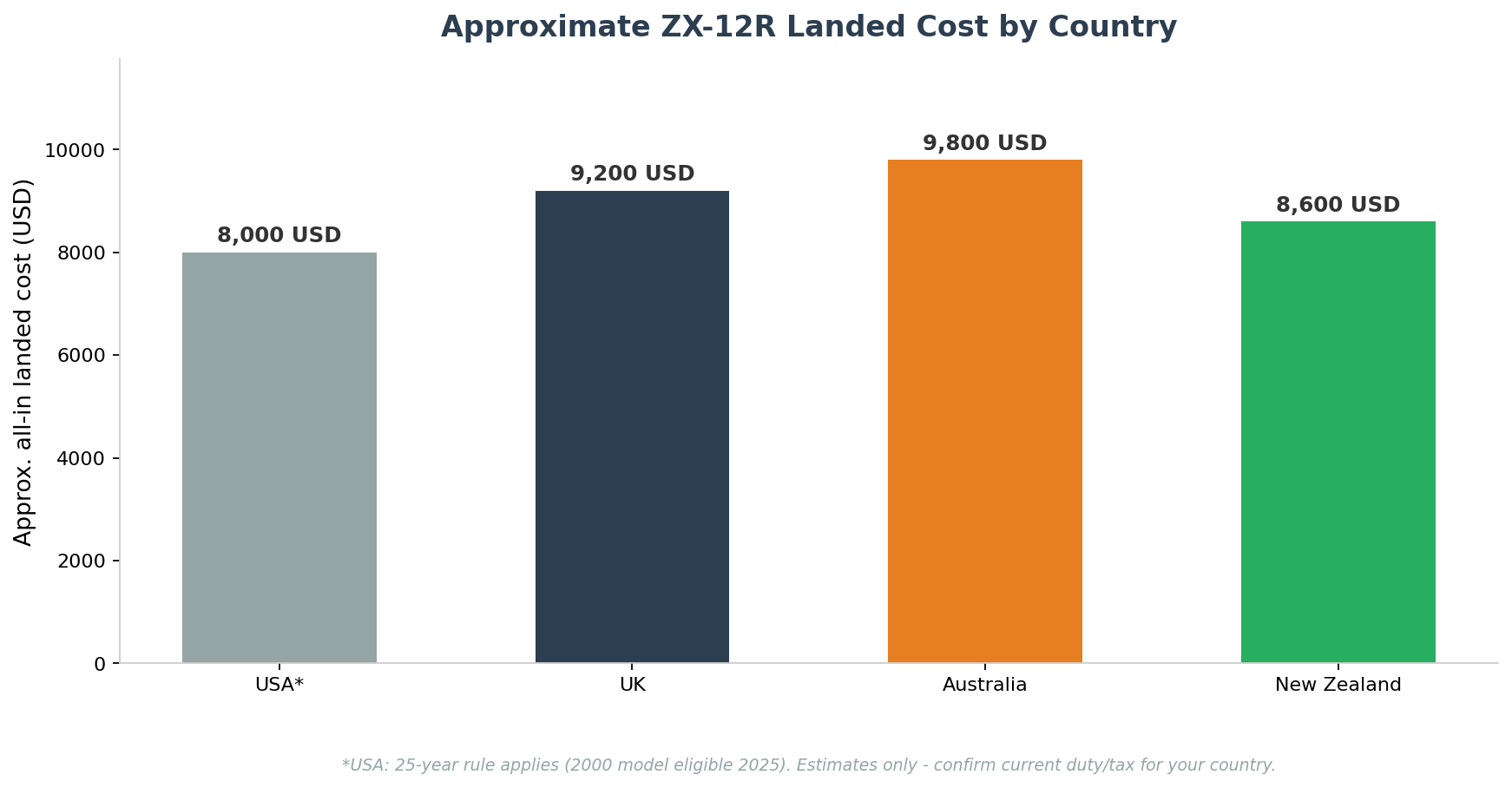
Import rules are where dreams meet paperwork, so let's be honest and country-specific.
United States. Here is the good news and the fine print. The ZX-12R was officially sold in the US from 2000 to 2005, so most American riders can simply buy one domestically. If you specifically want a Japanese-market bike, the US 25-year rule is the clean path: a bike becomes freely importable once it is 25 years old. That means a 2000 ZX-12R is eligible now (2025), a 2001 in 2026, and so on, rolling forward one model year at a time. Importing a newer non-US example before it hits 25 years is a headache best avoided. See the NHTSA import rules for the current process.
United Kingdom. No age barrier. A ZX-12R of any year can be imported and registered. You will handle a NOVA declaration, pay import VAT and duty, and put the bike through the appropriate test before it gets a plate. The UK is one of the friendliest markets for importing a bike like this — the government's importing a vehicle guide walks through each step.
Australia and New Zealand. Both allow ZX-12R imports. Australia's rules are stricter and generally revolve around eligibility schemes and compliance, so confirm your path before you commit. New Zealand is famously import-friendly and has long been a haven for JDM machinery — a clean ZX-12R fits right in.
Wherever you are, the golden rule is the same: confirm your own country's current requirements before you bid, because the paperwork, not the bike, is what trips people up. Our team can walk you through the rules for your country before you spend a cent.
What a ZX-12R From Japan Actually Costs
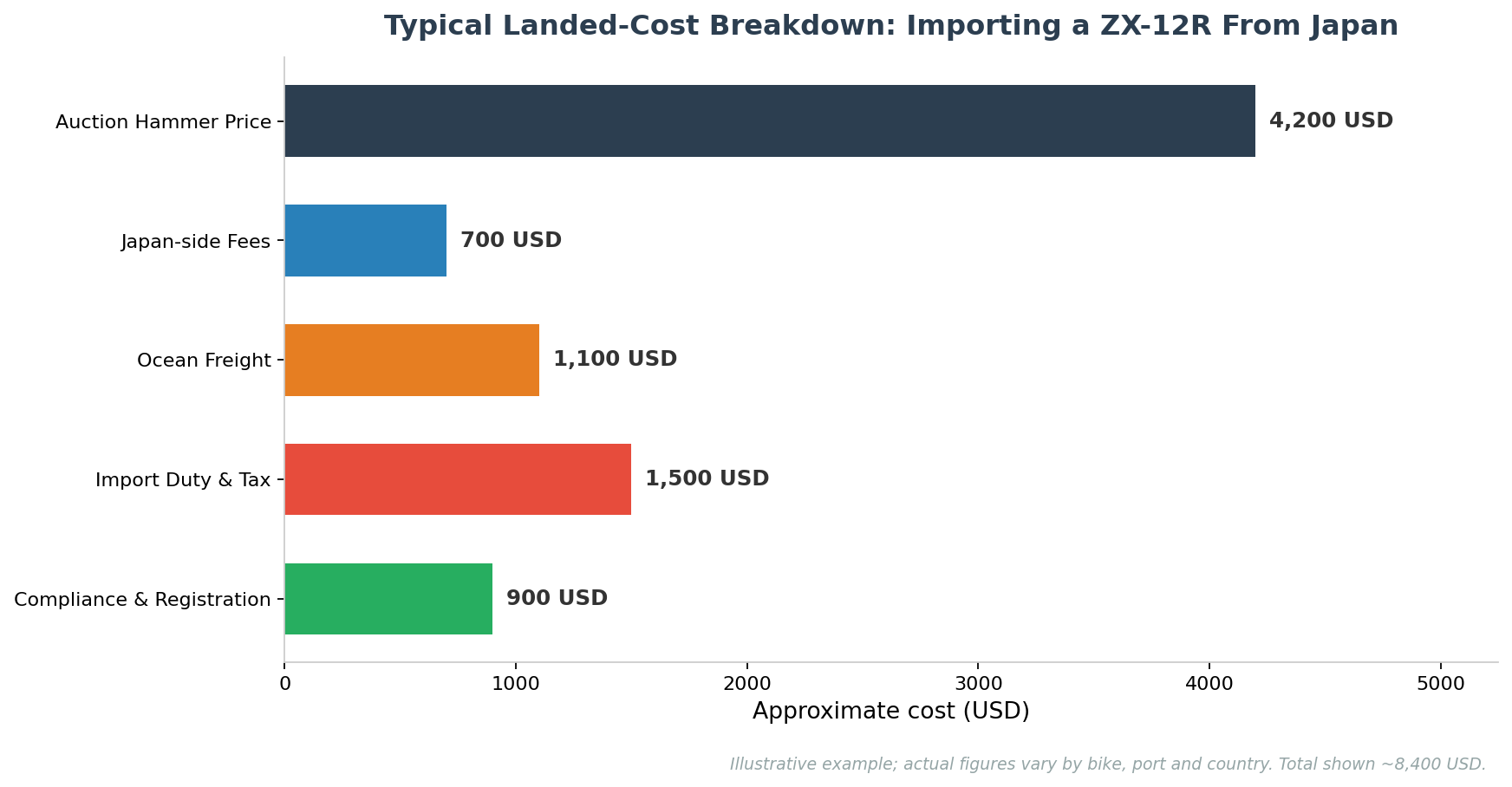
Let's talk real numbers. A clean, honest ZX-12R at Japanese auction typically hammers somewhere in the region of a few thousand dollars — dramatically less than a comparable Hayabusa, precisely because of that reputation gap. On top of the winning bid you add the costs of getting it to your door.
The cost breakdown chart above shows a realistic example. The stack usually looks like this:
- Auction hammer price — the bike itself, the biggest single line.
- Japan-side fees — auction fees, inland transport to the port, and export documentation.
- Ocean freight — container or RoRo shipping to your nearest port.
- Import duty and tax — this varies wildly by country and is often the second-biggest number after the bike.
- Compliance, registration and inspection — the local paperwork to make it road-legal.
One owner memorably described snagging a good ZX-12R for around 3,500 euros and calling it "better than an H2 for the money." That captures the whole value proposition: hyperbike performance at commuter-bike prices. Add shipping and duty and you are still, in most countries, well under what a running Hayabusa of the same era costs. If you want a precise, no-surprises quote for your exact country, ask our team for a landed-cost breakdown.
How to Read the Auction Sheet for a ZX-12R
The auction inspection sheet is your eyes in Japan, and for a fast, 20-year-old bike it is everything. A neutral third-party inspector grades each machine, and learning to read that grade is how you avoid buying someone else's mistake from the other side of the world.
The overall grade runs on a scale where higher is better — a 4 or 4.5 is a genuinely good used bike, a 5 or 6 is exceptional, and anything with an R has been repaired after an accident. But the number is only half the story. The written condition map on the sheet flags scratches, dents, corrosion and rust spot by spot.
For a ZX-12R specifically, use the sheet to check the exact areas that cost money: look for notes around the clutch cover and engine cases (the clutch-basket clue), any mention of electrical faults, and evidence of a hard life like crash damage or worn fairings. Learn the system properly with our guide to Japanese auction grades before you commit to a bid.
The Numbers: ZX-12R Specifications and Performance
Let's put some hard figures behind the legend, because the ZX-12R's spec sheet is the reason it earned a place in the speed war in the first place.
The engine is a 1,199cc liquid-cooled DOHC inline-four with 16 valves, fed by fuel injection with a ram-air system that force-feeds the airbox as speed climbs. Claimed output is around 178 PS at 10,500 rpm, and — crucially — with ram air at speed the real intake pressure pushes effective power higher still. Torque is huge and arrives low, which is exactly why owners keep using that word "torquey." You do not need to chase the redline to make this bike move; it pulls hard from 3,000 rpm in almost any gear.
Dry weight sits around 210 kg, which was competitive for a hyperbike of the era, and the monocoque frame keeps the mass tightly packaged. The bike runs a 120/70 front and a fat 200/50 rear tyre, twin front discs (radial-mount calipers from 2002), and a 20-litre fuel tank. Combine that tank with the roughly 10 L/100 km appetite owners report and you get the honest ~200 km working range we mentioned earlier.
Performance? Even a stock, restricted ZX-12R will run the quarter-mile in the mid-to-high 9-second bracket in the right hands and pull to its 186 mph electronic ceiling with room to spare. The whole tragedy — and the whole bargain — is that the hardware was built to go well beyond that. Free the restriction (more on that next) and the ZX-12R shows what Kawasaki actually intended.
Modifications, Derestriction and the ZX-12R Aftermarket
One reason to buy a ZX-12R is that it responds beautifully to a handful of sensible modifications, and the market for a clean donor bike from Japan makes it the ideal starting point.
The first thing most owners do is address the speed restriction. Because the 186 mph cap was electronic, the ZX-12R community has spent two decades working out how to unlock the bike's real potential with fuelling and ECU changes. We are not going to publish a how-to for going 200 mph on a public road — that is a track-only conversation — but understand that the restriction is a software leash, not a hardware limit, and it is a big part of why enthusiasts love these bikes.
Beyond that, the popular, genuinely useful upgrades are well established: a quality slip-on or full exhaust to shed weight and wake up the intake note, a Power Commander or equivalent to sort the fuelling (the standard maps are conservative), a steering damper for high-speed stability, and braided brake lines to sharpen the older bikes' stopping power. A suspension refresh — fresh fork oil, seals and a serviced rear shock — transforms a tired 20-year-old example.
The ZX-12R also has a small but serious drag-racing following. The bottom end is famously tough, which is why builders have long used it as a base for big-power turbo and nitrous projects. You will find plenty of forum threads and videos of ZX-12Rs pushing well past 250 rear-wheel horsepower. That toughness matters even if you never modify yours: it means a well-maintained standard engine is barely working at stock power and tends to go the distance. When you source a low-mileage bike from Japan, you are getting an engine with decades of life left in it.
ZX-12R vs ZX-14R: Buy the Original or the Successor?
If you are shopping the Kawasaki hyperbike family, you will inevitably ask whether to skip the ZX-12R and go straight for its successor, the ZX-14R (the ZZR1400 in some markets). Here's the honest breakdown.
The ZX-14R, launched in 2006 as the ZX-12R bowed out, is the bigger, smoother, more modern machine. It has more capacity, more midrange, better electronics and a more refined ride. If your priority is effortless real-world speed and touring comfort, and your budget stretches to it, the ZX-14R is the better pure motorcycle.
But the ZX-12R has three things the ZX-14R can't buy back. It is significantly cheaper. It is lighter and steers more keenly, so it feels more like a sportbike and less like a missile-shaped sofa. And it has that irreplaceable place in history as the bike that ended the speed war — the monocoque original that was born to hit 200 mph. For a collector or an enthusiast who values character and value over outright polish, the ZX-12R wins. For a rider who just wants the fastest, comfiest big Kawasaki, the ZX-14R does. Both are excellent imports; the right answer is about what you want to feel, not just numbers.
Is the ZX-12R a Future Classic? Why Collectors Are Waking Up
For years the ZX-12R was just a cheap fast bike. That is quietly changing, and if you are buying now you are buying ahead of the curve.
Think about what the ZX-12R actually represents. It is the machine that ended the top-speed war — the last true "we're going for 200 mph" project before the industry agreed to stop. It carries a world-first monocoque frame that no other production bike has copied. And it was built for only six years, in relatively modest numbers, with the cleanest survivors sitting in Japanese garages. Those are the exact ingredients that turn a used bike into a collectible.
You can already see it happening with the first-generation Hayabusa, whose clean early examples have started climbing in value as buyers realize the era is over — no manufacturer will ever build an unfiltered 190 mph missile like this again. The ZX-12R sits one step behind the Hayabusa on that curve, which means it is still cheap while it has every reason not to stay that way. Japanese owners have kept the best ones effectively as new, and those are the bikes worth chasing.
None of this means you should buy a ZX-12R as a pure investment — buy it because it is a spectacular motorcycle you will actually enjoy. But it is nice to know that a clean, low-mileage, honest example bought sensibly from Japan is the kind of bike that tends to hold its money rather than bleed it. That is a rare thing in the used-bike world, and it is one more reason to buy the right one, from the right place, the first time.
Container vs RoRo: How to Ship a ZX-12R From Japan
Once you have won your ZX-12R, it has to cross an ocean, and how you ship it changes both the cost and the risk. There are two ways to do it, and the right choice depends on your budget and how precious the bike is to you.
RoRo (roll-on, roll-off) is the budget option. Your bike is strapped down inside a dedicated vehicle vessel alongside cars and other machines, rolled on at the Japan port and rolled off at the destination. It is cheaper and perfectly fine for a standard used bike, but the machine is handled by port staff and is exposed to the elements of a shared deck, so it is not the choice for a concours example.
Container shipping costs more but wraps the bike in protection. Your ZX-12R can be crated or securely strapped inside a container, sometimes sharing the space with other bikes to split the cost. Nobody rides or rolls it around a busy dock, and it arrives exactly as it left. For a clean, low-mileage hyperbike you plan to keep, the extra spend on a container is cheap insurance.
Either way, factor sea transit at several weeks plus port handling on both ends into your timeline. A rushed import is where mistakes happen, so plan the shipping the moment you win the bike, not after. Our team arranges both methods and will tell you honestly which one your specific ZX-12R deserves.
Common Mistakes Buyers Make Importing a ZX-12R
Most import horror stories are not bad luck — they are avoidable mistakes. Here are the ones that catch ZX-12R buyers most often, so you can sidestep every single one.
Chasing the cheapest bike instead of the cleanest. A rough ZX-12R with a hidden clutch-basket or charging fault will cost you more in the first six months than a properly graded bike costs to buy. On a 20-year-old hyperbike, condition beats price every time.
Ignoring the auction grade. The grade and condition map exist to protect you. Bidding on an ungraded bike, or waving away an R (repaired) note on a 186 mph machine, is how people import someone else's crash.
Forgetting the paperwork clock. Buyers get so focused on the bike that they skip confirming their own country's rules. Check your import eligibility, duty and testing requirements before you bid, not after the bike is on a boat.
Under-budgeting the landed cost. The hammer price is only the start. Add Japan-side fees, freight, duty, tax and local compliance, and the true cost can be well above the bid. Get a full landed-cost figure up front so there are no nasty surprises at the port.
Going it alone on the first try. The auction system is in Japanese, the sheets take experience to read, and the logistics are unforgiving. A good agent turns all of that into a single conversation. If you would rather not learn the hard way, let our team handle the whole import for you.
How AWA Auction Helps You Buy One
Buying a hyperbike sight-unseen from a Japanese auction is not something you want to attempt alone on your first try. That is the entire reason AWA Auction exists.
We give you access to the same Japanese auction network the dealers use, we translate and interpret the inspection sheet so you know exactly what you are bidding on, we bid on your behalf, and we handle export, shipping and the documentation your country needs. You get the pick of Japan's clean, low-mileage ZX-12Rs without needing to speak Japanese or fly to Osaka.
Ready to find yours? Browse current listings to see what's available right now, or contact our team and tell us the exact ZX-12R you're after — year, condition, budget — and we'll hunt it down.
The ZX-12R is one of those rare bikes that gives you more than you pay for: the power of a hyperbike, the history of a legend, and a price that has not caught up with either yet. Buy a clean one from Japan, look after it, and you will own a genuine piece of the speed war for a fraction of what it deserves. That window will not stay open forever, so if a ZX-12R has been on your list, now is the time to move.
Frequently Asked Questions
Answers to the questions ZX-12R buyers ask most, straight from owner forums and real import experience.
See Also
Share this article: