
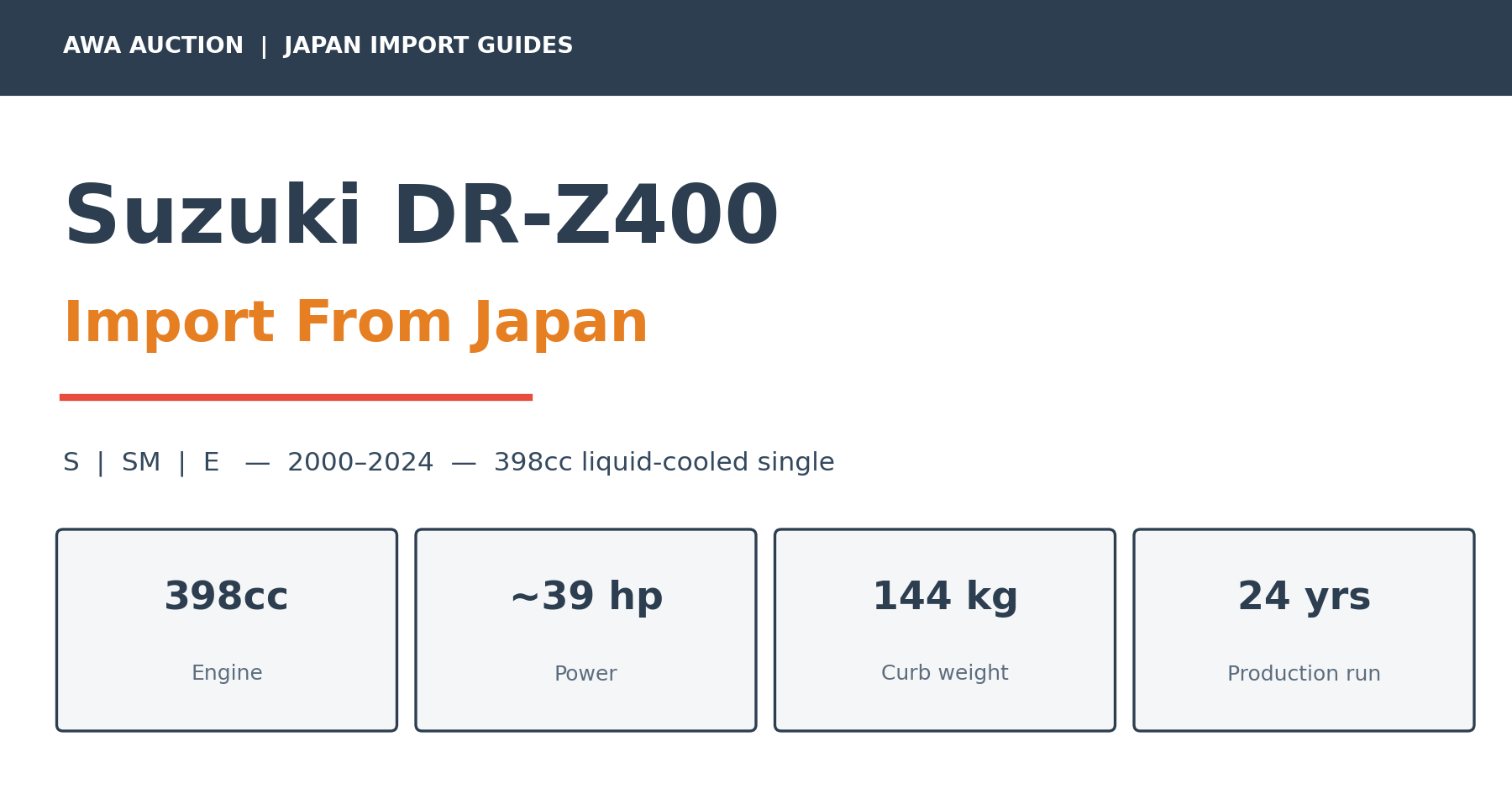
A Suzuki DR-Z400 import from Japan is one of the few remaining ways to buy a genuinely simple, genuinely tough dual-sport that has not been softened by twenty years of emissions regulation. Suzuki built this bike from 2000 to 2024 and barely touched it. No fuel injection. No ABS. No ride modes. A 398cc liquid-cooled single, a Mikuni carburettor, a five-speed gearbox, and a frame that has been thrashed through deserts, dropped in green lanes, and wheelied down every high street in the English-speaking world.
Then, in 2025, Suzuki replaced it with the fuel-injected DR-Z4S and DR-Z4SM. Which means the DR-Z400 is now a finished story — a complete, fully documented used platform with 24 years of known faults, known fixes, and a global parts industry that has not gone anywhere.
Here is the thing nobody mentions about this bike: the hard part of buying one is not finding a DR-Z400. They are everywhere. The hard part is finding one that has not been abused, bodged, or "improved" by an owner with a drill and a YouTube tab open. That is exactly the problem Japan solves.
This guide covers what you actually need to know: which variant to chase, which years matter, the four mechanical faults that separate a good bike from a money pit, what a landed import really costs against UK and Australian used prices, and how to read a Japanese auction sheet so you are bidding on evidence instead of hope.
DR-Z400S vs DR-Z400SM vs DR-Z400E: sorting out the names first
Three letters change everything, and plenty of buyers get this wrong before they have even opened an auction listing.
DR-Z400E is the off-road model. No lights in most markets, no mirrors, no number plate hanger, closer gearing, and the lightest of the three at around 132kg. It is a competition-flavoured trail bike. Importing one is straightforward as a machine, but registering it for road use in the UK, Australia or New Zealand is a paperwork fight you probably do not want.
DR-Z400S is the street-legal dual-sport. Lights, indicators, mirrors, electric start, a 21-inch front wheel and a 935mm seat height that will have shorter riders tiptoeing at every junction. This is the model that goes green-laning on Sunday and commutes on Monday.
DR-Z400SM is the supermoto, launched in 2005. Same engine, but 17-inch wheels, inverted forks, a 300mm front disc and road-biased suspension tuning. Seat height drops to around 890mm. This is the variant most people actually want, and the price data reflects it.
Pick your variant before you start bidding. A DR-Z400S converted to supermoto wheels by a previous owner is not the same bike as a factory SM — the SM got different forks and brakes, not just rims.
Why import a DR-Z400 from Japan instead of buying local
Suzuki sold the DR-Z400 in the UK, Australia, New Zealand and the US, so you are not importing something unobtainable. You are importing a condition. And on this particular bike, condition is the entire argument.
Think about what happens to a dual-sport in its home market. It gets ridden through winter salt. It gets dropped in mud and pressure-washed into the bearings. It gets bought by a rider learning to wheelie. It gets an airbox hacked open with a hole saw and never rejetted. By the time a ten-year-old DR-Z400 reaches its fourth owner in Britain, it has usually lived a hard life and the paperwork trail has evaporated.
Japan is different for three specific reasons. Garage storage is normal, which is why Japanese-market machines routinely arrive with clean frames, unpitted forks and readable fasteners. Annual mileages are low — a great many Japanese bikes are weekend machines. And the Japanese auction system grades every single lot with a written inspection sheet, so you can see corrosion, scratches and mechanical notes recorded by an independent inspector before you place a bid.
The honest version: you are not importing a DR-Z400 from Japan to save money on the cheapest example. You are importing to buy the top 10% of surviving examples at roughly mid-market money. On a bike where a neglected engine costs more to fix than the bike is worth, that trade is worth making.
The 398cc single that refuses to die
The DR-Z400 motor is the reason this bike has a cult following instead of a fanbase. It is a 398cc liquid-cooled, four-valve, DOHC single producing roughly 39hp and 29lb-ft. Those are not exciting numbers. They are, however, numbers that a 144kg motorcycle turns into something extremely entertaining.
What matters more is durability. Owners regularly report DR-Z400 engines passing 50,000 miles on nothing more than oil, filters and periodic valve checks. The design is deliberately conservative: no balance-shaft complexity beyond what the job needs, a carburettor instead of a sensor-dependent injection system, and a service procedure that a competent home mechanic can complete on a Saturday.
Cross Training Adventure ran an owner-survey video on DR-Z400 problems and mods that has drawn over 457,000 views, and the recurring theme across owners is consistent: the bottom end is not the weak point. What kills these engines is neglect and bad modification, not design.
There is one genuine engineering compromise to know about. The DR-Z400 has a relatively small oil capacity for a hard-working single, which means oil degrades faster under heat than it would in a bigger-sumped engine. Use a good synthetic and change it on schedule rather than when you remember. This is not a flaw so much as a bike telling you what it needs.
DR-Z400 generations explained: what changed and when
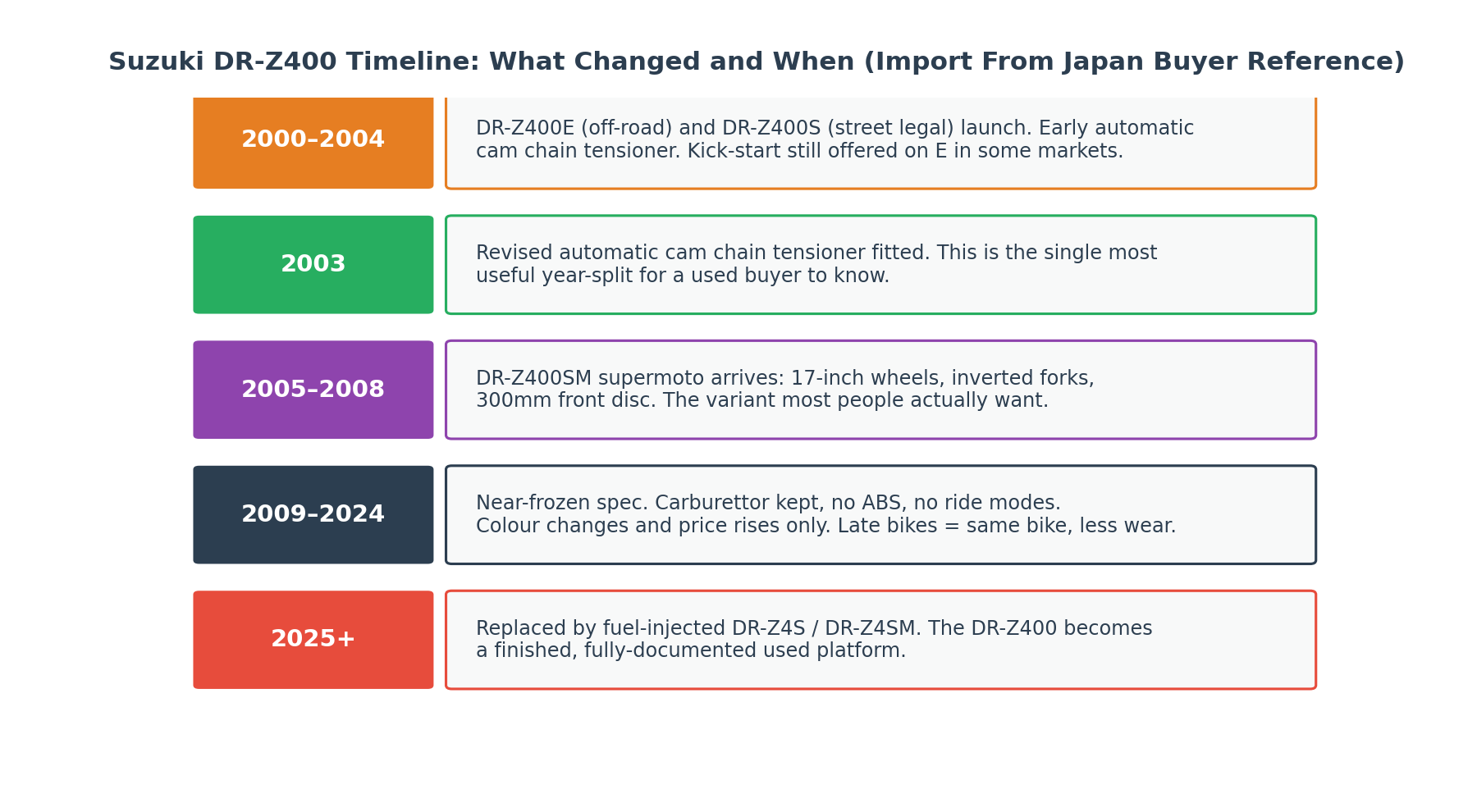
Calling these "generations" is generous. Suzuki made one significant mechanical revision in 24 years and then left the bike alone.
2000–2004: Launch years. The DR-Z400E off-road model and DR-Z400S street-legal model arrive together. These carry the original automatic cam chain tensioner, which is the one meaningful mechanical black mark on the bike's record.
2003: Suzuki revised the automatic cam chain tensioner. If you remember one date from this article, make it this one. It is the single most useful year-split for a used buyer.
2005–2008: The DR-Z400SM arrives with 17-inch wheels, inverted forks and the bigger front disc. This is when the DR-Z400 stopped being a trail bike with lights and became a genuine urban weapon.
2009–2024: Effectively frozen. Colour schemes changed. Prices crept upward. The carburettor stayed. ABS never appeared. A 2022 DR-Z400S is mechanically the same bike as a 2009 one, which is genuinely useful news for an importer — a late, low-mileage Japanese bike is the same machine with less wear and a shorter corrosion history.
2025 onward: Replaced by the DR-Z4S and DR-Z4SM, both fuel-injected, both with ride-by-wire, traction control, a gravel mode and ABS, at an MSRP of $8,999. Different bike, different buyer.
DR-Z400 specifications: what you are actually importing
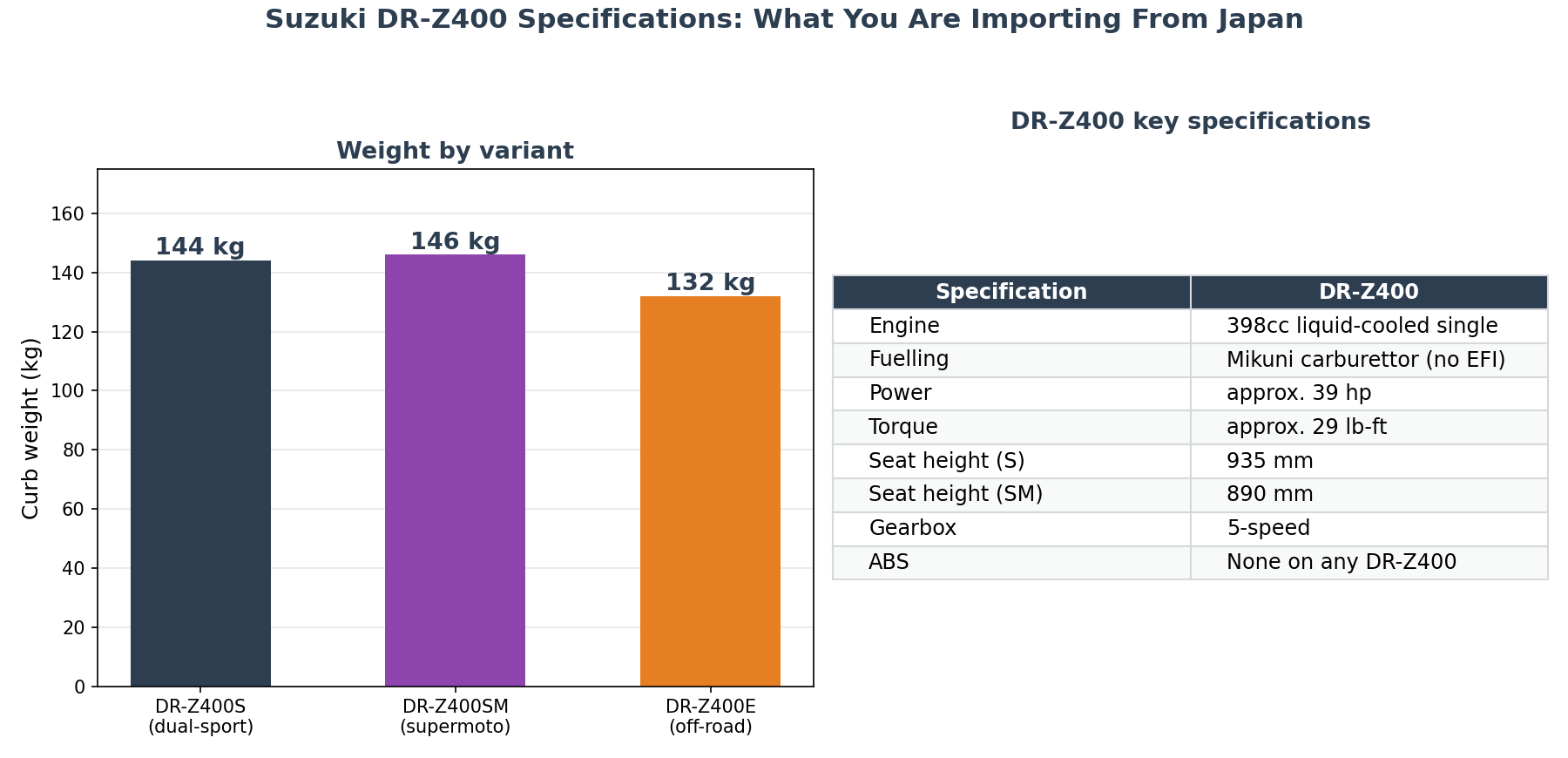
The numbers matter less than the ratio between them. A 398cc single making 39hp sounds modest until you put it in a chassis weighing 144kg wet. That is roughly a third less than a mid-capacity naked bike, and it changes what the bike feels like in every situation that involves turning, stopping or picking it up off the ground.
Fuelling is a Mikuni carburettor throughout the entire production run. No fuel injection, ever. That means no fuel pump to fail, no throttle position sensor to go out of calibration, and no dealer software required to diagnose a running fault. It also means the bike cares about altitude and needs its jetting matched to whatever else you have changed.
Seat height is the specification most likely to end your interest in a DR-Z400S. At 935mm it is a genuinely tall motorcycle. The DR-Z400SM drops to roughly 890mm thanks to smaller wheels, which is still tall but manageable for most riders. Lowering links and shaved seats exist, and both compromise the bike slightly.
Gearbox is a five-speed. Fifth is tall enough for motorway work on the SM and slightly overwhelmed on the S with its 21-inch front and knobbly tyres. Neither variant is a touring bike, and anyone telling you otherwise has never done 200 miles on one.
No DR-Z400 of any year has ABS. If ABS is a requirement for you, the 2025 DR-Z4S is the bike you want and this guide is not for you.
Known DR-Z400 problems to check before you bid
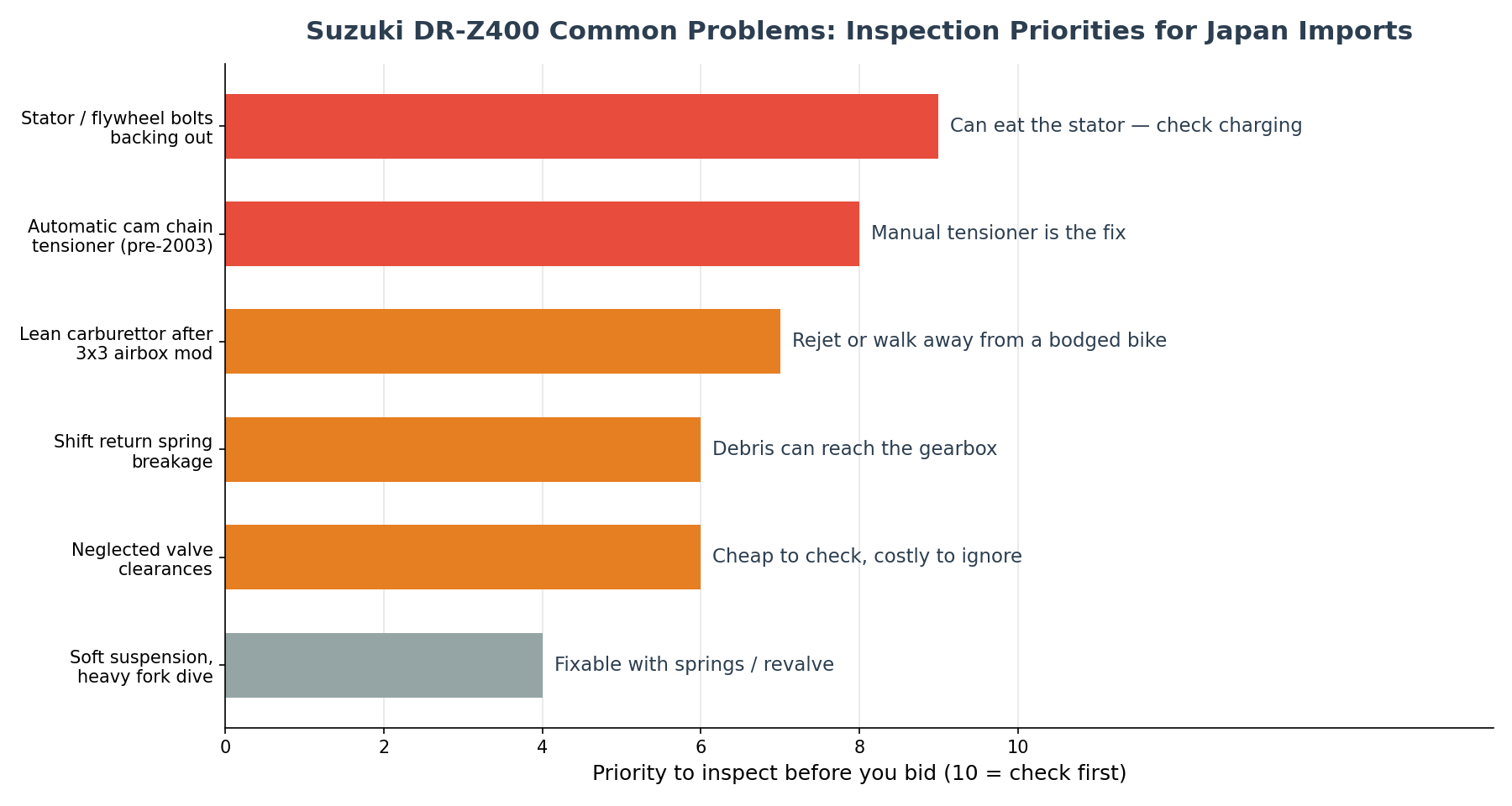
Twenty-four years of production means every fault has been found, documented and argued about on forums. That is an advantage. Here is the short list that actually decides whether a bike is worth bidding on, ranked by how much it costs to get wrong.
Stator and flywheel bolts backing out. The most expensive common failure on the bike. Documented across owner forums including ThumperTalk and Suzuki Central, the bolts securing the flywheel can loosen, back out, and in the worst cases destroy the stator and damage the flywheel. The fix is preventive and cheap — clean threads, plenty of thread locker, correct torque — but the repair after a failure is not.
Automatic cam chain tensioner on pre-2003 bikes. The original ACCT can allow the cam chain to stretch prematurely. Owners on Adventure Rider and SuperMoto Junkie have documented cases where a stretched chain jumps a tooth, and a single-cylinder engine that jumps a tooth is a single-cylinder engine that meets its own valves. A manual cam chain tensioner is the accepted fix and is a common, sensible modification to see on an older bike.
Lean running after the 3x3 airbox modification. More on this below, because it deserves its own section.
Shift return spring breakage. The shifter return spring can snap. On its own that is a cheap part. The risk is the broken fragment finding its way into the gearbox, which turns a cheap job into an engine-out job. A DR-Z400 with vague, notchy or non-returning gear selection is a bike you inspect before you buy, not after.
Neglected valve clearances. Not a design fault — a maintenance fault, and an extremely common one. Owners skip it because the bike keeps running. Tight clearances on a four-valve single burn valves eventually.
Soft suspension and heavy fork dive. Reviewers have consistently noted the stock suspension feels underdamped when you push, with noticeable dive under braking on the SM. This is a tuning issue rather than a fault, and springs or a revalve fix it.
The cam chain tensioner question: how much should it worry you?
This is the one topic where DR-Z400 forums generate more heat than light, so here is the practical version.
The automatic cam chain tensioner on early bikes has a real, documented failure pattern. Suzuki revised it in 2003. That does not mean every pre-2003 bike is a grenade and every post-2003 bike is safe — it means the risk profile is different and the inspection priority changes.
On a pre-2003 import, you want one of two things: evidence that a manual cam chain tensioner has been fitted, or a plan to fit one shortly after the bike lands. A manual tensioner is an inexpensive part. Fitting it is a job most competent home mechanics manage, and it converts an ongoing worry into a maintenance item you check periodically.
On a 2003-onward bike, treat the cam chain as a normal wear item. Listen for rattle on start-up and light throttle. FortNine produced an engine-diagnosis video specifically about a DR-Z that "sounds like it wants to kill itself," which has drawn over 388,000 views — a reminder that top-end noise on this engine is common enough to warrant a whole video, and diagnosable enough that you can learn to hear it.
Here is the honest framing: this is not a reason to avoid the DR-Z400. It is a reason to prefer a documented bike over a cheap one, which is precisely the argument for importing from Japan in the first place.
Stator failure: the cheap bolt that becomes an expensive weekend
If you only inspect one electrical system on a DR-Z400, make it the charging system.
The failure sequence is well documented. Flywheel or stator bolts loosen. A bolt backs out. It contacts the rotating flywheel. In the worst outcome it takes the stator windings with it. Riders discover this when the battery stops charging, and by then the parts bill is meaningful.
What makes this worth knowing for an importer is that it is diagnosable remotely, at least partially. A bike with an inspection sheet noting electrical faults, a non-starting engine, or a recently replaced battery is a bike worth asking further questions about. A battery that has been replaced twice in short succession is a charging system talking to you.
TheMotorcycleMD's channel has built a large audience on exactly this territory, with videos on motorcycle electrical faults and battery drain diagnosis pulling nearly 500,000 and 390,000 views respectively. That is the volume of a problem people genuinely have.
Once landed, the preventive job is straightforward: pull the cover, clean the threads properly, use quality thread locker, torque to specification. Do it once and stop thinking about it.
Jetting, the 3x3 mod, and why a "modified" DR-Z400 can be a red flag
The most common modification on this bike is the 3x3 mod — cutting a three-inch by three-inch hole in the airbox lid to improve airflow. It works. It also makes the bike run lean, because the stock Mikuni carburettor was jetted for the restricted airbox.
Run a 3x3 without rejetting and you get popping on the overrun, higher running temperatures and a bike that feels flat where it should feel eager. Forum consensus for sea level to roughly 4,000 feet with a 3x3 and stock exhaust lands around a 155 main jet with a 25 pilot; add an aftermarket exhaust and a 160 main is commonly quoted. Numbers vary by altitude and setup, and anyone quoting one figure as universal truth has not ridden at elevation.
Here is the part that matters for a buyer. Yammie Noob's DR-Z400 content has drawn over 643,000 views on the main review and another 226,000 on a video titled "Most Important DRZ400 Mod EVER! (No More Jetting)" — and the popularity of that second video tells you how many owners are wrestling with fuelling they do not understand.
So when you see a heavily modified DR-Z400 in an auction listing, ask a harder question than "what has been done to it?" Ask whether the person who did it finished the job. A hacked airbox with a stock carburettor is not a modification. It is an unfinished one, and you inherit it.
This is a genuine argument in favour of a stock Japanese bike. Bennetts made the same point in its DR-Z400SM buying guide: the best SM to buy is a standard one, because performance parts frequently spell trouble.
Best and worst years to buy a DR-Z400
Because Suzuki changed so little, "worst year" on a DR-Z400 means something different than it does on most bikes. There is no catastrophic model year. There is a risk gradient.
Years to approach carefully: 2000 to 2002, purely because of the original cam chain tensioner. These bikes are also now old enough that corrosion, wiring degradation and multiple owners are the real story. A good one is a good bike. A cheap one is a project.
The sweet spot for a DR-Z400S: 2005 onward. Revised tensioner, mature parts supply, and enough of them built that you can be picky.
The sweet spot for a DR-Z400SM: honestly, any of them, with a preference for later. The SM ran from 2005 and changed almost nothing, so the newest example your budget reaches is usually the correct answer. A 2018 SM is a 2006 SM with fewer heat cycles.
The one to actively chase from Japan: a late, low-mileage, unmodified DR-Z400SM in stock trim. It is the same bike people paid new money for, with a fraction of the wear, a documented inspection sheet and no previous owner's carburettor experiments to undo.
Notice what is missing from this list: any advice to avoid a particular year because Suzuki broke something. They did not. That is unusual and it is worth valuing.
What the DR-Z4S replacement means for DR-Z400 values
This is the section most DR-Z400 buying guides have not caught up with, because it only became relevant recently.
In 2025 Suzuki launched the DR-Z4S and DR-Z4SM at $8,999 apiece. Fuel injection, ride-by-wire, a three-mode drive selector, traction control with a dedicated gravel mode, selectable ABS, a new steel twin-spar frame with an aluminium subframe and swingarm. It is a better motorcycle by every objective measure.
It is also a different proposition. The DR-Z400's appeal was always that it had nothing to go wrong. Add sensors, add electronics, add ABS, and you add capability along with things that need diagnosis when they misbehave.
Two consequences follow for anyone buying used. First, the DR-Z400 is now a closed platform. Every fault is known, every fix is documented, and the aftermarket has 24 years of production volume to support. That is the safest possible position for a used bike to be in.
Second, clean stock examples get scarcer, not more common, from here. The supply of unmodified DR-Z400s stopped growing in 2024. Demand from riders who specifically want a carburettor and no electronics has not stopped. RevZilla's first ride of the 2025 DR-Z4SM generated exactly the reaction you would expect — plenty of interest in the new bike, and plenty of people saying they would rather keep the old one.
If you want a carburetted DR-Z400 in genuinely good condition, the window for buying one cheaply is closing, not opening.
DR-Z400 used prices vs a Japan import landed on your driveway
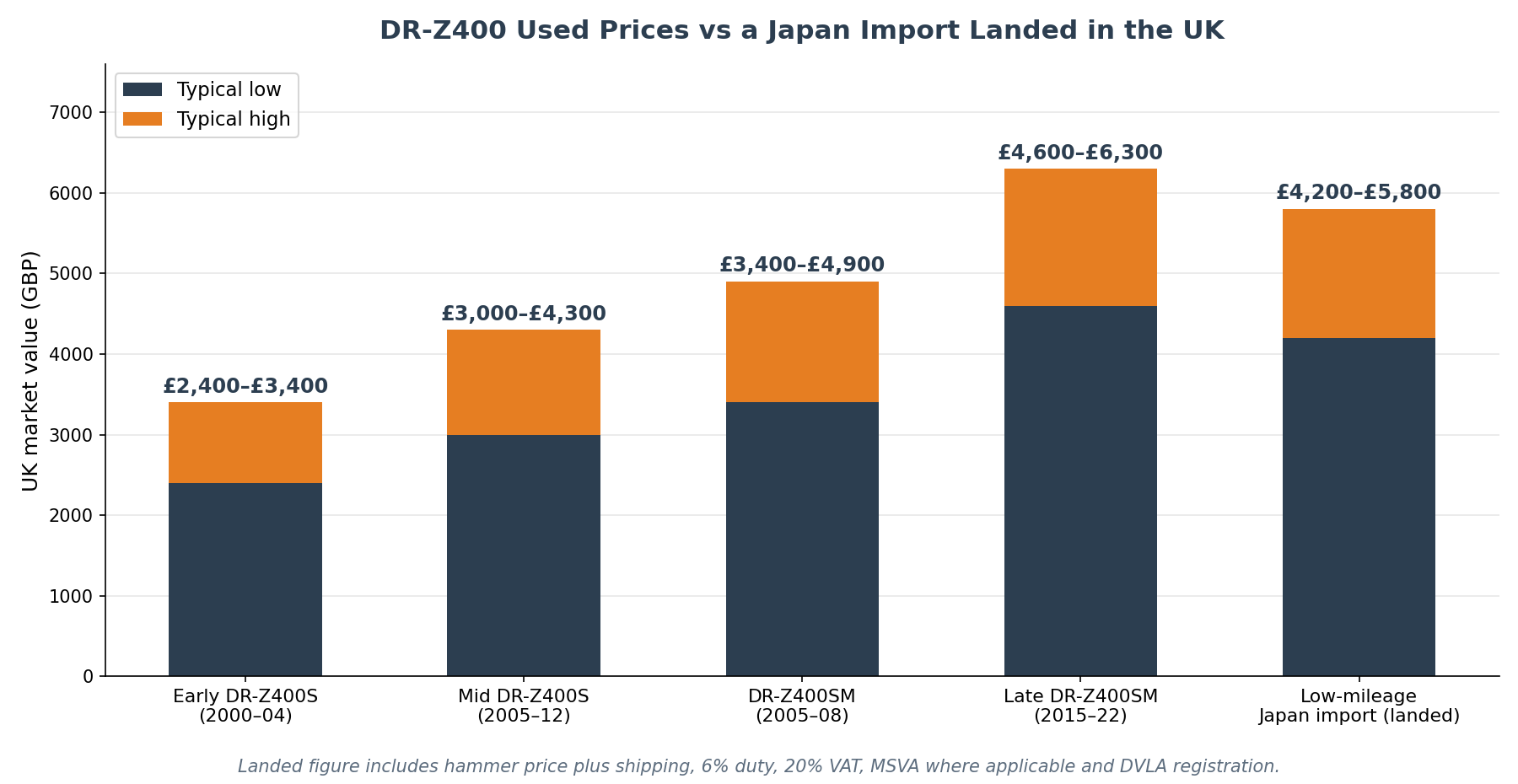
Here are realistic UK market figures, then the import maths.
An early DR-Z400S from 2000 to 2004 sits around £2,400 to £3,400 depending on condition and history. A mid-period DR-Z400S from 2005 to 2012 runs roughly £3,000 to £4,300. A DR-Z400SM from the 2005 to 2008 launch years lands around £3,400 to £4,900. Late SMs from 2015 onward command £4,600 to £6,300, and dealer-stocked very-low-mileage examples have been advertised well north of that — £6,697 for a 213-mile 2026-registered SM is a real listing, and near-new stock has been advertised between £7,499 and £7,995.
Now the import side. On top of a Japanese hammer price, budget for shipping at roughly £400 to £1,000 depending on whether you go RoRo or share a container, 6% import duty on machines over 250cc, 20% VAT calculated on the landed value, MSVA at £100 to £250 if the bike is under ten years old, and £55 for DVLA registration. Add a realistic allowance for a UK MOT and any remedial work.
Total add-on cost lands in the £1,500 to £2,500 range for a typical DR-Z400. A well-bought low-mileage example therefore arrives at somewhere around £4,200 to £5,800 all-in.
One worthwhile note for anyone importing an early bike: machines over 30 years old attract 0% duty and reduced 5% VAT as historic vehicles. The DR-Z400 launched in 2000, so the first examples reach that threshold in 2030. Not yet — but if you are buying an early bike to keep, that is a genuinely useful date to have in your diary.
Is importing a DR-Z400 from Japan actually worth it? The honest maths
Look at those two numbers next to each other and the picture is clear, but it is not the picture importers usually sell you.
A landed Japanese DR-Z400 at £4,200 to £5,800 costs roughly what a good late SM costs in the UK. You are not saving thousands. On the cheapest end of the market — a tired early DR-Z400S at £2,400 — importing makes no financial sense whatsoever, because the fixed costs of shipping and compliance do not shrink to match a cheap bike.
So when does it work?
It works when you want a specific thing the local market cannot reliably supply: a low-mileage, unmodified, corrosion-free example with documented condition. In the UK, a fifteen-year-old dual-sport that has never seen road salt is close to a unicorn. In Japan, it is a Tuesday.
It works when you are buying the SM, where local prices are high enough that the import maths gets genuinely competitive.
It works when you value evidence. A Japanese auction sheet gives you an independent inspector's assessment. A private seller in a car park gives you an opinion from someone who wants your money.
It does not work when you want the cheapest possible DR-Z400. Buy that one locally, budget for a full recommissioning, and accept what you are getting.
How to import a DR-Z400 from Japan: the six steps
The process is more administrative than difficult. Here is the sequence for a UK import; Australia and New Zealand differ in the compliance step but follow the same shape.
1. Set your specification and your ceiling. Decide S or SM, decide the year range, decide the maximum landed cost. Write it down. Auctions are designed to make you forget it.
2. Source and bid through an agent with auction access. Japanese motorcycle auctions are trade-only. You need an exporter who can inspect, translate the sheet and bid on your behalf.
3. Read the auction sheet before bidding. This is the step that decides everything. More on it below.
4. Arrange shipping and pay on arrival. RoRo is cheaper, container is safer and often shared. Once the bike lands, file your NOVA declaration within 14 days of arrival — HMRC will then bill you for duty and VAT.
5. Get approval. Bikes under ten years old need MSVA. Bikes over ten years old are generally exempt if unmodified and compliant on basic safety items such as lighting. This is one area where a stock bike saves you real hassle.
6. Register with the DVLA. £55, plus your approval certificate, NOVA confirmation and proof of purchase. Then MOT it and ride it.
Ready to see what is available? Browse our current Japanese auction listings and we will walk you through the specification and the paperwork.
How to read a Japanese auction sheet on a DR-Z400
Every bike in a Japanese auction carries an inspection sheet completed by an independent grader. Learn to read it and you have an advantage no local buyer has.
Overall grade. Grades run roughly 1 to 6 plus S for new. Aim for grade 4 or above on a DR-Z400. Grade 3 and below usually means visible damage, heavy wear or a repair history, which on a dual-sport frequently means an off-road life.
Corrosion and scratch notation. The sheet marks corrosion, scratches and dents by location. On a DR-Z400, pay particular attention to notes around the exhaust header, the lower frame rails and the fork lowers.
Mileage and verification. Look for confirmation that the odometer reading is consistent with the bike's condition and paperwork.
Modification notes. Japanese sheets flag non-standard parts. On this bike that is gold. An exhaust and airbox note tells you to ask about jetting before bidding, not after.
What to ask an agent to check in person. Charging system function, gear selection through all five gears, top-end noise on start-up, and whether the airbox lid is intact. Those four questions filter out most of the bikes that turn into projects.
Our team reads these sheets daily and translates what actually matters. If you want a second opinion before you commit, talk to us first.
DR-Z400 vs rival Japanese dual-sports: which import makes sense
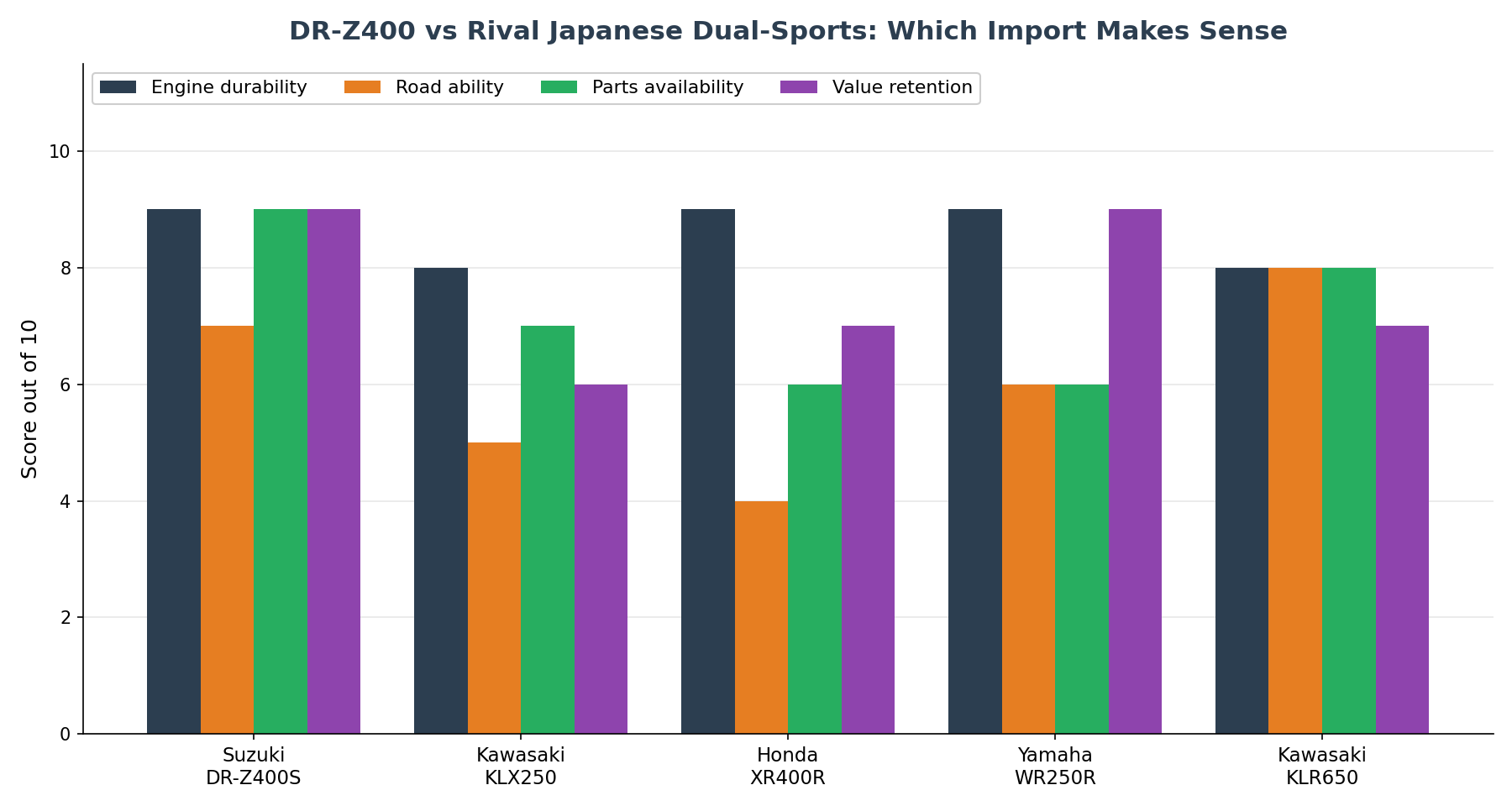
Kawasaki KLX250. Lighter and friendlier off-road, considerably slower on it. The KLX runs out of engine on anything faster than a B-road, and a 250 that needs to be thrashed to keep up wears faster than a 400 that does not. Choose the KLX if your riding is 80% dirt.
Honda XR400R. Air-cooled, kick-start, and mechanically about as durable as anything Honda has built. It is also the least road-capable bike here by a distance, and finding a genuinely street-legal one is a paperwork adventure. A wonderful trail bike, a poor commuter.
Yamaha WR250R. The intelligent alternative. Fuel-injected, superb suspension, brilliantly engineered, and it holds value ferociously — which is precisely the problem. WR250Rs are expensive used and were built in smaller numbers, so parts availability is thinner. If your budget stretches and you want modern fuelling, it is a genuine rival.
Kawasaki KLR650. A different animal. Heavier, softer, more comfortable, far better on a motorway, notably worse in tight going. The KLR is a long-distance travel bike. The DR-Z400 is a bike that fits in a lift.
Where the DR-Z400 wins is the combination nobody else quite matches: durable engine, genuine road ability, huge parts supply from 24 years of production, and strong value retention. It is the compromise bike that stopped feeling like a compromise.
Running costs: what a DR-Z400 actually costs to own
Cheap. Genuinely cheap, and that is a large part of the appeal.
Fuel consumption sits comfortably in the 55 to 65mpg range on the S with sensible riding, dropping on the SM if you use the throttle the way the SM invites you to. The fuel tank is small, so expect to plan around range rather than economy — this is a bike you fill often, not a bike that costs much to fill.
Servicing is where the savings compound. Oil and filter changes are a home job. Valve clearance checks use shims and require patience rather than special tools. There are no injectors to clean, no ECU to interrogate, no dealer-only diagnostics. A carburettor rebuild kit costs less than a tank of fuel on a big tourer.
Consumables are the ongoing cost. The DR-Z400 eats chains and sprockets faster than a road bike, particularly if you ride it off-road, and the SM will destroy road tyres at a rate proportional to how much fun you are having. Budget accordingly.
Insurance is low. Depreciation is close to zero on a well-bought example, which is unusual and worth factoring into the import maths — a landed Japanese DR-Z400 at £5,000 is not a bike that will be worth £3,000 in three years.
The modifications worth having, and the ones that scare buyers
The DR-Z400 aftermarket is enormous, and the Japanese domestic market feeds it. Search Japanese parts listings and you will find chain guides, radiator guards, luggage racks, side stand extension pads, brake disc guards and bore-up kits for the DR-Z400 sold as current stock — the platform is still actively supported in its home market.
Worth having: a manual cam chain tensioner on early bikes, uprated fork springs and a rear spring matched to your weight, a radiator guard, and a properly jetted carburettor if the airbox has been opened. All of these fix a known shortcoming without introducing a new one.
Worth having on an SM: braided brake lines and decent pads. The front brake is competent, and it responds well to better hydraulics.
Treat with suspicion: big-bore kits, aggressive cams, and anything that raises compression. Brake Magazine built what it called the "perfect budget unicorn adventure bike" around this platform in a video with over 481,000 views, and the sensible builds follow the same principle — improve the chassis and the reliability, leave the engine alone.
Actively avoid: a 3x3 airbox mod with untouched stock jetting. It is the single most common bodge on this bike and you can hear it on the overrun.
Is the DR-Z400 a good first bike? The honest answer
Partly.
The case for it is strong. It is light, it is forgiving, the power delivery is linear, the clutch is easy, and dropping it costs you a lever rather than a fairing. Learning on a bike that does not punish mistakes is genuinely valuable, and 39hp is enough to be useful without being enough to frighten you into a hedge.
The case against is the seat height and the lack of ABS. At 935mm the DR-Z400S excludes a lot of riders on inseam alone, and a new rider on any bike without ABS is a new rider who needs to learn threshold braking properly.
Yammie Noob's supermoto video — "TOP 7 SuperMoto Motorcycles to Buy! (Avoid the DRZ400)" — has drawn over 556,000 views and 1,100 comments, and the argument is worth taking seriously: for a rider who wants supermoto performance, the DR-Z400SM is undertyred, undersprung and outgunned by purpose-built alternatives. Srkcycles reached a similar split verdict in a 724,000-view video calling it one of the greatest motorcycles ever made — but.
Both are right. The DR-Z400 is a superb first bike and a mediocre final one. Buy it knowing which it is for you.
Your pre-purchase checklist for a DR-Z400 import from Japan
Print this. Give it to your agent.
Paperwork: auction grade 4 or above, mileage consistent with condition, no repair history flagged on the sheet.
Engine: start-up noise from the top end, cam chain rattle at light throttle, evidence of a manual tensioner on pre-2003 bikes, oil condition and level, no coolant weeping from the water pump.
Electrical: charging system output, battery age, any history of repeat battery replacement, all lights and indicators functioning.
Gearbox: clean selection through all five gears, positive shifter return, no false neutrals.
Fuelling: airbox lid intact or a documented rejet, no popping on the overrun, clean idle when warm.
Chassis: fork seal condition and stanchion pitting, head bearing play, swingarm bearing play, chain and sprocket wear, wheel bearing condition.
Corrosion: exhaust header, lower frame rails, fasteners, fork lowers. Japanese bikes usually pass this comfortably, which is exactly why you are buying one.
Modifications: a full list, with the question "was it finished?" applied to every item.
Where AWA Auction fits in your DR-Z400 import
We buy from Japanese motorcycle auctions every week. That means we see DR-Z400s constantly — the good ones, the tired ones, and the ones with an airbox hole and a stock carburettor that someone will regret buying.
What we do is straightforward. We translate the auction sheet properly rather than summarising it. We tell you what the inspector actually wrote about corrosion and mechanical condition. We arrange inspection where it matters, handle shipping, and hand you the documentation you need for NOVA, MSVA and DVLA registration without you having to learn the system yourself.
We will also tell you when importing is the wrong call. If your budget only reaches an early DR-Z400S, we would rather say so than sell you a shipping quote.
The DR-Z400 is finished as a production motorcycle and unfinished as a used-buying opportunity. The good ones are still out there, in garages in Japan, with sheets attached and low numbers on the clock. They will not be there forever.
See Also
Share this article: