
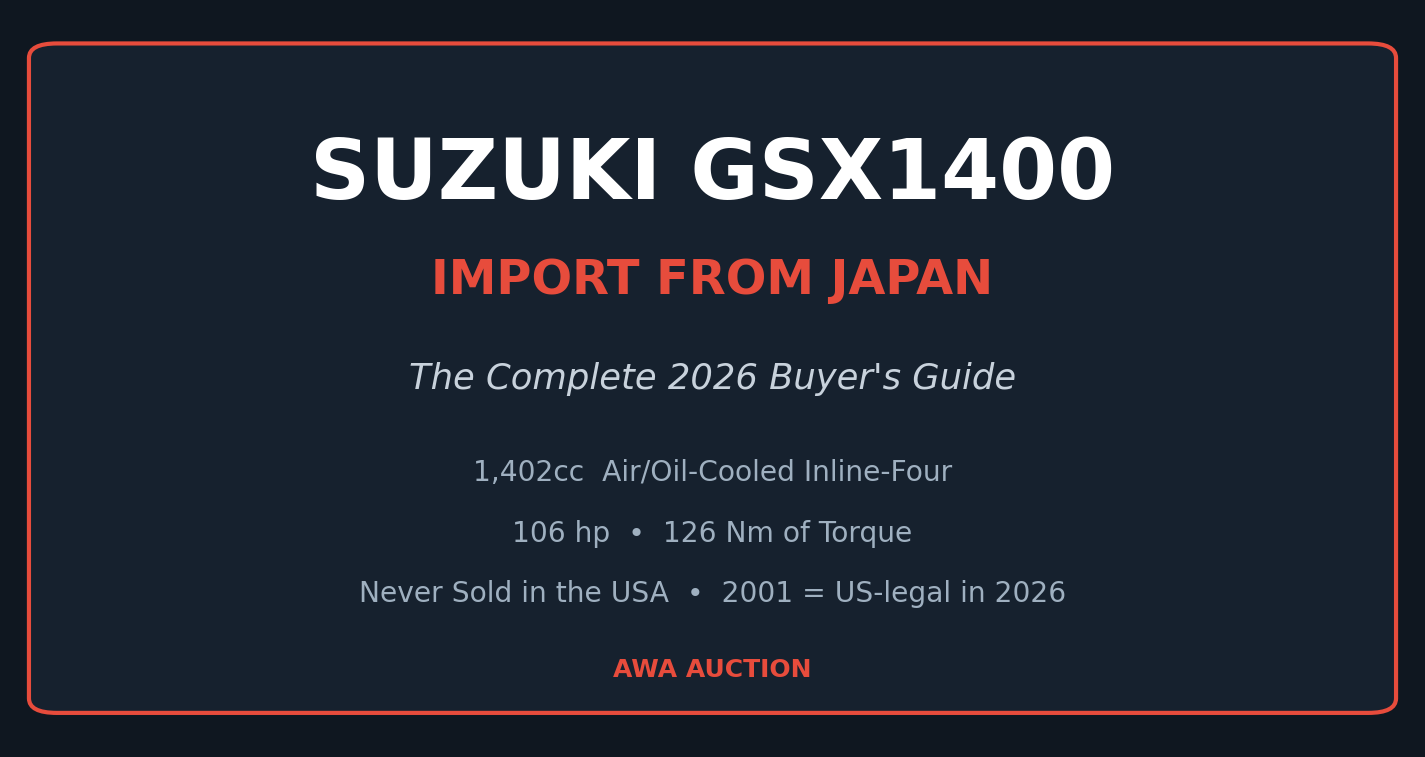
A Suzuki GSX1400 import from Japan is how you buy the most under-rated muscle bike of the 2000s for the price of a tired commuter. This is the big air/oil-cooled Suzuki that America never got to buy new, the one your local dealer has probably never even seen, and the one that owners hang onto for decades and refuse to sell. It makes 106 hp, a thumping 126 Nm of torque, and a noise like a warehouse full of angry hornets. And right now it is quietly becoming a modern classic.
Here is the thing nobody tells you. The GSX1400 was built for Japan, Europe and Australia, and never officially sold in North America. That single fact is why it flies under the radar in the English-speaking world, and it is exactly why a clean one is still a bargain. One owner summed the bike up in a single line: "Massive power, comfy seat, wide bars, relaxed riding position and super affordable. This may just be the ultimate no-fuss raw bike." Another, twenty years and 138,000 kilometres into ownership, simply said he still loves it.
This guide covers the whole story: what the GSX1400 actually is, why importing from Japan beats waiting for one to turn up locally, every generation from the 2001 K1 to the final 2008 K8, how it stacks up against the Kawasaki ZRX1200R, Yamaha XJR1300 and Honda CB1300, the honest list of known problems and years to watch, what one really costs landed at your door, the import rules for the US, UK, Australia and New Zealand, and the wild tuning scene that turns this bike into a 200 hp monster. Everything here is checked against people who own and ride these bikes, not brochure copy.
What Is the Suzuki GSX1400 (and Why America Never Got One)
The Suzuki GSX1400 is a retro muscle roadster built around a 1,402cc air and oil-cooled inline-four engine. Suzuki launched it in Japan in 2001, brought it to Europe and Australia in 2002, and kept it in production until 2008. Think of it as Suzuki's answer to a simple question: what happens if you take the tough old Bandit 1200 engine, make it bigger, torquier and more modern, and wrap it in muscular naked bodywork inspired by the legendary GS1000 of the late 1970s?
The answer is a bike that makes 106 hp at 6,800 rpm and 126 Nm of torque at just 5,000 rpm. Those numbers do not sound dramatic until you ride one. The whole point of the GSX1400 is that it never needs to rev. It hooks top gear from below 15 mph and pulls like a train, glitch-free, all the way to an easy 140 mph. Japanese-market bikes were held to 100 PS to satisfy Japan's old voluntary power limit, which is worth knowing when you inspect an import.
The engine is the star. It is air-cooled with oil-jet cooling under the pistons, a design Suzuki call SACS, and it is famously indestructible. Owners routinely pass 100,000 kilometres with nothing more than routine servicing. The bottom end is so strong that tuners bolt superchargers to it without rebuilding anything. This is not a fragile, highly-strung machine. It is an anvil with wheels.
And that anvil never made it to a single US Suzuki showroom. Suzuki decided the North American market wanted sportbikes and cruisers, not a heavyweight European-style naked, so the GSX1400 was never federalised for the States. For American riders, that leaves exactly one door: importing from Japan, where these bikes were sold in big numbers and where the used market is deep, clean and honestly graded.
Why Import a Suzuki GSX1400 From Japan Instead of Buying Local
If you live in the UK or Australia you can, in theory, find a GSX1400 without importing. So why bother with Japan? Three reasons: choice, condition, and honesty.
Choice comes first. The GSX1400 was a big seller in Japan, so the domestic used market has far more of them than anywhere else, and in far more colours and conditions. A UK buyer often finds just three for sale in the whole country in a given month. A Japanese auction house can have a dozen crossing the block in a single week. When you are hunting a specific year, a specific colour, or an unmolested low-mileage example, that depth of stock is everything.
Condition is the second reason, and it is a big one. Japanese owners tend to ride less, garage their bikes, and maintain them obsessively. Roads are well-surfaced and salt is rarely used the way it is in northern Europe. The result is that a Japanese GSX1400 with genuine low mileage is often in dramatically better shape than a same-year bike that has spent twenty British winters getting rained on. As one owner warned, "finding a decent one with low miles is nearly impossible" in the home market. In Japan, they are still out there.
Honesty is the third. Japanese motorcycle auctions grade every bike on a standardised scale, with an independent inspector noting mileage, corrosion, accident history and mechanical faults on a printed sheet. You are not trusting a seller's Instagram photos. You are reading a neutral report. Once you learn to read an auction grade, you can buy a bike sight-unseen with more confidence than you would buying one down the road.
Put those three together and the case is simple. You get more bikes to choose from, in better condition, described more honestly, usually for less money even after shipping. That is why importing wins.
Suzuki GSX1400 Generations Decoded: 2001 to 2008
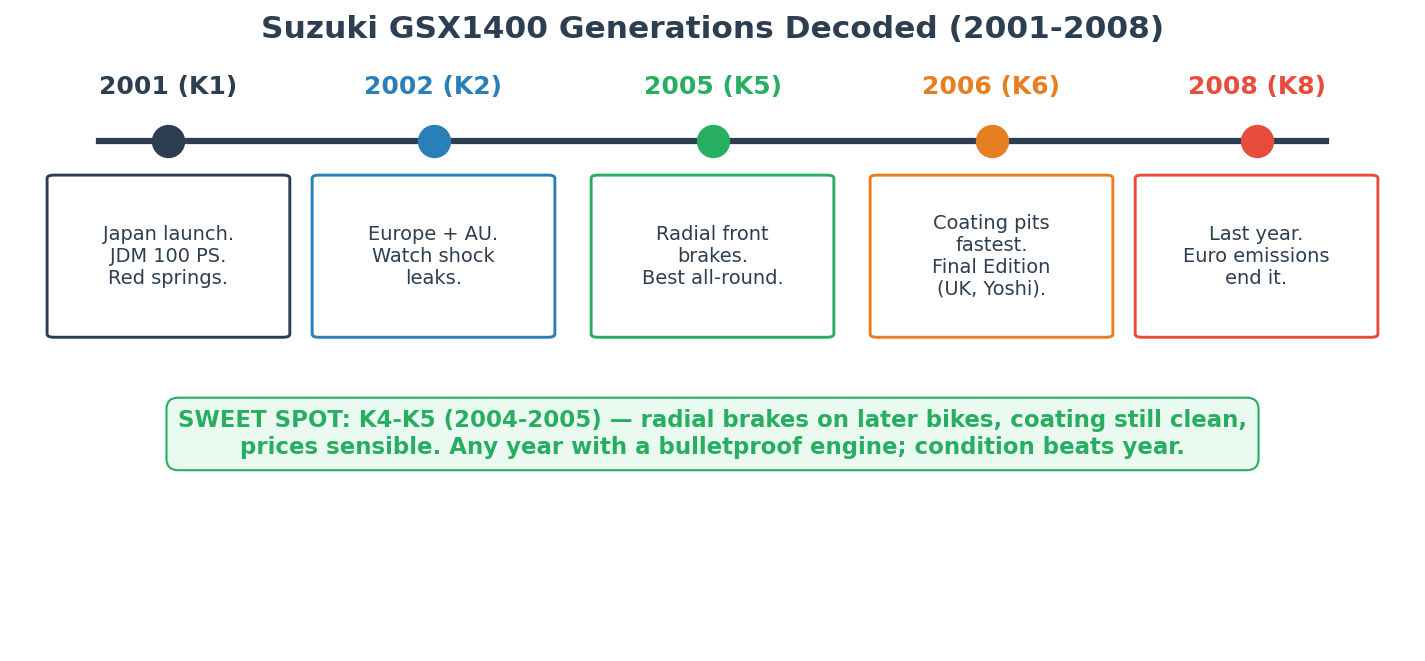
The GSX1400 changed less over its life than almost any bike of its era, which is part of its charm. But there are meaningful differences between the years, and knowing them stops you overpaying or buying the wrong one. Suzuki used the K-code system, so a K1 is a 2001 bike, a K5 is a 2005, and so on.
2001 K1: The Japan-Only Original
The first year was a Japanese-market bike only. These are the purest early cars, usually restricted to 100 PS, and they often wear the tell-tale red suspension springs that mark a genuine JDM machine. They are carburetted, simple and mechanically identical in the ways that matter to later bikes. If you want the earliest example and you value originality, a clean K1 is a lovely thing.
2002 to 2004 K2 to K4: Europe and Australia Arrive
For 2002 Suzuki brought the GSX1400 to Europe and Australia, bumping the claimed output to 106 hp. This is where the volume is, and where most imports come from. The one watch-out is the rear shock: some K2 bikes suffered leaking shocks after a few years, so check the rear suspension carefully and ask the owner directly. By the K4 in 2004, the bike was thoroughly sorted and represents some of the best value in the range.
2005 K5: The All-Rounder
The 2005 K5 brought radial-mount front brake calipers and other detail improvements, sharpening the front end without changing the bike's relaxed character. Many owners consider the K5 the sweet spot: late enough to have the better brakes, early enough to avoid the worst of the coating problems that plagued later bikes. If you can find a clean K4 or K5, you are buying the GSX1400 at its best.
2006 to 2008 K6 to K8: Fuel Injection and the Final Edition
Later bikes gained fuel injection to meet tightening emissions rules, which makes cold starting easier but adds complexity. The 2006 K6 is the year to inspect most carefully, because the protective coating Suzuki used on the engine cases and fork lowers tends to pit and weather worst on these bikes. The flip side is the 2006 Final Edition sold in the UK, with unique black-and-gold paint and a factory-fitted Yoshimura exhaust. It is the most collectible GSX1400 of all, and prices reflect that. Production ended in 2008 when European emissions rules finally killed the air-cooled engine.
The honest summary: the engine is superb in every year, so buy on condition, not on K-code. A rough K5 is a worse buy than a cherished K2. Chase the bike, not the badge.
The Air-Cooled Muscle Four: GSX1400 vs ZRX1200R vs XJR1300 vs CB1300
The GSX1400 did not exist in a vacuum. It was the Suzuki entry in a four-way scrap between the last great air-cooled muscle roadsters: the Kawasaki ZRX1200R, the Yamaha XJR1300, the Honda CB1300 and the big Suzuki. These four are spiritual successors to the superbikes of the 1970s and 80s, all rider skill, mechanical simplicity and big-bore inline-four character. If you are shopping for one, you are really shopping for all four, so here is how they line up.
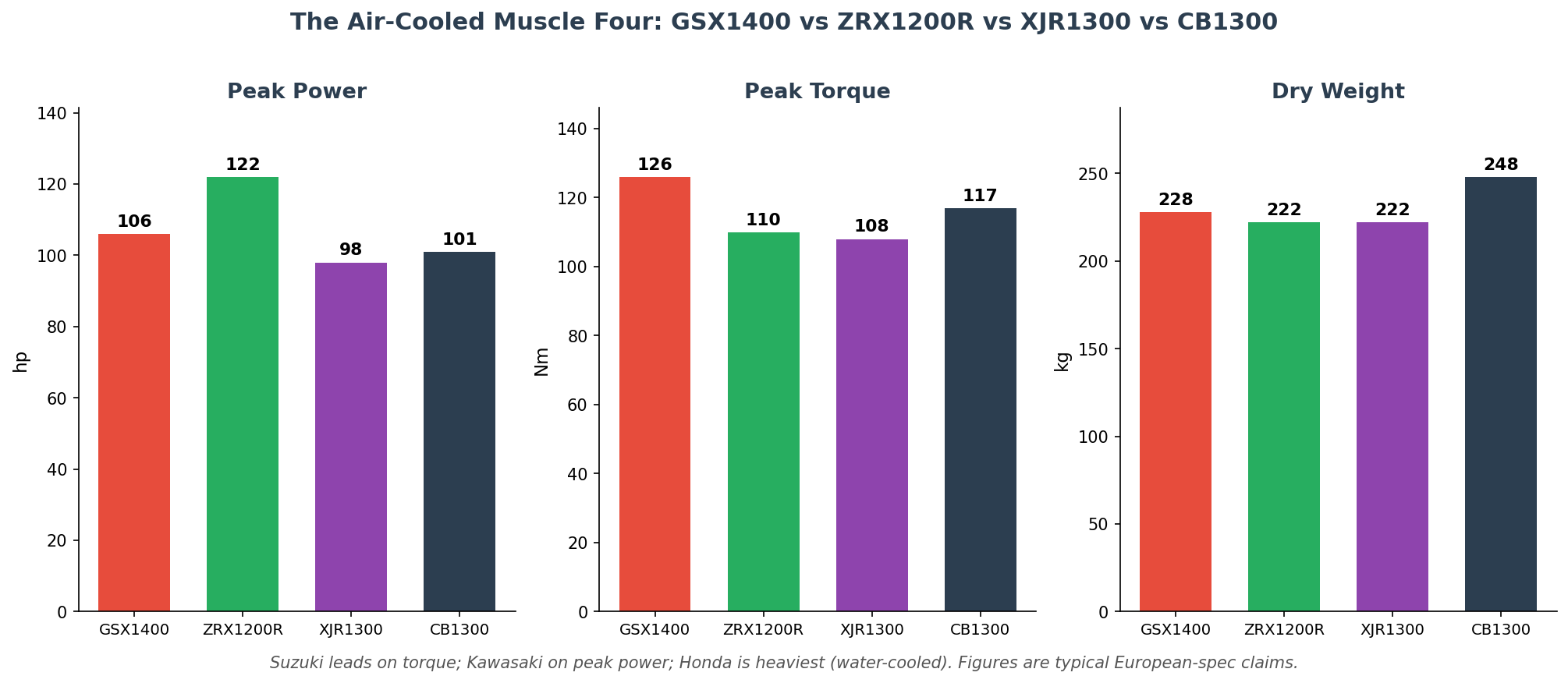
The Suzuki GSX1400 is the most imposing of the group: big, brash and deliberately intimidating. It has the largest engine and the most low-down torque, which makes it the easiest and most flexible of the four to ride hard. It cleanly hooks top gear from below 15 mph and accelerates away at a faster, glitch-free pace than the others. If you want towering torque and everyday practicality, including 14 litres of genuine under-seat storage with fold-out bungee clips, the Suzuki is unbeatable.
The Kawasaki ZRX1200R has the sharpest personality and the most iconic looks, styled after Eddie Lawson's AMA superbike racers in a green you can spot from orbit. Its 1,164cc engine makes around 122 hp, the highest peak power of the group, and the chassis is a genuine step ahead of the Suzuki's. If you want the most charismatic design and the keenest handling, the Kawasaki is the one.
The Yamaha XJR1300 is the smoothest and most classic. Air and oil-cooled like the Suzuki, it harks straight back to the 1980s and barely changed in its sixteen-year life. Its handling is not quite as resolved as the Honda or Kawasaki, but it has unmatched old-school charm and a wonderful, creamy engine. It is the connoisseur's choice.
The Honda CB1300 is the best all-rounder and the outlier. Honda bent the rules and gave its bike a water-cooled engine, which makes it the most refined and the best-suspended of the four, but also the heaviest at around 248 kg. If you want the polished, do-everything option and you do not mind the extra weight, the Honda is hard to fault.
So where does that leave the Suzuki? Right where its fans want it: the biggest, torquiest, most muscular and most affordable of a brilliant quartet. It is the one that makes you laugh out loud in the first hundred metres. As one long-term owner put it, "I remember laughing while riding this monster. Awesome bike. My best experience on a motorbike in more than 30 years."
Suzuki GSX1400 Years to Avoid and Known Problems
Let us be straight with you, because a bulletproof reputation does not mean a perfect bike. The GSX1400 has a handful of well-documented weak spots, and knowing them turns you from an easy mark into a sharp buyer. None of them are engine-related, which tells you everything about how tough that motor is.
Finish, Corrosion and Fuel-Tank Rust
This is the big one. The protective coating Suzuki applied to the engine cases and fork lowers starts to pit and weather after a few years, and the 2006 K6 bikes look the worst of the lot. Worse still, fuel-tank rust is a well-known issue that Suzuki never properly addressed, so always inspect inside the tank with a torch. Chipping on the wheel finish is common too. On a bike this age, cosmetic corrosion is the single biggest thing separating a good example from a money pit.
Suspension: Leaking Shocks and Soft Forks
Some early K2 bikes suffered rear shocks that leaked after adjustment, so test the rear suspension and look for oil weeping around the shock body. The forks, meanwhile, are a touch underdamped and undersprung for such a tall, heavy bike. This is not a fault so much as a known characteristic, and the fix is cheap and well-proven: progressive fork springs and thicker fork oil transform the front end. Many owners do it as a matter of course.
Weight and What It Means
At around 228 kg dry, the GSX1400 is a heavy motorcycle, and it carries its weight fairly high. That is fine once you are moving, but it makes low-speed manoeuvres and car-park shuffling harder work than on a lighter bike. It is not a problem to fix, just a reality to accept. If you want a flickable middleweight, this is not your bike. If you want a locomotive with attitude, it is exactly right.
The Import Tell: Red Springs
One useful quirk. Genuine Japanese-market bikes often left the factory with red suspension springs, while European bikes did not. If you are inspecting a bike that is claimed to be a fresh Japanese import, red springs are a good corroborating sign, and their absence is worth a question. Combine that with the 100 PS restriction on JDM bikes and the auction paperwork, and you can quickly confirm a bike's real history.
The verdict on years to avoid: there is no year with a fatal flaw. The engine is superb throughout. Approach the 2006 K6 with your eyes open for coating and finish issues, check early K2 shocks, and on every single bike inspect the tank, the cases and the fork lowers for corrosion. Condition beats model year every time.
What a Suzuki GSX1400 Really Costs to Import
Here is where a lot of first-time importers get a nasty surprise: the price of the bike is only half the story. The auction hammer price is the beginning, not the end. To know what you are really spending, you have to model the full landed cost, and that means adding export handling, sea freight, duty, tax and local compliance on top of the purchase.
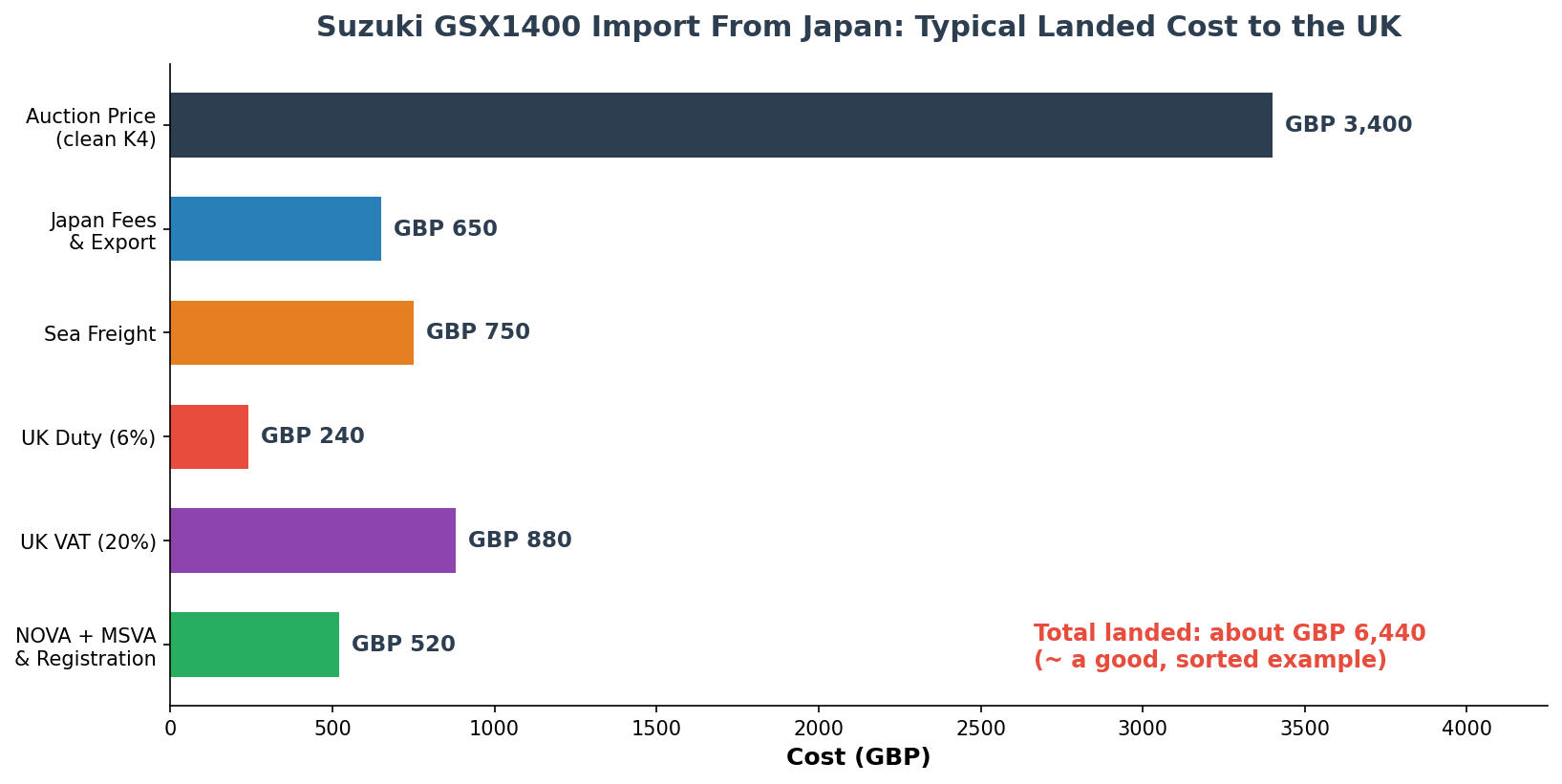
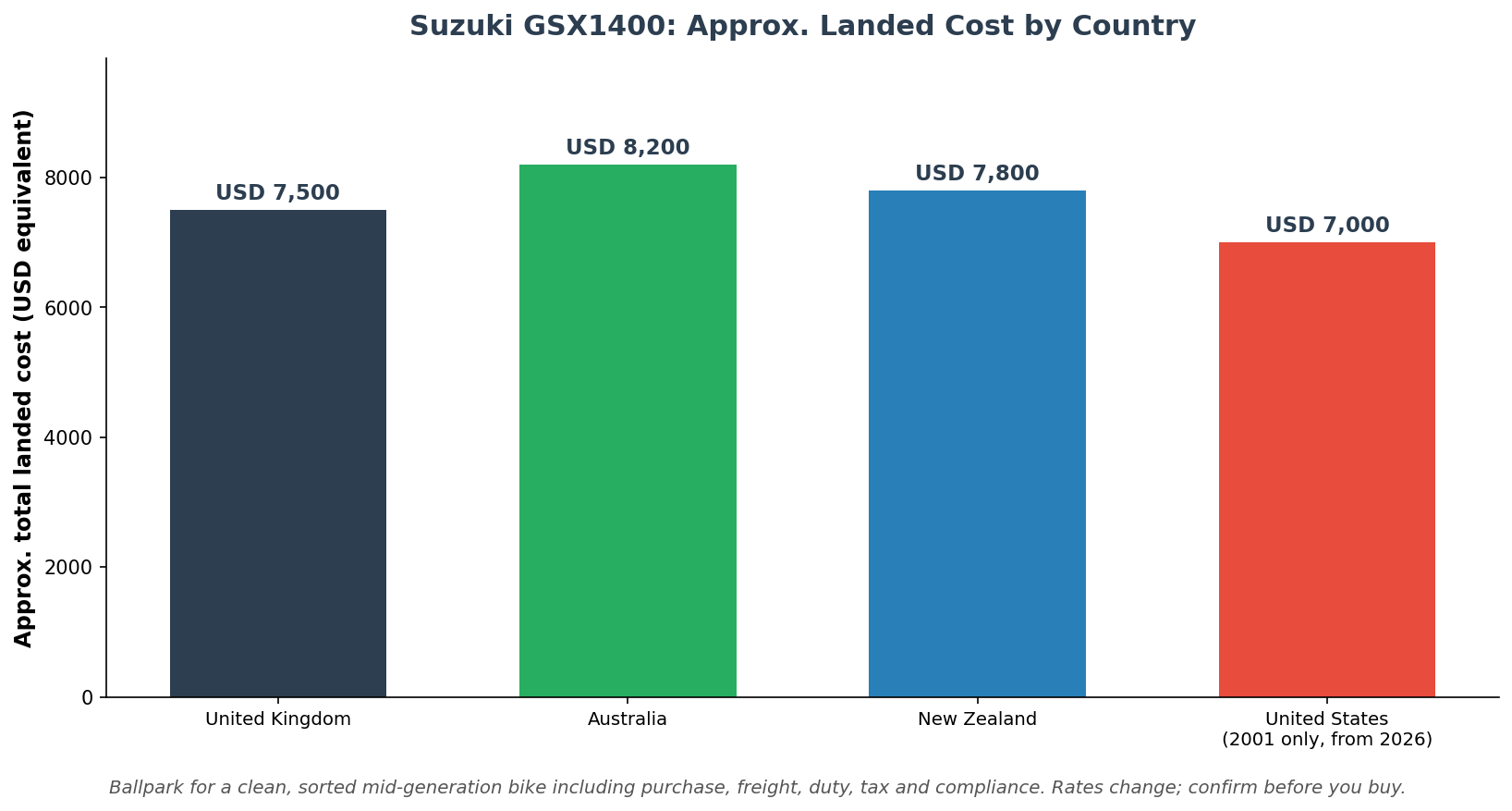
The chart above shows a realistic UK example. A clean K4 typically hammers at around GBP 3,400 at auction. Add roughly GBP 650 for Japanese-side fees and export paperwork, about GBP 750 for sea freight, GBP 240 in import duty at 6%, GBP 880 in VAT at 20%, and around GBP 520 for the NOVA declaration, the MSVA test and registration. That brings the total to about GBP 6,440 for a good, sorted bike ready to ride. The auction bike itself is barely half of the final figure.
That ratio is the single most important lesson in importing. A bike that looks cheap on a Japanese auction site is not cheap once it is standing in your garage with plates on it. Cheap bikes carry the same freight, duty and compliance costs as good ones, which is exactly why buying a slightly better example almost always makes financial sense. The fixed costs do not care whether the bike is a gem or a dog.
For context, remember what these bikes are doing to values. One owner noted that a 2001 GSX1400 that cost about GBP 5,000 new is still worth around GBP 3,000 twenty years later, and clean low-mileage examples now sell for more than they cost new. Another was looking at a 6,000-mile 2004 bike priced at USD 8,000, well above its original 6,500. Depreciation, on a well-chosen GSX1400, has essentially stopped. That changes the maths: you are not buying a disposable old bike, you are buying an appreciating classic that you can ride every day.
Import Rules by Country: US, UK, Australia and New Zealand
Every country treats imports differently, and the GSX1400 lands in a different legal position in each. Here is the honest picture for the four main English-speaking markets. Rules change, so always confirm the current position with the relevant authority before you commit money.
United States: The 25-Year Rule and the 2026 Opening
This is the timely one. Because the GSX1400 was never sold in the US, it can only come in under the 25-year rule, the NHTSA exemption that lets any vehicle at least 25 years old be imported without meeting federal safety standards. The exemption is calculated from the actual month of manufacture, not the model year. That means the earliest 2001 GSX1400s are crossing the 25-year line right now, in 2026, with eligibility rolling forward month by month through the year. A bike built in, say, March 2001 becomes importable in March 2026. For American fans who have watched these bikes from afar for two decades, the door is finally opening. Later bikes will follow on the same rolling timeline through the 2030s.
United Kingdom: NOVA and the MSVA Test
The UK is the most established market for GSX1400 imports and the process is well-trodden. You declare the bike to HMRC through the NOVA system within 14 days of arrival, pay 6% duty and 20% VAT on the bike plus shipping, and then put the bike through the MSVA test, a one-off inspection for personally imported machines. Once it passes and you have the paperwork, you register it with the DVLA and get your plate. It is more steps than a domestic purchase, but thousands of importers do it every year without drama.
Australia: An Established Home Market
Australia actually got the GSX1400 new, so there is a domestic base, but imports remain popular for choice and condition. Australia's import rules are stricter than most and revolve around approval schemes and the age of the vehicle, so the paperwork needs care and often a registered automotive workshop for compliance. Budget for that in both time and money. The reward is access to Japan's deep, well-kept stock rather than Australia's thinner used market.
New Zealand: Often the Simplest
New Zealand has one of the most import-friendly systems in the world, which is why the country is full of Japanese imports of every kind. The bike goes through an entry certification and compliance check, you pay GST, and once it is complied and registered you are riding. One GSX1400 owner summed up the appeal simply, describing "cruising New Zealand every day on it." For many Kiwi buyers, importing is simply the normal way to buy a bike.
The GSX1400 Tuning Scene: Superchargers, Big-Bore Kits and 200 HP
Most buying guides stop at "the engine is reliable" and move on. That misses the best part of the story. The GSX1400's bottom end is so tough that it has spawned one of the most serious tuning cultures of any modern classic, and understanding it tells you a lot about the bike you are buying.
Start with the easy stuff. The single most common first move, repeated by owner after owner, is to bin the heavy stock exhaust, fit a full aftermarket system from Akrapovic, Yoshimura or Scorpion, add a K&N air filter, and remap the fuelling. That alone frees up power, drops weight and unlocks the engine's real voice. As a bonus, a good used stock exhaust sells for around GBP 400 on eBay, so the upgrade partly pays for itself.
Then it gets serious. A whole community of owners fits 1550cc big-bore kits with uprated camshafts, braced swingarms and uprated oil coolers, producing around 150 hp at the rear wheel with monstrous torque. One owner described exactly that build: "1550cc conversion, uprated oil cooler, Akrapovic headers, 4-into-1 exhaust and a Power Commander, plus a braced rear swingarm that improves the cornering." These are not garage-queen experiments. They are daily-ridden bikes.
And at the far end, the superchargers. The UK firm TTS Performance produces bolt-on supercharger kits for the GSX1400 that push output close to 200 hp, and they still run production batches on demand. One owner, laughing his way through a video of a blown GSX1400, called it "massive power, comfy seat, wide bars. This may just be the ultimate no-fuss raw bike." Another put it more bluntly: "I've modded mine to 126 hp and 142 Nm at the back wheel and it's monstrously torquey. Adding a supercharger is just mental. Want it."
The point of all this is not that you should supercharge your import. It is that the GSX1400 is one of the very few modern bikes whose engine can take that kind of abuse and shrug it off. When people tell you this motor is bulletproof, the 200 hp supercharged bikes running around the UK are the proof.
Living With a Suzuki GSX1400 Day to Day
Specs and auction sheets tell you what to buy. They do not tell you what it is like to own one, so here is the real-world picture from people who ride these bikes every day.
Comfort is a genuine strength. The riding position is upright and roomy, the seat is wide and well-padded, and the bars are set for a relaxed, commanding stance rather than a racing crouch. One owner reported riding two-up with his partner on the back for long distances in total comfort, still enjoying the thick, full exhaust note. This is a bike you can do 300 miles on and get off smiling, which is not something you can say about most naked bikes with this much attitude.
Practicality is better than the muscular looks suggest. That 14 litres of under-seat storage, complete with fold-out bungee hooks, genuinely swallows a lock, waterproofs and a bit of shopping, and it is more usable stowage than any of its rivals offer. For a bike that looks like a clenched fist, the GSX1400 is a surprisingly sensible thing to run.
Running costs are what you would expect from a big air-cooled four. Fuel economy sits in the region of 40 mpg with a gentle right hand, dropping fast if you use the torque the way you will want to. Tyres and consumables are standard fitments and easy to source. Servicing is simple, valve clearances are straightforward for any competent mechanic, and there is no fragile electronics package waiting to bankrupt you. This is old-school mechanical honesty, and it is cheap to keep on the road. If you want to see how a well-sorted example presents, our current listings are a useful reference point for condition and pricing.
The character is the thing owners never stop talking about. People are always a little shocked, as one rider noted, "when they see a GSX1400 messing about with litre bikes." It is a big beast that punches far above its spec sheet on real roads, and it does it while being comfortable, practical and cheap to run. That combination is rare, and it is exactly why owners hang onto them for decades.
How to Buy a Suzuki GSX1400 at a Japanese Auction
You have chosen the bike. Now for the practical part: how do you actually buy one at a Japanese auction without getting burned? The system is designed to protect buyers, but only if you know how to read it.
It starts with the auction grade. Every bike is inspected by an independent grader who assigns an overall score, typically from 1 up to 6 or S, plus separate notes on the bike's condition. A grade 4 or higher generally means a solid, honest bike. Alongside the grade is the inspection sheet, a map of the motorcycle marked up with any scratches, dents, rust or mechanical issues the inspector found. Learning to read that sheet is the single most valuable skill in importing.
For a GSX1400 specifically, direct the inspection at the known weak points. Ask about corrosion on the engine cases and fork lowers. Ask about the state of the fuel tank inside. Check the mileage against the general condition, because these bikes rack up big distances and a suspiciously low reading deserves scrutiny. Confirm whether the bike is a restricted 100 PS Japanese-spec machine and whether it has been de-restricted. And look for the red springs and matching paperwork if originality matters to you.
Then there is the practical reality that you are usually bidding from thousands of miles away, in a currency that is not yours, on a sheet written partly in Japanese. This is where most private buyers come unstuck. Bidding at Japanese auctions requires membership, a deposit and the ability to interpret the grading and paperwork correctly and quickly. Get one detail wrong and a cheap bike becomes an expensive mistake. This is exactly the gap a good import partner exists to fill.
How AWA Auction Helps You Import a Suzuki GSX1400
This is where we come in, and we will keep it honest. Importing a GSX1400 yourself is entirely possible, but it means joining Japanese auction houses, wiring deposits, decoding grade sheets, arranging export and freight, and navigating your own country's customs and compliance. Any single mistake in that chain costs real money. AWA Auction exists to run that chain for you.
We give you direct access to the same Japanese auctions where the best GSX1400s are sold, with the grade sheets translated and interpreted so you know exactly what you are bidding on. We inspect for the specific weak points that matter on this model, the tank, the cases, the shocks, the real mileage, so you do not buy someone else's corrosion problem. And we handle export, shipping and the paperwork trail through to your door, whether you are in London, Sydney, Auckland or, now that the 25-year window has opened, the United States.
The result is that you get the deep choice and honest condition of the Japanese market without the risk of navigating it blind. You can browse the motorcycles we currently have available to see what is crossing the auctions right now, and if you have a specific GSX1400 in mind, a particular year, colour or spec, you can tell our team exactly what you are hunting and we will go and find it.
The GSX1400 is one of those bikes that people buy once and keep for twenty years. It is torquey, tough, characterful and quietly appreciating, and it was never sold where most of the English-speaking world could buy one new. Importing from Japan is not the hard way to get one. It is the only way to get the best one. And in 2026, for the first time, that includes American riders too.
See Also
Share this article: