
A Suzuki GSX-R750 import from Japan is how clued-up riders get the straightest, lowest-mileage example of the bike a lot of people quietly call the best sportbike ever built. The 750 has no real rival. It is lighter and sharper than a litre bike, and it hits far harder than any 600. Suzuki has been refining that exact recipe since 1985, and the home market that bought these bikes new, ran them on the right oil, and kept them in heated garages is Japan. The cleanest GSX-R750s on earth are sitting in Japanese auction halls right now, each one graded by an independent inspector, waiting for a buyer who knows what to look for.
You want one of those. Not a tired ex-track bike that has been crashed twice, "tuned" by a 19-year-old with a screwdriver and a YouTube account, and flipped three times in two years. This guide walks you through every generation, the years to avoid, the recalls that actually matter, what the bike really costs to land in your driveway, and the rules for the US, UK, Australia and New Zealand. By the end you will know more about buying a GSX-R750 than most dealers do.
Why import a Suzuki GSX-R750 from Japan?
Here is the thing the local classifieds never tell you: a sportbike's price says almost nothing about its condition. Two GSX-R750s can wear the same year, the same colour and the same mileage, and one is a gem while the other is a money pit. The difference is history, and in your local market history is whatever the seller decides to tell you.
Japan flips that. Bikes there are sold through auction houses that employ independent inspectors. Every machine gets a written sheet that grades the body, the frame, the engine and the paint, and flags accident repairs, rust and modifications. You are not trusting a stranger's word. You are reading a document written by someone who has no stake in the sale.
On top of that, Japan simply treats motorcycles better. Roads are smooth, salt is rare outside the snow country, shaken inspection culture keeps bikes maintained, and storage is usually indoors. A 20-year-old GSX-R750 out of Tokyo or Osaka often looks better than a five-year-old bike from a rainy, gritty climate. You buy at wholesale auction money instead of retail dealer money, and even after the agent fee, the freight and your country's taxes, a clean 750 frequently lands for less than an equivalent local bike — with paperwork the local bike will never have.
The bike that invented the race replica
To understand why the GSX-R750 still matters, you have to go back to 1985. Suzuki unveiled the original at the Cologne show in October 1984 for the 1985 model year, and it changed everything. While rivals were selling soft, heavy "sport" bikes, Suzuki built a road-legal endurance racer: an aluminium cradle frame, a dry weight near 176 kg, and an air and oil-cooled engine that revved like nothing else on the street. It looked like the works racer because it basically was one.
That first bike, and the slabside and slingshot models that followed, set the template every modern superbike still copies — light, focused, race-derived, and sold to the public almost unfiltered. The GSX-R name has carried that idea for forty years across hundreds of detail changes, but the core never moved: a 750cc four-cylinder engine in the smallest, lightest chassis Suzuki could build around it.
And unlike the 600 and the 1000, the 750 was never chasing a racing class. The World Superbike and supersport rulebooks pushed everyone toward 600s and litre bikes, so the 750 became a thing made purely because riders loved how it felt. That is exactly why it has the cult following it does, and exactly why the good ones are worth importing properly.
Suzuki GSX-R750 generations, decoded
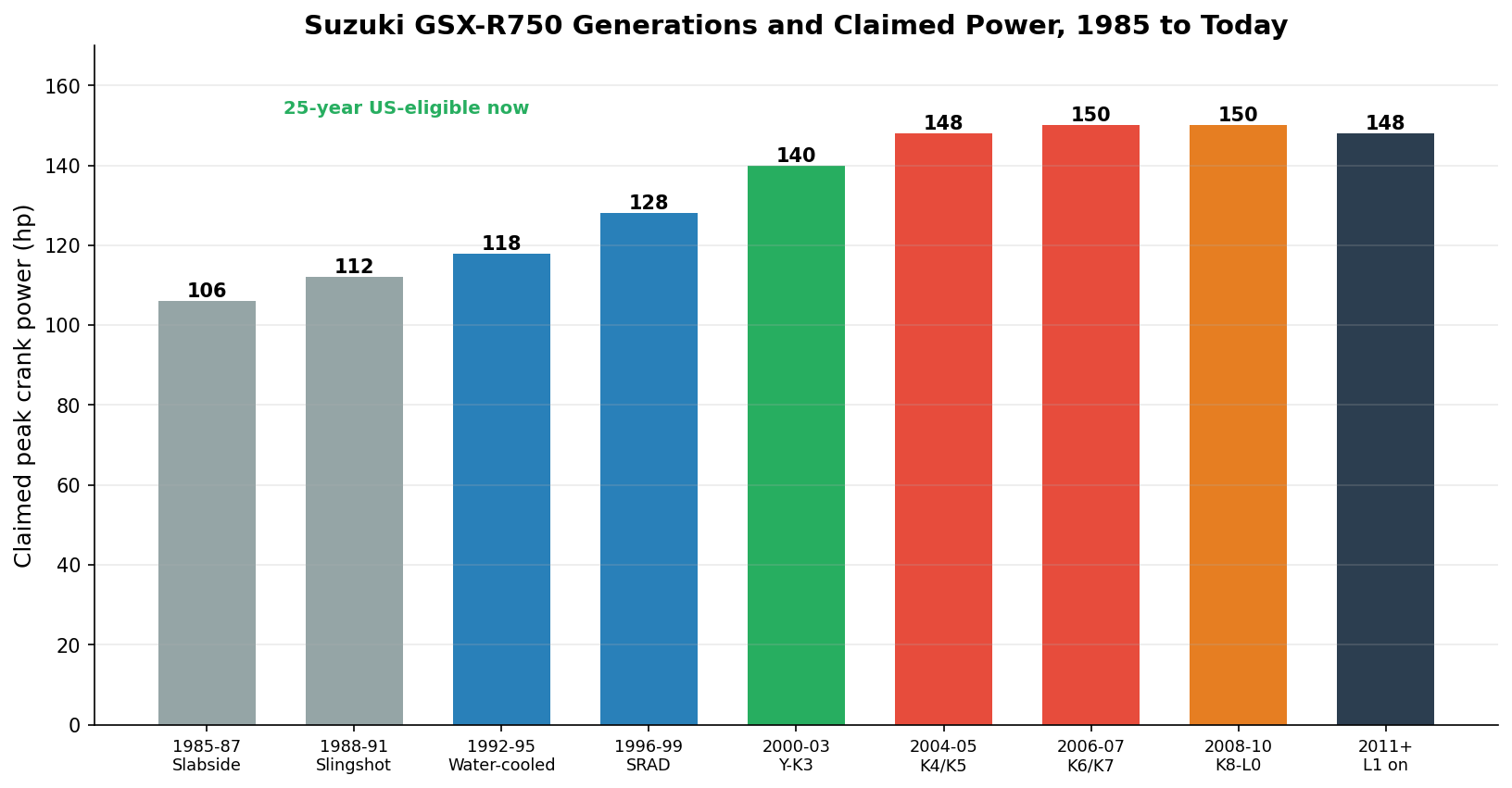
The GSX-R750 splits into clear eras, and knowing which one you are looking at is half the battle. Here is the honest breakdown.
1985-1987, the "slabside" (slabbie). The originals. Air and oil-cooled (Suzuki's SACS system), flat-sided bodywork, and that raw, light, twitchy character that made the legend. The engines are genuinely strong. The early wheels were spindly and the chassis is old-school, but as a collector's import these are gold — and crucially for American buyers, they are old enough to import on the road today.
1988-1991 (1992 in the US), the "slingshot." Named after the slingshot carburettors, still oil-cooled, rounder bodywork, more midrange. A friendlier, faster slabbie. These are the sweet spot for riders who want the classic air/oil feel with slightly more usability, and they are also 25-year-eligible for the US now.
1992-1995, water-cooled. Suzuki finally added liquid cooling. Heavier and a bit anonymous compared to what came before and after — the forgotten middle child. Fine bikes, but rarely the one collectors chase.
1996-1999, the SRAD. A landmark. Suzuki fitted a new twin-spar alloy frame derived from the RGV500 GP racer and the Ram Air Direct intake that gave the SRAD its name. Carburettors until 1998, fuel injection from 1998. This is where the modern GSX-R750 silhouette begins, and a clean SRAD out of Japan is one of the best-value classic sportbikes you can buy.
2000-2003 (Y, K1, K2, K3). Fuel-injected, lighter, sharper, and the start of the truly modern era. The K1 in particular was a big leap in weight and focus. These are the bikes American importers are watching closely as the 25-year clock ticks down year by year.
2004-2005 (K4, K5). The one everyone wants. More on that below.
2006-2007 (K6, K7). New frame, slipper clutch, nitrided forks, around 150 bhp. The best-handling 750 of the era, and still a seriously fast, usable bike today.
2008-2010 (K8, K9, L0) and 2011 onward (L1 on). Restyled, refined, and then essentially frozen — Suzuki has kept the platform largely unchanged for over a decade because it was already so good. The current bike is, in spirit, a polished K6. There is also one recall era in here you need to know about, covered later.
The K5/K6 legend: why the mid-2000s GSX-R750 is the one everyone wants
Ask ten experienced riders which used 750 to buy and most will say the same thing: a K4 or K5. The reviewers agree. The 2004-2005 bikes are described as "almost perfect" — radial brakes that finally matched the chassis, styling that landed just right, and a motor and chassis better than most riders can fully use.
The K5 engine in particular earned a reputation for being bulletproof. It is torque-rich from low and midrange, and once you cross 6,000 rpm it turns genuinely savage all the way to its 11,500 rpm redline. The handling is the trick, though: enough power to thrill but not so much that you are fighting it, which makes the bike feel agile and stable at the same time. That is the magic the 600 and 1000 never quite match.
How good is it? On the internet, riders still trade stories of a stock K5 750 outpacing far newer, far more expensive machinery on track. One widely shared example had a tuned K5 keeping a modern Ducati Panigale V4S honest on a circuit — and while the internet always exaggerates, the underlying point is real. The mid-2000s 750 punches absurdly far above its price.
The K6/K7 then improved the handling again with a new frame and a slipper clutch, at the cost of a touch of the K5's rock-solid stability under brakes. Pick the K5 if you want the reliable, stable all-rounder; pick the K6 if you want the sharper track tool. Either way, a clean Japanese-market example is the bike to import.
The "perfect middleweight" math: 600 vs 750 vs 1000
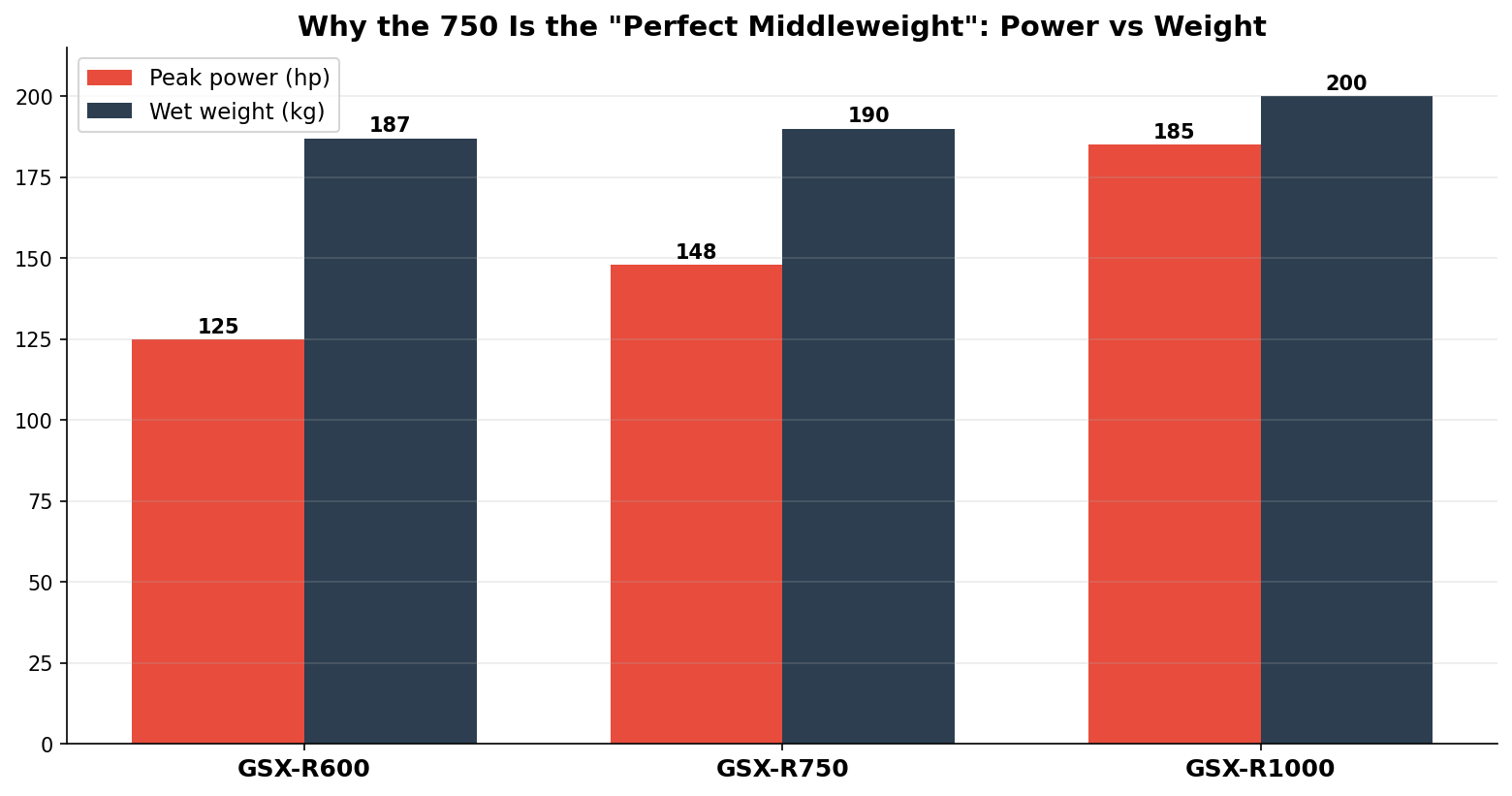
People throw around the phrase "perfect middleweight," but the numbers actually back it up. A modern GSX-R600 makes roughly 125 hp; the GSX-R1000 makes around 185 hp. The 750 sits at about 148 hp — but it weighs almost exactly the same as the 600, not the 1000.
That is the whole story in one sentence: 750 power in a 600-sized, 600-weight chassis. You get a bike that flicks into corners like the small one but pulls out of them like the big one. The 600 has to be screamed everywhere to make progress. The 1000 has so much power that on the road you use maybe 60% of it before things get scary. The 750 lives in the exact middle, and on a real road with real speed limits it is faster and far more satisfying than either.
That is why the 750 survived even as racing rules killed off its competitors. It was never built to win a class. It was built to be the best motorcycle, and for a huge number of riders it is.
GSX-R750 years to avoid and known problems
No bike is perfect, and pretending otherwise is how people get burned. Here is the honest, generation-by-generation list of what to check.
First-generation slabbies (1985-1987): the rectifier sits too close to the engine and cooks itself, so charging-system failures are common — budget for a relocated, uprated regulator/rectifier. Early wheels were thin and some were reinforced; check for cracks. The engines themselves are tough.
Early SRAD (1996-1997): some early 1996 bikes had cylinder head and piston clearance issues, the carburetted models can suffer carb icing on cold, damp days, and there was a known fuel pump hose problem. None are dealbreakers on a well-kept bike, but they are worth confirming.
Fuel-injected 2000s bikes: the big one is second gear. Several model years had a transmission design defect where second gear could slip and, in the worst cases, cause gearbox failure. Suzuki revised the input shaft and other parts and issued an internal service bulletin. On any 2000s 750, ride it and confirm second gear holds under hard acceleration.
All generations: the regulator/rectifier and charging system are the recurring Suzuki weak point — a bike that struggles to keep its battery charged usually needs that part. Also watch for the universal sportbike red flags: track damage, mismatched fasteners, aftermarket "fixes" hiding crash repairs, and electrical gremlins from cheap accessory wiring.
This is exactly where importing from Japan pays for itself. A Japanese auction inspection sheet flags accident repair, frame damage and corrosion before you ever wire money. Most of the problems above are easy to dodge when an independent inspector has already gone over the bike for you.
The 2011-2014 transmission recall, explained
One recall is big enough to get its own section. Suzuki recalled more than 23,000 GSX-R750 (and related GSX-R600) machines from the 2011-2014 model years over a transmission fault that could leave the rear wheel with insufficient drive — a serious safety issue, because a sudden loss of power mid-corner or mid-overtake can cause a crash.
If you are importing an 2011-2014 GSX-R750, this is non-negotiable: confirm whether the recall work was completed. In Japan, dealer service records and the auction sheet often show it. You can also verify against the manufacturer and safety-authority recall databases by frame number. It is a free fix when done through a dealer, but you want it done — never assume a grey-import bike had it sorted.
This does not make the 2011-2014 bikes bad. Post-recall, they are excellent and the same fundamentally brilliant platform. It just means you do one extra check that a careless buyer skips.
What it actually costs to import a GSX-R750 from Japan
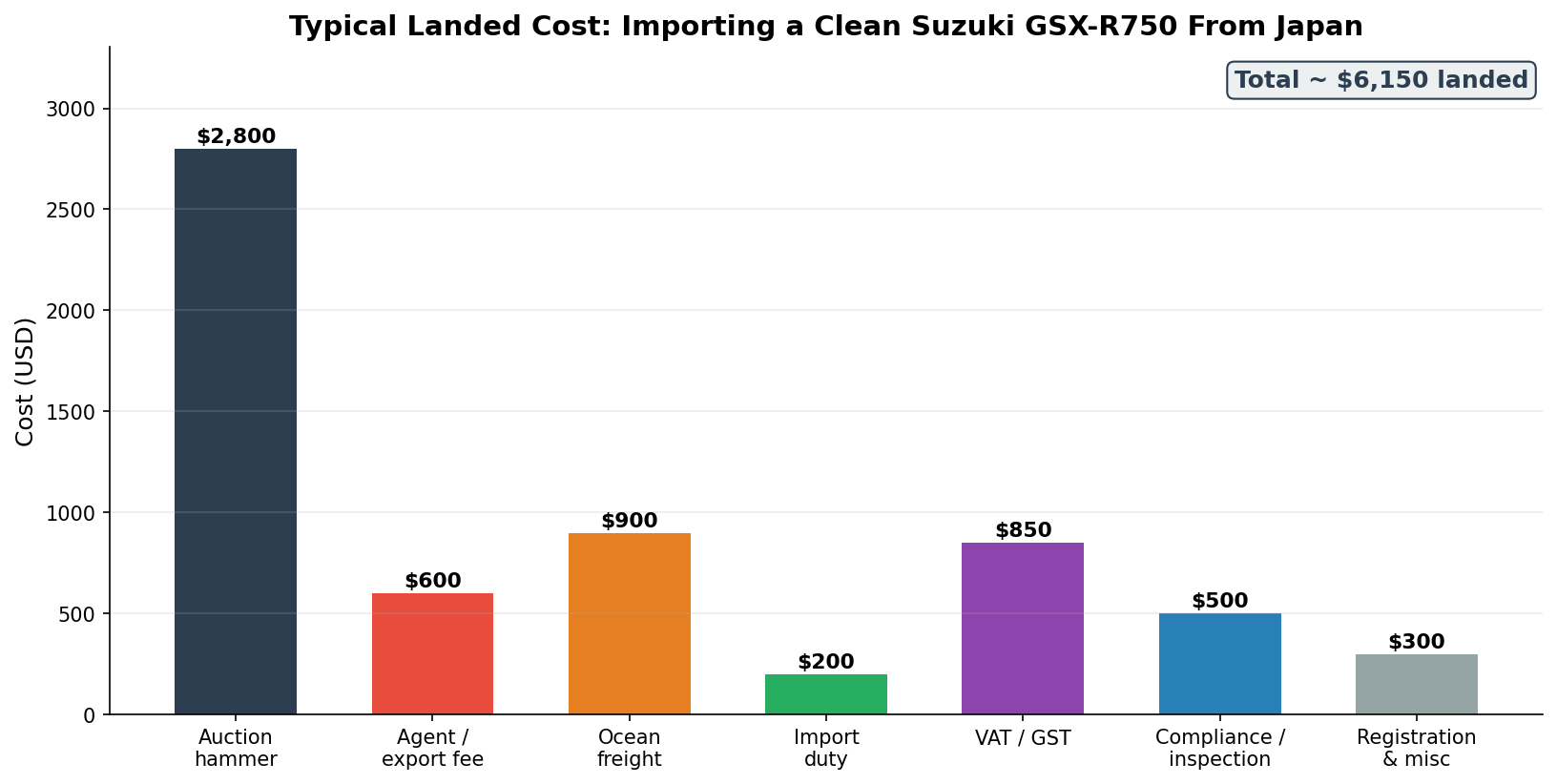
Let's talk real numbers, because "it depends" helps nobody. The chart above breaks down a typical landed cost for a clean GSX-R750, and the pattern holds across most destinations even when the totals shift.
The auction hammer price is the big one — for a tidy SRAD or early fuel-injected 750 you are often looking at somewhere around 2,500 to 3,500 US dollars at auction, a fraction of retail. On top of that sits the agent and export-handling fee (translation, bidding, export paperwork, deregistration), ocean freight (more if crated solo, less if shared in a container), your country's import duty, then VAT or GST calculated on the landed value, plus any compliance or inspection cost and finally local registration.
Add it up and a clean 750 commonly lands in the rough region of 6,000 to 7,500 US dollars all-in, depending heavily on country taxes and shipping method. Compare that to retail prices for a similar-condition, properly documented 750 in your home market and the import route usually wins — and you end up with the bike that has the paperwork, not the one that doesn't.
Two ways to save real money: share a container with other buyers to cut freight per bike, and use an agent who buys at volume so the export-side handling is lean. The single most expensive mistake, by contrast, is buying a cheap bike with hidden damage — the inspection sheet exists precisely to stop that.
Landed cost by country: US, UK, Australia, New Zealand
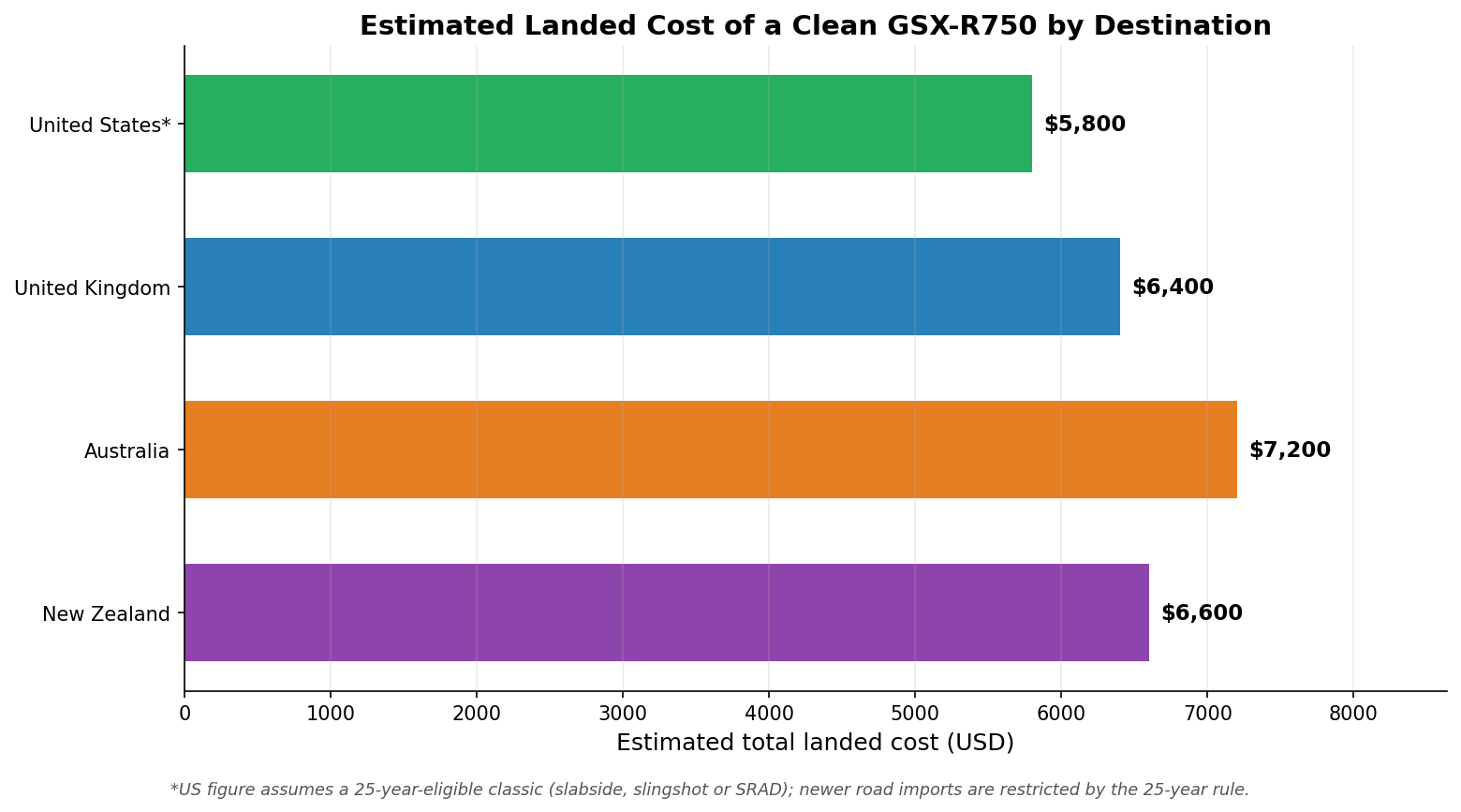
Where you live changes the math, mostly through taxes and compliance rules. These are ballpark figures for a clean classic-era GSX-R750 and should be treated as planning numbers, not quotes.
United States. The cheapest on paper, but with a giant asterisk: the 25-year rule (see the next section). A road-legal US import has to be a 25-year-eligible classic, which keeps the bike itself affordable, and there is no federal VAT — you pay duty and then state-level taxes and registration when you title it.
United Kingdom. Expect import duty plus 20% VAT on the landed value, a NOVA notification to HMRC, and for newer bikes an MSVA or IVA-style test before registration. Classic-era 750s are popular UK imports and the process is well-trodden.
Australia. Typically the most expensive, thanks to GST, possible Luxury layers on value, and a stricter compliance regime — you generally need the bike to fit an approved import pathway before it lands. Plan for higher compliance costs and confirm eligibility first.
New Zealand. GST applies and there is a compliance/certification step, but the scheme is comparatively friendly to motorcycle imports, which is why so many JDM bikes end up there. Budget for the certification and you are usually fine.
In every one of these countries the rule is the same: confirm your specific bike's eligibility and tax treatment before you bid, not after it has landed at the port.
The US 25-year rule and the GSX-R750
American readers, this is the section that saves you a heartbreak. The United States has a 25-year rule: a motorcycle becomes exempt from the usual EPA and DOT import restrictions once it is at least 25 years old. Younger than that, and importing it as a road-legal street bike is effectively off the table for individuals.
For the GSX-R750, that is actually great news, because this bike has been around since 1985. As of 2026, every GSX-R750 up to roughly the 2001 model year is 25-year-eligible — and that includes the entire legendary classic run: the slabbies, the slingshots, the SRADs and the early fuel-injected K1. Each year, one more model year crosses the line. The beloved K5? It does not become freely road-importable to the US until 2030. The 2006 K6 follows in 2031.
So the smart American play is to import the classic and modern-classic 750s now — a clean Japanese-market SRAD or a slingshot is a phenomenal bike and an appreciating one — and to keep an eye on the calendar for the early-2000s machines as they age in. If you want a newer 750 before its 25th birthday, your only legal US route is off-road/closed-course use, not the street. Honesty here beats a five-figure paperweight stuck in customs.
How to read a Japanese auction sheet on a GSX-R750
The auction sheet is your superpower, so learn to read it. Every bike gets an overall grade — typically on a scale where 4 and up means a clean, honest machine, 3.5 is usable with some wear, and anything labelled R (or with repair notes) has had accident work. There is also a separate interior/cosmetic grade using letters, where A and B are good and lower letters mean scuffs, rust or fading.
For a GSX-R750 specifically, look past the grade at the inspector's notes and diagram. You want to see honest mileage, no frame or subframe repair marks, and original or sensible bodywork. A few stone chips on a 20-year-old sportbike are normal and even reassuring. What you do not want is hidden repaint over a repaired frame, mismatched panels suggesting a crash, or signs of a hard track life.
Because the 750 is a tuner's favourite, pay special attention to modification notes — aftermarket exhausts, fuel controllers and rearsets are common and usually fine, but heavy modification can hide a bike that has been ridden hard. If you cannot read the Japanese shorthand yourself, this is exactly what a good import agent does for you: they translate the sheet and tell you honestly whether the bike is worth bidding on. We do this every day.
Step-by-step: importing your GSX-R750 from Japan
Here is the whole process, start to finish, with no mystery.
Step 1 — Confirm eligibility. Check the 25-year rule (US) or your country's import and compliance pathway before anything else. Know which model years you are legally allowed to import on the road.
Step 2 — Set your budget all-in. Use the landed-cost breakdown above. Decide your maximum total, then work backward to your maximum auction bid so taxes and freight do not surprise you.
Step 3 — Pick your agent. You need a Japan-based exporter with auction access, who can bid for you, read sheets, handle export deregistration and arrange shipping. This is the single most important choice you will make.
Step 4 — Hunt and read sheets. Watch the auctions for the right generation and condition. Have every promising sheet translated and graded honestly before you bid. Patience here is rewarded; the right 750 always comes around.
Step 5 — Bid and win. Your agent places your maximum bid. If you win, you pay the hammer price plus fees.
Step 6 — Export and ship. The bike is deregistered for export, crated or containered, and put on a vessel. Ocean transit is usually a few weeks depending on route.
Step 7 — Clear customs and comply. At your port, you pay duty and tax and complete any required inspection or certification (MSVA/IVA in the UK, compliance in AU/NZ).
Step 8 — Register and ride. Title and plate the bike, get insurance, and go enjoy the best middleweight ever made. Realistic total timeline from winning to riding is roughly four to eight weeks.
What nobody tells you: track bikes, tuning, and the "Glock of sportbikes"
Spend any time in GSX-R culture and you learn two things fast. First, these bikes are everywhere in the modified and track world, which is both the appeal and the trap. A popular buyer-advice video with well over half a million views has its top comment — liked thousands of times — calling the GSX-R "the Glock of the sportbike world": utterly reliable, everywhere, and good. That reputation is earned. The flip side is that because they are so common and so tunable, the used market is full of bikes that have been thrashed, crashed and "improved" by their owners.
Tuning is genuinely part of the GSX-R story. A single dyno clip of a 750 with a full Akrapovic system and a Power Commander has racked up over two million views. That culture is fun, but it means you must be extra careful buying used: a slammed, chromed, badly-wired build hides a multitude of sins, and a bike that has been mapped aggressively may have been ridden just as aggressively.
This is the real argument for importing a clean Japanese-market bike instead of buying local. In Japan, far more GSX-R750s lived ordinary lives — commuted, maintained, garaged — and the inspection sheet tells you which is which. You skip the entire guessing game that defines the domestic used-sportbike market. You get the Glock-grade reliability without inheriting some stranger's track crashes.
How AWA Auction gets you a clean GSX-R750
This is what we do. AWA Auction gives English-speaking buyers in the US, UK, Australia, New Zealand and beyond direct access to Japan's motorcycle auctions — the same wholesale halls the local dealers quietly buy from. We bid on your behalf, translate and honestly assess every auction sheet, handle export and deregistration, and arrange shipping to your port.
For a bike like the GSX-R750, where condition and history make or break the purchase, that inspection-sheet expertise is the whole point. We will tell you when a bike is a gem and, just as importantly, when to walk away. Browse the GSX-R750s and other clean Japanese bikes clearing auction now, and when one catches your eye, get in touch and we'll read the sheet before you commit a single dollar.
You can keep rolling the dice on the local classifieds, or you can buy the bike with the paperwork. For a 750 this good, the second option is the only one that makes sense.
GSX-R750 vs the rivals you'll cross-shop
When you go hunting for a 750-ish sportbike, a few names come up. It helps to know where the GSX-R750 sits against them so you buy with your eyes open.
Against the Yamaha YZF-R6 and other 600s, the Suzuki simply has more usable engine. The R6 is a screaming, top-end track weapon that needs constant revs to feel alive. The 750 makes its grunt lower down, so it is faster and far less tiring on the road while still being razor-sharp on a circuit. If your riding is mostly real roads, the 750 wins easily.
Against litre bikes like the GSX-R1000 or a Honda CBR1000RR, the 750 trades a chunk of straight-line violence for a much friendlier chassis and far more confidence in the corners. On a public road you will rarely be slower on the 750, and you will arrive less frightened. The litre bike makes sense if you live on track or crave the top-end rush; for everyone else the 750 is the smarter buy.
Against the modern Kawasaki Z900 or naked middleweights, the GSX-R is the more committed, more focused sporting tool — full fairing, racier riding position, and that endurance-racer DNA. The naked bikes are comfier around town; the GSX-R is the one you take to a track day and a mountain road. Cross-shop honestly against your own riding, and the 750 holds up against all of them. A clean Japanese import just makes it the value pick on top.
Insurance, running costs and living with an imported GSX-R750
Buying the bike is one thing; living with it is another, so let's be straight about ownership. A GSX-R750 is a sportbike, and insurers treat it as one — premiums sit above a commuter or a small naked bike, especially for younger riders, so get a quote before you fall in love with a specific bike. On an imported classic, an agreed-value classic policy can sometimes work out cheaper and protects the bike's real worth.
Running costs are reasonable for the performance. The inline-four is happy on regular servicing, fuel economy is sensible if you keep your wrist calm, and tyres and chains are normal sportbike consumables rather than exotic ones. Parts availability is a genuine strength: the GSX-R750 has been built in huge numbers for decades, so consumables, service items and even crash parts are easy to find worldwide, and the aftermarket is enormous.
The one ownership point specific to imports is documentation. Keep every piece of paper from the import — the auction sheet, the export certificate, the bill of lading, the customs and tax receipts. They prove provenance, they make eventual resale far easier, and on a desirable classic 750 they genuinely add value. A well-documented Japanese import is worth more than a vague local bike of the same age, and the paperwork is half the reason.
The racing pedigree that makes the 750 special
It is easy to forget, looking at a clean road bike in an auction hall, that the GSX-R750 carries one of the deepest racing résumés in motorcycling. The original was built around endurance-racing know-how, and over four decades the 750 has won at club, national and world level in countless hands. That heritage is not marketing fluff — it is baked into why the chassis feels the way it does and why the engine is so tough.
For an importer, that pedigree matters in a practical way. It means a vast, knowledgeable global community, deep technical documentation, and a parts and tuning ecosystem that simply does not exist for more obscure bikes. Whatever goes wrong, someone has fixed it before and written it down. Whatever you want to improve, a proven part already exists. You are buying into forty years of collective experience, not just a motorcycle.
It also props up resale value. Bikes with real competition heritage and a passionate following hold their money far better than disposable commuters, and the classic-era GSX-R750s in particular are quietly appreciating as good ones get rarer. Import a clean, documented example and you are buying an asset that rides brilliantly, not a depreciating appliance. That is a rare combination, and it is the whole reason the 750 deserves the extra care of a proper Japanese import.
Frequently asked questions
Is it cheaper to import a Suzuki GSX-R750 from Japan than to buy one locally?
Usually, yes. You buy at wholesale Japanese auction prices instead of retail dealer prices, so even after the agent fee, ocean freight and your country's duty and tax, a clean GSX-R750 often lands for less than an equivalent-condition local bike. The bigger win is what you don't see on the price tag: you get an independent inspection sheet documenting the bike's real condition before you commit, which is exactly the thing the local used market never gives you.
Which GSX-R750 generation should I import?
It depends on your country and budget. For US buyers limited by the 25-year rule, a clean 1996-1999 SRAD or a 1988-1991 slingshot is the sweet spot — iconic, eligible now, and superb value. For UK, Australia and New Zealand buyers who can import newer bikes, the 2004-2005 K5 is the all-time favourite for its bulletproof engine and balance, with the 2006-2007 K6 a close second for sharper handling. There is no wrong answer; there are only wrong examples, which is why the inspection sheet matters more than the year.
Can I import a GSX-R750 to the United States?
Yes, but only 25-year-eligible models for road use. The US 25-year rule exempts motorcycles from EPA and DOT import restrictions once they are at least 25 years old. Because the GSX-R750 dates back to 1985, every model year up to around 2001 is freely importable on the road as of 2026, with one more year crossing the line annually. Newer bikes — including the K5 — can only be imported for closed-course or off-road use until they reach 25 years of age. Always confirm your specific model year before bidding.
What are the worst years for the GSX-R750?
There is no single "cursed" year, but a few generations need extra checks. First-generation slabbies (1985-1987) are prone to charging-system failures from the badly-positioned rectifier. Early SRADs (1996-1997) had cylinder head clearance, carb icing and fuel pump hose niggles. Several early-2000s fuel-injected bikes had a second-gear transmission weakness, so test that gear under load. And 2011-2014 bikes are subject to a major transmission recall — fine once the recall work is done, risky if it wasn't. A good auction sheet and a recall check defuse almost all of this.
What's the deal with the 2011-2014 transmission recall?
Suzuki recalled more than 23,000 GSX-R600 and GSX-R750 machines from the 2011-2014 model years over a transmission fault that could leave the rear wheel with insufficient drive, raising crash risk. If you import a bike from those years, verify the recall fix was completed — through Japanese dealer service records, the auction sheet, or a frame-number check against the manufacturer and safety-authority databases. The repair is free at a dealer, and a post-recall bike is completely sound.
How long does it take to import a GSX-R750 from Japan?
Plan for roughly four to eight weeks from winning the auction to riding the bike, though it varies. Winning and paying is quick. Export deregistration and loading takes a few days to a couple of weeks. Ocean transit is typically two to six weeks depending on your route. Then customs clearance, any required inspection or certification, and local registration add a final stretch. Sharing a container can be cheaper but sometimes a little slower than a solo crated shipment.
Is the GSX-R750 really better than a 600 or a 1000?
For most riders on real roads, yes. The 750 makes around 148 hp but weighs essentially the same as a 600, so it has the litre bike's punch in the small bike's body. A 600 has to be revved hard everywhere to keep up; a 1000 has more power than you can safely use on the street. The 750 lives in the middle and is faster and more satisfying than either in normal riding. That balance is exactly why it survived after racing rules killed off its rivals, and why so many experienced riders consider it the perfect sportbike.
Are modified or ex-track GSX-R750s worth importing?
Be careful. The GSX-R750 is one of the most heavily tuned and tracked sportbikes in the world, which means the used market is full of bikes that have been ridden hard and "improved" by their owners. Sensible modifications like a quality exhaust or rearsets are fine and common in Japan too. But a heavily modified or obviously track-prepped bike can hide crash damage and abuse. This is the core reason to import a clean, documented Japanese-market machine: the inspection sheet flags accident repair and modification so you don't inherit someone else's mistakes.
How do I read a Japanese auction sheet for a GSX-R750?
Each bike carries an overall grade — 4 and above is a clean, honest machine, 3.5 is usable with wear, and an R grade or repair note means accident work. A separate letter grade covers cosmetics. For a 750, focus on the inspector's notes and diagram for frame repairs, honest mileage and modification flags rather than just the headline number. If you can't read the Japanese shorthand, a good import agent translates it and tells you honestly whether to bid. That translation service is one of the main reasons buyers use an agent instead of going it alone.
Buying any used sportbike unseen is a risk — but a Japanese auction import, read properly, is the most informed used-bike purchase you can make. Get the sheet read, confirm your eligibility, and the GSX-R750 will reward you for years.
See Also
Share this article: