
The Suzuki Hayabusa import from Japan route is how you land a clean, honest example of the world's most famous hyperbike without paying flogged-and-modified prices at home. Here's the thing nobody tells you when you start hunting a Busa: the bikes that left Japan in 1999 got thrashed, crashed, turbocharged, and stretched into drag bikes. The ones that stayed in Japan got ridden gently, dealer-serviced, and parked in heated garages. If you want a Hayabusa that wasn't ridden like it was stolen, you buy it where it was built.
This is a 1,299cc — later 1,340cc — piece of motorcycling history. It was the bike that broke 300 km/h from the factory, forced an entire industry into a 300 km/h truce, and has stayed in production for over a quarter of a century almost unchallenged. And four decades of grey-import culture means a Japanese auction house will sell you one with a graded inspection sheet that tells you more about its real condition than most used-bike adverts ever will.
This guide covers all of it: why JDM Hayabusas beat the export bikes you'll find locally, the famous 180 km/h limiter and how it changes what you're buying, which of the three generations to chase, what's actually legal to import to the US, UK, Australia, and New Zealand, what the landed cost really comes to, and the faults that will bite you if you bid blind.
What Is the Suzuki Hayabusa? The Bike That Broke 300 km/h
The Hayabusa landed in 1999 and instantly rearranged the food chain. Suzuki's engineers built a 1,299cc liquid-cooled, 16-valve, DOHC inline-four wrapped in some of the most aerodynamic — and divisive — bodywork ever bolted to a motorcycle. The shape wasn't styled to look pretty. It was styled in a wind tunnel to cut drag, and it worked: the first-generation Hayabusa cleared roughly 190 mph straight off the showroom floor.
The name is a deliberate insult to its rivals. "Hayabusa" means peregrine falcon — a bird that dives at over 300 km/h and famously preys on the blackbird. Honda's CBR1100XX Super Blackbird had just taken the "fastest production bike" crown. Suzuki named its answer after the one thing that hunts blackbirds. Subtle.
That first model was so fast it triggered a panic. By 2000, manufacturers quietly agreed to a "gentlemen's agreement" capping top speed at 299 km/h — the media rounded it to 186 mph — to keep regulators from banning fast bikes outright. The 1999 Hayabusa is the bike that ended the top-speed wars, which is exactly why the unrestricted first-year examples are now the most collectible.
The numbers that mattered in 1999
- Engine: 1,299cc liquid-cooled DOHC 16-valve inline-four
- Power: around 173 bhp (export); JDM versions were electronically restricted, more on that below
- Top speed: roughly 190 mph in 1999, before the 299 km/h agreement
- Weight: about 215 kg dry — heavy, but irrelevant once it's moving
- Character: a hyperbike that's also genuinely comfortable for long distances
Why it's stayed relevant for 25+ years
Numbers don't explain why people stay loyal to the Busa for decades. The engine does. The Hayabusa motor is famously over-built — it's the go-to platform for turbo and supercharger builds making 400-plus horsepower precisely because the bottom end can take it. Stock, it delivers a wall of torque that pulls cleanly from 2,000 rpm without drama, which makes it one of the few "fastest bike on earth" machines you can also use as a relaxed tourer.
That over-engineering is on full display in the Suzuki factory tour footage out of Japan — a manufacturing-process video showing the Hayabusa being assembled has pulled over 6.3 million views, and it's worth watching before you buy. You see the crankshaft balancing, the head assembly, the dyno testing. It explains, better than any spec sheet, why a well-kept Busa with 60,000 km on it is still barely run in.
Why Import a Hayabusa From Japan (Instead of Buying Local)
You can buy a Hayabusa in almost any country. So why ship one halfway around the world? Three reasons, and they all come down to the same thing: condition.
Japanese bikes lead harder lives on paper but easier lives in reality. Japan's vehicle inspection system (shaken) and a culture of meticulous dealer servicing mean used bikes there tend to be mechanically honest. More importantly, Japan's domestic riders tend to keep bikes clean, stock, and low-mileage. The Hayabusa was a status object in Japan, not just a drag-strip weapon.
The export-market Busas got abused. Here's the uncomfortable truth every honest dealer knows: a huge share of Western Hayabusas were bought specifically to go fast in a straight line. They got stretched swingarms, nitrous kits, turbochargers, and stunt abuse. As one widely-shared used-bike inspection guide puts it bluntly — blown clutches and stripped gears are common on used Busas "because people flog these motorcycles and break gears." A stock, unmolested example is genuinely harder to find at home than you'd expect.
The auction sheet tells the truth. When a bike goes through a Japanese auction, a professional inspector grades it and notes every scratch, dent, and oil weep on a standardized sheet. You're not trusting a seller's adjectives. You're reading an independent technical report. For a bike as easy to abuse as a Hayabusa, that paperwork is worth more than any number of glamour photos.
Add it up and the logic is simple: the cleanest, most original, best-documented Hayabusas in the world are sitting in Japanese auction halls right now, and most buyers outside Japan don't know how to reach them.
JDM vs Export Hayabusa: The 180 km/h Limiter Explained
This is the single most important thing to understand before you import a Busa from Japan, and it's the detail most buyers miss.
Hayabusas sold inside Japan — true JDM-spec bikes — were electronically restricted to 180 km/h (about 112 mph). This wasn't a Hayabusa quirk; it was a Japanese domestic-market convention applied to fast bikes for decades. Export Hayabusas, by contrast, ran unrestricted in 1999 and then to the 299 km/h gentlemen's agreement from 2000 onward.
So a JDM Hayabusa you import is, in stock form, software-limited to 180 km/h. That sounds like a dealbreaker. It usually isn't, and here's why.
The limiter is almost always reversible
The 180 km/h restriction is electronic, not mechanical. The engine, gearbox, and everything that makes a Busa a Busa are identical. On most JDM Hayabusas the limiter is removed with an aftermarket fuel/ignition controller, a "TRE" (timing retard eliminator) dongle, or an ECU flash — common, cheap, well-documented tools. The bike that arrives capped at 180 km/h becomes a full-power 299 km/h machine with a plug-in part.
Worth being honest, though: derestricting changes the bike's legal status in some places and may affect insurance or warranty if you're buying newer. For a Gen 1 import that's a non-issue. For a near-new Gen 3 it's worth a conversation with your insurer.
Other JDM-spec quirks to know
- Speedo in km/h: obvious, but it matters for UK/US/AU registration — you may need a km/h-to-mph conversion or a dash that reads both.
- Lighting and indicators: JDM lighting generally meets international standards, but some markets want specific rear fog or headlight beam patterns for registration.
- Documentation in Japanese: your export agent provides the de-registration certificate and an English translation/auction sheet — essential for customs.
None of this is hard. It's just the stuff that separates a smooth import from a frustrating one, and it's exactly what a good export partner handles for you.
Which Generation to Buy: Gen 1 vs Gen 2 vs Gen 3
The Hayabusa has run across three clear generations, and which one you import depends on your budget, your country's import rules, and whether you want a raw analog icon or a modern electronic missile.
Gen 1 (1999–2007): the icon, and the import sweet spot
The original. 1,299cc, no traction control, no ride modes — just a brutally fast inline-four and that unmistakable jelly-mould shape. This is the generation that broke 300 km/h and the one collectors chase. The 1999 and 2000 models had an aluminium rear subframe that can crack under heavy loads, so Suzuki switched to steel for 2001 onward — a known detail to check.
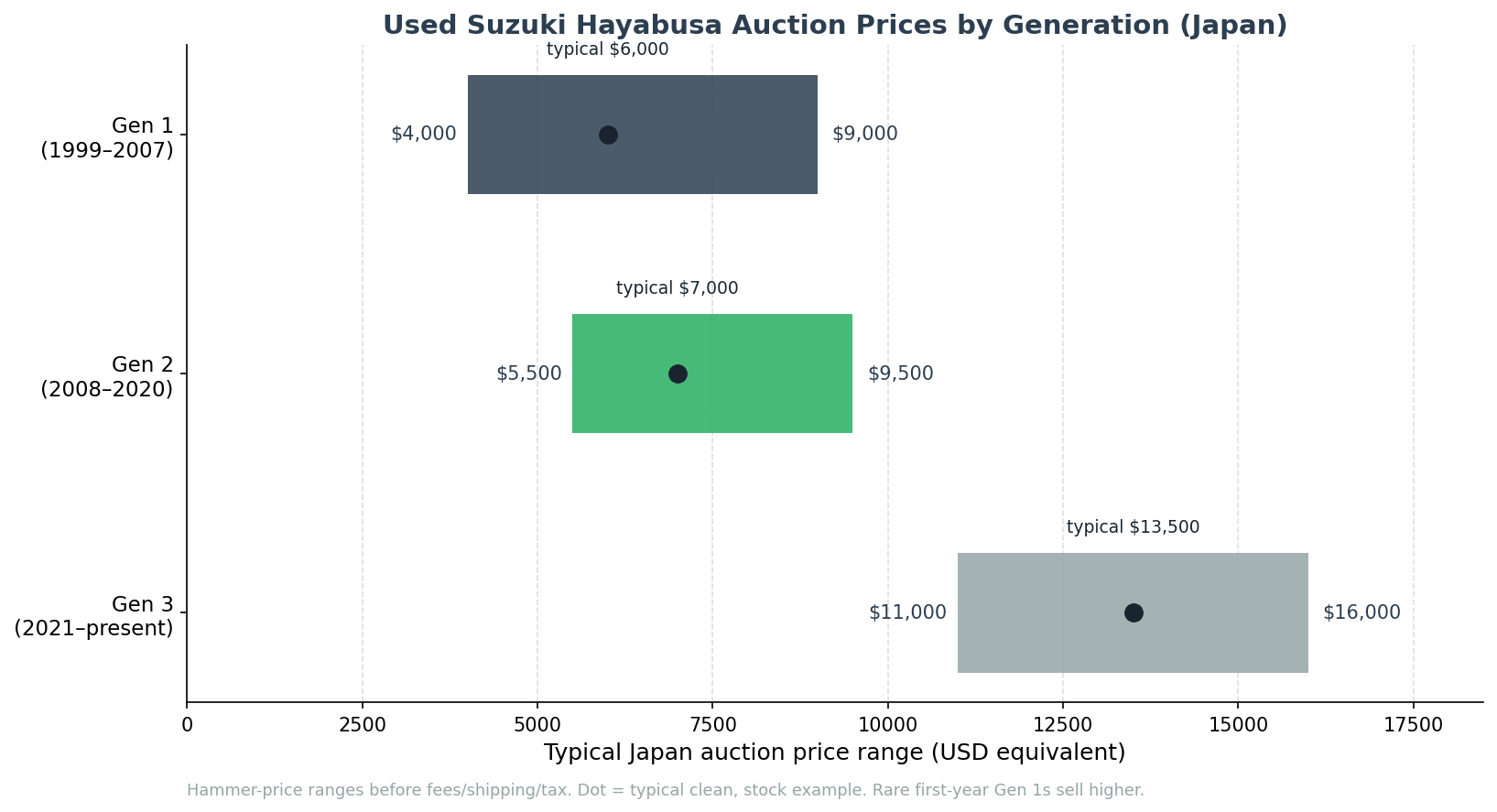
For importers, Gen 1 is the prize. It's the most affordable to buy, the most culturally significant, and — critically — it's the generation that has aged into the various 25-year and rolling import windows. A clean, stock, low-mileage Gen 1 from Japan is one of the best value modern classics you can buy.
Gen 2 (2008–2020): the connoisseur's daily
The displacement grew to 1,340cc with reworked internals, fuel injection, and a stronger exhaust to meet emissions while making more power. From 2013, ABS and Brembo brakes became standard, and the model gained dual-mode traction control. The widely-cited buyer consensus is that the Gen 2 — especially a 2013-or-later "Gen 2.5" with ABS — is the sweet spot for used buyers: modern safety kit and smoother power without Gen 3 money. Watch the early 2008–2009 cam-chain tensioner; the reinforced hydraulic unit from around 2011 fixed it.
Gen 3 (2021–present): the electronics flagship
Still 1,340cc, but reworked for stricter emissions with new pistons, rods, cams, and injectors — and a full electronics suite: ride-by-wire throttle, multiple riding modes, cornering ABS, launch control, cruise control, and a TFT-flanked dash. Peak power dropped fractionally (to about 188 bhp) to meet regulations, but mid-range and usability went up. Importing a Gen 3 from Japan is more about getting a clean, low-mileage example at a good price than about rarity, since it's still in production.
The 25-Year Rule and Import Legality (US, UK, Australia, NZ)
Whether you can import a given Hayabusa — and how easily — depends entirely on where you live. Here's the honest country-by-country picture. Rules change, so always confirm with your national authority before you bid.
United States: the 25-year rule is your friend
The US bars most non-conforming vehicles unless they're at least 25 years old, under the Imported Vehicle Safety Compliance Act. The clock runs on the month and year of manufacture, not the model year — and bringing a bike in even a few weeks early can get it seized. The good news: as of 2026, Gen 1 Hayabusas from 1999, 2000, and 2001 are now 25-plus years old and freely importable to the US without meeting current FMVSS or EPA standards. Each year, another model year rolls into eligibility. This is precisely why early Busa prices in Japan are climbing — American demand just switched on.
United Kingdom: easiest of all
The UK has no 25-year rule. You can import a Hayabusa of any age. Older bikes (generally over 10 years and "not substantially changed") can take a simplified route, while newer machines may need an MSVA test and will attract import VAT and duty. A km/h speedo and JDM lighting are the usual registration housekeeping. The UK is the most flexible market for Busa imports of any generation.
Australia and New Zealand: doable, with paperwork
Australia operates under the Road Vehicle Standards Act, and motorcycles generally come in via the Specialist and Enthusiast Vehicle Scheme or as bikes over 25 years old on the older register — confirm current eligibility on the official register before bidding. New Zealand is famously import-friendly and has long absorbed huge numbers of Japanese bikes; you'll need compliance/entry certification and the usual de-registration paperwork from Japan. Both markets are well-trodden paths for Japanese imports, so the process is mature.
What It Actually Costs: The Landed Price Breakdown
Let's talk real money. The auction price is only the start — the figure that matters is the landed cost: the bike sitting in your garage, registered, with nothing left to pay. Below is a realistic breakdown for a clean Gen 1 Hayabusa imported to a typical Western destination. Treat these as ballpark figures in USD; your exact numbers depend on exchange rates, port, and the bike.
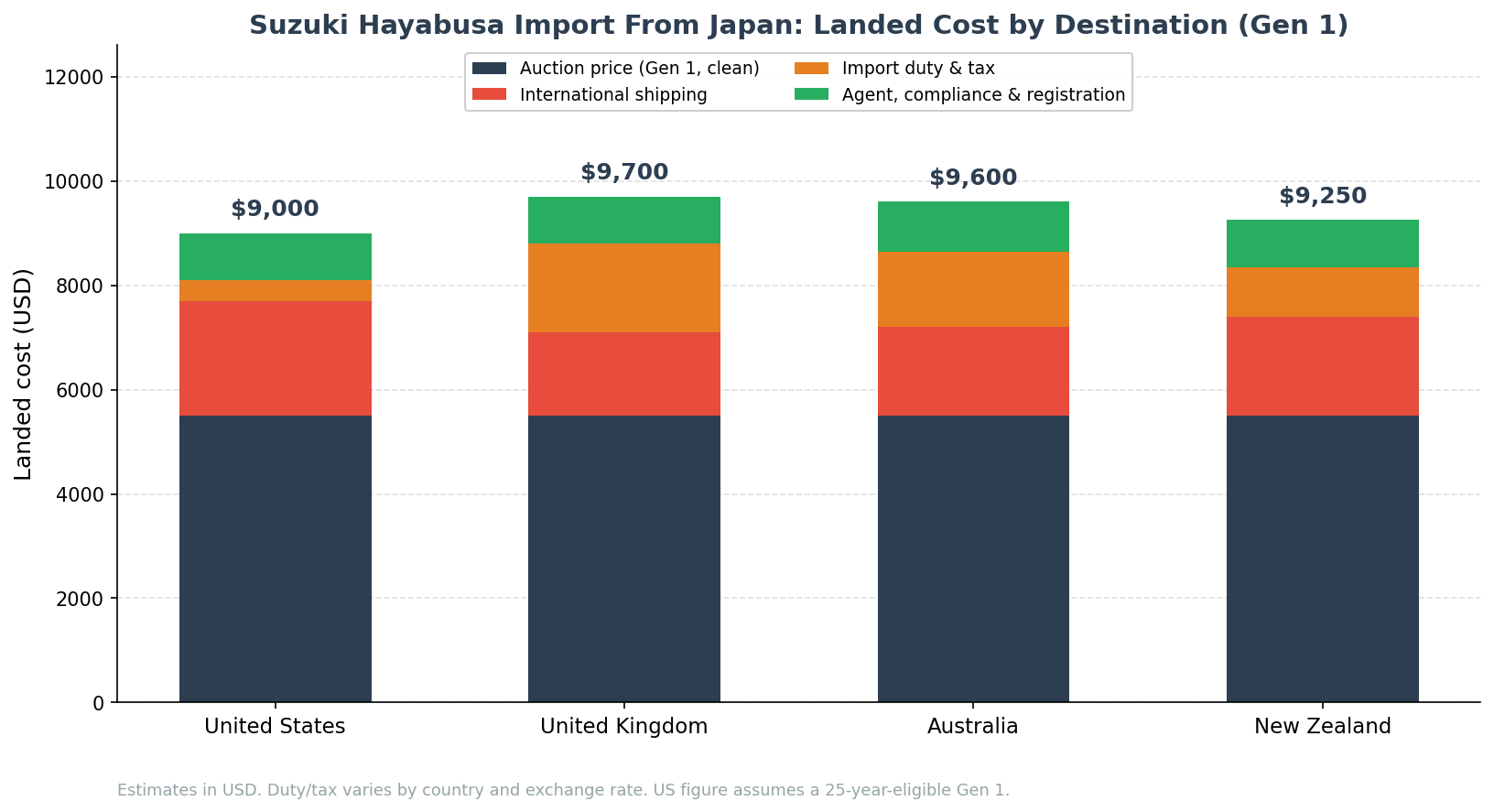
- Auction hammer price: a clean, stock Gen 1 typically runs the equivalent of roughly $4,000–$7,000 in Japan; pristine collector examples and rare first-year bikes go higher.
- Auction & agent fees: the auction house fee plus your export agent's service fee — usually a few hundred dollars combined.
- Domestic transport & export prep: moving the bike to port, de-registration, and crating — a few hundred dollars.
- International shipping: roughly $1,000–$2,500 depending on destination and whether it's containerized or RoRo.
- Import duty & tax: the big variable. The UK adds import VAT (20%) plus duty; the US is comparatively light on a 25-year-old bike; Australia adds GST and duty. This line moves your total more than any other.
- Compliance, registration & derestriction: any inspection/compliance test, plates, and the limiter-removal part — typically a few hundred dollars all-in.
For most buyers, a clean Gen 1 Hayabusa lands somewhere in the $8,000–$13,000 range fully sorted, depending heavily on destination taxes. That's the honest figure. Anyone quoting you "just the auction price plus shipping" is hiding the duty line — and it's the line that hurts.
Why it's still worth it
Because you're not comparing the landed cost against a cheap local bike. You're comparing it against a clean, stock, low-mileage, properly documented local bike — and those are rare and expensive everywhere. When you factor in that most Western Busas have been thrashed, the Japan route often gets you a genuinely better bike for similar money.
How to Read the Auction Sheet on a Used Hayabusa
The auction sheet is your superpower, and most first-time importers don't know how to read it. Every bike at a major Japanese auction is graded by an independent inspector. Learn the system and you can buy with confidence from the other side of the planet.
The overall grade
- Grade 6 / S: essentially new or near-new condition.
- Grade 5: excellent, low mileage, very minor flaws.
- Grade 4 / 4.5: the sweet spot for a used Busa — good honest condition, normal wear, no major issues.
- Grade 3: noticeable wear or repairs; fine if priced right and you know what you're getting.
- Grade R / RA: repaired or previously damaged — read the notes carefully and proceed with caution on a hyperbike.
The interior/condition map
Beyond the headline grade, the sheet includes a diagram with coded marks: A-scratches, U-dents, W-repaired/wavy panels, and notes on the engine, tyres, and modifications. On a Hayabusa, you're hunting for one word above all: stock. Aftermarket exhausts and bar-end mirrors are fine. Stretched swingarms, nitrous plumbing, turbo fittings, and crash damage are the red flags. The sheet — and good agents will translate it — tells you all of this before you bid.
We go deep on this in our dedicated guides to reading Japanese auction inspection sheets and Japanese auction grades explained — both worth reading before your first bid.
Common Hayabusa Faults to Check Before You Bid
The Busa is famously tough, but "tough" doesn't mean "indestructible," and the way people ride them creates predictable wear. Real owners on the long-running Hayabusa owners' forums repeat the same warnings. Here's what to look for in the auction notes and photos.
- Clutch and gearbox: the most common abuse damage. Hard launches and clutch dumps wear clutches and can chip gears (notoriously 2nd gear). Listen for it in any video, and prefer a bike with a documented gentle history.
- Cam chain tensioner (early Gen 2): 2008–2009 bikes can have a rattly tensioner; the reinforced hydraulic unit from ~2011 cured it. A noisy top end at startup is a clue.
- Fuel pump relay: a known electrical weak spot — symptoms are intermittent no-start, low-rpm stalling, or sudden power loss. Cheap to fix, but worth knowing.
- Gen 1 rear subframe (1999–2000): the aluminium subframe can crack under heavy loads; 2001-on went to steel. Check the auction notes on early bikes.
- Hard starting on early bikes: some Gen 1s are fussy to start cold; usually carburation/sensor housekeeping, not a deal-breaker.
- Stretched swingarms and turbo kits: not a "fault" exactly, but a modified drag-build is a very different purchase from a stock road bike. The auction sheet flags modifications — read it.
The pattern is clear: most Hayabusa problems come from how the bike was ridden, not from how it was built. That's the entire argument for importing a gently-used JDM example with a clean, graded sheet rather than gambling on a local bike with an unknown past.
Step-by-Step: How Importing a Hayabusa From Japan Actually Works
Importing sounds intimidating until you see it broken into steps. It isn't a single scary leap — it's a sequence, and most of it happens while you're getting on with your life. Here's the whole process from "I want a Busa" to "it's in my garage."
Step 1: Set your spec and budget
Decide the generation, the maximum mileage you'll accept, the minimum auction grade, and your absolute landed-cost ceiling. Be specific. "A stock Gen 1, grade 4 or better, under 40,000 km, all-in under $12,000" is a brief an agent can actually work to. "A nice Hayabusa" is not.
Step 2: Watch the auctions
Japan's motorcycle auctions run on a weekly cycle, and stock turns over fast. Hundreds of bikes pass through, and only some match your brief. This is where access matters: the auctions aren't open to the public, so you either register through a licensed agent or you don't get in at all. Your agent surfaces the matching bikes, sends you the photos and the translated auction sheet, and gives you an honest read on each.
Step 3: Bid
You set your maximum bid; the agent bids on your behalf. You're not sitting up at 3 a.m. watching a Japanese live feed. If you win, great. If the bike goes over your max, you walk away and wait for the next one — there's always another one. Discipline here is everything. The buyers who overpay are the ones who fall in love with a single listing.
Step 4: Payment, de-registration, and export prep
Once you've won, the bike is paid for, de-registered from the Japanese system, and prepared for export. You receive the de-registration certificate (the Japanese title document) and an English translation. The bike is moved to the export port and crated or loaded for shipping.
Step 5: Shipping
The bike sails to your nearest port — usually 3 to 6 weeks on the water depending on destination. You'll get the bill of lading and tracking. This is the slow part, and there's nothing to do but wait.
Step 6: Customs, duty, and compliance
At your end, the bike clears customs, you pay any import duty and tax, and it goes through whatever compliance or inspection your country requires. This is where having all the paperwork in order — which your agent prepared — saves you weeks of headaches.
Step 7: Registration and derestriction
Final step: register the bike, fit plates, sort the speedo if your market needs mph, and remove the 180 km/h limiter if you want full power. Then you ride. From winning the auction to riding the bike, expect roughly 8 to 14 weeks all in.
Why Early Hayabusa Values Are Climbing
Here's something worth understanding before you buy: the Gen 1 Hayabusa has quietly crossed from "fast old bike" into "appreciating modern classic," and the timing of that shift is no accident.
Three forces are pushing early Busa prices up at once. First, the US 25-year rule just opened the door — every year, another model year of Hayabusa becomes legal to import to the world's biggest motorcycle market, and that demand lands squarely on the Japanese supply of clean examples. Second, the 1999 first-year bikes carry genuine historical weight as the machines that ended the top-speed wars, and collectors pay premiums for "the first one." Third, the supply of unmolested Gen 1s is shrinking every year as the abused ones get crashed, parted out, or turned into drag builds.
Put simply: the number of clean, stock, low-mileage Gen 1 Hayabusas in the world only goes down, while the number of people legally allowed to buy one only goes up. That's the textbook setup for appreciation. It doesn't mean you should buy a Busa as an investment — buy it because you want to ride one of the great motorcycles. But it does mean that buying a clean, original example now, rather than a thrashed one, is the financially smart move as well as the sensible one. Originality is what holds value. Modifications, however cool, rarely do.
This is also why the auction-sheet discipline matters so much. A grade 4.5 stock Gen 1 isn't just a nicer bike to own than a grade 3 modified one — it's a better-protected purchase. The market is increasingly rewarding condition and originality, exactly the things a Japanese auction sheet documents in black and white.
Container vs RoRo: Shipping Your Hayabusa Safely
One decision that catches first-time importers off guard: how the bike actually crosses the ocean. There are two main methods, and they're a genuine trade-off between cost and protection.
RoRo (Roll-on/Roll-off) means the bike is secured to the deck of a dedicated vehicle carrier. It's cheaper and perfectly common, but the bike is handled more and stored in a shared space, which carries a slightly higher risk of cosmetic knocks. For a workhorse bike that's fine. For a clean, appreciating Gen 1 you've carefully selected for its condition, it's worth thinking twice.
Container shipping means the bike is crated — often sharing a container with other vehicles to split the cost — and is far better protected from weather and handling. It costs more, but for a Hayabusa whose entire appeal is its pristine, original condition, the extra few hundred dollars is cheap insurance. A scratched tank on a $10,000 collector bike costs far more than the shipping upgrade would have.
Our rule of thumb: RoRo for a rider you plan to use hard, container for anything where condition is the whole point — which, for a carefully-chosen JDM Busa, it usually is. We cover the full trade-off in our guide to container vs RoRo motorcycle shipping.
How AWA Auction Gets You a Hayabusa From Japan
This is exactly what we do. AWA Auction gives English-speaking buyers direct access to the Japanese motorcycle auctions where the cleanest Hayabusas are sold — the same auctions Japanese dealers buy from, without the dealer markup.
Here's how it works in plain terms. You tell us what you want — say, a stock Gen 1 Hayabusa, grade 4 or better, under 40,000 km. We watch the auctions, translate the sheets, and send you the genuine candidates with our honest read on each one. You set your maximum bid; we bid for you. When we win, we handle de-registration, export paperwork, crating, and shipping to your nearest port, and we walk you through compliance and registration on your end. The 180 km/h limiter, the Japanese documents, the auction-sheet translation — that's all our job, not yours.
You can browse the motorcycles currently available to see what's coming out of Japan right now, and if you've got a specific Hayabusa spec in mind, contact our team and we'll start hunting. No obligation, no pressure — just access to the best Busas in the world before they sell to someone who knows where to look.
The Bottom Line
The Hayabusa is one of the few motorcycles that's genuinely a legend — fast enough to end the top-speed wars, tough enough to make 400 horsepower, and iconic enough to stay in production for over 25 years. But the open market is full of abused, modified, and tired examples. The clean, stock, honest ones are in Japan, sold through auctions most buyers can't reach, with a graded sheet that tells you exactly what you're getting.
Import a Hayabusa from Japan and you skip the gamble. You get the condition, the documentation, and — for US buyers on a Gen 1 — a bike that's finally legal under the 25-year rule. The falcon was always built to be hunted down. You just need to know where to look.
See Also
Share this article: