
A Suzuki Katana import from Japan is still the smartest way to land a clean, honest example of the most divisive silhouette in motorcycling history. The Katana is the bike that practically invented the word "reimport" in Japan, it was built in Japanese factories long after Europe stopped caring, and Japanese owners treated these machines like family heirlooms. That is exactly why the best surviving Katanas on the planet are sitting in Japanese auction halls this week rather than rotting in a shed in Yorkshire or Ohio.
Here's the thing nobody tells you in the glossy retro features: the Katana you actually want, the wide-shouldered GSX1100S with that guillotine fairing, was sold and stockpiled in Japan in numbers no other market ever saw. Suzuki kept the 1100 alive on the home market into the early 2000s while UK dealers had moved on a decade earlier. So if you want one that has not been thrashed, crashed and "improved" by three previous owners, you import it. From Japan. Where it came from.
This guide walks you through every Katana variant worth importing, what one really costs landed in your garage, how the auction process works, the Katana-specific traps on the inspection sheet, and the import rules for the UK, US, Australia and New Zealand. No fluff, no recycled spec-sheet padding — just what a sharp buyer needs to bring a great Katana home.
Why the Suzuki Katana is the bike that invented "reimporting from Japan"
Most model guides skip the history. Skip it on the Katana and you miss the entire reason Japan is the right place to buy one.
When Suzuki unveiled the GSX1100S Katana at the 1980 Cologne show, designed by Hans Muhr and Hans-Georg Kasten of Target Design, it was an export model. Full power, 1100cc, aimed squarely at Europe and the US. Japan, at the time, had a self-imposed cap that effectively limited domestic big-bore sales, so the home market got the smaller GSX750S Katana instead. Riders in Japan who wanted the real 1100 had to buy one that had been shipped abroad and then brought back — a "reimport," or gyaku-yunyu. The Katana was so desirable that it turned reimporting from a niche grey-market trick into a mainstream Japanese hobby. The bike literally taught a generation of Japanese enthusiasts how to source machines internationally.
There's a cultural point hiding in that story, too. Because the Katana was the bike Japanese enthusiasts learned to source from abroad, it created the exact infrastructure — exporters, auction access, shipping know-how — that now lets the rest of the world buy bikes out of Japan. The reimport boom built the pipes. Four decades later those same pipes run in reverse, carrying clean Japanese Katanas to collectors in London, Sydney and Los Angeles. When you import one today, you're not fighting the system; you're using a trade route the Katana itself helped carve.
That history matters to you because it flipped the supply map. By the 1990s Suzuki was building Katanas specifically for Japanese demand, including domestic-market editions and the celebrated Final Edition examples around 2000. Decades of that production stayed in Japan, maintained under the country's brutal shaken inspection regime, ridden gently, and stored indoors. The result: when you go looking for a Suzuki Katana to import from Japan, you are fishing in the deepest, cleanest pool of survivors anywhere on Earth.
One Japanese exporter walkaround of a 1997 GSX1100 Katana in original condition has pulled over 650,000 views on YouTube — not because the bike is rare, but because original, unmolested examples make collectors weak at the knees. That is the standard Japan can still deliver and your local market usually cannot.
Which Suzuki Katana are you importing? Every generation explained
"Katana" covers about four decades of very different motorcycles. Buy the wrong one by accident and you'll end up with a 400cc learner bike when you wanted a 1100cc icon. Here's the family tree that actually matters at auction.
GSX1100S Katana (1981 onward) — the one you came for
The original 1100. Air-cooled, 16-valve inline four, roughly 111 horsepower in original export tune, and that unmistakable silver guillotine fairing with the stepped seat. This is the collectible centerpiece. Early export bikes had the quirky pop-up "nose" headlight and seven-spoke wheels; later Japanese-market runs cleaned up the details and ran into the late 1990s. If someone says "Katana" and means it, this is the bike.
Mechanically it's classic 1980s Suzuki: a stout double-cradle frame, twin-shock rear on the earliest bikes evolving to a rising-rate monoshock on later versions, four Mikuni carbs, and an engine derived from the GSX1100 that earned a reputation for being almost impossible to kill. It will happily cruise at motorway speeds all day, and the riding position — that long reach to the bars over the tank — is part of the character, not a flaw to be fixed. People who "improve" the ergonomics usually end up missing the original after a season.
What you pay in Japan depends heavily on originality and edition. A tidy, running, mostly-original GSX1100S typically hammers somewhere between ¥800,000 and ¥1,400,000 at auction, with concours and Final Edition examples pushing well beyond that. Rough but complete projects still turn up under ¥600,000. Those numbers move with the collector market, but the trend for clean originals has been firmly upward for a decade, which is half the reason serious buyers import now rather than later.
GSX750S Katana — the domestic hero
Japan's home-market answer when 750cc was the practical ceiling. Same DNA, smaller engine, and several styling generations (including a half-fairing version and the wild pop-up headlight model). Plenty of these survive in Japan, prices are gentler than the 1100, and for many riders the 750 is the sweet spot — lighter, cheaper to insure, and still pure Katana.
Here's a detail most buyers miss: because the 750S was sold in Japan in genuine volume, the survivor pool is enormous and the spread of condition is wide. You can find everything from ratty commuters to garage-kept showpieces, which makes the auction sheet your most powerful tool. Expect hammer prices roughly ¥400,000 to ¥900,000 depending on generation and condition. For a rider who wants the Katana look and feel without classic-1100 money, the 750S imported from Japan is arguably the smartest buy in the whole family.
GSX400S Katana — the JDM-only oddball
A 400cc Katana built almost entirely for Japan's restricted licence and tax brackets. You will basically never find one outside Japan, which is exactly why importing is the only realistic way to get one. There's a wildly popular Japanese restoration series on YouTube — over 770,000 views — built around a rider who bought a 16-year-neglected GSX400S Katana for ¥100,000 (about £530) and brought it back to life. That video tells you two things: project 400s are genuinely cheap in Japan, and they exist in numbers no other country can match.
Don't dismiss the 400 as a toy, either. In Japan the 400cc class is a serious, well-supported category, and the GSX400S is a properly engineered scaled-down Katana, not a parts-bin special. For markets with no displacement barrier to registration, a 400S is a charming, insurable, easy-to-park way to own the silhouette — and it ships in the same container space as a 1100 for a fraction of the bike cost. Buy a running one rather than a basket case unless restoration is the whole point for you.
Final Edition and anniversary GSX1100S (around 2000)
Suzuki sent the air-cooled Katana off with special late editions sold into the Japanese market. These command the strongest money and are the holy grail for importers who want the definitive version with the latest factory updates and the lowest typical mileage.
Why do collectors chase them so hard? Late bikes got the benefit of two decades of running production tweaks, they were bought by enthusiasts who knew exactly what they had, and many were preserved almost from new. A documented, low-mileage Final Edition with its books and tools is the closest thing to a blue-chip air-cooled Katana, and Japan is essentially the only place they exist in any number. If your budget stretches to one, it's the example least likely to ever cost you money.
Modern Katana 1000 (2019 onward)
The reborn, water-cooled Katana built on the GSX-S1000 platform — 999cc, around 150 horsepower, modern brakes and electronics, sold new in Japan, the UK and beyond. A Suzuki Katana walkaround from Motorcycle Live has racked up over 2.2 million views, which tells you the modern bike pulls a crowd. Importing a used modern Katana from Japan makes sense if you want low miles and JDM colours, though the value gap versus a local used bike is smaller than it is for the classic.
The modern bike is the easy one to live with: fuel injection, real brakes, traction control and a riding position your wrists will thank you for. Where importing earns its keep is condition and colour — Japanese-market bikes are often barely run-in, kept immaculate, and offered in finishes that never reached your local dealer. Just go in knowing it depreciates like any modern machine, so chase a clean, low-mile example rather than expecting an investment.
Why Japan is the best place to import a Suzuki Katana
You can buy a Katana anywhere. You import one from Japan for five concrete reasons, and they all come back to condition and choice.
Volume. Japan's big auction houses move tens of thousands of bikes a week. On any given week there are multiple Katanas of different generations crossing the block. That means you wait for the right one instead of overpaying for the only one within driving distance.
Condition. The shaken roadworthiness system makes neglect expensive, so Japanese owners maintain bikes properly or take them off the road entirely. Add famously clean fuel, low average mileage and a culture of indoor storage, and the baseline Japanese Katana is mechanically healthier than its Western twin.
Originality. Western Katanas have usually been through the modifier mill — Yoshimura cans, rearsets, paint, "café" conversions. Japan still has a steady stream of bone-stock, factory-correct examples, which is what holds value.
JDM-only variants. The GSX400S and many 750S editions never officially left Japan. Importing is the only path to them.
Honest paperwork. Every bike at a major Japanese auction gets an independent inspection sheet graded by the auction house. Learn to read it and you get a brutally honest condition report before you spend a yen. Try getting that from a private seller on Facebook.
What a Suzuki Katana costs to import from Japan
Let's talk real money. The hammer price is only the beginning, and anyone who quotes you just the auction figure is selling you a fantasy. Here is a realistic all-in breakdown for a clean GSX1100S Katana landed in the UK, the single most common destination for classic Katana imports.
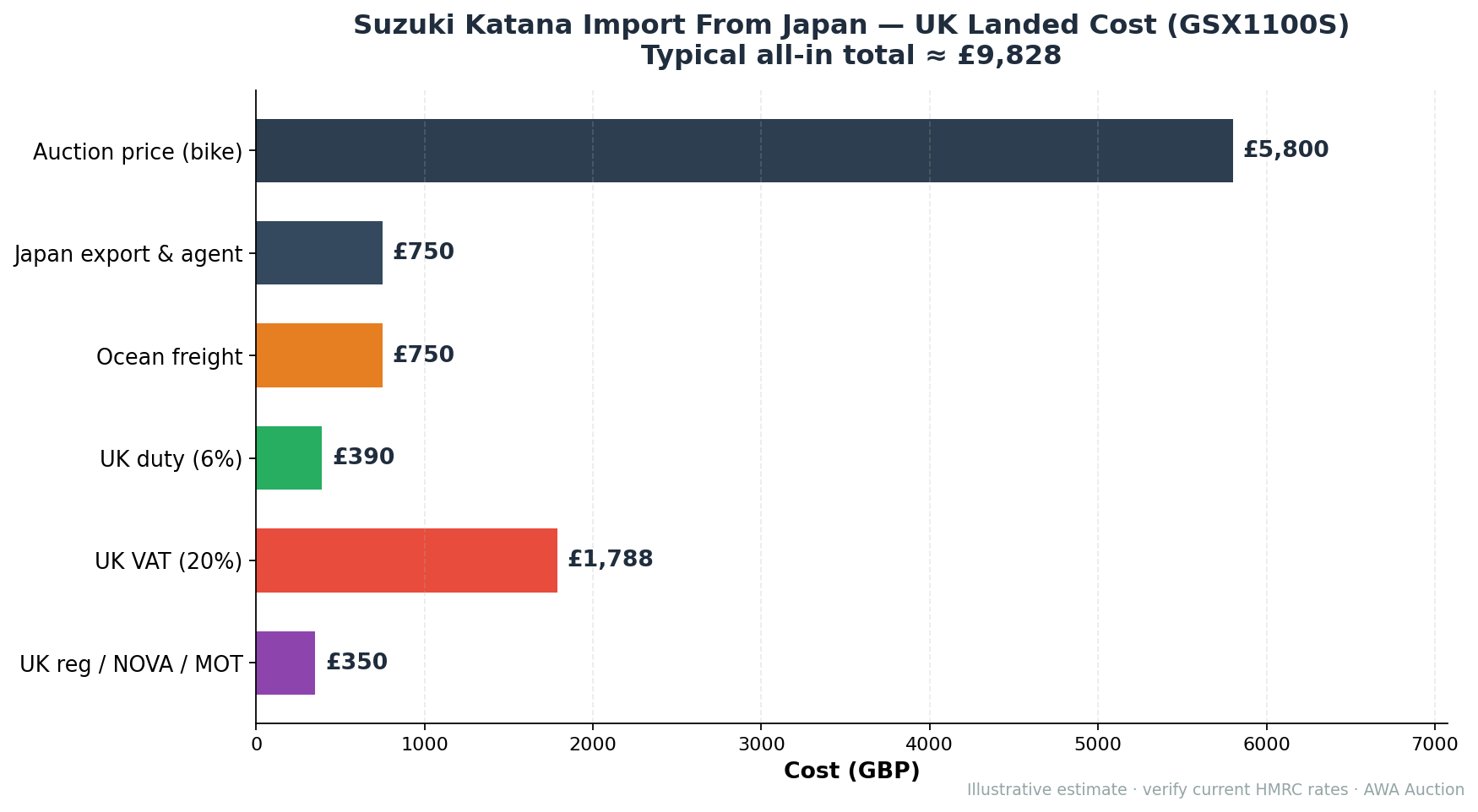
For a genuinely good, original GSX1100S, budget around £9,500 to £11,000 all-in to your door. That typically breaks down as roughly £5,800 for the bike at auction, about £750 in Japanese-side export paperwork and agent commission, £600 to £900 for ocean freight in a shared container, then UK import duty and VAT calculated on the bike plus freight, and finally around £350 for UK registration, the NOVA declaration and a fresh MOT. A useful rule of thumb: add at least 40% to the hammer price for everything else on a classic, because the bike's value is high relative to the fixed shipping cost.
Australian buyers run similar maths with different labels. A clean GSX1100S typically lands in Australia for AUD 15,000 to 19,000 once you add the bike, Japanese export fees, freight to Sydney or Melbourne, GST, import approval and state compliance. The headline rates differ from the UK, but the structure is identical: the bike is the big number, the fixed costs are roughly constant, and the percentage you add on top shrinks as the bike's value rises. That is exactly why importing makes more sense on a sought-after classic than on a cheap commuter — you are spreading the same shipping bill across a far more valuable machine.
A GSX750S lands for noticeably less — often £6,500 to £8,000 — because the bikes themselves are cheaper while shipping and fees stay roughly the same. A tidy GSX400S project can come in under £4,000 landed, which is the whole appeal. The modern Katana 1000, by contrast, only makes financial sense if you find an unusually low-mileage or special-colour example, since UK used prices for the modern bike are already competitive.
Two costs catch first-time importers off guard. The UK charges reduced 6% duty on motorcycles plus 20% VAT, and the VAT is charged on the bike, the freight and the duty — tax on tax. And classic bikes over 30 years old can qualify for historic VAT relief in some cases, so always check the current rules with HMRC before you assume the full rate. For the official position, read the UK government guidance on importing vehicles into the UK.
Step-by-step: how to import a Katana from Japan
The process is far less scary than the forums make it sound. Strip away the panic and it's seven steps.
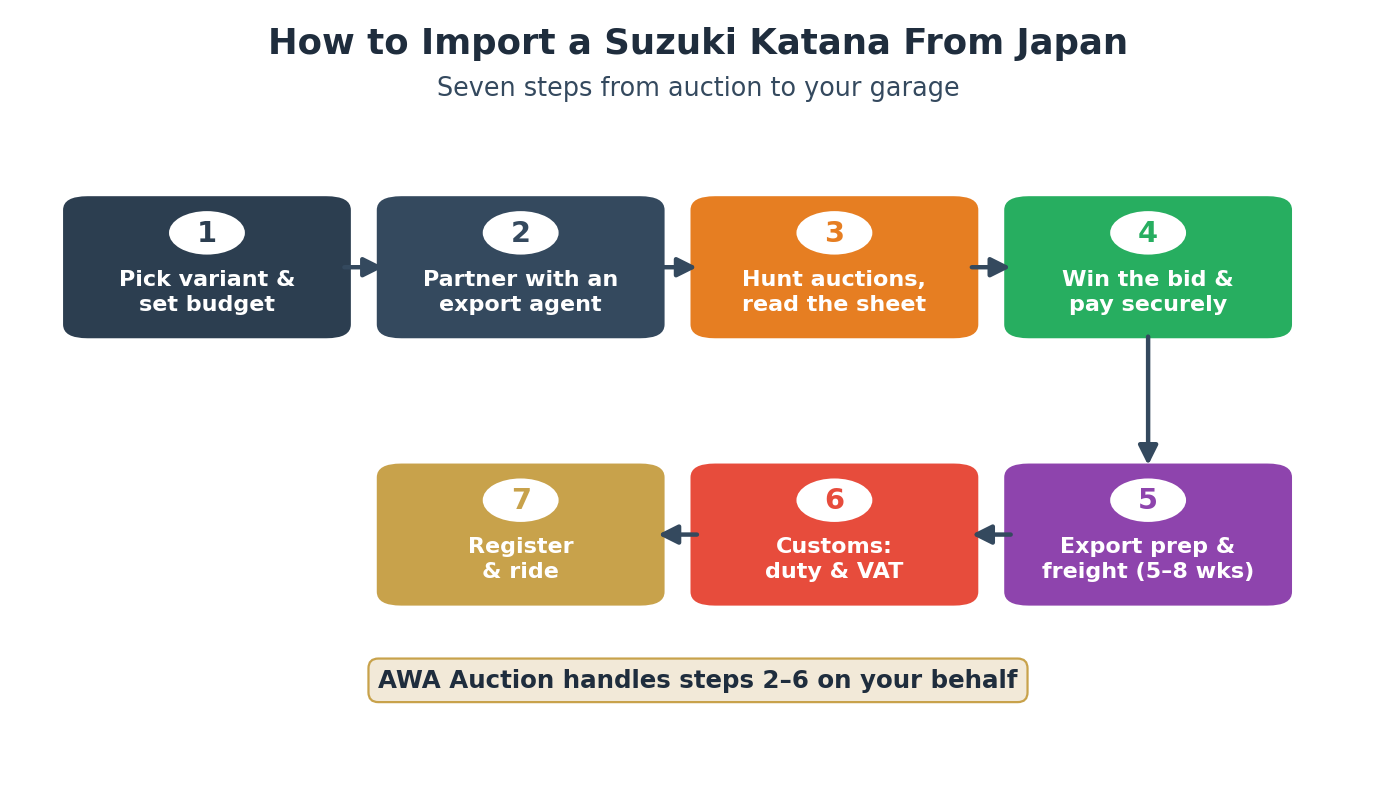
1. Pick your exact variant and budget. Decide 1100S, 750S, 400S or modern, and set a hard landed-cost ceiling, not just an auction ceiling.
2. Partner with an export agent. You do not bid at Japanese auctions directly — you need a licensed exporter with auction access who bids on your behalf, translates the sheet, handles export and books freight. This is the single most important decision you'll make.
3. Hunt the auctions. Your agent feeds you listings from the big houses. You review photos and the auction inspection sheet, set a maximum bid, and wait. Patience here is worth thousands.
4. Win and pay. When you win, you pay the hammer price plus auction and agent fees. Reputable agents use protected payment so your money is held until the bike is secured.
5. Export prep and shipping. The agent de-registers the bike, drains fuel, and loads it into a shared or dedicated container, or sends it RoRo. Sea freight to the UK or Europe usually runs five to eight weeks.
6. Customs clearance. On arrival you (or a customs broker) pay duty and VAT and clear the bike. Keep every document — the export certificate is gold for registration.
7. Register and ride. Submit your NOVA, get any required inspection or MOT, register with the DVLA (or your country's equivalent), put a plate on it, and go ride the most stared-at bike at any meet.
Want to see what's clearing the block right now? You can browse current listings to get a feel for live Katana pricing before you commit.
Reading the auction sheet: Katana-specific red flags
The Japanese auction inspection sheet is your best friend, but only if you know which Katana-specific lines to scrutinize. A generic "grade 4 looks clean" check misses the things that sink a Katana deal.
Frame and steering-head corrosion. Air-cooled Katanas are old now. Surface rust is normal and cosmetic; structural corrosion at the steering head or subframe is not. Cross-reference the sheet's frame notes with close-up photos.
The "restored" trap. A Katana described as fully restored can be a treasure or a horror. Repaints hide accident history, and incorrectly restored bikes lose the factory-correct details collectors pay for. On a classic, an honest original beats a glossy restoration almost every time.
Aftermarket everything. Yoshimura exhausts, non-standard carbs, rearsets and aftermarket bodywork are everywhere on Katanas. They are not automatically bad, but they affect value and sometimes registration. Note every non-stock part and price the bike as if you'll need to source originals.
Pop-up headlight mechanism. On the variants that have it, that motorized nose light is a known fiddly part. Confirm it works; replacements are pricey and scarce.
Mileage versus wear. A low-mile Katana that shows heavy wear has either a swapped clock or a hard life. The sheet's wear notes should match the odometer story. If you're new to the grading system, our guide on how Japanese auction grades work is worth reading before you bid.
Modern Katana 1000 versus the classic GSX1100S: which should you import?
This is the question that splits the room, and the honest answer depends entirely on what you want the bike to do.
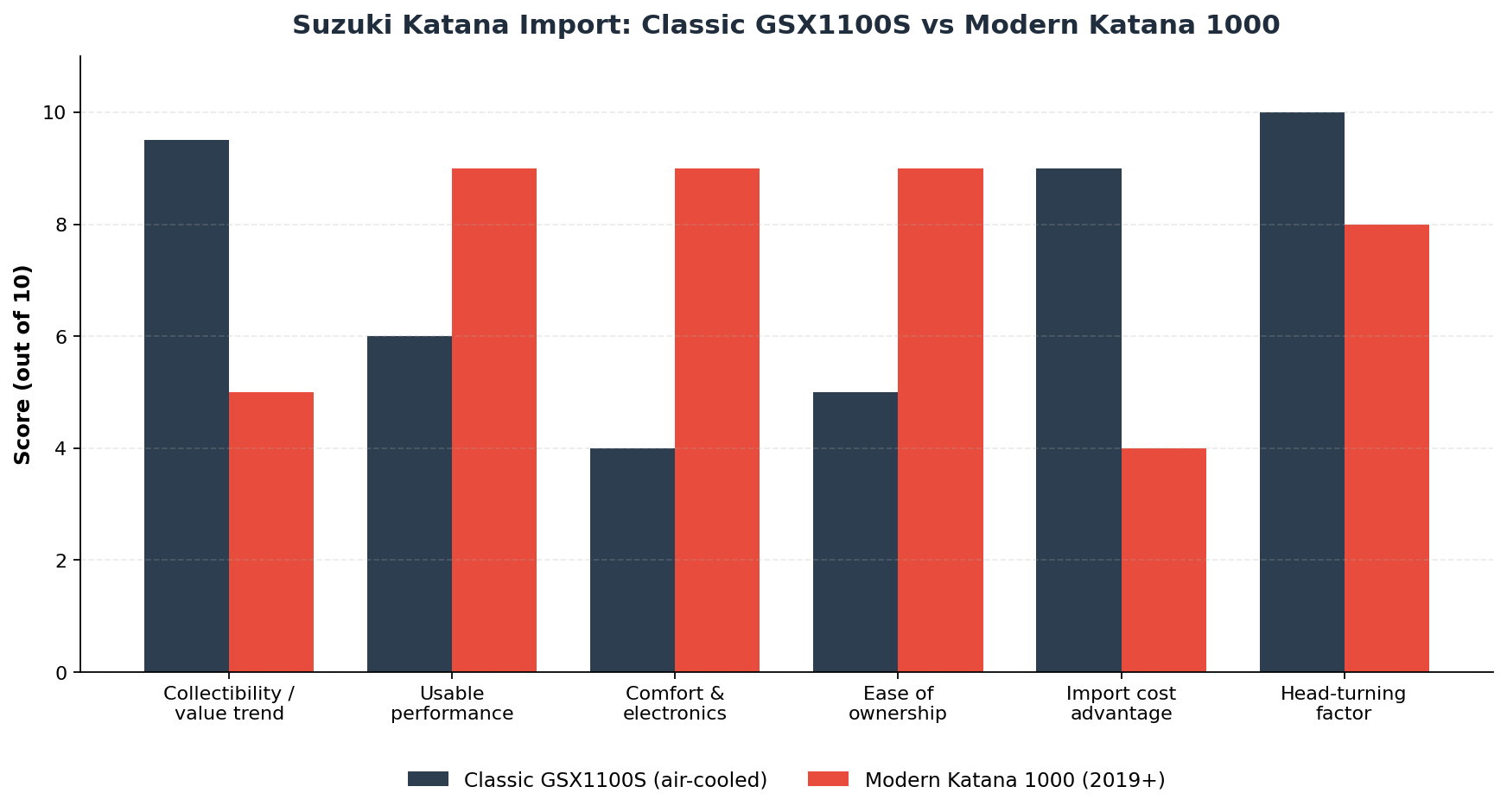
The classic GSX1100S is a rolling piece of design history. It's an investment-grade collectible, the values are climbing, and nothing else on the road looks remotely like it. It's also a 40-year-old air-cooled bike — heavier steering, drum-era brakes by modern standards, and parts hunting is part of the lifestyle. You import the classic with your heart and your spreadsheet, knowing it'll likely hold or gain value.
The modern Katana 1000 is a genuinely fast, comfortable, electronically modern bike with around 150 horsepower from the proven GSX-S1000 engine. A Japanese reviewer described being shocked by its acceleration — "scary" was the word — and the Bike Oh old-versus-new Katana comparison, with nearly half a million views, makes the gap in usable performance obvious. You import the modern one to ride hard and daily, not to flip for profit.
Put bluntly: classic for collecting and head-turning, modern for riding fast with a warranty-era engine underneath you. The import math favours the classic, where Japan's price-and-condition advantage is largest. For the modern bike, only chase low-mile or special-edition examples.
Common mistakes when importing a Katana from Japan
Most import horror stories come from the same handful of avoidable errors. Dodge these and you're ahead of 90% of first-time buyers.
Budgeting the hammer price, not the landed cost. The bike is maybe two-thirds of what you'll actually spend on a classic. Always run the full landed number first.
Picking an agent on price alone. The cheapest agent who ghosts you after the bid is the most expensive mistake in this whole process. Choose communication, auction access and a track record over a slightly lower commission.
Ignoring the variant details. A GSX750S is not a GSX1100S, and a reimport-spec bike is not the same as an original export bike. Confirm the exact model code before you bid.
Assuming US buyers can register one easily. The American 25-year rule is strict, and it changes everything for US importers. More on that below.
Forgetting consumables. A bike that's sat in a Japanese garage for years needs tyres, fluids, a battery and probably fork seals on arrival. Budget a few hundred for recommissioning, whatever the sheet says.
If you'd rather have a human walk you through your specific build and destination, our team will happily do that — just contact our team with the variant you're chasing.
Country-by-country: Katana import rules for the UK, US, Australia and New Zealand
Where you live changes everything about which Katana you can register. Here's the short version for the four markets most of our readers ask about.
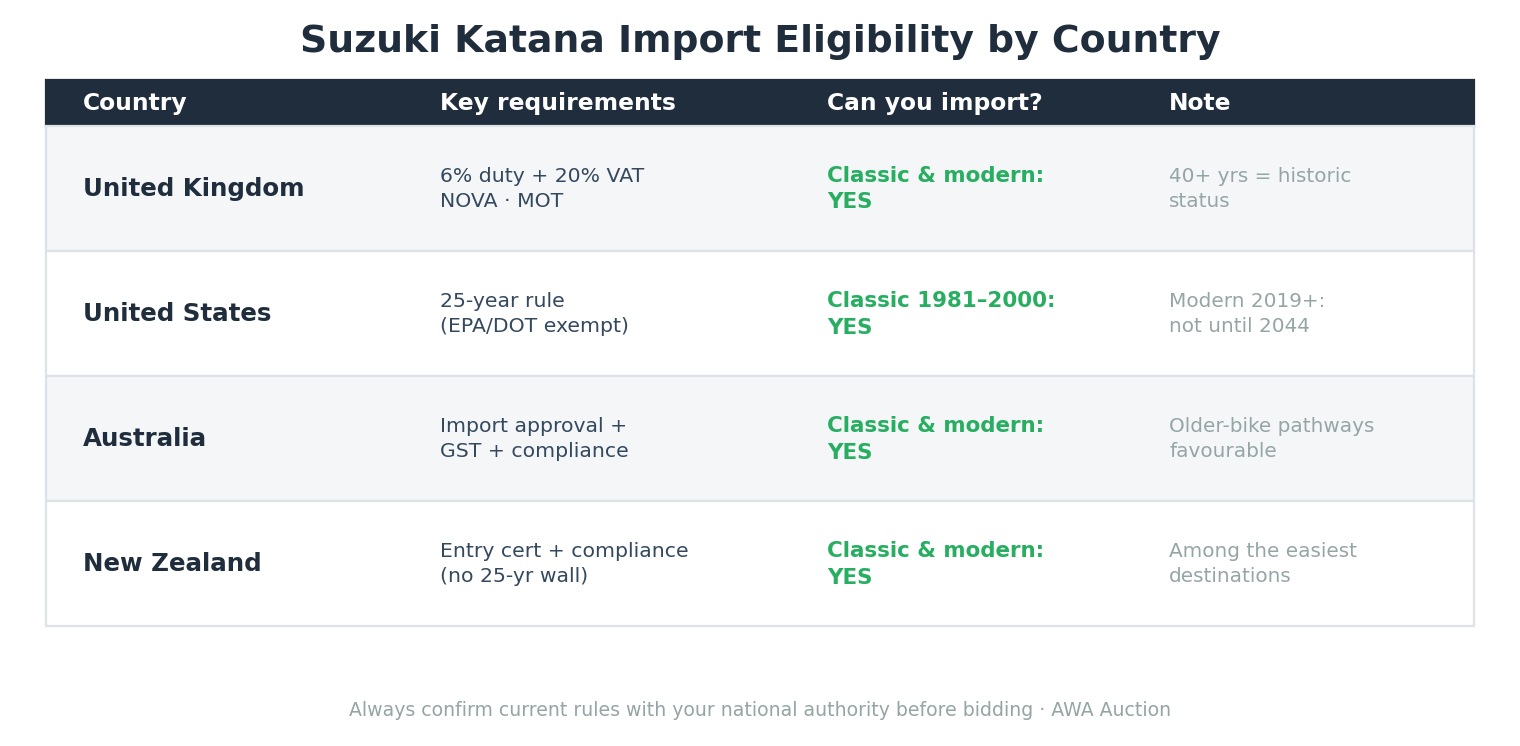
United Kingdom. The friendliest market for classic Katanas. Pay 6% duty and 20% VAT, file a NOVA within 14 days, get an MOT, and register with the DVLA. Bikes over 40 years old roll into historic status with potential tax and MOT exemptions, so an early-1980s GSX1100S is in a sweet spot.
United States. The 25-year rule rules everything. A motorcycle can be imported for street use once the model is 25 years old, exempting it from EPA and DOT requirements. That means original 1981–2000 GSX1100S and 750S Katanas are fully eligible right now, which is great news for American collectors. The modern 2019+ Katana, however, cannot be road-registered via import until 2044 — so US buyers should focus squarely on the classics. The official framework lives with US Customs and Border Protection.
Australia. Australia's import rules favour older bikes through its concessional and 25-year-plus pathways, and classic Katanas are a popular import. Expect to deal with import approval, GST, possible LCT exemptions for bikes, and state registration with a compliance check. Original GSX1100S examples are sought after in the Australian classic scene.
New Zealand. One of the easiest destinations, which is why so many JDM bikes end up there. NZ requires entry certification and compliance, but there's no blanket 25-year wall like the US, so both classic and modern Katanas can be imported and registered, subject to the standard certification process. For many Kiwi riders, a JDM Katana is one of the most straightforward iconic imports to put on the road.
Whatever your destination, confirm the current rules with your national authority before you bid — regulations shift, and a bike you can't register is just expensive furniture.
Known Suzuki Katana problems and what they cost to fix
No 40-year-old motorcycle is perfect, and pretending otherwise is how people get burned. The good news is that the air-cooled Katana's weak spots are well documented and mostly affordable. Knowing them turns the auction sheet from a wall of Japanese into a checklist.
Charging system. Like a lot of 1980s Suzukis, the original regulator/rectifier runs hot and can fail, and the stator can follow it. Many owners upgrade to a modern MOSFET regulator early. Budget a couple hundred for a proper fix; it's the single most common Katana gremlin and it's cheap insurance.
Carburettors. A bike that's been parked for years almost certainly has gummed carbs. A full clean, new seals and a balance sorts it, but factor in the labour if you're not handy with a screwdriver. Bikes sold straight off a long shaken lapse are the usual suspects here.
Fork seals and brakes. Old rubber perishes. Fork seals weep, brake lines harden, and caliper pistons seize if the bike has sat. None of it is expensive, but a freshly imported Katana should get fresh fluids, seals and a brake rebuild as a matter of course before you trust it at speed.
Original paint and the pop-up nose. Original paint and decals are getting hard to source, so a bike with tidy, correct cosmetics carries a real premium. On pop-up-headlight variants, confirm the motor and linkage actually work — the parts are scarce and the repair fiddly.
Electrics in general. Four decades of heat cycling makes connectors brittle and earths unreliable. A patient afternoon with electrical cleaner and dielectric grease fixes most "mystery" faults. None of this is scary; it's just the price of admission on a genuine 1980s classic, and far cheaper than the corrosion repairs a non-Japanese bike would need.
Suzuki Katana values: are they a good investment?
Let's be honest about money, because a lot of Katana buyers are quietly thinking about it. The classic GSX1100S has behaved like a blue-chip modern classic over the past decade. Original, low-owner examples have climbed steadily, Final Edition bikes lead the pack, and the supply of genuinely unmolested machines only shrinks each year. This is the textbook profile of a bike that holds value: iconic design, finite numbers, a passionate global following and a steady stream of media attention keeping it in the public eye.
That said, two things separate a Katana that appreciates from one that just sits there costing you money. The first is originality — the market rewards factory-correct bikes and punishes butchered "café" conversions. The second is provenance and condition, which is precisely where importing from Japan gives you the edge, because Japan still produces honest, original examples with paper trails. A modified Western bike with a fresh respray is a much weaker bet than a stock Japanese import with matching numbers and an auction sheet to back it up.
The modern Katana 1000 is a different story. It's a brilliant motorcycle but it depreciates like any modern bike, so treat an imported one as something to ride and enjoy rather than a nest egg. If your goal is a machine that earns its garage space financially, the classic GSX1100S imported from Japan is the play — buy the best original you can afford and keep it original.
Living with an imported Katana: parts, the Yoshimura factor, and the community
Importing the bike is one chapter. Owning it is the rest of the book, so let's set expectations.
Parts. This is where Japan keeps giving. The Katana has deep aftermarket and reproduction support, and Japanese specialist suppliers stock a remarkable range of consumables, gaskets, cosmetic parts and performance bits. Webike and the big Japanese parts houses list thousands of Katana items, so the bike you import from Japan is also the bike you can most easily keep running with parts from Japan. Plan for a slightly longer wait on niche items shipped internationally, and stockpile the cheap perishables when you order.
The Yoshimura factor. The Katana and Yoshimura are practically a love story — the tuning house's exhausts and engine work defined the hot-rod Katana scene, and a period-correct Yoshimura system can actually add value rather than subtract it, unlike most aftermarket parts. If your imported bike wears genuine vintage Yoshimura kit, research it before you "restore to stock," because you might be sitting on something collectors want.
The community. Few bikes have a fan base like the Katana. Owners' clubs span Japan, the UK, Europe, Australia and the US, and they are a goldmine for parts leads, registration tips and honest advice on what your specific variant should look like. Tap that knowledge before and after you import; the people who've already done it will save you money and mistakes.
Riding it. Finally, ride the thing. A well-sorted Katana is torquey, stable and genuinely fun, and there is nothing quite like the reaction it gets. You didn't import a piece of Japanese design history to leave it under a cover — you imported it to enjoy the most talked-about silhouette in motorcycling.
Timing your Katana import: when to buy at Japanese auction
Timing won't make or break a Katana purchase, but a little patience around the calendar can quietly save you money. Japanese auction volumes and prices move with predictable rhythms, and knowing them helps you bid smart.
Spring, when Japan's riding season kicks off, tends to push demand and prices up as domestic buyers go shopping. The quieter, colder months often see softer bidding on classics, which can work in a patient importer's favour. Year-end and the run-up to Japan's vehicle-tax and shaken cycles also nudge more bikes onto the market as owners clear the decks. None of this is a rule you can set your watch by, but if you're flexible on timing, waiting for a calmer auction week beats panic-bidding on the first Katana you see.
The bigger timing point is the long game. Clean, original air-cooled Katanas are not getting more plentiful, and the classic-bike market has rewarded buyers who moved early on iconic models. If you've decided a GSX1100S is the bike you want, the most expensive strategy is usually waiting another five years and hoping prices fall. They rarely do on bikes like this. Buy the right example when you find it, not the cheapest example when you're impatient.
Your first weekend with an imported Katana: a recommissioning checklist
The bike clears customs, the courier drops it off, and you're standing in your garage with a 40-year-old icon and a grin. Resist the urge to thumb the starter and ride off into the sunset. A Katana that has crossed an ocean after sitting in a Japanese garage needs a methodical going-over first, and an hour of care now prevents a roadside disaster later.
Start with the fluids. Drain and refill the engine oil and filter regardless of what the seller says, flush the brake fluid, and check the coolant on the modern bike. Old fuel is the enemy on carburetted classics, so drain the tank, inspect for rust inside, and put fresh petrol through clean carbs. Fit a new battery — shipping batteries are rarely worth saving — and check every fuse and bulb before you rely on the lights.
Then work the chassis. Inspect the tyres for age cracking and replace anything with hard, square-edged rubber no matter how much tread is left; tyres go off with time, not just mileage. Check fork seals for weeping, lubricate and adjust the chain, confirm the brakes bite cleanly without dragging, and torque the major fasteners. On the classics, give the wheel bearings and steering head a wobble test.
Finally, the paperwork lap. Get your registration and any required inspection sorted before you put miles on it, photograph the frame and engine numbers against your import documents, and start a maintenance log from day one. A documented history is part of what makes a Japanese-import Katana hold its value, so begin building yours the moment it lands. Do all this and your first proper ride will be a celebration, not a recovery mission.
How AWA Auction helps you import a Suzuki Katana from Japan
This is where we stop being a guide and start being useful. AWA Auction gives English-speaking buyers direct access to Japan's motorcycle auctions — the same halls where those clean, original Katanas cross the block every week.
We translate the auction inspection sheets so you understand exactly what you're bidding on, including the Katana-specific red flags this guide covers. We bid on your behalf, handle the export paperwork and de-registration, arrange container or RoRo shipping to your country, and keep you updated from hammer-fall to your front door. No guessing, no language barrier, no flying to Japan.
Whether you want a Final Edition GSX1100S to put away as an investment, a cheerful GSX400S project, or a low-mile modern Katana 1000 in a JDM colour you can't get at home, we'll help you find the right one and land it cleanly. Start by browsing current listings to see what's available, then contact our team and tell us which Katana you're hunting.
The Katana taught Japan how to reimport motorcycles forty years ago. Let us help you do the same — properly, this time, with the best examples on Earth and someone in your corner who reads the auction sheet so you don't have to.
See Also
Share this article: