
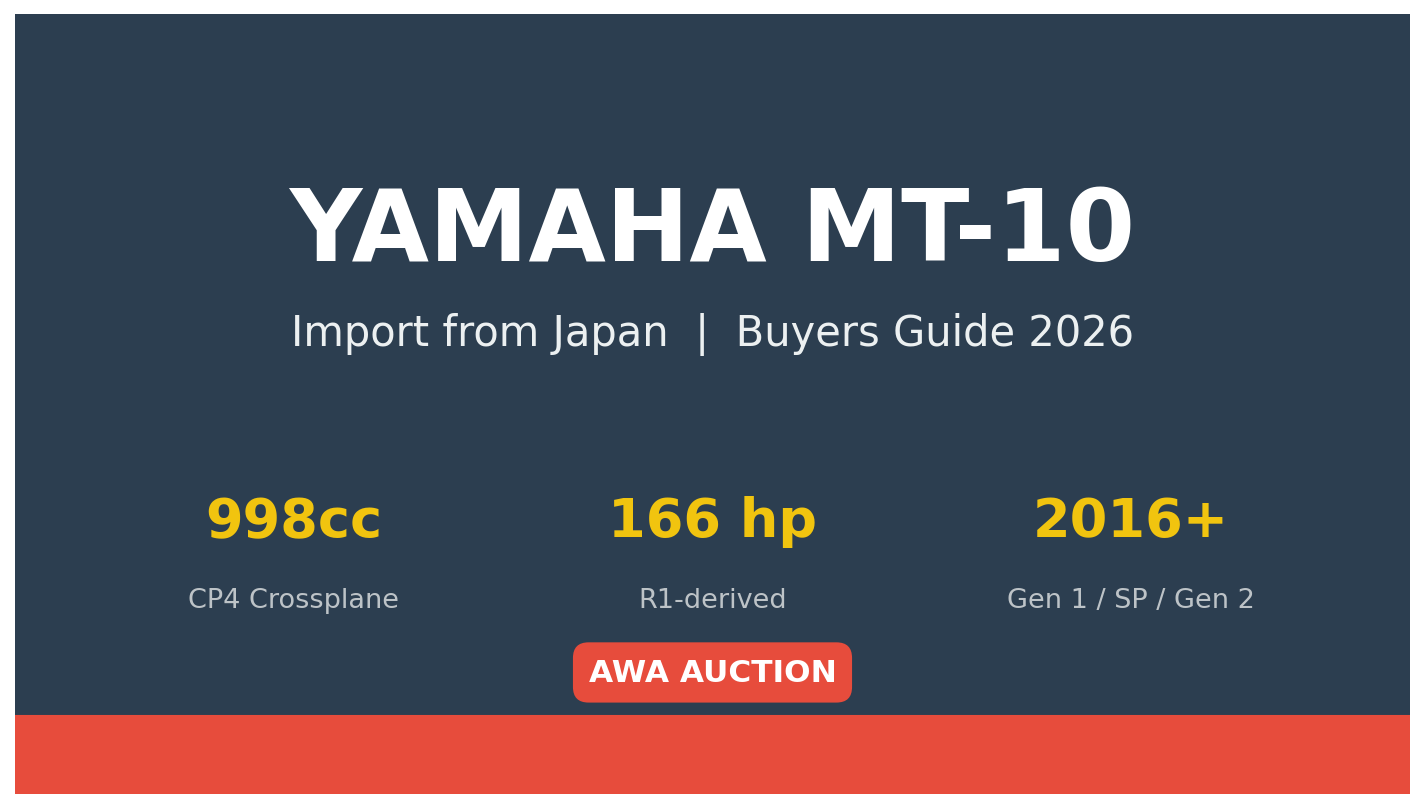
If you are looking to import a Yamaha MT-10 from Japan, you are chasing one of the most honest hooligans money can buy: a naked bike built around a detuned YZF-R1 superbike engine, wrapped in aggressive Transformer styling, and priced well under the exotic European supernakeds it embarrasses. It is the bike people describe as "the naked R1," and for once the internet cliche is basically accurate.
Here is the thing nobody mentions in the glossy reviews. The MT-10 is a fantastic used buy, but the market is full of traps: early bikes with snatchy fueling, US-market FZ-10 examples that confuse the naming, SP models that command a premium some sellers do not deserve, and neglected examples where a rare-but-real engine issue turns a bargain into a boat anchor. Japan is where the clean, low-mileage, honestly-graded stock lives — but only if you know what you are looking at.
This guide walks you through every version, every known problem, the years to avoid, real used prices, the all-in cost of landing one in the UK, Australia or New Zealand, and how to read a Japanese auction sheet so you do not overpay for a tired bike. Let's get into it.
What is the Yamaha MT-10?
The Yamaha MT-10 is a litre-class hyper-naked — Yamaha's flagship "Master of Torque" streetfighter, sitting at the top of the MT family above the MT-07 and MT-09. It launched in Europe for the 2016 model year, and it exists for one reason: to take the crossplane engine from the YZF-R1 superbike, retune it for real-world roads, and bolt it into a stripped-back naked chassis you can actually use every day.
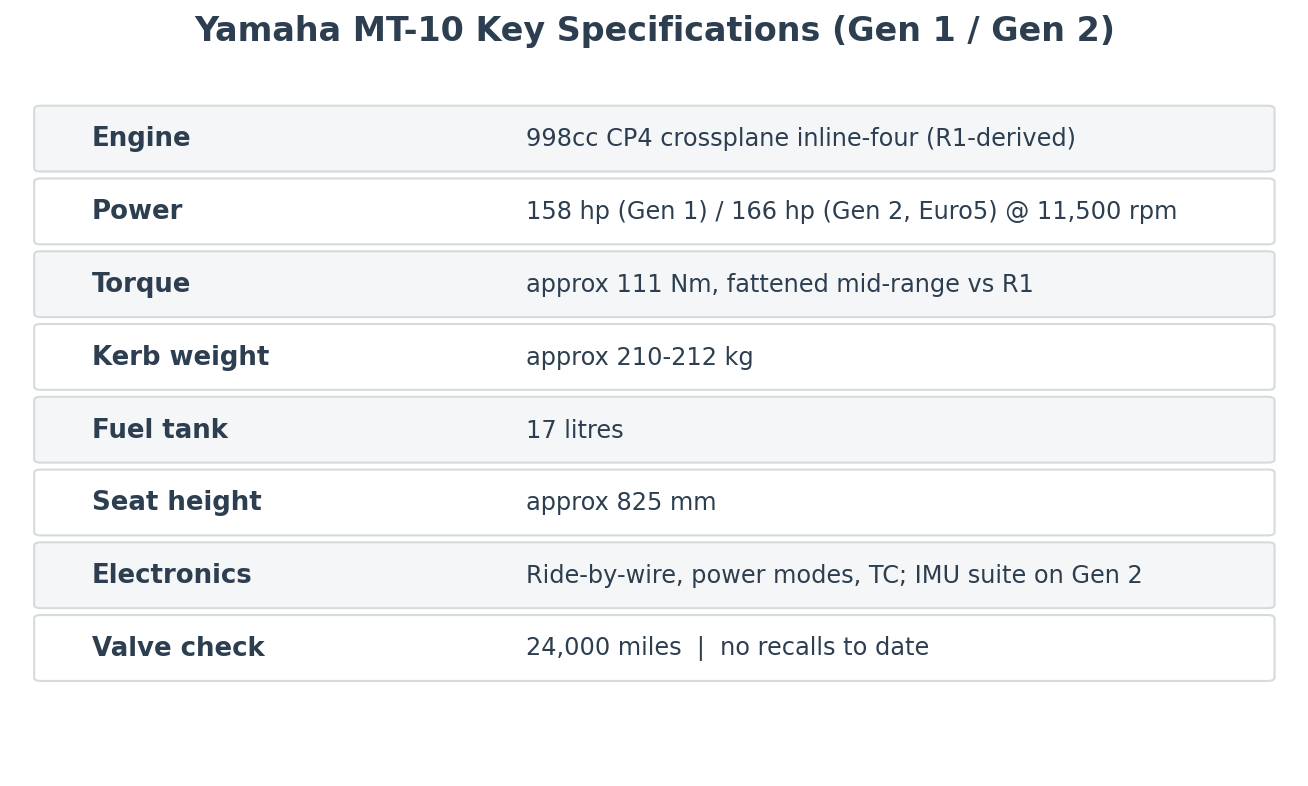
That 998cc CP4 crossplane inline-four is the whole story. It is based on the 2015 R1 motor but re-engineered to focus on low and mid-range torque rather than a screaming top end, with a new intake, exhaust and fueling. The first-generation bike makes a claimed 158 horsepower at 11,500 rpm; the 2022 update pushed that to just under 166 horsepower while passing Euro5. Either way, you get an engine with a lumpy, off-beat exhaust note and a fat wave of drive that arrives the instant you crack the throttle.
Add a stiff aluminium Deltabox frame, upright bars, fully adjustable suspension, ride-by-wire with multiple power modes, traction control and (on later bikes) a full IMU-based electronics suite lifted from the R1, and you have a bike that flatters a good rider and terrifies a lazy one. It is fast, loud, comfortable enough to tour on, and stupidly good value used. That combination is exactly why buyers keep importing them.
You can see the kind of Japanese-market stock we mean on our current listings, and if you want a specific year or trim hunted down at auction, our team can track it for you.
MT-10 vs FZ-10 vs MT-09: clearing up the name confusion
Before you spend a penny, you need to understand three names, because sellers muddle them constantly and it costs buyers real money.
MT-10 vs FZ-10. They are the same bike. In North America, Yamaha originally sold this machine as the FZ-10 for 2017, then renamed it the MT-10 from the 2018 model year when it aligned the whole FZ range (FZ-07, FZ-09, FZ-10) with the global MT naming (MT-07, MT-09, MT-10). Yamaha chose "FZ" in the US initially because of the name recognition of the legendary FZ-1. So if you see a 2017 FZ-10 on a Japanese export site or a US-sourced bike, that is a first-generation MT-10 — same engine, same chassis, just a badge and a market. The RevZilla "2017 Yamaha FZ-10 First Ride" video has racked up over 1.2 million views and 1,500 comments, and half of them are people asking exactly this question. Now you know.
MT-10 vs MT-09. These are NOT the same bike, and this is the mistake that actually bites. The MT-09 is a lighter, cheaper, 890cc three-cylinder (CP3). The MT-10 is a heavier, more powerful 998cc four-cylinder (CP4) derived from the R1. They look related and share family styling, but they are different machines aimed at different riders. The MT-09 is the playful middleweight; the MT-10 is the litre-class heavyweight champion. Yamaha's own "Which MT should you buy" comparisons — one has over 880,000 views — exist precisely because so many buyers cannot tell them apart. Read the engine, not the badge: three cylinders is an MT-09, four cylinders is an MT-10.
The CP4 crossplane engine: why the MT-10 feels different
The heart of the MT-10 is Yamaha's crossplane-crank inline-four, the "CP4," and it is worth understanding because it is the single biggest reason to buy this bike over a rival.
Most inline-four engines use a flat-plane crank, where the pistons fire in even, predictable intervals and produce that familiar smooth wail. Yamaha's crossplane crank spaces the firing intervals unevenly — 270-180-90-180 degrees — which is the same principle Yamaha uses in MotoGP. The result is a motor that sounds more like a V4 or a big twin, with a hard, syncopated bark instead of a smooth scream, and a much more linear, tractable delivery of torque. In plain English: it pulls like a tractor low down and still revs out like a superbike up top.
On the R1 that character is tuned for the track. On the MT-10, Yamaha detuned the top end and fattened the midrange so it works on the street, where you spend most of your time between 4,000 and 9,000 rpm. That is why owners describe the MT-10 as feeling faster than the numbers suggest — the drive is always right there, no waiting for the tacho to climb. It is also why the aftermarket exhaust scene for this bike is enormous: people cannot get enough of the crossplane soundtrack.
Because the engine is essentially R1-derived, it is over-engineered for street duty and, treated properly, extremely durable. The catch is the word "properly" — which brings us to problems.
Yamaha MT-10 generations explained
Choosing the right generation is half the buying decision. Here is how the MT-10 evolved, and what each version is worth hunting for.
First generation (2016-2021): the original crossplane naked
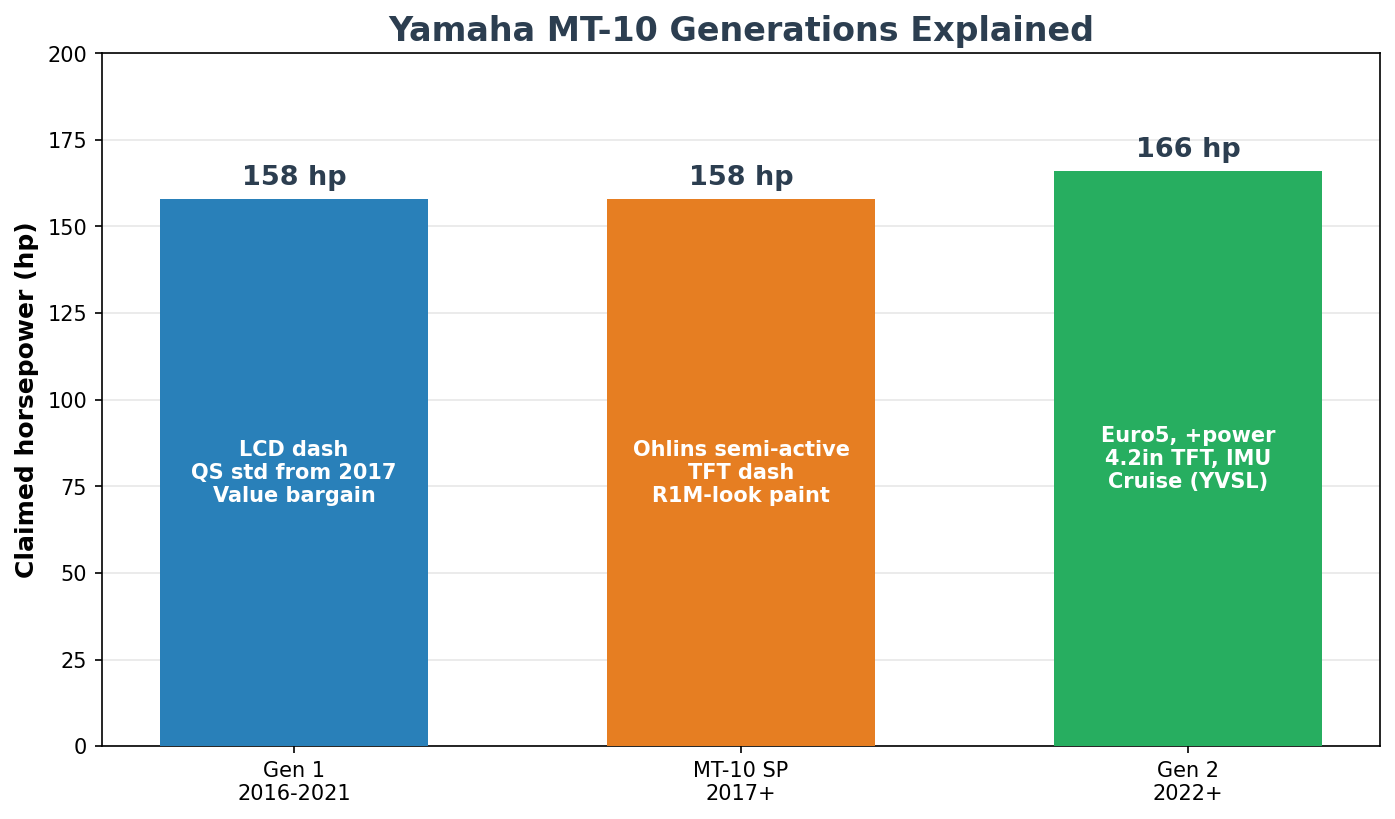
The bike that started it all. Claimed 158 horsepower, fully adjustable suspension, three power modes, traction control, an LCD dash, and a raw, slightly unfiltered character. Early 2016 bikes are known for snatchy low-rpm fueling (more on that below), which Yamaha smoothed over the following years. From 2017 a quickshifter (up only) became standard fitment. This generation is now the used bargain of the range: strong, characterful, and cheap for the performance.
MT-10 SP (2017 onwards): the electronic-suspension flagship
Launched in late 2016 for Europe, the SP is the one enthusiasts lust after. It adds Ohlins semi-active electronic suspension derived from the R1M, a full-colour TFT dash, the quickshifter, and an exclusive silver-blue "R1M-look" paint scheme. On the used market the SP is the smart buy if you can find a clean one at the right money, because that Ohlins kit is expensive to fit aftermarket. A well-kept 2019 SP has traded around GBP 8,999 in the UK — which is remarkable value for semi-active suspension and an R1-derived engine.
Second generation (2022 onwards): the grown-up supernaked
The big update. Yamaha reworked the engine to pass Euro5 while nudging output up to almost 166 horsepower, added a 4.2-inch colour TFT display, fitted the full R1-derived IMU electronics package (cornering ABS, lean-sensitive traction control, slide control, lift control), sharpened the styling, and — crucially for touring riders — added the Yamaha Variable Speed Limiter, an electronic cruise-control cousin. This is the most refined, most usable MT-10, and prices reflect that. If you want the latest tech and can pay for it, this is the target.
Common problems on a used Yamaha MT-10
The MT-10 is fundamentally reliable — it has never been subject to a recall — but "reliable" is not the same as "buy blind." Here is what actually goes wrong, based on owner forums, buying guides and the FZ-10/MT-10 owner community.
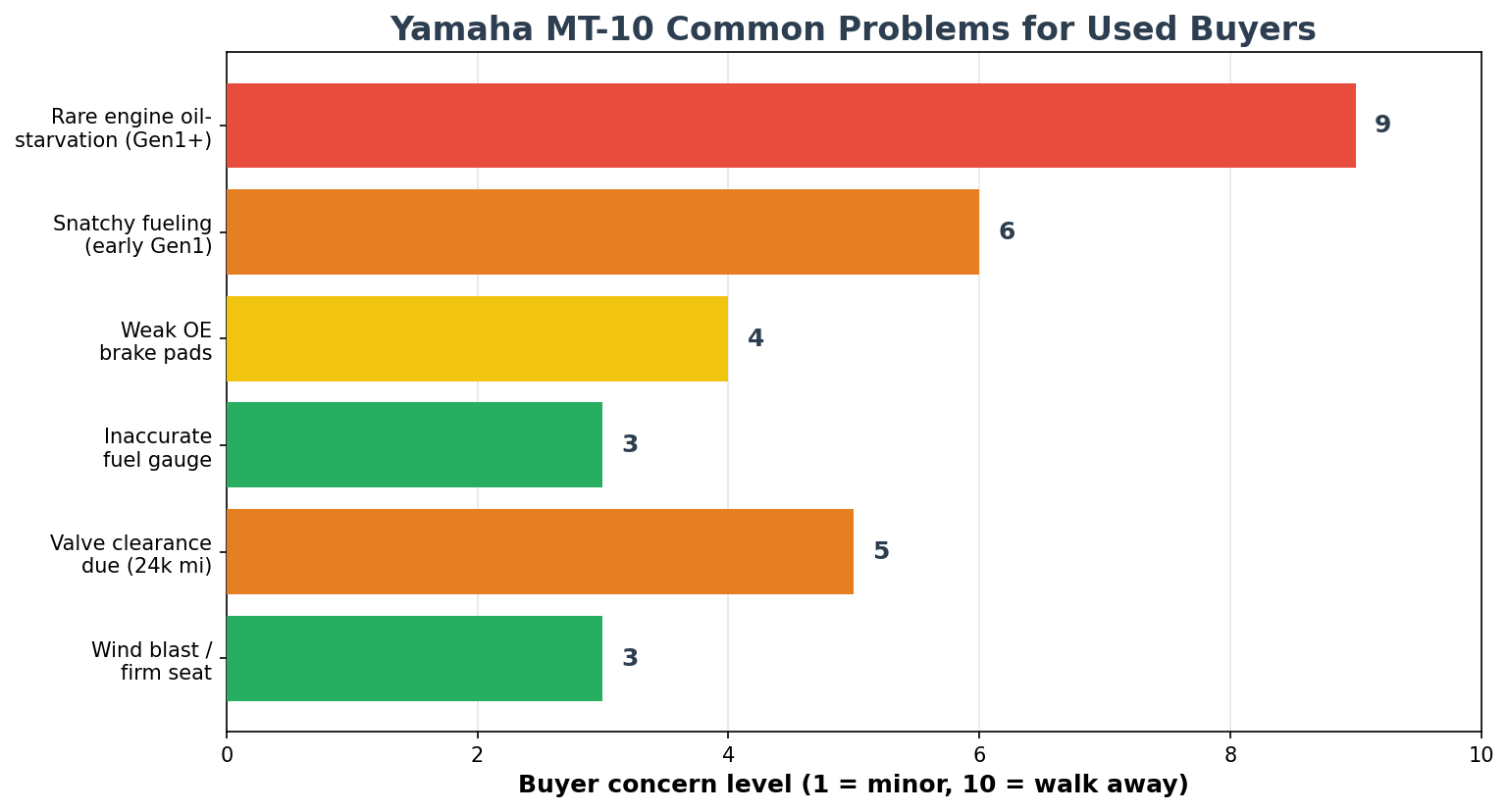
Rare engine failures from oil starvation. This is the scary one, and you need it in perspective. A small minority of owners have reported engines letting go, and where it has been traced, the cause was oil starvation — oil not reaching a bearing, the bearing seizing to the crank, and a rod breaking. It is genuinely rare, but it is why a full, stamped service history matters more on this bike than on almost any rival. An MT-10 with religious oil changes is a safe bet; one with a mystery gap in its history is a gamble. Walk away from bikes that cannot prove their servicing.
Snatchy low-rpm fueling (mostly early Gen1). The earliest 2016 bikes can be jerky and abrupt when you roll on and off the throttle at low revs, and a handful of owners have reported rough running or stalling at idle. Yamaha improved this year on year, and the Gen2 is smooth. On a Gen1, a Power Commander or a good ECU flash cures most of it — factor that into your offer if the bike has not already been tuned.
Weak standard brake pads. The chassis and calipers are fine, but Yamaha's original-equipment pads are the weak link and get criticised in nearly every owner review. It is a cheap fix — a set of decent aftermarket pads transforms the bite — but it means a stock bike will feel underwhelming on the brakes. Do not let a seller convince you the whole braking system is shot; it is almost always just the pads.
Inaccurate fuel gauge. A common niggle. The gauge is optimistic and then drops quickly, and combined with a modest 17-litre tank and a thirsty engine ridden hard, real-world range is shorter than you would like. Learn the trip meter, do not trust the bars.
Valve clearances and top-end ticking. The MT-10 needs its valve clearances checked at 24,000 miles. A rhythmic ticking that grows louder with revs usually points to valves needing adjustment. It is scheduled maintenance, not a defect — but a valve check is a workshop job, so a bike due or overdue for one is a bargaining chip.
Wind blast, hard seat, heat. These are naked-bike realities rather than faults. With no fairing, motorway speeds get breezy; the stock seat is firm on long rides; and like most compact litre bikes it throws heat in traffic. None of it is a dealbreaker, but know it before you buy so you are not surprised.
Which years to avoid, and the best year to buy
Good news: there is no genuinely bad MT-10. There is no cursed year, no design disaster to swerve. But there is a clear hierarchy of value.
The compromise to know about: the very first 2016 bikes have the roughest fueling. They are not broken, and a tune fixes them, but if you want plug-and-play smoothness, look 2017 or later.
The value sweet spot: a 2018-2020 MT-10 or, better still, an MT-10 SP from those years. You get the improved fueling, the standard quickshifter, and — on the SP — semi-active Ohlins suspension, all at a used price that makes the European rivals look absurd. This is the smart-money zone.
The best bike, if budget allows: a 2022-onwards Gen2. More power, cornering-aware electronics, cruise control, colour TFT. It is the MT-10 with the rough edges polished off. You pay for it, but it is the one to have if you plan to keep it and rack up miles.
Whatever the year, history beats age every time. A well-serviced 2016 with a fueling tune is a better buy than a neglected 2021 with a patchy record.
What a used Yamaha MT-10 costs — and the all-in import number
Let's talk money. Used MT-10 prices in the UK vary by generation and trim, but here are realistic ballparks for clean, honest bikes:
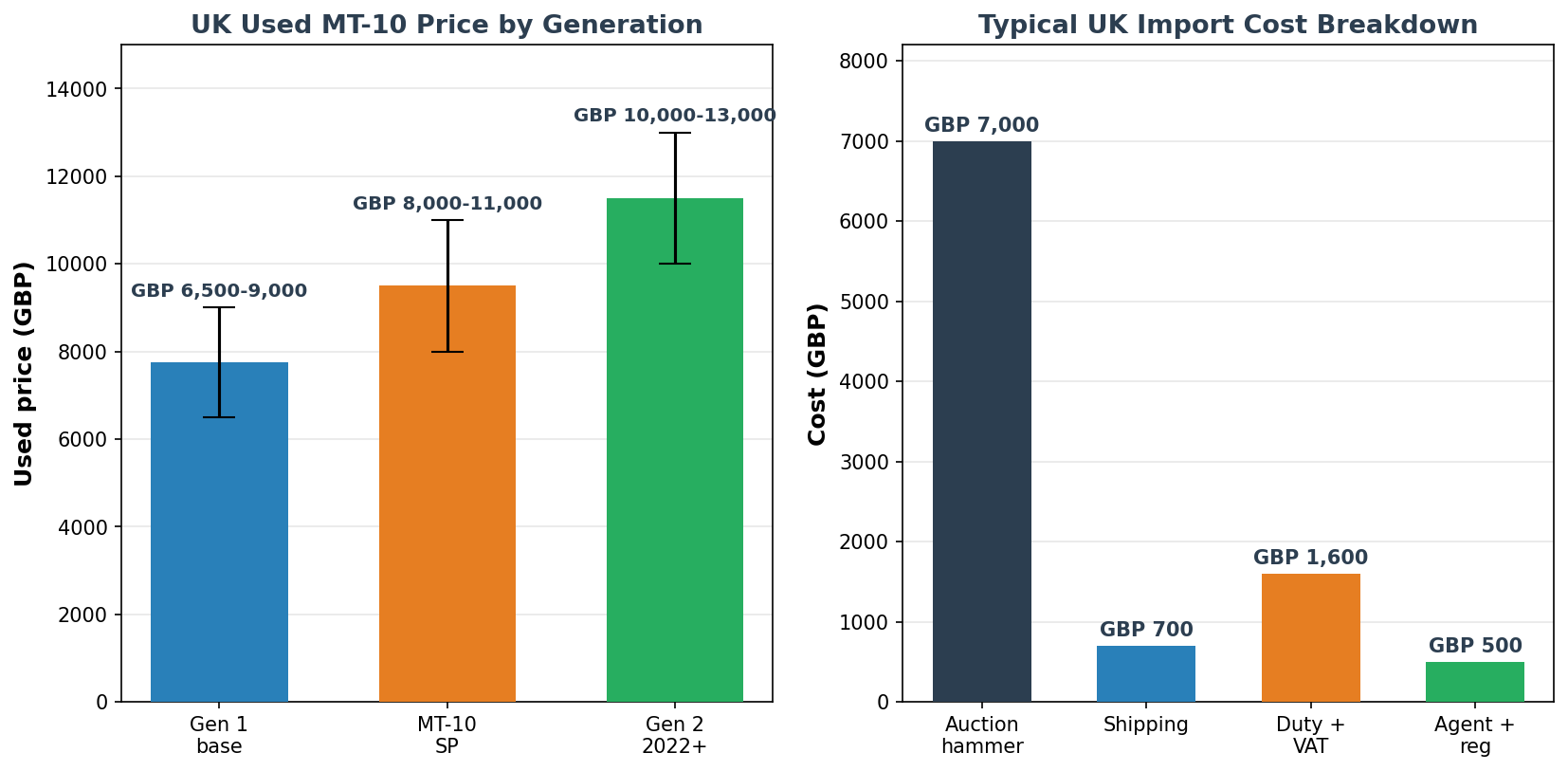
- Gen1 base (2016-2021): roughly GBP 6,500 to 9,000 depending on year, miles and extras.
- MT-10 SP (2017-2021): roughly GBP 8,000 to 11,000 — the Ohlins suspension holds value well.
- Gen2 (2022 onwards): roughly GBP 10,000 to 13,000-plus, with low-mileage examples near new-bike money.
Now the important part: the sticker price is not the landed price. When you import an MT-10 from Japan, you also pay shipping, import duty, VAT (in the UK), any agent or auction fees, and registration. As a rough guide for a UK import, budget the auction hammer price plus roughly GBP 1,800 to 2,800 in shipping, duty and VAT combined, plus a few hundred for agent fees and registration. The exact figure depends on the bike's value and your country, which is why the numbers only make sense once you have a specific bike in front of you.
The reason importing still wins is what you get for the money: Japanese-market bikes are typically lower-mileage, better-kept and honestly graded by an independent auction inspector. You are often buying a cleaner bike than the equivalent-priced local example. For a full walk-through of duties and shipping for your country, talk to our team — we quote the all-in landed cost before you commit, so there are no surprises at the port.
Can I import a Yamaha MT-10 to the USA?
Time for the honest answer American readers deserve. The MT-10 was sold officially in the United States — as the FZ-10 in 2017 and the MT-10 from 2018 onward — so you almost never need to import one. Your local dealer network already had them, and used examples are on the US market right now.
And the 25-year rule closes the import door anyway for the foreseeable future. US federal law only allows road-legal import of motorcycles 25 years or older without meeting current federal standards. The MT-10 launched in 2016 (2017 as the FZ-10 stateside), so the earliest bikes will not clear the 25-year threshold until 2041 or later. Until then, a Japanese-market MT-10 can be imported for track, parts, collection or off-road use, but not registered for the road.
So this guide is aimed squarely at the UK, Australia and New Zealand, where importing a JDM MT-10 makes real sense. If you are in the US, buy local — you are not missing out.
How to import a Yamaha MT-10 from Japan, step by step
Importing sounds intimidating the first time. It is not — it is a process, and once you have seen it laid out, it is genuinely straightforward.
Step 1: Set your budget and spec
Decide your generation (Gen1, SP or Gen2), your maximum landed budget, and your must-haves — quickshifter, Ohlins, mileage ceiling, colour. Knowing exactly what you want stops you overbidding on the wrong bike at 2am.
Step 2: Find the bike at auction or in export stock
Japanese auctions list hundreds of bikes weekly, each with an independent inspection sheet. You can either bid through an agent or buy from ready-to-export dealer stock. Either way, insist on seeing the auction sheet and clear photos.
Step 3: Read the auction sheet and verify grade
This is where the deal is won or lost. The grade and inspector's notes tell you the truth about the bike — see the dedicated section below.
Step 4: Win it, then handle export paperwork
Your agent secures the bike, arranges de-registration and the export certificate, and books shipping. You will get a document pack (export certificate, invoice, bill of lading) that customs in your country will want.
Step 5: Ship, clear customs and register
The bike travels by container (cheaper, shared) or crate. On arrival you pay duty and VAT, clear customs, and then register it — in the UK that means an NOVA notification, an MOT if applicable, and DVLA registration. Then you ride.
Do it once and it stops being scary. A good agent handles most of the friction — your main job is choosing the right bike, which is exactly what the rest of this guide is for.
MT-10 vs the rivals: how the supernaked stacks up
The MT-10 does not exist in a vacuum. Here is how it compares to the bikes you will cross-shop, and where it wins.
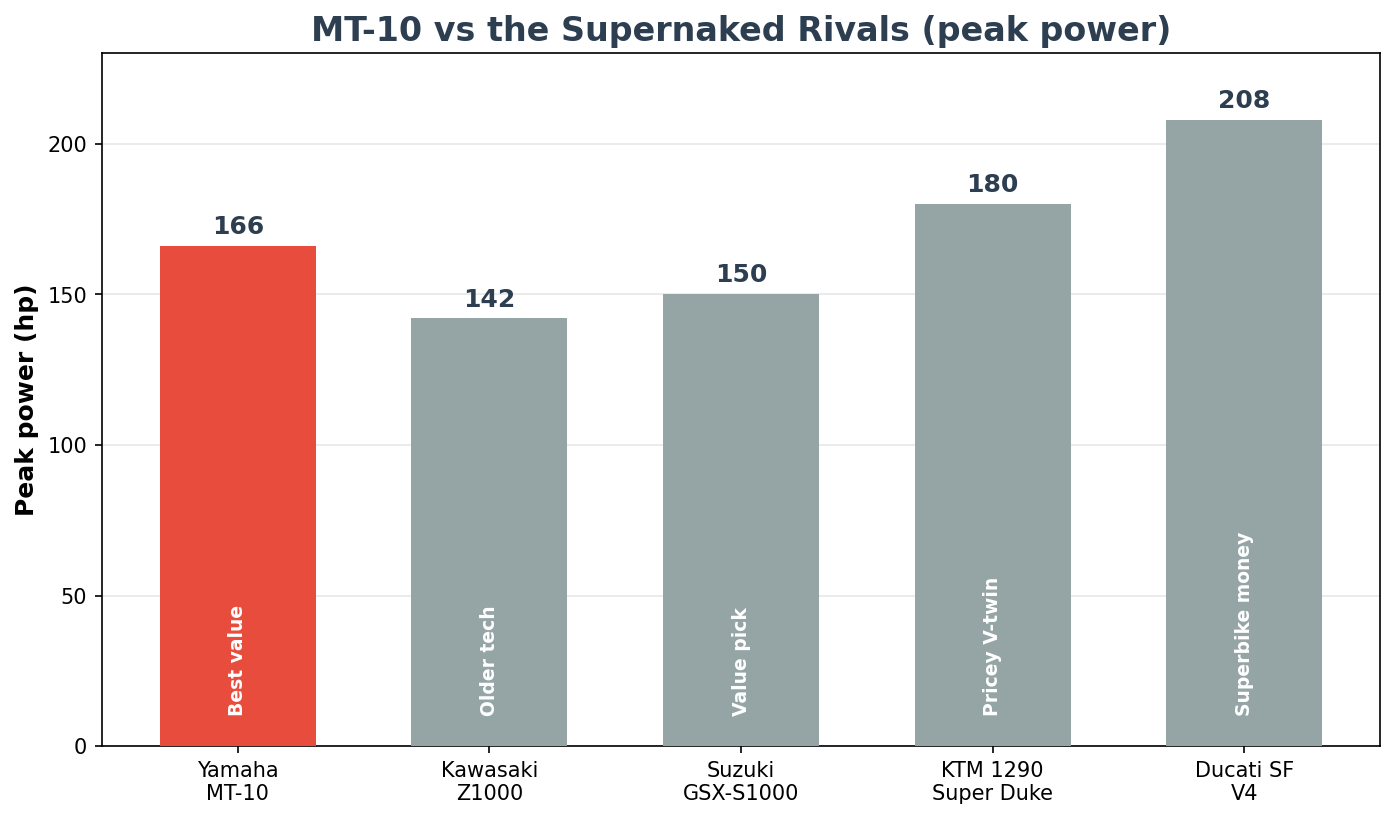
vs Kawasaki Z1000. The classic value comparison — there is a YouTube head-to-head with over 5 million views and 750 comments arguing exactly this. The Z1000 is a gorgeous, characterful naked with a lovely 142-horsepower four, but it is down on power, older in its electronics, and lacks the R1-engine pedigree. The MT-10 is faster, better equipped and more modern. The Z1000 wins on looks for some; the MT-10 wins on substance. If you want the Z1000's cousin from the same era, our stock rotates through both.
vs Suzuki GSX-S1000. The Suzuki uses a legendary K5 GSX-R1000-derived engine and undercuts the MT-10 on price, making it the value rival. It makes around 150 horsepower and is a brilliant bike, but the Yamaha's crossplane character, electronics and finish edge it in most comparisons.
vs KTM 1290 Super Duke R. The KTM is the mad one — a 180-horsepower V-twin with brutal drive and a fearsome reputation. It is faster and more aggressive, but also pricier to buy and run, and more highly strung. The MT-10 is the more usable, more affordable, more reliable everyday weapon.
vs Ducati Streetfighter V4. The Ducati is in another league on paper — over 200 horsepower — and another league on price and maintenance cost too. It is a superbike with the fairing removed. The MT-10 is 90 percent of the thrill for half the money and a fraction of the running cost. For real-world riders, that maths favours the Yamaha.
Running costs: what to budget for an MT-10
The MT-10 is a litre-class performance bike, so it is not a scooter to run — but it is far cheaper than the European exotica it competes with.
Expect sportbike tyre wear if you ride it the way it wants to be ridden; a rear can disappear in a few thousand hard miles. Fuel economy is fine when cruising and thirsty when you exploit the engine, and the 17-litre tank means fairly frequent stops. Servicing is straightforward, with the big-ticket valve-clearance inspection at 24,000 miles. Insurance sits in the higher brackets because of the power, so get a quote before you buy. Chain, pads and consumables are all standard-fitment and reasonably priced. Budget like a fast bike, not a superbike, and you will be about right.
How to read a Japanese auction sheet for an MT-10
This is the skill that separates a great import from a disappointing one. Every bike at a Japanese auction gets an independent inspection and a grade, and learning to read it means you buy with your eyes open.
The overall grade runs from around 6 (near new) down through 5, 4.5, 4, 3.5 and lower — anything 4 or above is generally a clean, well-kept bike, while 3.5 and below means wear or damage you need to understand. Alongside the number is an interior/exterior grade (letters A to D) and a map of the bike marking scratches, dents and corrosion with standardised codes. For an MT-10 specifically, look for notes around the fairing-less bodywork, the exhaust (aftermarket cans are common and can affect emissions compliance), crash damage on the bar ends, levers and pegs, and mileage that matches the condition. Low, verified mileage on a grade 4-plus bike with a clean sheet is exactly what you are importing Japan to find.
Our team reads these sheets every day, so if you are unsure how to interpret one, send it over and we will tell you honestly what it says. There is a fuller breakdown in our dedicated auction-sheet guide, linked from our listings.
MT-10 SP vs standard MT-10: is the Ohlins worth importing?
This is the question that stalls most MT-10 buyers, so let's settle it. The SP costs more used, and the difference is almost entirely the semi-active Ohlins electronic suspension (plus the TFT dash on early bikes and the exclusive paint). Is it worth chasing?
For most road riders, the honest verdict is: yes, if the price gap is small, no, if it is large. The Ohlins system continuously adjusts damping to the road and your riding, and on a bike with this much power it genuinely improves both comfort and control — the standard bike's suspension is good, but the SP's is a class above. The catch is that fitting equivalent semi-active suspension to a standard bike aftermarket costs a fortune, so a used SP at a modest premium is a bargain, while an overpriced SP is not worth stretching for over a clean standard bike.
Here is the practical rule: if a tidy SP is within about GBP 1,000-1,500 of the standard bike you were looking at, buy the SP — you will never regret the suspension. If the gap is GBP 2,500 or more, a standard MT-10 with a set of good aftermarket pads and properly set-up conventional suspension will make you very happy for less. Either way, you are buying an R1-engined naked for supermini money, so it is hard to lose.
What a Yamaha MT-10 is actually like to live with
Spec sheets only tell you so much. Here is what owners actually report after living with the bike, drawn from the long-term reviews and owner communities that have racked up millions of collective views.
The first thing everyone mentions is the engine character. That crossplane bark, especially with an aftermarket exhaust, is the reason people fall in love and the reason they keep the bike. It does not sound like an ordinary four — it has a hard, off-beat growl that comes alive as the revs climb, and owners describe grinning inside their helmets on every on-ramp. The torque means you rarely need to work the gearbox hard in town; you can short-shift and surf the midrange, then drop a gear and unleash the top end when the road opens up.
Day to day, the upright bars and roomy ergonomics make it far more comfortable than any faired superbike, and it is a legitimate everyday bike — commute on it, run errands, then attack a mountain road at the weekend. The compromises are the ones we flagged: wind blast at motorway speed because there is no fairing, a firm seat that some owners swap, real-world fuel range that has you hunting for a station sooner than you expect from a 17-litre tank, and heat in slow traffic. None of it stops people covering serious mileage. The recurring theme in ownership reports is that the MT-10 is a big, fast, characterful bike that somehow also works as daily transport — which is exactly the trick a great hyper-naked is supposed to pull off.
The other consistent note: it feels like far more bike than the price suggests. Riders coming off European supernakeds that cost twice as much routinely admit the MT-10 gives up surprisingly little in the real world. That value story is the whole reason to import one.
Popular MT-10 mods
The MT-10 has a huge aftermarket, and most owners cannot resist a few upgrades. The near-universal first mod is a slip-on or full exhaust, purely to unleash the crossplane soundtrack — a stock MT-10 hides its best feature. After that: an ECU flash or Power Commander to smooth the fueling and add midrange, aftermarket brake pads to fix the one genuine weak point, a taller screen or small flyscreen to tame the wind blast, a comfort seat for touring, adjustable rearsets and levers, and a tail tidy for looks. When you buy used, tasteful mods can add value — but poorly fitted electrical extras (badly wired heated grips, dodgy tail tidies) are a red flag for how the bike has been treated. Judge the quality of the work, not just the parts list.
Is the Yamaha MT-10 a good first big bike?
Honest answer: it can be, but it is not the obvious first choice. With around 160 horsepower and instant crossplane torque, the MT-10 has serious performance, and a nervous beginner can find it intimidating. But — and this matters — the electronics are excellent, the power modes let you soften the delivery, the traction control is genuinely good, and the upright riding position and tractable low-end make it far more manageable than a fully-faired superbike. A sensible rider stepping up from an MT-07 or MT-09, treating it with respect and using the rider modes, will get on fine. A first-ever big bike for someone with little experience? Start on something gentler, then graduate to this. The MT-10 rewards a bit of experience.
Pre-purchase checklist for a used MT-10
Before you commit — whether at auction or in the metal — run through this:
- Service history: full, stamped, with oil changes on time. This is non-negotiable on the MT-10 given the rare oil-starvation failures.
- Cold start: listen for rhythmic top-end ticking that grows with revs — a sign valve clearances are due.
- Fueling: on a Gen1, check for excessive snatch or stalling; budget a tune if it has not had one.
- Brakes: spongy or weak? Usually just the pads — cheap, but use it to negotiate.
- Crash evidence: check bar ends, levers, pegs, engine cases and subframe for scuffs or replacement parts.
- Mileage vs condition: they should match; a "low-mileage" bike with worn controls is telling you a story.
- Electronics: cycle through the dash, modes, quickshifter and (SP) suspension settings to confirm everything works.
- Auction sheet: grade 4 or above, clean map, verified mileage.
Tick those boxes and you are buying one of the great modern nakeds with your eyes wide open. Browse our current stock or tell our team the exact MT-10 you want, and we will find it in Japan and land it at your door.
See Also
Share this article: