
If you want to import a Yamaha TDM850 from Japan, you are chasing one of the most misunderstood bargains in the used market: the bike that quietly invented the "crossover" long before anyone had a name for it. Half trail-bike, half sports-tourer, all torque, the TDM took a Paris-Dakar-winning engine and wrapped it in an upright, do-everything chassis. It makes about 77 hp and a fat 76 Nm of torque, weighs sensibly, and will commute all week, tour all summer, and still make you grin on a wet mountain road where sharper bikes are wetting themselves.
Here is the thing nobody tells you in the classified ads: there are two very different TDM850s, and buyers mix them up constantly. The early bikes (Yamaha code 3VD, 1991 to 1995) run a smooth 360-degree crank. The later bikes (code 4TX, 1996 to 2001) got the punchy 270-degree "big bang" crank shared with the TRX850 sports twin — the same firing feel Yamaha later built its whole modern CP2 range around, the one in today's MT-07. That one difference changes how the bike sounds, pulls, and feels. Buy the wrong one for you and you will be disappointed; buy the right one and you will keep it for a decade.
This guide walks you through the split personality, the engine that makes it special, the model-year changes, the exact faults to check, what it really costs to land one in your driveway, and the import rules that decide whether you can even register it. Every TDM850 ever built is now over 25 years old, which matters enormously if you are in the United States. By the end you will know which TDM to chase and roughly what to pay for it.
What Is the Yamaha TDM850, and Why Does It Still Matter?
Yamaha unveiled the TDM850 at the end of 1990 and put it on sale in 1991. On paper it was odd: a big parallel twin with 17-inch and 18-inch wheels, long-travel suspension, an upright riding position, and a half fairing. It was not a trail bike, not a sportbike, and not a tourer. It was all three at once, and the motorcycle press did not quite know where to file it. Yamaha marketed it as a road-focused, sporty spin on their XTZ750 Super Ténéré rally machine.
Three decades later, that idea is everywhere. The Yamaha Tracer, the Suzuki V-Strom, the Kawasaki Versys, the whole "adventure sport" and "crossover" category — they all sell the same promise the TDM made first: one bike that does the job of three. The TDM never sold in huge numbers and it never sold in the United States officially, which is exactly why it is interesting now. It is a genuine piece of design history that most people have forgotten, and Japan is full of clean, low-mileage examples that were cherished, dealer-serviced, and stored indoors.
Buyers in the US, UK, Australia, and New Zealand are waking up to this. Modern-classic Yamahas have been climbing in value, and the TDM850 sits right at the sweet spot: cheap enough to be an impulse buy, interesting enough to hold its money, and mechanically simple enough that a competent home mechanic can keep it running for peanuts. The catch is finding a good one, because the ones that stayed in Europe were mostly ridden into the ground. That is the case for importing straight from Japan.
The Engine: A Paris-Dakar Twin Reborn for the Road
The heart of the TDM850 is an 849cc DOHC parallel twin with five valves per cylinder — three intake, two exhaust — and a dry-sump lubrication system. That five-valve head and the basic architecture came straight from the XTZ750 Super Ténéré, the bike Yamaha used to win the Paris-Dakar rally. Yamaha bored the rally motor out to 849cc (89.5mm bore, 67.5mm stroke) and retuned it for the road. The result is a lump that pulls hard from just off idle and never feels strained.
The numbers tell the story: roughly 77 hp at 7,500 rpm and 76 Nm of torque at 6,000 rpm. That is not a huge horsepower figure by modern standards, but the torque arrives early and stays flat, which is why owners describe the TDM as "unburstable" and "a bike you ride on the torque, not the tacho." You short-shift, let the twin lug, and it just surges forward. On a real road with real corners and real traffic, that flexibility beats a peaky four every time.
The dry-sump design keeps the engine compact and the centre of gravity low, and the five-valve head breathes well for its era. This is an engine that was designed by people who wanted midrange grunt and long-term durability, not a dyno headline. Look after the basics — oil, valve clearances, a healthy charging system — and these motors run to genuinely high mileages. Plenty of TDMs have cleared 100,000 km and kept going. One German used-bike test on YouTube (Jens Kuck's Gebrauchtcheck, with nearly 90,000 views) walks through a high-mileage example and lands on the same verdict every long-term owner reaches: the engine is the strongest part of the bike.
Mk1 vs Mk2: The 3VD and 4TX Are Two Different Bikes
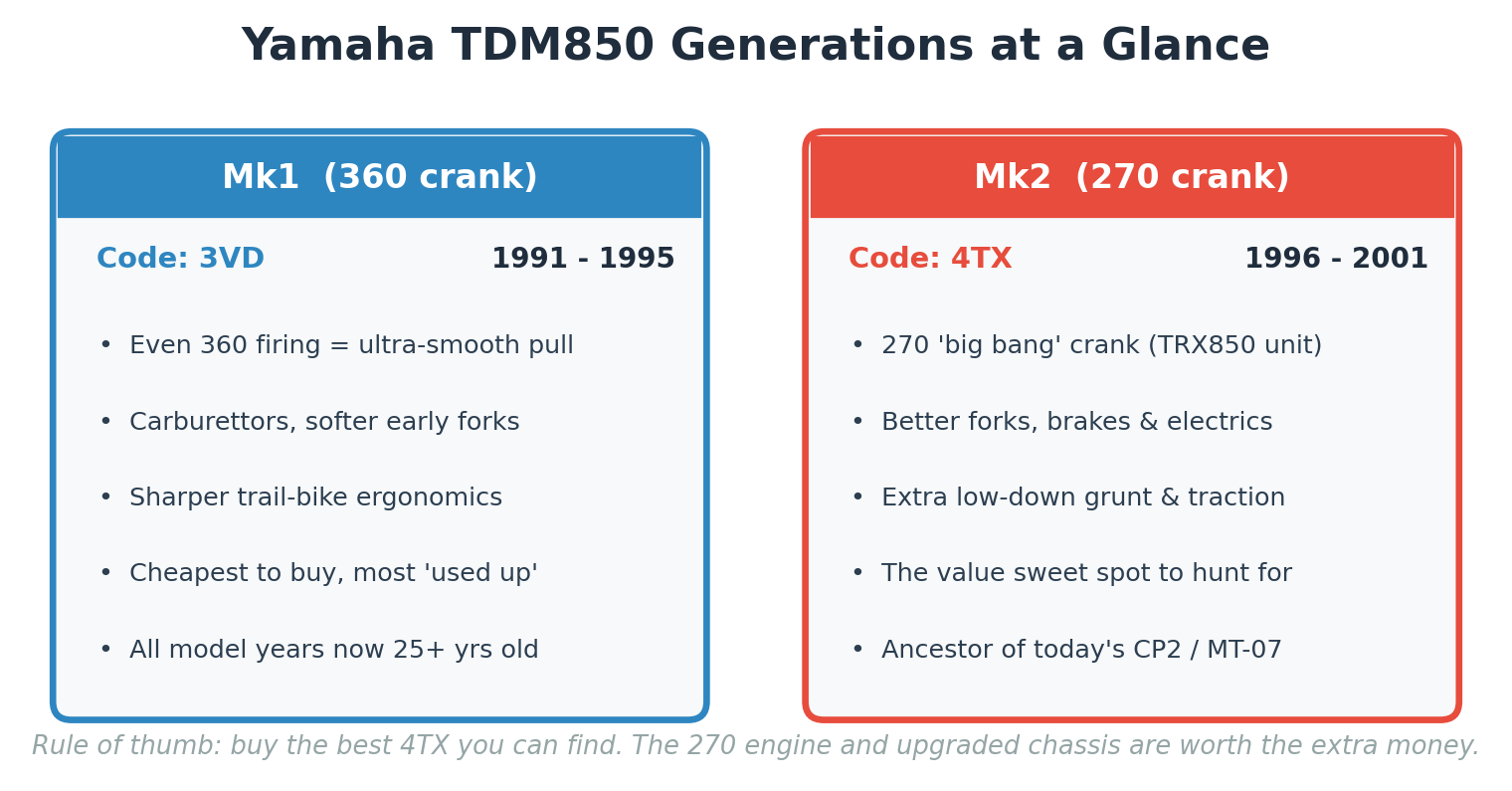
This is the single most important thing to understand before you spend a penny. The TDM850 came in two generations that look similar but feel completely different to ride.
Mk1 (code 3VD, 1991 to 1995): the smooth one
The original TDM used a conventional 360-degree crankshaft, where both pistons rise and fall together. The upside is an incredibly smooth, linear torque curve — the engine spins up like a turbine with very little vibration. Early bikes ran carburettors, softer forks, and slightly more dirt-bike-flavoured ergonomics. They are the cheapest TDMs to buy today, but they are also the most likely to have been thrashed, crashed, or neglected, because they are the oldest. A tidy 3VD is a lovely, gentle thing. A tired one is a project.
Mk2 (code 4TX, 1996 to 2001): the punchy one
In 1996 Yamaha gave the TDM a serious update, and the headline was a new 270-degree firing order — the "big bang" crank shared with the TRX850 sports twin. Instead of firing evenly, the cylinders fire in a lopsided pattern that gives the engine a lumpy, V-twin-like exhaust note, extra character, and a subtle traction benefit because the tyre gets a small rest between power pulses. Yamaha also fitted better forks, brakes derived from the FZR600 sports bike, improved electrics, and revised bodywork. Post-1997 examples in particular are noted for better handling and reliability.
Here is why that 270-degree crank matters beyond this one bike. That firing pattern is the direct ancestor of Yamaha's modern "crossplane concept" CP2 engine — the twin in the MT-07, Ténéré 700, and R7. One proud owner recently posted a photo of his TDM850 on Yamaha Day and tagged it #4TX #CP2, and he is exactly right: he is riding the grandfather of the bike everyone raves about today. If you want the TDM that feels most like a modern Yamaha twin, you want a 4TX.
The rule of thumb: buy the best 4TX you can find. The 270-degree engine, upgraded chassis, and stronger electrics are worth the modest price premium over a Mk1. A 1996-or-later TDM is simply a better, more usable motorcycle, and because they are newer they have generally lived easier lives.
Yamaha TDM850 Years to Avoid (and the Sweet Spot)
There is no single cursed model year to swear off — the TDM was fundamentally sound throughout its run. But there are patterns worth knowing.
Approach the very early Mk1s (1991 to 1992) with your eyes open. The 1990s were not Yamaha's finest hour for paint, plating, and corrosion resistance, and the oldest bikes have had the longest time to rot. Fasteners seize, exhausts corrode, and switchgear gets tired. None of it is a dealbreaker on a cheap bike, but factor restoration time into the price. Many early European TDMs were ridden as all-weather hacks and it shows.
The 1996 changeover year is the value inflection point. A 1996 or 1997 4TX gives you the better crank, the better forks, and the better brakes while still being cheap. That is the smart-money zone: enough age to be dirt cheap and 25-year-rule eligible everywhere, but new enough to have the good hardware.
The final 1999 to 2001 bikes are the ones to hunt if you want the best condition. They are the youngest, they usually carry the fewest miles, and Japanese-market examples from these years are frequently spotless. They cost a little more, but a clean late 4TX is the TDM to buy once and keep. The successor TDM900 arrived in 2002 with fuel injection and an all-new chassis, so the 850 story closes cleanly at 2001.
Whatever the year, condition beats age. A well-loved, fully serviced 1994 3VD is a far better buy than a neglected 2000 4TX with a mystery history. Which is exactly why the auction sheet matters — more on that below.
Known Problems Every TDM850 Buyer Must Check
The TDM850 is a durable, honest motorcycle, but it is also 25 to 35 years old. Every one of them will need some attention. Here are the specific things that go wrong, drawn from owner forums, used-bike guides, and the people who have lived with these bikes for decades.
Regulator/rectifier failure — the big one
The most common electrical complaint on the TDM850 is a failing regulator/rectifier, the part that manages charging voltage. In one long-running owner survey, a majority of bikes had suffered a reg/rec failure at some point. The symptoms are a battery that boils, dies, or overcharges, and dim or flickering lights. The good news: it is a cheap, well-understood fix, and many owners fit an uprated aftermarket unit and never think about it again. On any bike you are considering, check the charging voltage at the battery with the engine running — it should sit around 14 volts, not climbing past 15.
Camchain and top-end noise
A handful of TDMs have suffered seized camchains, usually on neglected engines that missed oil changes. This is rare, but a rattly top end on cold start is a warning sign worth taking seriously. A healthy TDM engine is mechanically quiet once warm. Listen carefully, and walk away from anything that clatters.
Oil consumption and mystery oil loss
These engines use a little oil — that is normal for the design, and nothing to panic about as long as you top it up. What is less normal is the level dropping "for no apparent reason," which several guides flag. Keep an eye on the level, check for leaks around the gearbox output, and do not trust a bike whose owner cannot tell you the last time they checked the oil.
Gearbox output seal leaks (Mk2)
On some 4TX bikes, the gearbox sprocket oil seal can weep. Not every bike suffers from it, but look for oily residue behind the front sprocket cover. It is a straightforward seal replacement, but it tells you whether the bike has been maintained.
The clunky gearbox and false neutrals
This is a character trait, not a fault, but you should know about it. The TDM gearbox engages with a firm, agricultural clunk, and there is a well-known false neutral lurking between first and second. New owners think something is broken; it is not. Every TDM does this. Just be deliberate with your gearchanges and it becomes second nature.
Exhaust and corrosion
The exhaust collector boxes can rot from the inside, and general corrosion on fasteners, brackets, and switchgear is common on bikes that lived outdoors. This is precisely where a Japanese-market bike wins: dry storage and gentle use mean far less rot than a comparable UK or Australian bike that spent its life in the weather. Inspect the underside of the exhaust and every visible fastener.
What the TDM850 Is Like to Live With
Numbers and fault lists only tell you so much. What is it actually like to own one? In a word: easygoing. The upright bars and roomy seat make it comfortable for long days, the torque makes town riding lazy and relaxed, and the modest weight makes it flickable on a back road. It is not fast in a straight line by modern standards, but it carries corner speed beautifully and it never intimidates.
The TDM developed a loyal, almost cult following in Europe precisely because it is so usable. Even Richard Hammond, long before Top Gear, reviewed the TDM850 back in his Men and Motors days — the clip still pulls tens of thousands of views — and the theme of every review from then to now is the same: this is a bike you underestimate until you ride it, and then you get it. Owners fit luggage, ride two-up, tour continents, and keep the bikes for years. Search any TDM community and you will find people on their second or third one.
Running costs are low. Insurance is cheap because it is an old bike with modest power. Tyres are a common size. Consumables are affordable, and because the engine is so under-stressed, the big-ticket maintenance intervals come around slowly. The main ongoing task is the same as any 30-year-old bike: keep on top of the electrics, the fluids, and the corrosion, and it will keep going.
TDM850 vs the Rivals: TRX850, Transalp, and V-Strom
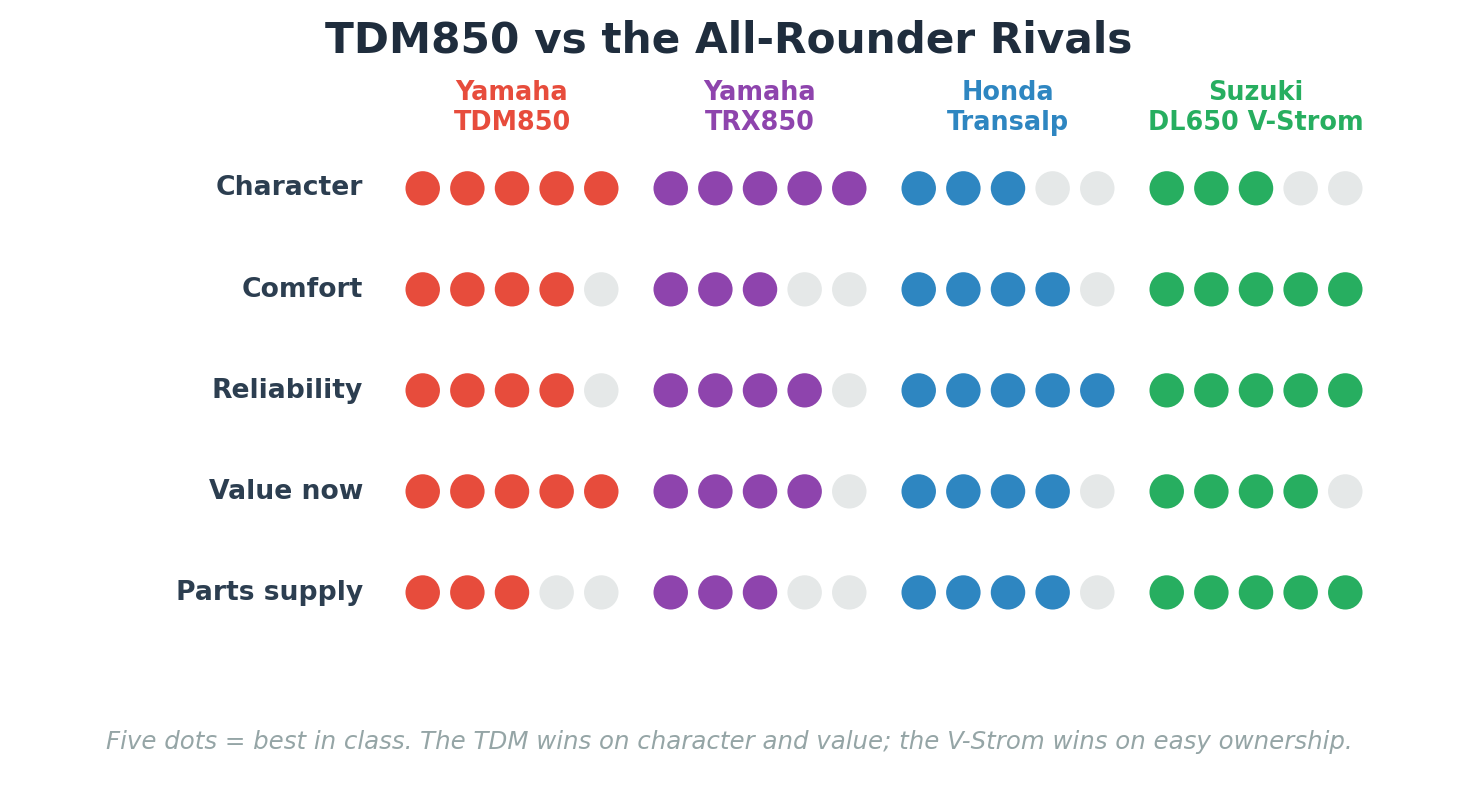
The TDM850 does not have obvious direct rivals, because it more or less created its own segment. But a few bikes overlap with it, and understanding the differences helps you decide whether the TDM is really the one for you.
Yamaha TRX850. The TDM's own sports-twin sibling, sharing the 270-degree engine and gearbox in a steel-trellis, Ducati-style frame. If the TDM is the sensible all-rounder, the TRX is the extrovert café racer using the same heart. Bike journalist Steve Cooper called the TRX "very much the thinking man's sports bike," and it is reaching cult status of its own. Buy the TRX if you want looks and a sportier stance; buy the TDM if you want comfort and versatility. Both are brilliant twins.
Honda Transalp (XL600V / XL650V). Honda's road-biased trail bike is the TDM's closest philosophical rival — another do-anything twin from the same era. The Transalp is more off-road capable and arguably a touch more reliable, with Honda's famous build quality. The TDM is faster, more fun on tarmac, and has more character. If your riding is 90 percent road, the TDM is the better tool.
Suzuki DL650 V-Strom. The modern equivalent of the TDM idea, and the benchmark for easy ownership. A V-Strom is newer, fuel-injected, and has bulletproof parts supply, so it is the sensible head-over-heart choice. But it has none of the TDM's quirk, history, or that lovely five-valve rally-derived engine. You buy a TDM850 with your heart; you buy a V-Strom with your spreadsheet.
The scorecard above sums it up. The TDM wins on character and value-for-money right now; the V-Strom wins on sheer ease of ownership; the TRX splits the difference with more style. There is no wrong answer, but if you are reading a guide about importing a 30-year-old Yamaha twin, you already know which side of the head-versus-heart line you are on.
What It Costs to Import a TDM850 from Japan
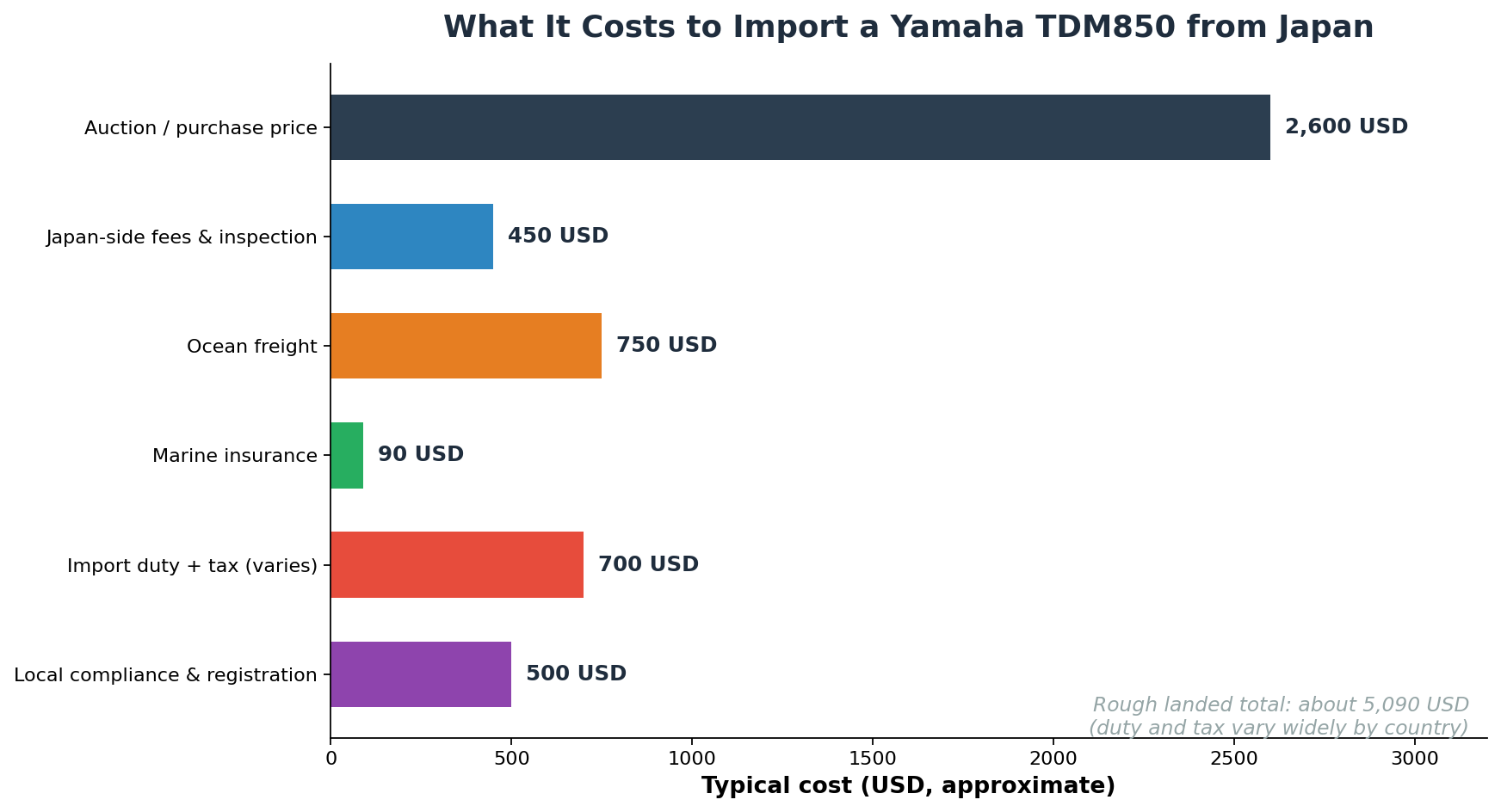
Let us talk real money. The appeal of the TDM850 is that it is cheap to buy in the first place, so even after shipping and duty it lands as an affordable, interesting motorcycle. Here is roughly how the costs stack up for a clean mid-price 4TX, in US dollars, as a planning estimate rather than a firm quote.
Auction or purchase price: A good TDM850 at a Japanese auction typically changes hands somewhere in the region of a couple of thousand dollars, sometimes less for a tidy Mk1, a little more for a spotless late 4TX. These are not expensive bikes at source.
Japan-side fees and inspection: Auction fees, a pre-export inspection, de-registration, and handling to the port add a few hundred dollars. This is also where a good agent earns their keep by inspecting the bike before it ships.
Ocean freight: Container or RORO shipping from a Japanese port (Osaka, Nagoya, or Yokohama) to your nearest arrival port. Budget several hundred dollars depending on distance and method. Transit to the US West Coast averages 18 to 22 days; East Coast ports add another month via the Panama Canal.
Marine insurance: A small percentage of the bike's value to cover it in transit. Cheap, and worth it.
Import duty and tax: This is the wildcard and varies enormously by country — anywhere from very little to a substantial chunk of the bike's value once VAT or GST is added. Do not skip this line; it is often the biggest single cost after the bike itself.
Local compliance and registration: Roadworthiness checks, any required modifications, and registration fees in your home country.
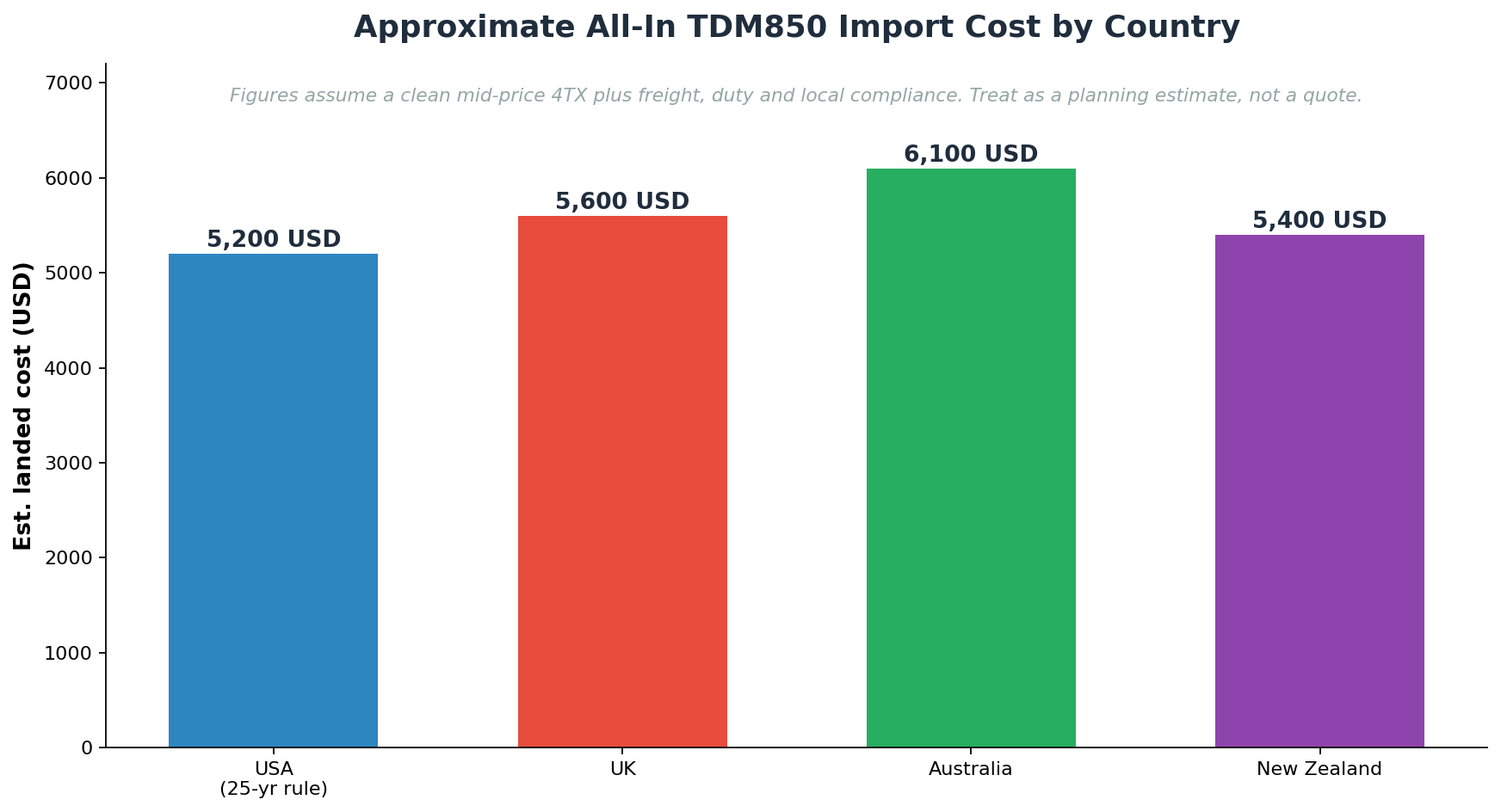
Add it all up and a TDM850 lands in your garage for roughly five to six thousand US dollars all-in, depending heavily on where you live and how nice a bike you buy. For a genuine slice of Yamaha history that will run for years, that is a lot of motorcycle for the money.
Is the Yamaha TDM850 Legal to Import to Your Country?
Legality is the part that catches people out, so get it right before you bid. The rules differ by country, and for the TDM850 there is one very good piece of news.
United States: every TDM850 is now eligible
This is the headline. Because the TDM850 was never sold in the US, it has to come in under the 25-year import rule, which exempts vehicles 25 years or older from the usual FMVSS safety and EPA emissions requirements. As of 2026, anything built in 2001 or earlier qualifies — and since the TDM850 ran from 1991 to 2001, every single one is now eligible. There is no more waiting.
One critical detail: US Customs and NHTSA go by the actual manufacture date on the title, not the model year in the listing. A bike advertised as a "2001" could have been built in late 2000 or early 2002, so always confirm the build date on the Japanese documentation before you assume it qualifies. Also note that California has extra emissions rules even for exempt vehicles, while Texas, Florida, and most other states register 25-year imports without additional testing.
United Kingdom
The UK is one of the easiest places to import a TDM850, partly because so many were originally sold there, so the model is well understood by the registration system. You will pay import duty and VAT on entry, arrange an MOT, and register the bike with the DVLA. Because these bikes were officially sold in the UK, parts and knowledge are everywhere.
Australia and New Zealand
Both countries allow older motorcycles in, but Australia's rules are stricter and generally favour bikes on the approved lists or those over a certain age brought in under specific schemes. Import approval, GST, and compliance and registration all apply, and Australia typically lands out as the most expensive of the four markets once everything is totted up. New Zealand is more straightforward and a popular route for Japanese imports, with a required compliance inspection on arrival. In both cases, check the current rules with your import agent before committing — regulations change.
How to Read a Japanese Auction Sheet for a TDM850
Every bike sold through a Japanese auction comes with an inspection sheet graded by an independent inspector, and learning to read it is the single best skill an importer can have. It is your eyes on a bike you cannot physically touch.
The overall grade runs from around 1 (rough or modified) up to 5 or S (as-new), with 3.5 and 4 being the realistic sweet spot for a clean, honest older bike. Anything graded 4 or above on a 25-year-old TDM is a genuinely good example. Below that, read the notes carefully.
The sheet also carries a diagram of the bike with letter codes marking damage: A for scratches, U for dents, C for corrosion, and so on, each with a number for severity. On a TDM specifically, zoom in on the areas you already know are weak — the exhaust and collector box for corrosion, the fasteners and switchgear for rust, and any notes about the electrics or a weak battery that might hint at reg/rec trouble. Mileage is recorded and generally trustworthy on Japanese bikes, and a genuine low-mileage, well-graded TDM is exactly the kind of bike that justifies importing rather than buying local.
If you cannot read the Japanese notes yourself, this is where working with people who can becomes priceless. A good auction agent translates the sheet, flags the red flags, and stops you buying a rotter you would have regretted. It is worth reading our full guide on decoding these sheets before you bid.
Popular TDM850 Upgrades and Modifications
One of the quiet joys of a TDM850 is how easy and cheap it is to improve. Owners have been fettling these bikes for 30 years, so the community knowledge is deep and the fixes are well proven. If you import one, here is where the money usually goes.
Uprated regulator/rectifier. Given that the stock reg/rec is the bike's main weak point, a lot of owners fit a modern MOSFET unit as a matter of course, often sourced from a later Yamaha or a specialist supplier. It runs cooler, charges more reliably, and turns the TDM's biggest electrical worry into a non-issue. If a bike you are buying has already had this done, treat it as a plus.
Exhaust. The standard collector boxes rot and the stock cans are heavy and muffled. A slip-on or full aftermarket system — Delkevic and similar budget brands are popular — drops weight, wakes up the 270-degree twin's lovely offbeat bark, and sidesteps the corrosion problem. One well-viewed YouTube clip does a straight before-and-after of a TDM with and without a Delkevic pipe, and the difference in character is night and day.
Suspension refresh. Thirty-year-old fork oil and tired shock bushes take the edge off any old bike. Fresh fork oil, new seals, and a serviced or replacement rear shock transform how a TDM steers and rides. It is not glamorous, but it is the upgrade that makes the biggest difference to how the bike feels.
Luggage and touring kit. Because so many owners tour on their TDMs, there is a healthy supply of racks, panniers, screens, and heated-grip setups. The half fairing is a good base to build a genuine long-distance tourer on.
None of this is expensive, and none of it requires special tools. That approachability is a big part of why the TDM has kept its following: it rewards a spanner-friendly owner and asks very little in return.
Your TDM850 Pre-Purchase Checklist
When you import through an auction, the graded sheet does a lot of the inspection for you. But whether you are reading a sheet or looking at a bike in the metal, run through this TDM-specific checklist before you commit.
Charging system. Start the engine and, if you can, measure the voltage at the battery. Around 14 volts at a fast idle is healthy; a climbing figure past 15 points at the reg/rec. Ask whether it has ever been replaced.
Cold-start top end. Listen to the engine from cold. A little mechanical chatter that quietens as it warms is normal; a persistent rattle from the top end could be the camchain and is a reason to be cautious.
Oil. Check the level and look for leaks, especially around the front sprocket cover on 4TX bikes where the output seal can weep. Ask the owner how often they check it, because these engines like a top-up.
Gearbox. Expect a firm, clunky change and a false neutral between first and second — that is the TDM being a TDM. What you do not want is graunching, jumping out of gear, or a clutch that drags.
Corrosion. Look under the exhaust for rot on the collector box, and check fasteners, brackets, and switchgear for rust. This is exactly where a dry-stored Japanese bike beats a weather-beaten local one.
Fairing and plastics. TDM bodywork and decals are getting hard to find, so cracked panels or missing trim are worth money to put right. Factor it into your offer.
History and mileage. On a Japanese auction bike the recorded mileage is generally trustworthy, and a low-mileage, well-graded example is precisely the bike that justifies importing. Match the sheet's mileage and grade against the photos and the inspector's notes.
Who Should Buy a TDM850 — and Who Should Skip It
Honesty helps here, because the TDM is not for everyone and the last thing you want is to import a bike you fall out of love with.
Buy a TDM850 if you value character and torque over outright speed, you want one affordable bike that can commute, tour, and scratch, and you enjoy — or at least do not mind — keeping an older machine on the road. It suits riders who have owned a few bikes and appreciate a torquey twin that flatters real-world riding. It is a brilliant first "interesting" import: cheap to buy, simple to fix, rich in history, and genuinely usable every day. If you love the idea of riding the grandfather of the MT-07's engine, this is your bike.
Think twice if you want a plug-and-play modern experience with a warranty, dealer support, and instant parts availability — a used V-Strom or a Tracer will serve you better and stress you less. The TDM will need the occasional bit of care, its gearbox is agricultural, and some plastic and trim parts are getting scarce. If mechanical quirks annoy you rather than charm you, this is not the bike.
Absolute beginners can ride a TDM safely — it is not a scary bike — but the 30-year-old ownership commitment is more than most brand-new riders want to take on. A tidy, cheaper, more modern first bike usually makes more sense, with the TDM as the reward once you have some miles and some spanner confidence under your belt.
If you have read this far and you are still nodding along, you already know which category you are in. The TDM850 is one of the great head-versus-heart imports, and for the right rider it is enormously satisfying.
How AWA Auction Helps You Import a TDM850
Importing a 30-year-old Japanese twin sounds daunting, and doing it blind absolutely would be. That is the whole point of using an auction partner who is already inside the Japanese system. AWA Auction gives you direct access to the same Japanese auctions where clean, well-kept TDM850s come up week after week — the low-mileage, dry-stored bikes that never made it out of Japan.
We help you find the right TDM for your budget, read and translate the auction sheet so you know exactly what you are bidding on, handle the export paperwork and shipping, and get the bike moving toward your door. Instead of trusting a blurry photo and a hopeful seller, you get a graded, inspected bike and a team that knows what to look for on this specific model — the reg/rec, the exhaust rot, the difference between a tired 3VD and a cherished late 4TX.
Browse what is currently available and see what is coming through the auctions, or get in touch and tell us the exact TDM850 you are after. Whether you want a cheap 1996 project or a spotless final-year 4TX to keep forever, the right bike is almost certainly sitting in an auction lane in Japan right now.
See Also
Share this article: