
A Yamaha XJR1300 import from Japan is how you buy the last of the great air-cooled muscle bikes without paying collector money for it. The XJR is a 1980s idea that survived into the 2010s: a huge, oil-cooled inline-four bolted into a simple steel cradle, no fairing, no rider modes, no radiator. Yamaha built it for the country that loves this kind of machine most, and that country still has the cleanest examples on the planet.
Here is the thing nobody at a Western dealer will tell you. The XJR1300 was never a big-volume bike outside Japan, and it was never officially sold in the United States at all. One American rider summed up the whole scene in a single post: "Shame we never got these UJMs in North America." So the used market in the West is thin, tired, and picked over, while inside Japan these bikes were bought by older riders, serviced on the dot, and parked indoors between rides.
This guide covers the entire XJR family, every generation worth knowing, the famous years-to-avoid questions, how it stacks up against the Kawasaki ZRX1200, Suzuki GSX1400 and Honda CB1300, the real landed cost to your door, and the import rules for the US, UK, Australia and New Zealand. No hedging, no filler, just what a mate in the trade would actually tell you over a coffee.
Why import a Yamaha XJR1300 from Japan instead of buying local
Three reasons, and they all point the same direction.
Condition. The XJR is a bike you buy with your eyes and your ears. There is no rare electronics pack or limited trim that swings the value. What swings the value is whether the engine cases are unmarked, whether the tank is dent-free, whether the Ohlins shocks are original and whether the four carbs or injectors were ever properly synced. Japan's domestic bikes tend to score well on all four because the ownership culture there is genuinely careful. A YouTube commenter under a period review put it plainly: "Proud to say I own this exact red and black model. 26 years old, and it's still great." That is the kind of bike Japan still has in numbers.
Choice. When you shop locally you take whatever your region happens to have that month. When you buy through the Japanese auctions you are choosing from tens of thousands of bikes a week across every grade, colour and generation. Want an early carb model with the Kenny Roberts paint, or a late fuel-injected one with low miles? Both are out there this week in Japan. Neither is at your local dealer.
Price. Because Japan built and sold these in real numbers, supply keeps prices sane. The same clean XJR1300 that sits at a premium in a UK or Australian showroom is often a mid-market bike at a Japanese auction. Even after freight and duty, importing a genuinely good one frequently lands below the price of a tired local example. You can browse current listings to see what condition looks like at Japanese prices.
There is a fourth reason that matters more every year: the XJR1300 is quietly appreciating. As the last generation of genuinely air-cooled big Japanese fours, these bikes are following the same curve the earlier UJMs did, from cheap used transport to sought-after modern classic. Values in the West have already firmed up as supply dried up. Japan is the one market where you can still buy ahead of that curve rather than behind it, which means an imported XJR is as much a smart hold as it is a great ride.
What the Yamaha XJR1300 actually is
Strip away the nostalgia and the XJR1300 is a beautifully stubborn thing: a 1251cc air- and oil-cooled inline-four, two valves per cylinder on the earliest engines and later four-valve heads, feeding a five-speed box, all wrapped in a round-tube steel frame with twin rear shocks. It is the anti-superbike. Where the 1998 R1 chased lap times, the XJR chased the feeling of a fistful of torque and a big lazy engine that never seems to stress.
That engine traces back to the air-cooled FJ1100/1200 sport-tourer motor of the 1980s, retuned for midrange grunt. It is the reason the XJR feels the way it does: it pulls hard from almost nothing. Reviewers who tested all the big retros noted the XJR "manages to pull top gear from 20mph with added gusto." You short-shift, you surf the torque, and you leave the redline alone. That is the XJR experience in one sentence.
It is also why the bike aged so gracefully. There is very little to go wrong on an air-cooled twin-shock four. No water pump, no radiator, no hoses, no complicated ride-by-wire. One long-term owner review called the air-cooled XJR lump "one incredibly solid lump and almost impossible to break." That simplicity is exactly what makes a 15 or 20-year-old imported example a sensible buy rather than a gamble.
XJR1200 to XJR1300: the full family tree
To buy the right XJR you have to know where it came from, because the earlier XJR1200 still turns up in auction listings and is often cheaper.
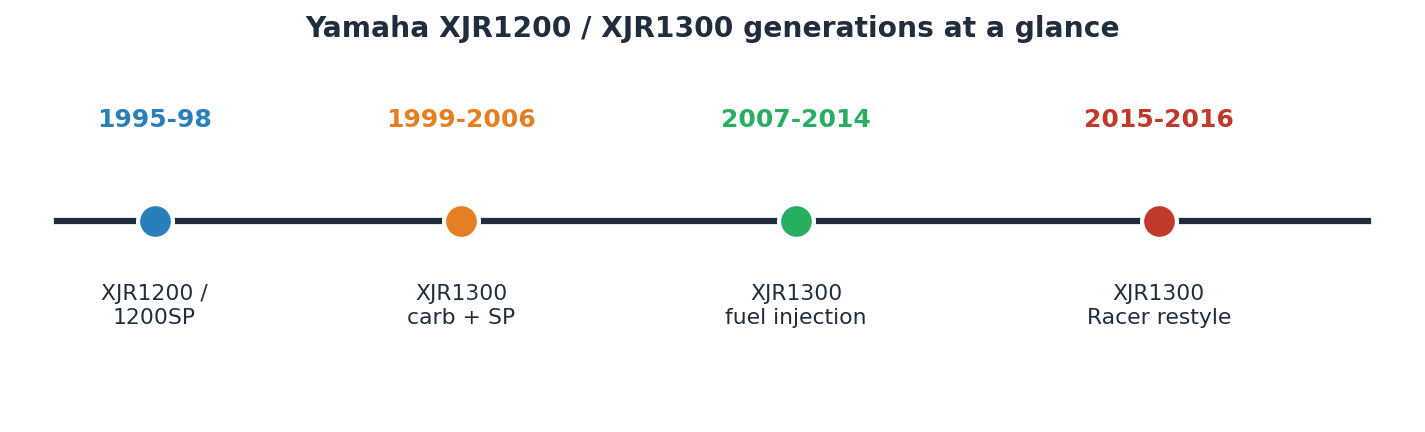
The line started in 1995 with the XJR1200, a 1188cc air-cooled four aimed squarely at the retro-muscle crowd. There was a hotter XJR1200SP with Ohlins shocks and a few choice upgrades. In 1999 Yamaha bored the engine out to 1251cc and the XJR1300 was born, replacing the 1200 and keeping the same essential recipe. It then ran, remarkably, all the way to 2016 with only detail changes.
That longevity is the joke of the whole story. The original shape survived 16 years almost untouched. When Yamaha finally tried to modernise it in 2015 with the fashionable "Racer" restyle aimed at the cafe-racer hipster market, buyers shrugged and it was dropped after just two years. As one buyer's guide dryly noted, "the previous model had managed to endure a lifespan of 16 years and the updated trendy version was killed off in just two." The people who wanted an XJR wanted the honest original, not a rebrand.
Every XJR1300 generation decoded
Here is the practical breakdown of what you are actually looking at when a listing pops up.
1999-2001, the early carb bikes. Four Mikuni carburettors, steel tank, minimal electronics, and the purest version of the experience. These are the cheapest way in and, thanks to the US 25-year rule, the first XJR1300s becoming legal to import into America. They need a healthy carburettor sync to run their best and hate sitting unused, but a well-kept one is a lovely, mechanical, analogue thing.
2002-2006, the sweet spot. From 2002 Yamaha fitted Ohlins rear shocks as standard (before that only the SP had them). This matters more than it sounds: the Ohlins units are rebuildable, where the base shocks on earlier bikes are not, so a 2002-onward bike is easier to keep feeling fresh two decades later. From 2004 the bikes gained an immobiliser, which is worth knowing because you want both keys. Many enthusiasts consider this window the one to target: still carbs, still simple, but with the good suspension.
2007-2014, the fuel-injected era. In 2007 the XJR1300 got a thorough update: fuel injection, a revised catalytic 4-into-1 exhaust, and a raft of detail mods. The fuel injection transforms cold starts and low-speed manners. A period buyer's guide is blunt about it: "post-2007 fuel-injected bikes are considerably easier to live with." If you want a big retro you can just thumb into life on a cold morning and ride, this is your era.
2015-2016, the Racer restyle. Flat bars or the bikini-faired "Racer," new tank, more self-conscious styling. Mechanically still the same lovely engine, but built in tiny numbers for only two years, so they are rarer and pricier. Some love the look; plenty of buyers still prefer the classic shape underneath.
The air-cooled muscle four: XJR1300 vs ZRX1200, GSX1400 and CB1300
You cannot honestly talk about the XJR1300 without its three great rivals, because if you are importing one you should know whether one of the others suits you better. This was one of the last true four-way fights in motorcycling, and the motoring press road-tested them together for years.
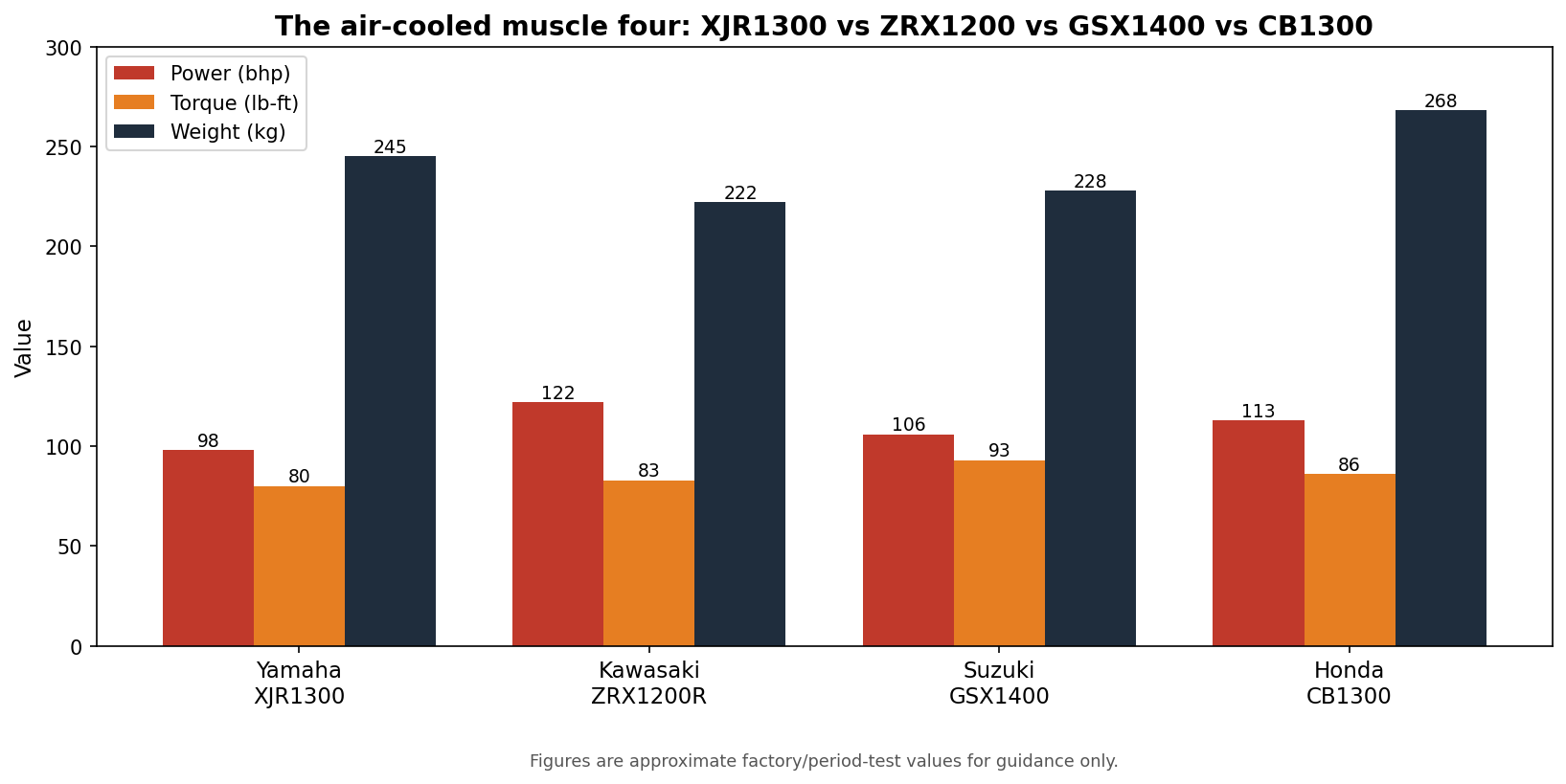
The Suzuki GSX1400 is the torque monster. With the biggest engine of the group it is, in the words of one group test, "unbeatable" for "towering torque and everyday practicality." Testers found it would "cleanly hook top from below 15mph and accelerate away at a significantly faster, glitch-free pace" than the others. If you value flexible, lazy shove above all, the Suzuki is the pick.
The Kawasaki ZRX1200R is the handler and the poser, in the best way. It has the sharpest Eddie Lawson replica styling and, per the same tests, "handling so dialled in" that it is "the easiest to scratch on." Its 1164cc motor is smooth and linear. If you want the most iconic look and the best chassis, the ZRX is the one. We cover it in full in our Kawasaki import guides.
The Honda CB1300 quietly cheated. Where the Suzuki and Yamaha stayed true to air-and-oil cooling, Honda gave the CB1300 a liquid-cooled engine, "a modern twist" that makes it the smoothest and most refined of the four, and the heaviest. If you want the best-rounded, most fuss-free package, the Honda is hard to fault.
So where does that leave the XJR1300? Honestly, testers agreed its handling "isn't as good as the Honda or Kawasaki and it feels like it hasn't taken advantage of any modern technology." But that is also the whole point. The XJR is the most old-school, the most charismatic, the one with "unmatched charm" if what you want is "smoothness, classic style, and relaxed riding." It is the bike you buy with your heart, then justify with your head because Japan has so many good ones.
Yamaha XJR1300 years to avoid and known problems
Let us be clear up front: the XJR1300 is a genuinely reliable motorcycle. There is no cursed year that ruins the model. One MCN buying guide describes it as "generally fault-free," and the air-cooled 1251cc four routinely sails past 100,000km on basic maintenance. The commenter who said his "2001 Kenny Roberts is still my daily rider 22 years down the track and it's still going strong" is not an outlier.
That said, every old bike has a short list of things to hunt for, and knowing them turns a risky import into a safe one.
Regulator/rectifier. This is the classic weak point across the range. It is a known failure item on big air-cooled Yamahas of this era. On any bike you are considering, factor in checking the charging voltage; a failed reg/rec is cheap to fix but can leave you stranded and can cook a battery.
Carburettor gumming (pre-2007). The carb bikes hate sitting. A neglected one "will feel lumpy at low speeds" and want a proper four-carb balance. This is common on imports that sat in a Japanese garage, and it is usually a clean, sync and jet away from perfect, but budget for it.
Cam chain tensioner and head gasket (early bikes). On earlier machines, check the cam chain tensioner carefully and look for oil weeping around the head gasket. Neither is catastrophic, but both are worth spotting before money changes hands.
Corroded connectors and dead clocks. On higher-mileage examples, inspect the electrical connectors for corrosion. A few owners also grumble that "the clocks have a habit of packing up," so make sure everything on the dash actually works during inspection.
Immobiliser keys (2004 on). From 2004 the XJR has an immobiliser. Buy a bike with both coded keys; sourcing a replacement later is a hassle you do not want.
Chassis quirks owners actually report. Two honest notes from long-term owners: the XJR "tended to eat front tyres if you threw it around a lot," and it "bottomed out quite easily" when ridden very hard on stock suspension with the peg feelers. Neither is a dealbreaker; both are reasons the post-2002 Ohlins bikes and a set of decent tyres are worth the extra.
The XJR1300 pre-purchase inspection checklist
You are buying a bike you cannot throw a leg over first, so the auction inspection and the grading sheet do the seeing for you. Here is what to have your agent confirm.
Engine. Cold-start behaviour (especially on carb bikes), even idle, no top-end rattle that could point to the cam chain tensioner, no oil weep at the head gasket, and healthy charging voltage for the reg/rec.
Suspension. Confirm the rear shocks are the correct Ohlins units on a 2002-onward bike and that they are not blown or leaking. Check fork seals for weeping.
Cosmetics that signal history. Unmarked engine cases and bar-ends suggest the bike was never dropped. Original paint in good order matters on the Kenny Roberts and other special colours. Rust under the tank and on the downpipes tells you how it was stored.
Electrics and keys. Every dash function working, no bodged wiring, and both immobiliser keys present on 2004-onward bikes.
Documentation. Service records, the export certificate, and a grade that matches the photos. This is where a good agent earns their fee. If anything on the sheet does not add up, walk away; there is another good XJR next week. When you are ready, our team can vet specific auction lots for you through the contact page.
How to read a Japanese auction sheet for an XJR1300
Every bike sold through the Japanese auctions comes with a translated inspection sheet, and learning to read it is the single biggest thing that separates a happy import from a sad one. Bikes are graded on an overall scale, typically from 1 up to 6 or S, where 4 and above is a solid, honest used bike and 4.5 to 5 is genuinely tidy. Grades of 3 and below usually mean cosmetic tiredness or needed work, which can still be a bargain if you know what you are taking on.
Beyond the headline grade, the sheet carries a map of the bike marked with codes: A for scratches, W for wavy or repaired panels, S for rust, C for corrosion, and so on, each with a number for severity. On an XJR you are hunting for corrosion codes around the tank and exhaust, and any repair marks that hint at a past drop. We break the whole system down in our dedicated guide to reading Japanese auction inspection sheets, and it is worth twenty minutes before you bid on anything.
The XJR1300 tuning culture you are buying into
Part of the joy of importing an XJR is the aftermarket world that grew up around it. This engine responds beautifully to breathing mods. One owner in a review comment section described his 2000 bike with a "Klaus Goerz airbox and ignition mod, Dynojet and Devil Cup exhaust" making "130 hp on the rear wheel," a serious jump over the stock figure from simple, reliable changes.
Then there is the custom scene. The XJR1300 is one of the most popular donor bikes on earth for cafe racers and modern-retro builds; a single BikeBrewers XJR cafe racer feature has pulled nearly 400,000 views, and professional builds like the DeBolex Engineering XJR have become icons in their own right. If you have ever wanted a big, torquey base for a tasteful custom, importing a clean stock XJR from Japan is the smart starting point, because you begin with a straight, rust-free bike instead of a tired local one.
Even in standard trim the appeal is obvious. A New Zealand owner of an imported 2006 European-spec bike called it "a true weapon, yet a great Sunday cruiser as well." That dual character, brutal when you want it and relaxed when you do not, is exactly what keeps XJR values firm.
What it is actually like to live with an imported XJR1300
Reviews and spec sheets only tell you so much. Here is the day-to-day reality, gathered from the owners who have racked up the miles.
The defining sensation is torque. You do not rev an XJR, you lean on it. Roll the throttle open in almost any gear and the big air-cooled four just gathers itself and goes, which makes real-world overtakes effortless and town riding relaxed. One long-term owner captured the appeal perfectly: "No shifting beyond third gear, went 50km/h up to 180 within a wink." You spend most of your time surfing a wave of midrange and rarely bother chasing the redline.
It is a big, comfortable bike on open roads, which is why the New Zealand owner quoted earlier called his a "great Sunday cruiser." Where it shows its age is the motorway grind and hard scratching. Owners are refreshingly honest here: "Harsh and unpleasant on the motorway, but a dream on the A and B roads." The upright riding position catches the wind at speed, and the stock suspension will bottom if you really attack. This is a bike that rewards a flowing, torque-led riding style rather than a manic one.
Maintenance is old-school and, for many, part of the charm. There is no valve-shim lottery hidden behind a radiator; the air-cooled engine is right there, easy to work on, with a huge parts and knowledge base built up over two decades. If you can do basic servicing yourself, running costs are genuinely low. If you cannot, any competent independent shop can, because there is nothing exotic to learn.
The honest summary from the people who own them is that the XJR1300 is a keeper. The comment that gets repeated in every review section, half-joking, is the one every rider recognises: "Me watching every motorcycle review ever: this would be the perfect bike for me." The difference with the XJR is that a surprising number of owners actually mean it, and still have the bike a decade later.
The real landed cost of importing an XJR1300 from Japan
Let us talk actual money, because "importing from Japan" only makes sense if the numbers work. The chart below shows a realistic UK example for a good, clean XJR1300. Your destination changes the taxes, but the shape of the breakdown is the same everywhere.
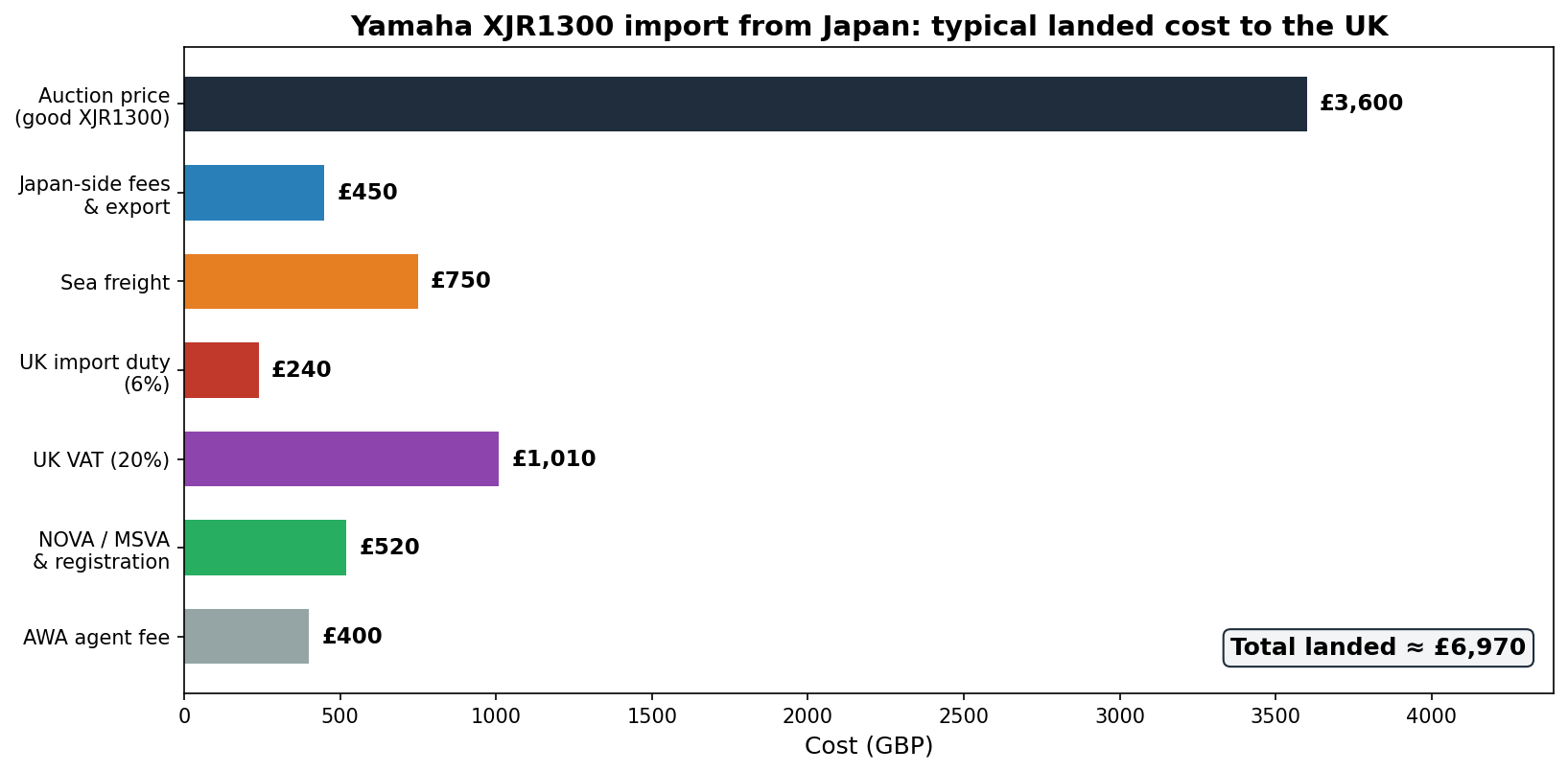
The auction price of the bike itself is only part of the story. On top of it sit the Japan-side fees and export paperwork, sea freight in a container or crate, your country's import duty, your country's consumption tax or VAT, any inspection and registration cost, and the agent's fee for doing the buying and logistics. Add it all up and a genuinely nice XJR1300 typically lands in the UK somewhere in the region shown, which still tends to undercut a comparable local bike once you account for condition.
Two honest caveats. First, a cheaper auction bike is not always cheaper landed, because a tired bike needs more sorting once it arrives. Second, freight and currency move, so treat these as a well-informed estimate rather than a quote. For a precise figure on a specific bike, our team can work up a full landed cost before you commit.
Country by country: US, UK, Australia and New Zealand rules
The single most important variable in importing an XJR1300 is where you live, because the rules differ wildly. Here is the honest state of play in each major market.
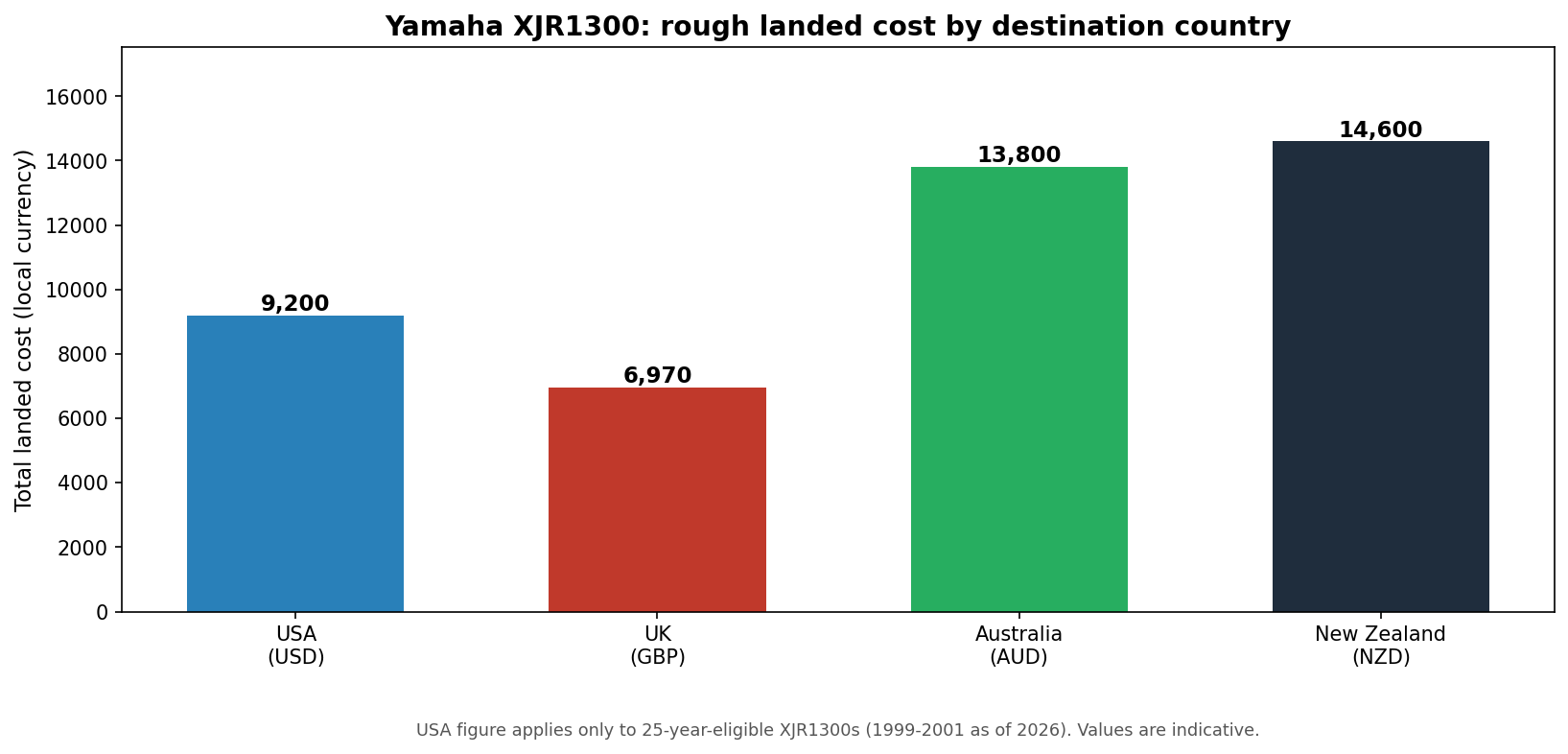
United States. This is the big one, and there is no way to sugar-coat it: the XJR1300 was never federalised for the US, so it can only come in under the 25-year rule, which exempts vehicles a quarter-century old from modern federal standards. As of 2026 that means only the earliest bikes qualify: a 1999 XJR1300 became eligible in 2024, a 2000 in 2025, a 2001 in 2026, and so on, one model year at a time. If you are American and you want an XJR, you are shopping the early carb bikes, and honestly that is no bad thing. The X post lamenting "we never got these UJMs in North America" is finally, slowly, being answered by the calendar.
United Kingdom. The most import-friendly major market. Any XJR1300 can be brought in regardless of age. You will pay import duty and VAT on the landed value, complete a NOVA notification to HMRC, put an older bike through an MOT, and register it with the DVLA. The process is well-trodden and predictable, which is why so many Japanese imports live happy lives on British roads.
Australia. Australia allows road bike imports but the framework is stricter, generally routing older bikes through the concessional or historic pathways and requiring compliance and state registration. A 15-year-plus XJR is very much doable, but budget for compliance steps and expect the total landed figure to sit higher than the UK, as the chart reflects.
New Zealand. A famously bike-import-friendly country with a strong culture of Japanese imports. Your XJR will need to pass entry certification and the usual compliance and registration, but New Zealanders import Japanese motorcycles as a matter of routine, and clean XJR1300s are a common and welcome sight there.
Whatever your country, the golden rule is the same: confirm eligibility before you bid, not after. For authoritative, current detail always check your own government's source, such as the US NHTSA import page or the UK's vehicle import guidance, and let your import agent handle the paperwork maze.
XJR1300 vs the modern retro alternatives
Should you import a twenty-year-old XJR or just buy a shiny new modern retro? Fair question, and the honest answer depends on what you actually want.
A new Kawasaki Z900RS, Honda CB1000R or Triumph Speed Twin gives you a warranty, ABS, traction control and fuel injection that never needs a thought. If that peace of mind is what you are after, buy new and enjoy it. But none of them are air-cooled, none of them have that specific old-school four-cylinder character, and all of them cost meaningfully more than a clean imported XJR. You are paying a premium for newness and electronics.
The XJR1300, by contrast, gives you the real thing: an genuinely air-cooled UJM engine of a type nobody builds anymore, twin shocks, a simple frame, and that endless torque, for the price of a used commuter. It asks a little more of you in maintenance and it will not brake or handle like a 2026 bike. In return it hands you something that is quietly becoming a modern classic, bought at the one place on earth where they are still plentiful and cheap. For a lot of riders, that trade is a no-brainer.
There is also the intangible that no modern bike can bottle: heritage you can feel. The XJR traces a direct line back through the FJ engine to the golden age of the Universal Japanese Motorcycle, the era that defined what a big bike should be for a whole generation. Riding one is not a costume; it is the actual object, still doing exactly what it was built to do. Modern retros imitate that feeling. The XJR simply is it, which is why so many owners who could easily afford something new choose to import an old one instead.
Shipping and what happens when your XJR1300 arrives
Once you win a bike at auction, the logistics run on well-established rails, but it helps to know the shape of it so nothing feels like a surprise.
The bike is collected from the auction house, prepared for export, and given its export certificate, the document that deregisters it in Japan and lets it leave the country. From there it travels by sea, either crated individually or loaded into a shared container, typically taking a few weeks to reach the UK, Australia or New Zealand and a little longer to reach North America depending on the port.
When it lands, your country's customs process kicks in. This is where the duty and tax are assessed on the landed value, and where you complete the local paperwork: a NOVA notification in the UK, compliance and entry certification in Australia and New Zealand, and the age-eligibility documentation in the US. Older bikes then go through the relevant roadworthiness check, an MOT in the UK for example, before final registration and plates.
None of this is something you have to navigate alone. A good import agent coordinates the freight, submits the paperwork, and hands you a bike that is ready to register. The practical upshot is that from winning bid to riding your XJR is usually a matter of weeks, not months, and the only Japanese you ever needed to read was on the auction sheet, which we translated for you.
How AWA Auction helps you import an XJR1300
Importing sounds intimidating from the outside: a foreign auction, a foreign language, a grading system you have never seen, and shipping halfway around the world. That is exactly the gap we exist to close. AWA Auction gives you access to the same Japanese motorcycle auctions the trade uses, with English-speaking help at every step.
We help you search live auction stock for the exact XJR1300 you want, translate and interpret the inspection sheet so you know precisely what you are bidding on, bid on your behalf, and handle export, freight and the documentation for your country. You get the pick of Japan's clean, careful-owner bikes without needing to speak a word of Japanese or fly anywhere.
If an XJR1300 is on your list, start by looking at what is actually available right now. Browse current listings to get a feel for condition and pricing, and when you see something you like, or you just want a straight answer about eligibility and cost for your country, contact our team and we will walk you through it.
Frequently asked questions
See Also
Share this article: