
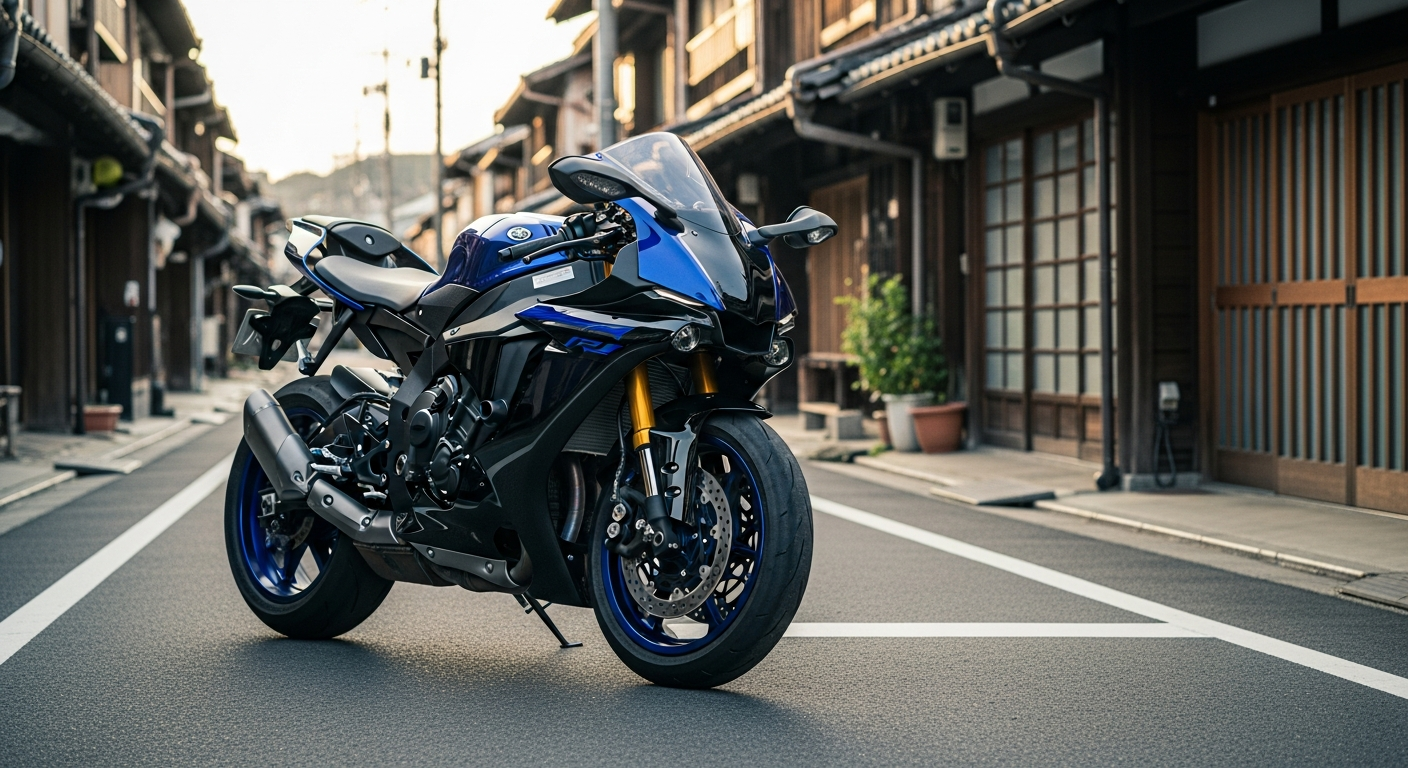
In 1998, Yamaha quietly broke the rulebook. The first Yamaha YZF-R1 weighed less than a 600, made almost 150 horsepower, and packed it into a wheelbase short enough to loft the front wheel in the first three gears. Magazines didn't know whether to call it brilliant or terrifying. The answer was both — and nearly thirty years later, the R1 is still the bike that defined what a modern superbike is supposed to feel like.
Here's the part nobody tells you: the best-kept R1s on the planet are sitting in Japan right now, and you can buy one for less than a tired example in your local classifieds.
Japan has a motorcycle culture obsessed with low mileage, dealer service stamps, and selling on before the next inspection cycle. That combination produces clean, honest bikes — and a domestic auction system that moves thousands of them every week at prices Western buyers rarely see. A 2009 crossplane R1 with 12,000 km and a full book costs a fraction in Japan of what the same bike commands once it has been imported, registered, and parked on a Western showroom floor.
This guide walks you through importing a Yamaha YZF-R1 from Japan in 2026 — which generation to chase, what each year actually is, what it costs to land one on your driveway, how the rules work in the US, UK, Australia, New Zealand and Canada, and the auction-sheet red flags that separate a steal from a money pit.
Why Import a Yamaha YZF-R1 From Japan Instead of Buying Local
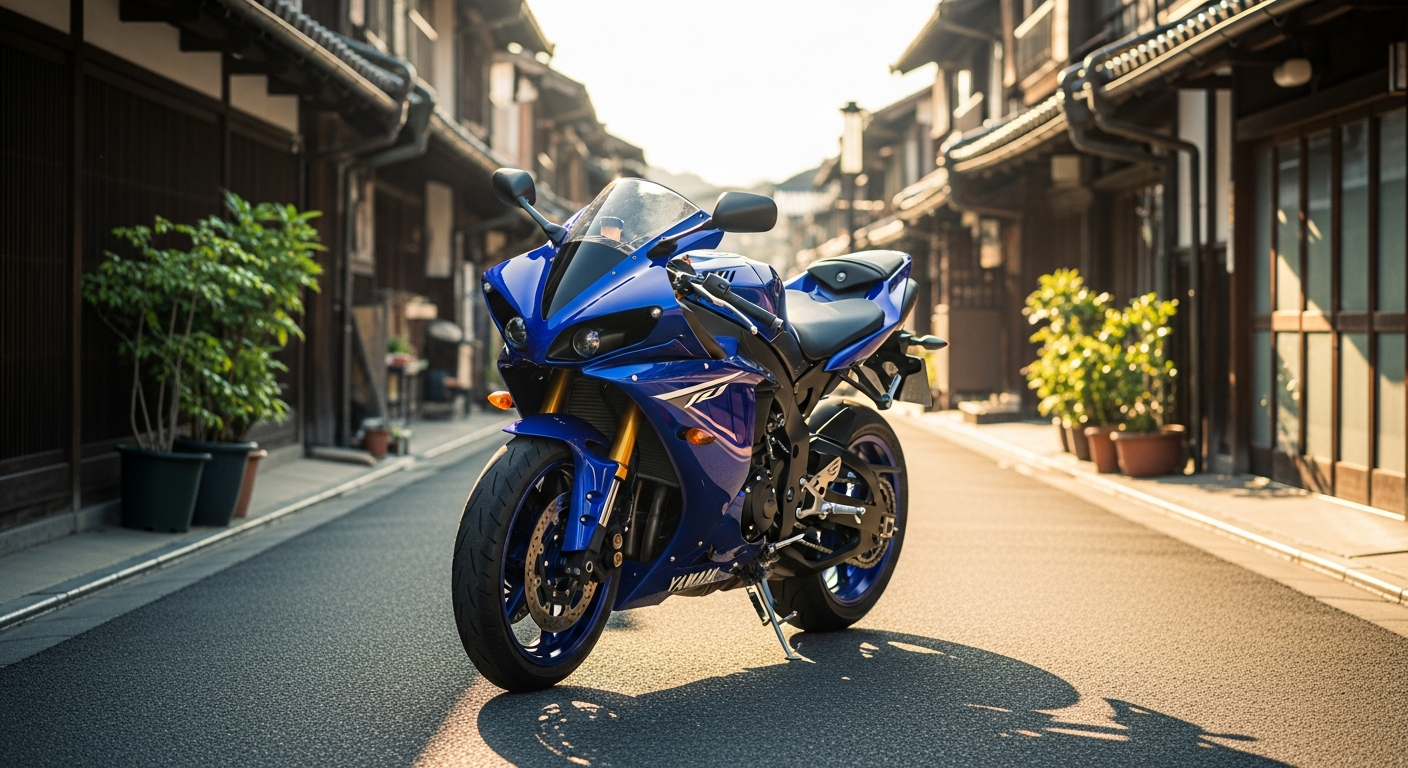
Three reasons, and they compound.
First, condition. Japanese riders do low annual mileage and they maintain to the calendar, not to failure. The shaken inspection system makes neglect expensive, so bikes get serviced whether they need it or not. A ten-year-old R1 out of Japan routinely shows mileage and cosmetic condition that a comparable Western bike passed years ago. You're not buying someone's track-day refugee with crash damage hidden under fresh fairings — you're buying a commuter-grade superbike that spent its life garaged.
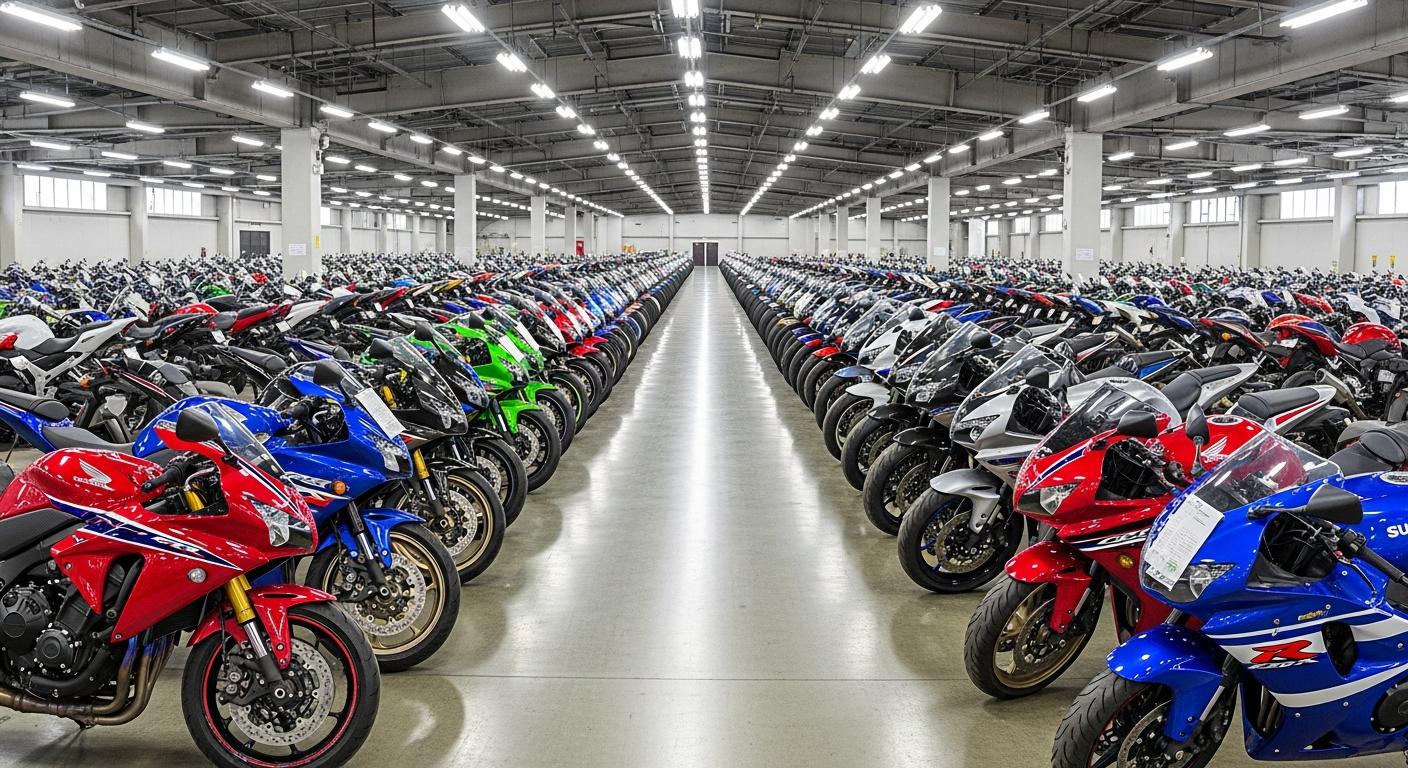
Second, supply and price. Japan's used market is enormous. Platforms tied into the domestic auctions list well over 100,000 used motorcycles at any given moment, and the R1 is one of the most common sportbikes in that pool. Deep supply means soft prices. Even after shipping and duty, a clean imported R1 frequently lands cheaper than the equivalent bike bought retail at home — and it arrives in better shape.
Third, the specific bikes you can't get locally. Some R1 years and special editions barely reached Western markets, or sold out instantly. The 50th Anniversary 2012 model, the early crossplane bikes in their original colours, low-kilometre 2004 underseat-exhaust examples — Japan has them in numbers. If you want a specific year in a specific spec, the Japanese auctions are where it actually exists.
There's a fourth reason for riders in the UK and EU. Tightening emissions rules have squeezed big sportbikes out of dealerships, and a privately imported, well-chosen R1 registered through the proper channel is often the sanest route to a clean example. You just need to know which year clears your country's rules — which is exactly what the import-reality section below covers.
The R1 Story: Why a 1998 Bike Still Sets the Standard
You can't buy an R1 well without understanding why it has the cult following it does — because that reputation is what keeps Japanese auction prices honest and demand steady.
Before the R1, the open-class sportbike was a compromise: powerful but heavy, or light but fragile. Yamaha's engineers did something clever with the 1998 bike. They stacked the gearbox shafts vertically to shorten the engine, which let them pull the wheels closer together without shortening the swingarm. Short wheelbase, long swingarm, low weight — the result steered like a 600 and pulled like a literbike. Independent tests of the original clocked 0–60 mph in under three seconds and a top speed around 168 mph, numbers that humbled everything in 1998.
That formula — chase weight, sharpen the chassis, then add power — became the template every rival copied. The R1 forced Honda, Suzuki and Kawasaki to respond, and the litre-class arms race that followed gave us the modern superbike.
The other reason the R1 matters is the crossplane crankshaft. In 2009 Yamaha brought technology straight off its YZR-M1 MotoGP bike to the road, making the R1 the first production sportbike with a crossplane crank. It changed the way the engine delivered power and, just as importantly, the way it sounded — a lumpy, V-twin-like growl instead of the usual inline-four scream. Riders either loved it or were baffled by it, and that divide is still part of why certain R1 years command a premium on the used market today.
The Yamaha YZF-R1, Generation by Generation
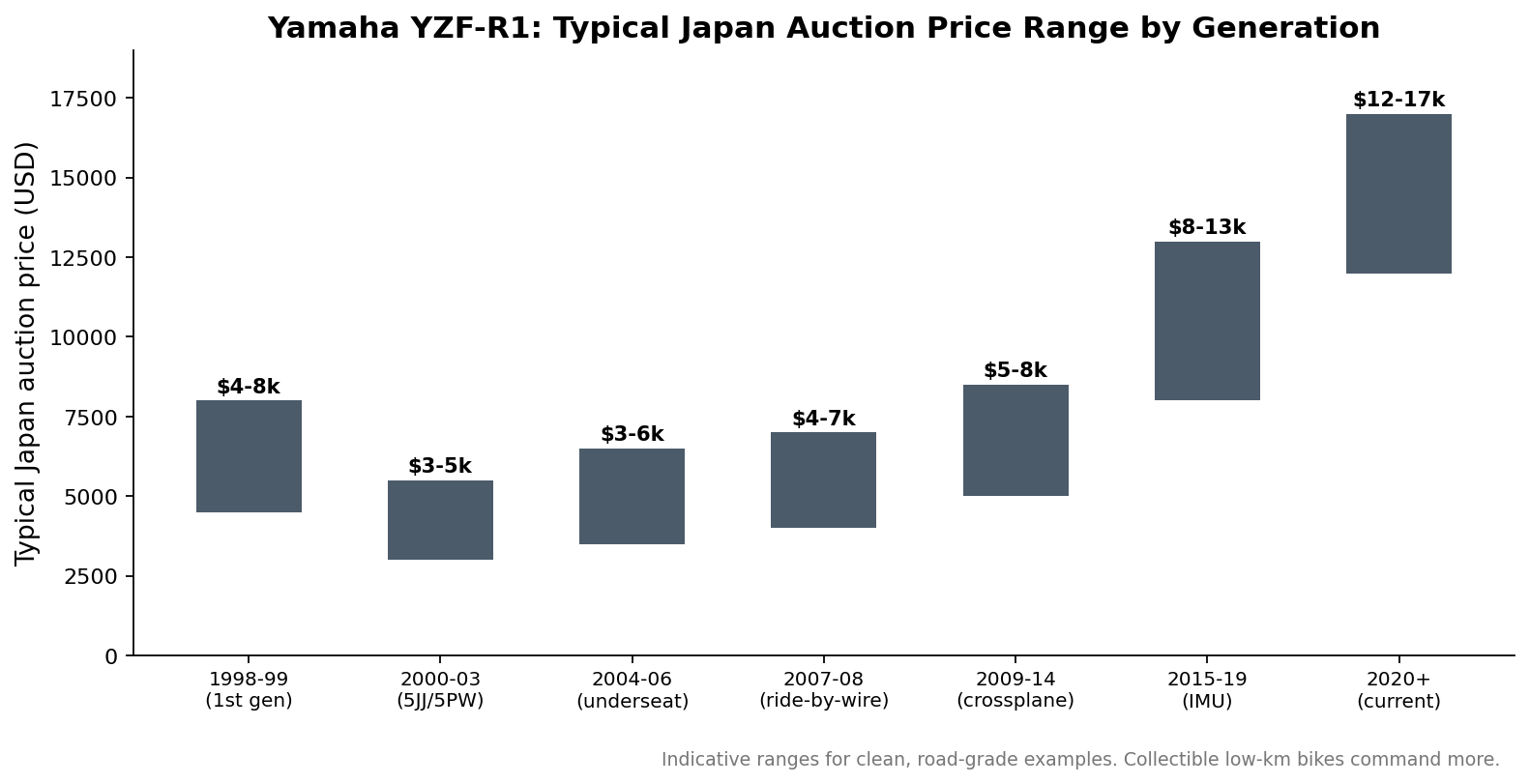
Importing the right R1 starts with knowing exactly what each year is. The wrong year can mean tired suspension, a known weak spot, or a bike that simply doesn't suit how you ride. Here's the honest rundown, generation by generation.
4XV / First Generation (1998–1999): The Original Hooligan
The bike that started it all. Light, short, and gloriously aggressive, the first R1 is now a modern classic and prices reflect that. It wheelies on a whiff of throttle and the brakes and suspension feel period-correct — which is to say, you'll notice three decades of progress the moment you ride a newer one. Buy this generation with your heart, not as a daily. Clean low-kilometre 1998–99 examples are exactly the kind of collectible bike Japan still hoards, and from 2026 the very earliest ones cross the 25-year threshold that opens the US market.
5JJ (2000–2001): The Sensible Refinement
Yamaha smoothed the rough edges — fuelling, gearbox, and stability all improved without losing the manic character. These are underrated and often cheaper than the 1998, making them a smart entry point if you want the look and feel of the first-shape R1 with fewer compromises.
5PW (2002–2003): Fuel Injection Arrives
The first fuel-injected R1, riding on the stiffer Deltabox III frame. Sharper, more rigid, and easier to live with day to day. A genuinely usable modern-classic that doesn't yet carry first-gen collector pricing.
2004–2006: The Underseat-Exhaust Era
A landmark redesign. A new Deltabox V frame, fresh bodywork, twin underseat exhausts and a more powerful, lighter, sleeveless-block engine — the most potent R1 yet, with tested top speeds approaching 190 mph. This is many people's favourite analogue R1: fast, characterful, and still mechanically simple compared with the electronics-laden bikes that followed. Japan has these in abundance, and they represent some of the best value in the whole R1 timeline right now.
2007–2008: Ride-by-Wire and the Last Screamer
An all-new four-valve engine with Yamaha's first ride-by-wire throttle and YCC-I variable intake, wrapped in MotoGP-inspired styling. This is the final conventional-crank R1 — the last one that revs and screams like a traditional inline-four before the crossplane changed everything. For purists who don't want the lumpy crossplane character, the 2007–2008 bikes are the sweet spot.
2009–2014: The Crossplane Revolution
The big one. The crossplane crankshaft arrived from the M1 race programme, bumping output to around 180 hp and giving the R1 its unmistakable growl and fat, tractable midrange. Traction control joined the party in 2012 alongside a redesigned nose and the collectible 50th Anniversary edition. These bikes ride beautifully on the road thanks to that midrange, and they're now squarely in affordable-superbike territory out of Japan. If you want the defining modern R1 without 2015-and-later prices, this is it.
2015–2019: The 200-Horsepower Electronics Monster
A clean-sheet bike built around a MotoGP-derived chassis and a six-axis IMU — the first R1 with a full electronics suite: lean-sensitive traction control, slide control, wheelie control, launch control, the lot. Over 200 hp and a dramatic weight drop. This generation rides like a track weapon and demands respect. The R1M variant adds Öhlins electronic suspension and carbon bodywork, and clean Japanese examples of both are a regular feature in the auctions.
2020–2026: The Current Refinement
The latest evolution sharpened the electronics, updated the cylinder head and intake, and refined the styling, while keeping the 998cc crossplane engine. In many markets the road-going R1 has been wound back toward track-focused availability, which makes a clean used Japanese example increasingly attractive. These are the priciest to import but still undercut local retail in most countries.
Which R1 Year Should You Actually Import?

Forget the spec-sheet bragging rights for a second. The right R1 is the one that matches how you ride and what your country lets you register. Here's the practical matchmaking.
If you want a collectible that will hold value: the 1998–1999 first generation. Buy the cleanest, lowest-kilometre, unmolested example you can find. Originality is everything — standard exhaust, no crash history, complete bodywork.
If you want the most bike for the least money: the 2004–2006 underseat-exhaust generation, or the 2009–2014 crossplane. Both are plentiful in Japan, mechanically sorted, and ride brilliantly on real roads. The crossplane in particular gives you genuine superbike pace with midrange you can actually use.
If you want a road bike you'll ride a lot: a crossplane 2009–2014. The torque makes it forgiving and fun below licence-losing speeds, and the running costs are sane.
If you want a track-capable weapon with modern safety nets: a 2015–2019 with its full IMU electronics suite. The rider aids genuinely lift your safety margin on a bike this fast.
If you want a daily-usable inline-four scream: a 2007–2008. The last conventional-crank R1, with ride-by-wire smoothness.
One honest warning. Every R1 is a serious motorcycle. The 1998 will hurt you with raw aggression; the 2015 will hurt you with sheer speed. If this is your first big sportbike, the crossplane 2009–2014 is the most forgiving way in — and conveniently, it's also the best value out of Japan.
What It Costs to Land an R1 on Your Driveway
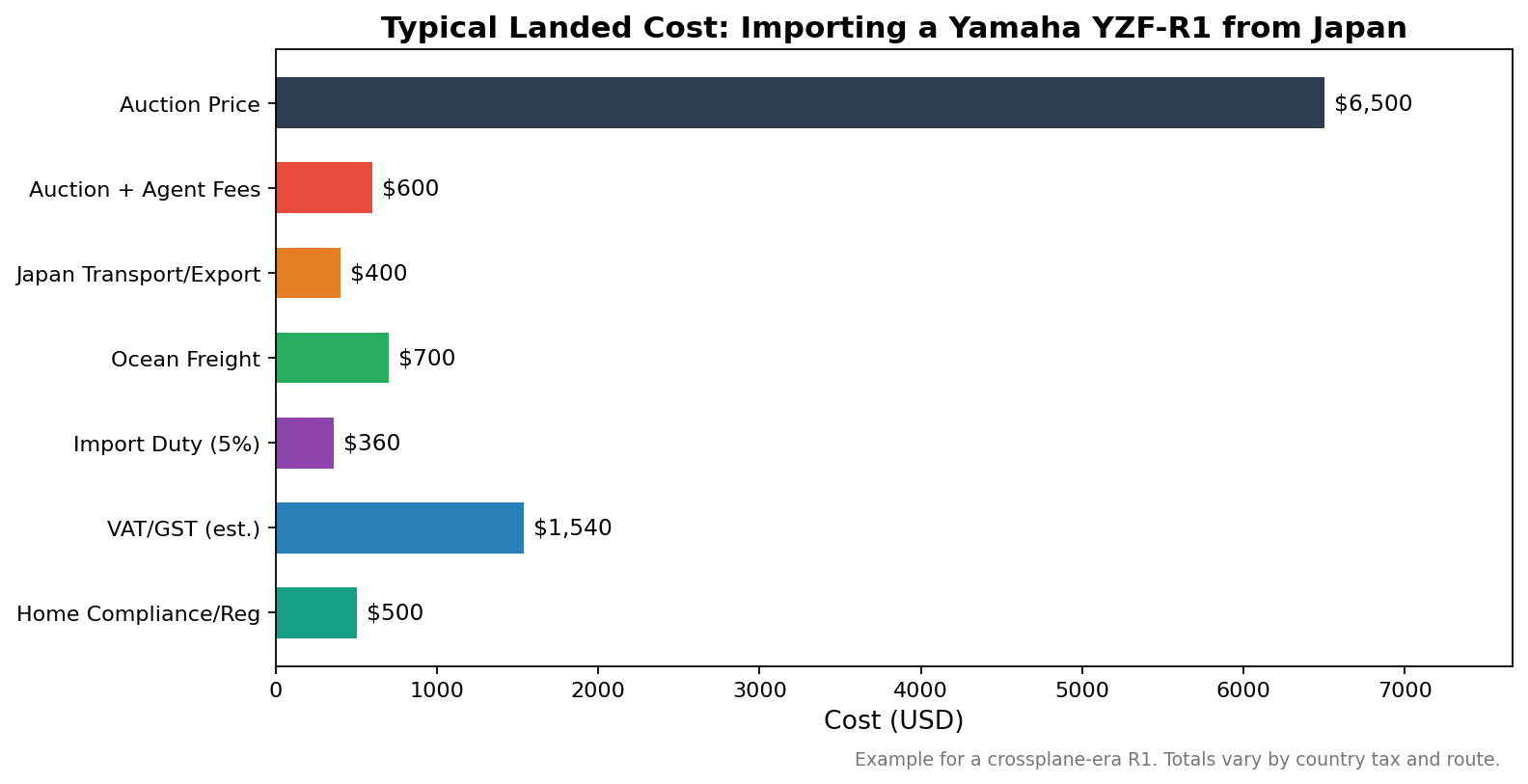
This is where most first-time importers get nervous, so let's lay it out plainly. The auction hammer price is only the start. The real number — the landed cost — is the auction price plus a stack of predictable fees.
Here's a realistic example for a clean crossplane-era R1 imported to a Western market. Treat these as ballpark figures; your exact total shifts with exchange rates, destination port, and your country's duty rate.
Auction price: a tidy 2009–2012 R1 with reasonable kilometres typically hammers in the region of $5,500–$7,500. Call it $6,500 for this example.
Auction and agent fees: the auction's buyer fee plus your import agent's commission usually runs $400–$700 combined. This is what you pay for someone on the ground bidding, inspecting and handling paperwork. Budget $600.
Domestic transport and export prep in Japan: moving the bike from the auction yard to the port, deregistration, and export documentation — roughly $300–$500. Call it $400.
Ocean freight: shipping a crated motorcycle runs around $300–$800 depending on destination. Call it $700 for a long route.
Import duty: this is the big variable. Motorcycle duty rates range from around 5% in some countries to far higher in others, and it's charged on the bike's value plus freight. At, say, 5% on a ~$7,200 base, that's around $360 — but check your own country's rate carefully, because this single line can swing the total dramatically.
Local tax (VAT/GST/sales tax): in the UK that's 20% VAT; in Australia and New Zealand it's GST; in the US it's state sales tax at registration. On our example, a 20% VAT bill alone would add well over $1,500. This is the line most people underestimate.
Compliance, inspection and registration at home: the IVA/MSVA in the UK, compliance work in Australia, entry certification in New Zealand, or state titling in the US. Budget $200–$1,000 depending on country and whether modifications are required.
Add it up and a $6,500 auction R1 typically lands somewhere between $9,000 and $11,500 depending heavily on your country's tax regime. The headline lesson: in low-tax destinations the maths is excellent; in high-VAT countries, run the full sum before you bid, not after.
The 25-Year Rule and Country-by-Country Import Reality
This is the section that decides whether your dream R1 is even legal to register where you live. The rules differ sharply by country, and getting them wrong is the single most expensive mistake an importer can make.
United States
The US is governed by the 25-year rule. A motorcycle that is at least 25 model years old is exempt from the federal DOT and EPA conformity requirements that block newer non-US-spec imports. In 2026 that means R1s from 1998, 1999, 2000 and 2001 are eligible to import freely as classics — and the earliest first-generation bikes are now crossing that line. Newer R1s are far harder; they generally have to satisfy DOT/EPA conformity, which for a grey-market sportbike is rarely practical. If you're in the US and want a Japanese R1, you're shopping the first-generation bikes — which happen to be the collectible ones.
United Kingdom
Post-Brexit, importing from Japan means paying import duty (a few percent on motorcycles) plus 20% VAT on the bike-plus-freight value, then passing inspection. Older bikes go through the simpler MSVA; the bike must be registered with the DVLA before it can go on the road. Age doesn't exempt you from tax, but the UK has no equivalent of the US 25-year wall, so in principle you can import a much wider range of R1 years — you just pay the VAT and clear the inspection.
Australia
Australia allows personal motorcycle imports but the bike must be able to meet registration standards in your state, and there are federal requirements including asbestos testing on older vehicles (Japanese bikes can carry asbestos in old gaskets and brake components, so certification matters). Expect import duty plus 10% GST, and budget for compliance work. The rules reward doing your homework before the bike ships, not after it arrives.
New Zealand
New Zealand is one of the friendlier destinations. Used Japanese imports are a normal part of the market, the bike goes through entry certification and a compliance check on arrival, and GST applies. Many Kiwi riders import directly from the Japanese auctions precisely because the pathway is well-trodden and the bikes are right-hand-drive-market appropriate.
Canada
Canada runs a 15-year rule for imports that don't meet local standards — more generous than the US 25-year wall. That opens up a wide band of R1 years to Canadian buyers, subject to provincial registration and inspection plus duty and tax. For Canadians, the crossplane bikes from 2009 onward are increasingly within reach as they age past the threshold.
The common thread: confirm your country's rule and your destination state or province's registration requirements before you place a single bid. The bike is the easy part. The paperwork is what catches people out.
Reading the Auction Sheet: R1-Specific Red Flags
Every Japanese auction bike comes with an inspection sheet — a graded, coded report from the auction's own inspector. Learning to read it is the difference between buying blind and buying smart. The overall grade runs roughly from 6 (nearly new) down to 1 (rough or modified), with R for repaired and accident history. But the grade alone isn't enough on an R1; you need to read the specifics.
Here's what to watch for on an R1 in particular.
Crash and tip-over evidence. Sportbikes get dropped. Look for notes on bar-end, lever, fairing and frame-slider scuffs. A light tip-over is survivable; frame damage or a repaired (R-graded) chassis is a walk-away.
Aftermarket exhaust and tune. Hugely common on R1s in Japan. A full system isn't automatically bad, but it can hide a tired engine's sound, complicate emissions compliance in strict countries, and means the original is gone — which matters for resale on the collectible early bikes.
Mileage versus condition. Japan's low-mileage reputation is real, but verify it against the sheet's wear notes and the dash photos. A bike with suspiciously low kilometres but heavy wear on the pegs and controls has a story it isn't telling.
Electronics and warning lights on later bikes. The 2015-and-later R1s are electronics-dense. Any note about dashboard warning lamps, IMU faults, or non-functioning rider aids is a serious flag — these systems are expensive to diagnose and repair.
Corrosion. Check the sheet and photos for rust on fasteners, header pipes and the frame, especially on bikes from snowier regions of Japan where roads are salted in winter.
If you can't read Japanese auction grades confidently, this is exactly where a good agent earns their fee — and where buying through a service that translates and verifies the sheet protects you from an expensive surprise.
Common Mistakes Importers Make With the R1
After watching a lot of these deals go through, the same avoidable mistakes come up again and again. Here's how to dodge them.
Bidding before checking the import rule. The number one error. Someone falls in love with a 2018 R1M, wins it, and then discovers the US won't let them register a non-conforming bike that isn't 25 years old. Confirm eligibility first. Always.
Underestimating tax. The auction price is the seductive number, but VAT or GST plus duty can add 25–35% on top in high-tax countries. Build the full landed cost before you bid, using the breakdown above.
Chasing the cheapest bike instead of the cleanest sheet. A grade 3.5 bike $800 cheaper than a grade 4.5 isn't a bargain if it needs forks, a fairing set and a chain-and-sprockets. On a sportbike, condition is everything. Pay for the sheet, not the hammer price.
Ignoring the exhaust and emissions trap. A loud aftermarket can may be a selling point in Japan and a registration headache in your country. If you're importing somewhere with strict noise or emissions testing, factor in the cost of refitting a stock system.
Going it alone on the paperwork. Deregistration in Japan, export certificates, bill of lading, customs entry at home, compliance and registration — miss one document and the bike sits in bond racking up storage fees. A proper import service exists for exactly this reason.
Forgetting the early bikes are getting scarce. Clean, original first-generation R1s are drying up as collectors absorb them. If a genuinely good 1998–99 example comes up at a fair grade, hesitation costs more than money — it costs the bike.
R1 Ownership Reality: Running Costs and What to Budget After It Lands
Getting the bike to your driveway is half the story. The R1 is a thoroughbred, and thoroughbreds have appetites. Here's what to expect once it's yours, so the running costs don't ambush you the way the import tax ambushes the unprepared.
Tyres. A serious sportbike eats serious rubber. Ridden with any enthusiasm, an R1 will go through a rear tyre in a few thousand kilometres, and a quality sport tyre set isn't cheap. If you track the bike, halve those numbers. This is the single biggest consumable on any R1, full stop.
Chain and sprockets. High power and aggressive gearing mean the drivetrain wears. Budget for a chain-and-sprocket set every 15,000–25,000 km depending on how you ride and how religiously you clean and lube the chain. An imported bike with an unknown chain history should get a fresh set early — cheap insurance against a snapped chain at speed.
Servicing intervals. Oil and filter changes are routine, but the valve-clearance check is the one that matters and the one people skip. On the crossplane bikes the valve service is a labour-heavy job, so factor it into your budget if the imported bike is due. A bike with a documented Japanese service history — common, given the maintenance culture — saves you guessing.
Insurance. Insurers see "litre sportbike" and reach for the big numbers. An imported bike can complicate quotes further, since some insurers price grey imports differently. Get a quote before you bid, not after — a surprise premium can change whether the whole deal makes sense.
Brakes and fluids. An R1 that's been sitting — and auction bikes often have — needs fresh brake and clutch fluid and a careful look at the pads and discs. Spongy brakes on a 180-plus-horsepower bike are not a "later" job.
Here's the honest summary: the R1 is cheap to buy out of Japan and not cheap to run hard. Budget for consumables like you mean it, and the bike will reward you. Treat it like a commuter and skip the maintenance, and a fast bike becomes an expensive one.
Tuning, Spares and the JDM Parts Advantage
One underrated bonus of importing from Japan: it's the home market for the bike, which means parts and the tuning scene run deep.
Japan's aftermarket for the R1 is enormous — Yoshimura, Akrapovič distribution, Öhlins, and a thriving used-parts ecosystem feeding off the same auctions that sell the bikes. If you want a specific OEM panel in a discontinued colour, a clean set of original cans to replace a previous owner's loud aftermarket system, or a hard-to-find bracket, the part very often exists in Japan when it's unobtanium elsewhere.
This matters in two practical ways. First, for the collectible early bikes, sourcing original parts to return a modified R1 to stock is far easier through Japanese channels — and originality is exactly what protects the value of a 1998–99 example. Second, for the later electronics-heavy bikes, having access to the home market's parts supply takes some of the fear out of owning a complex machine far from a dealer.
The flip side: don't let a heavily modified bike tempt you just because the mods are tasteful. Every non-standard part is a question mark on emissions compliance, insurance, and resale. The cleanest path is a standard bike plus a known parts pipeline — which importing from Japan happens to give you.
The R1 Against Its Rivals: CBR1000RR, GSX-R1000 and ZX-10R
The R1 didn't grow up alone. The Japanese "big four" literbikes spent two decades trading blows, and understanding where the R1 sits helps you decide whether it's genuinely the bike you want — or whether one of its rivals out of the same Japanese auctions suits you better.
Versus the Honda CBR1000RR. The Honda has always been the polished, friendly one — the literbike you can ride smoothly without it trying to bite. The R1, especially the crossplane bikes, has more character and a rawer edge. If you value refinement and ease, the Honda makes a case; if you want personality and that crossplane growl, the R1 wins.
Versus the Suzuki GSX-R1000. The Gixxer is the value brawler — torquey, durable, and usually a touch cheaper. The R1 feels more exotic and more focused, particularly the 2015-and-later electronics bikes. Both flood the Japanese auctions, so it often comes down to which clean example surfaces first at the right grade.
Versus the Kawasaki ZX-10R. The Kawasaki leans hardest into track performance and has the racing pedigree to back it. The R1 counters with arguably the most distinctive engine character of the four. For a pure track tool the ZX-10R is formidable; for a bike that's special on the road, the R1's crossplane motor is the trump card.
The honest takeaway: all four are superb, and all four are abundant and cheap out of Japan. The R1 earns its place not by being the fastest on paper but by feeling like nothing else — and that's exactly why its used demand stays strong.
How AWA Auction Gets You an R1 From Japan
This is the part where the theory becomes a bike in your garage. Importing from a Japanese auction solo means navigating a Japanese-language bidding system, an inspection-sheet code you can't read, and a paperwork chain spanning two countries. That's where AWA Auction comes in.
AWA gives you direct access to the same Japanese motorcycle auctions the domestic trade uses — the deep pool where the clean, low-mileage R1s actually live. We translate and verify the auction sheet so you know exactly what you're bidding on, place bids on your behalf, and handle the export documentation, shipping and the handoff to your local compliance process. No guessing at grades, no surprise storage fees, no bidding blind.
Want to see what's available right now? Browse our current listings to get a feel for the R1s and other Japanese sportbikes coming through the auctions. When you're ready to talk specifics — a target year, a budget, your country's import rules — contact our team and we'll map out exactly what it takes to land your R1.
Frequently Asked Questions
How much does it cost to import a Yamaha YZF-R1 from Japan?
Plan on the auction price plus roughly $2,000–$4,000 in fees, freight, duty and tax for most destinations. A $6,500 auction R1 typically lands between $9,000 and $11,500, with the biggest variable being your country's VAT/GST and duty rate. Low-tax destinations come in at the bottom of that range; high-VAT countries like the UK at the top.
Which Yamaha R1 year is the best to import?
For value and real-world riding, the 2009–2014 crossplane generation is hard to beat — plentiful in Japan, mechanically sorted, and forgiving thanks to its midrange. For a collectible, chase a clean 1998–1999 first-generation bike. For a track-focused weapon with modern electronics, a 2015–2019.
Can I import a newer R1 to the United States?
Generally no, unless it's at least 25 model years old. The US 25-year rule exempts older bikes from DOT/EPA conformity, so in 2026 that means 1998–2001 R1s import freely. Newer non-US-spec R1s are very difficult to register legally, so US buyers should focus on the first-generation bikes.
Are Japanese-market R1s reliable?
Yes — and often more so than Western-market bikes of the same age. Japan's low average mileage and strict shaken inspection culture mean these bikes are typically well-maintained and lightly used. Verify it against the auction sheet, but the reputation is earned.
What is a Japanese auction sheet and why does it matter?
It's a standardised inspection report graded by the auction house, covering overall condition, mileage, damage and modifications. For a sportbike like the R1 it's essential — it reveals crash history, aftermarket parts and wear that photos alone hide. Learning to read it (or using a service that translates it) is the core of buying safely.
How long does it take to import an R1 from Japan?
Typically four to twelve weeks from winning the auction to the bike arriving, depending on shipping route and how often vessels run to your port. Add a few more weeks for home-country compliance, inspection and registration before you can ride it.
What's the difference between the crossplane and conventional-crank R1?
The 2009-and-later crossplane crank fires unevenly, giving a lumpy V-twin-like growl and fatter, more usable midrange torque. The pre-2009 conventional crank revs and screams like a classic inline-four. Neither is "better" — it's a character choice. Crossplane suits road riders; the screamer suits purists.
Do I need an import agent, or can I bid on the Japanese auctions myself?
Technically the auctions are trade-only and conducted in Japanese, so almost everyone imports through an agent or service. A good one translates the sheet, bids for you, and handles export paperwork and shipping — which is exactly the friction that stops most people from importing solo. It's the difference between a smooth deal and a bike stuck in customs.
Is the Yamaha R1 a good first big bike if I import one?
Honestly, the R1 is a lot of motorcycle for a first big bike. If you're set on one, the 2009–2014 crossplane is the most forgiving thanks to its tractable midrange and available traction control. Avoid starting on a raw 1998 or a 200-horsepower 2015-plus. Respect the bike, get some saddle time, and it'll be one of the great ones.
Will an imported Japanese R1 have parts and service support in my country?
Largely yes. The R1 is a globally sold model, so consumables, brakes, tyres and most service parts are standard. Japan-specific cosmetic parts can differ slightly, but mechanically the bike is the same — and Japan's deep used-parts market, accessible through the same auction ecosystem, fills most of the gaps.
What documents do I need to import an R1 from Japan?
You'll need the Japanese export certificate (deregistration proof), the bill of lading from the shipping line, a commercial invoice showing the purchase value, and the auction sheet itself as a record of condition. At your end, customs will want those to assess duty and tax, and your registration authority will want proof of compliance or inspection. Miss one and the bike can sit in bond accruing storage charges — which is why most importers let a service handle the paperwork chain end to end.
Why are R1s cheaper at Japanese auctions than buying locally?
Three things stack up: Japan's used market is huge so supply is deep, Japanese riders cover low annual mileage so bikes stay clean, and the domestic auction is a wholesale trade channel without the retail markup. You're effectively buying at dealer-cost rather than showroom price. Even after shipping, duty and tax, that wholesale starting point often beats local retail — and the bike usually arrives in better condition.
See Also
Share this article: