
Yamaha built the YZF-R6 to do one thing better than almost anything else on two wheels: scream to 16,500 rpm and carve a corner like a scalpel. When you decide to import a Yamaha YZF-R6 from Japan, you're not buying a commuter or a comfy tourer. You're buying the purest 600cc supersport the company ever made — and the cleanest examples left on earth are sitting in Japanese auction halls right now, often with under 15,000 km on the clock.
Here's the part nobody mentions: Yamaha quietly killed the street R6 in most markets around 2020. What's left in dealerships is the track-only "R6 Race" with no lights and no plate. So if you want a road-legal R6 that isn't thrashed, beaten, or crashed, the used market is the market now — and Japan is where the good ones live.
A YouTube ride video titled "FULL Power Mode ON Yamaha R6 Street Ride" has pulled over 17 million views and 187,000 likes. People are obsessed with this bike. The problem is that obsession plus a thirty-year-old supersport reputation means a lot of abused R6s out there. This guide walks you through the generations, the known problems, the real landed cost, and exactly how to buy a good one from Japan without getting burned.
Why the R6 Is the Smartest 600 to Import From Japan Right Now
Three things make Japan the best place on the planet to find a clean R6.
First, mileage. Japanese riders tend to ride less, store bikes indoors, and sell early. Shaken — Japan's strict periodic inspection — pushes owners to move bikes on before big maintenance bills land. The result is a steady supply of low-kilometre, well-kept supersports.
Second, price. A tidy used R6 in good condition sells for roughly $5,000–$7,500 in Western classifieds, with excellent examples pushing past $10,000. At a Japanese auction, the same bike can hammer for the equivalent of $3,500–$6,000. Even after shipping and tax, you frequently land it for less than a tired local one — and yours arrives with a documented inspection sheet instead of a stranger's promises.
Third, honesty. The Japanese auction system grades every bike on a standardized sheet, with an independent inspector noting scratches, rust, frame damage and engine condition. It's the closest thing to an unbiased pre-purchase inspection you'll get before you've spent a cent. Once you can read that sheet — and we'll get to that — you can shop thousands of bikes a week from your couch.
You can browse the kind of Japanese-market supersports we source on our current listings page, and the same import pipeline that brings in R1s and ZX-9Rs handles the R6 with no extra drama.
Yamaha YZF-R6 Generations: Which Year Should You Actually Buy?
The R6 ran for two decades, and the model code on the frame matters more than the badge. Buy the wrong year and you inherit a known fault. Buy the right one and you get the sweet spot of power, reliability and price. Here's the honest breakdown.
1999–2002 (First generation, RJ03/5EB)
The original R6 made a then-shocking 120 horsepower and revved to 15,500 rpm — the first 600 to officially claim triple digits. These are now genuine modern classics. They're light, raw, and carbureted, which means no ride-by-wire gremlins but also fiddly cold starts and carbs that hate sitting. Great for collectors and purists. Less great if you want fuel injection and plug-and-play reliability.
2003–2005 (Second generation, RJ05/5SL)
Fuel injection arrived, along with sharper styling and an underseat exhaust on later years. The 2005 model in particular has a cult following — Regular Car Reviews' "2005 Yamaha YZF-R6" video alone has 1.3 million views and 3,800 comments, most of them arguing about how unhinged the top end feels. This generation is a strong value pick: injected, plentiful, and cheaper than the bikes that followed.
2006–2007 (Third generation, the ride-by-wire R6)
This is the big one. The 2006 R6 was the first production motorcycle in the world to use ride-by-wire throttle (Yamaha's YCC-T) — it beat the R1 to it by a year. It also gained a slipper clutch and a claimed 125 horsepower at a frankly absurd 14,500 rpm.
But here's the catch every R6 forum will warn you about: the 2006–2007 bikes are the ones with the cam chain tensioner concern, and some early units had a tachometer that famously over-read by around 1,000 rpm. The tensioner issue is manageable if the bike's been serviced, but a neglected 06–07 with no records is exactly the kind of bike that can grenade an engine. Documentation is everything on this generation.
2008–2016 (Fourth/fifth generation, the YCC-I years)
For most buyers, this is the R6 to import. The 2008 update added YCC-I — Yamaha's variable-length intake system — which fattens the midrange and smooths the power delivery, plus revised bodywork and a stiffer frame. The cam chain tensioner worry of the 06–07 cars was addressed. These bikes are mechanically sorted, gorgeous, and still terrifyingly fast.
You'll find a deep pool of these in Japan because they sold well there. If you want the best blend of reliability, value and that classic high-revving R6 character, look hard at a clean 2008–2014 example.
2017–2020 (Final generation)
The last R6s got R1-derived styling, a 43mm KYB fork, ABS, traction control and ride modes. They're the most refined and the safest to ride fast, but they're also the most expensive and the rarest on the used market — partly because emissions rules choked the top-end power slightly compared to the 2008–2016 bikes. If your budget stretches and you want modern electronics, this is the one. If you want maximum bike for the money, it isn't.
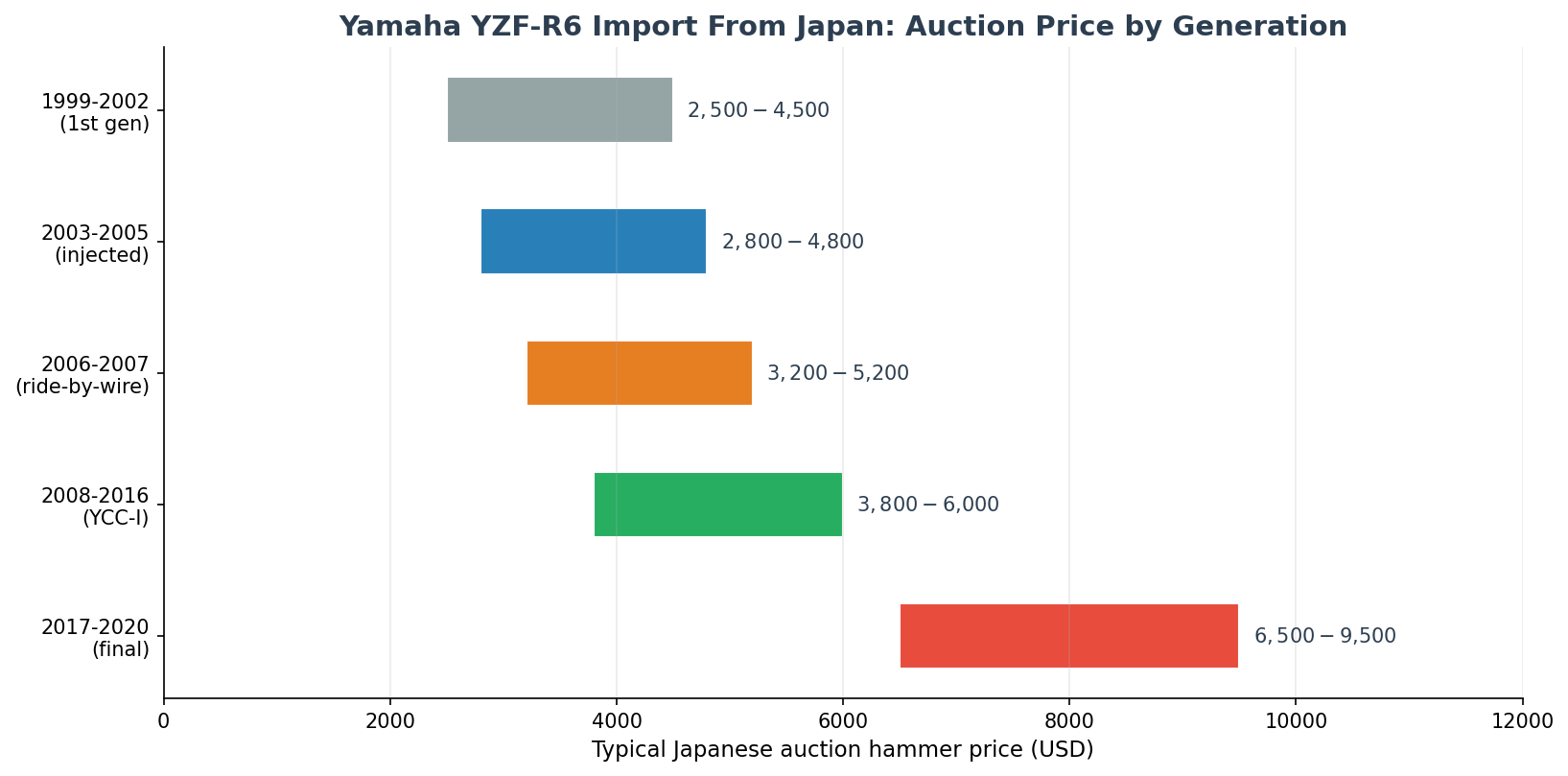
The chart above shows the rough auction-to-landed price spread by generation. The 2008–2016 band is where most smart imports cluster: enough refinement to be reliable, cheap enough to make importing genuinely worth it.
The R6 Engine and Spec Sheet, Explained Without the Marketing
The R6's heart is a 599cc liquid-cooled inline-four with a 67.0mm bore and a tiny 42.5mm stroke. That short stroke is why it revs to the moon — the 2006-onward bikes spin to roughly 16,500 rpm, with peak power arriving up near 14,500. Torque is modest by design: around 59 Nm. This is not a bike that pulls hard from 3,000 rpm. It comes alive above 9,000 and turns into a banshee past 12,000.
Claimed crank power sits around 120–125 horsepower depending on the year, translating to roughly 105–110 at the rear wheel. Dry weight hovers near 165–190 kg depending on generation and whether you're reading dry or wet figures. The chassis is the real story: a Deltabox aluminium frame, fully adjustable suspension on most years, and steering geometry built for one purpose — changing direction fast.
What does that mean in plain English? The R6 is a track weapon you can ride on the road, not a road bike that's okay on track. The riding position is aggressive — high pegs, low clip-ons, weight on your wrists. Adobo Moto's popular "Why It's Cheaper to Build a Used Yamaha R6" video and dozens like it exist precisely because owners fall down the rabbit hole of making an already-sharp bike sharper. Know what you're signing up for before you buy.
For the official lineage and spec history, Yamaha's own model archive and the official Yamaha Motor site and the YZF-R6 reference page are useful cross-checks against any auction listing's claims.
Known R6 Problems and the Auction-Sheet Red Flags That Reveal Them
Every R6 forum thread titled "what to look out for when buying a used R6" lands on the same short list. Memorize it before you bid.
Cam chain tensioner (2006–2007). The headline fault. A failing tensioner causes rattle on startup and, worst case, catastrophic engine damage. On these years, demand service records and listen to a cold-start video.
Stator and regulator/rectifier failure (all years). The single most common R6 electrical gremlin. Symptoms are a dying battery, dim lights, or a bike that won't hold charge. It's not expensive to fix, but a seller hiding it is a seller hiding other things.
Transmission on pre-2004 bikes. Early R6s can have weaker gearboxes and second-gear issues if abused. Buyers on the R6 forums consistently warn against poorly documented 2004-and-earlier examples.
Crash and track damage (every year). This is the big one for a supersport. The R6 is the most raced 600 in history. A huge share of used examples have been down — on track, on the road, or both.
Here's where the Japanese auction sheet earns its keep. An independent inspector marks frame scuffs, weld repairs, fork misalignment, and replacement bodywork. Track bikes betray themselves: missing mirrors and indicators, drilled fairings, safety-wired bolts, aftermarket rearsets, and a suspiciously low odometer paired with worn-out brake discs. A bike that's "never been down" but wears fresh fairings and scuffed bar-ends is telling you a story. Learn to read the sheet's S-to-R condition grades — our walkthrough on reading Japanese auction inspection sheets covers exactly what each mark means — and you'll filter out the crash repairs before you ever pay.
What an Imported Yamaha R6 Actually Costs in 2026
Let's talk real numbers, because vague "it depends" answers help nobody. Your landed cost is the auction hammer price plus a stack of predictable fees.
Say you win a clean 2010 R6 for the equivalent of $5,000 at auction. On top of that you'll pay an auction/agent fee, domestic transport to the port, export paperwork, ocean freight, then duty and tax at your end.
Ocean freight is the big swing. RoRo (roll-on/roll-off) shipping from Japan to the US West Coast runs roughly $800–$1,400; to the East Coast, $1,200–$2,000. Container shipping costs more — $1,500–$2,800 — but adds protection, which some buyers want for a pristine supersport. For a single bike, RoRo is usually the value choice.
Import duty in the US is about 2.4% of the bike's value — trivial. Your real tax variable is at the destination: the UK and most of Europe add VAT at 20%, Australia adds GST plus duty, and the figure swings your total by thousands. Industry rule of thumb: total landed cost runs 15%–55% above the FOB Japan purchase price depending on country.
So that $5,000 auction R6 typically lands somewhere between $7,500 and $10,000 all-in. Compare that to a $9,000 local bike with no history and a mystery past, and the math starts to make sense fast.
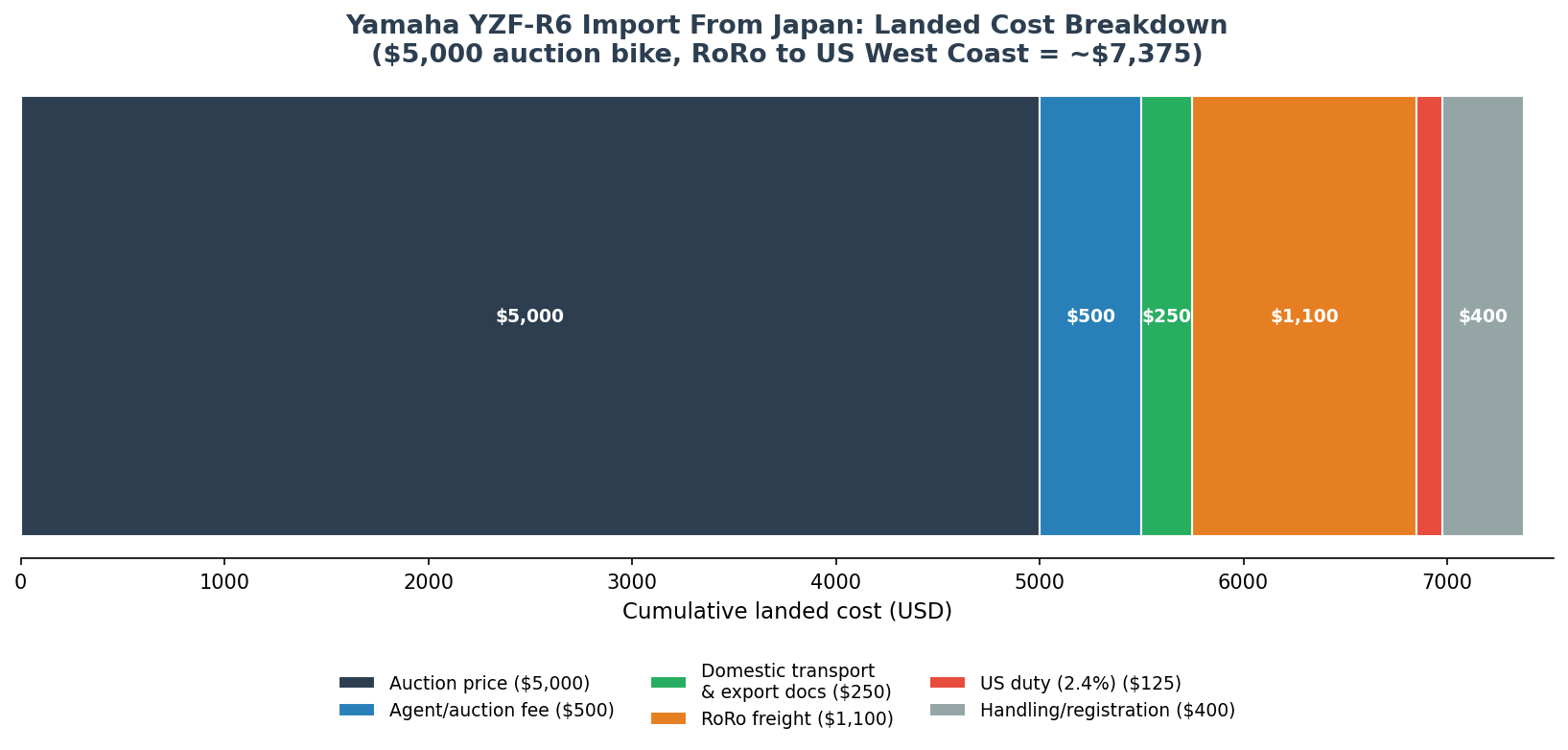
The breakdown above assumes a mid-range RoRo shipment to a moderate-tax destination. Plug your own country's VAT/GST rate in and the freight and tax bars stretch or shrink — everything else stays roughly constant. If you want a precise quote for your exact bike and port, our team will run the numbers for you before you commit.
Here's a concrete example so the numbers feel real. Win a 2011 R6 in grade-4 condition for the yen equivalent of $5,200. Add roughly $500 in auction and agent fees, $250 in domestic transport and export documentation, and $1,100 for RoRo freight to the US West Coast. That puts you around $7,050 landed at the port before duty. Tack on 2.4% US duty (about $125) and your destination handling, and you are riding away near $7,500 — for a documented, low-mileage supersport that would cost $9,000-plus locally with none of the paperwork. Swap the US for the UK and the 20% VAT alone adds well over a thousand dollars, which is exactly why your destination tax rate, not the auction price, decides whether importing makes sense for you.
R6 vs ZX-6R vs CBR600RR vs GSX-R600: How the R6 Stacks Up
The R6 doesn't exist in a vacuum. If you're importing a 600 supersport, these are the bikes you're cross-shopping, and each has a personality.
Kawasaki ZX-6R. The friendly one. Kawasaki's 636cc versions add midrange torque that makes the bike easier and more fun on the street. If you want a supersport you can actually commute on, the ZX-6R is the softer landing.
Honda CBR600RR. The polished one. Famously smooth, balanced and reliable, with razor steering. It's the bike track instructors recommend. Slightly less manic at the top than the R6, slightly more usable everywhere else.
Suzuki GSX-R600. The value one. Plentiful, cheap to run, and a tuner favourite. Build quality feels a notch behind the Honda, but the bang-for-buck is real.
Triumph Daytona 675. The character one. A triple, not a four, so it makes torque the inline-fours can only dream of down low — but parts and specialists are thinner on the ground, especially as a Japanese import.
So where does the R6 win? Outright top-end ferocity and steering precision. Nothing in this class changes direction or revs quite like it. The trade is comfort and low-rpm grunt — the R6 asks the most of its rider and gives the most back. If you've owned bigger bikes and want a scalpel, import the R6. If this is your first sportbike, a ZX-6R or CBR600RR will keep you happier. The same logic we lay out in our Kawasaki and Yamaha import guides applies: match the bike to your wrists and your riding, not your ego.
Who Should Buy an R6 — and Who Should Walk Away
This is the section the spec sheets skip, and it'll save some of you a lot of money and pain.
Buy an R6 if: you've ridden sportbikes before, you do track days or twisty back-road riding, you want the sharpest-handling 600 ever built, and you understand that "comfortable" isn't in its vocabulary. The R6 rewards commitment. Ridden well, in its element, almost nothing this size is faster point to point.
Walk away if: you want a daily commuter, you have wrist or back problems, you're a brand-new rider, or you're under 25 in a country where supersport insurance will cost more than the bike. That last one is not a joke — insurers treat the R6 as a high-theft, high-claim machine, and the quotes can be eye-watering.
And here's the trap nobody warns importers about: the "R6 Race." From 2021, Yamaha sold the R6 only as a track-only model with no headlight, no indicators, and no road registration in most markets. If you spot a suspiciously cheap late R6 listing, check whether it's a Race model. Importing one and discovering you can't legally plate it is an expensive lesson. Stick to pre-2021 road bikes unless track-only is exactly what you want. McknightBo's "Things I Wish I Knew Before Buying a R6" video exists for a reason — most of those regrets are about buying the wrong version or the wrong condition, not the wrong brand.
How to Import a Yamaha R6 From Japan, Step by Step
The process is more straightforward than the forums make it sound. Here's the path.
Step 1 — Set your spec and budget. Decide your generation, your maximum landed budget, and your non-negotiables (mileage cap, no crash history, stock or modified). Write it down so you don't get auction fever.
Step 2 — Get access to the auctions. Japanese motorcycle auctions like BDS, JBA and the USS network are wholesale-only — you bid through a licensed agent. That's where an importer like AWA comes in: we hold the account, place bids, and translate the sheet.
Step 3 — Shortlist and read the sheets. Filter by model, year and grade. For each candidate, read the inspection sheet and the photos. Reject anything with frame marks or vague history.
Step 4 — Set your max bid. Decide your ceiling including fees and stick to it. Auctions move fast and the cheap-looking ones attract crowds.
Step 5 — Win, pay, and consolidate. Once you win, the bike moves to the export yard, gets de-registered and prepped for shipping.
Step 6 — Ship. Choose RoRo or container. Yokohama, Kobe and Nagoya are the usual departure ports. Transit is typically 3–6 weeks depending on destination.
Step 7 — Clear customs and register. Pay duty and tax, pass any required inspection, and title the bike. This is the step that varies most by country — see the next section.
If that sounds like a lot of moving parts, it is — which is exactly why most buyers hand the auction access, bidding and freight to a specialist and just pick the bike. You can start that conversation through our contact page.
Pre-Purchase Inspection Checklist for an Imported R6
Even with a clean auction sheet, run through this before you bid and again when the bike lands. Print it if you have to.
Cold start. Demand a startup video. Listen for cam chain rattle (especially 06–07), check for blue smoke, and watch the idle settle. A reluctant cold start hints at neglect.
Charging system. Given the stator/rectifier reputation, ask whether the charging voltage has been checked. A healthy R6 charges around 13.8–14.5 volts at the battery.
Frame and subframe. Look for paint overspray, weld marks, and misaligned panels — all crash tells. The subframe bends easily in a tail-slide crash.
Forks and discs. Check for fork pitting and oil weeping. Heavily worn brake discs on a low-mileage bike scream track use.
Tyres and chain. Check the tyre DOT date code; old rubber on "low mileage" bikes is a red flag. A rusty or kinked chain means lazy maintenance.
Bodywork and bolts. Drilled fairings, safety-wired bolts, and aftermarket rearsets point to a track history the seller may not advertise.
Documents and VIN. Confirm the frame VIN matches the export paperwork and the auction sheet. Mismatches are an instant walk-away.
Country-by-Country R6 Import Rules
The bike's the same everywhere; the paperwork isn't. Here's the short version for the main English-speaking markets.
United States. Motorcycles 25 years or older import freely as classics — so 1999–2000 R6s are now in the clear. Newer bikes must meet EPA/DOT standards, which is where most modern supersport imports get complicated. Duty is about 2.4%. Check the current EPA vehicle import rules before committing to a non-25-year bike.
United Kingdom. No age bar, but you'll pay 20% VAT plus duty, register through the DVLA, and may need an MOT and IVA depending on the bike. The UK is high-tax but R6-friendly.
Australia. Tighter. You generally need import approval before the bike ships, and road-bike eligibility rules are strict. The 25-year rule under the SEVS/older-vehicle pathways helps with first-gen bikes. Always confirm approval first — Australian customs will not improvise for you.
New Zealand. More import-friendly than Australia, but the bike must pass entry certification and meet frontal-impact and emissions rules for its year. Low-mileage Japanese bikes usually sail through.
Canada. The 15-year rule makes Canada one of the easiest markets — most R6 generations qualify. Confirm provincial registration and inspection requirements.
For any country, verify the live rule with your national customs or transport authority before you bid. Import law shifts, and a bike on the water is a bad time to learn your year isn't eligible.
Owning and Maintaining an Imported R6
An R6 isn't high-maintenance, but it is a high-strung engine that wants to be looked after.
Valve clearances are the big scheduled job — Yamaha specifies a check around every 26,000 km (about 16,000 miles), and a short-stroke screamer like this genuinely needs it. Skipping valve checks is how people end up with expensive top-end work.
Oil and filter every 6,000 km or so, chain and sprockets as a set, and quality tyres — the R6 chews through soft rubber if you ride it the way it wants to be ridden. Brake fluid and coolant on schedule. None of it is exotic; all of it is non-negotiable.
Resale is a quiet bonus of importing. A clean, documented, low-mileage Japanese R6 holds value well precisely because the supply of unmolested examples keeps shrinking. Buy a good one, keep the records, and you're not just buying a bike — you're buying an appreciating modern classic that happens to be one of the best-handling 600s ever made.
Ready to find yours? Browse what's coming through the auctions on our listings page, or tell us your dream R6 spec and we'll hunt it down at our contact page.
What R6 Owners Actually Say After a Year of Living With One
Spec sheets sell bikes; owners tell the truth. Dig through the most-watched R6 ownership videos and the big forum threads and the same themes come up again and again.
The first is that the R6 is happiest when it's working. The channel laniākean's "Should you buy an old Yamaha R6?" and RoyalRsix's "WATCH THIS BEFORE YOU BUY A YAMAHA R6" both land on the same point: below 8,000 rpm the bike feels almost flat, and riders new to supersports mistake that for "slow." It isn't slow. It's waiting. Ride it in the wrong rev range and you'll wonder what the fuss is about; wring its neck on a back road and you'll understand why people keep them for a decade.
The second theme is comfort, or the lack of it. Wrists, lower back, and knees all file complaints on long rides. Owners who commute on an R6 almost universally fit bar risers or just accept the ache. If your import is going to do motorway miles, go in with eyes open.
The third is running costs that surprise first-timers: sticky tyres that last a season if you're enthusiastic, chain-and-sprocket sets that wear as a unit, and that valve-clearance check that people love to skip until it bites. None of it is catastrophic — but the R6 is not a fit-and-forget commuter, and pretending it is leads to the neglected examples you're trying to avoid buying.
The fourth, and the nicest, is that almost nobody regrets the bike itself. The complaints are about ergonomics and insurance, never about the engine or the handling. That's a rare thing to see in used-bike reviews, and it's the single best argument for spending the effort to import a clean one rather than settling for a tired local bike.
Buying a Modified R6: Bargain or Booby Trap?
A big chunk of used R6s have been modified, because the aftermarket for this bike is enormous. A full exhaust system, a fender eliminator, frame sliders, an aftermarket screen, rearsets, and a flashed ECU are so common they're almost stock. So how do you tell a tasteful build from a money pit?
Good mods are bolt-on and reversible: a quality slip-on or full system from a known brand, frame sliders (which usually mean the owner cared about protecting the bike), braided brake lines, and fresh suspension. These can genuinely add value and tell you the owner was an enthusiast, not an abuser.
Bad mods are the ones that hide damage or hint at hard track use. Drilled fairings and safety-wired drain bolts mean track days. A "stage 3" everything build on a cheap bike often means the engine's been thrashed. Cheap eBay rearsets and a no-name exhaust suggest corners were cut. And any electrical splicing for aftermarket gauges or quick-shifters is worth a careful look, because the R6's charging system is fussy enough without amateur wiring loaded on top.
Adobo Moto's widely-shared "Why It's Cheaper to Build a Used Yamaha R6" video captures the appeal — and the trap. Building a used R6 into your dream bike is genuinely cheaper than buying new, but only if you start with a clean, honest base. Import a modified bike if the mods are quality and reversible and the price reflects them. Walk away if the modifications are obviously masking a hard life. When in doubt on a specific listing, send us the auction sheet and photos through our contact page and we'll tell you straight whether it's a build or a booby trap.
Why the R6 Became the Most Raced 600 of All Time
You can't talk about importing an R6 without understanding why so many of them exist — and why so many have been raced. When Yamaha launched the bike in 1999, it rewrote what a 600 was capable of, and racing organisers took notice. For two decades the R6 was the weapon of choice in World Supersport and in club and national 600 racing around the globe.
That racing pedigree is a double-edged sword for a buyer. On one hand, it means the bike is brilliant — a chassis honed by decades of competition feedback, and an engine that thrives on the kind of abuse most road bikes hate. On the other, it means a disproportionate number of used R6s have spent weekends being ridden at ten-tenths on a circuit. The supersport class effectively mandated the R6 as a base bike for years, so the world is full of ex-race and track-day examples wearing road plates.
This is the single most important reason to buy through the Japanese auction system rather than a random classified ad. Japan's domestic R6s skew heavily toward street use and short commutes, and the auction sheet flags the track-prepped ones. You're fishing in a cleaner pond, with a referee pointing out the fish that bite. Combine the R6's competition-bred ability with a low-mileage, street-used Japanese example and you get the best of both worlds: a track-capable bike that hasn't actually lived on track.
Special Editions and Colours Worth Hunting at Auction
Not all R6s are created equal, and a few versions carry extra desirability — which matters both for enjoyment and for resale.
The classic blue-and-white Yamaha Racing livery is the one most buyers picture, and it stays in demand. The 60th Anniversary editions in the yellow-and-black "speed block" scheme are genuine future collectibles and worth paying a premium for if you find a clean one. White and matte-grey years have their fans too, and some Japan-market bikes wear colour combinations that never officially reached Western showrooms — a quiet bonus of importing, since you end up with a bike your local riders simply can't buy.
Condition still trumps colour every time. A perfect plain-coloured R6 beats a scuffed anniversary bike for both riding and value. But when two examples are otherwise equal, the rarer livery is the one to chase — it's the closest thing to free money in the used supersport game, and Japanese auctions are where the unusual factory colours surface. If you've got a specific year and colour in mind, tell us and we'll keep an eye on the weekly catalogues for you.
Frequently Asked Questions
How much does it cost to import a Yamaha YZF-R6 from Japan?
Budget the auction hammer price plus roughly $2,000–$4,000 in agent fees, freight, duty and tax for most destinations. A $5,000 auction R6 typically lands between $7,500 and $10,000 all-in. The single biggest variable is your country's tax: low-tax markets like the US sit at the bottom of that range, while 20%-VAT countries like the UK sit at the top.
Which Yamaha R6 year is the best to import?
For the best mix of reliability, value and that classic R6 scream, target a clean 2008–2014 model. Those years got the YCC-I variable intake, a sorted chassis, and they sold well in Japan so supply is deep. If you want modern ABS and traction control and have the budget, the 2017–2020 bikes are the most refined; if you want a cheap modern classic, a fuel-injected 2003–2005 is the value play.
Which R6 years should I avoid?
Be cautious with poorly documented 2006–2007 bikes because of the cam chain tensioner concern, and with abused 2004-and-earlier examples that can have weaker gearboxes. None of these years are bad with full service history — the problem is buying a neglected one. Records matter more than the model year.
Is the Yamaha R6 still being made?
Not as a road bike in most markets. Yamaha discontinued the street-legal R6 around 2020 and from 2021 sold only the track-only "R6 Race" with no lights and no registration. That's exactly why importing a clean used road model from Japan has become the smart way to get one.
How long does it take to import an R6 from Japan?
From winning the auction to the bike landing, plan on roughly 4–8 weeks. Ocean transit alone is about 3–6 weeks depending on destination, plus auction settlement, export prep and customs clearance at your end. RoRo and container both run on similar timelines; container just costs more.
Is it cheaper to import an R6 than to buy one locally?
Often, yes. Japanese auctions are a wholesale channel, so you start near dealer cost rather than retail. Combined with low-mileage, well-kept bikes, the landed cost frequently beats a comparable local example — and yours arrives with a documented inspection sheet instead of a stranger's word.
Can a beginner ride a Yamaha R6?
It's not the ideal first bike. The R6 makes its power high in the rev range, has an aggressive riding position, and carries punishing insurance for younger riders. A new rider is usually better served by a ZX-6R or a smaller bike first. If you're set on an R6 as a first sportbike, get proper training and respect the top end.
What's the difference between a road R6 and the R6 Race?
The R6 Race, sold from 2021, has no headlight, no indicators, no mirrors and no road registration — it's built purely for the track. A road R6 is fully street-legal. If you import a Race model expecting to plate it, you'll likely be stuck. Always confirm which version a late-model listing actually is.
How do I know if an auction R6 has been crashed?
Read the Japanese auction inspection sheet, which marks frame damage, weld repairs and replaced panels, and study the photos for paint overspray, misaligned bodywork, drilled fairings and safety-wired bolts. A low odometer paired with heavily worn brake discs is a classic track-use tell. When a sheet and photos disagree with the seller's story, trust the sheet.
Do I need a special licence or inspection to register an imported R6?
That depends entirely on your country. The US clears bikes over 25 years as classics and charges about 2.4% duty; the UK needs DVLA registration plus VAT; Australia requires import approval before shipping; New Zealand and Canada are relatively import-friendly with their own certification steps. Always confirm the current rule with your national customs or transport authority before you bid.
See Also
Share this article: