
Here's a number that should change how you shop for your next sport bike: a clean, low-mileage Japanese 600 that costs eight to ten grand at your local dealer can land on your driveway from a Japan auction for around half that. The 600cc class is the sweet spot of the used-import world, and almost nobody outside the import scene knows it. This is the guide to fixing that.
If you want the best 600cc motorcycles to import from Japan, you're looking at the single most competitive, best-built, most over-engineered class of motorcycle the big four ever made. Honda, Yamaha, Suzuki, and Kawasaki spent two decades trying to murder each other in the 600 supersport wars, and the survivors of that fight are now hitting the 25-year mark and becoming legal to import into the US, Australia, and beyond. Cheap, fast, reliable, and finally importable. That's a rare combination.
This guide breaks down which 600s are worth importing, what they actually cost landed, how the Japan auction system works, and the traps that separate a smart buy from an expensive mistake. We pulled real numbers from owners who daily these bikes, container-import footage with nearly 19 million views, and the inspection data AWA sees on the auction floor every week.
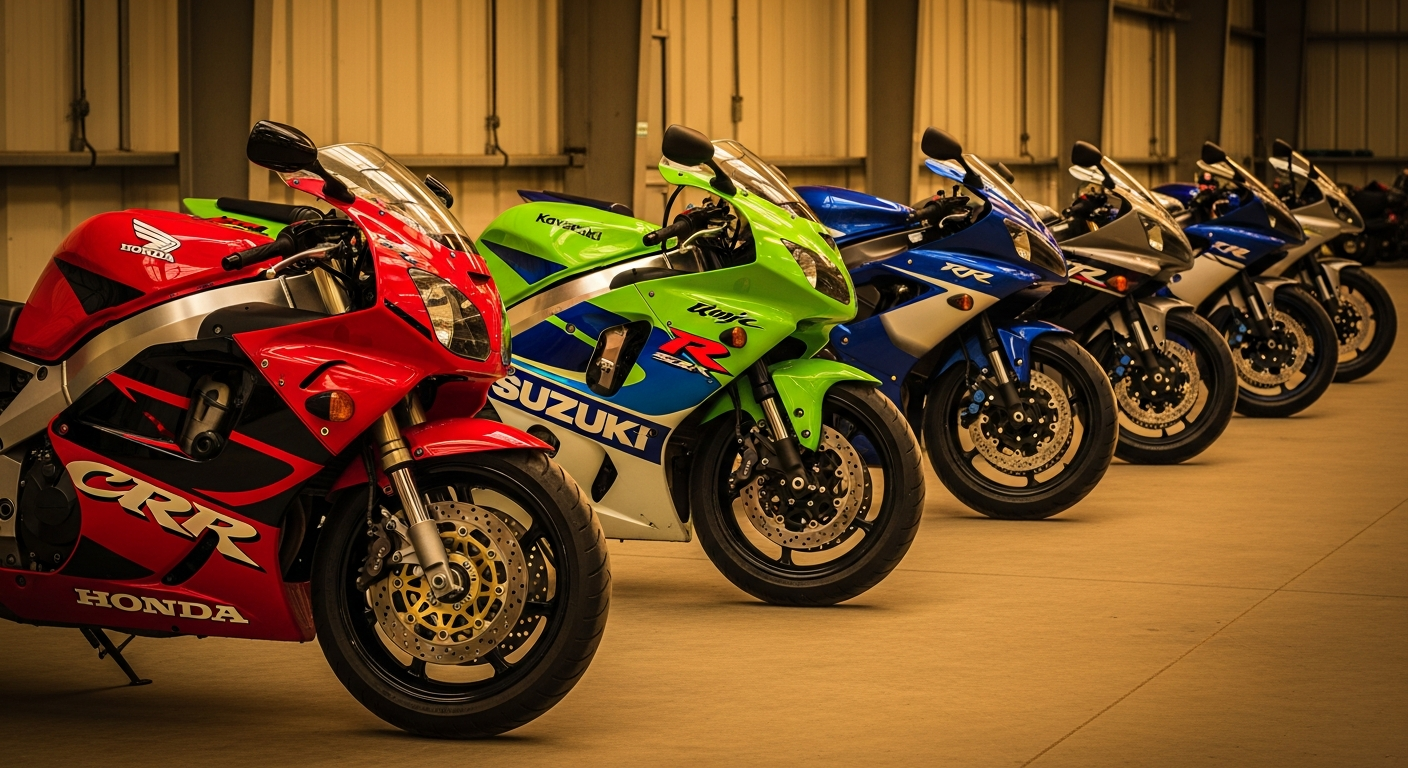
Why 600cc Is the Smartest Class to Import From Japan
Walk into any motorcycle forum and you'll find the same eternal argument: 600 versus 1000. The liter-bike crowd will tell you a 600 is underpowered. They're wrong, and the people who actually ride 600s know it. A modern 600 supersport makes 105 to 130 horsepower, weighs around 160 to 190 kg, and will out-corner almost anything on a back road. It does zero to sixty in roughly three seconds. As one rider put it in a video with over two million views, "you're gonna take off quicker than 90% of all the cars on the road." The 600 isn't slow. It just makes you work for it, and that's the point.
Now layer the import math on top. Japan registered and rode millions of these bikes through the 1990s and 2000s, then largely parked them as the domestic market shifted. The result is a deep, deep pool of well-kept 600s sitting in Japanese auctions every single week, sold on honest inspection sheets, often with mileage that would make a Western buyer suspicious it's a typo. Supply is high, condition is high, and domestic Japanese prices are low. That's the recipe for value.
There's also the reliability story. These engines were built to survive being revved to the moon every day. One owner posted that he has 50,000 miles on his 2009 ZX-6R and called it "such a great bike, nothing compares to an engine screaming to 16,000 rpm." Another dailies an '07 ZX-6R for 60-plus miles a day and "loves every minute of it." These aren't fragile track toys. They're Japanese inline-fours, which means they're closer to indestructible than almost anything else with two wheels.
Put it together and the case writes itself. You get a bike that's quick enough to scare you, tough enough to commute on, cheap enough to import for the price of a used economy car, and increasingly legal as the 25-year clock ticks forward. If you're going to import one bike from Japan, a 600 is the most rational choice on the board.
The Two Worlds of 600cc: Supersport vs. All-Rounder
Before you start bidding, you need to understand that "600cc" describes two completely different kinds of motorcycle, and buying the wrong one is the most common mistake new importers make.
The first world is the supersport: the CBR600RR, YZF-R6, GSX-R600, and ZX-6R. These are race bikes with lights. Clip-on bars low and forward, rearset pegs, a riding position that folds you over the tank, and engines tuned to make their best power up near a 15,000 to 16,000 rpm redline. They're glorious on a twisty road or a track day and punishing in city traffic. People love to claim 600s "suck around town because they make power at higher revs," but owners who actually live with them will tell you that's overblown. They're peaky, not useless.
The second world is the all-rounder: the CBR600F, Hornet 600, Bandit 600, and Yamaha Fazer 600. Same displacement, totally different philosophy. Upright bars, a comfier seat, an engine retuned for midrange instead of top-end screaming. The CBR600F is the textbook example. One owner did 20,000 miles and three European tours on his and called it "totally reliable with superb build quality." That's not a sentence anyone writes about an R6.
Here's the thing nobody tells first-time buyers: the all-rounders are usually the smarter import. They're cheaper at auction, they hold up to daily use, they're more comfortable for anyone over thirty, and they're far easier to live with if this is going to be your only bike. The supersports are the trophies. The all-rounders are the keepers. Figure out which one you actually are before you bid, because the auction does not issue refunds for buyer's remorse.
The Best 600cc Supersports to Import From Japan
These are the four bikes that defined the class. Every one of them is a brilliant machine, and the "best" one genuinely depends on what you want. Here's the honest breakdown.
Honda CBR600RR and CBR600F4i
The CBR600RR is the racer's pick. It carried Honda's Supersport World Championship winning streak through 2008 and won again in 2010 and 2014. On track it's a scalpel: precise, planted, endlessly confidence-inspiring. The trade-off is that it's the most committed riding position of the bunch, so a daily diet of it will test your wrists and lower back.
If you want most of the Honda magic with half the punishment, hunt for the CBR600F4i instead. It's the bridge between the all-rounder F-series and the full RR: real sportbike performance, slightly more humane ergonomics, and bulletproof Honda build quality. For a lot of importers, the F4i is the smart-money Honda 600.
Yamaha YZF-R6
The R6 is the screamer. Historically the top seller in its class, it has the highest redline, the sharpest steering, and the most uncompromising track focus of any Japanese 600. It's also the least comfortable for street riding, full stop. If your plan is canyon runs and track days, the R6 is arguably the most thrilling 600 ever built. If your plan is commuting, you will feel every one of those miles in your shoulders. Buy it with your eyes open.
Suzuki GSX-R600
The GSX-R is the all-rounder of the supersports. Owners consistently say the same thing: "most say GSX-R 600 is the most comfortable of the bunch. Great all-around bike." It gives up a hair of the R6's razor edge in exchange for ergonomics you can actually live with, plus the legendary Gixxer chassis. If you want a supersport that won't wreck you on the ride home, the Suzuki is the pick. It's also generally the most price-forgiving of the four at auction.
Kawasaki ZX-6R and the 636
Kawasaki played the smartest game in the class. Frustrated that a true 600 makes its power high in the rev range, in late 2002 they stretched the engine to 636cc. The 636 makes a claimed 130 bhp and, crucially, adds low and midrange grunt that a standard 599cc 600 simply doesn't have. Under the right conditions it'll nudge 170 mph. For street riding, the 636 is the cheat code: supersport handling with enough bottom-end that you're not constantly flogging it to keep up with traffic.
There's a catch for racers. Displacement-restricted Supersport racing required a true 600, so Kawasaki also sold the limited 599cc ZX-6RR. If you want the bike that's nicest on the road, get the 636. If you're chasing a class-legal race bike, find the RR. The ZX-6R also earns the "first big bike" crown among owners, one of whom wrote, "nothing has made me smile like my zx6r. NOTHING, and I daily it."
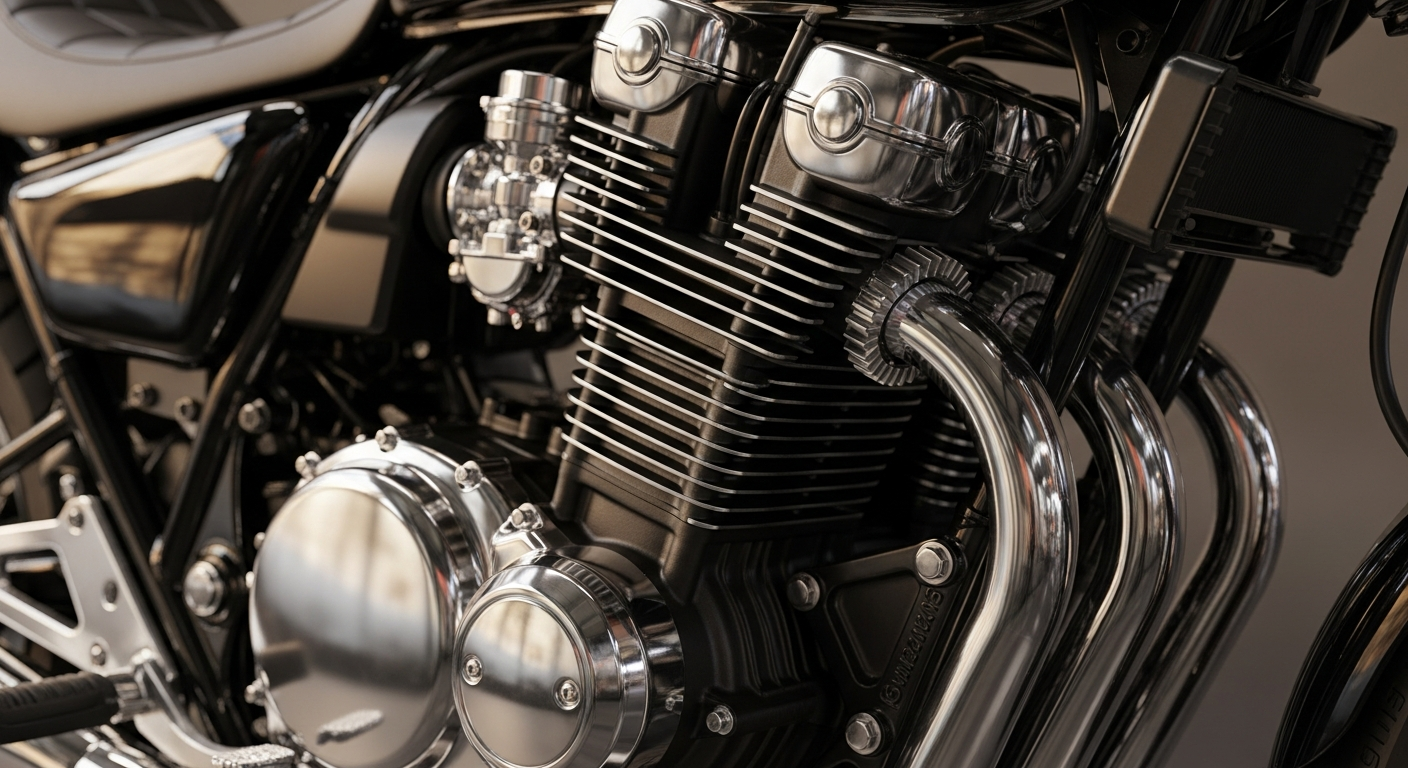
The Best 600cc All-Rounders and Nakeds to Import
This is where the real value lives, and where most first-time importers should be looking. These bikes use detuned versions of the same brilliant engines wrapped in chassis built for the road instead of the track.
Honda CBR600F
The CBR600F is the default answer to "what's the best all-round 600?" It's the balanced one, meaning the engine is matched perfectly to the chassis and it's genuinely easy to ride in everything from city traffic to a track day. It's torquey enough down low to be practical, light enough to be fun, comfortable enough for distance, and built to a standard that shrugs off high mileage. If you want one bike that does everything competently and never lets you down, this is it.
Honda Hornet 600 and Yamaha Fazer 600
These are the naked and half-faired all-rounders built on screaming supersport engines. The Hornet 600 takes a CBR600 four, retunes it for street, and bolts it into an upright streetfighter. The Fazer 600 does the same trick with Yamaha's Thundercat engine. A dyno showdown of the Hornet 600 (in both carb and fuel-injected form) against the Fazer 600 and XJ6 has racked up over twenty million views, which tells you how beloved these bikes still are. They're cheap at auction, easy to maintain, and they sound fantastic. For a first big bike that you'll actually ride every day, a Hornet or Fazer is hard to beat.
Suzuki Bandit 600 and the 650 twins
The Bandit 600 is the budget hero of the group: an air/oil-cooled four in a comfortable standard chassis, dead simple to work on, and almost impossible to kill. Worth a mention alongside the true 600s are the modern middleweight twins, the Suzuki SV650 (645cc V-twin) and Kawasaki Z650. They're not 600 fours, but they live in the same price and use-case bracket, trade top-end scream for fat low-end torque, and make superb first big bikes. If "best 600cc" to you means "best middleweight to actually own," these twins deserve a spot on your shortlist.
Which 600 Should You Buy? Picks by Rider Type
Enough hedging. Here's the straight advice depending on who you are.
- The first-big-bike rider: Get a Kawasaki ZX-6R 636, a Suzuki SV650, or a Honda Hornet 600. Forgiving power delivery, manageable ergonomics, and reputations for reliability. One owner literally said, "every squid should start on a 600." He's right, as long as you respect it.
- The track-day junkie: Yamaha YZF-R6 or Honda CBR600RR. Nothing else in the class is as sharp. Just accept that the commute home will hurt.
- The daily commuter: Honda CBR600F or Yamaha Fazer 600. Upright, comfortable, frugal, and tough enough to ride 60 miles a day for years.
- The comfort-first sport rider: Suzuki GSX-R600. The most livable of the supersports by a clear margin.
- The collector or flipper: A clean, low-mileage CBR600RR or first-year R6 with a great auction sheet. These are the bikes whose values are starting to climb as the 25-year clock turns them into legal classics.
Notice that no single bike wins every category. That's exactly why the 600 class is so good, and why importing gives you an edge: instead of buying whatever your local dealer happens to have, you get to pick the precise bike that fits you from a Japanese auction pool of thousands.
The 25-Year Rule and 600cc Legality by Country
This is the part that makes or breaks your import, so read it twice. Most of the iconic Japanese 600s were built from the mid-1990s through the 2000s, which puts them right on the edge of the import-eligibility line in the strictest markets. The rules differ wildly by country.
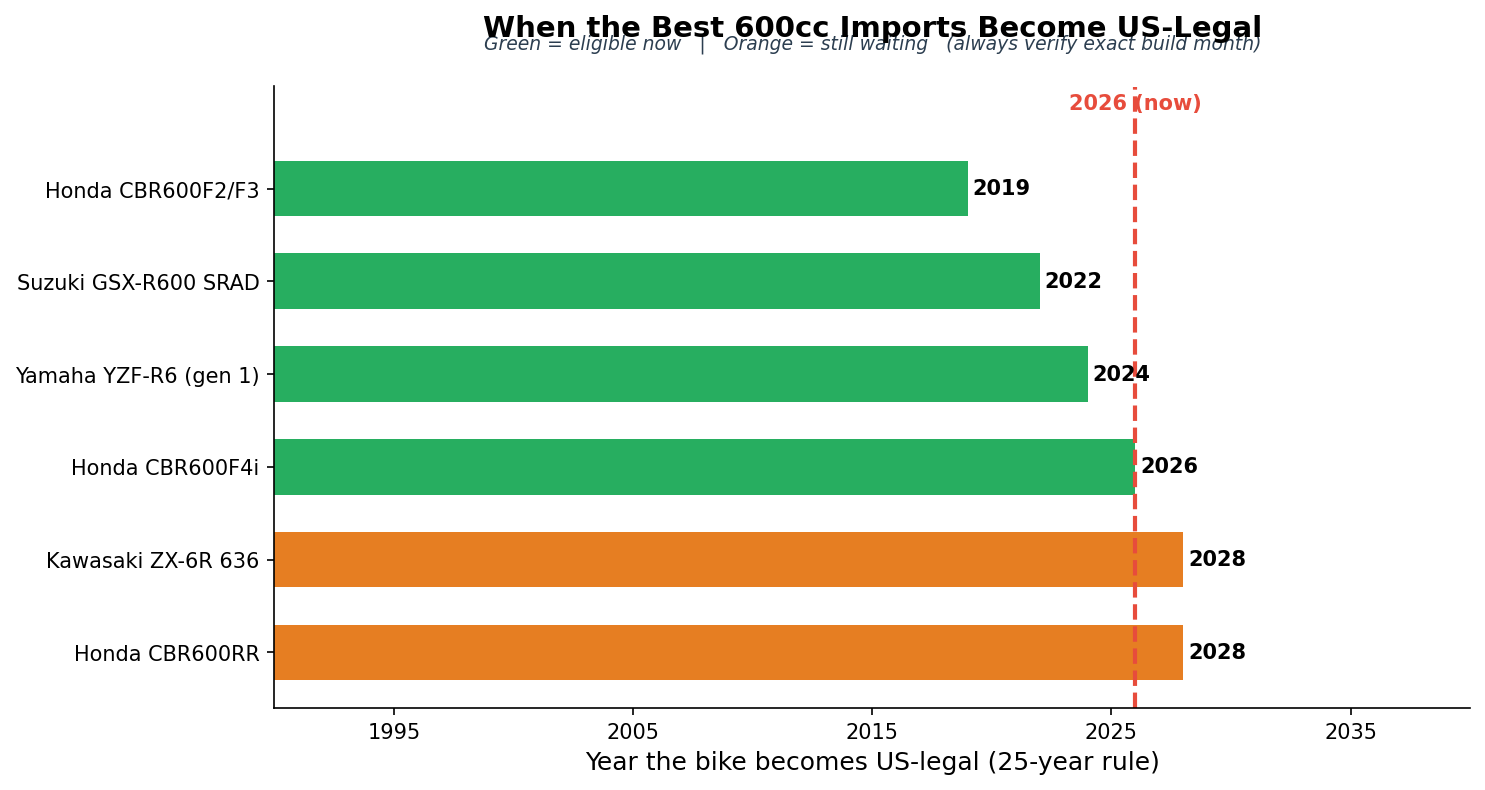
United States. The federal 25-year rule is the big one. Once a motorcycle is 25 years old, it's exempt from federal safety and emissions requirements and can be imported freely. The critical detail almost everyone gets wrong: eligibility is calculated from the actual manufacturing date, not the model year. A bike badged as a 2001 model but built in December 2000 became eligible in December 2025. One built in January 2001 has to wait until January 2026. As of 2026, the line is sweeping through the 2001 model year month by month, which means the first wave of CBR600F4i, R6, GSX-R600, and ZX-6R examples are becoming legal right now. Earlier 600s like the mid-90s CBR600F and first-gen R6 are already in the clear.
Australia. The 25-year rule applies here too (2001 and earlier is open), plus you'll deal with the VIA/ROVER approval and asbestos inspection. The good news for 600 buyers: motorcycles attract zero import duty in Australia, only GST.
Canada. Canada uses a far friendlier 15-year rule, and motorcycles over 15 years old are treated as non-regulated, so the RIV process doesn't apply. That means a 2011 ZX-6R is already legal in Canada while the US buyer waits until 2036. If you're Canadian, your 600 options are enormous.
UK and New Zealand. Neither uses a blanket age ban. In the UK you'll handle NOVA and possibly an MSVA test depending on the bike; in New Zealand you'll deal with entry certification and compliance. Both markets let you import a much newer 600 than the US or Australia ever will.
The image below shows when the major supersport 600s become US-legal under the 25-year rule. Use it as a rough map, then always verify the exact build date on the specific bike's documents before you bid.
What a 600cc From Japan Actually Costs (Landed Cost Breakdown)
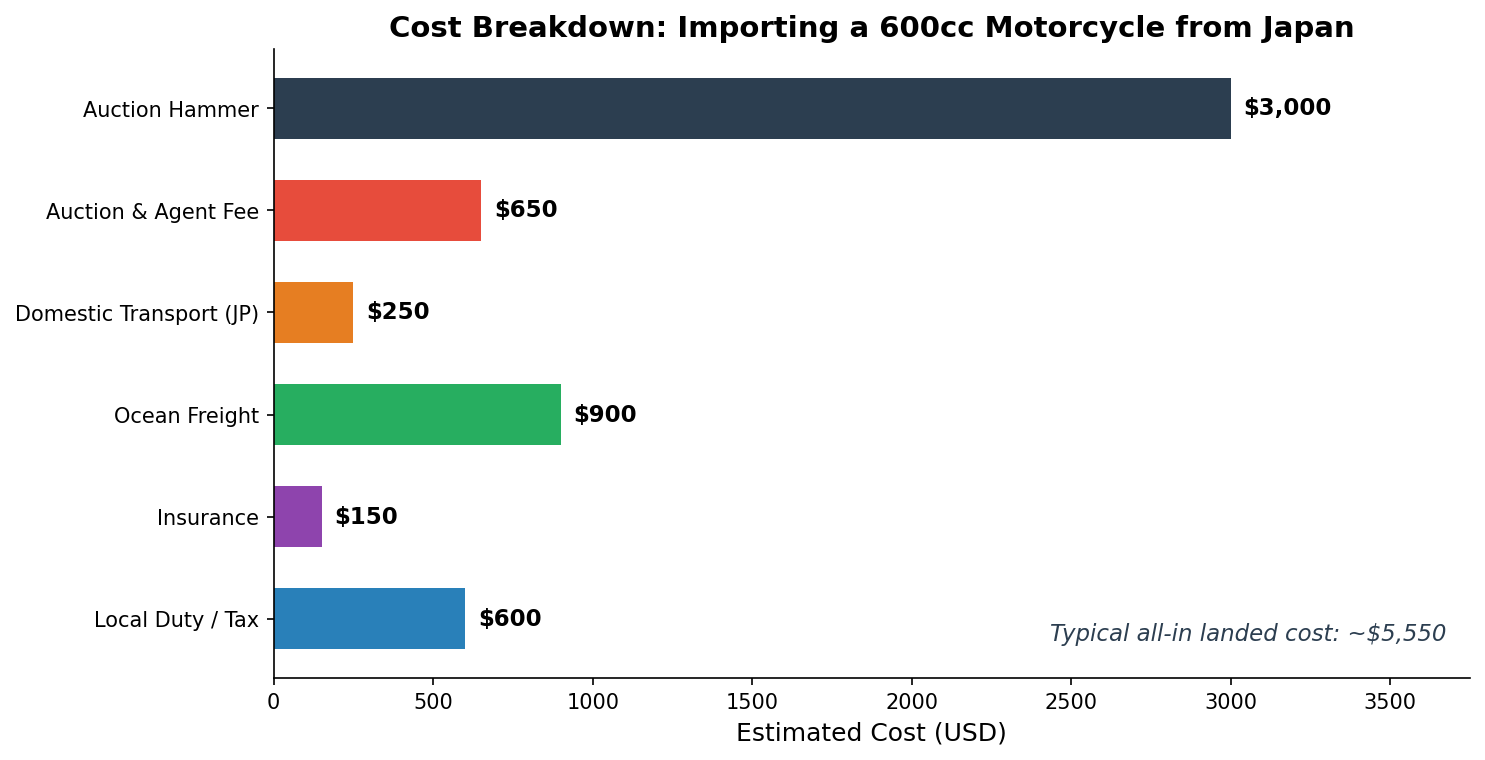
The auction hammer price is the headline, but it's never the real number. Your landed cost is hammer price plus auction fees, the export agent's commission, domestic transport in Japan, ocean freight, insurance, and then whatever your own country charges to let the bike in. Skip that math and you'll get a nasty surprise at the port.
Here's a realistic example for a clean all-rounder 600 like a Hornet or CBR600F. The auction hammer typically lands around 350,000 to 500,000 yen, roughly 2,400 to 3,400 US dollars at recent rates. Add an auction/agent fee, domestic transport to the port, and ocean freight, and you're typically looking at an all-in landed cost somewhere around 5,000 to 6,500 dollars before your home country's taxes. A sharp supersport in collector-grade condition, like a low-mileage R6 or CBR600RR, will sit at the higher end or above.
The country charges vary a lot. The US applies a 2.5% duty on motorcycles over 700cc but the classic 25-year route keeps the paperwork minimal; Australia charges zero motorcycle duty and only GST; the UK adds VAT plus a small duty; Canada's CUSMA/CPTPP origin rules can zero the duty. The point isn't the exact figure, it's that you have to add your local layer on top of the landed number, not pretend it doesn't exist.
The chart below breaks down where the money actually goes on a typical 600 import. Notice how the hammer price is often less than half the total. That's the single most important thing to internalize before you fall in love with a cheap auction listing.
How the Japan Auction Process Works for a 600
Japan sells over a million used motorcycles a year through organized auctions, and the vast majority change hands on the strength of an inspection sheet alone, without the buyer ever touching the bike. That sounds insane until you understand the system. It works because Japanese auction houses employ neutral inspectors whose only job is to describe the bike honestly, and because the supply is so deep that there's always another one next week.
The major motorcycle auction houses are BDS (the biggest, running tens of thousands of bikes), JBA, and the bike lanes of the giant USS car auctions. You can't bid at these directly as a foreign buyer; they're trade-only, members-only systems. That's where an export agent like AWA comes in. The agent holds the auction membership, bids on your behalf up to your limit, wins the bike, handles the export paperwork, and arranges shipping.
The flow looks like this. You tell your agent the exact 600 you want and your maximum landed budget. The agent searches the week's auction listings, sends you the candidates with their inspection sheets and photos, and you pick. On auction day the agent bids to your cap. Win or lose, you move on; there's no emotional auction-floor pressure because you set the ceiling in advance. Once you win, the bike gets de-registered, transported to port, loaded into a container or RoRo vessel, and shipped. Total timeline from winning bid to your driveway is usually six to ten weeks.
The container side of this is real and well documented. A US channel filmed buying an entire 40-foot container of motorcycles from Japan; the video has nearly 19 million views, and the host explains on camera, "the reason we're able to import these is because they're over 25 years old." That's the whole game in one sentence. The bikes are out there, the system is mature, and you just need someone with auction access to play it for you.
The 600cc Buyer's Checklist: What to Check Before You Bid
The inspection sheet is your eyes when you can't be there in person. Learn to read it and you'll buy better than people standing in the same warehouse. Here's what matters specifically on a 600.
- Overall grade. Aim for grade 4 or higher (or A/AB on the letter-graded bike sheets). Grade 3 and below usually means real cosmetic or mechanical work ahead. The grade is the inspector's one-symbol summary, and it's honest.
- Crash and repair marks. On the condition map, watch for repair symbols around the steering head, main frame, and subframe. Supersport 600s get dropped and crashed more than any other class because they attract aggressive riders. A bike with frame repair marks is a hard pass unless you really know what you're doing.
- Valve clearances and service history. These high-revving fours need their valve clearances checked on schedule. A "click-click" top-end noise on a cold start can signal neglected valves. Ask whether the bike has a recent service record.
- Carb sync (on carbureted models). Older 600 fours run four carburetors that need balancing. Hesitation or a lumpy idle noted on the sheet often just means the carbs need a sync, but factor the labor in.
- Mileage versus condition. Don't fear high mileage on these engines. A 50,000-mile ZX-6R that's been serviced is a better buy than a 9,000-mile bike with a mystery history. Condition and records beat the odometer every time.
- Originality. Aftermarket exhausts, Power Commanders, and race bodywork can be fine, but they can also hide a hard-ridden track life. Stock bikes with clean sheets are the safest imports.
- Build date. If you're importing into the US or Australia under the 25-year rule, confirm the exact month and year of manufacture, not just the model year. This is the difference between a legal import and a bike stuck at the port.
Common Mistakes Nobody Warns You About
Most import horror stories come from the same handful of avoidable errors. Here's the short list.
Buying the trophy instead of the bike you need. A pristine R6 is intoxicating on screen. Then it arrives, you ride it to work twice, and your back files for divorce. Match the bike to your actual riding, not your fantasy.
Ignoring the landed-cost stack. The hammer price is often less than half the total. People budget for the auction number, forget freight and local taxes, and then can't afford to register the thing. Run the full math first.
Getting the 25-year date wrong. Confusing model year with build date is the classic. A 2001-badged bike built in early 2001 is not yet US-legal in early 2026. Verify the manufacture month before you bid, or you'll own a very expensive paperweight at the port.
Skipping the agent and trying to bid solo. The auctions are trade-only. Every few months someone tries to shortcut the system, wires money to a stranger off a forum, and never sees a bike. Use a real export agent with verifiable auction access. That myth that Japanese bikes are "right-hand drive," by the way, was the single most-liked joke on that container video with 7,500 likes. Motorcycles don't have a steering side. Don't let internet nonsense talk you out of a great buy.
Falling for a grade you didn't read. A cheap grade-3 bike with repair marks isn't a bargain, it's a project. The savings on the hammer price evaporate the first time you price frame parts. Buy the grade, not the price tag.
600cc by the Numbers: Power, Comfort, and Price Compared
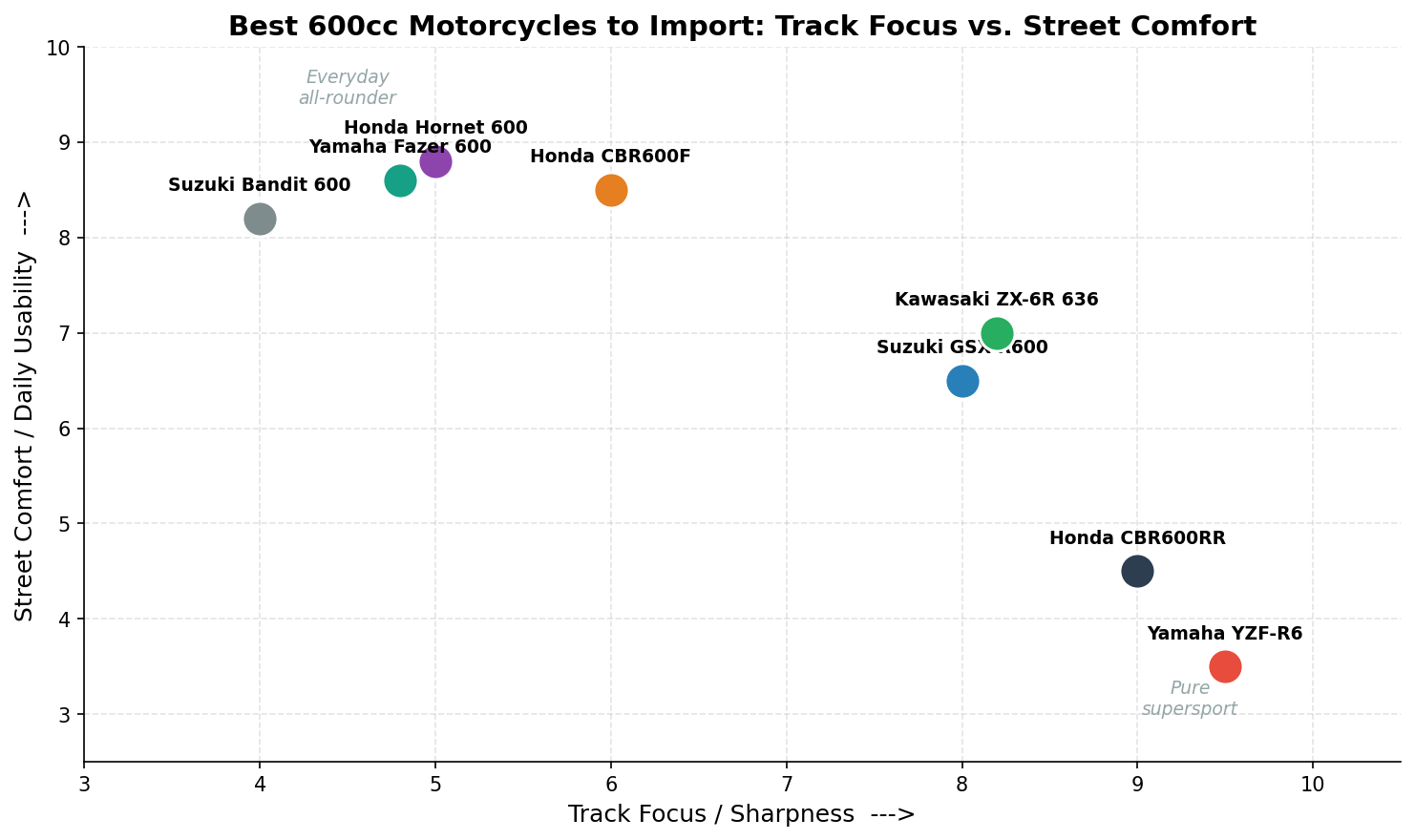
Specs only tell part of the story, but they tell an important part. The supersport 600s cluster tightly on peak power, all making between roughly 105 and 130 horsepower, yet they spread out dramatically on how livable they are. The R6 sits at one extreme: maximum sharpness, minimum comfort. The GSX-R600 and the all-rounders sit at the other: a little less knife-edge, a lot more usable. The ZX-6R 636 quietly splits the difference, which is why it's such a popular street pick.
Price at auction tracks desirability more than performance. A clean CBR600F or Bandit 600 is often the cheapest way into a brilliant Japanese four, while a low-mileage R6 or CBR600RR in collector condition commands a premium that climbs every year as the 25-year clock turns them into legal classics. The all-rounders are where the value hides; the supersports are where the future appreciation lives.
The chart below plots the main 600s by track focus versus street comfort, so you can see at a glance where each bike lands. The closer a bike is to the top-right, the better it balances both. Use it to sanity-check your shortlist against how you actually ride.
Living With an Imported 600: Parts, Insurance, and Resale
Owning an imported 600 is almost identical to owning a domestic one, because these were global-market engines built in the millions. Parts are the big worry for first-time importers, and for the mainstream Japanese 600s that worry is mostly unfounded. Consumables, filters, brake pads, chains, sprockets, tires, and most service parts are shared across markets and sit on the shelf at any decent shop. Honda, Yamaha, Suzuki, and Kawasaki designed these bikes for worldwide sale, which is exactly why owners brag about 50,000-mile motors that still pull cleanly to redline.
The parts you have to think about are the Japan-specific bits: certain fairings, badges, and the occasional JDM-only color or trim panel. Those can take longer to source and cost more. The fix is simple, buy the cleanest example you can on the auction sheet so you're not chasing cosmetic parts in the first place. A grade-4 bike with no crash marks rarely needs anything but maintenance.
Insurance is usually a non-issue. An imported 600 with a clean title and a proper VIN registers and insures like any other middleweight. The only friction comes from getting the title and registration sorted in markets with strict paperwork, which is precisely the part a good export agent and a thorough set of documents make painless.
Resale is where importing quietly pays off. Because you bought below local retail, a well-kept imported 600 often holds its value better than the same bike bought new at a dealer, and the genuinely collectible models are climbing. A pristine, low-mileage supersport that's just crossed the 25-year line is no longer a used bike, it's an appreciating classic. Buy a good one, keep the auction sheet and import documents in a folder, and you're holding an asset, not a depreciating toy.
Is a 600 Enough Bike? Settling the 600 vs. 1000 Question
You can't research 600s for ten minutes without tripping over the liter-bike debate, so let's settle it. The video titled "600cc vs 1000cc Sportbikes" has over two million views and a hundred thousand likes for a reason: this argument never dies. Here's the honest answer. On a public road, a 600 is more than enough bike for ninety-nine percent of riders, and it's more fun for most of them.
A modern 600 forces you to use the engine. You rev it, you stay in the powerband, you actually ride the thing instead of short-shifting and surfing torque. A liter bike makes so much grunt that you're using a fraction of it everywhere except a closed track, and the consequences of a careless wrist are far less forgiving. The 600 rewards skill; the 1000 demands restraint. For a first big bike, a back-road weapon, or a daily that won't try to kill you, the 600 is simply the better tool.
There's a running joke among 600 riders that the bikes are so focused they barely bother with creature comforts, like the supersports that ship without a proper fuel gauge so owners "just assume we're always out of gas" and reset the trip meter at every fill-up. It's a fair ribbing, but it captures the spirit of the class: these are purposeful machines built to do one thing brilliantly. If you want a sofa, buy a tourer. If you want to feel like a hooligan at legal speeds, the 600 is the answer, and importing one from Japan is the cheapest way to get the good version of it.
Five 600s Quietly Turning Into Collectibles
The same 25-year clock that makes these bikes legal also makes them collectible, and a handful are appreciating fast. If you're buying with one eye on resale, these are the ones worth watching.
- First-generation Yamaha YZF-R6 (1999-2002). The bike that lit the modern 600 horsepower war. Clean, low-mileage early R6s are climbing as they cross into legal-classic territory.
- Honda CBR600F2 and F3 (early-to-mid 1990s). The bikes that defined the all-rounder formula and dominated club racing. Tidy original examples are getting genuinely hard to find.
- Suzuki GSX-R600 SRAD (late 1990s). The first true Gixxer 600, with the ram-air SRAD intakes. A proper landmark bike and increasingly sought after.
- Kawasaki ZX-6R 636 (2003-2004). The first of the torquey 636s, beloved by street riders and now a cult favorite.
- Honda CBR600RR (2003-2006). The MotoGP-styled racer that won championships. The cleanest early RRs are the future blue-chip of the class.
None of these requires a fortune today, which is exactly the point. Importing a clean example from Japan now, on a good auction sheet, is how you get ahead of a curve that's already bending upward. The bikes that are merely cheap used 600s in 2026 are the modern classics of 2031.
Step-by-Step: Importing Your 600 From Japan
Here's the whole process from daydream to driveway, in order, so you know exactly what you're signing up for.
- Step 1 - Pick your bike and budget. Decide on the exact model and a hard maximum landed cost. Not the hammer price, the all-in number including freight and your local taxes.
- Step 2 - Engage an export agent. Find an agent with real memberships at BDS, JBA, or USS. They're your eyes, hands, and bidding license in Japan.
- Step 3 - Review candidates. Each week the agent sends you bikes matching your spec, with inspection sheets and photos. You read the grade and condition map, ask questions, and shortlist.
- Step 4 - Bid to your cap. On auction day the agent bids up to your ceiling. You either win or you wait for next week. No emotion, no overpaying.
- Step 5 - Export paperwork. The bike is de-registered in Japan and the export documents, including the all-important build-date proof, are prepared.
- Step 6 - Shipping. The bike is crated into a container or loaded RoRo and sails to your nearest port. This is the slow part, usually three to six weeks on the water.
- Step 7 - Customs and registration. You clear customs, pay any local duty and tax, complete whatever compliance your country requires, and register the bike. Then you ride.
Total elapsed time is normally six to ten weeks from winning bid to first ride. The single biggest variable is your own country's compliance step, which is why getting the documents right at Step 5 matters so much. Do it properly once and the whole thing is genuinely painless.
How AWA Auction Helps You Land the Right 600
This is exactly the problem AWA Auction exists to solve. We hold the auction memberships at the major Japanese houses, so you get access to the same deep pool of 600s the trade sees, every week. You tell us the model and your budget; we send you real candidates with their inspection sheets translated and explained, bid to your cap, and handle export, shipping, and paperwork end to end.
You can browse what's coming through and get a feel for current condition and pricing on our live listings, and when you're ready to hunt for a specific bike, our team will walk you through it. No auction membership required, no wiring money to strangers, no guessing at a sheet you can't read. Just the right 600, landed where you live.
See Also
Share this article: