
Japanese motorcycle suspension is the reason your import feels like somebody else's bike. Not the tyres. Not the geometry. Not the fact that it is twenty years old and has spent its life on the other side of the planet. The springs.
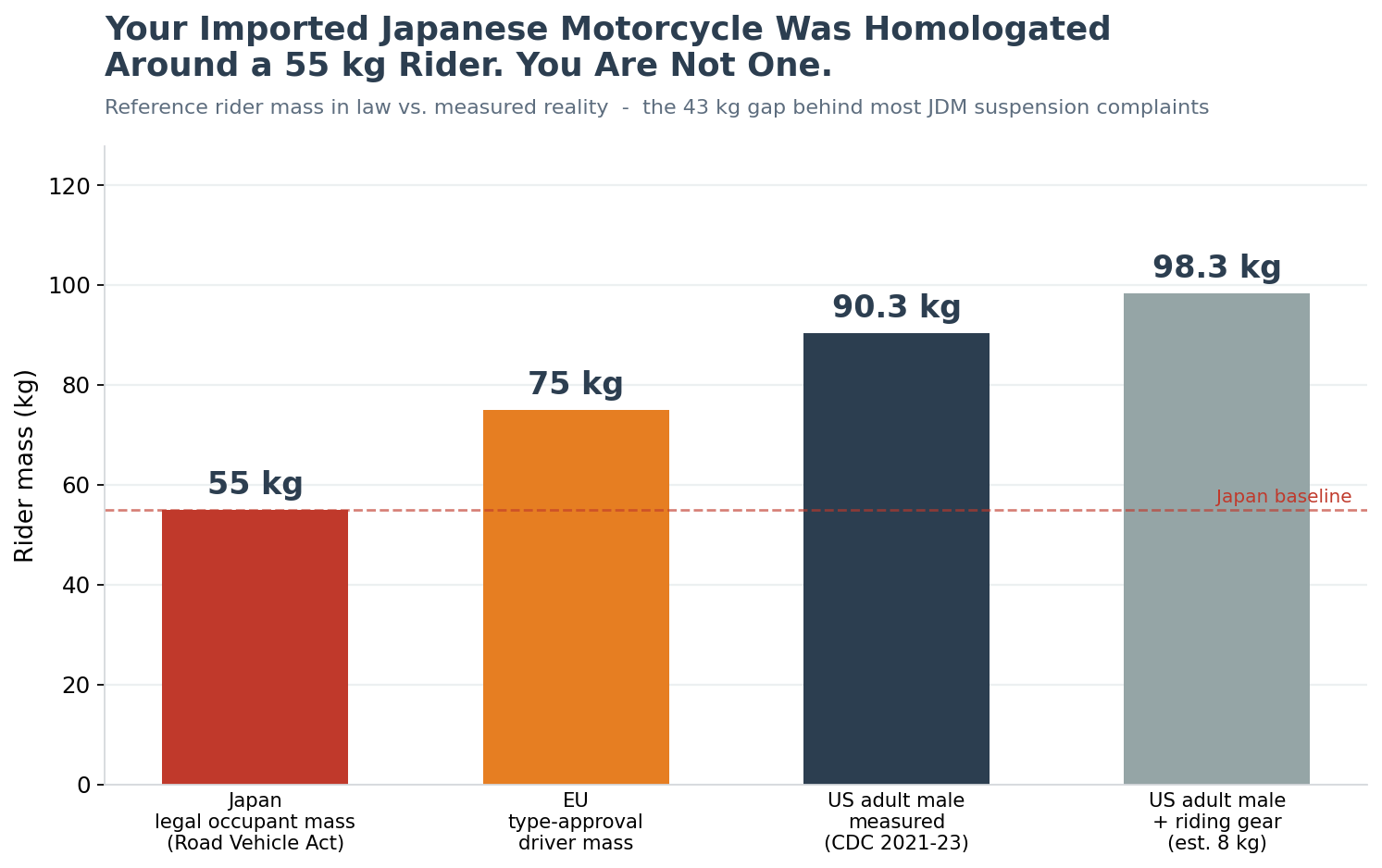
Here is the thing nobody mentions when they sell you a JDM bike: Japan and Europe do not agree on how much a rider weighs, and they never have. Japan's Road Vehicle Act works to a figure of 55 kg per occupant. The European Union writes 75 kg into its type-approval rules for the same class of machine. That is a 20 kg disagreement baked into two sets of national law, and every bike built primarily for the Japanese market grew up on the lighter side of it.
Then there is the third number, and it is the one that actually matters to you. The US Centers for Disease Control measures adult men at 199.0 lb — 90.3 kg. Not a legal assumption. An actual measurement, taken with actual scales, on actual people, between August 2021 and August 2023.
So the bike was homologated against a 55 kg reference figure. You weigh 90 kg. Add a helmet, an armoured jacket, boots and trousers and you are closer to 98 kg before you have packed a toothbrush.
That gap is not an opinion. It is arithmetic, and it explains almost everything people complain about after their first month on an imported Japanese motorcycle.
Japan writes 55 kg into the rules. Europe writes 75 kg.
Start with the paperwork, because the paperwork is where the difference is written down in black and white.
Under Japan's Road Vehicle Act and the associated safety standards (道路運送車両の保安基準), a vehicle's gross weight is calculated as kerb weight, plus maximum load, plus the weight of its occupants — and the occupant figure is fixed at 55 kg per person. That number has been in Japanese vehicle regulation for decades. It governs how a bike's gross vehicle weight is declared, which in turn feeds into its classification, its documentation and its type approval.
Now cross to Europe. Regulation (EU) No 168/2013 governs the approval of two- and three-wheel vehicles. Its supporting delegated regulations define a vehicle's "actual mass" and "reference mass" as the mass in running order plus the mass of the driver, taken as 75 kg. Same class of vehicle. Same kind of calculation. Different rider by 20 kg.
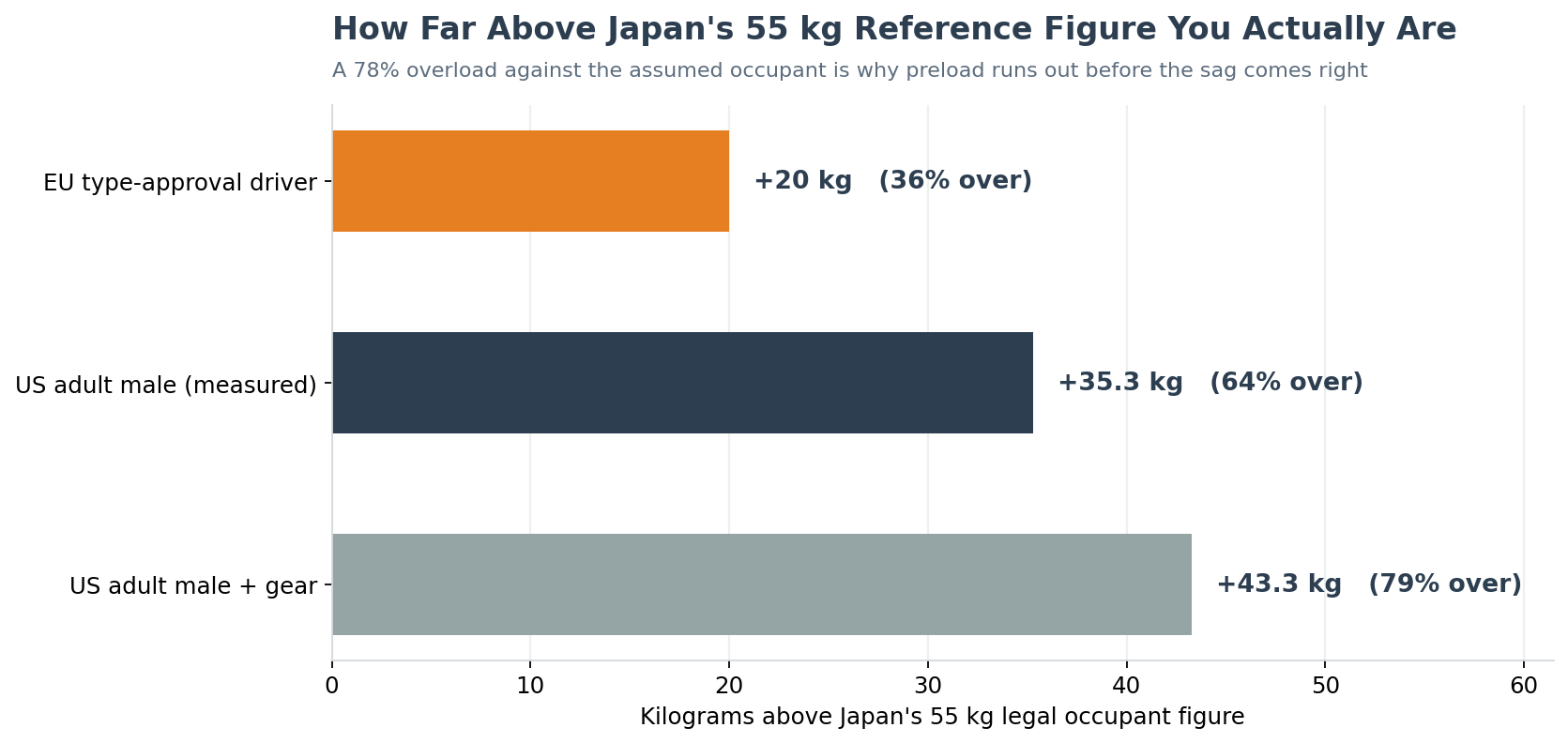
Twenty kilograms is 36% more rider. It is not a rounding error and it is not a translation quirk. It is two regulators looking at their own populations and writing down different answers.
What the 55 kg figure does and does not mean
Be precise about this, because the internet will not be.
The 55 kg figure is a legal reference mass used for weight declarations and classification. It is not a note pinned above a Kayaba engineer's desk saying "assume the customer weighs 55 kilos." No suspension engineer sets a spring rate by reading the vehicle code.
But regulations of this kind do not appear out of nowhere. They get written to reflect the population the vehicle is sold to, and they then sit underneath every weight-related calculation the manufacturer files. A bike developed, tested, ridden and signed off in a market whose legal occupant is 55 kg is being developed around a lighter human than one signed off in a market whose legal occupant is 75 kg. The regulation is the visible, citable edge of a difference that runs through the whole design brief.
And the suspension trade will tell you the same thing from the other direction. Ask any suspension shop what rider weight factory springs are targeted at and you will get a range somewhere around 70 to 80 kg — and that is for bikes built for Western markets. Which means even a European-market motorcycle is undersprung for the average American man. A Japanese-market one starts further back still.
Two independent sources, one legal and one commercial, pointing the same direction. That is about as close to proof as this subject gets.
What this does to Japanese motorcycle suspension in practice
A spring has one job: hold the bike up in the middle of its travel so the damping has room to work. Get the spring wrong and nothing downstream can save you.
This is the point that Dave Moss — probably the best-known suspension tuner working in English — has spent a decade hammering into people. His video comparing setup for a 135 lb rider against a 235 lb rider (60 kg versus 105 kg) has been watched over 186,000 times, and the whole premise is that these two riders are not adjusting the same bike differently. They need different springs. You cannot click your way from one to the other.
Here is what happens when a rider 35 kg heavier than the reference figure sits on a bike sprung for that figure:
The bike sits too low in its travel
Suspension travel is a budget. A typical road bike has somewhere around 120 mm at the front and 120 to 130 mm at the rear. You are supposed to spend roughly a third of it just standing still with the rider aboard, leaving two-thirds for the road.
Put too much weight on a soft spring and you spend half of it before you have moved. Now the fork has 60 mm left to deal with a pothole that needs 80. It runs out. When a fork runs out of travel it does not gently protest — it goes solid, and the front tyre skips.
The geometry quietly changes
Ride height is not decoration. Sag the front more than the rear and you steepen the rake, shorten the trail and make the steering nervous. Sag the rear more than the front and you do the opposite: the bike goes lazy, runs wide in corners and refuses to turn without a shove.
Most people who buy an import and report that "it doesn't handle like the reviews said" are not wrong about the bike. They are riding a machine sitting 20 mm lower than its designer intended at both ends, which is a different motorcycle geometrically.
Braking gets genuinely unpleasant
Grab the front brake on an undersprung fork and it collapses. The wheelbase shortens, the rake steepens, and the bike becomes twitchy exactly when you least want a twitchy bike. Riders describe this as the front "tucking" or "diving away." It is not the brakes and it is not the tyre. It is a spring that is too soft holding up a rider it was never asked to hold up.
The damping goes out of range
This is the subtle one. Damping controls how fast the suspension moves. It is calibrated for a spring of a particular rate. Fit the wrong spring and the damping curve no longer matches the spring curve — so the bike wallows on a soft spring even with the rebound wound fully in, and no clicker setting fixes it, because the clickers were never the problem.
RevZilla's explainer on suspension terminology has half a million views for a reason. Most riders have never been told that preload, damping and spring rate are three separate things, and that only one of them is adjustable from the side of the road.
The second problem: your shock is exactly as old as your bike
Spring rate is the half of this that people eventually work out. The other half nobody mentions at all.
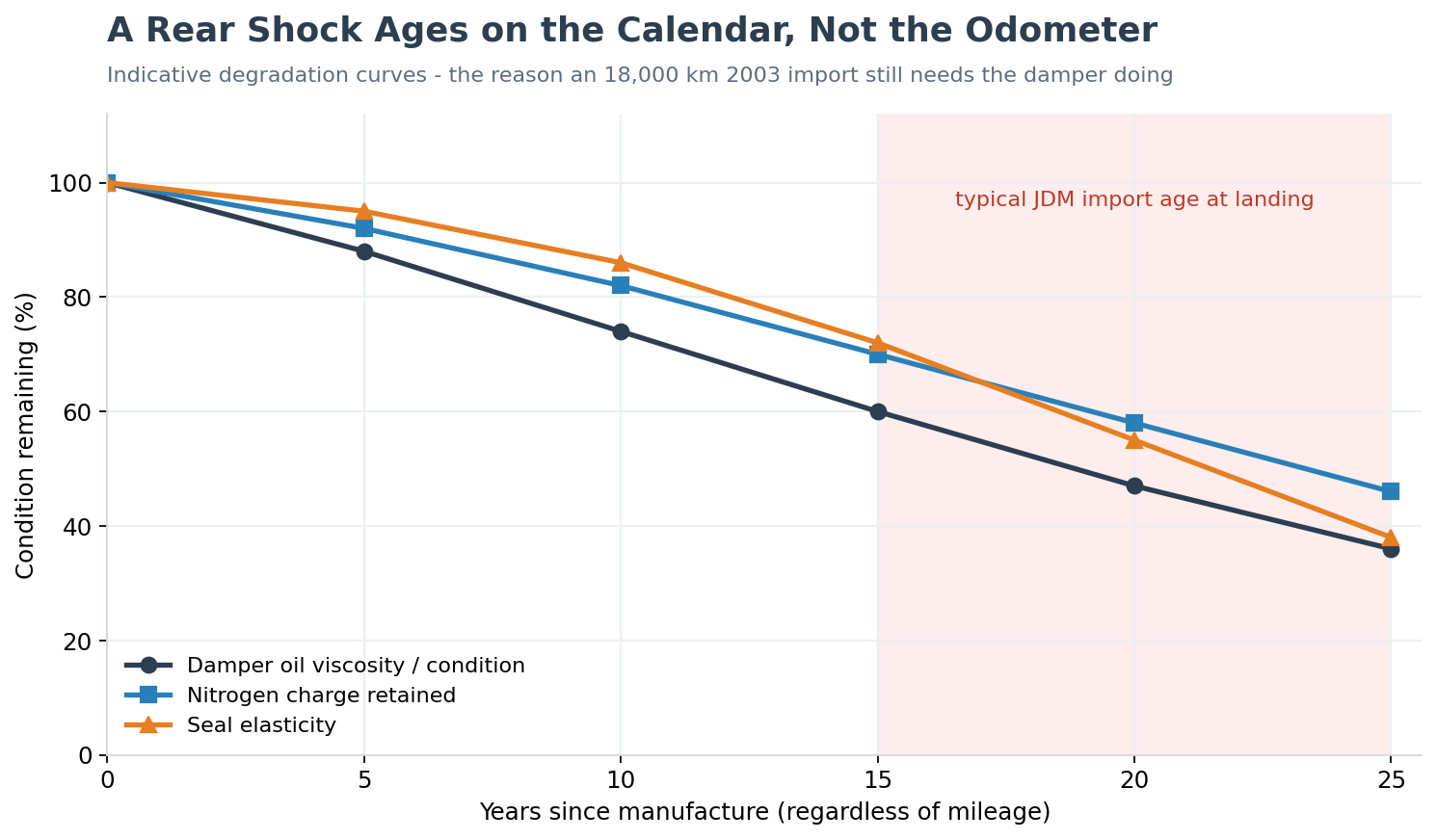
A rear shock is a sealed pressure vessel containing oil and, on most units, nitrogen behind a bladder or a floating piston. Both of those degrade. Not from use — from time.
The oil shears and loses viscosity. The nitrogen bleeds past the seal a molecule at a time. The seal itself hardens. None of this requires anyone to ride the bike. A motorcycle that sat in a Japanese lock-up for eight years has a shock that aged eight years, and the auction sheet will not mention it because there is no way to see it from the outside.
Ichiban Moto's teardown of a set of motorcycle shocks has drawn 272,000 views and nearly 700 comments, and the comment section is the most useful part. It is full of people discovering that the shock on their perfectly clean, low-mileage bike was full of black sludge.
Why this hits imports harder than local bikes
Three reasons, and they stack.
Japanese bikes have low mileage and high age. That is the whole appeal — a 2003 machine with 18,000 km on it. But the shock does not know it has only done 18,000 km. It knows it has been sitting since 2003. Low mileage protects the engine and the chain. It does nothing for the damper oil.
Shaken pushes maintenance towards what gets inspected. Japan's periodic inspection regime is thorough about brakes, lights, emissions and structure. It does not require anyone to open a rear shock and check the oil. A bike can pass inspection after inspection with a completely dead damper, because a dead damper is not an inspection item anywhere in the world.
Nobody rebuilds a shock on a bike they are about to export. A rebuild costs real money and adds nothing to the auction price, because the auction grade does not have a box for it. The rational move for a Japanese seller is to leave it alone. So they leave it alone.
How to tell a dead shock from a soft one
These need different fixes, so it matters.
Push down hard on the rear of the bike and let go. A healthy shock rises once, smoothly, and stops. A dead one either keeps oscillating — up, down, up, settle — or comes back up so fast it feels like a pogo stick, or so slowly it feels like it is stuck in treacle.
A soft-but-healthy shock does none of that. It simply sits too low with you on it and behaves properly otherwise.
If the bike bounces more than once, you have a damping problem and no spring will fix it. If it settles cleanly but sits too low, you have a spring problem and no rebuild will fix it. Most twenty-year-old imports, unhelpfully, have both.
Diagnose it in twenty minutes: the sag test
You do not need a workshop. You need a tape measure, a zip tie and a friend. This is the single most useful twenty minutes you can spend on an imported bike, and it is the reason MC Garage's sag video has been watched 663,000 times and MOTOTREK's has been watched 484,000.
Sag is how far the suspension compresses under weight. There are two numbers.
Static sag — the bike on its own
Get the wheel off the ground (paddock stand, or a friend holding it) and measure from the rear axle straight up to a fixed point on the tail. Write it down. Now put the bike on its wheels with nobody on it, bounce it gently to settle, and measure again. The difference is static sag.
Do the same at the front: measure from the fork seal to the bottom of the lower triple clamp, unloaded and loaded.
Rider sag — you on the bike, in gear
Same measurement, but with you sitting on the bike in full riding kit, feet on the pegs, in your normal riding position, with a friend steadying the bars. Bounce, settle, measure.
What the numbers mean
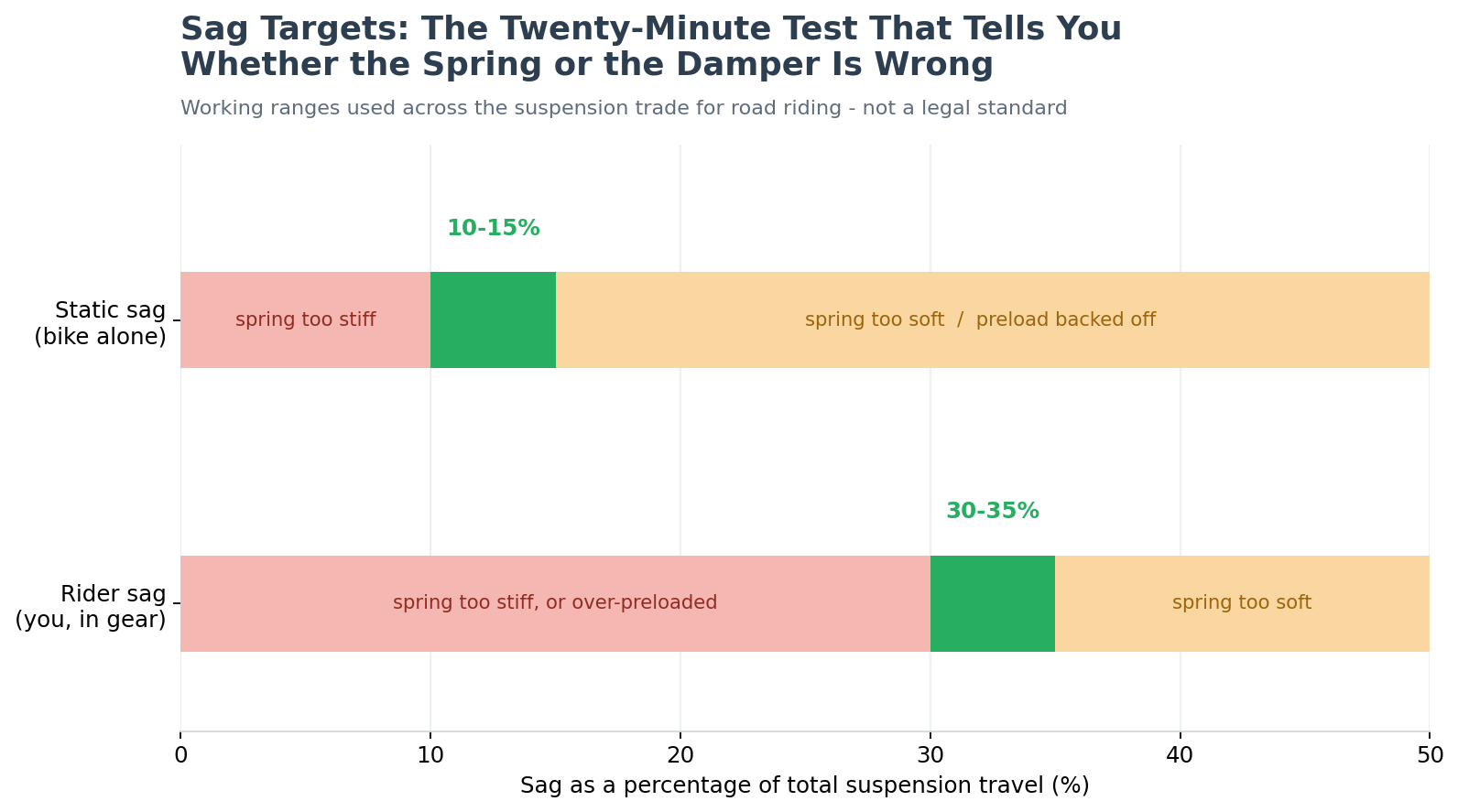
Rider sag should land at roughly 30 to 35% of total travel for road riding. On 120 mm of fork travel that is about 36 to 42 mm. On 120 to 130 mm of rear travel it is about 36 to 45 mm.
Static sag should come in around 10 to 15% — roughly 12 to 18 mm on the same travel figures.
Now read them together, because one number alone tells you nothing:
- Rider sag too high, static sag also high. Spring too soft. This is the classic imported-JDM-bike result. Preload will mask it slightly and then run out.
- Rider sag correct, static sag near zero. Spring too stiff, propped up with preload. Less common on imports, but it happens where a previous owner wound everything in trying to fix the first problem.
- Both in range. The spring suits you. If it still rides badly, the problem is damping — oil, valving or a dead shock.
Here is the part that catches people out: if you have wound the preload to maximum and rider sag is still too high, you have proved the spring is wrong. Preload does not change spring rate. It only changes where in the spring's range you start. Running out of preload adjustment is not a setup failure — it is a diagnosis.
Those percentage bands are working ranges used across the suspension trade, not a legal standard. Track riders run tighter numbers, adventure riders run looser, and a well-set-up bike at 36% is not dangerous. Use them to find out which direction you are wrong in, not to chase a decimal place.
The four symptoms that are suspension and not something else
Riders misdiagnose this constantly, usually by blaming the tyres and buying new ones that do not help.
1. It runs wide in corners and feels lazy turning in
Rear sitting too low relative to the front. Slackens the rake, lengthens the trail, and the bike stops wanting to change direction. People blame the front tyre profile. It is almost never the front tyre profile.
2. The front dives hard and the bike feels nervous under brakes
Fork spring too soft for you. New brake pads will not fix it. Neither will a steering damper, which is treating a symptom of a symptom.
3. It wallows over undulations at speed
Damping out of range, spring out of range, or both. If it wallows with the rebound fully wound in, the spring is the problem. If it wallows and also bounces repeatedly when you push on it, the damper is dead.
4. It crashes through on sharp bumps despite feeling soft everywhere else
This one confuses everyone, because "soft" and "harsh" sound like opposites. They are not. A soft spring uses up its travel early and then hits the end of the stroke, where the bike goes rigid. The bike feels soft in the middle and brutal at the edges. That is a spring rate problem wearing a costume.
What is genuinely not suspension
To be fair to the tyres: a weave at high speed with a hand off the bars is often wheel balance or a worn head bearing. A vibration that changes with engine speed is not suspension at all. A pull to one side under braking is usually a sticking caliper. Do not spend a thousand dollars on springs to fix a two-dollar wheel weight.
What it costs to fix, in three honest tiers
Suspension has a reputation as a rich man's upgrade. It is not. The cheapest tier costs nothing at all, and it is the one most import buyers have never done.
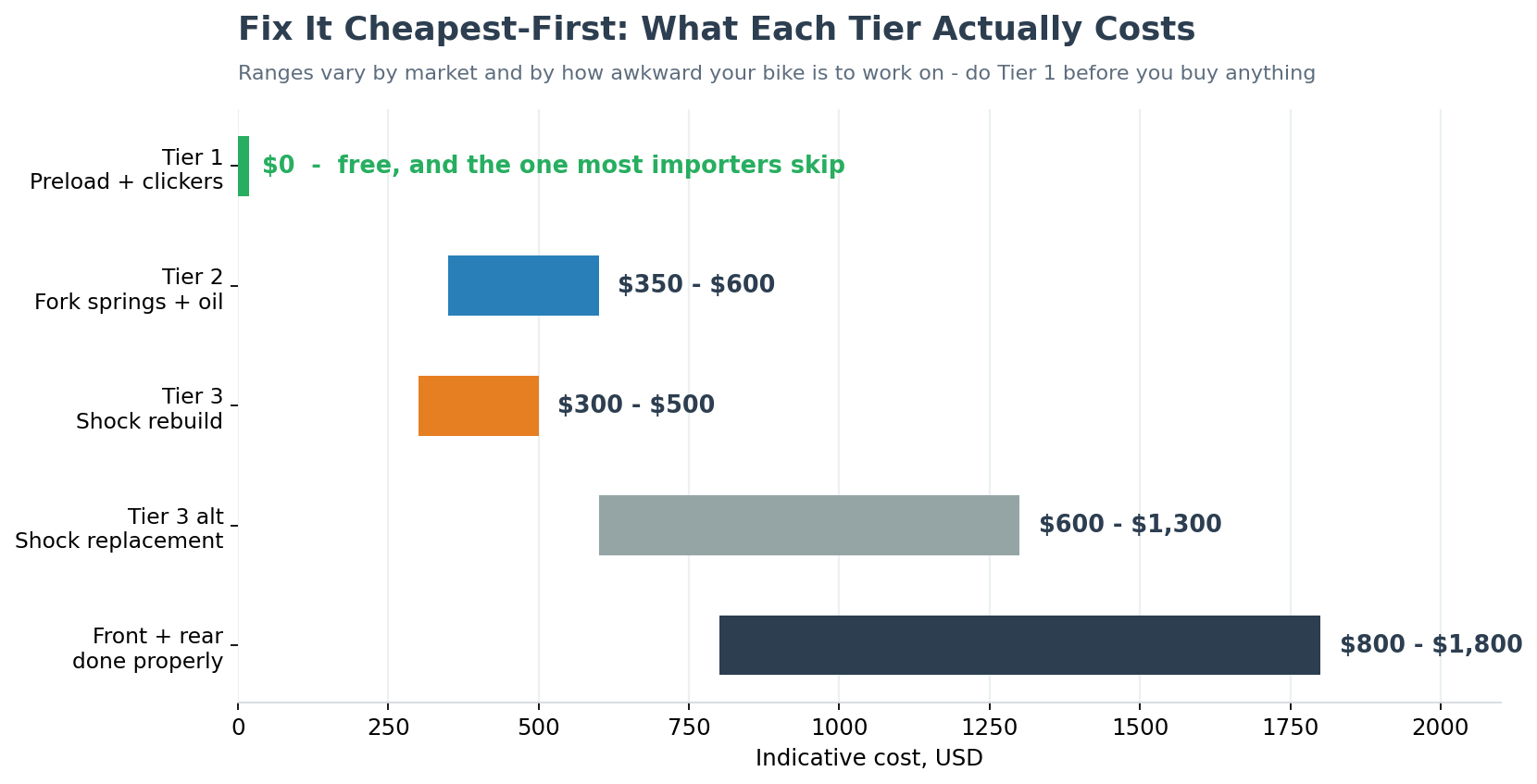
Tier 1 — Free. Set the preload and the clickers properly.
Cost: $0. Time: one afternoon.
Do the sag test. Wind the rear preload collar until rider sag lands in range. Do the same at the front if the fork has preload adjusters. Then set rebound to the middle of its range and ride it.
On a moderately heavy rider and a mid-size bike, this alone often recovers most of what is wrong. It is free, it is reversible, and skipping it means you will not know what the next tier actually bought you. Do this first. Always.
The catch: if you run out of adjustment, you have found your answer. Go to Tier 2.
Tier 2 — Fork springs and fresh oil
Cost: roughly $350 to $600 all in. Time: two to three hours of labour.
Straight-rate fork springs matched to your weight typically run $120 to $200 a pair. Fork oil is another $25 to $40. Labour, if you are not doing it yourself, is usually $200 to $350 depending on whether the forks come out easily.
On a twenty-year-old import the oil is worth doing regardless of the springs. Fork oil degrades on the same clock as shock oil, and it is far cheaper to replace because the forks are not sealed pressure vessels.
This is the single best-value job on the list. The rider on the Tenere 700 video who fitted stiffer springs generated 286 comments on one upgrade, and the recurring theme is people surprised that a part costing less than a set of tyres changed the bike more than the tyres did.
Tier 3 — The rear shock
Cost: $300 to $500 to rebuild, or $600 to $1,300 to replace. Time: a week at a specialist, or an afternoon plus shipping.
A rebuild means new oil, new nitrogen charge, new seals, and — if you ask for it and the unit allows — a spring matched to your weight. On an original Japanese-market shock this is usually the right call, because a rebuilt OEM unit with a correct spring is a genuinely good damper.
Replacement makes sense when the shock body is corroded, when the unit is non-rebuildable (many budget OEM shocks are sealed), or when you want adjustability the original never had. Aftermarket units from the established names span roughly $600 at the budget end to $1,300 and up for a fully adjustable unit.
Do not replace the shock before you have done Tier 1. A new shock set up wrong rides worse than an old shock set up right.
What the whole job costs
Front and rear done properly on a typical imported middleweight lands somewhere between $800 and $1,800, and that is a range because forks that need seals, bushings and a stanchion are a different job from forks that need springs and oil.
Set against the bike: on a $4,000 landed import, spending $1,200 to make it handle correctly is 30% of the purchase price, which sounds enormous until you price a comparable local-market bike that already handles correctly. It is usually cheaper. It is almost always cheaper than replacing the bike.
These figures are indicative and vary a great deal by market, currency and how awkward your particular bike is to work on. Get a quote before you commit to anything in Tier 3.
What to check before you bid on a Japanese auction bike
Everything above is fixable after the fact. Some of it is cheaper to avoid.
Read the auction photos for suspension, not just for panels
Auction photographers shoot the bike, not the components, but the components are in the frame anyway.
Look at the fork stanchions. Pitting above the seal is the expensive kind of damage. A pitted stanchion tears a new seal within weeks, and replacing a stanchion costs more than a set of springs. Rust dots on the chrome in the photos are a real finding.
Look for oil on the fork legs. A wet ring below the seal or a dark stain down the lower leg means a blown seal. Cheap to fix, but it also means the fork has been running low on oil, which means the bushings have been running dry.
Look at the shock body and spring. Surface rust on the spring is cosmetic. Corrosion on the shock body, particularly on the shaft, is not — a pitted shaft destroys the seal and makes a rebuild pointless.
Look at the linkage on a monoshock bike. Rear linkage bearings are the most neglected component on any Japanese motorcycle, full stop. They sit in the worst place for water and salt, and almost nobody greases them. Seized linkage bearings make the rear end feel harsh in a way that no amount of shock work will fix, and you cannot see them in a photograph — which is exactly why you should assume they need doing on any import over fifteen years old and budget the couple of hours accordingly.
Read the auction sheet honestly
The grading system is excellent at what it covers and silent on what it does not. Suspension condition is not a graded item. A grade 4 or 4.5 bike can have a completely dead shock and the sheet will be accurate, because the sheet never claimed otherwise.
What the sheet does tell you is history that predicts suspension condition. Corrosion notes anywhere on the machine mean the linkage bearings are worse than average. A repair history at the front end means the fork has been apart, or should have been. High age with low mileage — the classic Japanese profile — means the oil is old regardless of what the odometer says.
Ask the question before the hammer falls
If you are bidding through an agent, ask two things: whether the rear shock shows any oil weep at the shaft, and whether the bike bounces once or repeatedly when pushed. Both are ten-second checks for someone standing in front of the bike, and both are invisible in photographs. Any agent who will not walk over and push down on a bike for you is telling you something useful about how they will handle the rest of your purchase.
Check whether your "JDM" bike is actually a re-import
Here is a wrinkle that catches even experienced importers, and it works in your favour when it applies.
Not every motorcycle sold in Japan was built for Japan. Through the 1990s and 2000s a steady trade ran in gyaku-yunyu — reverse imports. These were machines built in Japan, exported to Europe or the United States in full-power export specification, and then brought back into Japan and sold there, because Japanese buyers wanted the unrestricted versions their domestic market did not offer.
A re-imported bike carries export-market hardware. That includes, in many cases, export-market spring rates — chosen for the 75 kg European reference rider rather than the 55 kg domestic one.
So two apparently identical bikes on the same auction floor, same model, same year, can have genuinely different springs under them. One will feel soft under you. The other will feel about right.
How to spot one
The tells are on the paperwork and the bodywork, not the suspension itself.
Speedometer face. A domestic-market bike from the restricted era reads to 180 km/h. A re-import typically reads to 260 or 300 km/h, because it was never subject to the domestic top-speed convention.
Power output on the documents. Domestic-spec machines of the restricted era were held to lower published figures than the same model sold in Europe. A registration document showing the higher export figure is a strong signal.
Warning labels and switchgear markings. Export bikes carry English-language warning decals. Domestic bikes carry Japanese ones. It is crude, but it works from a photograph, which is more than can be said for most of this.
Model code on the frame. Manufacturers used different type codes for domestic and export variants of the same machine. If you can read the frame number and the model code, you can usually settle the question outright — and the code is visible on most auction sheets.
None of this means a re-import is automatically the better buy. It means you should find out which one you are bidding on before you budget for springs, because on one of them you may not need to.
Two-up makes the gap worse, not twice as bad
If you ride with a pillion, run the arithmetic again, because it does not scale the way you would expect.
Japan's regulations count two occupants at 55 kg each — 110 kg total. The EU counts a 75 kg driver, and its load calculations for a second occupant push the same direction. Meanwhile a real couple in real riding gear is comfortably 170 to 190 kg between them.
That is 60 to 80 kg over the figure Japanese regulation assumes for a fully occupied motorcycle. On a rear spring already soft for you alone, adding a passenger does not make it a bit worse — it pushes the suspension into the last quarter of its travel, where it has almost no useful stroke left and hits the bump stop over anything sharper than a manhole cover.
This is why so many imported bikes feel acceptable solo and frankly alarming two-up. It is not the passenger's fault and it is not a design flaw. It is a spring that was correct for a combined load 70 kg lighter than the one you are asking it to carry.
If you ride two-up regularly on an imported bike, the rear spring is not an upgrade. It is the fix.
Where this bites hardest, and where it barely matters
The 55 kg problem is not evenly distributed. Some imports are transformed by a $400 spring kit. Others were fine all along.
Worst affected: 250 and 400 cc Japanese-market machines
Japan's licence and tax structure created an entire class of motorcycle that exists nowhere else — the 400 cc four-cylinder, the 250 cc sportbike, the small-capacity naked. These were built for the domestic market, sold almost exclusively in the domestic market, and never had a European or American variant to force a heavier spring rate into the parts bin.
If you have imported a ZXR400, a XJR400, a CBR250RR or a CB400 Super Four, assume the suspension is set up for someone considerably lighter than you and budget for springs from day one. These bikes reward the work more than almost anything else you can import, because the chassis underneath is genuinely good and the springs are the only thing hiding it.
Badly affected: lightweight and mid-size singles and twins
A light bike has less of its own mass to compress the spring, so the rider is a bigger proportion of the total load. Put a 95 kg rider on a 160 kg bike and the rider is 37% of the loaded weight. Put the same rider on a 260 kg tourer and he is 27%. The lighter the bike, the more your weight dominates, and the more wrong a light spring gets.
Less affected: large-capacity bikes sold worldwide
Anything that was engineered for global sale from the start — the litre sportbikes, the big tourers, the export-market nakeds — carried a spring rate chosen with European and American riders in the room. A FJR1300 or a CB1300 was never a Japan-only proposition, and its springs reflect that.
These bikes still need the oil doing on age grounds. They usually do not need springs.
Barely affected: cruisers
Cruisers carry their rider low and forward of the rear axle, run short rear travel, and are already sprung firm for the geometry. A heavier rider on a Japanese cruiser mostly notices it as a firmer ride rather than a handling problem. Check the sag anyway — but do not expect a revelation.
The order to do this in
Most people do this backwards, buy the expensive part first, and then discover the cheap part was the problem.
Step one: measure sag before you touch anything. Write the numbers down. You cannot tell whether you improved a bike you never measured.
Step two: check the tyres and pressures. Twenty-year-old rubber with 20 psi in it will imitate every suspension fault on this page. Fix that first because it is free and because it invalidates everything else. Old tyres on imports are common enough to deserve their own separate treatment.
Step three: check the head bearings and the linkage. Both are cheap, both feel like suspension faults, and both make a fresh spring feel disappointing if they are ignored.
Step four: set preload and clickers. Free. Re-measure sag. Ride it for a week.
Step five: fork springs and oil. The best value on the list.
Step six: the shock. Rebuild or replace, having established that everything upstream is right.
Skipping to step six is how people end up with a $1,200 shock on a bike that still runs wide, because the linkage bearings were seized the whole time.
How AWA Auction handles this
We buy from Japanese auctions every week, and we have looked at a great many bikes whose sheets say nothing whatsoever about the suspension — because no auction sheet anywhere does.
What we can do is look. When we inspect a bike on your behalf, the fork stanchions, the seal area, the shock shaft and the linkage are on the list, alongside the things the grade already covers. A wet fork seal or a pitted shaft changes what a bike is worth, and it is far better to know before the hammer than after the shipping invoice.
We will also tell you honestly which category your target bike falls into. If you are 95 kg and looking at a 400 cc Japanese-market four, you should walk in expecting to spend a few hundred dollars on springs, and you should factor that into what you bid. That is not a reason to avoid the bike. It is a reason to price it correctly.
You can browse what we currently have available, or talk to us about a specific model and what it is likely to need once it lands. If you tell us your riding weight, we will tell you whether the bike you are looking at was ever sprung for someone your size.
The short version
Japan's vehicle regulations work to a 55 kg occupant. Europe's work to 75 kg. The CDC measures the average American man at 90.3 kg, and adds nothing for a helmet and a jacket.
Your imported Japanese motorcycle is not badly designed and it is not worn out. It is set up for a rider who is not you, on damper oil that has been sitting still since the bike was new.
Measure the sag. It takes twenty minutes and costs nothing. Then spend the cheapest money first — preload, then oil, then springs, then the shock — and re-measure between each step.
Most imported bikes that "don't handle" are three hundred dollars and an afternoon away from handling properly. The parts are not exotic. The problem is just that nobody told you the bike was built around a rider 35 kg lighter than you.
Sources and further reading: Japan's occupant mass figure comes from the Safety Regulations for Road Vehicles (道路運送車両の保安基準) and the associated MLIT notices. The EU driver mass figure comes from Regulation (EU) No 168/2013 and its delegated regulations. US body measurement data comes from the CDC National Center for Health Statistics, Anthropometric Reference Data for Children and Adults, August 2021–August 2023.
See Also
Share this article: