
The best naked motorcycles to import from Japan are hiding in plain sight. Walk through any auction warehouse outside Tokyo and you'll notice something the glossy magazine lists never tell you: for every faired sportbike on the floor, there are three stripped-down, upright, gloriously simple naked bikes. Bars wide, engine on show, no plastic to hide behind. When the YouTuber brian_636 filmed his "Bikes You ONLY See in Japan" walkaround — a clip that's pulled over 1.3 million views and 70,000 likes — the comment that stuck with me was a rider who'd visited Japan and test-rode a Honda CB400 for a day: "Really wish they sold them here." That's the whole story of the best naked motorcycles to import from Japan in one sentence. The bikes exist. They're brilliant. They were just never sold in your country.
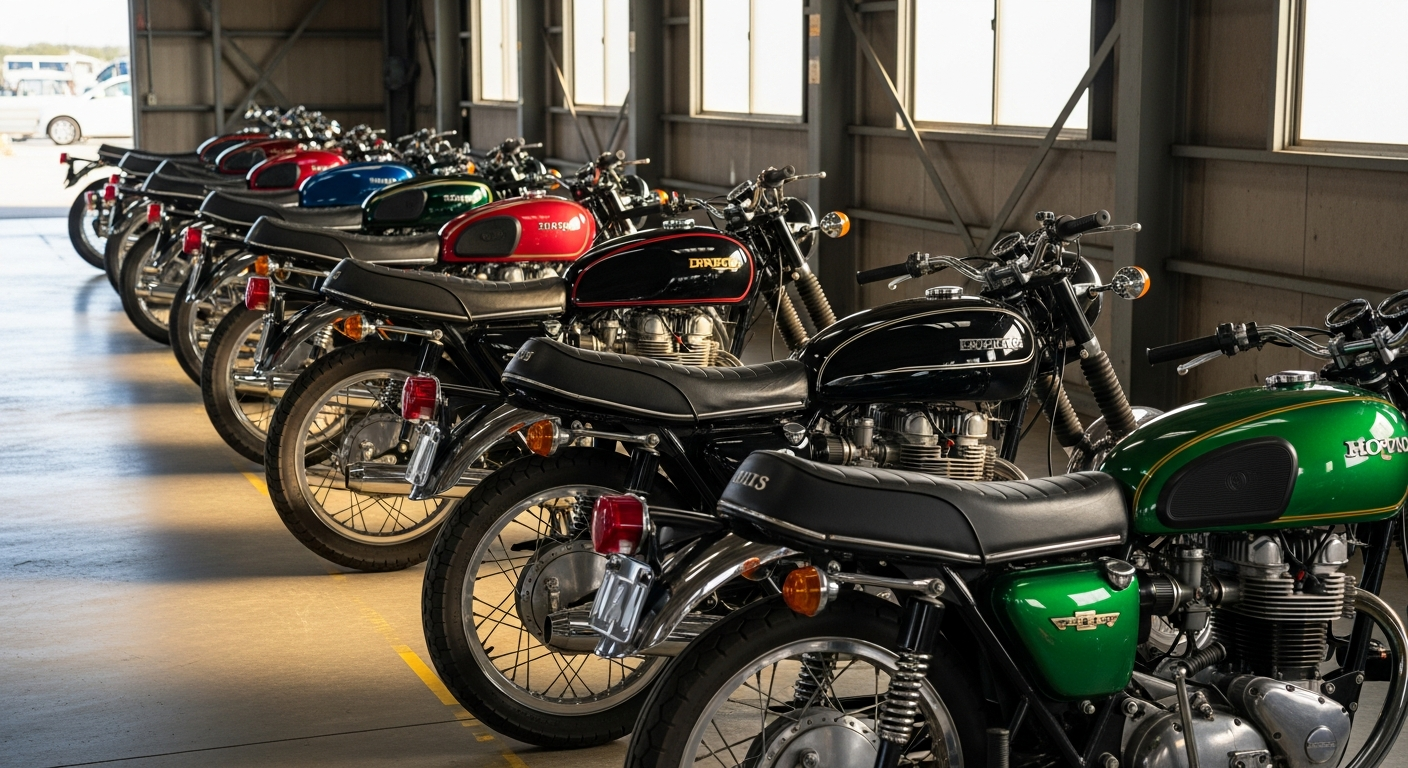
This guide is the one I wish existed when I started. Not a generic "10 best Japanese bikes" listicle, but a straight-talking buyer's guide to the naked and standard machines that make the most sense to ship from Japan — which models, which generations, what they cost landed on your driveway, and the legal clock that decides whether you can register one at all. Whether you're in the US, UK, Australia, or New Zealand, the playbook is the same, and Japan is the warehouse.
What counts as a "naked" bike — and why Japan is the place to buy one
Let's define terms, because "naked" gets thrown around loosely. A naked bike — also called a standard or a streetfighter when it's angrier — is a motorcycle with no fairing, or only a tiny flyscreen. You sit upright. The handlebars are wide and tall. The engine hangs out in the open for everyone to admire. It's the original shape of the motorcycle, before sportbikes wrapped everything in plastic in the chase for top speed.
The Australian rider behind the AussieRider channel summed up the split in a video that's been watched 4.4 million times: sportbikes fold you forward over the tank for aerodynamics and track work, while nakeds keep you upright, relaxed, and able to actually see where you're going. One is a scalpel. The other is a Swiss Army knife you'll ride every day.
So why Japan? Three reasons, and they all stack.
First, Japan built nakeds nobody else got. A whole class of high-revving 400cc four-cylinder machines — the CB400 Super Four, the XJR400, the ZRX400 — was created for the Japanese domestic market and largely stayed there. These aren't detuned export bikes. They're JDM-only jewels.
Second, Japanese bikes are kept absurdly well. The shaken roadworthiness inspection system makes neglect expensive, so owners service on schedule and store bikes indoors. The used market is enormous and unsentimental, which means clean, low-mileage machines cycle through the auctions every single week.
Third — and here's the part nobody mentions — the same strict licensing and inspection laws that created these bikes also made Japan flush with them. UK insurer Bikesure put it plainly: Japan's tough road-licensing rules and a "virtually non-existent second-hand market" in the 90s made it economic to export nearly-new bikes abroad. Decades later, that pipeline is still open. You just need to know how to tap it.
Why naked bikes make the smartest import
Here's the thing nobody tells you up front: of all the categories you could ship from Japan, nakeds are the most rational. Not the flashiest. The smartest.
Start with comfort. An upright riding position is the difference between a bike you ride twice a month and a bike you ride to work. No wrist pain, no folded-up knees, no neck ache after an hour. For real-world riding — commuting, weekend blasts, the occasional longer trip — the naked wins every time.
Then there's the money math when things go wrong, and on a used bike they eventually do. Jalopnik laid it out for new riders: sportbikes are "covered in easily-cracked plastics that are costly to replace when new riders inevitably drop them." A naked has almost nothing to break in a tip-over. A bent lever, a scuffed bar end, a scratched tank if you're unlucky. Drop a faired bike and you're looking at hundreds in fairing panels — assuming you can even find them for a 25-year-old grey import.
Naked bikes are also mechanically honest. The engine is right there. No fairing to unbolt before you can check a hose, sync the carbs, or spot a weep. For a bike you've imported — where you want to inspect everything yourself — that openness is a gift.
And the values are climbing. The clean JDM 400 fours and the big air-cooled standards have quietly become collectible, but they haven't hit the insane prices the two-stroke 250s command. You're still buying in before the curve goes vertical.
The two worlds of Japanese naked bikes
Once you start shopping, you'll realize "Japanese naked" splits into two very different worlds. Knowing which one you're in changes everything about price, paperwork, and what you're actually getting.
World one: the JDM 400 four-cylinder. These are the small-capacity, screaming inline-fours built for Japan's domestic licensing tiers — the CB400SF, XJR400, ZRX400, Bandit 400, GSX400 Impulse, and CB-1. Most were never officially sold outside Japan. They rev to the moon, sound like miniature superbikes, and are almost impossible to find anywhere except the Japanese auctions. If you want one, you import it. Full stop.
World two: the global big-bore standard. These are the muscle nakeds — CB1300 Super Four, XJR1300, ZRX1200, GSX1400, Bandit 1200. Some were sold in export markets, but Japan has the cleanest examples, the rare JDM-spec versions, and the best prices. Visordown famously pitted the CB1300, ZRX1200R, GSX1400, and XJR1300 against each other in a four-way standard shootout — and every one of those bikes is easier and cheaper to find in Japan than at home.
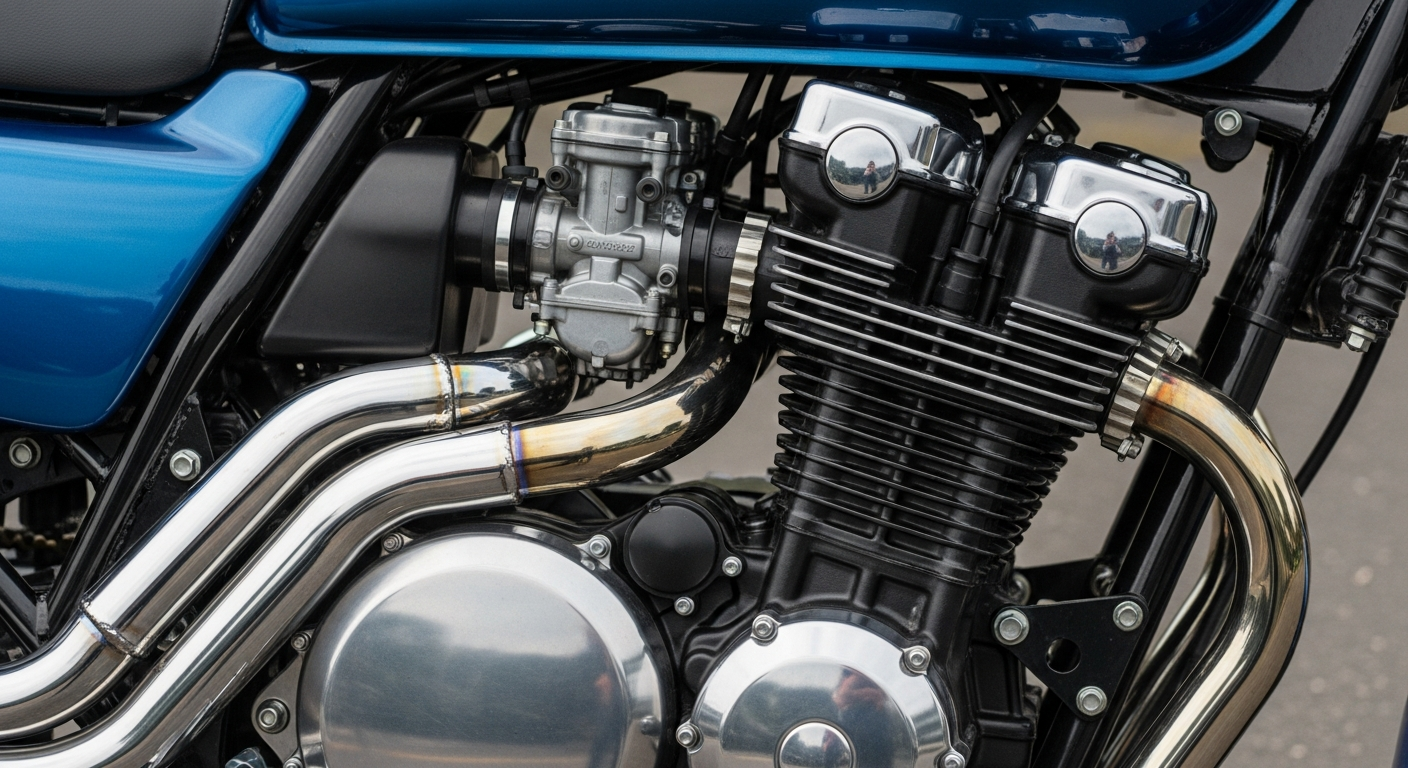
The rest of this guide walks both worlds, model by model, then gets into the money and the mechanics. Let's start with the bikes that made the JDM naked legendary.
The JDM 400 four-cylinder legends
This is the category that justifies the whole exercise. Japan's licensing system historically made anything over 400cc a serious hassle to license, so manufacturers poured engineering into 400cc four-cylinder bikes that punch far above their size. The result was a golden age of tiny, high-strung inline-fours that simply don't exist anywhere else.
Honda CB400 Super Four
The king. The CB400SF is the bike that visiting rider in the brian_636 comments called "a perfect bike," and he's not wrong. A liquid-cooled, 16-valve inline-four making around 53 horsepower from 399cc, it revs cleanly past 11,000 rpm and sounds like a scaled-down superbike. Honda still uses it as the standard training machine in Japanese riding schools, which tells you everything about how friendly and bulletproof it is. We'll break down its generations in the next section, because there's real money in knowing which one to buy.
Yamaha XJR400
If the CB400SF is the polished all-rounder, the XJR400 is the muscle-bike in miniature. Air-cooled four, retro styling lifted straight from the big XJR1200/1300, twin shocks out back, and a torquey character that makes it feel bigger than it is. It's the bike for someone who wants the classic UJM (Universal Japanese Motorcycle) look without the weight of a literbike. Clean ones are getting harder to find, which is exactly why you import now.
Kawasaki ZRX400
Kawasaki's answer, and a styling icon. The ZRX400 wears the bikini fairing and color scheme that nods to Eddie Lawson's championship-winning superbikes — the green-and-white "Lawson replica" look in 400cc form. Air-cooled four, gutsy mid-range, and a following that borders on cult. It's the enthusiast's pick of the JDM 400s.
Suzuki Bandit 400 and GSX400 Impulse
Suzuki's GSF400 Bandit brought a high-revving, race-derived four to the segment with a chassis that loved corners. The GSX400 Impulse leaned into the muscle-standard look. Both are the value buys of the JDM 400 world — less hyped than the Honda and Kawasaki, often cheaper at auction, and just as fun.
Honda CB-1 (NC27)
The deep-cut. The CB-1 was Honda's late-80s naked built around the CBR400's screaming four, with bold styling that was too weird for its time and is now exactly the kind of thing collectors hunt. Low production, distinctive, and a genuine sleeper. If you want a JDM 400 nobody else at the bike night will recognize, this is it.
Here's the reality check on all of these: most never left Japan, and the few grey imports that reached the UK and Australia in the 90s are aging out. The auctions in Japan are the only place you'll find a steady supply of clean, unmolested examples. That's not marketing — it's just where the bikes are.
CB400SF Super Four generations decoded
Because the CB400SF is the bike most people import first, it's worth knowing exactly what you're bidding on. Buy the wrong generation and you'll overpay for the wrong feature set. Here's the cheat sheet.
First generation (1992–1998), NC31. The original. Liquid-cooled four, conventional valve operation, simple and tough. This is the budget entry point — the cheapest way into the CB400SF family, and a bike that just works. No VTEC trickery, just a sweet-revving four.
VTEC / second generation (1999–2001), NC39. Honda added Hyper VTEC, which keeps two valves per cylinder closed at low rpm and snaps all four open higher up for a hit of top-end rush. The first VTEC's switch-over point is fixed and sits fairly high, so you have to rev it to feel the magic. Purists are split; everyone agrees it sounds incredible.
VTEC Spec II / III (2002–2007). Honda kept refining. Spec II added a HISS immobilizer and reworked the VTEC switch-over; Spec III lowered the changeover rpm so the VTEC kick arrives sooner and the bike feels livelier in normal riding. These are the most usable VTEC bikes and the sweet spot for a daily rider.
Revo (2008 onward). The VTEC Revo made the valve transition smooth and rpm-variable, plus fuel injection. These are the newest and most refined — but newer also means the 25-year import clock hasn't ticked over for most markets yet. More on that below.
The drag race between a modern Yamaha R3 and a CB400 Super Four that's been watched 1.3 million times makes the point better than any spec sheet: a 30-year-old design with twice the cylinders still holds its own against a current beginner bike, and sounds ten times better doing it.
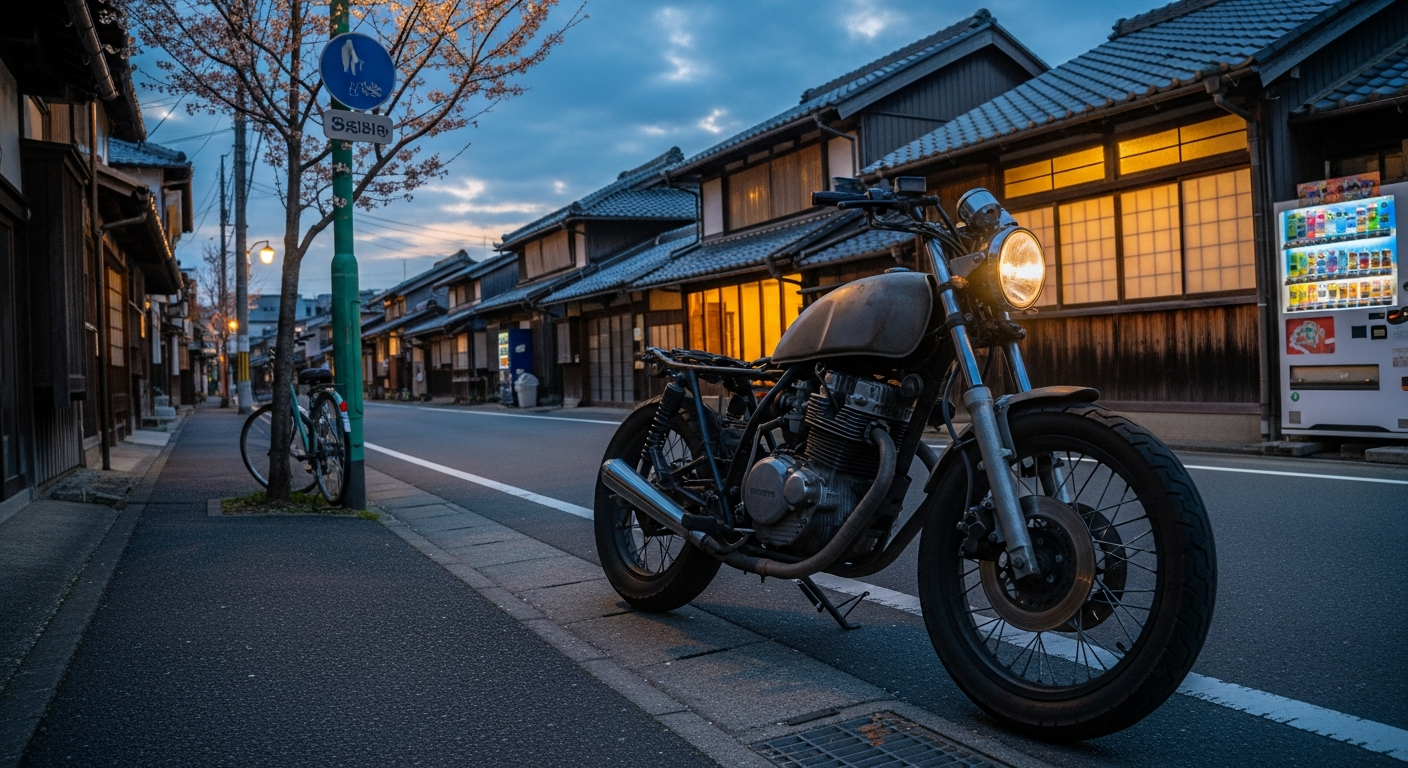
The big-bore muscle standards
Now we go up a few weight classes. If the JDM 400s are about revs and finesse, the big-bore standards are about torque, presence, and that unmistakable air-cooled inline-four thump. These are the bikes Visordown lined up for its big-naked road test, and any one of them makes a superb import.
Honda CB1300 Super Four
The biggest, smoothest, most refined of the lot. A 1,284cc inline-four wrapped in classic standard styling, the CB1300SF is a magic-carpet muscle bike — effortless torque everywhere, build quality that shames bikes twice the price, and a riding position you could sit in all day. It's heavy, but it carries the weight like a luxury car. The JDM versions are plentiful and clean.
Yamaha XJR1300
The survivor. The XJR1300 was one of the longest-running air/oil-cooled four-cylinder bikes ever made, outlasting nearly every rival before emissions law finally caught up. That means there's a deep pool of them in Japan across many model years. Big torquey lump, twin shocks, classic looks, and a chassis that's happier in the bends than its retro styling suggests. A brilliant first big import.
Kawasaki ZRX1200R
The one with attitude. The ZRX1200R carries on the Eddie Lawson superbike-replica look at full size — the bikini fairing, the green paint, the muscle stance. Strong engine, sharp handling for a big standard, and a die-hard following. It eventually gave way to the Z1000, which makes the ZRX the last of a breed worth grabbing.
Suzuki GSX1400
The torque monster. Suzuki built the GSX1400 as a deliberate throwback — a huge air/oil-cooled four with monstrous low-end grunt, made for riders who thought everything else had gone too clinical. It's the connoisseur's muscle standard: less common, hugely satisfying, and increasingly collectible.
Suzuki Bandit 1200
The value champion. The Bandit 1200 took the GSX-R-derived oil-cooled engine, detuned it for fat mid-range, and wrapped it in a do-everything package that cost peanuts new and is a steal used. Comfortable, fast enough to scare you, and easy to live with. If you want maximum bike for minimum landed cost, the Bandit 1200 is hard to beat.
The middleweight all-rounders
Between the 400s and the literbikes sits a sweet band of middleweight nakeds that are the most sensible imports of all — enough power to be exciting, light enough to be friendly, cheap enough to be guilt-free.
The Honda Hornet 600 (CB600F) takes a CBR600 four and tunes it for a wicked mid-range scream — a genuine giant-slayer that's still affordable. Its bigger brother the Hornet 900 (CB900F) adds Fireblade-derived punch for not much more money. The Suzuki Bandit 600 is the friendlier, torquier alternative, and the SV650 — Suzuki's V-twin that helped define the modern naked segment in 1999 — offers light weight, a rigid chassis, and a torquey twin that suits new and experienced riders alike. Kawasaki's Z750 rounds out the group with aggressive styling and a strong four. None of these will bankrupt you, and all of them are everywhere in the Japanese auctions.
Modern retro nakeds worth importing
Not every great Japanese naked is 25 years old. A newer wave of retro-styled nakeds has arrived, and for markets with shorter import windows — or buyers who simply want modern brakes and fuel injection — these are worth a look.
The Kawasaki Z900RS is the standout: modern Z900 performance dressed in unapologetic 1970s Z1 styling, and it's become an instant modern classic. Yamaha's XSR700 and XSR900 wrap the brilliant MT-series twins and triples in heritage clothing — the XSR900 in particular is a riot. Honda's CB1000R brings Fireblade-derived power to a sharp neo-retro naked. These won't qualify for the 25-year rule in the US or Australia for years yet, but in Canada (15-year rule), the UK, and New Zealand, many are already importable. Know your country's clock before you fall in love.
The UJM story: how Japan kept the naked bike alive
To understand why Japan is so rich in nakeds, you have to understand the UJM — the Universal Japanese Motorcycle. When Honda launched the CB750 in 1969, it set the template that every Japanese maker copied for two decades: an inline-four engine, upright bars, twin shocks, no fairing, and a do-anything attitude. That was the standard bike, and for years it was simply the motorcycle.
Then the 80s and 90s happened. The race for outright performance pushed sportbikes into full fairings and forward-folded ergonomics. Cruisers went the other way, low and laid back. The plain upright standard fell out of fashion in export markets — but not in Japan. There, the UJM never died. The licensing tiers kept the 400 four alive, the home market kept buying air-cooled muscle standards long after the West moved on, and Japanese build quality meant the bikes survived in beautiful condition.
That's the quiet advantage you're tapping when you import a naked from Japan. You're not buying a bike that got left behind. You're buying from the one market that kept building and maintaining the format the rest of the world abandoned and is now rediscovering — which is exactly why modern retro nakeds like the Z900RS sell as fast as they're built. Japan was right about the naked bike the whole time. The auctions are where the proof is parked.
Best naked motorcycle to import from Japan by rider type
Enough history. Which one is right for you? Here's the honest matchmaking.
The new rider: CB400 Super Four. Friendly power, bulletproof reliability, the bike Japan itself trains on. You will not outgrow it for years.
The sound junkie: Any VTEC CB400SF, or an XJR400. The four-cylinder scream at full chat is the entire point, and it's why that VTEC sound video has 1.5 million views.
The classic-styling lover: XJR1300 or ZRX1200R. Retro looks, air-cooled character, and enough torque to back up the attitude.
The comfort-first commuter: CB1300 Super Four. Smooth, refined, effortless, and built to a quality standard that's almost gone now.
The value hunter: Suzuki Bandit 1200 or 600. The most bike per dollar landed, with parts that are cheap and everywhere.
The collector playing the long game: Honda CB-1 or a clean Kawasaki ZRX400. Rare, distinctive, and on the way up.
The 25-year rule and import legality by country
Now the part that decides whether any of this is legal where you live. The single most important factor isn't the bike — it's its age, measured against your country's import rule.
United States: The 25-year rule. A motorcycle becomes exempt from federal import restrictions once it's 25 years old, calculated to the month of manufacture. In 2026 that means anything built in 2001 or earlier sails through. A 1998 CB400SF? Easy. A 2005 model? You're waiting until 2030.
Australia: Effectively a 25-year rule as well for the simplest path — bikes 25 years and older import with far less red tape. Newer bikes are possible but involve more compliance work.
Canada: The friendliest of the big markets, with a 15-year rule. In 2026 that opens up everything built in 2011 or earlier — which means many VTEC Spec III CB400SFs, late XJR1300s, and even some modern retros are already legal to bring in.
United Kingdom and New Zealand: No blanket age bar. You can import a bike of almost any age, subject to registration, emissions/compliance paperwork, and the usual taxes. This is why so many JDM 400 fours ended up in the UK in the first place.
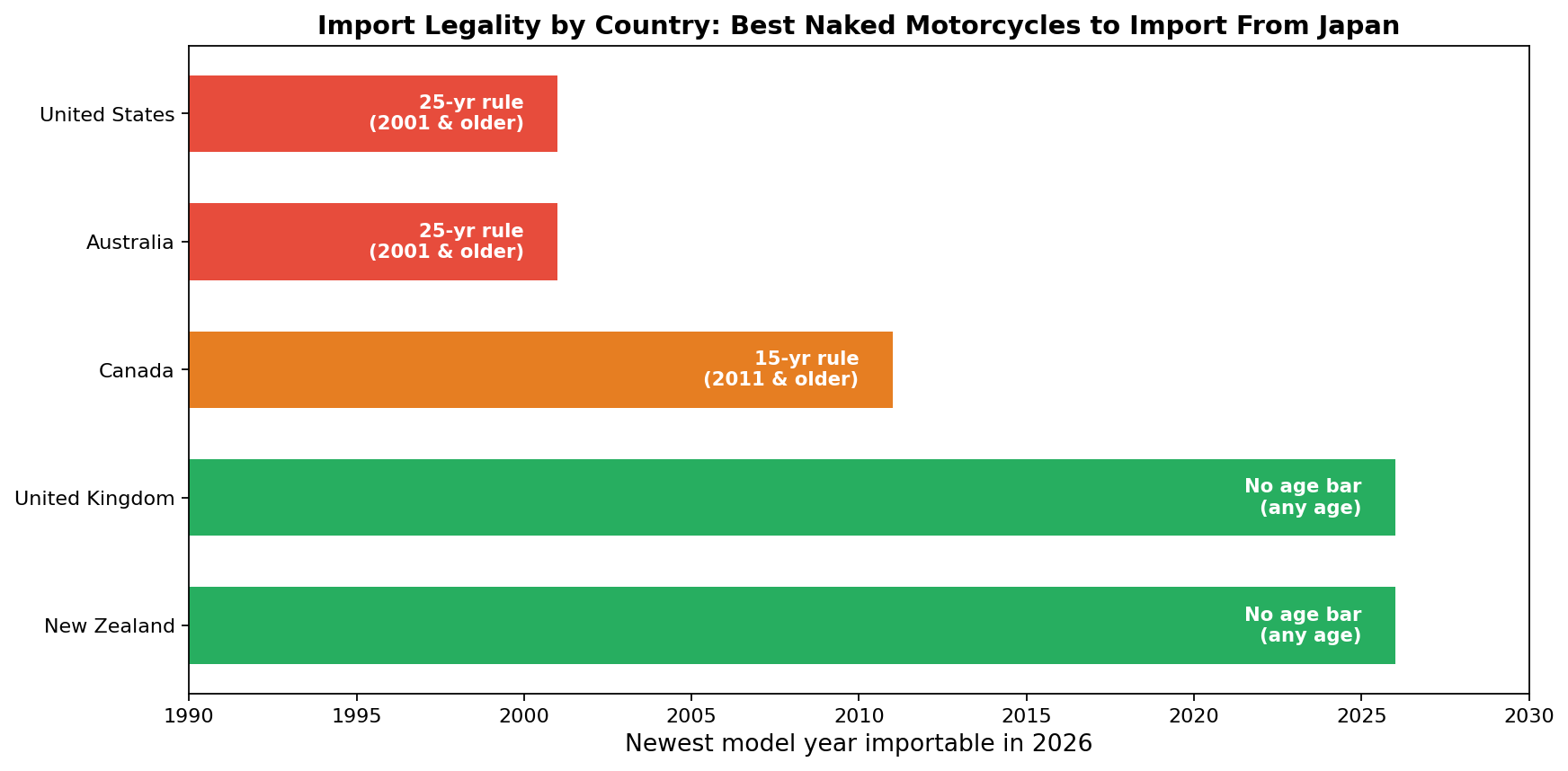
The takeaway: check your country's clock before you bid. A bike that's perfect for a Canadian buyer is illegal for an American for another four years. Get this wrong and you've shipped a paperweight.
What it actually costs: landed price breakdown
Let's talk money, because "it's cheap in Japan" means nothing until you add up the landed cost — the all-in figure to get the bike registered on your driveway.
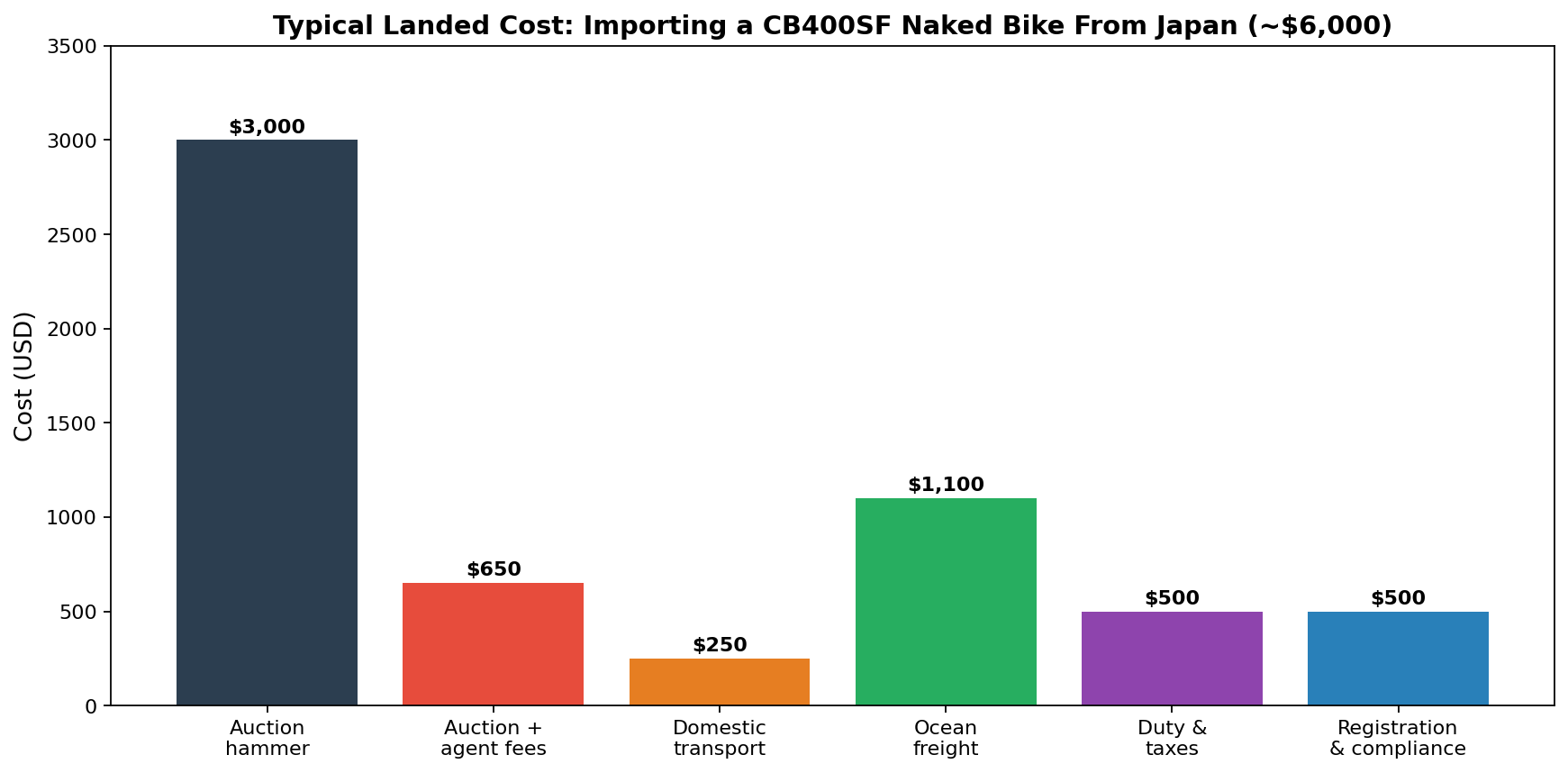
Take a clean CB400SF as the worked example. The hammer price at a Japanese auction for a tidy one runs somewhere around $2,500–$3,500. On top of that you stack the auction and agent fees, domestic transport to the port, ocean freight, your country's import duty (motorcycles are often low or zero duty — check your tariff code), local taxes, and the registration and compliance work at home.
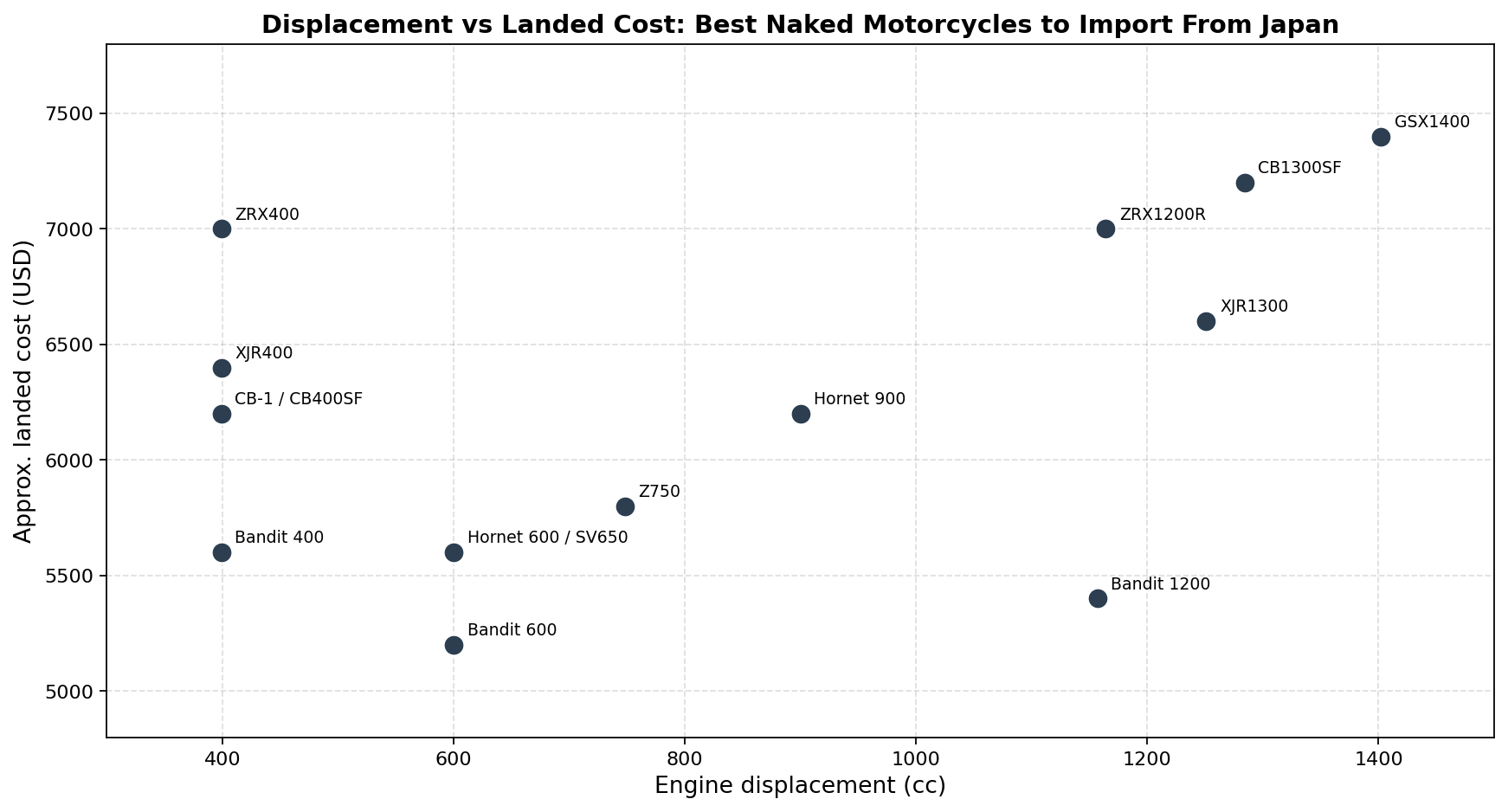
Add it all up and a CB400SF typically lands somewhere around $5,500–$7,000 depending on your country and shipping method. A big-bore standard like a Bandit 1200 can land cheaper because the bikes are cheaper to buy; a rare ZRX400 in mint condition can land higher because the hammer price is higher. The fees and freight are roughly fixed — it's the auction price that swings.
Here's the honest comparison: a clean JDM CB400SF or XJR400 in the UK or Australia often sells for well north of what it costs to import one yourself, precisely because supply is drying up. You're not just buying a bike — you're cutting out the middleman who'd otherwise do exactly what you're about to do.
Where does the naked sit against other categories? Roughly in the value sweet spot — cheaper to buy than the collectible two-strokes, cheaper to run and repair than a faired sportbike, and holding value better than a generic commuter.
How to buy a naked bike at a Japanese auction
You can't just log into the Japanese auctions yourself — they're trade-only, members-only systems. You buy through an export agent who holds membership and bids on your behalf. Here's how the process actually runs.
Step 1 — Pick your agent and set a budget. The major motorcycle auction networks are BDS (Bike Dealer System), JBA (Japan Bike Auction), and the bike lanes within USS. Your agent has access to thousands of bikes a week across these. Set a hard maximum that includes all the landed costs above, not just the hammer price.
Step 2 — Search the live catalogues. Tens of thousands of bikes pass through every week. You can filter by model, year, mileage, and auction grade and have your agent flag matches.
Step 3 — Read the auction inspection sheet. This is the single most important skill. Every bike gets an independent inspector's grade (commonly 5/4.5/4/3.5 and so on, plus a separate exterior letter grade) and a condition map marking scratches, dents, rust, and repairs. A grade 4 or 4.5 bike is clean. Anything graded R has been repaired. Learn to read the sheet, or lean on an agent who'll translate it honestly.
Step 4 — Bid. Your agent places the bid in real time. If you win, you pay; if not, you move to the next one. There's another every week.
Step 5 — Export and ship. The agent handles deregistration, export paperwork, and booking freight — container (safest) or RoRo (cheaper). Expect roughly six to ten weeks door to door depending on your country and port.
The naked-bike buyer's checklist
Nakeds have their own inspection priorities. Here's what to focus on when you read the sheet and when the bike arrives.
On the four-cylinder bikes: Listen for carb sync — a lumpy idle on an older CB400SF or Bandit usually just needs the four carbs balanced, but factor it in. Check that the high-rpm pull is clean, because a four-cylinder that won't rev freely has a problem. On VTEC CB400SFs, confirm the VTEC actually switches over crisply.
On the air/oil-cooled big-bores: Look for oil weeps around the head and cam covers — some seepage is normal on old air-cooled fours, but pooling isn't. Check the regulator/rectifier health (a known weak point on older Japanese fours) and that the charging system holds voltage.
On everything: Originality matters for resale — a bike with its original bodywork, exhaust, and clocks is worth more than a modified one. Check the auction sheet's mileage notation for the "改" tamper mark, verify fork seals aren't weeping, and confirm the frame map shows no major repair history. A naked hides nothing, so a clean visual inspection tells you a lot.
Common mistakes when importing a naked from Japan
The buyers who get burned almost always make one of these five mistakes.
1. Bidding before checking the age rule. The number one error. Falling for a 2006 CB400SF when you live in a 25-year-rule country means you've bought a bike you can't register for years.
2. Ignoring the auction grade. A cheap hammer price on a grade 3 or R bike isn't a bargain — it's a project. Pay for a 4 or 4.5 and save yourself the heartache.
3. Forgetting parts availability. JDM-only models can need JDM-only parts. The good news: Japan's parts network is deep and ships worldwide. The bad news: you need to know that before you buy something obscure.
4. Choosing RoRo to save a little, then regretting it. Open RoRo shipping is cheaper but exposes the bike. For a clean naked you've waited months for, a container is cheap insurance.
5. Buying a modified bike for the originality price. Aftermarket exhausts and chopped subframes are common on JDM nakeds. They're fine if you want them — just don't pay original-condition money for a modified machine.
Five naked bikes about to take off
If you're buying partly with your head and partly hoping the bike appreciates, these five are the ones I'd watch.
Honda CB400SF (early VTEC, 1999–2001): The most desirable usable CB400, and clean ones are getting scarce.
Kawasaki ZRX400: The Lawson-replica looks and cult status are pushing prices up faster than the others.
Suzuki GSX1400: Low production, connoisseur appeal, and a "they don't make them anymore" story that collectors love.
Honda CB-1 (NC27): Rare, distinctive, and exactly the kind of overlooked bike that suddenly gets expensive.
Yamaha XJR1300 (final years): As the last air/oil-cooled big four, the run-out models are starting to be recognized as the end of an era.
Living with an imported naked bike
Once it's on your driveway, ownership is refreshingly simple — which is half the reason to buy a naked in the first place.
Parts: Japanese parts suppliers ship consumables and many OEM parts worldwide. For the global models (Bandit, SV650, Hornet) parts are everywhere. For the JDM-only 400s, you'll lean on Japanese suppliers and specialist forums — not a problem, just a habit to build.
Insurance: Most insurers treat a registered imported bike like any other classic or used machine once it's through the paperwork. Agreed-value classic policies are worth asking about for the appreciating models.
Resale: This is where nakeds quietly shine. A clean, original imported CB400SF or XJR holds value because the supply at home is shrinking while interest grows. Buy well, keep it tidy, and you're as likely to make money as lose it.
How AWA Auction helps you import the right naked
This is exactly what we do. AWA Auction gives English-speaking buyers direct access to the Japanese motorcycle auctions — the same BDS, JBA, and USS lanes where these bikes pass through by the thousand every week. We translate the auction sheets honestly, bid on your behalf, handle the export and shipping paperwork, and get the bike to your port with the landed cost laid out up front so there are no surprises.
If you know the model you want, tell us and we'll hunt clean examples. If you're still deciding between a CB400SF and an XJR1300, we'll talk you through it like the bike-obsessed people we are.
Browse our current listings to see what's available right now, or contact our team and tell us which naked you're chasing. The warehouse is in Japan. We're how you reach it.
See Also
Share this article: