
The Honda CB1100 is the bike Honda built to remind everyone what a motorcycle is supposed to feel like, and importing a CB1100 from Japan is still the cheapest way to get a clean, low-mileage, air-cooled one. Japan kept these in showrooms from 2010 right up to the final 2022 edition, the home market bought them in big numbers, and Japanese owners tend to baby them. That combination is exactly why the best examples on Earth are sitting in Japanese auction halls this week, not in your local classifieds.
Here's the thing nobody mentions in the glossy reviews: a CB1100 that has been ridden for ten gentle summers in Japan, garaged the rest of the year, and run on the country's famously clean fuel is mechanically in a different league from a UK or US bike that has weathered road salt and stop-start commuting. You're not just buying a model. You're buying the best surviving population of that model.
This guide walks you through every generation, the JDM-only details that matter, what it actually costs to land one in your driveway, how to read the auction sheet so you don't get burned, and the import rules for the US, UK, Australia and New Zealand. By the end you'll know exactly which CB1100 to chase and how to bring it home.
Why the CB1100 Is the Smartest Air-Cooled Import Right Now
The CB1100 arrived in 2010 as Honda's modern tribute to the original CB750 — a 1,140cc air-cooled inline-four wrapped in classic 1970s lines, with chrome, a round headlight, and twin shocks. It was sold new in Japan, Australia and New Zealand from launch, reached Europe in 2013, and stayed in production until Honda quietly retired it in 2022. The US never got it as a mainstream model, which is a big part of why American enthusiasts look to Japan.
Three things make it a standout import. First, the engine. It's deliberately understressed — Honda detuned a fundamentally over-built motor so it would last. Reviewers and long-term owners describe it as "unburstable," with examples crossing 100,000 km without drama. An air-cooled four has almost nothing exotic to fail, which is precisely what you want in a bike crossing an ocean to reach you.
Second, supply. Because Japan was the home market, the auction system is awash with CB1100s in every trim and condition. When dozens of the same model cross the block every week, you can afford to be picky and wait for a genuinely clean one rather than overpaying for the only example in your country.
Third, the values are still sane. The CB1100 has the cult-classic ingredients — air-cooling, an inline-four, retro styling, and a model that's now out of production — but it hasn't yet exploded in price the way the Kawasaki Z900RS has in some markets. Importing while the home-market price is still reasonable is how you get ahead of the curve.
One Japanese road-test channel review of the CB1100 RS has pulled well over 800,000 views, and the comments are full of riders asking the same question from overseas: "How do I get one of these out of Japan?" That demand is real, and it's the reason a focused import guide beats a generic review every time.
The CB1100 by the Numbers: Specs and Riding Character
Before you commit money to importing one, it helps to know exactly what the CB1100 is and isn't. This is not a power bike, and it was never meant to be. It's a torque-rich, refined, do-anything roadster built around feel.
The heart of it is a 1,140cc air-cooled inline-four producing roughly 88–90 horsepower and around 67 lb-ft of torque, depending on year and market. Those aren't headline numbers in 2026 — a modern litre sportbike makes nearly double the power — but the way the CB1100 delivers its grunt is the point. There's usable torque from just above idle, a smooth pull through the midrange, and that unmistakable air-cooled inline-four sound that no liquid-cooled rival quite matches.
It's a substantial bike. Wet weight sits in the 250–255 kg range, which sounds heavy but carries low and feels planted once moving. The seat height is a friendly 790–795mm, making it accessible to shorter riders — a genuine selling point versus tall adventure bikes. The tank holds around 14 litres on early bikes and a little more on the EX, and real-world fuel economy in the high-50s mpg (UK) means a comfortable 150-plus-mile range between stops.
The riding position is upright and relaxed, classic standard-bike geometry, with wide bars and mid-mounted pegs. It's comfortable for a full day in the saddle, especially on the EX with its plusher setup. The RS firms everything up for a sportier feel. What unites every version is approachability — this is a big bike that never feels intimidating, which is exactly why it appeals to riders returning to motorcycling and to those who want classic looks without classic-bike unreliability.
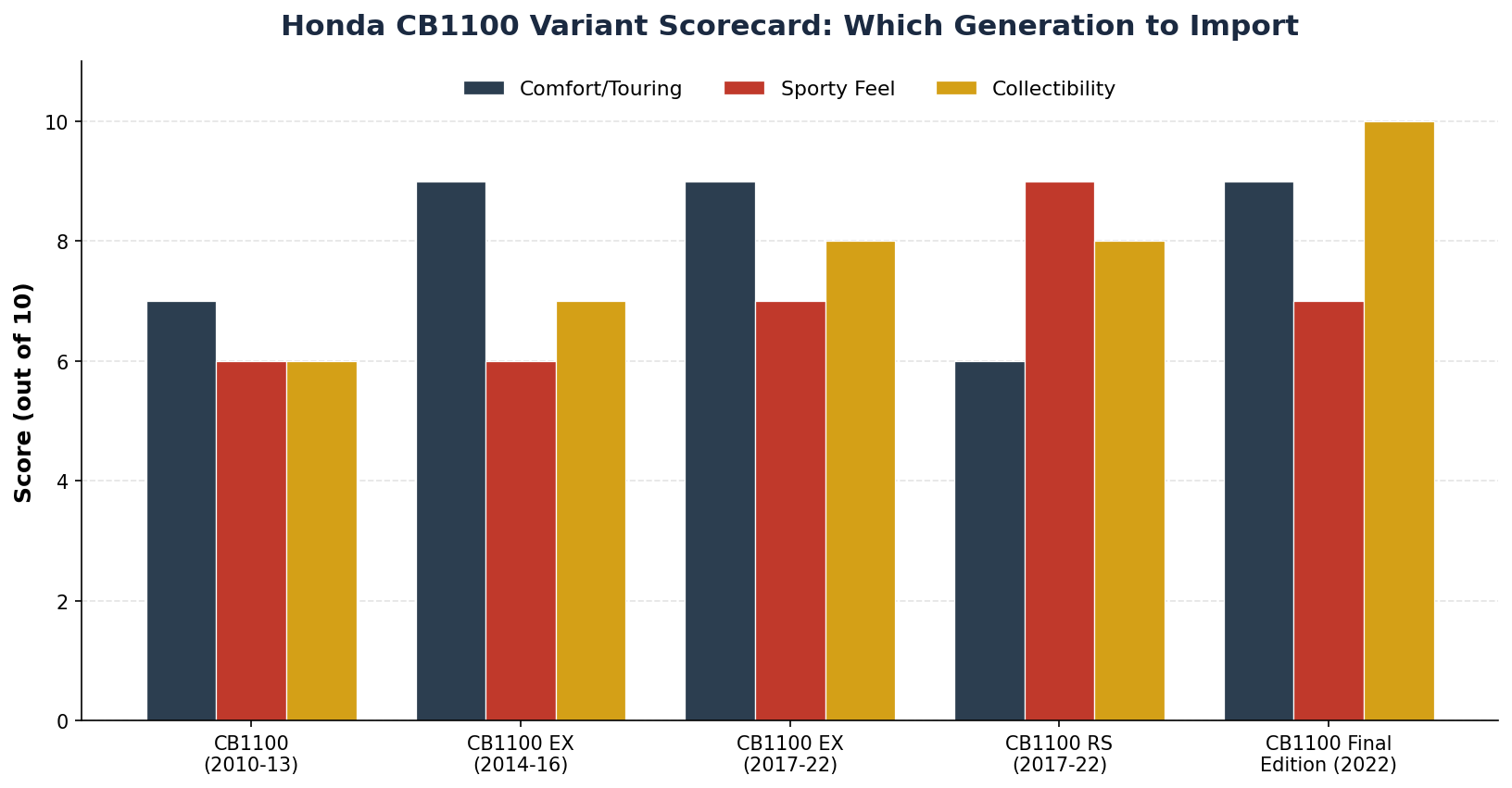
Understanding this character matters for importing, because it tells you which variant to chase. Touring and relaxed cruising? The EX. Spirited backroad riding? The RS. Pure collectibility? The Final Edition. Don't import a bike that doesn't match how you'll actually ride.
CB1100 Generations and Variants From Japan, Explained
The CB1100 looks like one bike across its whole run, but there are meaningful differences between trims and model years. Get this part right and you'll bid on the version that actually suits you instead of the first clean one you see.
CB1100 (2010–2013): The Original
The first ones off the line. Cast aluminium wheels, a 4-into-2-into-1 exhaust, a five-speed gearbox, and fuel injection (PGM-FI) from day one — no carburettors here, despite the old-school looks. These early bikes are the purest expression of the design and usually the most affordable to buy. The five-speed box and slightly firmer ride are the main trade-offs versus later models. For a buyer who wants the cleanest retro silhouette at the lowest entry price, the 2010–2013 is the value pick.
CB1100 EX (2014–2016): Wire Wheels and Class
The EX is where the CB1100 grew up. Honda fitted wire-spoke wheels (a huge visual upgrade for the classic look), switched to a 4-2-2 megaphone-style exhaust, added a larger fuel tank, and refined the chassis. It's the variant most buyers fall for on looks alone. Comfort and touring ability are excellent. If you want the quintessential "modern classic" CB1100, the EX is it.
CB1100 EX (2017–2022): The Six-Speed Sweet Spot
The 2017 update is the one to know about. Honda added a sixth gear, a slipper/assist clutch, LED lighting, and a lighter exhaust system. The extra ratio transforms motorway manners — the engine finally relaxes at speed instead of buzzing. For anyone who plans to actually ride their import long distances, the 2017-onward EX is the smartest all-round choice and worth the price premium.
CB1100 RS (2017–2022): The Sporty One
The RS takes the same updated six-speed platform and sharpens it: 17-inch cast wheels front and rear (instead of the EX's 18-inch fronts), firmer suspension, blacked-out finishes, sportier ergonomics, and a more aggressive stance. It rides like a roadster rather than a cruiser-tourer. If you want the CB1100 that corners hardest and looks meanest, the RS is your bike — and it tends to hold value well.
CB1100 Final Edition (2022): The Collector's Pick
Honda sent the CB1100 off with limited Final Edition models in 2022, available in both EX and RS flavours with special colours and badging. Production numbers were small, and these are the examples most likely to appreciate. If your goal is a future classic to store as much as to ride, a low-mileage Final Edition out of Japan is the trophy.
The scorecard below sums up how the variants stack up across the three things buyers actually care about — long-distance comfort, sporty feel, and collectibility.
JDM-Spec vs Export-Spec — What's Actually Different
This is where importing directly from Japan earns its keep. A Japanese-market CB1100 is not identical to the European or Australian version, and the differences usually favour the JDM bike.
Japanese-market bikes were the first to launch and often received colours, trims and special editions that never left the country. The home market got the widest variety of paint schemes across the model's life, so if you're hunting a specific look, Japan is where it lives. Japanese examples also tend to ship with their original equipment intact — factory Bridgestone tyres, untouched analogue clocks, unmolested exhausts — because the JDM owner culture leans heavily toward keeping bikes stock and pristine.
Then there's condition. Japan's shaken inspection system effectively forces owners to keep bikes maintained to a high standard, and the country's mild riding seasons plus widespread garage storage mean far less corrosion than you'll find on a comparable European bike. A JDM CB1100 with a documented service history is about as safe a used-bike bet as exists.
The practical things to check on a JDM bike are minor and easily sorted: the speedometer reads in km/h (fine in metric countries, a quick swap or conversion for the US), the headlight may need adjusting for the side of the road you ride on, and the owner's documentation will be in Japanese — which is exactly what a good import agent translates for you. None of these are dealbreakers. They're the small price of getting the best-preserved version of the bike.
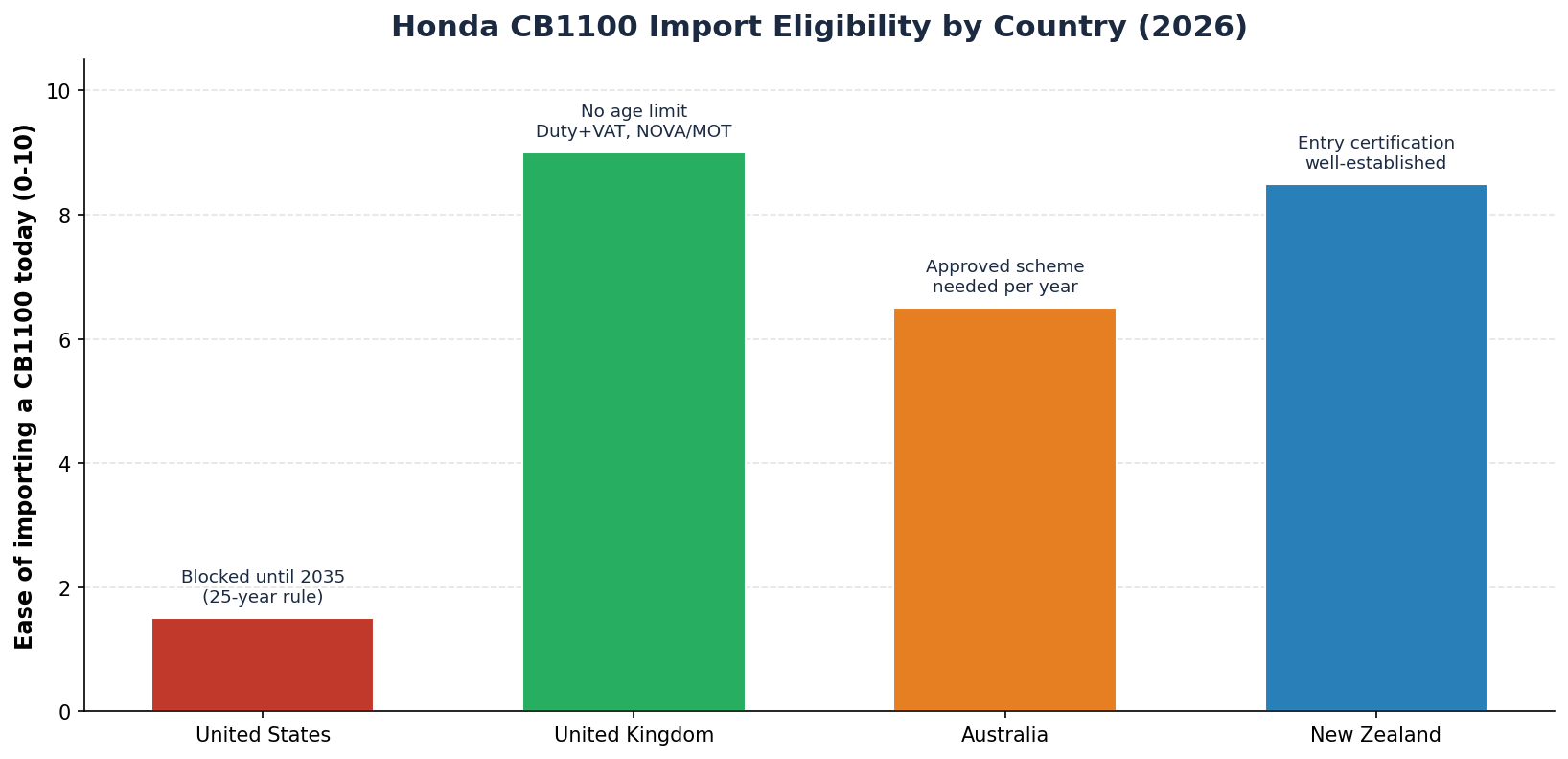
Import Eligibility by Country: The Rules You Must Check First
Before you fall in love with a listing, confirm you can legally land it. The CB1100 is a 2010-and-newer model, and that single fact changes everything depending on where you live.
United States — The 25-Year Rule
The US bans road registration of most motorcycles under 25 years old unless they already meet full DOT and EPA standards, which grey-market JDM bikes don't. Because the CB1100 launched in 2010, the earliest examples don't become eligible under the 25-year exemption until 2035. Translation: for now, a US buyer generally cannot import a CB1100 for street use under the standard rolling exemption. The exceptions are off-road/track-only use, or holding the bike as a collector piece until it ages in. American CB1100 fans should treat this guide as a buying playbook for when eligibility opens — and as a reason to track values now, before the rush.
United Kingdom — No 25-Year Rule
The UK is the friendliest major market for a CB1100 import. There's no minimum age barrier. A personally imported bike goes through customs (you pay duty and VAT), then either an MSVA/IVA-type approval or, more commonly for a model that was officially sold in Europe, registration on documentation, followed by an MOT and a NOVA notification to HMRC. Because the CB1100 was a European-market bike from 2013, parts and type-approval familiarity make UK registration straightforward. This is why our cost example below is built around a UK landing.
Australia — Approved Schemes and the Older-Bike Path
Australia allows motorcycle imports through several schemes. The CB1100 was sold new in Australia, so locally there are bikes already — but JDM-spec examples and special editions still draw importers. Eligibility runs through the Register of Approved Vehicles and the relevant import-approval pathway; bikes over 25 years old enter more easily, while newer ones need an approval before they ship. Check the current Department of Infrastructure rules for your specific year before bidding.
New Zealand — Practical and Import-Friendly
New Zealand has long been one of the easiest countries to import a used Japanese bike into, with a well-trodden compliance and certification process. A CB1100 needs to pass entry certification (structural and emissions checks appropriate to its age) and then registration. NZ's large existing population of imported Japanese machinery means the supporting trade — compliance shops, parts, knowledge — is everywhere.
The golden rule across all four countries: confirm eligibility for your exact model year before you place a bid, not after you've won one. Rules change, and a five-minute check saves a five-figure mistake.
What a CB1100 Really Costs to Import From Japan
The auction price is the headline, but it's rarely more than 60% of what you'll actually spend. The smart move is to budget the full landed cost from the start. A widely repeated rule of thumb among importers is to add at least 30% on top of the hammer price for fees, freight and taxes — and for a higher-value bike heading somewhere with VAT, it can be more.
Here's a realistic breakdown for landing a clean CB1100 EX in the United Kingdom. Your numbers will shift with the bike's value, the exchange rate, and whether you ship by RoRo or in a shared container, but the shape of it holds.
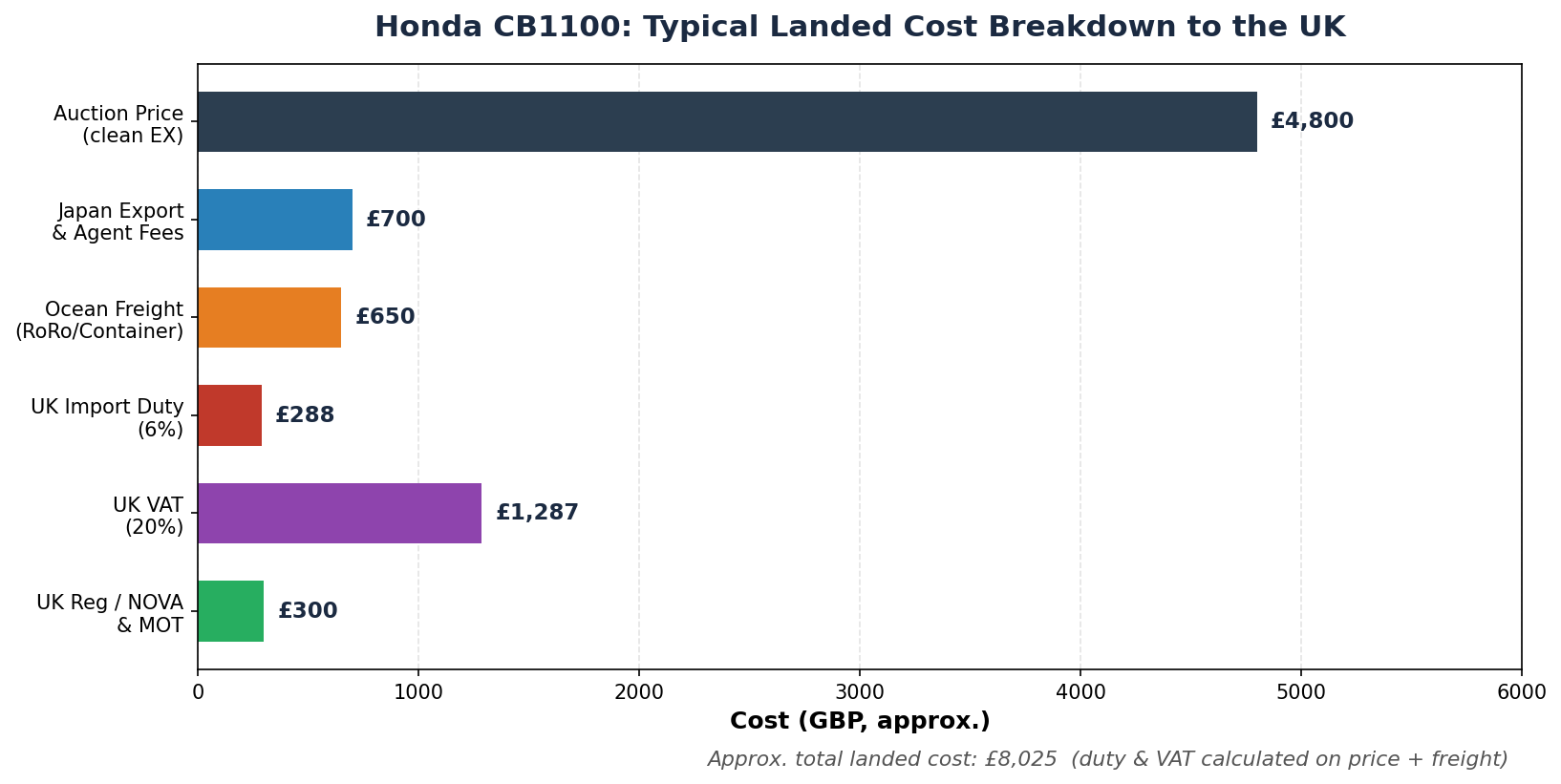
Walking through it: the auction bike itself is around £4,800 for a tidy EX. Japanese export paperwork, de-registration, domestic transport and the agent's commission add roughly £700. Ocean freight runs £550–£800 depending on method and port. UK import duty on a motorcycle is 6%, and VAT is 20% — both calculated on the cost of the bike plus freight, which is why VAT is the second-biggest line on the chart. Finally, budget around £300 for UK registration, the NOVA process and an MOT. All in, you're looking at roughly £8,000 to put a clean, low-mileage JDM CB1100 EX on the road.
Compare that to UK retail for an equivalent EX and the maths often still favours importing — and crucially, you get a Japanese-condition bike rather than a salt-aged local one. The savings are real, but the bigger win is condition and choice.
Two cost traps to avoid. First, don't chase the absolute cheapest auction bike; a £3,500 bike that needs £1,500 of work is no bargain. Second, don't under-budget the taxes — duty and VAT are non-negotiable and catch first-time importers out constantly.
How to Read a CB1100 Auction Sheet (Grades and Red Flags)
Every bike at a Japanese auction comes with an inspection sheet written by an independent grader. Learn to read it and you can buy with confidence from the other side of the world. Ignore it and you're gambling.
The overall grade is the first number you look at. As a working guide: grade S or 6 means essentially new or nearly so; 4.5 to 5 is an excellent used bike with only light wear; 4 is a solid, honest used bike — the sweet spot for value; 3.5 shows visible wear and may need cosmetic attention; and anything 3 or below needs real scrutiny. R or RA flags a bike that has been repaired after damage — not automatically a no, but you'll want detail. 0 or *** often signals a heavily modified or non-running bike.
For a CB1100 specifically, here's what to hunt for on the sheet and the photos:
Exhaust headers. Air-cooled fours show their age at the downpipes. Look for bluing, pitting or surface rust on the headers — common on bikes left outside, and pricey to replace with genuine parts.
Originality. The CB1100's value lives in being stock. Aftermarket pipes, bar swaps or removed centre stands knock the appeal. The grader's diagram marks scratches and dents; a clean diagram on a stock bike is gold.
Corrosion on fasteners and forks. Even in Japan, a coastal bike can show corrosion. Check fork lowers and engine casings in the photos for cloudiness or pitting, and look for any fork-seal weep on bikes over 20,000 km.
The auction-house comments. The Japanese notes are where the truth hides — accident history, oil leaks, warning lights. A good agent translates these in full. If an agent won't translate the comments, walk away.
A grade 4 to 4.5 CB1100 with a clean diagram, original exhaust, and no accident note in the comments is the bike you want. Pay a little more for that and you'll spend a lot less fixing things later.
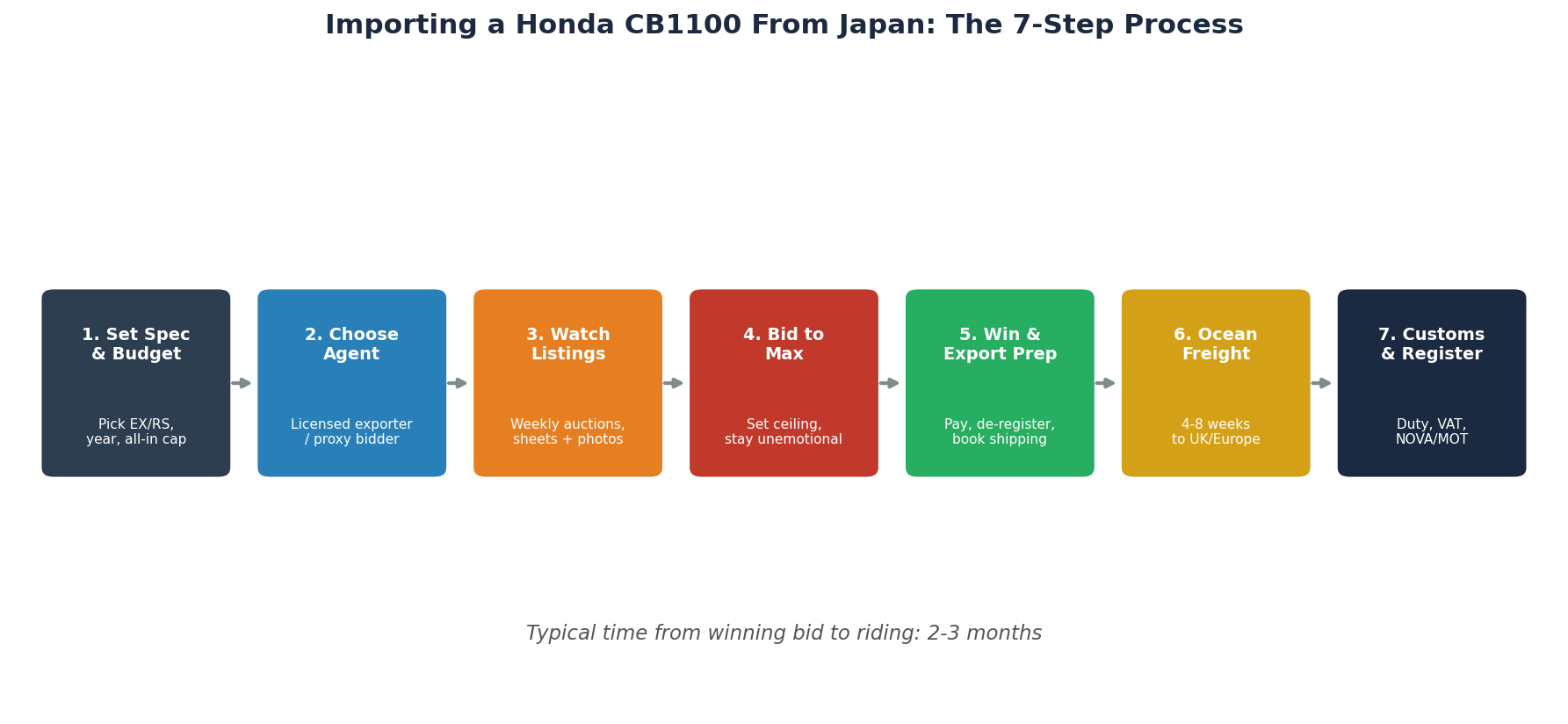
Step-by-Step: Buying a CB1100 at a Japanese Auction
The auction system can feel like a black box from overseas. It isn't. Here's the whole process, start to finish.
Step 1 — Set your spec and budget. Decide on the variant (EX, RS, year range) and your maximum landed budget, not just your maximum bid. Work backwards from the all-in figure using the cost breakdown above.
Step 2 — Partner with an export agent. You can't bid directly at the big Japanese auctions as a private foreign buyer; you go through a licensed exporter or proxy bidder. This is the single most important decision in the whole process. A good agent gives you auction access, honest sheet translations, bidding strategy, export paperwork and shipping in one place.
Step 3 — Watch the listings. CB1100s appear at the major auctions every week. Your agent sends you the listings matching your spec, with the inspection sheet and photos. You shortlist the clean ones.
Step 4 — Set your maximum bid. Auctions move fast and clear in seconds. You set a ceiling, your agent bids to it, and you don't get emotional. If you lose one, another comes next week — that's the beauty of buying the home-market model.
Step 5 — Win, pay, and prep for export. Once you win, you settle the invoice (bike plus fees), the agent collects the bike, de-registers it, and books shipping. RoRo (roll-on/roll-off) is cheaper; a shared container offers more protection. For a clean classic, many buyers pay the bit extra for a container.
Step 6 — Shipping and arrival. Sea freight from Japan to the UK or Europe typically takes four to eight weeks. To Australia or New Zealand it's often quicker. You'll get a bill of lading and tracking.
Step 7 — Customs, taxes and registration. On arrival you (or your agent's local partner) clear customs, pay duty and VAT, and begin registration — the NOVA/IVA/MOT chain in the UK, entry certification in NZ, and so on. Then the keys are yours.
From winning bid to riding, budget two to three months. It's not instant, but neither is finding a Japanese-condition CB1100 any other way.
CB1100 Reliability — What to Check Before You Bid
The CB1100's reputation is rock-solid, and that's not marketing — long-term reviews and owner reports consistently describe total reliability and an engine that shrugs off big mileage. But "reliable model" doesn't mean "every example is perfect." Buying remotely, you check for the known weak points before you commit.
Regulator/rectifier and charging. The most commonly reported electrical niggle across the CB1100's life is rectifier/regulator wear, which can cause battery drain or charging issues. It's a cheap, well-understood fix, but ask whether the bike's been sorted and check for any battery or electrical note on the sheet.
Fork seals. On higher-mileage bikes (over ~20,000 km) front fork seals can weep. Look closely at the fork legs in the auction photos for oil residue. A seal job is routine but worth pricing in.
Exhaust corrosion. As noted, the headers are the air-cooled tell. Genuine Honda replacement systems aren't cheap, so a clean, un-blued exhaust adds real value.
Idle and fuelling on early bikes. The CB1100 is fuel-injected, not carburetted, so it doesn't suffer the classic carb gumming of older Hondas. Early bikes can occasionally feel slightly fussy at low revs if neglected; a bike with regular service history won't.
Service history. This is the single best predictor of a good bike. A documented maintenance record — even partly in Japanese — strongly correlates with an accident-free, well-cared-for machine. Prioritise history over a marginally lower price every time.
Tick those boxes and a CB1100 will likely outlast your interest in it. These are some of the most stress-free big bikes Honda has ever built.
Running Costs and Parts Availability
A reliable bike is only cheap to own if you can feed it. The good news with the CB1100 is that it shares plenty of Honda DNA, and because it was sold across Japan, Europe, Australia and New Zealand, the parts network is broad. Consumables — filters, pads, tyres, chains — are standard sizes you'll find anywhere. Service intervals are sensible, with valve checks at the longer end of the spectrum thanks to that understressed motor.
Where you'll occasionally pay more is genuine Honda bodywork and the exhaust system, which is why buying a clean, original example matters so much — replacing a corroded factory exhaust or a scratched tank panel is the kind of cost that erases an import "bargain." For a JDM bike, a good agent can also source Japanese-market parts and original accessories that are hard to find elsewhere, which is a quiet bonus of buying from the home market.
Insurance for a CB1100 tends to be reasonable in most markets — it's a sensible, mid-power classic-styled bike, not a sportbike, so premiums reflect that. Factor a registration and first-service budget into your landed cost and you'll have no nasty surprises in year one.
CB1100 vs the Retro Rivals: Is It Still the One to Import?
The modern-classic class is crowded now, and it's fair to ask whether the CB1100 is still the import to chase. Honestly, it depends on what you want.
The Kawasaki Z900RS is the obvious rival — liquid-cooled, more powerful, sharper handling, and styled after the legendary Z1. It's faster and more modern, but it's also water-cooled (less "pure" to traditionalists) and, in many markets, pricier and appreciating quickly. The Yamaha XSR900 is the tech-forward, lighter, more aggressive option with a brilliant triple engine, but it trades the classic look for neo-retro. And the Triumph Bonneville family offers British retro charm but a parallel-twin character that's worlds away from an inline-four's smooth howl.
What none of them give you is the CB1100's specific magic: a genuine air-cooled inline-four, the direct visual lineage to the CB750 that started it all, and Honda's bulletproof reliability — at a price that, for now, undercuts the hottest rivals. In a 2017 retro-roadster comparison test that's been watched nearly 800,000 times, the CB1100 was repeatedly singled out as the most authentic, most "old-school correct" bike of the bunch, even when it wasn't the fastest.
If you want outright performance, the Z900RS or XSR900 win. If you want the most honest, most reliable, most genuinely classic air-cooled four — and you want the best-preserved examples on the planet — the CB1100 from Japan is still the move.
Where the CB1100s Actually Are: Inside Japan's Auction System
Most overseas buyers picture a single "Japan auction." In reality it's a network of large weekly auctions run by different operators across the country, and the CB1100 turns up across most of them. Understanding the landscape helps you set expectations and spot a fair price.
The big motorcycle auctions handle thousands of bikes a week between them. Dealers consign trade-ins, finance companies move repossessions, and private sellers offload through agents. Each bike is photographed, inspected by an independent grader, and listed with that all-important sheet. The volume is the point: on any given week you'll often see five, ten, or more CB1100s of varying trims and grades, which is why patience pays. You're never bidding on the last one.
Prices at auction reflect grade, mileage, originality and the month — values soften in Japan's winter and firm up in spring as riding season returns. A nicely kept EX in the grade 4 to 4.5 band tends to clear in a predictable range, and once you've watched a few weeks of results with your agent, you'll develop a feel for what "too cheap" (suspicious) and "too dear" (impatient) look like.
One underrated advantage of the auction route over a Japanese used-bike dealer: transparency. The independent grade and the auction-house comments are written by someone with no stake in selling you the bike, so they tend to be brutally honest. A dealer's listing is marketing; an auction sheet is a report card. For a remote buyer, that honesty is worth a great deal.
Special Editions and Colours Worth Hunting
Part of the joy of buying from the home market is access to the full palette of CB1100 colours and limited runs, many of which never reached export showrooms. Over its life the CB1100 wore everything from deep candy reds and classic Honda blues to subdued metallic greys and two-tone schemes that nod straight back to the 1970s.
Collectors pay particular attention to the anniversary and Final Edition models. The 2022 Final Edition closed the book on Honda's last air-cooled big four, and its limited numbers make it the example most likely to climb in value. Earlier special colours and trim packages — especially those exclusive to Japan — carry a premium among enthusiasts who want a CB1100 that stands out at a bike night.
If your goal is a future classic as much as a riding bike, prioritise originality and a rare colour over a marginally lower mileage. A stock, special-colour CB1100 with honest history will always be more desirable — and more liquid if you ever sell — than a modified one. The home market is the only place you'll reliably find these, and that's the whole argument for importing rather than settling for whatever turned up locally.
RoRo vs Container: Choosing How to Ship Your CB1100
Once you've won your bike, you choose how it crosses the ocean, and the decision affects both cost and peace of mind.
RoRo (roll-on/roll-off) is the budget option. The bike is secured on a vehicle deck and rides the ship as-is. It's cheaper and perfectly standard, but the bike is handled more and exposed to the elements and other cargo during the voyage. For a workhorse bike or a tight budget, it's fine.
Shared container shipping costs a little more but puts your CB1100 inside a sealed, weatherproof box, often crated or strapped on a pallet alongside other bikes. For a clean, original classic you've gone to the trouble of importing from Japan, the extra protection is usually money well spent — it's cheap insurance against dock rash and salt spray on a bike whose value lives in its condition.
Whichever you choose, make sure the bike is properly drained of excess fuel and prepared per shipping rules, and that you've got marine transit cover. A reputable agent arranges all of this and gives you a bill of lading to track the shipment. Factor four to eight weeks of transit to the UK or Europe into your plans, and remember the clock on registration only starts once it lands.
How AWA Auction Gets Your CB1100 Out of Japan
This is exactly the kind of buy AWA Auction exists for. We're inside the Japanese auction system every day, which means we see the CB1100s the moment they list — not after a dealer has marked them up.
Here's how we make it simple. We give you access to the major Japanese auctions where the CB1100s actually trade. We translate every inspection sheet in full — including the auction-house comments where the real story lives — so you bid on facts, not photos. We help you set a sensible maximum, bid on your behalf, and when you win we handle de-registration, export paperwork, and shipping to your country. You get a single point of contact from "I want a clean EX" to "it's in my garage."
Because we do this constantly, we know which graders to trust, which red flags actually matter on a CB1100, and how to keep the all-in cost honest. No surprises at the customs desk.
Want to see what's crossing the block right now? Browse our current listings, or tell us the exact CB1100 you're after and we'll hunt it down at auction.
Frequently Asked Questions
How much does it cost to import a Honda CB1100 from Japan?
For a clean CB1100 EX landed in the UK, budget around £8,000 all-in: roughly £4,800 for the bike, £700 in Japanese export and agent fees, £550–£800 freight, 6% import duty and 20% VAT (both on bike + freight), and about £300 for registration, NOVA and an MOT. A good rule of thumb is to add at least 30% to the hammer price for everything else.
Can I import a Honda CB1100 to the USA?
Not yet for normal street registration. The US 25-year rule means a model can only be imported under the rolling exemption once it's 25 years old, and the CB1100 launched in 2010 — so the earliest examples become eligible in 2035. For now, US options are limited to off-road/track use or buying to hold as a collector bike until it ages in.
Which CB1100 variant is best to import?
For all-round riding, the 2017-onward CB1100 EX is the sweet spot thanks to its six-speed gearbox, slipper clutch and LED lighting. For sportier handling, choose the RS. For pure value, the 2010–2013 original. For collectibility, hunt a 2022 Final Edition.
Is the Honda CB1100 reliable?
Yes — it's one of the most reliable big bikes Honda has made. The air-cooled inline-four is deliberately understressed and routinely passes 100,000 km. Watch for the known minor items: regulator/rectifier wear, fork seals on higher-mileage bikes, and exhaust header corrosion.
Is the CB1100 fuel-injected or carburetted?
Fuel-injected. Despite its retro 1970s styling, the CB1100 used Honda's PGM-FI fuel injection from its 2010 launch, so it doesn't suffer the carburettor gumming that plagues genuinely old classics left to sit.
What's the difference between a JDM and a European CB1100?
Japanese-market bikes often had exclusive colours and special editions, tend to be kept more original (factory tyres, stock exhaust, untouched clocks), and benefit from Japan's strict shaken maintenance culture and low-corrosion climate. The main JDM quirks are a km/h speedo and Japanese paperwork, both easily handled.
How long does it take to import a CB1100 from Japan?
From winning the auction to riding, plan on two to three months. Sea freight alone is typically four to eight weeks to the UK/Europe and often faster to Australia and New Zealand, with the rest going to export prep, customs and registration.
How do I read the auction grade on a CB1100?
Grades run roughly from S/6 (as-new) down. A grade 4 to 4.5 is the value sweet spot — an honest, clean used bike. Below 3.5 needs scrutiny, and R/RA means it's been repaired after damage. Always have the Japanese auction-house comments translated, because that's where accident history and leaks are recorded.
Can I import a CB1100 to the UK, Australia or New Zealand?
Yes. The UK has no minimum age rule — you pay duty and VAT, then register via the NOVA/MOT route. New Zealand has a well-established entry-certification process for used Japanese bikes. Australia allows it through approved import schemes; check eligibility for your exact year before bidding. The US is the only one of the four currently blocked by the 25-year rule.
Why import from Japan instead of buying locally?
Two reasons: condition and choice. Japan's home-market bikes are the best-preserved CB1100s in the world thanks to garage storage, clean fuel and strict inspections, and the sheer volume at auction lets you wait for a genuinely clean, original example instead of settling for the only one in your country.
See Also
Share this article: