
If you want a Honda CBR600F import from Japan, you are chasing one of the smartest used buys on two wheels — a bike that will do a track day, a two-up tour and a wet Tuesday commute without ever feeling out of its depth. The CBR600F built its reputation on being the sportbike you could actually live with, and three decades later that reputation is why clean examples still sell fast.
Here's the thing nobody tells you before you start bidding: the "CBR600F" is not one bike. It is a family that ran from 1987 to 2006, then came back for a second life from 2011 to 2013. F1, F2, F3, F4, F4i, and the later Hornet-based F — they share a badge and a philosophy, but the frames, the engines and the prices are miles apart. Mix them up and you either overpay for an old carbed F3 or you miss out on the fuel-injected F4i that is the one most riders actually want.
We pulled the detail in this guide from owners and long-term reviewers, not a Honda brochure. One Spanish long-term test of an F4i with 70,000km on the clock has drawn over 516,000 views and 1,300-plus comments, and the message is the same one you hear everywhere: these engines just do not die. A separate clip built entirely around the word "unkillable" — a high-mileage F4i compression test — has passed 731,000 views. That is the reputation you are buying into, and it is the reason a good CBR600F is one of the safest bets in the used Japanese market.
What is the Honda CBR600F (and why it is not the CBR600RR)?
The Honda CBR600F is Honda's original 600cc "sport" model — a fully-faired inline-four built to be fast enough for a keen rider and comfortable enough for everyday use. That dual personality is the whole point. Where later race-replica bikes chase lap times, the F was designed around real roads, real distances and real budgets.
The confusion almost every buyer runs into is the CBR600F versus the CBR600RR. They are different bikes. The RR, launched in 2003, is the hardcore supersport — race-focused riding position, peakier engine, firmer everything. The F is the softer, roomier, more forgiving machine, with a comfier seat, a more upright reach to the bars and a motor that pulls cleanly from low revs. If your plan is touring, commuting and the occasional spirited blast, the F is the bike you actually want. If your plan is knee-down track days every weekend, you were probably looking at the RR anyway.
Get this distinction right before you bid, because Japanese auction listings and export sites throw both into the same search results. You do not want to win a stripped-out RR when you meant to buy a comfy F.
Honda CBR600F generations explained: F1 to F4i
This is the section that saves you money. Every CBR600F generation looks broadly similar in a thumbnail, but the differences underneath are enormous. Here is the honest map.
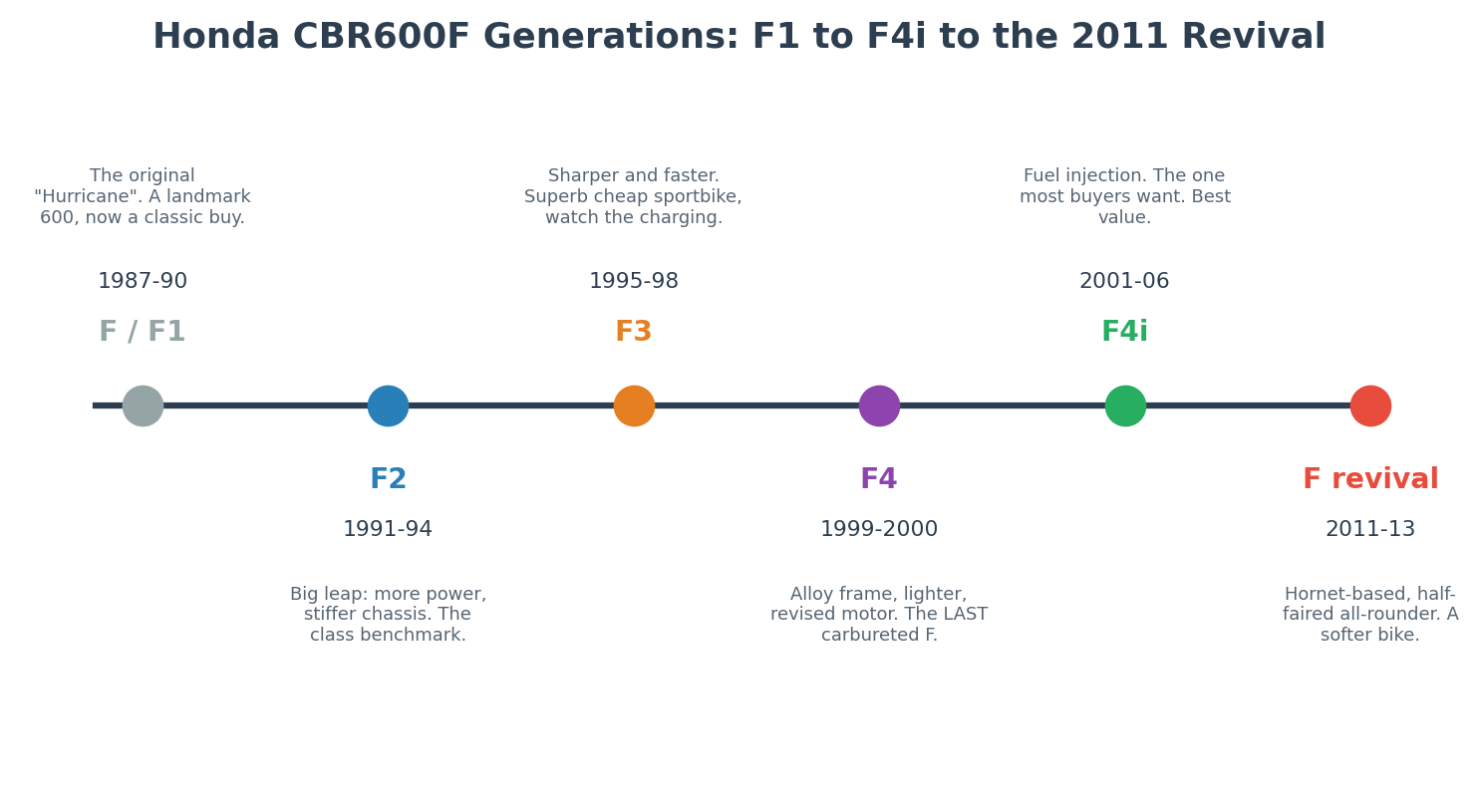
CBR600F / F1 (1987-1990) — the bike that started it. The original "Hurricane" was a genuine milestone in 1987, but by today's standards it is a classic first, a usable sportbike second. Buy one because you love it, not because you want the quickest 600.
CBR600F2 (1991-1994) — the jump from F1 to F2 was massive. More power, a stiffer chassis, sharper looks. The F2 is where the CBR600F became the class benchmark and started dominating showrooms on both sides of the Atlantic. Prices are cheap and the bikes are tough, but watch for age-related tiredness.
CBR600F3 (1995-1998) — more power again, a slicker fairing and small refinements over the F2. The F3 is a brilliant cheap sportbike and a huge favourite in the track-day and budget-racing scene. Just know that the F3 is also the generation forum owners most often flag for charging gremlins — more on that below.
CBR600F4 (1999-2000) — a proper leap. Honda ditched the old steel frame for an aluminium chassis, revised the motor, brakes and suspension, and cut weight. The F4 was the last carburettor CBR600F, and for a lot of riders that makes it the sweet spot: modern enough to feel sharp, simple enough to fix in your own garage.
CBR600F4i (2001-2006) — the one most people are really searching for. The "i" is fuel injection, and it transformed the bike. No more choke, no more sticky carbs, cleaner cold starts and crisper throttle. The F4i split into a sportier "F" and a more touring-focused "FS Sport" in some markets, and it stayed on sale alongside the racier RR for years. If you want the best blend of usability and value, the F4i is the default answer.
CBR600F (2011-2013) — the revival. Honda brought the "F" name back on a Hornet-derived platform: an approachable, half-faired all-rounder aimed at commuters and new riders. It is a completely different animal to the 1990s bikes — softer, torquier, easier — and it is worth knowing this generation exists so you do not confuse a 2012 F with a 1998 F3.
Why import a Honda CBR600F from Japan?
Because Japan is where the good ones are. Japanese-market CBR600Fs tend to have lower mileage, drier lives and far better cosmetic condition than the equivalent UK, Australian or New Zealand bikes that spent 20 winters on salted roads.
There are three concrete reasons the import route wins for a bike this age:
Condition. A 20-year-old sportbike that lived in a British garage has usually been dropped, tracked or thrashed. A Japanese-market example often comes from a careful owner in a mild climate with a proper service history. On a bike where corrosion is the number one enemy, that matters more than any spec sheet.
The auction sheet. When you buy through a Japanese auction, every bike gets graded by an independent inspector, and the auction sheet tells you about crash damage, rust, tyre condition and modifications before you ever bid. It is the single most honest document in the used-bike world, and it is why importing from Japan is less of a gamble than a Sunday-morning classified you can only judge from four blurry photos.
Choice. Japan sold CBR600Fs in numbers, and the domestic market keeps clean, standard, unmolested examples in circulation long after they have vanished elsewhere. If you want an original F3 or a low-mileage F4i that has not been turned into a race bike, Japan is where it lives.
You can browse the kind of Japanese-sourced stock we mean on our current listings, and if you want a specific year or trim tracked down at auction, our team does exactly that.
Honda CBR600F specs and performance
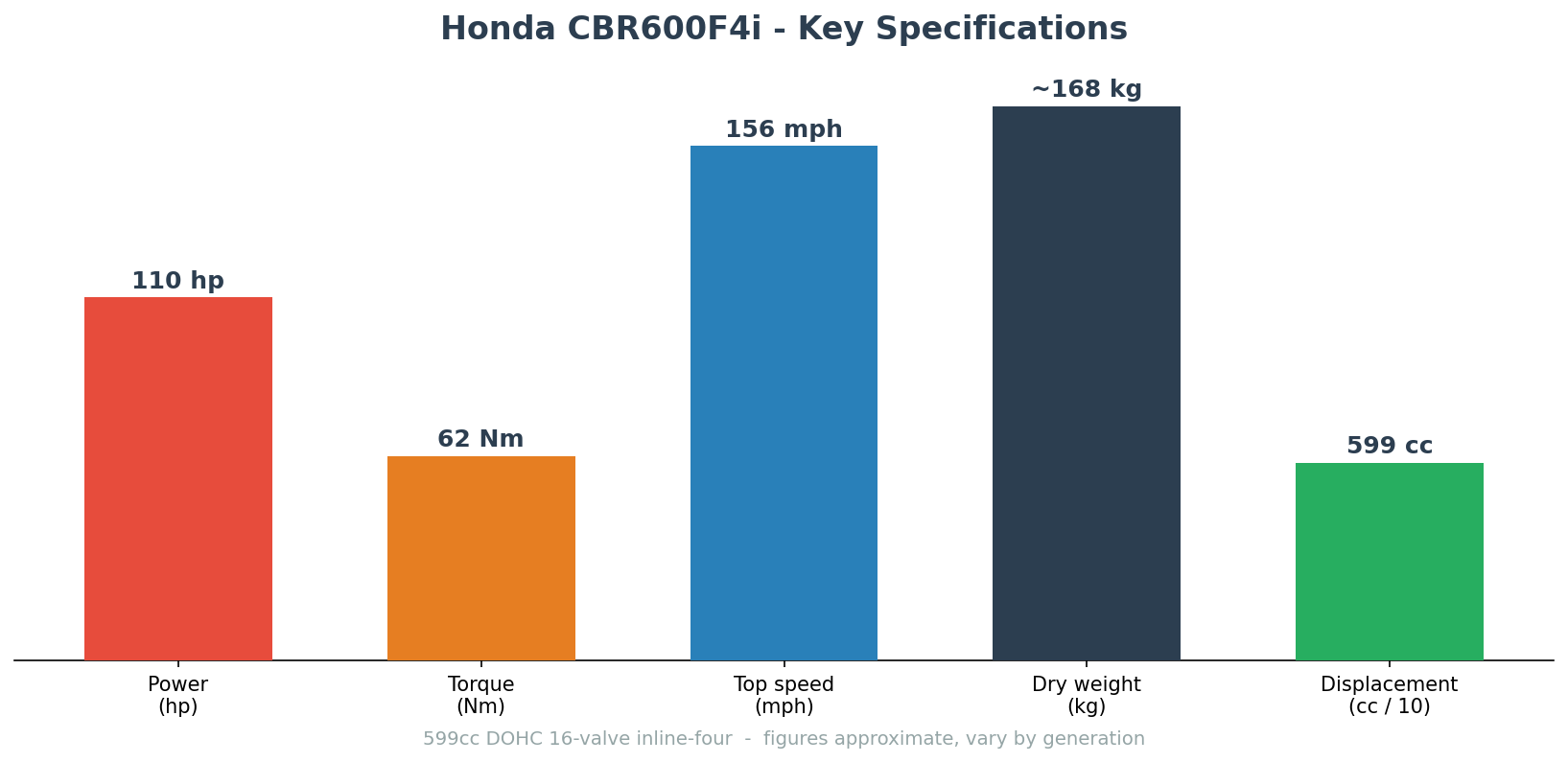
Numbers vary across the generations, but the F4i is the benchmark most buyers care about, so let's anchor on it. The F4i runs a 599cc DOHC 16-valve inline-four producing around 110 horsepower at 12,000rpm and roughly 62Nm of torque, good for a top speed near 156mph and a 0-60mph time comfortably under four seconds.
What the raw figures miss is how the F delivers that performance. This is not a highly-strung motor that only wakes up at 10,000rpm. It pulls cleanly from the midrange, so you spend less time hunting gears and more time actually enjoying the road. The riding position is the other half of the story: taller bars, a roomier tank-to-seat reach and a seat you can sit on for two hours without staging a mutiny. That combination is why the F earned its "do-anything" badge while the RR earned its "brilliant but brutal" one.
Weight sits in the low-190kg range dry depending on generation, brakes are strong twin front discs, and the suspension is adjustable enough to set up for your weight without needing aftermarket parts. For a bike you can buy for the price of a used scooter, that is a lot of capability.
Carb vs fuel injection: F4 vs F4i
This is the decision that trips up more buyers than any other, so let's settle it. The 1999-2000 F4 is carbureted. The 2001-2006 F4i is fuel injected. They look almost identical. They ride very differently to own.
The carbed F4 is mechanically simpler and cheaper to buy. If you enjoy spannering, a set of clean carbs is a satisfying thing to maintain, and there is no injection ECU to worry about. The downside is real-world: carbs on a 20-plus-year-old bike gum up if the machine has been sitting, cold starts need the choke and fuelling is never quite as crisp.
The injected F4i just works. Thumb the starter on a freezing morning and it fires. No choke, no flat spots, no carb rebuild after the bike sat over winter. For most riders importing a CBR600F to actually use, the F4i is worth the small price premium every single time.
Here's the honest exception: if you want the lightest, purest, most "analogue" CBR600F experience and you are handy with tools, the carbed F4 is a lovely thing. Everyone else should buy the F4i and never think about a float bowl again.
Honda CBR600F common problems to check
The CBR600F is one of the most reliable sportbikes ever built — but "reliable" is not "immortal," and every generation has a handful of known weak spots. Know them and you will out-negotiate 90 percent of sellers.
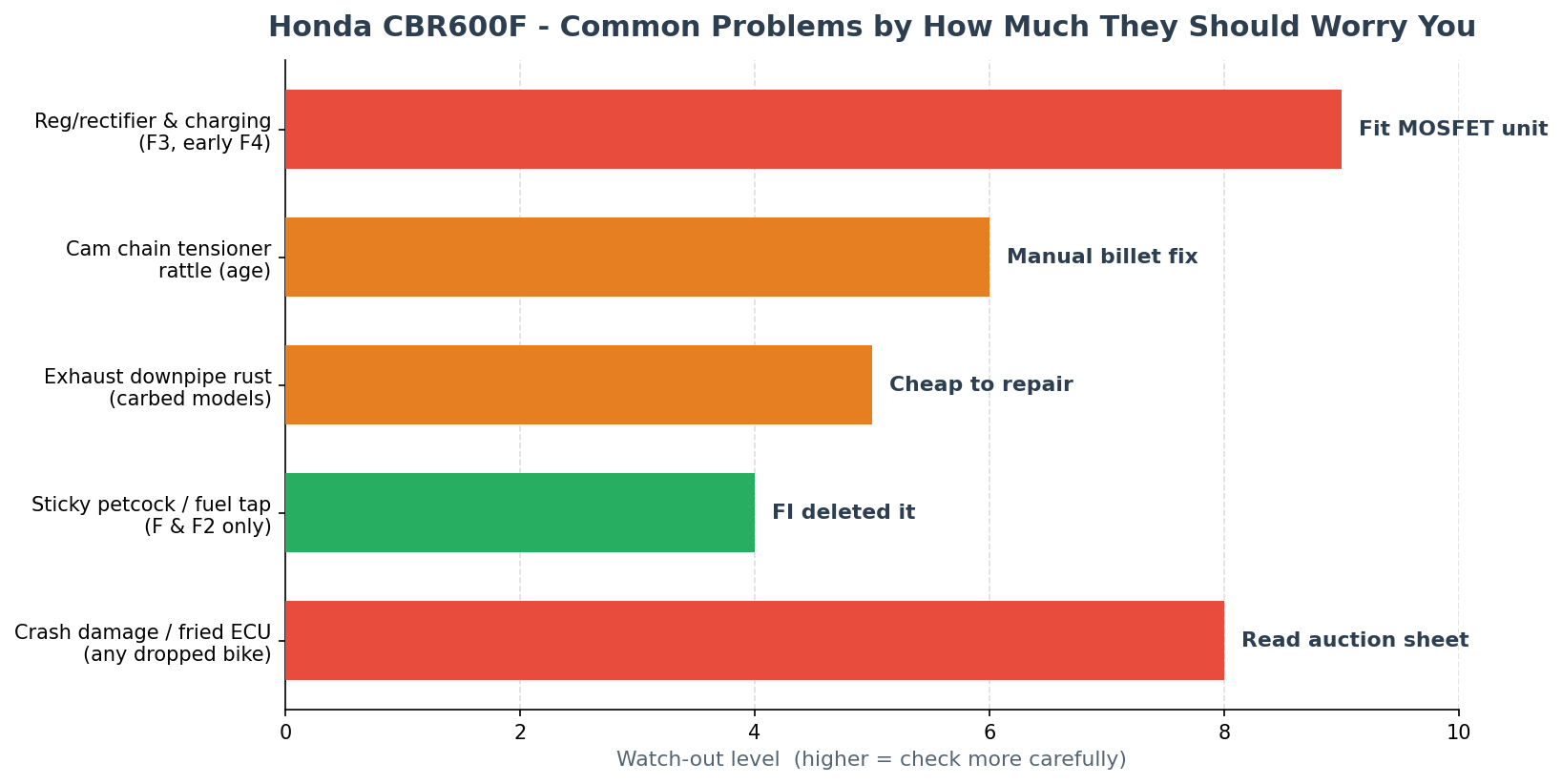
Regulator/rectifier and charging. This is the big one, especially on the F3 and early F4. The reg/rec runs hot, and when it fails it can cook the battery or fry the connector plug. One F3 owner reported going through roughly five regulator/rectifiers over the bike's life. The fix is well known: fit a modern MOSFET regulator with a bigger heatsink, and check the charging voltage at 5,000rpm reads a healthy 13.5-14.5 volts before you buy. A melted or discoloured reg/rec plug is a bargaining chip, not a dealbreaker.
Cam chain tensioner. The hydraulic cam chain tensioner can fail with age, giving a rattle on start-up. The proper fix owners swear by is a manual billet tensioner from a specialist. Listen for top-end chatter when the engine is cold.
Exhaust downpipe corrosion. The exhaust headers rust at the joints, particularly on earlier carbed models that lived outdoors. A blowing exhaust join is common and cheap to sort, but factor it in.
Sticky petcock (fuel tap). The F and F2 are known for sticking fuel taps. The F3 and F4 improved it, and the injected F4i deleted the petcock entirely, so this only applies to the older carbed bikes.
Crash damage and fried electronics. Sportbikes get dropped. Be wary of any CBR that has been down hard: electrical spikes from a tip-over cut-out switch can damage the ECU on the injected bikes, and bent subframes or rewelded pegs hide in cheap listings. This is exactly where the Japanese auction sheet earns its keep — it grades crash history before you commit.
Which years to avoid, and the sweet spot
Nobody wants to hear "avoid a whole generation," and honestly you do not have to. Every CBR600F is a good bike if it has been looked after. But some are smarter buys than others.
Be cautious with: tired, cheap F1s and early F2s bought purely on price. They are 30-plus years old now, and a bargain that needs forks, brakes, carbs and an exhaust is not a bargain. The F3 is superb value but budget for the charging system.
The sweet spot: a clean, standard, low-mileage F4i (2001-2006) from Japan. You get fuel injection, the aluminium chassis, the best brakes of the classic run, and the injected bike's freedom from carb hassles — all for well under the price of a modern learner bike. If you want the last carbed purity, a tidy F4 (1999-2000) is the connoisseur's pick.
Whatever the year, condition beats generation. A pampered F3 will make you happier than a neglected F4i every time.
How much does a Honda CBR600F cost to buy and import?
The CBR600F is one of the great budget heroes, and that is a huge part of the appeal. Here are realistic used ranges before import, based on current UK market listings.
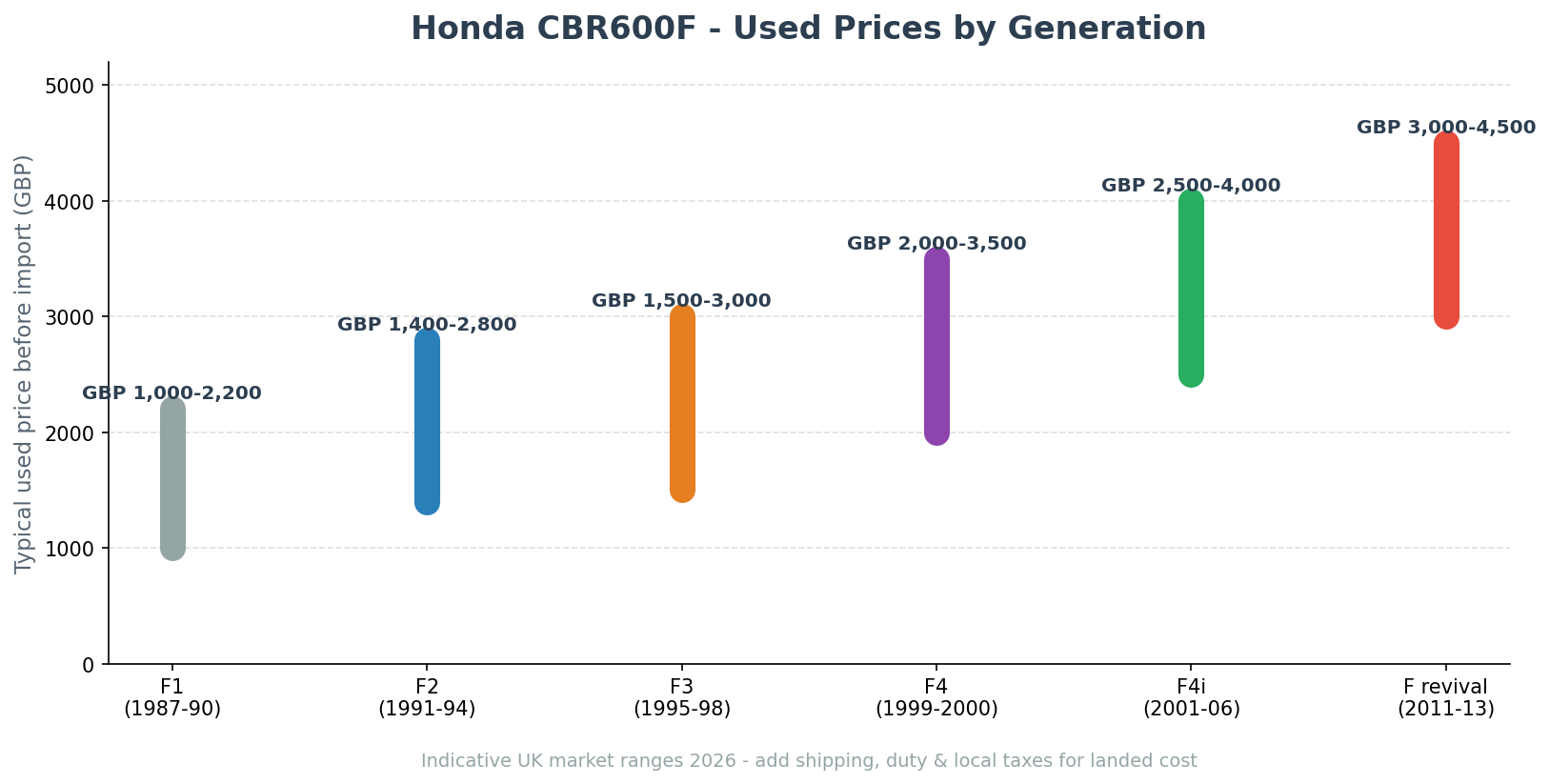
Tidy 1990s bikes — F2 and F3 — start around GBP 1,500 and clean examples sit around GBP 2,500 to 3,000. F4s land roughly GBP 2,000 to 3,500. Good F4is run about GBP 2,500 to 4,000, with minters and low-mile Japanese imports pushing higher. The 2011-2013 revival F sits around GBP 3,000 to 4,500 as a more modern used commuter.
When you import from Japan, the sticker price is only part of the story. Budget for the auction or purchase price, export and shipping, your destination's import duty and taxes, and any local compliance or registration. On a bike this affordable, those fixed costs are a bigger slice of the total than they would be on a superbike, so it makes sense to import a genuinely good example rather than the cheapest runner you can find. Paying a little more for a graded, low-mileage bike spreads those fixed import costs over a machine that will actually last.
For a full walk-through of duties and shipping for your country, talk to our team — we quote the all-in landed cost before you bid, so there are no surprises at the port.
The US 25-year rule and the CBR600F
American readers, this section is for you, and it is good news. The US bans road-importing most vehicles until they are 25 years old, and that clock decides which CBR600F you can actually ride home.
The maths is simple. In 2026, anything from 2001 or earlier clears the 25-year rule. That means the F1, F2, F3, F4 and the first year of the F4i (2001) are all eligible right now. A 2002-2006 F4i is not yet legal to road-import into the US — a 2002 becomes eligible in 2027, and so on year by year.
So if you are in the States and you want a fuel-injected F4i on the road today, you are looking at a 2001. Want the carbed simplicity? The F4 and every 1990s F are wide open. For riders in the UK, Australia and New Zealand there is no such rule — you can import any year you like, subject to normal compliance.
The Honda CBR600F import process, step by step
Importing sounds intimidating until you have done it once. Here is the honest sequence.
Step 1 — Decide the exact bike. Generation, year, trim, colour, budget. A CBR600F import goes smoothly when you know whether you want an F4i or an F4 before you start, not while you are bidding.
Step 2 — Find it at auction or from stock. Either bid at a Japanese auction through an agent, or buy from an exporter's existing inventory. The auction route gives the widest choice and the auction sheet; buying from stock is faster and simpler.
Step 3 — Read the auction sheet. Grade, mileage, rust notes, repair history. This is where you dodge the crashed and the corroded. A good agent translates and interprets it for you.
Step 4 — Win, pay, export. The exporter handles de-registration, export paperwork and booking the bike onto a vessel or into a container.
Step 5 — Shipping and landing. Sea freight is the norm. Expect a few weeks in transit depending on your country.
Step 6 — Duty, compliance and registration. Pay import duty and taxes, meet any local compliance standard, and register the bike. Then ride it.
None of these steps is hard on its own. The value of a good import partner is that they chain them together so you never touch a Japanese customs form. That is the whole job we do.
What nobody tells you: the "unkillable" 600
Spend an evening in CBR600F owner communities and one word keeps coming up: unkillable. It is not marketing. It is what people who have run these bikes to the moon and back actually say.
That 731,000-view compression-test video built its entire premise on a high-mileage F4i that simply refused to wear out. The 516,000-view Spanish long-term review documents an F4i at 70,000km still running like new. These are not cherry-picked garage queens — they are hard-used bikes proving that Honda's late-1990s and early-2000s inline-fours are among the most durable engines the company ever built.
The practical takeaway is liberating: on a CBR600F, mileage matters far less than maintenance. A well-serviced 60,000km F4i with a fistful of receipts is a better buy than a "low-mileage" example that sat neglected in a shed. Buy the history, not the odometer.
The other thing owners tell you? It is a brilliant first big bike. That Polish review titled itself around the question "a good 600-class sport bike to start on?" and racked up over 426,000 views precisely because so many riders were asking it. The answer, over and over, is yes — the F is fast enough to thrill and forgiving enough to learn on.
Honda CBR600F vs the rivals
The 600 class was a war zone, and the CBR600F fought a specific corner of it: usability. Here is how it stacks up against the obvious alternatives you will also see on the export sites.
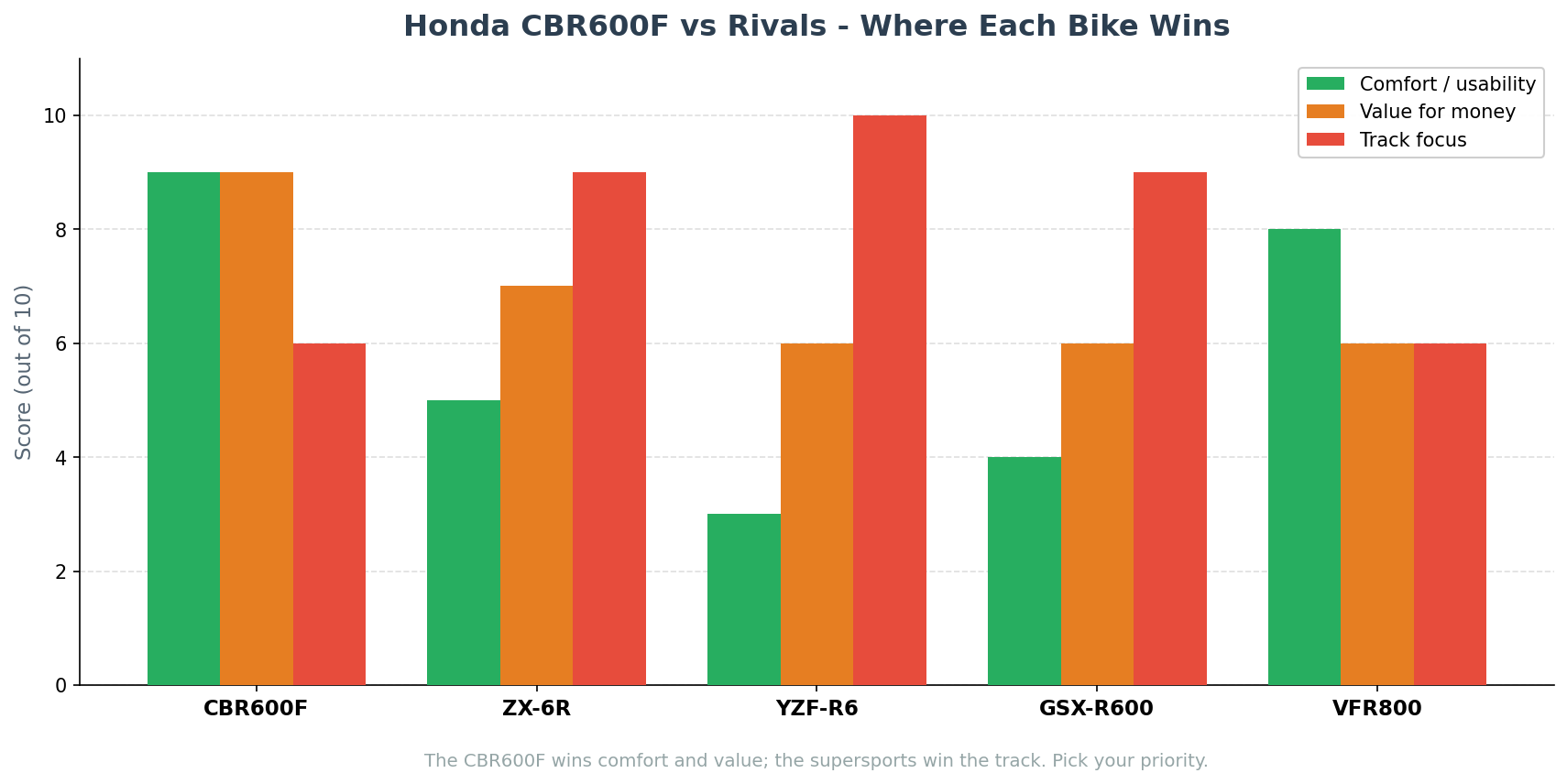
vs Kawasaki ZX-6R — the ZX-6R is racier, peakier and more focused. Sharper on a track, harder work on a commute. The CBR600F wins on all-day comfort and low-rev manners.
vs Yamaha YZF-R6 — the R6 is a screaming supersport that lives above 10,000rpm and punishes you below it. Glorious on a circuit, exhausting in traffic. The F is the bike you keep when the track novelty wears off.
vs Suzuki GSX-R600 — the Gixxer is the committed track weapon of the group. Fantastic if that is your world; overkill and uncomfortable if it is not.
vs Honda VFR800 — this is the closest rival in philosophy. The VFR800 is a heavier, plusher V4 sport-tourer with gorgeous character but higher running costs and weight. If you want more touring and do not mind the bulk, read our VFR800 guide. If you want lighter, cheaper and simpler, the CBR600F is your bike.
The pattern is clear. The CBR600F rarely wins the spec-sheet fight. It wins the "which one would you still own after five years" fight — and that is the one that matters when you are spending your own money.
Maintenance costs: what to budget
This is where the CBR600F really pulls ahead. It is cheap to run in a way modern sportbikes simply are not.
Consumables are shared with millions of other Hondas, so parts are everywhere and cheap. Tyres, brake pads, chain and sprockets, filters and oil are all standard sizes at standard prices. Valve clearance checks come at sensible intervals and, crucially, the engine is easy to work on — the F was built in an era when a competent home mechanic could do most jobs on the driveway.
Budget for the known items: a MOSFET reg/rec upgrade if it has not been done, a manual cam chain tensioner if you hear a rattle, and an exhaust join repair on older bikes. Do those three things to a clean import and you have a sportbike that will cost you tyres and oil for years. Insurance is typically modest too, because a 20-year-old 600 is not a theft magnet the way a new superbike is.
High mileage: how many miles is too many?
Short answer: higher than you think. These engines routinely pass 60,000, 80,000, even 100,000km with basic care, and the video evidence backs it up.
What actually matters is service history and cold-start health. A CBR600F that starts cleanly, holds a steady idle, charges correctly and has a folder of receipts is a safe buy at 70,000km. A "23,000km" bike with no history, a rough idle and a suspiciously shiny chain is the gamble. On this model, run away from mystery low mileage and toward documented high mileage.
Check the basics on any high-miler: smooth gearchange, no top-end rattle when cold, correct charging voltage, straight forks, and even tyre wear. Get those right and the odometer number is almost an afterthought.
Popular Honda CBR600F modifications
Most CBR600Fs you will see have a mod or two, and the good news is the popular ones are sensible rather than silly.
An aftermarket exhaust (slip-on or full system) is the most common — it saves weight, wakes up the soundtrack and is easily reversible. A MOSFET regulator/rectifier is less a mod than a reliability upgrade, and a bike that has had one is a green flag. Braided brake lines sharpen the aging brakes for very little money. Fresh, properly-set suspension or a rebuild transforms how a tired F rides.
What to be wary of: heavily race-prepped bikes with drilled fairings, aftermarket loom hacks or dodgy rewiring. On a budget import you want originality and honest maintenance, not someone else's abandoned track project.
Is the Honda CBR600F a good first big bike?
Yes — and it is one of the best in the business. This is not us being polite; it is the reason hundreds of thousands of riders learned on one.
The F gives you real sportbike performance without the intimidation. The power is strong but progressive, the riding position is humane, the seat is genuinely usable, and the whole bike is forgiving of the mistakes new riders make. It is fast enough that you will not outgrow it in a season, and cheap enough that dropping it in a car park does not ruin your year.
Compared with jumping straight onto a razor-edged supersport, the CBR600F lets you build skill on a bike that flatters you rather than punishing you. That is exactly why owner reviews aimed at new riders keep pulling hundreds of thousands of views — the question "is this a good first 600?" has been answered yes for over 30 years.
The CBR600F engine: built to outlast the bike around it
Understanding why the CBR600F is such a safe used buy comes down to the engine, so let's spend a minute on it. Honda's 599cc inline-four is the definition of over-engineered in the best possible way. It was designed to survive being revved hard by a generation of riders who bought it as their first fast bike, and it did exactly that.
The reason it lasts is boring and brilliant: modest state of tune for the displacement, generous oil capacity, robust bottom-end bearings and a valvetrain that holds its clearances. Where a screaming supersport wrings every last horsepower out and pays for it in shorter service life, the F leaves headroom on the table. That headroom is what you are cashing in when you buy a 70,000km example that still pulls cleanly to the redline.
This is why the owner videos matter so much for this particular bike. When a compression-test clip on a high-mileage F4i pulls three-quarters of a million views under the banner of "unkillable," that is not a fluke going viral — it is thousands of owners recognising their own experience. The engine is the product. Everything else on the bike is replaceable and cheap; the motor is the thing you are really trusting, and it has earned that trust across four decades.
For an importer, that changes the whole risk calculation. On most 20-year-old vehicles the engine is the scary unknown. On a CBR600F, a documented, well-serviced motor is close to a sure thing — which is why you should spend your inspection energy on corrosion, crash history and electrics, not on fretting over the odometer reading.
What the Japanese auction sheet actually tells you
Half the reason importing from Japan beats buying locally is a single piece of paper, so it is worth knowing how to read it. When a bike goes through a Japanese auction, an independent inspector grades it and marks up a diagram of the machine. That sheet is not marketing — the inspector has no stake in the sale, and misgrading damages the auction house's credibility.
The overall grade runs on a scale where higher numbers mean better condition, with letter codes for the cosmetic state. But the gold is in the map. The inspector marks scratches, dents, rust, replaced panels and repair points directly onto a diagram of the bike, with codes telling you exactly what and where. A scratch on the fairing is one thing; a repair mark on the frame is a completely different conversation.
For a CBR600F specifically, you are hunting for three things on that sheet: evidence of a hard crash (frame or subframe marks), corrosion notes (this is a bike where rust is the main enemy), and genuine low, verified mileage. A clean sheet on a low-mile F4i is about as close to a guarantee as the used market offers.
The catch is that the sheet is in Japanese, in shorthand, and easy to misread if you do not do it every day. That is exactly the part a good import partner handles for you — translating the grade, decoding the repair map, and telling you honestly whether a bike is worth bidding on. We would rather talk you out of a bad CBR600F than land you a corroded one.
What a good CBR600F feels like to ride
Specs tell you what a bike does. They do not tell you what it feels like, and with the CBR600F the feel is the whole reason it has fans 30 years on.
Swing a leg over a clean F and the first thing you notice is that it fits. The bars are high enough that your wrists are not carrying your weight, the seat is broad enough to be comfortable, and the reach to the pegs is roomy rather than folded-up. It welcomes you rather than daring you. Then you ride it, and the second thing you notice is the midrange — roll the throttle at 5,000rpm and the bike just goes, no need to wring its neck.
Push harder and the sporting side wakes up. The chassis is stable and predictable, the front end tells you what the tyre is doing, and the whole bike changes direction with an easy, honest precision. It is not the sharpest tool in the 600 class and it never pretended to be. What it is, is trustworthy — a bike that flatters a decent rider and forgives a rusty one.
That character is why so many owners describe the F as the bike they wish they had never sold. It is fast enough to grin at, comfortable enough to tour on, cheap enough to run without thinking, and tough enough to trust. Import a good one from Japan and you get all of that with the condition and history a local example can rarely match.
Honda CBR600F pre-purchase checklist
Print this, or send it to your import agent. Before money changes hands on any CBR600F, confirm:
Identity: the exact generation and year, and that it is an F and not an RR. Match the frame and engine numbers to the paperwork.
Charging: voltage at the battery reads 13.5-14.5V at 5,000rpm; the reg/rec plug is not melted or discoloured; ask whether a MOSFET unit has been fitted.
Engine: clean cold start, steady idle, no top-end rattle (cam chain tensioner), no smoke, and a service history you can actually see.
Chassis: straight forks, no fork-seal weeping, even tyre wear, a chain and sprockets in good order, and no crash-repair tells around the pegs, subframe or fairing mounts.
Exhaust: check the header joints for rust, especially on carbed bikes.
The auction sheet: for a Japanese import, read the grade and the inspector's notes. It is the most honest thing in the whole transaction — use it.
Tick those boxes and you are buying one of the all-time great used sportbikes with your eyes open. Browse our current stock or tell our team the exact CBR600F you want, and we will find a graded example at auction in Japan and land it at your door.
See Also
Share this article: