
If you want to import a Honda NC750X from Japan, you have picked the most sensible motorcycle almost nobody brags about. It is a 745cc parallel-twin adventure-styled commuter that sips fuel like a scooter, swallows a full-face helmet in a lockable front boot where the tank should be, and refuses to break. It is the bike people buy after they have owned something fast and finally admit that most of their riding is a commute, a coffee run, and the occasional weekend blast.
Here is the thing nobody mentions about the NC750X: it is quietly one of the best-selling big bikes in Europe, and Japan is full of clean, low-mileage examples, including the DCT automatic that a lot of markets barely stocked. That combination is exactly why importing one makes sense. This guide covers the generations, the DCT-versus-manual argument, the real problems, the years to avoid, what a used one costs, and how to actually get one home.
What is the Honda NC750X?
The NC750X is Honda's "new concept" all-rounder, launched as the 700 in 2012 and enlarged to 745cc in 2014. The X stands for the adventure-styled version with a taller screen, longer travel and an upright riding position. There is also the naked NC750S and, in some markets, an Integra maxi-scooter that shares the same guts. The X is the one worth chasing.
What makes it odd is the engine. Honda took the philosophy behind a car engine, tuned it for low-rev torque, and gave it a redline barely above 6,500rpm. It makes around 54bhp and 68Nm, which sounds modest until you realise nearly all of that torque arrives just off idle. You do not rev this bike. You surf a wave of low-down shove and change up early, which is exactly why it returns 80mpg without trying.
The party trick is the storage. Because the engine is canted forward and the fuel tank lives under the seat, the space where a tank normally sits becomes a 22-litre lockable "frunk" that holds a full-face Arai. No other mainstream motorcycle does this. That single feature converts skeptics faster than any spec sheet.
NC700X vs NC750X vs NC750S: don't buy the wrong one
Japanese auction listings throw around NC badges loosely, so learn the differences before you bid.
The NC700X (2012-2014) uses a 670cc version of the same twin making about 51bhp. It is a fine bike, but the later 750 is smoother and pulls harder for pennies more, so there is little reason to import a 700 unless the price is silly.
The NC750X (2014-on) is the 745cc adventure-styled model you actually want: taller screen, longer suspension, upright bars, the tall stance that suits the "X" name.
The NC750S is the naked roadster on the same platform, lower and cheaper but with less wind protection and shorter travel. If a Japanese listing shows a flat, low bike with no beak, that is the S, not the X. Confirm the model code and the bodywork in photos, because a hurried buyer can pay X money for an S.
Why import a Honda NC750X from Japan?
Three reasons. First, Japan bought these in huge numbers as commuters, so the used pool is deep and clean, with plenty of low-mileage bikes that spent their lives on smooth city roads and got dealer servicing.
Second, DCT availability. The dual-clutch automatic is far more common on Japanese-market bikes than on many used forecourts abroad, and it is the version most import buyers actually want. If you have your heart set on a low-mileage DCT, a Japanese auction is often the fastest way to find one at a fair hammer price. It is worth browsing the current listings just to see how many clean DCT examples pass through that never reach a Western dealer.
Third, condition per pound. Japan's strict inspection culture (shaken) and low average mileage mean a ten-year-old NC750X out there can look and ride like a three-year-old bike elsewhere. You are buying someone else's careful ownership.
Be honest with yourself, though: the NC750X was sold new in the UK, Australia and New Zealand, so you are not importing something unobtainable. The savings on cheaper models can be slim once shipping and duty land. The win is condition, spec, and colour or trim you cannot find locally. We will do the honest maths later in this guide.
The engine: why a "boring" 745cc twin is the whole point
Reviewers love to call the NC engine lazy. They are right, and that is the feature, not the bug. It is a 270-degree parallel-twin tuned for the rev range you actually use in the real world. Peak power lands around 6,250rpm and the redline is not far after, so there is no reward for wringing its neck.
What you get instead is a motor that feels torquey from 2,000rpm, refuses to stall, and lets a nervous rider trickle through traffic without drama. It is also built like an anvil. Owners routinely report 60,000 to 100,000 miles with nothing more than fluids and the occasional consumable. One long-term reviewer on YouTube documented a 20,000-mile bike (Knox, 517,000-plus views) that still felt tight and faithful, which is the whole reason people fall for these things.
The downside of a low redline is a bit of buzz through the bars and pegs at motorway speed, and a flat top end if you expect a sportbike hit. Neither surprises anyone who understands what they bought.
DCT vs manual: the honest breakdown
This is the single biggest decision, so let's be straight about it.
Honda's DCT (Dual Clutch Transmission) is a proper automatic with two clutches and no lever. It shifts itself in D or Sport mode, or you flick paddles in manual mode. On the NC750X it is genuinely brilliant in town: no clutch fatigue, no stalling, smooth creeping through traffic. A RevZilla "Daily Rider" episode on the 2021 DCT (836,000-plus views, 1,300-plus comments) is the go-to explainer, and the comments are full of converts who swore they would hate it. If you have never ridden one, get on a DCT for ten minutes before you decide, because the internet argument almost always loses to the actual experience.
The honest gripes are real, too. In default D mode the computer is desperate to upshift for economy, so you can be in 6th at 40mph and feel it hunt. Riders also complain it can upshift back after you have manually dropped a gear, or shift mid-corner if you are not in manual mode. The fix is simple: use Sport mode or the paddles when you are riding for fun, and let D do its thing on the commute.
The manual is lighter by around 10kg, cheaper to buy, cheaper to fix, and the gearbox itself is the one component owners nitpick: it can feel notchy and throw the occasional false neutral, especially if the chain and shift linkage are neglected. Nothing dangerous, just a clunk.
Buy DCT if your riding is mostly urban and you value the auto in stop-start traffic; it is the version most import shoppers hunt for. Buy manual if you want lower weight, lower cost, and full control. Both are reliable. Do not let anyone tell you the DCT is fragile, because it is not, but do read the problems section, because when a DCT does misbehave it is not a cheap fix.
The frunk: 22 litres of the most useful storage on any bike
It deserves its own section because it is the reason half of owners keep the bike. The front luggage compartment holds 22 litres from the 2016 update onward (a litre up on the original), it locks with the ignition key, and it genuinely fits a full-face helmet. That means no top-box needed for the shopping, no backpack sweating into your spine, and a dry place for your phone, wallet and gloves.
Import tip: check the frunk lid, hinge and lock on any auction bike. A tired seal lets water in, and a bike that lived outdoors may have a stiff or corroded latch. It is cheap to sort, but it tells you how the previous owner treated the bike.
What owning an NC750X is really like
The spec sheet does not explain why owners are so loyal, so let's borrow from the people who actually live with these bikes. The Missenden Flyer's long-term ownership videos and Knox's 20,000-mile review both land on the same verdict: it is the bike you stop thinking about, in the best possible way. It starts, it goes, it carries your stuff, it costs almost nothing, and it never leaves you at the roadside.
The viral short from Goedhart Motoren that racked up nearly 11 million views summed the appeal up in one line: "the most convenient motorcycle of the moment." That word, convenient, is the whole pitch. You wear normal clothes, drop your helmet in the frunk, and go. No fairing to polish, no chain-snapping power, no drama.
Owners on X back this up. One rider mentioned the stock tyres being "a little puncture prone" but transforming the handling once swapped, a small, honest niggle rather than a complaint. Another put the NC750X in the same sentence as the Yamaha Tracer as their ideal do-everything sport-tourer. That is the crowd this bike attracts: sensible riders who have nothing to prove and a lot of miles to cover.
The flip side, told straight: it is not a bike that makes your pulse race. There is no top-end scream, no wheelie-on-the-throttle hooligan streak. If you want a bike that thrills, look elsewhere in the current listings. If you want a bike you will still be quietly grateful for in five years, this is it.
Honda NC750X generations explained
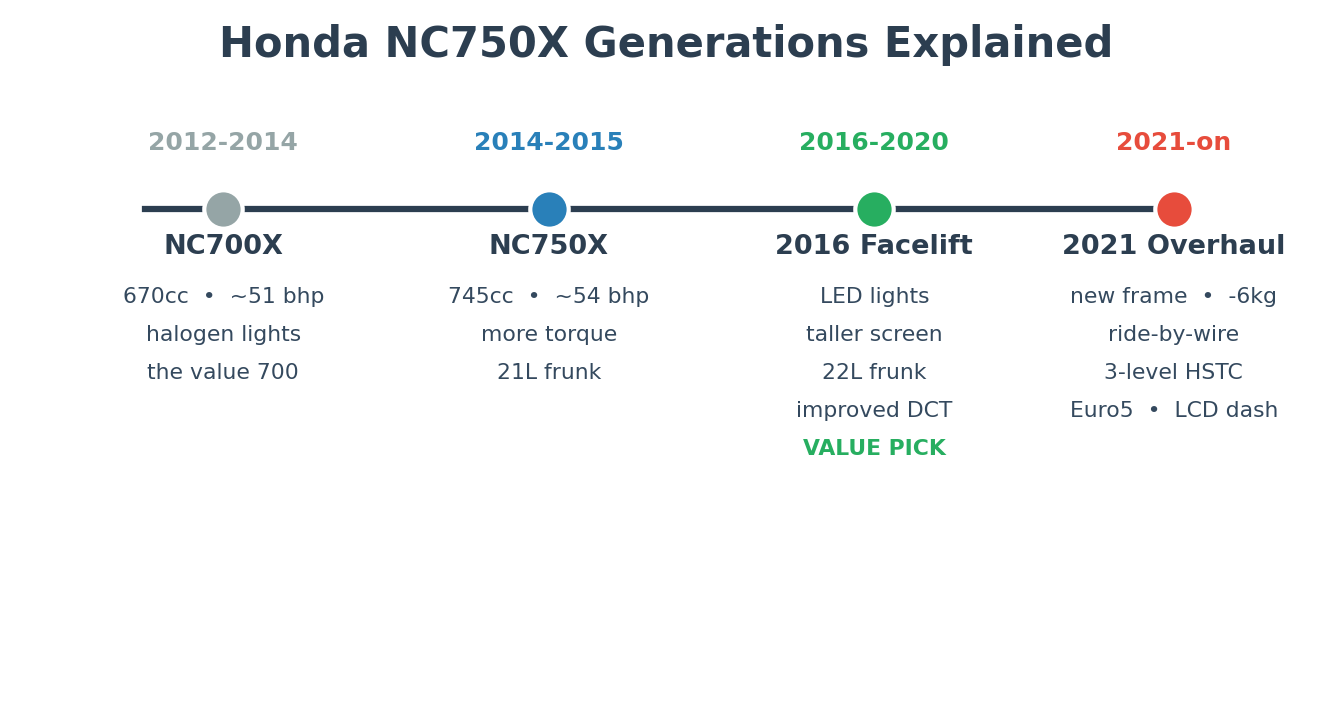
There are three eras to know, and they matter for both price and features.
2014-2015 (first 750): The bore-out from 670 to 745cc added smoothness and a touch more torque. Same basic chassis as the 700, halogen lights, smaller screen, 21-litre frunk. These are the cheapest way into a 750 and mechanically sound, just the least refined.
2016-2020 (the facelift): This is the value sweet spot. Honda gave it LED lights, a taller and more adjustable screen, sharper adventure styling, a 22-litre frunk, Euro4 compliance and, crucially, a much-improved DCT. Big Rock Moto's "World's Most Practical Motorcycle" video (515,000-plus views) is built around this era for good reason. Clean, plentiful, and does everything the new one does for less.
2021-onward (the overhaul): A new lighter frame, throttle-by-wire, updated engine mapping with a little more torque (around 50.9 lb-ft), a three-level HSTC traction control system, a full LCD dash, and roughly 6kg shaved off. It is the one to buy if you want the latest tech and Euro5 emissions. It also commands the highest used prices, so the import maths is tightest here.
Honda NC750X specifications by generation
Here is what the numbers actually look like across the three eras, so you can match an auction listing to the right spec.
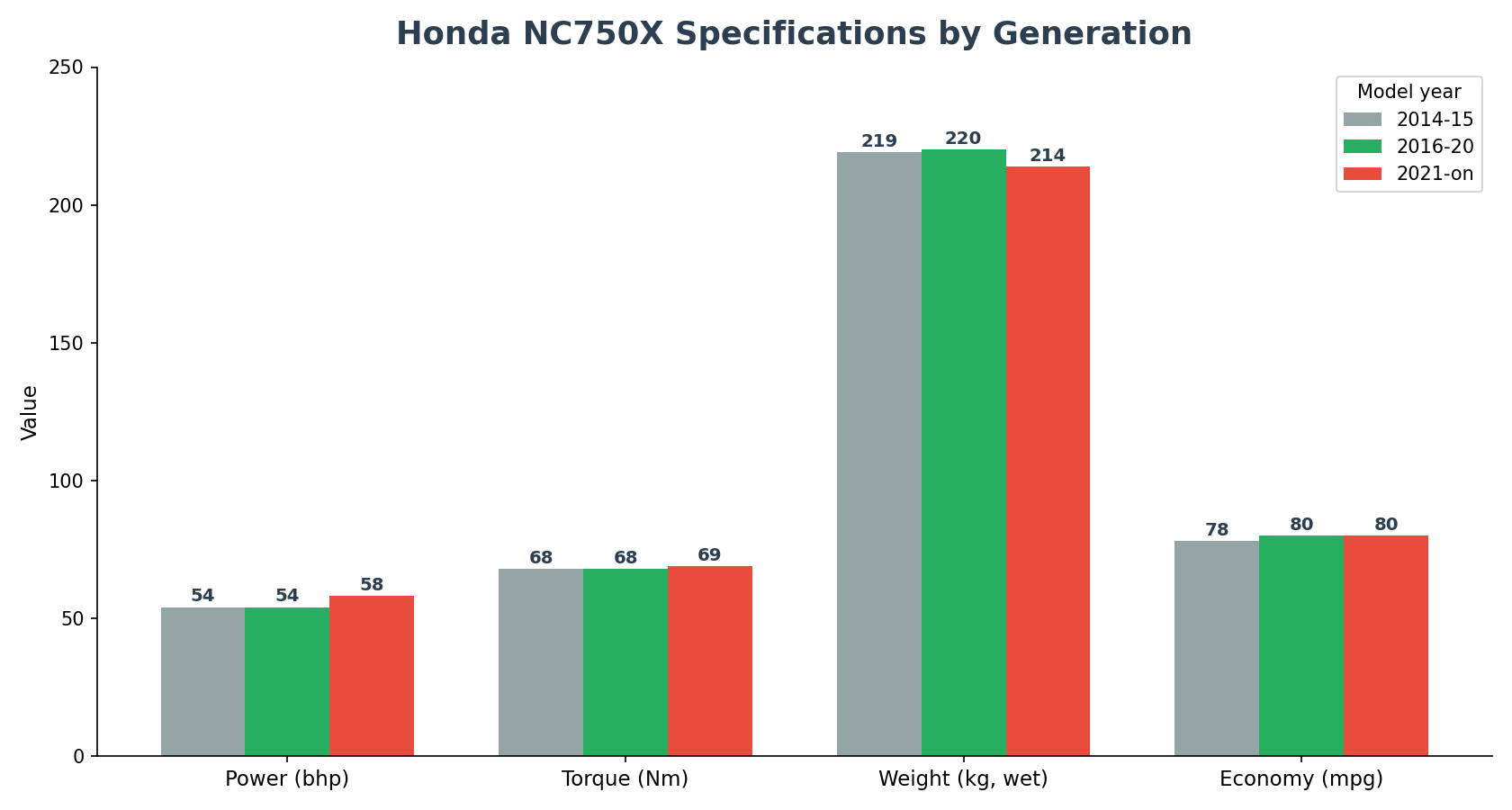
The headline figures barely move because that is the point of this bike: around 54-58bhp, 68Nm, a 14.1-litre under-seat tank, 800mm seat, and real-world economy in the high 70s to low 80s mpg. The 2021 model is the lightest and most powerful, but a 2017 facelift bike gives up almost nothing that matters on the road.
Common problems and known issues
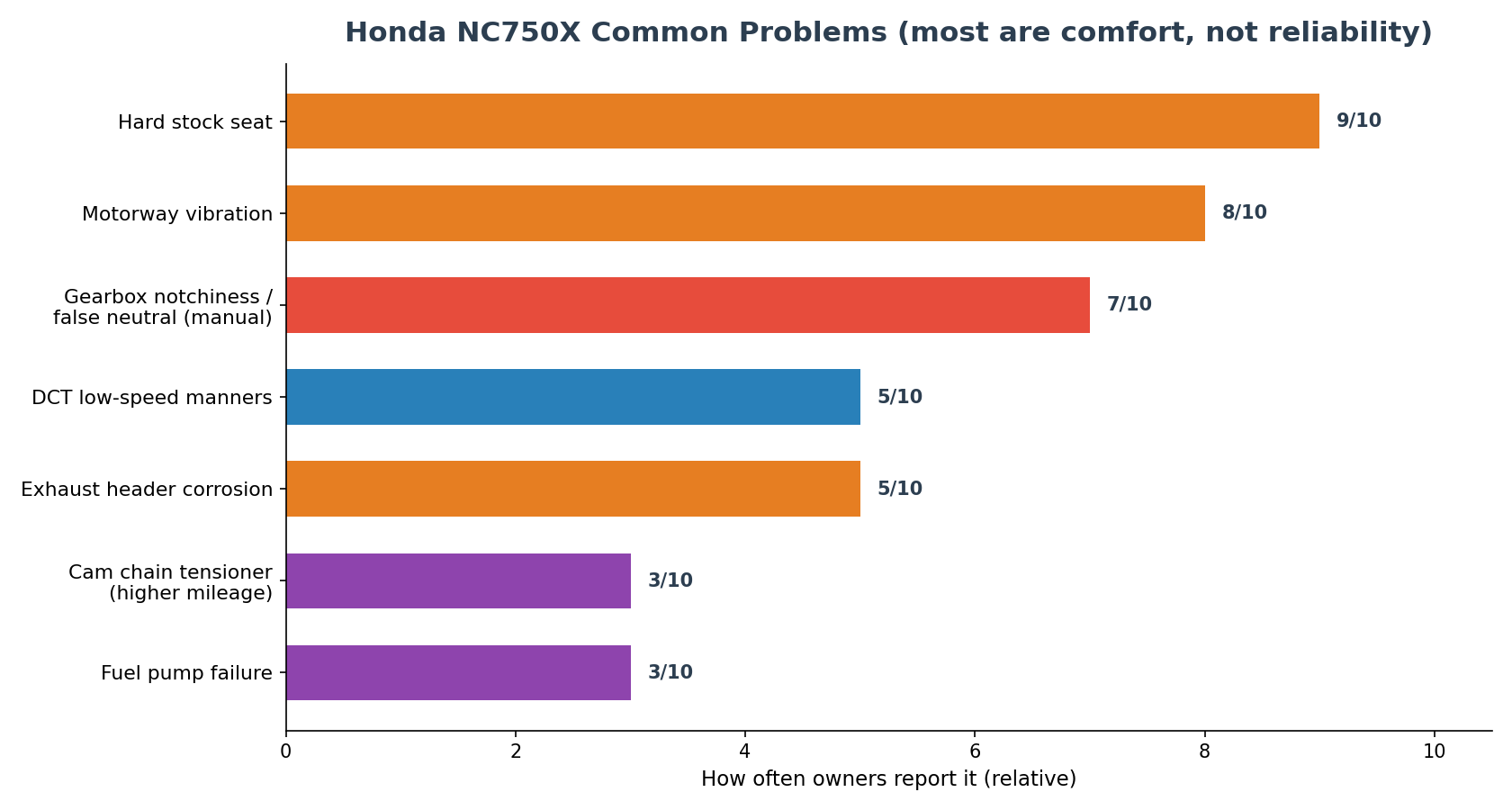
The NC750X is one of the most reliable bikes Honda has ever built, but "reliable" is not "perfect." Here is the honest list, drawn from owner forums and long-term reviews.
Gearbox notchiness and false neutrals (manual): The most common complaint. The manual box can feel clunky and occasionally slip into a false neutral, especially with a worn chain or dry shift linkage. Usually a symptom of neglect, not a design flaw.
DCT low-speed manners: Early hesitation or a slightly jerky feel at crawling speed, plus the over-eager upshifting in D mode. Rare hardware faults involve DCT sensors, the shift motor, or weak battery terminals confusing the electronics, so a healthy battery matters more than usual.
Cam chain tensioner: A minority of higher-mileage bikes have reported cam chain tensioner wear or failure. It is not epidemic, but listen for a rattle on cold start and factor an inspection into any high-mileage import.
Fuel pump failure: Some owners report a fuel pump that fails and causes stalling. It is a known-enough issue to check the service history for a replacement and to note any hot-start hesitation.
Corroded exhaust headers and bolts: The downpipes and fasteners can surface-rust, especially on bikes ridden through winters. Japanese imports often fare better here thanks to milder use, but inspect the header area anyway.
Vibration and a hard seat: The parallel-twin buzzes a little at motorway speed and the stock seat turns to plywood after a couple of hours. Both are comfort issues, both are cheaply fixed with bar-end weights and an aftermarket or Comfort seat.
Which years to avoid, and which to buy
There is no genuinely bad NC750X, which is rare praise. The earliest 2014-2015 750s are the least refined and had the earlier DCT calibration, so if you specifically want the automatic, a 2016-or-later facelift bike is smoother.
The value pick is a 2016-2020 facelift: LED lights, the bigger 22-litre frunk, the improved DCT and mature styling, at prices well below the new-shape bike. If you want the newest tech and the lightest chassis, the 2021-on is the buy, just expect to pay for it. Whatever the year, service history beats model year every time on a bike this durable.
Fuel economy and running costs
This is where the NC750X embarrasses almost everything else. Data from 180-plus owners on Fuelly clusters around the high 70s mpg, and 80-plus is easy with a gentle right hand. The 14.1-litre tank gives a genuine 250-mile range, which turns a tour into fewer fuel stops than your bladder needs.
Servicing is cheap because the engine is so under-stressed. Oil changes come at sensible intervals and, remarkably, valve clearance checks only fall due every 16,000 miles (24,000 km), roughly double what many bikes demand. Consumables last because you are not thrashing it. Insurance sits low thanks to modest power and Honda's reliability record. For a lot of owners this is the cheapest big bike they have ever run.
Add it up over a year and the numbers are almost comical for a 750. Fuel at 80mpg, a chain and sprockets that last because the power is gentle, tyres that go the distance because you are not melting them, and a service bill that a small commuter would recognise. This is the part that turns curious buyers into repeat owners: the NC750X does not just cost little to buy, it costs little to keep.
Comfort, ergonomics and two-up touring
The riding position is upright and roomy, with wide bars, a low 800mm seat and enough legroom that taller riders do not feel folded up. The screen on the facelift and 2021 bikes does a decent job of pushing wind off your chest, though the tallest riders still buy an aftermarket touring screen for motorway calm.
Two-up, the NC750X is better than its modest power suggests. The low-down torque means you do not have to thrash it with a passenger aboard, the pillion seat is reasonable, and the frunk plus a top-box swallows two people's kit for a weekend. The one weak spot is that stock seat, which goes hard after 90 minutes; a Comfort seat or an aftermarket unit fixes it and is the first upgrade most touring owners make. For a bike this cheap to buy and run, it punches well above its class as a genuine mile-eater.
What a used Honda NC750X costs
Let's talk money, because it decides whether importing is smart for you.
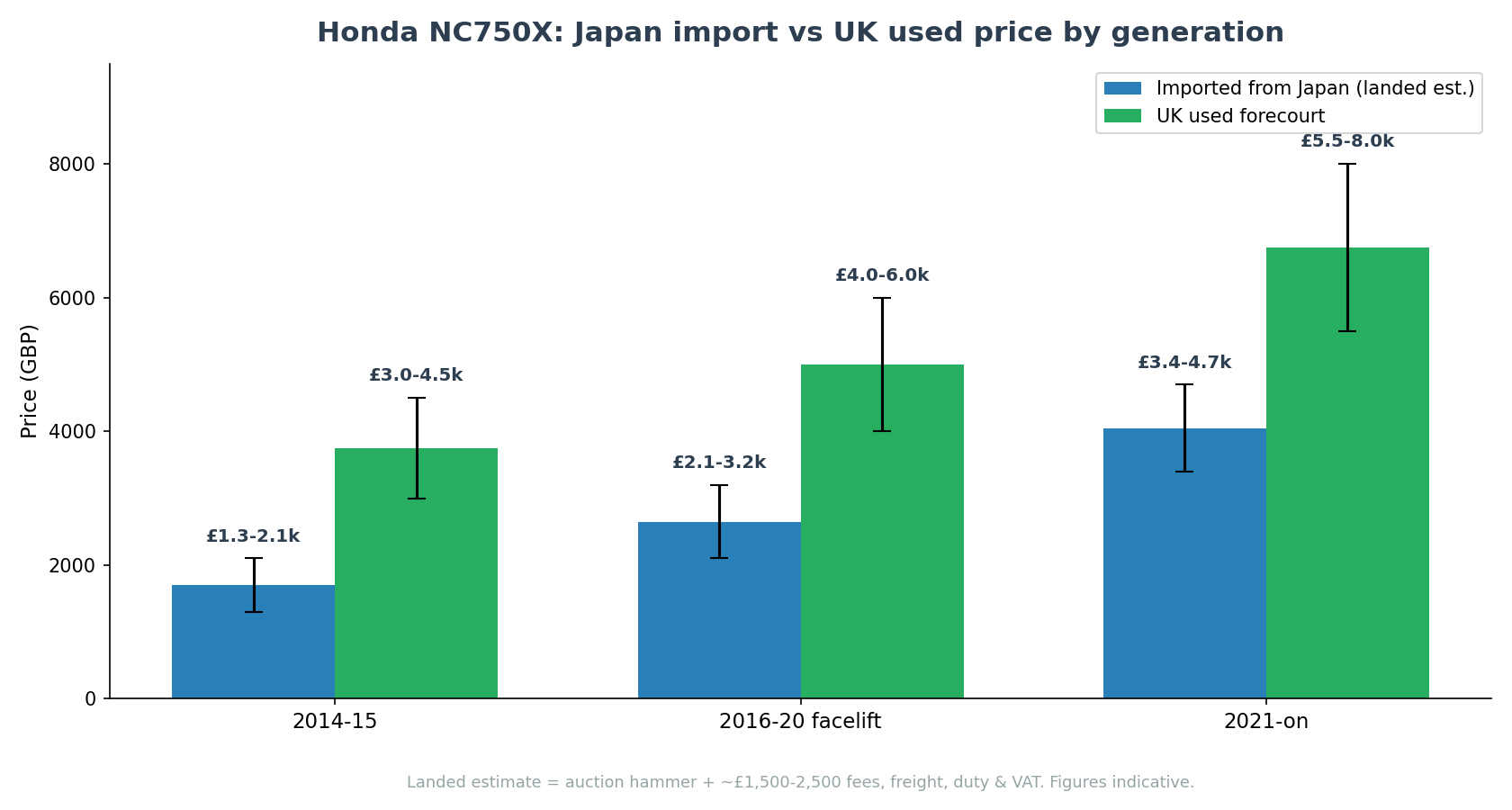
In Japan, auction hammer prices for tidy examples run roughly from the low hundreds of thousands of yen for early 2014-2016 bikes to well over half a million yen for clean 2021-on models. On top of the hammer price you add auction and agent fees, domestic transport, export paperwork, ocean freight, then import duty and VAT in your country, plus registration and any compliance work. As a rule of thumb, budget around 1,500 to 2,500 pounds of landed cost on top of the hammer price for a UK import.
Domestic UK used prices land roughly at 3,000-4,500 pounds for early 750s, 4,000-6,000 pounds for facelift bikes, and 5,500-8,000 pounds for the new-shape 2021-on, with DCT adding a few hundred. Do the sum honestly: on a cheap early bike the import barely saves money, but on a low-mileage facelift DCT in a colour you cannot find at home, importing gets you a better bike for similar money.
Is importing worth it versus buying local?
Straight answer: it depends on what you want.
If you just want any NC750X and you live in the UK, Australia or New Zealand, buying local is easier and probably cheaper on the entry-level bikes. If you want a specific spec, a low-mileage DCT, or a genuinely cherished example that has not been ridden through a decade of salted winters, Japan is where those bikes are, and the import premium buys you real condition.
The other honest angle is patience. Importing takes weeks, not minutes, and involves paperwork. If you need a bike next Saturday, buy local. If you can wait for the right one, an import gets you exactly what you want.
Can US buyers import an NC750X from Japan?
Mostly not yet, and it is worth saying plainly. The United States enforces a 25-year rule for road-legal imports of vehicles that were not originally sold there. The NC750X is modern, so the earliest 2014 bikes will not clear the 25-year threshold until 2039, and the NC700X of 2012 not until 2037. Until then a Japanese-market NC is a closed-course or off-road proposition in the US, not a street-legal daily. American buyers are better served by the plentiful US-market NC700X and NC750X sold new. UK, Australian and New Zealand buyers have no such barrier and can register an import normally.
How to import an NC750X from Japan step by step
The process is less scary than it looks once you have an agent doing the heavy lifting.
Step 1 - Set your budget and spec. Decide DCT or manual, generation, and your maximum landed price. Knowing the total budget stops you overbidding at auction.
Step 2 - Pick an import agent. A reputable agent gives you access to the Japanese auctions, translates the listings and auction sheets, bids on your behalf and handles export. This is where AWA Auction comes in; you can tell our team the exact spec you are after and let them do the hunting.
Step 3 - Find and bid. Your agent shortlists NC750X listings, shows you the auction sheet grades and photos, and places your bid up to your limit.
Step 4 - Export and ship. Once you win, the bike is de-registered, given export paperwork, and loaded for ocean freight or crated air freight. Ocean is cheaper and slower.
Step 5 - Land, clear and register. Pay duty and VAT, complete any compliance or inspection your country requires, then register and ride. Keep every document; it makes resale and insurance far easier.
How to read a Japanese auction sheet
The auction sheet is the single most useful document in the whole process, and learning to read it saves you from nasty surprises.
Each bike gets an overall grade, typically from S or 6 (essentially new) down through 4 and 3.5 (average used) to R or A (repaired or accident history). For an NC750X, aim for grade 4 or better unless the price is exceptional and the notes are clear.
The sheet also carries a diagram of the bike with codes marking scratches (A), dents (U), rust (S) and corrosion. A good agent translates these for you. Watch for notes around the frunk lid, the exhaust, and any electrical warnings, and treat a bike with no clear sheet as a bike you cannot fully trust.
One NC-specific tip: because these bikes were bought as cheap commuters in Japan, plenty have high recorded mileage. Do not panic at a big number. This engine treats 60,000km as barely broken in, so a well-serviced high-miler with a clean sheet is often a smarter buy than a low-mileage bike with vague history. Read the inspector's comments, not just the odometer.
Honda NC750X vs its rivals
The NC750X does not win on paper against sharper rivals, but it wins on the things that matter for daily use. Here is how it stacks up.
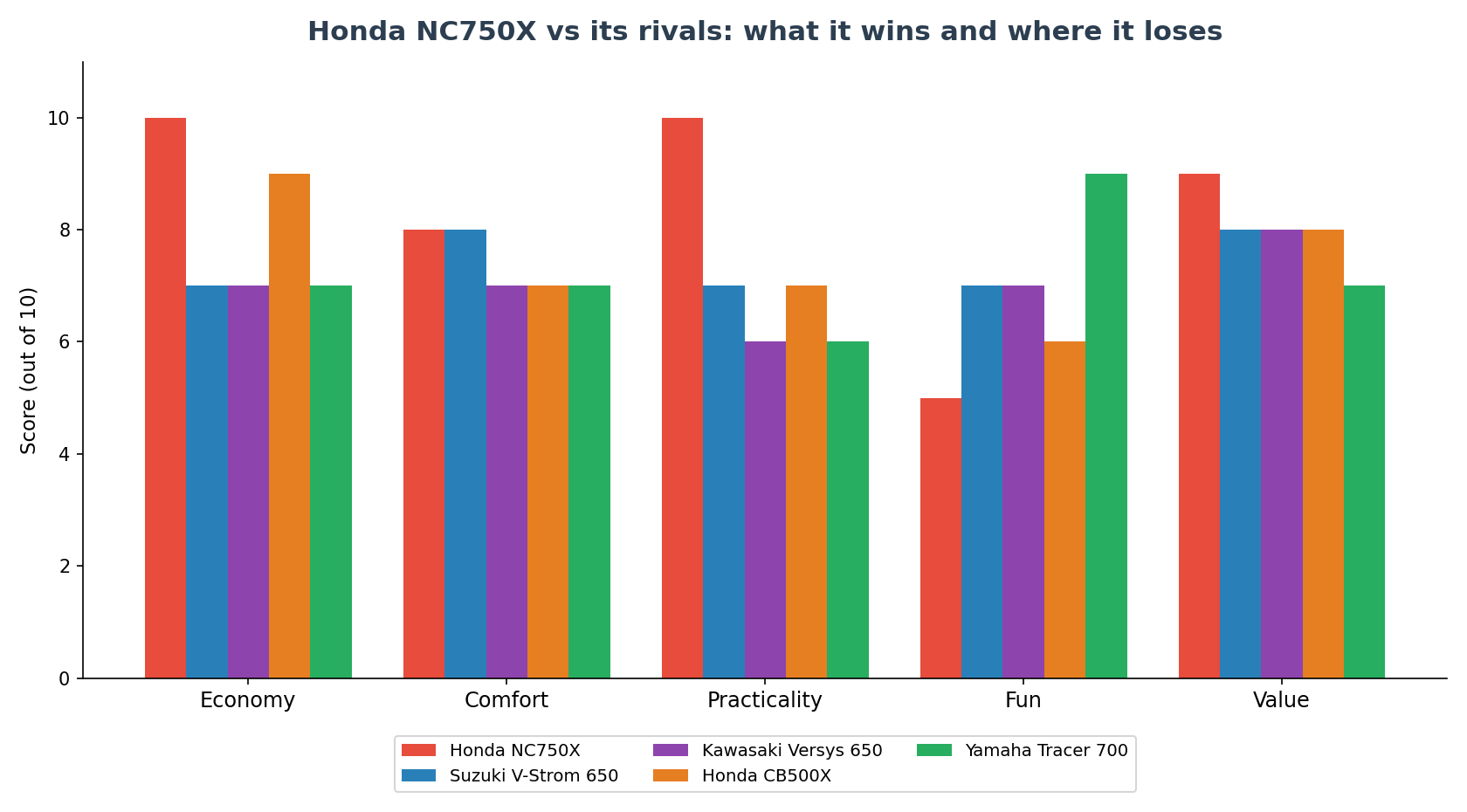
Against the Suzuki V-Strom 650 and Kawasaki Versys 650, the NC gives up top-end power and outright pace but returns better economy, the frunk, and the DCT option neither rival offers. Against the Honda CB500X it is bigger, torquier and more comfortable two-up, though the CB500X is lighter and A2-friendly. Against the Yamaha Tracer 700 the Yamaha is the more exciting, sportier ride, while the NC is calmer, cheaper to run and far more practical. If your priority is fun, buy the Tracer. If your priority is a bike that quietly does everything for years, the NC wins.
Popular modifications
Owners keep the mod list short and sensible, which fits the bike's character.
The common upgrades are a taller touring screen for motorway comfort, a Comfort or aftermarket seat to fix the plank, bar-end weights or Barkbusters to calm vibration and add hand protection, a centre stand (if not fitted) for chain maintenance, heated grips, and hard or soft luggage to go with the frunk. Many riders also add a small skid plate and engine bars. Nobody chases horsepower here, because that is not why you bought it.
Is the NC750X a good first big bike?
It is one of the best. The low seat, low centre of gravity, gentle power delivery and (on DCT) no clutch to stall make it about as unintimidating as a 750 gets. New riders build confidence fast, and the torquey engine never bites. The honest caveat: it is not exciting, so a thrill-seeker will outgrow the feel even if they never outgrow the practicality. For a first big bike that you will still be glad to own five years later, it is hard to beat.
Pre-purchase checklist for a used NC750X
Run through this before you commit to any import bid.
- Confirm it is the X, not the S, and the 750, not the 700, from the model code and bodywork.
- Check for DCT or manual and make sure it matches what you want.
- Cold-start it if possible and listen for cam chain rattle.
- Check the frunk lid, seal, hinge and lock for water damage or corrosion.
- Inspect the exhaust headers and fasteners for rust.
- On a manual, feel for a notchy shift or false neutrals in the history and test notes.
- On a DCT, confirm the battery is healthy and ask about DCT fluid changes.
- Read the auction sheet grade and the damage diagram; aim for grade 4 or better.
- Prioritise service history over model year; this engine outlives its owners.
Resale value and total cost of ownership
Here is a number that surprises people: the NC750X holds its value stubbornly well for a practical bike. Because demand is broad, running costs are tiny and reliability is legendary, used prices stay firm and a clean example is easy to sell on. That matters for an import, because the money you put into landing a good one is not money you wave goodbye to. You ride it for years, then sell it for a sensible fraction of what you paid.
Total cost of ownership is really the NC750X's killer stat. Cheap to buy, cheap to fuel, cheap to service, cheap to insure, and cheap to sell out of. Very few big bikes let you say all five at once. When owners describe it as the most sensible motorcycle they have ever run, this is the maths behind the sentiment.
A2 licence and learner-friendly notes
The full-power NC750X sits above the A2 licence limit, so it is not restrictable to A2 in stock form in most markets, which is worth knowing before you import one as a first bike. Riders on an A2 licence usually step up to the NC after passing their full test, or look at the smaller CB500X instead. Once you hold a full licence, though, the NC750X is about the friendliest 750 on sale: forgiving, low, torquey and (in DCT form) impossible to stall. It is the bike a lot of riders wish they had bought first.
How AWA Auction helps you import an NC750X
Importing a Honda NC750X from Japan is only as easy as the people handling it for you. AWA Auction gives you direct access to the Japanese motorcycle auctions where these bikes turn up clean and low-mileage, translates every auction sheet so you know exactly what you are bidding on, and handles the export, shipping and paperwork end to end.
Browse what is available right now, or talk to our team about sourcing the exact NC750X spec you want, DCT or manual, and we will find it, verify it, and get it to your door.
See Also
Share this article: