
If you want to import a Honda Transalp from Japan, you are chasing one of the most quietly capable dual-sport bikes ever built: a soft, unburstable V-twin in a light, comfortable chassis that will ride to the shops on Monday and to another continent on Friday. This is the bike people keep for twenty years and 100,000 miles. One owner in the comments under a popular review put it plainly: he rode from Ireland to Kazakhstan and back on a 2005 Transalp, the bike never let him down once, and he still rides the same machine today.
Here is the thing nobody mentions in the classified ads: the Transalp name covers four completely different bikes across nearly forty years, and the one you actually want almost certainly never sold in your country. That is exactly why Japan matters. Japan bought Transalps by the tens of thousands, rode them gently, serviced them at the dealer, and parked them in dry garages. This guide walks you through every generation, the exact years to avoid, the weak points to check, the 25-year rule that decides which ones Americans can legally land in 2026, and what a clean auction bike really costs in your driveway. By the end you will know precisely which Transalp to hunt and what to pay.
What Is the Honda Transalp (and Why Import One From Japan)?
The Honda Transalp is a middleweight adventure-touring bike built around a 52-degree liquid-cooled V-twin. Honda launched it in 1987 as a road-biased sibling to the fearsome Africa Twin, aimed at riders who wanted the go-anywhere look and comfort of a big trailie without the height, weight, or price of a full-blown Paris-Dakar replica. It was never the fastest thing in the showroom. It was never meant to be. It was meant to just work, forever, and it does.
That reputation is not marketing fluff. Freddie Dobbs, whose long-term Transalp review has been watched more than half a million times, nicknamed it "the indestructible workhorse," and the comment section reads like a roll-call of high-mileage true believers. One rider bought a 1990 model in 1997 and has since taken it through 23 countries, from the Arctic coast of Alaska to the southern tip of South America. Another bought his 600V new in September 1989 in the original white-blue-red paint and still owns it today. A 66-year-old rider chose a 1999 Transalp as his very first motorcycle, put 4,000 km on it in a year on tarmac and gravel alike, and called it the easiest bike in the world to live with. You do not get testimonials like that for a bike that breaks.
So why import one from Japan instead of buying local? Three reasons. First, availability: the Transalp sold in far bigger numbers in Japan and Europe than in markets like the US, Australia, or New Zealand, and the specific generation you want may simply not exist in your local classifieds. Second, condition: Japanese bikes cover low annual mileage, get dealer-stamped service, and rarely see winter salt, so a Japanese-auction Transalp is usually a cleaner, more honest bike than a tired local example at the same price. Third, honesty: the Japanese auction system grades every bike on a documented inspection sheet, so you know what you are bidding on before you spend a yen. For a bike this cheap and this reliable, importing turns a good deal into a great one.
There is a fourth reason too, and it is the one seasoned importers care about most: value stability. Japanese classics with genuine cult appeal have been climbing steadily, and the Transalp sits at the affordable end of that curve. You are buying a bike near the bottom of its depreciation, from the country with the best-preserved stock, at an exchange rate that in 2026 still flatters foreign buyers. Buy a rough local Transalp and you own a money pit. Buy a graded, low-mileage Japanese one and you own an appreciating, usable classic that owes you nothing.
What Transalp Owners Actually Do With Them
Spec sheets tell you nothing about a bike like this. The ownership stories tell you everything, and the Transalp's are extraordinary for such a humble, cheap machine. These are not press-fleet fantasies; they are the real experiences riders left under the reviews, and they are exactly the kind of primary evidence you should weigh before importing.
Start with distance. One rider commented that he rode from Ireland to Kazakhstan and back on a 2005 Transalp and the bike never let him down once, and he still rides it. Another has owned his since 1997 and used it to cross 23 countries, riding from the Arctic coast of Alaska to the southern tip of South America and from Istanbul to New Delhi. A third owner in Spain is on his fourth Transalp since 1992, his latest a pristine 1989 model. When a bike inspires people to buy it four times over three decades, that is not nostalgia, that is trust.
Then there is affordability. A German owner bought a 1993 Transalp with 42,000 km on the clock for 1,800 euros and called the bike "totally underrated," noting that in Germany the Transalp is still very much a thing. A UK rider paid 1,350 pounds for a 1995 example and said he will never sell it. These are the real transaction prices that make importing worthwhile: even after you add shipping and duty to a clean Japanese bike, you are landing a motorcycle that owners describe in almost romantic terms for the price of a decent set of tyres on a superbike.
The recurring theme in every story is that the Transalp simply does not stop. One long-term owner said outright that modern motorcycles still have to prove they will last as long as a Transalp, and that he always knows he will come home safe. Several riders describe theirs as the perfect all-rounder that handles tarmac and gravel with equal ease, does the daily commute, and then tours a continent on the weekend. That breadth, at that price, with that reliability record, is the entire reason this modest V-twin has a cult following, and the reason a clean imported example is such a quietly brilliant buy.
The Transalp Generations Explained: XL600V, XL650V, XL700V (and the New XL750)
Before you bid on anything, you need to know which Transalp you are looking at. The name stayed the same for decades while almost everything underneath changed. Get this wrong and you will buy the wrong bike for your riding. Here is the whole family, laid out so you can decode any listing at a glance.
XL600V (1987-1999): The Original Workhorse
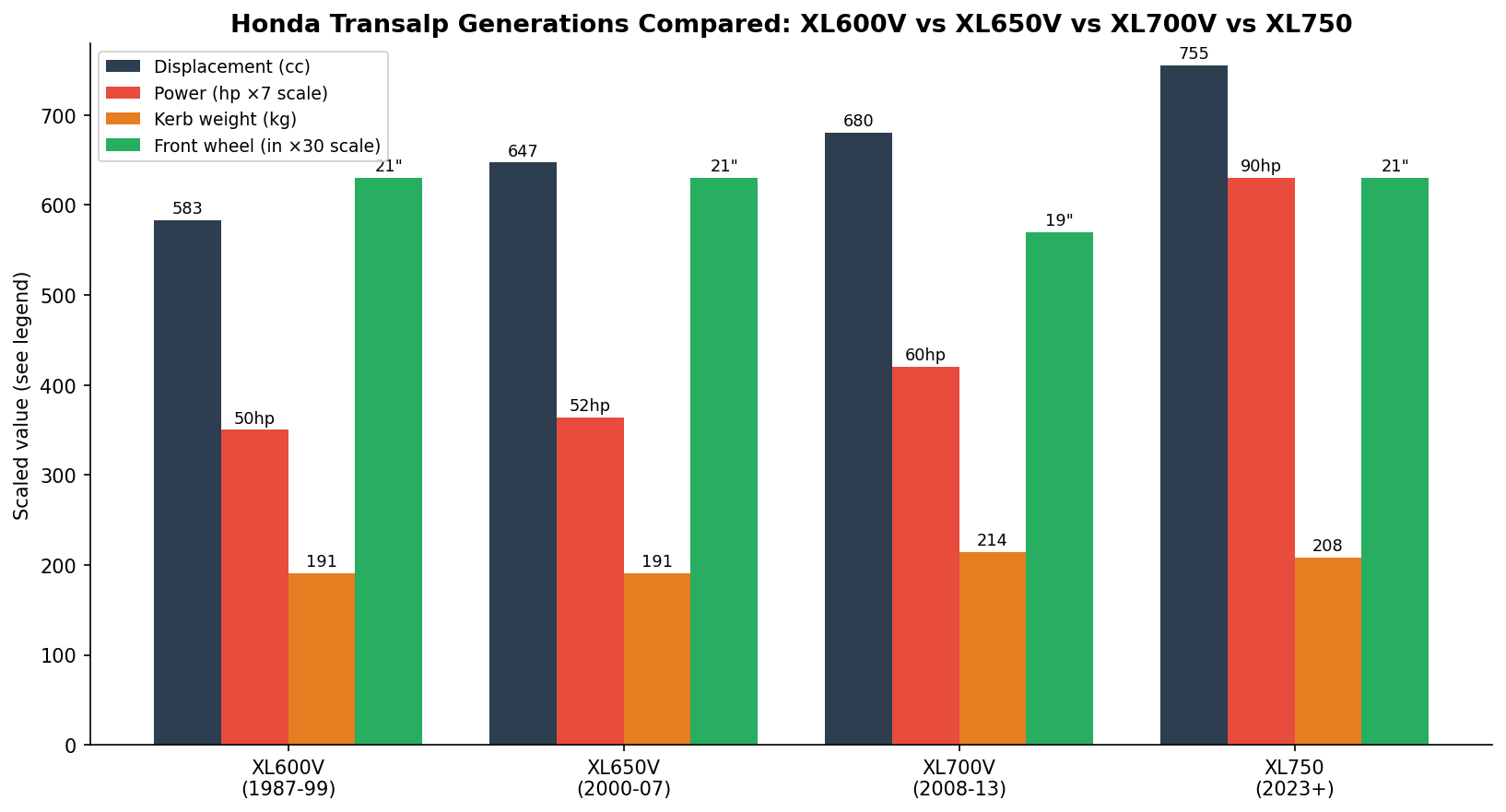
This is the Transalp that built the legend. A 583cc carbureted V-twin making around 50 hp at 8,000 rpm, a proper 21-inch front wheel for light off-road ability, and a dry, simple design that begs to be neglected and refuses to die. Early bikes (1987-1990) ran a rear drum brake; from 1991 Honda fitted a 240mm rear disc, and in 1994 the styling was revised with new lights and fairing. If you want the most "adventure" of the classic Transalps, the raw analog experience, and the cheapest entry into the family, the 600V is your bike. It is also the only generation every country can import right now, which we will come back to.
XL650V (2000-2007): The Sweet Spot
In 2000 Honda bored the engine out to 647cc, borrowing the more modern V-twin from the Deauville and Revere. Power nudged up to around 52 hp, torque improved, the shock was retuned for the road, the fuel tank grew by a litre, and the whole bike lost about 4 kg. Crucially, it kept the 21-inch front wheel and the carburetors, so it still feels like a "real" Transalp while ironing out a few of the 600V's rough edges. For most importers, the XL650V is the sweet spot: modern enough to live with daily, old enough to be dirt cheap, and reliable to a fault. Reviewers describe the motor as being in "a soft state of tune" that, serviced regularly, will simply go on forever.
XL700V (2008-2013): The Road-Biased One
The 2008 XL700V was the biggest philosophical shift. Honda punched the engine to 680cc, switched to fuel injection, dropped the front wheel from 21 to 19 inches, added an optional ABS, and fitted a catalytic converter to meet Euro 3. The result is smoother, more refined, and better on the motorway, but noticeably more road-focused and less happy in the dirt than its ancestors. If you never leave the tarmac and want fuel injection and optional ABS, the 700V makes sense. If you dreamed of a light, spoked, go-anywhere trailie, it strays from the original recipe. Know which you are buying.
XL750 (2023-present): The Modern Reboot
After a decade off, Honda revived the name in 2023 with a completely new bike: a 755cc parallel-twin (not a V-twin) making around 90 hp, a five-inch TFT dash, ride modes, traction control, and an optional E-Clutch. It is a genuinely good modern adventure bike, but it is a different animal from the classics, it is not old enough to import under any 25-year rule, and it is expensive. It matters here mostly because its arrival has poured fresh attention (and buyers) onto the classic Transalps, which brings us to the single most interesting reason to buy an old one right now.
Why the New XL750 Makes Classic Transalps More Tempting
Here is an angle almost no buying guide covers, and it comes straight from the most-watched Transalp video on the internet. When FortNine reviewed the new XL750, the entire piece, watched over 1.3 million times, was titled "How the EPA is Ruining Motorcycles." The argument: to pass modern noise and emissions rules, manufacturers are increasingly shipping bikes with restrictive ECU maps that strangle power and character, especially in the US market. One rider summed up the whole trend on X: the new Honda sport bikes, including the Transalp, get a different ECU map that limits power to pass American noise requirements.
You do not have to fully agree with that take to see the opportunity in it. The classic Transalps were built before any of that. A carbureted XL600V or XL650V is an honest, analog machine: no ride modes to defeat, no emissions map to unlock, no catalytic converter choking the exhaust note. It is exactly the kind of simple, mechanical motorcycle a growing number of riders are actively hunting for as new bikes get more digital and more regulated. The irony is delicious. The launch of the shiny new Transalp is the best possible advertising for the thirty-year-old one, and the smart money noticed. FortNine's crew even tracked down a 1988 model for the film, and a European 600V owner in the comments thanked them for the effort of finding one, because to that community the old bike is the point.
Translation for importers: demand for clean classic Transalps is rising, not falling, and the cheapest, best-preserved examples are in Japan. That is a window, and windows close.
Honda Transalp Years to Avoid (and the Sweet Spots)
No bike this old is completely free of bad years, and the Transalp is no exception. The good news is that the problem years are specific and easy to steer around once you know them.
Avoid the earliest 600Vs (1987-1988) unless the price is very low and the history is spotless. These first-year bikes are the ones most likely to show rising oil consumption past 40,000-50,000 km, caused by worn piston rings and, in some cases, tired valve guides and seals. They also used the early drum rear brake and had a few reported quirks with the output shaft and CDI ignition. None of it is a dealbreaker on a cheap, well-loved example, but you are buying the least-developed version of the bike. A later 600V fixes most of it for very little extra money.
The sweet spots are the mid-to-late XL600V (1994-1999) and the entire XL650V (2000-2007). By the mid-90s the 600V had the disc rear brake, revised styling, and all the early bugs sorted. The 650V then added displacement, a bigger tank, and a road-tuned shock while keeping the carbs and the 21-inch front. This is the Transalp most owners quietly recommend: cheap, reliable, easy to service, and old enough to import almost anywhere. If you want fuel injection and optional ABS and never ride off-road, the XL700V (2008-2013) is fine too, just remember it is the road-biased one with the smaller front wheel.
Whatever the year, condition beats specification every time. A dog-eared 650V with a mystery history is a worse buy than an honest, dealer-serviced 600V with a full book of stamps. On a bike this durable, the paperwork tells you more than the model year.
The Weak Points Every Transalp Buyer Must Check
The Transalp earns its "indestructible" reputation, but "hard to kill" is not the same as "has no known issues." These are the specific things that separate a clean auction bike from a project, and every one of them is checkable on the inspection sheet or in a pre-bid photo. Walk this list before you commit:
- Carburetor condensation and idle jets (600V/650V). A common complaint is a bike that feels flat below 3,000 rpm, running as if on one cylinder. The usual culprit is water condensing inside the tank and plugging the idle jet, not a failing engine. A carb clean fixes it, but factor it in on a bike that has sat unused.
- Regulator/rectifier and charging. Like most Hondas of the era, a tired reg/rec can cook a battery or leave you with a flat one. Check that the bike starts strongly and that any charging warning has been addressed. It is a cheap, well-documented fix if needed.
- CDI and side-stand cut-off. Early Transalps did not have the side-stand cut-off circuit that later ones did, and there is a lot of forum history about CDI faults and getting the correct replacement unit. Confirm which ignition the bike runs before you order any parts.
- Exhaust rust. The original exhaust systems rot, especially the collector, on bikes that have lived outdoors. It is not a mechanical worry, but a corroded system is a bargaining chip and a future cost. Japanese bikes usually fare far better here than salt-belt survivors.
- Wheel and suspension bearings. On any 600V, check the wheel bearings and the Pro-Link rear shock linkage bearings, plus look for loose or broken spokes. These are wear items on a bike that may have covered serious distance.
- Chain and sprockets. Standard driveline wear, but worth a specific mention: owners have reported issues with cheap aftermarket chain kits where the master link clasp failed, which is genuinely dangerous. Budget for a quality chain and sprocket set if the current one is worn.
- Oil consumption on high-mile early bikes. As covered above, a first-generation 600V burning oil past 40,000-50,000 km usually means rings. Ask for compression or leak-down numbers on any high-mileage early example.
None of these is exotic or expensive by big-bike standards, which is exactly why the Transalp is such a smart import. You are buying a bike whose faults are cheap, known, and fixable in a home garage with hand tools.
The 25-Year Rule: Which Transalps You Can Legally Import to the USA in 2026
If you are importing to the United States or Canada, one rule decides your entire shopping list: the 25-year rule. A vehicle that is at least 25 years old is exempt from the federal EPA and DOT/NHTSA standards it would otherwise have to meet, which makes importing a period-correct bike straightforward and legal. Under 25 years old, importing a non-US-market motorcycle becomes a bureaucratic nightmare. So the math matters.
In 2026, the cutoff is model year 2001. That means:
- Every XL600V (1987-1999) is comfortably eligible for the US and Canada right now. The entire first generation is fair game, and it is the cheapest generation too, which is a lucky coincidence for American buyers.
- The XL650V is phasing in. The 2000 and 2001 model years qualify in 2026, and each following year another model year of 650V becomes eligible, on a rolling basis. If you have your heart set on a 2003 650V, it will be importable in 2028.
- The XL700V (2008-2013) and XL750 (2023+) are not close. The 700V starts qualifying in 2033. Do not let a broker tell you otherwise.
For the UK, Australia, and New Zealand, there is no 25-year wall in the same way, though each has its own compliance path (an MOT and registration in the UK, an import approval and compliance plate in Australia, and an entry certification in New Zealand). The upside for those markets is that you can shop the whole Transalp range, including the road-biased 700V, without waiting for a birthday. Always confirm your own country's current rules before you bid, because the paperwork, not the bike, is what trips up first-time importers.
What a Japan-Auction Transalp Really Costs to Land
This is where importing stops being romantic and starts being spreadsheet. The good news: the Transalp is one of the cheapest interesting bikes you can import, and even fully landed it undercuts most local adventure bikes. Here is a realistic breakdown for a clean XL650V bought at a Japanese auction and shipped to your door.
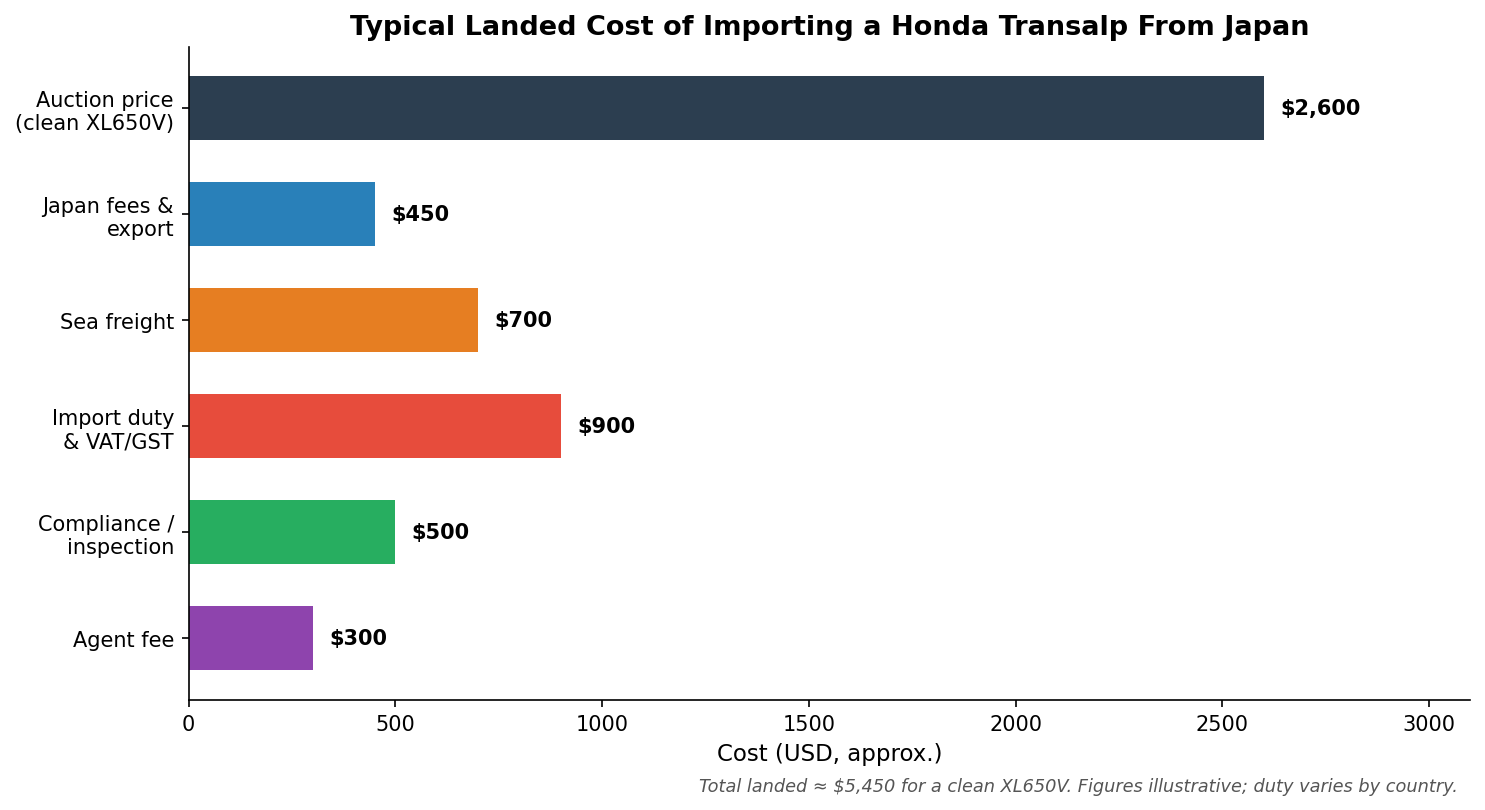
The auction hammer price on a clean, honest XL650V typically lands somewhere around the equivalent of 2,500 to 3,000 US dollars, with tidy 600Vs often cheaper still. On top of that you pay Japan-side fees and export paperwork, ocean freight (crated or roll-on/roll-off), your own country's import duty and sales tax, any compliance or inspection work, and your agent's fee. Add it up and a clean 650V comes home for roughly 5,000 to 5,500 US dollars in most markets, all in. For a bike that will run to six figures of mileage and asks almost nothing in return, that is a lot of motorcycle for the money.
Costs do shift by destination, mostly because of how each country charges duty and tax and how far the boat has to go. Here is the same clean-Transalp import compared across the main English-speaking markets.
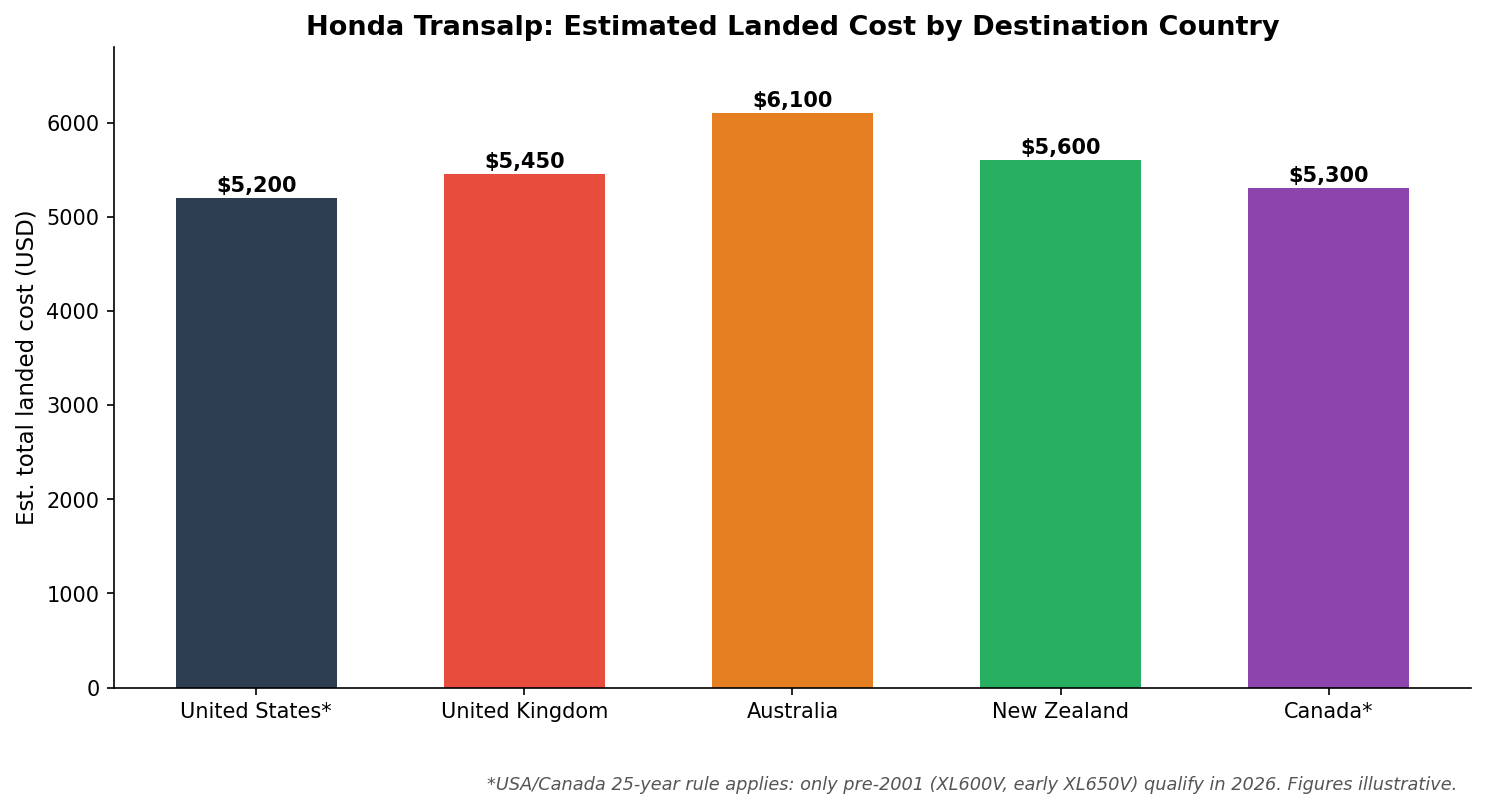
Australia tends to run highest thanks to distance and compliance requirements, while the US can be among the cheapest once a bike clears the 25-year exemption, since that removes a whole layer of compliance cost. UK buyers sit in the middle, paying import duty and VAT but benefiting from short shipping and a well-worn registration path. Wherever you are, the pattern holds: the bike is cheap, the shipping is predictable, and the tax is the variable. Know your own country's duty rate before you bid and there are no nasty surprises at the dock.
XL600V vs XL650V vs XL700V: Which Transalp Should You Import?
By now the choice is really between three usable generations (the XL750 being too new to import). The honest answer depends entirely on what you want the bike to do, and it helps to see the Transalp next to the rivals importers usually cross-shop it against.
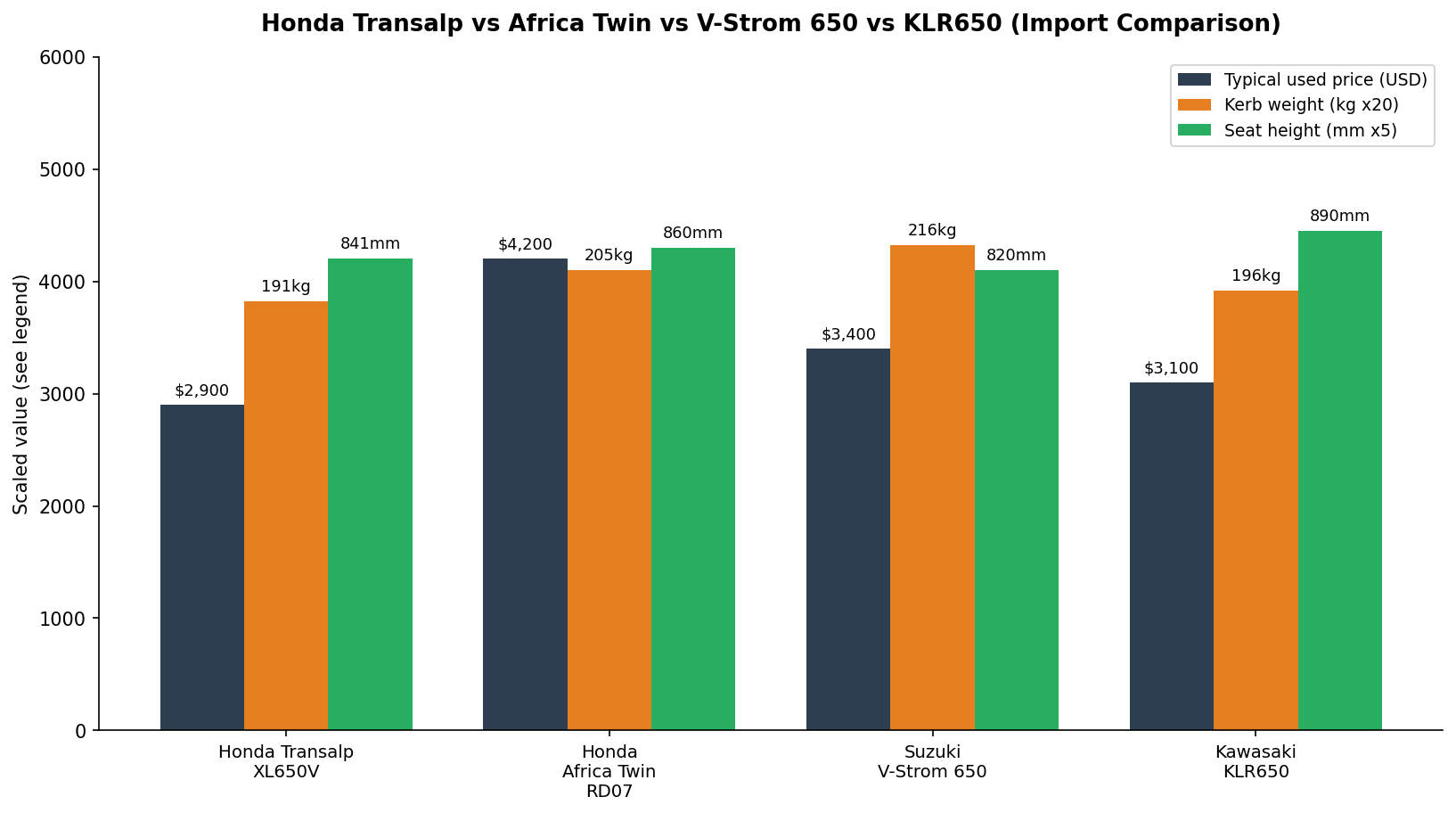
Buy the XL600V if you want the cheapest way into the family, the most off-road-capable classic Transalp with its 21-inch front, and the simplest possible machine to maintain. It is also the only generation Americans can import without checking a calendar. Just favor a 1994-or-later example to skip the early-bike niggles.
Buy the XL650V if you want the all-round sweet spot: a bit more torque, a bigger tank, a road-friendlier shock, and the same bulletproof carbureted simplicity, at a price barely above the 600V. For most importers this is the smart default.
Buy the XL700V if you live on the tarmac, want fuel injection and optional ABS, and do not care about serious dirt ability. It is the most refined classic Transalp and the best motorway bike of the three, at the cost of the original go-anywhere character.
Against the competition, the Transalp's pitch is obvious. It is lighter than a Suzuki V-Strom 650 and far cheaper than an original Africa Twin, with a friendlier seat height than the towering Kawasaki KLR650. It will not win a spec-sheet shootout, but it wins the ownership one: cheaper to buy, cheaper to run, and famously willing to outlive its owner. That is the whole Transalp argument in one bike.
How to Read a Japanese Auction Sheet on a Transalp
Every bike that crosses a Japanese auction block gets a translated inspection sheet, and learning to read it is the single most valuable skill an importer can have. It is your eyes on a bike 6,000 miles away, and for a Transalp it flags almost everything on the weak-points list above before you spend a cent.
Start with the overall grade. On the standard scale, a 4 or higher is a genuinely good bike, a 3.5 is average with some cosmetic wear, and anything below 3 needs a very good reason and very cheap money. R or RA grades mean the bike has been repaired, often after an accident, which on a cheap Transalp is usually a pass unless you know exactly what was fixed. Then read the diagram: the inspector marks scratches (A), dents (U), rust (S), and corrosion (C) on a map of the bike, letting you spot that rotted exhaust collector or a crash-marked crash bar from the photos.
For a Transalp specifically, look hard at the mileage against the condition, the presence of the original exhaust versus an aftermarket system, any note about the bike being hard to start (a hint at charging or carb issues), and the state of the tyres and chain. Cross-reference the sheet with the auction photos, and if anything is ambiguous, that is exactly what your import agent is for. Reading the sheet properly turns a gamble into a calculated, boring, profitable purchase, which is precisely how you want a bike import to feel.
One last tip on the sheet that pays for itself: match the odometer story to the wear. A Transalp showing 20,000 km but wearing a chewed chain, hazed switchgear and a pitted fork is almost certainly a bike with a rolled-back or replaced clock, and on a model this cheap that dishonesty is a hard pass. A genuine 80,000 km Transalp with tidy consumables and a stamped book is the better buy every time, because on this engine 80,000 km is barely run in. Trust the condition over the number, and let the auction grade and the photos, not the seller's optimism, set your maximum bid.
Who Should Buy a Transalp (and Who Should Skip It)
Let us be honest, because a good buying guide tells you when not to buy. The Transalp is not for everyone.
Buy one if you want a cheap, reliable, do-everything motorcycle that will commute, tour, green-lane gently, and shrug off neglect; if you value low running costs and easy home maintenance over outright performance; if you are a new or returning rider who wants a friendly, unintimidating first big bike (remember the 66-year-old who made it his very first motorcycle); or if you are the kind of rider who keeps a bike for a decade and wants one that will still be running when you are done. This is a bike for people who ride, not people who polish.
Skip it if you want speed, sharp handling, or bragging rights. Fifty-odd horsepower is plenty to cross a continent but it will not thrill anyone at a bike-night. Skip it too if you need serious off-road ability (a lighter, more dirt-focused enduro is a better tool), or if you must have modern electronics, big power, and a warranty, in which case the new XL750 or a rival adventure bike is the honest answer. The classic Transalp's genius is contentment, not excitement. If that sounds like a compliment to you, you are exactly the buyer Japan's warehouses are full of bikes for.
How AWA Auction Helps You Import a Transalp From Japan
Finding a clean Transalp is the easy part. Bidding at a Japanese auction you cannot physically attend, in a language you do not read, on a bike you cannot touch, is where most people freeze. That is exactly the gap we close.
AWA Auction gives you direct access to the same Japanese auction houses the professionals use, with every inspection sheet translated and explained, so you know precisely what you are bidding on. We handle the bidding, the export paperwork, the shipping, and the coordination with your local compliance and registration, and we tell you the honest all-in landed cost before you commit, not after. Whether you want a raw 1990s XL600V for the US 25-year sweet spot or a tidy XL650V shipped to the UK, we help you buy the right bike at the right price and get it home without the horror stories.
Browse what is coming through the auctions right now, or tell us the exact Transalp you are hunting and we will find it.
See Also
Share this article: