
If you want to import a Honda VTR1000F Firestorm from Japan, you are chasing one of the most honest sports bikes Honda ever built: a big 90-degree V-twin, no electronics to hide behind, and a soundtrack that turns grown adults into teenagers at every tunnel. This is the bike Honda built to fight Ducati — and then, quietly, made far more reliable than the thing it was fighting.
Here is the catch that trips up almost every first-time buyer. The same motorcycle wears two different names depending on where it was sold, and there is a completely separate, far pricier bike that shares its numbers. Get that wrong at a Japanese auction and you will either overpay or buy the wrong machine entirely. This guide fixes that, then walks you through the best years, the real landed cost, the two faults that matter, and the exact rules for the US, UK, Australia and New Zealand.
Why the Honda VTR1000F Firestorm is worth importing from Japan
The VTR1000F arrived in 1997 with an all-new 996cc, 90-degree V-twin and Honda's HMAS suspension. On paper it made around 110 horsepower, which even in 1997 was not headline-grabbing. That was never the point. The point was the way it made its power — a fat wall of torque from just above idle that shoves you out of corners without you ever having to chase the redline.
Owners do not talk about lap times. They talk about the feeling. One long-term owner on YouTube put it perfectly: the bike "drinks fuel like it's going out of fashion, but every time you roll it on it makes you smile — instant pick-me-up." Another, 26 years into ownership, said his is "still very exciting in the upper rev range." A third, who has owned seven previous supersport bikes, called the Firestorm "the most stable bike I've ridden" and reckoned it out-performs all of them "on real roads."
That is the real reason to import one. A clean Japanese-market Firestorm gives you a big-bore V-twin experience, from a manufacturer famous for building engines that simply do not die, for the price of a tired 600. Japan's used bikes are famously well kept — low mileage, dry-stored, and sold through auctions with an independent inspection sheet that grades every scratch. You get more bike, in better condition, for less money than the equivalent machine in the US, UK or Australia.
And there is a timing angle. The Firestorm is now firmly a modern classic. Values in Europe have stopped falling and started to firm up, especially for tidy, unmodified, big-tank examples. Buying one from Japan today is closer to buying an appreciating asset than a depreciating toy.
Firestorm or Super Hawk? Decoding the name before you bid
This is the single most important thing to understand before you spend a yen. The Honda VTR1000F was sold under two names:
- Firestorm — Europe, Japan, Australia, New Zealand and most of the world.
- Super Hawk — the United States and Canada.
Same bike. Same frame, same carbureted V-twin, same everything. If you are a US buyer searching "Super Hawk" and a UK buyer searching "Firestorm," you are both looking at the identical machine. Japanese auction listings will usually just say "VTR1000F" or "VTR1000" in the model field, so that is the term to search on when you are hunting through auction inventory.
Now the trap. There is another bike called the VTR1000 SP1 (sold in the US as the RVT1000R, and known to everyone as the RC51). It looks similar, it is also a 999cc Honda V-twin, and it shares part of the model name. It is not the same bike, and it is not in the same price bracket.
The SP1/RC51 is a fuel-injected, dual-overhead-cam, race-homologation superbike built from 2000 to 2006. It made roughly 136 horsepower, it won World Superbike titles, and clean examples sell for two to three times the price of a Firestorm. As one authority bluntly put it, the 1000F "was an engine test platform for Honda's eventual RC51 race homologation — but the RC51 engine shares no common components." Different bike, different money, different maintenance.
So before you bid, confirm three things: the model code, the presence of carburettors (Firestorm) versus fuel injection (SP1), and the price. If a "VTR1000" is priced like a bargain, it is a Firestorm. If it is priced like a collector superbike, it is an SP1. Never assume.
Quick spotter's guide
- VTR1000F Firestorm / Super Hawk: carbs, chain-driven cams, half-fairing with twin round headlights, relaxed riding position, ~110 hp. This is the affordable one.
- VTR1000 SP1 / SP2 / RC51: fuel injection, DOHC, full race-rep fairing, aggressive riding position, 130+ hp. This is the expensive one.
VTR1000F year-by-year: what changed from 1997 to 2007
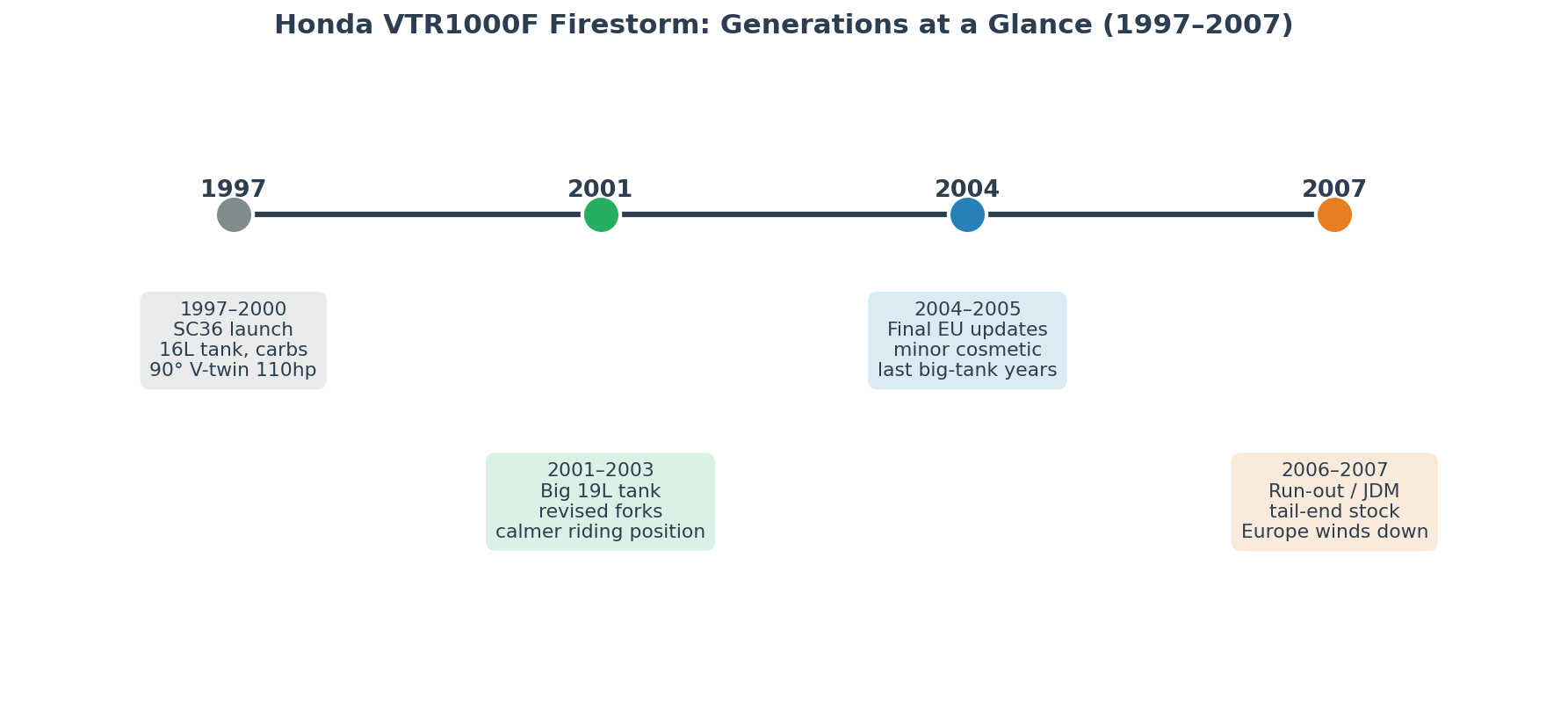
The Firestorm ran for roughly a decade with one genuinely important mid-life change and a lot of small tweaks. Here is what actually matters to an importer.
1997–2000: the original SC36
The launch bike. Full 110-ish horsepower, twin carburettors, and the notorious 16-litre fuel tank. That small tank is the defining weakness of the early bikes: combined with a thirsty V-twin, real-world range on a spirited ride can drop toward 200 km before the light comes on. Early examples also had the weakest charging components. Mechanically these are still excellent bikes, but you buy them knowing the tank is small and the riding position is a touch more committed.
2001–2003: the "big tank" — the one to buy
In 2001 Honda addressed the number-one complaint and fitted a 19-litre tank, along with revised front forks, smaller indicators and a slightly less extreme riding posture. This is the sweet spot. The extra three litres transform the bike from a machine you plan rides around to one you just ride. Every buying guide worth reading says the same thing: if you can, buy a 2001-onward big-tank Firestorm.
2004–2005: the final updates
Minor cosmetic and detail changes. Still the big tank, still a lovely thing, and often the lowest-mileage examples simply because they are newer. In Japan these later bikes are plentiful and well-preserved.
2006–2007: run-out
Europe wound the model down around 2005, but production and stock trickled on, and the Japanese domestic market kept examples circulating. If you find a genuine late one, you are looking at the youngest, freshest Firestorm you can buy.
Best years to buy — and the years to approach with caution
The short version: a clean 2001–2004 big-tank Firestorm is the bike you want. You get the larger tank, the calmer ergonomics, the sorted charging system, and generally lower mileage than the launch bikes.
That does not mean the early 16-litre bikes are bad. Far from it — they are cheaper, and a well-sorted 1998 with upgraded charging and manual cam-chain tensioners is a superb bike. But as a first import, where you cannot ride before you buy, the later big-tank example removes the two biggest early-bike annoyances in one go.
Approach with caution any Firestorm that is:
- Heavily modified with unknown-quality parts (especially rewired electrics or a bodged rectifier fix).
- Showing a rotted or freshly-painted front downpipe — the exposed front cylinder header rots, and a quick respray can hide a tired exhaust.
- Sold with no service history around the 16,000-mile valve-clearance interval.
- Listed with a low auction grade (below 3.5) unless the price genuinely reflects it.
Known faults every Firestorm buyer must check
The good news, straight from the people who have lived with these bikes: the VTR1000F engine is fundamentally tough. Unlike the Ducati it was built to fight, it uses conventional valve gear and a cam chain, so it is far less service-hungry — regular services every 4,000 miles and a valve-clearance check at 16,000 miles. But two specific weak points come up again and again, and both are cheap to sort if you know about them before you buy.
1. Cam-chain tensioners (the big one)
The original automatic cam-chain tensioners (CCTs) are the Firestorm's Achilles' heel. When they wear, you get a rattle — and in a worst case, a failure. Almost every experienced owner does the same fix: swap the automatic units for manual cam-chain tensioners. As one 14-year Super Hawk owner advised, "Definitely change out the cam-chain tensioners for manual ones — if you can, do them up with some safety wire." Another warned that his "cam-chain tensioner failed despite me asking Honda to check it several times." A Firestorm that already has manual CCTs fitted is worth paying more for.
2. The rectifier / regulator
The stock rectifier-regulator, especially on earlier bikes, runs hot and can fail — one owner described it as boiling his battery. The community fix is well known: fit an uprated rectifier, with many owners using a Yamaha R1 unit as a direct upgrade. As one put it, the manual tensioners and a "quality rectifier" address "without a doubt the weakest links in an otherwise super-reliable powertrain." Check the charging voltage on any bike you are serious about.
3. The smaller stuff
- Front downpipe corrosion — the exposed front header rots. Budget for a replacement or an aftermarket system.
- Starter motor — the occasional one gives up; listen for lazy cranking.
- Fork dive — the front end dives under hard braking; heavier fork oil or a spring upgrade fixes it and is a common owner mod.
- Fuel range — not a fault, but plan around it, especially on a 16-litre early bike.
None of these are deal-breakers. They are a known checklist, and a Firestorm that has already had the CCT and rectifier addressed is a genuinely bulletproof bike.
What a Firestorm really costs to import from Japan
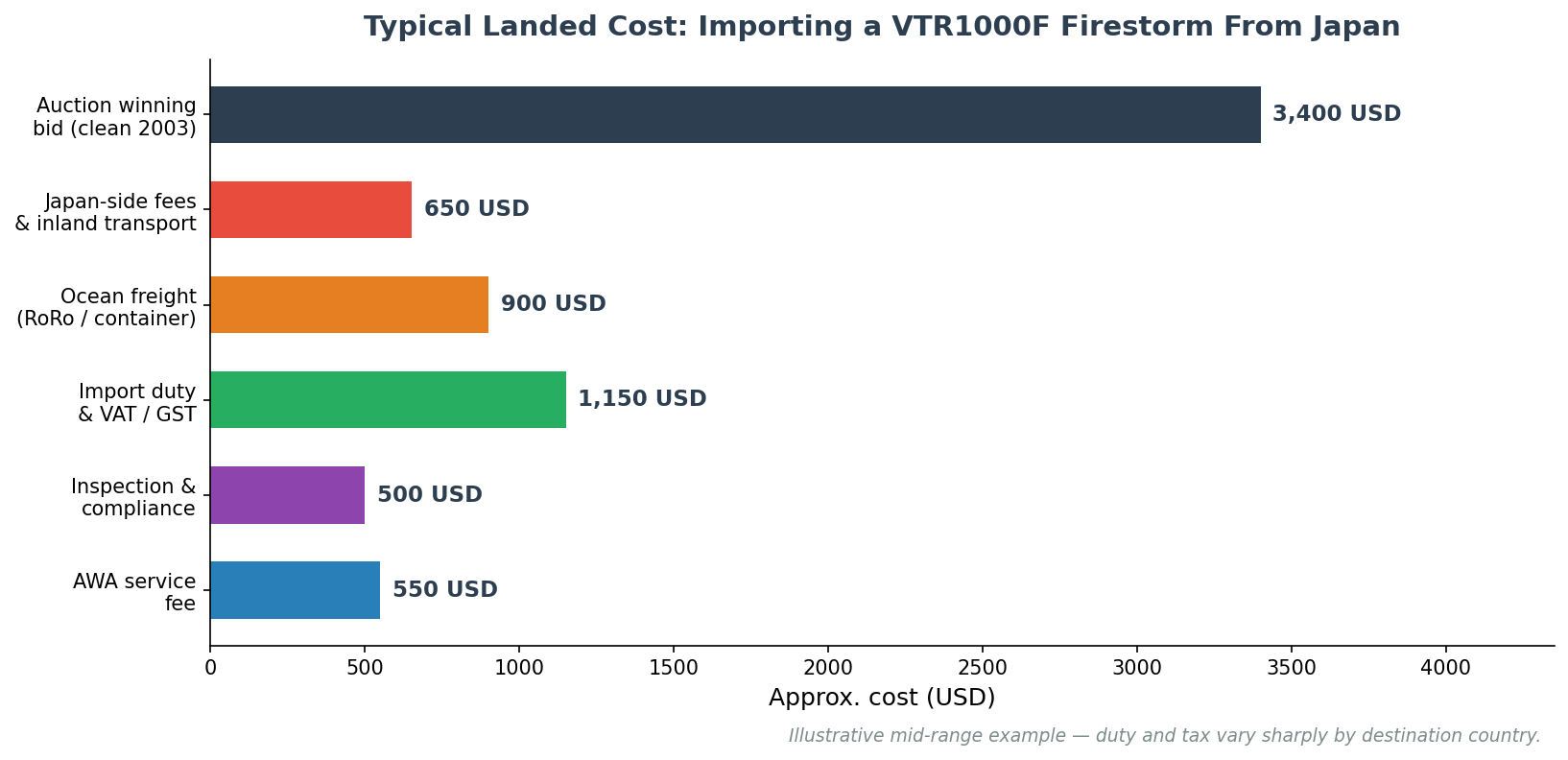
Let us talk real numbers. Firestorm values in Japan are still sensible: a clean, sorted big-tank example typically hammers somewhere around the equivalent of 3,000–3,800 USD at auction, with tidier or lower-mileage bikes at the top of that. On top of the winning bid you add the Japan-side fees and inland transport, ocean freight, your destination country's duty and taxes, inspection and compliance, and the service fee for the agent who does all of it for you.
The chart above shows an illustrative mid-range build-up for a clean 2003 bike. As a rule of thumb, the auction price is roughly half of your total landed cost — the rest is shipping, tax and paperwork. That is completely normal for importing, and it is why the cheapest auction bike is rarely the cheapest bike to land.
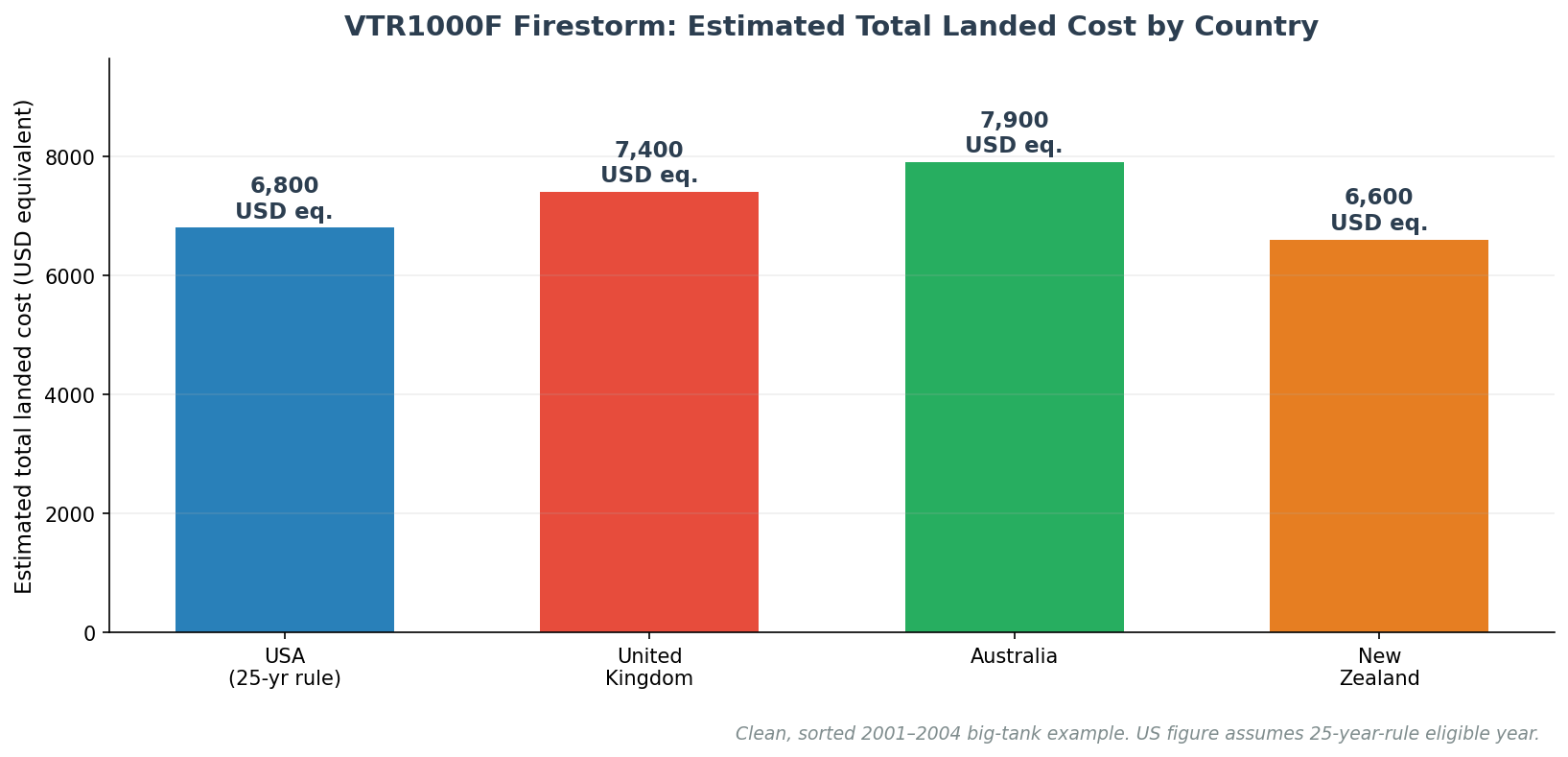
The single biggest variable is your destination country's tax regime, which is why two people importing identical bikes can end up paying very different totals. That brings us to the rules.
Country-by-country rules: US, UK, Australia and New Zealand
United States (the 25-year rule)
For US buyers, the Firestorm — sold there as the Super Hawk — is governed by the NHTSA 25-year rule, which exempts vehicles 25 years or older from federal conformance requirements. In 2026, that means model years up to and including 2001 are eligible to import. A 1998 became eligible in 2023; a 2001 is eligible now. Because the Super Hawk was also officially sold in the US, plenty of domestic examples exist — but importing a low-mileage JDM bike is often the way to find a genuinely clean one. Check current NHTSA eligibility for your exact year before committing.
United Kingdom
The UK is one of the easiest destinations. You will pay import duty and VAT, complete a NOVA declaration to satisfy HMRC, and put the bike through the registration process (older imports are generally straightforward). Because the Firestorm was a big seller in the UK, parts and knowledge are everywhere, which makes a JDM import very easy to live with.
Australia
Australia's import scheme allows road bikes that are 25 years or older to come in under the older-vehicle pathway, with state registration and compliance on arrival. Duty, GST and shipping apply. Given how well JDM bikes are preserved, a Firestorm is a strong candidate. Confirm the current rules with the relevant federal department for your build date.
New Zealand
New Zealand is famously import-friendly and takes a huge number of used Japanese vehicles. Expect entry certification (compliance), GST, and a straightforward registration. It is frequently the cheapest of the four countries to land a bike into, which the chart above reflects.
Whichever country you are in, the pattern is the same: the bike is cheap, the shipping is fixed, and the tax is where the countries diverge. Know your number before you bid.
The V-twin question: Firestorm vs its rivals
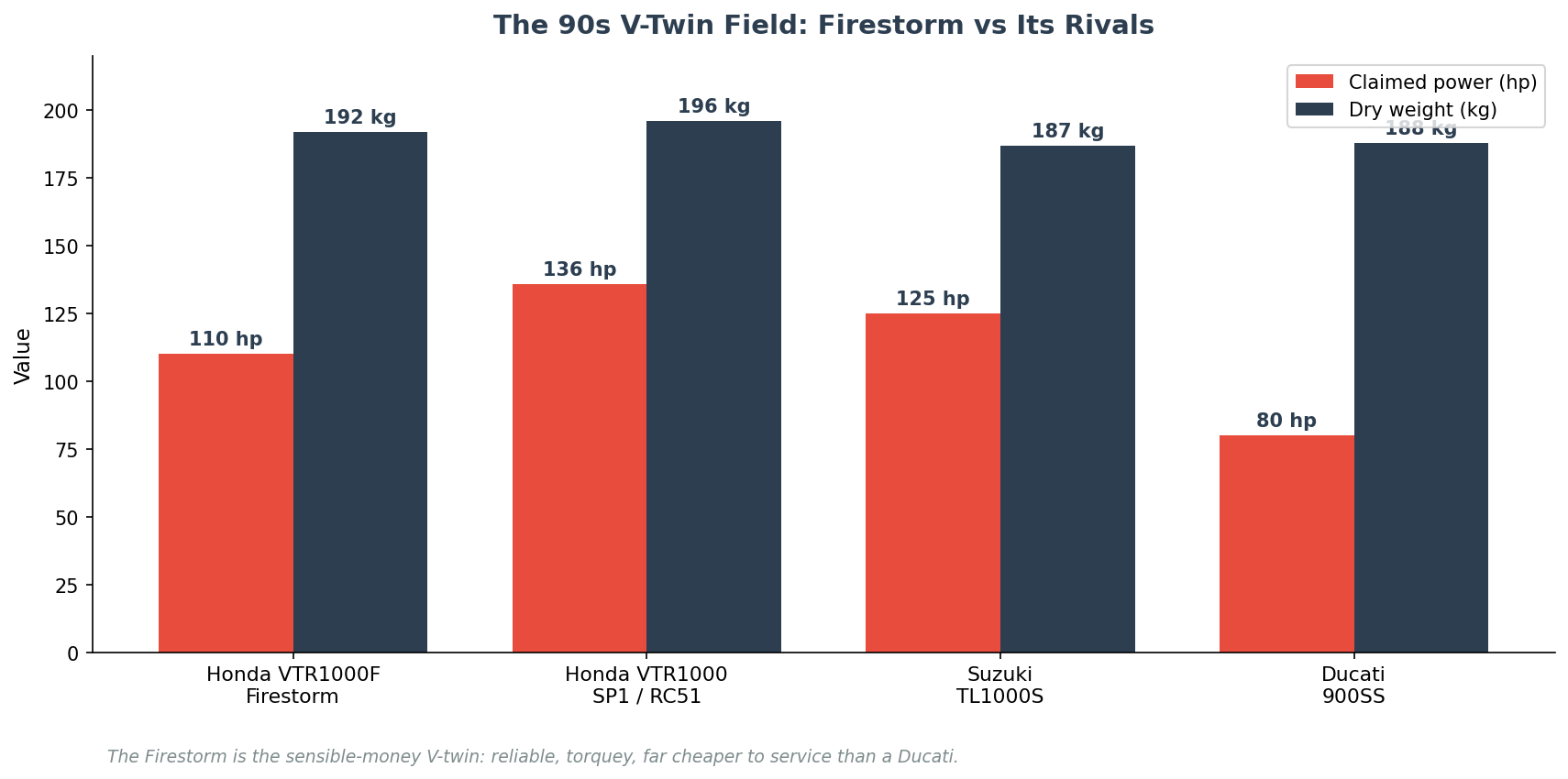
The late 1990s were the golden age of the big V-twin, and the Firestorm sat right in the middle of a fierce fight. Here is how it stacks up against the bikes it competed with — and why, for an importer, it is arguably the smartest buy of the lot.
The Ducati 900SS was the bike everyone lusted after, but it made less power and demanded belt changes and expensive desmo valve services. The Suzuki TL1000S was faster and rortier, but early ones had a fearsome reputation for handling drama. The Honda SP1/RC51 was the sharpest and most powerful, but it is a hard-edged race bike that costs superbike money and is punishing on the road.
The Firestorm's trick is that it does not win any single category — and that is exactly why owners keep them for decades. It is the reliable, torquey, everyday V-twin: cheaper to buy, far cheaper to service than the Ducati, more comfortable than the RC51, and calmer than the TL. One French owner who ran his for four years, daily, described it as "a treat every day." That is the Firestorm's whole personality in one sentence.
What owners actually say after years with the bike
The most convincing case for a Firestorm is not the spec sheet — it is how long people keep them. Trawl through owner videos and forums and the same themes repeat.
On the engine and the sound: "Nothing feels better than the torque and sound of the V2 engine." "Pulls like a train." "So many looks, it rips in any gear." The V-twin character is the thing that hooks people and does not let go.
On longevity: one owner is 26 years in and still smiling; another has had his 10 years and "loves the thing"; a US owner has run his '01 Super Hawk for 14 years. These are not garage queens — they are ridden, and they keep going.
On the trade-off everyone accepts: yes, it is thirsty. "Fuel consumption doesn't matter when you get on it," shrugged one owner, and that attitude is universal. Nobody who owns a Firestorm cares about the mpg, because the moment you open the throttle you understand the deal you signed.
On what to do when you get one: sort the suspension, fit manual cam-chain tensioners and a good rectifier, and then just ride it. Do those three things and you have, in the words of one long-termer, "an otherwise super-reliable powertrain" wrapped in one of the best-sounding bikes Honda ever made.
How to buy a VTR1000F Firestorm from a Japanese auction
Here is the process in plain terms. Japan's used bikes are sold through wholesale auctions that most overseas buyers cannot access directly. You work through an agent — like AWA Auction — who bids on your behalf, reads the all-important inspection sheet, and handles export, shipping and paperwork.
The inspection sheet is your best friend. Every auction bike is graded, and a translated sheet tells you about rust, accident history, tank condition, chain and sprocket wear, and anything modified. For a Firestorm, you specifically want the agent to confirm the model (F, not SP1), the tank size (19-litre from 2001), whether manual cam-chain tensioners are fitted, and the state of that front downpipe.
Set your maximum bid to include all the landed costs from the chart above — not just the hammer price — so there are no surprises. Then let the agent do the hunting. Because Japan has such deep inventory, you are not limited to whatever happens to be for sale in your country this month; you can wait for the exact colour, year and condition you want.
Ready to start? Browse the current listings to see what is coming through the auctions right now, or talk to our team about sourcing a specific VTR1000F Firestorm to your spec.
What it is actually like to ride a Firestorm
Numbers do not explain this bike, so let us describe the experience instead. Thumb the starter and the 90-degree V-twin settles into a lumpy, off-beat idle that already sounds more alive than any inline-four. Pull away and the first thing you notice is that you barely need the revs. There is usable torque from almost nowhere, so town riding is lazy and one-gear-fits-all.
Get onto an open road and roll the throttle in any gear, and the Firestorm does its party trick: a deep, surging drive that pins you back without ever feeling frantic. It is not the razor-edge rush of a litre sports bike screaming to 13,000 rpm. It is the shove of a big twin doing its best work between 3,000 and 8,000 rpm — the range you actually use on the road. Owners describe it as pulling "like a train," and once you feel it, the modest peak-horsepower figure stops mattering.
The chassis is old-school in the best way. The steel frame and HMAS suspension give a planted, confidence-inspiring feel that flatters an average rider. There is no traction control, no riding modes, no ride-by-wire — as one owner put it, "just you and your bike." For a lot of riders coming off soulless modern machinery, that stripped-back honesty is the entire appeal.
The riding position deserves a mention. Early bikes are a touch more committed; the 2001-onward update relaxed it slightly, which matters if you plan longer rides. It is a sports bike, so it is not a sofa, but it is far more usable day-to-day than the RC51 race-rep it is often confused with. This is a bike you can commute on, tour on lightly, and still hooligan through your favourite set of corners on a Sunday.
The modifications smart Firestorm owners make
Part of the joy of a modern-classic V-twin is that the community has already solved every weakness. If you import a Firestorm, here is the short list of upgrades that experienced owners consider close to mandatory — and the ones that are pure taste.
The reliability upgrades (do these)
- Manual cam-chain tensioners. The single most important upgrade. It removes the bike's one genuine engine worry. Many owners safety-wire them for peace of mind.
- Uprated rectifier / regulator. A common fix is a Yamaha R1 unit. It cures the charging system's tendency to cook itself and, in the worst cases, boil a battery.
- Suspension refresh. Fresh fork oil, a slightly heavier weight, and a serviced rear shock transform the handling and cure the nose-dive under braking. Owners routinely say the bike is a different animal once the suspension is "properly sorted."
The character upgrades (do these if you want)
- Aftermarket exhaust. The Firestorm already sounds superb; a good slip-on or full system makes the V-twin genuinely spine-tingling. This is the most popular mod for a reason.
- Taller screen and bar risers. Small, cheap comfort wins for anyone doing distance. One owner fitted "20 mm risers" specifically to make longer rides easier.
- Gearing tweaks. A tooth or two on the sprockets sharpens the drive further, though most people find the standard gearing perfect for the torquey engine.
The beauty of importing from Japan is that many well-kept JDM bikes already come with tasteful upgrades fitted by fastidious previous owners. It is not unusual to land a Firestorm that already has a quality exhaust, manual tensioners and a good rectifier — the exact spec you would have built yourself.
How Japanese auction grading protects you
If the idea of buying a 20-year-old bike sight-unseen from the other side of the world makes you nervous, the Japanese auction system is designed to solve exactly that problem. Every bike that crosses the block is inspected by an independent grader and given a numeric score, usually from 1 to 6 (plus condition codes), along with a map of every blemish.
A grade of 4 or higher generally means a clean, well-kept bike with no accident history. A 3.5 can still be a great buy if the notes are honest about cosmetic wear. Anything lower, and you read the sheet very carefully. Your agent translates all of this, so you are not guessing — you are buying against a documented condition report.
For a Firestorm specifically, the sheet lets you filter for the things that matter: genuine low mileage, an un-rotted downpipe, no crash damage, and originality. Because Japan cycles through so many bikes, you can afford to be picky and simply wait for a high-grade example in the colour and year you want, rather than settling for whatever is local to you.
JDM Firestorm vs a home-market Super Hawk: which should you import?
If you are in the United States, you have a choice most other buyers do not: you can buy a domestic Super Hawk that is already here, or import a Japanese-market Firestorm. Both are the same VTR1000F, so which makes sense?
The case for importing a JDM bike is condition. Japanese owners tend to ride less, store better, and maintain obsessively, and the auction grading gives you a documented paper trail. Low-mileage, rust-free, unmolested examples are simply more common in Japan than in a market where these bikes were often bought as cheap fun and ridden hard. If you want the cleanest possible Firestorm, Japan is where it lives.
The case for a domestic bike is simplicity — no shipping, no import paperwork, and US-spec lighting and speedometer already fitted. But you are fishing in a smaller, harder-used pond, and a tired local bike can cost more to put right than the premium you would have paid to land a pristine import.
For the UK, Australia and New Zealand the maths is even clearer, because the Firestorm was sold there too but good ones are getting scarce. A fresh JDM import often undercuts a scruffy local example on both price and condition. The one thing to confirm is minor market differences — headlight beam pattern, speedometer units — which a good agent and a compliance shop sort as part of the process.
Is the Firestorm a smart modern-classic investment?
For years the Firestorm was the bargain of the big-twin world. A 20-year-old example that cost thousands new could be had for the price of a decent pushbike, and values kept sliding. That era is ending.
Two things are happening. First, the pool of clean, unmodified, low-mileage Firestorms is shrinking every year as rough ones get scrapped or broken for parts. Second, the modern-classic wave that lifted air-cooled Kawasakis and early Fireblades is now reaching the late-90s V-twins. Buyers who grew up with posters of these bikes on their walls — and there are a lot of them, judging by the comments under every Firestorm video — are now old enough to buy the real thing.
That does not make a Firestorm a gold bar. It makes it a bike you can genuinely enjoy for years and reasonably expect to sell for close to what you paid, especially if you buy a tidy big-tank example and keep it standard or tastefully modified. Buy the best one you can find, look after that downpipe and those tensioners, and you own an appreciating asset that also happens to be one of the most charismatic bikes of its generation.
Import the right one from Japan, in high grade and low mileage, and you are buying at the smart end of that curve — a future classic while it is still affordable.
Common mistakes importers make with the Firestorm
Most Firestorm import disappointments come down to a handful of avoidable errors. Learn them now and you will buy well.
Confusing the F with the SP1. We have said it twice already because it is the mistake. Bidding on a "VTR1000" without confirming it is the carbureted F model can see you either overpay for a Firestorm at SP1 money or expect Firestorm running costs from a demanding race bike. Check the model code and the induction system every single time.
Chasing the cheapest hammer price. The lowest auction bid rarely lands the cheapest bike. A rough, low-grade example can need a downpipe, a rectifier, tensioners, fork work and tyres — quickly wiping out the saving. A high-grade bike costs a little more to buy and far less to enjoy.
Ignoring the tank size. If long-legged touring matters to you, do not buy a 16-litre early bike and then complain about the range. Hold out for the 2001-onward 19-litre tank.
Forgetting to budget for tax. Set your maximum bid to include every landed cost for your country, not just the winning bid. The riders who feel stung are the ones who forgot that duty and tax are where the countries diverge.
See Also
Share this article: