
If you want to import a Kawasaki ER-6n from Japan, you have picked the smartest bargain in the middleweight class. The ER-6n is the naked, budget-friendly parallel twin that taught a whole generation of riders that you do not need four cylinders or a five-figure price tag to have a genuinely good time. It is light, torquey, cheap to run, and its 649cc engine is close to indestructible. Japan is full of clean, low-mileage examples that were babied by careful owners and never saw a gritted winter road.
Here is the thing nobody tells you: the ER-6n was sold new almost everywhere, so most buyers assume there is no reason to import one. They are wrong. The difference between a tired, corroded UK learner bike that has been dropped twice and a dry, honest 12,000km Japanese example is enormous, and the price gap often is not. This guide covers everything: the engine, the three generations, the real problems, the years to avoid, what one actually costs landed, and how to read the auction sheet so you do not get burned.
We will be straight with you throughout. The ER-6n is not perfect, the finish is cheap in places, and it will never set your hair on fire. But as a first big bike, a sensible commuter, or a no-drama weekend toy, few bikes give you this much for the money. Let's get into it.
What is the Kawasaki ER-6n?
The Kawasaki ER-6n is a naked middleweight motorcycle powered by a 649cc liquid-cooled parallel twin. Kawasaki launched it in 2006 alongside its half-faired sister, the ER-6f, and built both until 2016, when the range was rebadged as the Z650 (naked) and Ninja 650 (faired). The "n" stands for naked; the "f" stands for faired. Same bike underneath, different clothes.
Kawasaki designed the ER-6 to be the everyman big bike. Enough torque to be fun and A2-friendly in restricted form, light enough for nervous riders, cheap enough that insurance and servicing would not bankrupt you, and reliable enough to shrug off neglect. It worked. The ER-6 became one of Europe's best-selling middleweights and the default choice for riding schools, commuters, and first-time 600-plus owners.
The 649cc twin makes a modest 72hp at 8,500rpm and 66Nm of torque at 7,000rpm. Numbers that look tame on paper feel perfect on the road, because the torque arrives low and the bike weighs around 200kg wet. It is the kind of engine you can ride lazily in top gear through town or rev out on a back road, and it does both without complaint. The tank-low, wide-bar riding position is upright and roomy, which is why so many people keep them for years.
ER-6n vs ER-6f vs Ninja 650 vs Versys 650: don't buy the wrong one
This is where buyers get confused, so let's clear it up before you bid on anything. All four bikes share the same 649cc parallel-twin engine and much of the same architecture. What differs is the bodywork, the seating position, and the intended job.
The ER-6n is the naked. No fairing, exposed engine, wide bars, minimal wind protection. This is the one you want if you like the stripped-back look and mostly ride in town or on back roads.
The ER-6f is the same bike with a half fairing and a small screen. It is a touch more comfortable at motorway speed and the plastics protect the rider from windblast. In Japan and some markets it was sold as the Ninja 650R. If you commute on fast roads, the f makes more sense.
The Ninja 650 is what the ER-6f became from 2017 onward, with sharper styling and a new trellis frame. Sportier looking, same friendly engine.
The Versys 650 takes the identical engine and wraps it in a tall, long-travel adventure-styled chassis. Upright, comfy, taller seat, softer suspension. If you want the ER-6 engine with touring comfort, the Versys is the one, and we cover it separately.
Here's the practical takeaway: the engine and its reputation for bulletproof reliability are shared across all of them. So the mechanical advice in this guide applies whether you end up on an ER-6n, an ER-6f, a Ninja 650, a KLE650 Versys, or the Z650 that replaced it. Pick the body style that suits your riding, then hunt for the cleanest example. For most people importing from Japan, the naked ER-6n is the sweet spot: cheapest to buy, easiest to inspect, and nothing to hide behind a fairing.
Why import a Kawasaki ER-6n from Japan?
You can buy an ER-6n on any Western classifieds site tomorrow, so why bother with Japan? Three reasons, and they are all about condition.
Japanese bikes do not rust. The ER-6n's biggest weakness is cheap finish: fasteners, brackets, and the exhaust downpipe surface-corrode fast on salty winter roads. A UK or northern-European ER-6n that has commuted through five winters looks tired even at low mileage. Japan does not salt its roads the way Britain does, storage is often indoors, and the used-bike culture rewards spotless machines. A Japanese ER-6n frequently looks a class above a Western bike of the same age.
Low, honest mileage. Japan's roads are congested and shaken (the roadworthiness test) makes older bikes expensive to keep, so many machines are sold on with genuinely low use. Auction sheets record verified odometer readings and grade the bike's condition on a standard scale, which means you are buying with far more transparency than a private WhatsApp seller can offer.
Fewer learner scars. The ER-6n is a magnet for beginners in the West, which means a huge share of the used pool has been dropped, curbed, or clumsily "restricted" and unrestricted. Japanese examples were more often bought by experienced riders as light second bikes, so drops and botched mods are rarer.
Add it up and importing gets you a better bike, not just a different one. You just need to know what a good example looks like and what the landed total will be, both of which we cover below.
The engine: the 649cc parallel twin that won't die
The heart of the ER-6n is a 649cc liquid-cooled, DOHC, 8-valve parallel twin with a 180-degree crank and fuel injection. It is one of the most durable engines Kawasaki has ever made. Owners and forums routinely report examples clocking 60,000, 80,000, and even 100,000-plus miles on nothing more than regular oil changes and the occasional valve check. Riding schools thrash these bikes daily for years, and they keep running.
Why so tough? The engine is deliberately under-stressed. Making 72hp from 649cc is a relaxed state of tune, so nothing is working at its limit. The parallel-twin layout is mechanically simple, cheap to service, and the same core unit powers the ER-6f, the Ninja 650, the Versys 650 adventure-tourer, and the KLE650. Kawasaki built this motor in enormous numbers over more than a decade and steadily refined it, which is exactly why parts are cheap and plentiful.
The character is the fun part. Because the torque peaks at 7,000rpm and the crank layout gives it a throaty, uneven beat, the ER-6n feels punchier than its power figure suggests. One French road test famously called it "la moto schizophrène" because it can potter around town like a scooter one minute and snarl up a mountain road the next. That split personality is exactly what makes it such an easy bike to live with and still enjoy.
Maintenance is genuinely cheap. Oil and filter every 7,500 miles (or 6,000km, whichever suits your habits), valve clearance checks at 15,000 miles and only occasionally after that because the shim-under-bucket valvetrain rarely drifts. There is no expensive desmo service, no cam belt, no four-cylinder faff. This is the antidote to bikes that punish you at every service.
Kawasaki ER-6n generations explained: 2006-2008 vs 2009-2011 vs 2012-2016
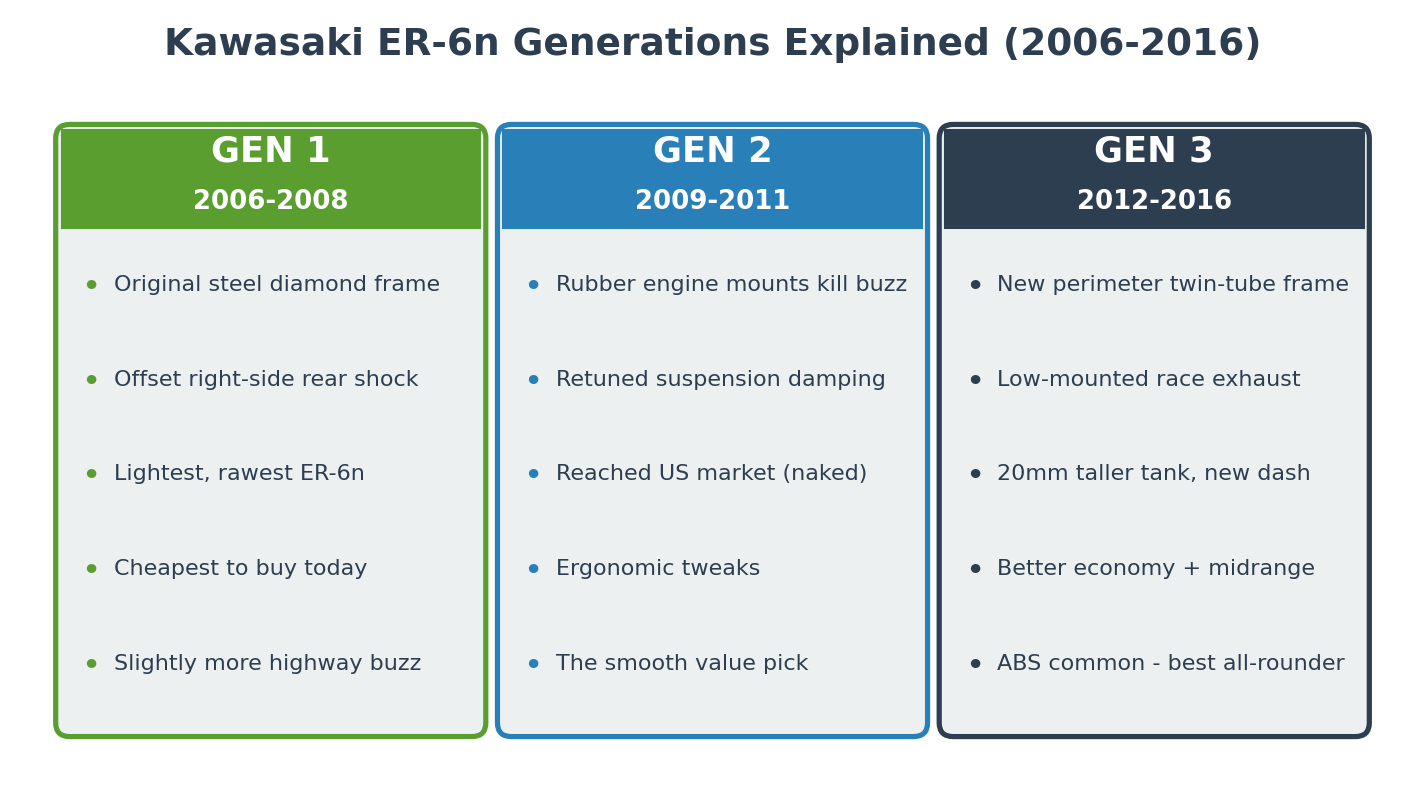
There are effectively three generations of ER-6n, and knowing which is which stops you overpaying for the wrong year.
Gen 1 (2006-2008): the original. This is the bike that started it all. Steel diamond frame, the offset rear shock mounted down the right side, twin-tube styling, and an underslung or high-rise exhaust depending on market. It is the lightest, rawest ER-6n, and the cheapest to buy today. The downside is slightly more vibration at motorway speed and the earliest, most basic suspension. A clean gen 1 is a lot of fun for very little money.
Gen 2 (2009-2011): the refinement. For 2009 Kawasaki added vibration-reducing engine mounts (rubber-mounted to smooth things at speed), retuned the suspension damping, and made small ergonomic tweaks. The naked ER-6n also reached the US market for the first time this year. This generation fixed the main complaint about the original, the buzz, without losing the light, flickable feel. For many buyers, a late gen 2 is the value pick.
Gen 3 (2012-2016): the grown-up. The 2012 overhaul was the biggest. Kawasaki fitted a new perimeter twin-tube frame, a matching swingarm, a low-mounted race-inspired exhaust, a redesigned tank that is 20mm taller for better knee grip, a new dash, and a revised fuel map with improved economy and stronger low-to-midrange. This is the most refined, best-finished ER-6n, and the one to buy if your budget stretches to it. ABS became widely available on this generation too, which is worth having.
The short version: gen 1 for cheapest fun, gen 2 for smooth value, gen 3 for the best all-rounder. None of them are bad. There is no dud generation, only better and worse individual bikes.
Kawasaki ER-6n key specifications at a glance
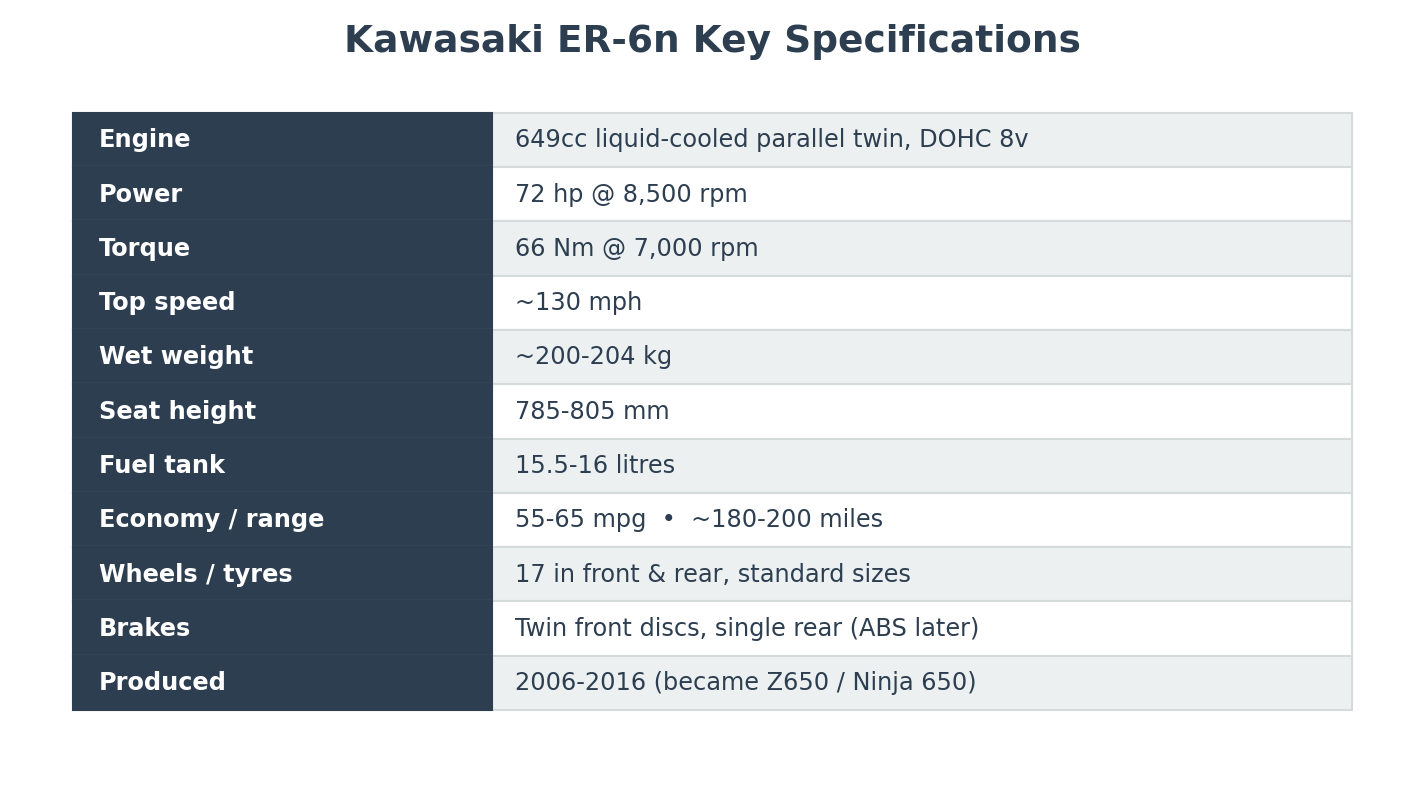
Here are the numbers that matter. The 649cc parallel twin produces 72hp at 8,500rpm and 66Nm of torque at 7,000rpm, enough for a genuine top speed of around 130mph and effortless real-world overtakes. Wet weight sits near 200-204kg depending on generation, so it feels light and manageable at walking pace and in car parks, which is a big deal for shorter or newer riders.
The seat height is a friendly 785-805mm, low enough for most people to flat-foot. The fuel tank holds 15.5 to 16 litres, and with real-world economy of 55-65mpg you can expect a usable 180-200 miles between fills. It runs a 17-inch front and rear wheel on cheap, widely available tyres, and the brakes are twin front discs with a single rear, with ABS on later and optional models. Nothing exotic, everything cheap to replace.
The takeaway from the spec sheet: this is a light, efficient, low-stress middleweight with numbers chosen for real riders, not spec-sheet bragging. That is exactly why it works so well as an import, because a low-mileage Japanese example gives you all of this in nearly-new condition for used money.
Kawasaki ER-6n common problems: what to check
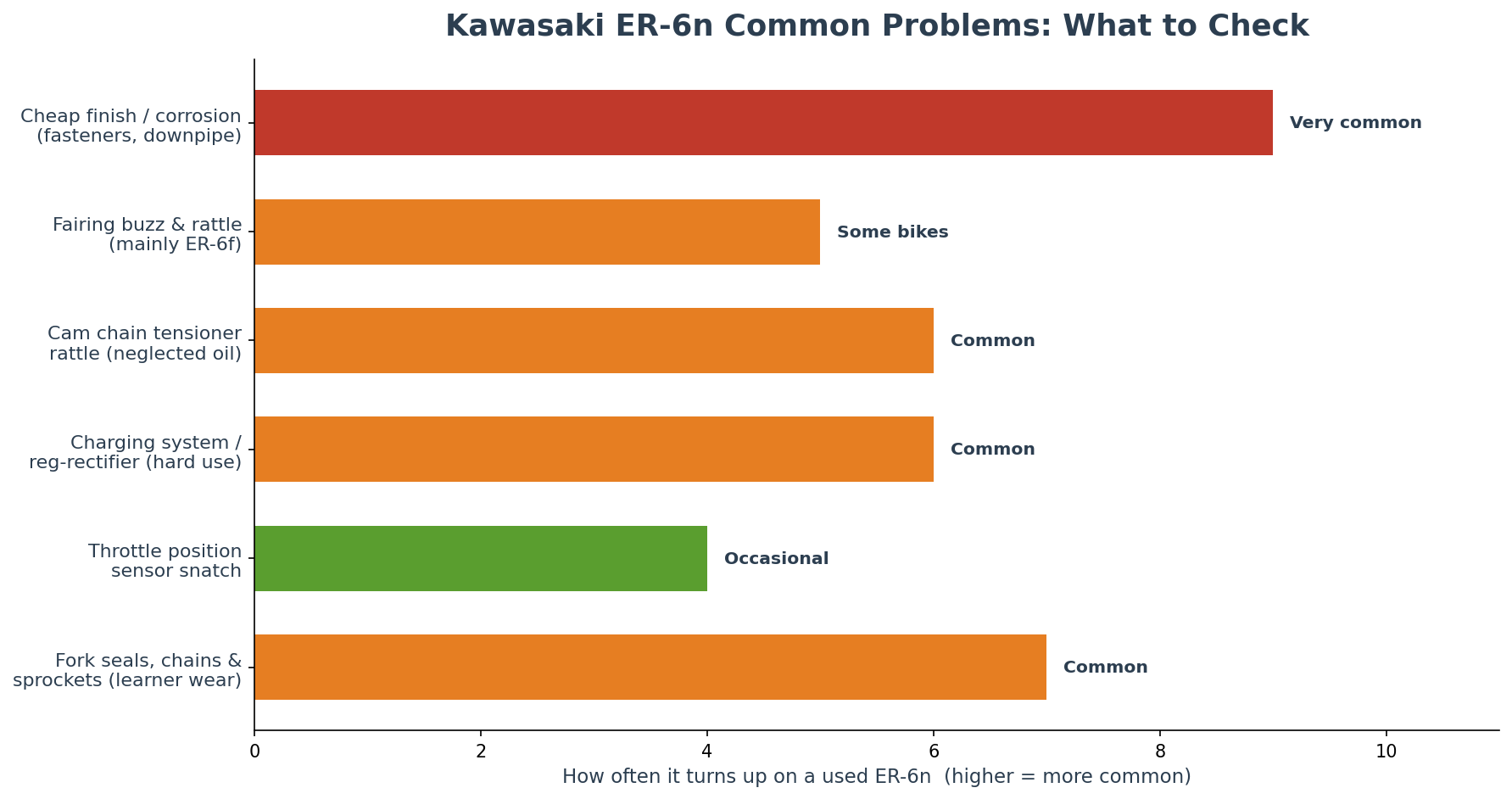
The engine is bulletproof, but the ER-6n is a budget bike and it shows in a few predictable places. None of these are deal-breakers, but knowing them tells you which bike to walk away from.
Cheap finish and corrosion. This is the number one issue. Fasteners, brackets, the sidestand, and especially the exhaust downpipes go rusty fast. On a salt-road Western bike this can look grim at low mileage. On a Japanese import it is usually far better, which is half the reason to import in the first place. Still, inspect the downpipe and fasteners in the auction photos.
Fairing rattle and buzz (mainly ER-6f). The half-faired ER-6f is known for an irritating vibration buzz at certain revs, and the plastics can rattle. The fix is foam padding inside the fairing, cheap but fiddly. The naked ER-6n mostly sidesteps this, which is another point in the naked's favour.
Cam chain tensioner noise. Neglect the oil changes and the cam chain tensioner can start rattling on cold starts, especially on higher-mileage bikes. A light rattle that clears in a second or two is usually fine; a persistent metallic clatter means the tensioner or chain needs attention. This is why service history matters more than mileage.
Charging system and electrics. Like many Kawasakis of the era, the regulator/rectifier and charging circuit are the weak link on hard-used bikes. A tired battery, dim lights, or a bike that has needed a jump are warning signs. It is a cheap, known fix, but factor it in on an unloved example.
Throttle position sensor and fuelling niggles. Some ER-6n owners report throttle position sensor (TPS) faults that cause a snatchy, hesitant low-speed throttle. It is usually a clean or replace job. A jerky, on-off throttle on a test blip is worth investigating.
Fork seals, chains and sprockets. The basic suspension gets tired, and fork seals weep on higher-mileage bikes. Because so many ER-6ns are learner bikes, chains and sprockets are often badly neglected, and evidence of drops (scuffed bar ends, levers, engine covers) is common. A dropped, rusty, chain-flogged bike is not worth saving when clean ones exist. That is the whole argument for buying from Japan.
Kawasaki ER-6n years to avoid, and the best years to buy
Let's be honest: there is no truly bad ER-6n year. The engine and the basic package were sound from day one. But some years are smarter buys than others.
Approach the earliest 2006-2007 bikes with your eyes open. They are not flawed, but they are the oldest, the most vibey at speed, and the most likely to have been ridden hard and neglected by now. Buy one for the price, not as a low-maintenance long-termer, and only if it is clean.
The value sweet spot is a late gen 2 (2010-2011) or an early gen 3 (2012-2014). The 2009-plus rubber engine mounts killed the buzz, and the 2012 frame-and-tank overhaul brought the best finish and ergonomics. A 2012-2016 ER-6n with ABS and a full service history is the one to hold out for. It rides better, looks fresher, and holds value best.
Prioritise ABS. On a bike this popular with newer riders, ABS is worth seeking out and became common on gen 3. If you are choosing between two similar bikes, take the one with ABS.
The single most important rule beats any year: buy on condition and history, not on age. A well-kept 2008 with receipts destroys a thrashed 2014 with a mystery past. This is exactly what a graded Japanese auction bike lets you do, because the condition is documented before you bid.
What a used Kawasaki ER-6n costs: UK prices vs Japan import
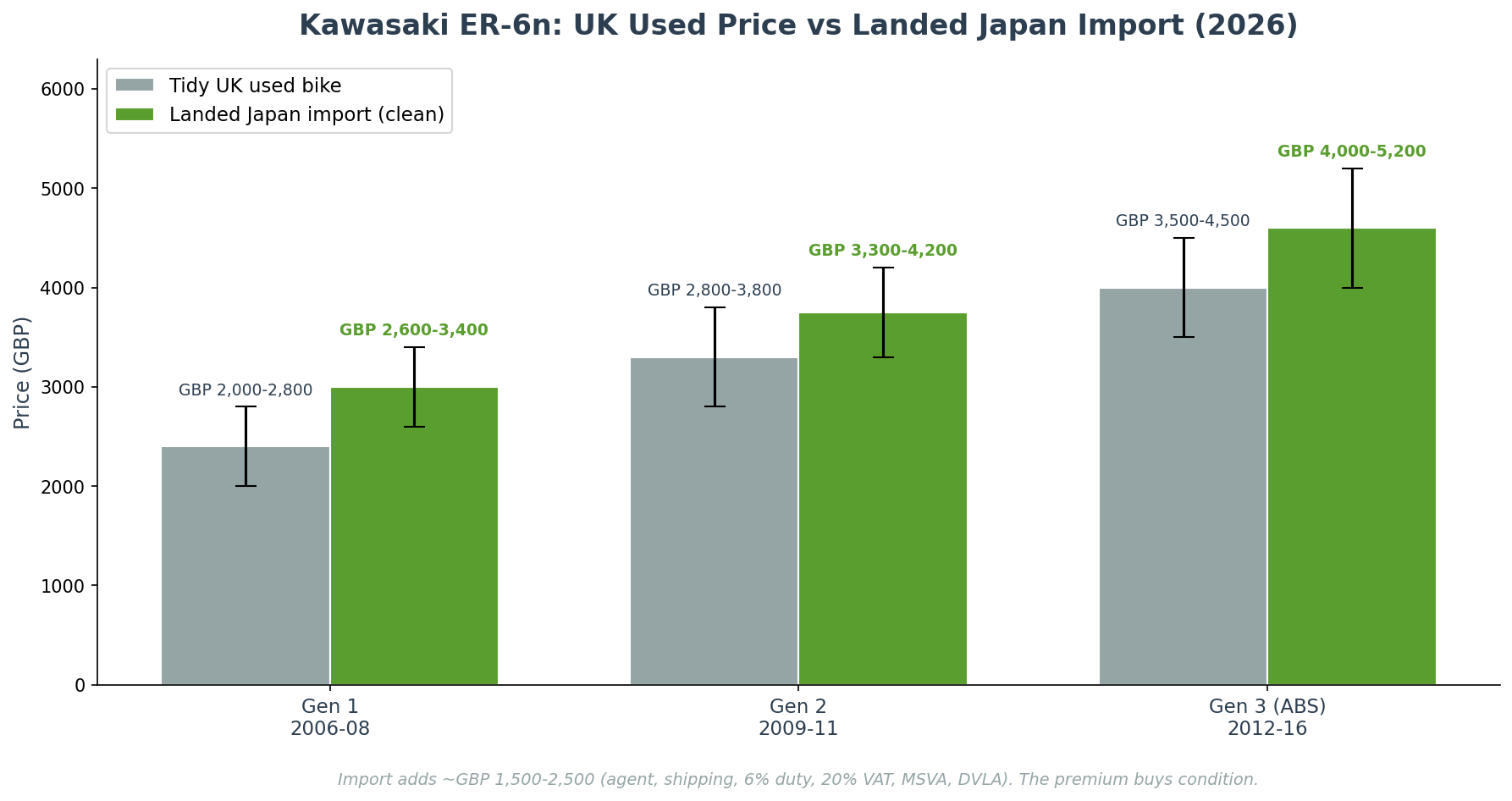
Let's talk real money. In the UK, tidy used ER-6n prices in 2026 look roughly like this: early gen 1 bikes from around £2,000-2,800, clean gen 2 examples £2,800-3,800, and the desirable 2012-2016 gen 3 with ABS from £3,500 up to £4,500 for a low-mileage minter. Dealer stock and later Ninja 650-badged bikes sit at the top.
Importing from Japan changes the maths. Auction hammer prices for ER-6ns are frequently lower than Western retail, especially for clean gen 2 and gen 3 bikes, because Japan has plenty of supply and domestic demand for older middleweights is soft. On top of the hammer price you add the export and shipping costs, and that is where you need to be realistic.
For a UK import, budget roughly £1,500-2,500 on top of the auction price for everything: the export agent and Japanese-side fees, ocean shipping (RoRo is cheapest at £400-600, a shared container is safer at £700-1,000), UK import duty of 6% on bikes over 250cc, 20% VAT, the MSVA test for bikes under ten years old at £100-250, and DVLA registration. Bikes over 30 years old get big duty and VAT breaks, but no ER-6n is that old yet.
Do the sum and a landed, low-mileage Japanese gen 3 can work out similar to, or a little more than, a tired UK bike of the same year, but you get a dramatically better example for the money. The import premium buys you condition. If you just want the cheapest ER-6n that runs, buy local. If you want the best one, import it.
Is importing an ER-6n from Japan actually worth it?
Time for the honest calculation, because we would rather you buy the right way than feel misled. The ER-6n is a cheap bike. That cuts both ways when you import.
On a £3,000 bike, adding £2,000 of import costs is a big percentage. If your only goal is "any running ER-6n," importing rarely beats buying the scruffy local one on price alone. So the honest answer is: importing an ER-6n makes sense when condition matters to you.
Where it wins clearly: you want a genuinely low-mileage, rust-free, undropped example and you are tired of viewing tired learner hacks; you want a specific spec (gen 3, ABS, a particular colour) that is thin on the ground locally; or you simply want a bike with a documented history rather than a stranger's word. A graded Japanese auction bike delivers all three, and the condition premium is real and lasting because it will not need the fasteners, downpipe, chain, and fork seals that a neglected bike will.
Where it does not: if you are chasing rock-bottom price and do not care about a bit of corrosion or a drop or two, the local market will always undercut a landed import on the very cheapest end.
Our take: import an ER-6n when you want the best example of a great-value bike, not when you want the cheapest example of a cheap bike. Know which buyer you are before you bid.
How to import a Kawasaki ER-6n from Japan: step by step
The process is simpler than most people fear. Here is how it actually works.
Step 1: Set your budget, landed. Decide your all-in ceiling, then work backwards. If your maximum is £5,000 on the road, your hammer-price target is roughly £2,800-3,300 once you subtract shipping, duty, VAT, and registration. Never bid against a number you have not calculated backwards.
Step 2: Choose a spec. Generation, ABS or not, colour, mileage ceiling. The tighter your brief, the easier it is to find the right bike and ignore the rest.
Step 3: Use an agent with auction access. Japanese auctions are trade-only, so you bid through an exporter like AWA. They translate the auction sheet, place your bid to your ceiling, and handle the win.
Step 4: Read the auction sheet (see below). This is the single most important skill in the whole process. Get it right and you buy blind with confidence.
Step 5: Export and ship. Your agent handles de-registration, export paperwork, and gets the bike to port. You choose RoRo (cheapest) or container (safest). Expect four to six weeks on the water to Europe.
Step 6: Clear customs and register. Pay duty and VAT on arrival, book the MSVA test if the bike is under ten years old, then register with the DVLA and get your plate. Ride it.
That is the whole thing. The paperwork sounds daunting written down, but a good agent does the hard parts, and you mostly just choose the bike and pay the bills.
How to read a Japanese auction sheet on an ER-6n
Here is the skill that separates a great import from an expensive mistake. Every bike at a Japanese auction gets an inspection sheet with an overall grade and a condition map, and learning to read it means you are not really buying blind at all.
The overall grade runs on a scale where 4 to 5 is a genuinely good used bike, 6 and S are near-new, and grades of 3 or below signal heavy wear, damage, or high mileage. For an ER-6n, aim for grade 4 or better unless you are deliberately buying a cheap project.
The condition map uses codes for each area: A-marks are scratches, W is a repaired dent or weld, S is rust, and U is a dent. On an ER-6n, pay special attention to rust marks around the exhaust and fasteners, and to any A or scratch codes on the bar ends, levers, tank, and engine covers, because those are the tell-tales of a drop.
Also read the inspector's notes and mileage verification. A low, verified odometer with a clean condition map is the holy grail. Watch for notes about aftermarket exhausts (common on ER-6ns and not always a bad thing), warning lights, or corrosion. If the sheet mentions the bike has been dropped or has electrical faults, factor in the charging system and fork seals we flagged earlier.
Do not do this alone. A good exporter reads hundreds of these and will tell you honestly whether a bike is a gem or a trap. That translation is exactly the value an agent like AWA adds, and it is why buying from Japan is safer than a private-sale gamble at home.
Kawasaki ER-6n vs its rivals: MT-07, SV650 and Hornet 600
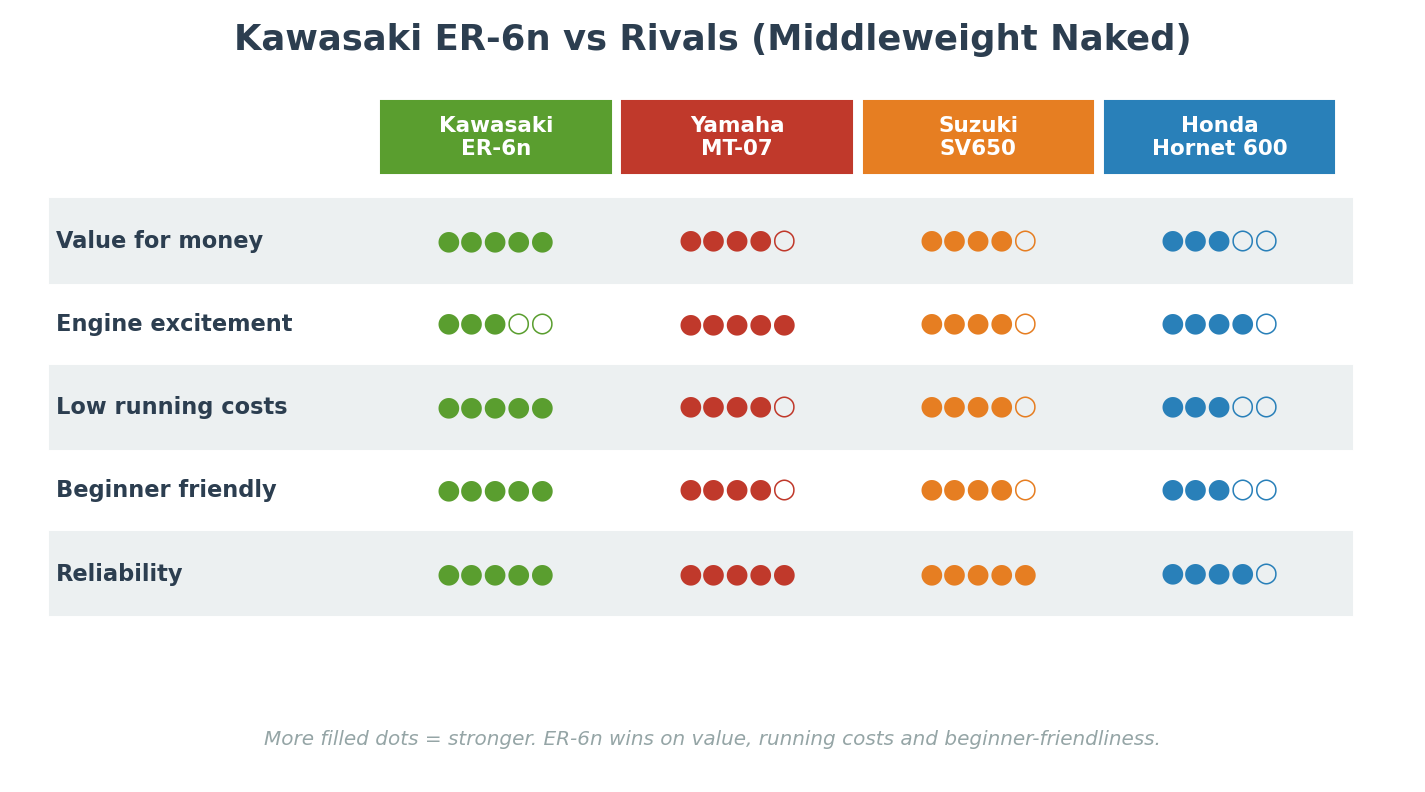
The ER-6n does not exist in a vacuum, and the most-watched ER-6n video on YouTube is a head-to-head against the Yamaha MT-07 that has racked up over 1.6 million views and a thousand arguments in the comments. So let's settle the rivalry honestly.
Yamaha MT-07. The MT-07 replaced the ER-6n as the class default and it is the more exciting bike: its 689cc CP2 twin has a stronger, punchier midrange and the whole thing feels friskier. But used MT-07s cost more, and the ER-6n counters with a lower price, an equally tough engine, and a slightly roomier, more relaxed riding position. If you want thrills, the MT-07. If you want value and comfort, the ER-6n wins.
Suzuki SV650. The SV's 90-degree V-twin is the enthusiast's pick for character and sound, and it is every bit as reliable. The ER-6n is a touch more practical and often cheaper, with a bigger tank feel and slightly more relaxed ergonomics. This one is close, and it comes down to whether you want V-twin charisma or parallel-twin sensibility.
Honda CB600F Hornet. The Hornet 600 counters with a screaming inline-four that loves revs, so it is the choice if you crave top-end noise and a sportier edge. The trade-off is worse fuel economy, a peakier engine, and higher running costs. The ER-6n is torquier low down, cheaper to run, and easier for a newer rider to exploit.
The verdict: the ER-6n is rarely the most thrilling bike in any comparison, but it is almost always the most sensible and the best value. That is the whole point of it. And because a clean Japanese import costs less than a comparable MT-07 or Hornet, the value gap only widens when you buy one from Japan.
Kawasaki ER-6n running costs and maintenance
This is where the ER-6n really shines and where it wins back any import premium over the years you own it. It is one of the cheapest big bikes to run.
Fuel economy sits at 55-65mpg in normal riding, so it is genuinely commuter-cheap. Tyres are standard 17-inch sizes that every brand makes, so a set costs a fraction of superbike rubber and lasts a long time given the modest power. Chain, sprockets, brake pads, and filters are all cheap, generic-ish parts shared across the huge ER-6/Versys/Ninja 650 family.
Servicing is a home-mechanic's dream. Oil and filter every 7,500 miles, valve clearance checks at 15,000 miles that rarely need adjustment thanks to the shim-under-bucket design, and no cam belt or desmo service to dread. Insurance is low because it is a middleweight beloved of learners and commuters, not a hooligan superbike. Even a full dealer service costs a fraction of what a four-cylinder or an exotic twin demands.
Over a few years of ownership, those savings add up to real money, and they are the reason so many ER-6ns rack up huge mileages in the hands of happy owners. Buy a clean import, look after it, and it will cost you almost nothing to keep.
Popular Kawasaki ER-6n modifications
The ER-6n is a favourite platform for tasteful, cheap upgrades, and a lightly modified import can be a great buy if the work is good.
The most common change is an aftermarket exhaust. A slip-on or full system from the likes of Leo Vince, Akrapovic, or M4 wakes up the twin's exhaust note, and these are so common on Japanese ER-6ns that you will see them constantly in auction listings. A good exhaust is a plus, not a minus, as long as the fuelling has not been left snatchy.
Beyond that, popular fixes and upgrades include a small flyscreen or fairing for wind protection on the naked, adjustable levers, a fender extender to protect the shock and header from road spray, tail tidies, crash protection, and heated grips. On the suspension side, uprated fork springs and a rear shock service transform the slightly soft standard setup for very little money.
Our advice: light, sensible mods add value and rideability. Be wary only of extreme "restrictor removal" hacks, dodgy wiring, or a Power Commander with no dyno printout. On a Japanese import, well-chosen accessories are usually a sign of an enthusiast owner, which is exactly who you want to buy from.
Is the Kawasaki ER-6n a good beginner bike?
Yes, and it is one of the best, but with one honest caveat. The ER-6n is soft, light, and forgiving in the way that matters for a new rider: the torque is gentle and predictable off idle, the weight is low and easy to manage at a standstill, the seat is low enough for most people to flat-foot, and the brakes and handling are friendly rather than sharp. It is A2-license friendly in restricted form, which is why riding schools love it.
The caveat: the standard suspension is basic and the finish is cheap, so a hard-used learner bike can feel tired and vague. This is precisely why a clean import beats a beaten local example for a first big bike. A newer rider on a rust-free, undropped Japanese ER-6n gets all the friendliness with none of the "why does everything rattle" disappointment.
One French reviewer's "schizophrenic bike" line is actually the perfect beginner endorsement: it is calm and easy when you are, and rewarding when you want more. That range is exactly what a first big bike should offer. Just resist the urge to unrestrict it the day your license allows, and it will teach you to ride properly.
Kawasaki ER-6n pre-purchase checklist
Before you bid on any ER-6n, run through this. It is the distilled version of everything above, and it is exactly the checklist a good exporter applies for you.
Condition first: Study the auction sheet grade (aim for 4 or better) and the condition map. Look hard at the exhaust downpipe, fasteners, and brackets for rust, and at the bar ends, levers, and engine covers for drop scars.
Engine and history: Prioritise a documented service history over low mileage. Listen for cam chain tensioner rattle on cold start in any video, and treat a snatchy throttle as a TPS flag. The engine itself is bulletproof if it was fed oil.
Electrics: Check for signs of a tired charging system, dim lights, or a weak battery, especially on higher-mileage or neglected bikes. It is cheap to fix but should be priced in.
Spec: Confirm the generation, whether it has ABS, and that any mods (usually an exhaust) are tidy and the fuelling is sorted. Match it to the brief you set before you started looking.
The numbers: Know your landed total before you bid, not after. Hammer price plus roughly £1,500-2,500 for a UK import. Never chase a bike past your calculated ceiling.
Tick these off and you will end up with a clean, honest ER-6n that gives you years of cheap, easy riding. Skip them and you risk buying someone else's neglected commuter from the other side of the world.
How AWA Auction helps you import an ER-6n from Japan
This is what we do. AWA gives you direct access to the Japanese trade auctions where the cleanest ER-6ns actually sell, the ones that never reach Western classifieds. We read the auction sheet for you in plain English, flag the rust and drop codes that matter on this specific bike, and place your bid to a ceiling you control.
We handle the export paperwork, arrange shipping to your port, and give you an honest landed total up front, no surprises after the hammer drops. Whether you want a cheap-and-cheerful gen 1 to learn on or a low-mileage 2014 gen 3 with ABS that puts every tired local bike to shame, we will find the good example and tell you the truth about it. That includes telling you when a bike is not worth importing, because a cheap bike bought badly helps nobody.
Start by browsing the current listings to see what is coming through, or contact our team to set a target on the exact ER-6n you want. Tell us your budget and your spec, and we will hunt down the clean, rust-free, honest example that makes importing worth it.
See Also
Share this article: