
The Kawasaki Ninja 400 is one of the most universally respected motorcycles ever built for the 400cc class. And yet, if you walk into a Kawasaki dealership in North America today, you won't find one. They stopped selling it new for the 2024 model year, replaced it with the Ninja 500, and left thousands of riders asking the same question: where do I get a Kawasaki Ninja 400 from Japan?
The answer is: Japanese auctions have hundreds of them.
Japan's domestic market — powered by BDS, USS, and a network of dealer auctions — turns over enormous quantities of low-kilometer, Shaken-certified Ninja 400s every single week. Bikes that were meticulously maintained by Japanese owners who serviced every 3,000 km and sold them the moment they hit 20,000 km because that's just what people do there. These bikes don't go to scrap. They go to auction, where buyers from Australia, New Zealand, the UK, and yes, the US, can pick them up for less than a used unit in their home market.
This guide covers everything: where to find Ninja 400s in Japan, what they actually cost at auction, total landed cost by destination country, how the import process works step by step, and what you need to know about the JDM spec versus LAMS-detuned versions sold locally.
Why Import a Kawasaki Ninja 400 from Japan in 2026?
The short answer: supply and demand. Japan has the bikes and your local market increasingly doesn't.
Kawasaki officially discontinued the Ninja 400 in North America for the 2024 model year. The replacement — the Ninja 500 with a 451cc engine — hit dealerships instead. The UK and European markets saw a similar shift. Yet the Ninja 400 continued to be manufactured and sold in Japan through 2023, and the used inventory from those model years flows steadily through Japanese auction systems.
Here's why this matters beyond simple availability:
Price. A 2021 Ninja 400 with 8,000 km in Japan sells at auction for roughly ¥380,000–¥450,000 (around $2,500–$3,000 USD equivalent). That same bike in the US used market lists for $5,500–$7,000. Even after adding agent fees, shipping, and import duties, buyers in Australia and New Zealand often land a comparable bike for less than the local market price.
Condition. Japan's Shaken system — mandatory biennial vehicle inspection with real mechanical standards — means bikes are maintained or they don't stay on the road. A Shaken-certified Ninja 400 from Japan isn't just a number on a certificate. It means the brakes, tyres, lighting, emissions, and suspension met official inspection standards within the last two years. You know what you're buying in a way that used private sale bikes rarely offer.
Selection. The Ninja 400 was enormously popular in Japan. BDS (Bike Dealer System), Japan's largest motorcycle auction network, processes 180,000+ bikes per year. The Ninja 400 is consistently one of the most common 400cc listings at BDS Kanto auctions, where 4,000+ bikes go through every Wednesday. You have real choice: year, color, mileage, condition grade, and optional extras like luggage mounts or aftermarket exhausts that previous owners added.
The YouTube numbers back this up. The MC Commute 2018 Ninja 400 review clocked 781,000 views. The YammieNoob 2023 first ride hit 739,000. The raw onboard review surpassed 1 million views. The audience for this bike is enormous, and a good portion of them are looking for a way to get one now that North American dealers have moved on.
 The Ninja 400's lightweight chassis and high-revving twin make it the go-to track bike for intermediate riders worldwide.
What You Need to Know About the Japanese Market Ninja 400
Before you buy, understand what you're actually getting.
The Japanese domestic market Ninja 400 (EX400G series) is mechanically identical to the global export version that was sold in North America, Australia, and Europe — same 399cc liquid-cooled parallel-twin, same DOHC 8-valve setup, same 6-speed transmission, same 785mm seat height. Where it gets interesting is in two specific areas: power output and compliance treatment.
JDM Power vs. LAMS-Detuned Versions
Australia and New Zealand both operate LAMS (Learner Approved Motorcycle Scheme), which restricts power-to-weight ratios for learner licences. When Kawasaki sold the Ninja 400 locally in those markets, it shipped with a revised fuel and ignition map to comply with LAMS limits of 150kW per tonne. The Japanese domestic market version runs full factory power output — approximately 44–45 hp — without that restriction.
This matters if you're an Australian or New Zealand buyer importing for personal use. A JDM Ninja 400 will run noticeably stronger than the LAMS-spec local version, and that extra performance stays available even after your L-plate comes off. Many experienced riders deliberately target JDM imports specifically for this reason.
For North American buyers, the difference is moot — the US, Canadian, and UK export-spec Ninja 400 always ran full power. The JDM version matches that.
Model Year Breakdown
Kawasaki produced the Ninja 400 in Japan from 2018 through 2023. Key model year distinctions:
2018–2019: The original generation. Slightly higher suspension travel, original green KRT or black non-KRT color. These are the oldest but often the best value at auction because mileage has accumulated and early-adopter owners have sold and moved on. Mechanically fully proven — six-plus years of reliability data from a large global fleet.
2020–2021: Minor refresh with updated graphics and minor ergonomic tweaks. Mechanically identical to 2018–19. This is the sweet spot for value — low enough price to be attractive, recent enough to have Shaken certification through to at least 2025.
2022–2023: Last model years before discontinuation globally. Highest values at auction. The 2023 KRT Edition in lime green tends to command a significant premium of ¥100,000–¥150,000 over equivalent non-KRT models. These are the bikes where genuinely low-kilometer examples are most plentiful.
Auction Grades to Target
Japanese motorcycle auction sheets use a grading system from S (showroom condition) to RA (suitable for parts only). For a Ninja 400 purchased for regular road use:
- Grade S or 6: Near-new condition, under 3,000 km, no marks or blemishes. Buy with confidence. Expect to pay a significant premium.
- Grade 5: Minor scuffs only, no structural damage, fully functional. Most common grade for 2020–23 examples and the standard for clean used bikes. This is what most buyers target.
- Grade 4.5–4: Light blemishes, possibly a cosmetic ding or minor fairing scratch, mechanically sound. Best value for the money in most cases.
- Grade 3.5 or below: Start reading damage codes carefully. Not automatically a problem, but requires careful evaluation before committing.
The auction sheet also documents specific damage using letter codes: A (scratches), U (dent or deformation), B (broken part), W (repainted over damage), X (major panel damage), XX (structural damage beyond economical repair). A bike graded 4 with A-1 codes on the fairing is a cosmetic tip-over mark — structurally irrelevant. A bike graded 4 with W-2 on the frame requires independent investigation.
Where to Find Kawasaki Ninja 400s in Japanese Auctions
Japan runs multiple motorcycle auction networks. Here's where to look, how they operate, and what sets each apart.
BDS — Bike Dealer System
BDS is the dominant force in Japanese motorcycle auctions. Founded in 1983, the network spans multiple auction houses across Japan — the flagship Kanto auction runs every Wednesday and processes approximately 4,000 motorcycles in a single session. Regional auctions in Osaka, Nagoya, Fukuoka, and Sapporo add thousands more units per week. Total annual volume across the network: over 180,000 bikes.
The BDS JUPITER system is a real-time electronic bidding platform used by licensed dealer-members. Individual buyers cannot bid directly on BDS — you go through a registered agent or exporter who holds BDS membership. This isn't bureaucratic friction; it's how the entire Japanese wholesale trade works, and it keeps the market efficient, documented, and largely free of the fraud that plagues unregulated used bike markets elsewhere.
A typical BDS Ninja 400 listing includes: auction grade, individual damage codes per panel section, odometer reading, tyre tread depth remaining in millimetres per wheel, brake pad thickness measurement, battery condition (Good/Weak/Replace), engine start behaviour (cold and warm), clutch and transmission function assessment, and a free-text notes field where the inspector flags anything unusual — a flat spot in the front tyre, an aftermarket exhaust that doesn't have a certificate, a replacement dash cluster. This is more information than you'd ever get buying a used bike from a private seller anywhere in the world.
USS Auction — Ninja Specialist Platform
USS operates a dedicated motorcycle auction service called USS Ninja, which is distinct from their vehicle auction operations. USS Ninja runs weekly and is particularly strong for popular sport and supersport models. If BDS is the general-market wholesale auction, USS Ninja is the enthusiast-oriented specialist.
For Ninja 400 buyers, USS tends to have strong inventory of the 2021–23 model years. The bidding tends to be slightly more competitive — enthusiast buyers drive prices up on desirable bikes — but the inspection quality and auction sheet detail match BDS standards. Some exporters have better relationships with USS than BDS; ask your chosen agent which they primarily use.
Direct Exporters and Listing Aggregators
Several companies aggregate Japanese auction listings into English-language interfaces. Sites like japanesecartrade.com, beforward.jp, and japan-motor.co.jp display BDS and USS inventory with English translations of the auction sheets. You can search by make and model, filter by grade, compare prices across recent transactions, and contact an exporter to arrange purchase.
These services are useful for getting a price-discovery snapshot before you engage a dedicated agent. Don't treat them as buying platforms in themselves — always work with a licensed exporter who can independently verify a bike's history, arrange pre-export inspection if needed, and handle the export documentation correctly.
One practical tip: use the aggregator sites to establish your price expectations before speaking to an agent. If you know that grade 5 2021 Ninja 400s are consistently clearing BDS at ¥400,000–¥450,000, you won't be surprised or misled by any exporter's pricing.
 BDS Kanto processes over 4,000 motorcycles every Wednesday — one of the densest concentrations of used bike inventory in the world.
How Much Does a Kawasaki Ninja 400 from Japan Actually Cost?
This is where most guides stop giving you useful information. Let's be specific.
Japanese Auction Prices (FOB Japan)
These are approximate BDS and USS auction hammer prices based on 2024–2025 transaction data, before agent fees or export costs:
| Model Year | Condition Grade | Km Range | Auction Price (JPY) | Approx USD |
|---|---|---|---|---|
| 2018–19 | 4–4.5 | 15,000–25,000 km | ¥200,000–¥280,000 | $1,330–$1,860 |
| 2020–21 | 4.5–5 | 8,000–18,000 km | ¥320,000–¥420,000 | $2,130–$2,800 |
| 2022–23 | 5–6 | 2,000–10,000 km | ¥480,000–¥680,000 | $3,200–$4,530 |
| 2023 KRT | 5–S | Under 5,000 km | ¥650,000–¥850,000 | $4,330–$5,660 |
(Exchange rate used: ¥150 = $1 USD approximate)
These are wholesale hammer prices. Add the agent/exporter fee on top: typically ¥40,000–¥55,000 ($265–$365) plus a processing charge of ¥10,000–¥15,000 for documentation and export paperwork.
Total Landed Cost by Destination
Here's where the math gets destination-specific. The cost breakdown chart below uses a representative 2021 Ninja 400 (grade 5, 10,000 km, auction price ¥400,000) as the base case.
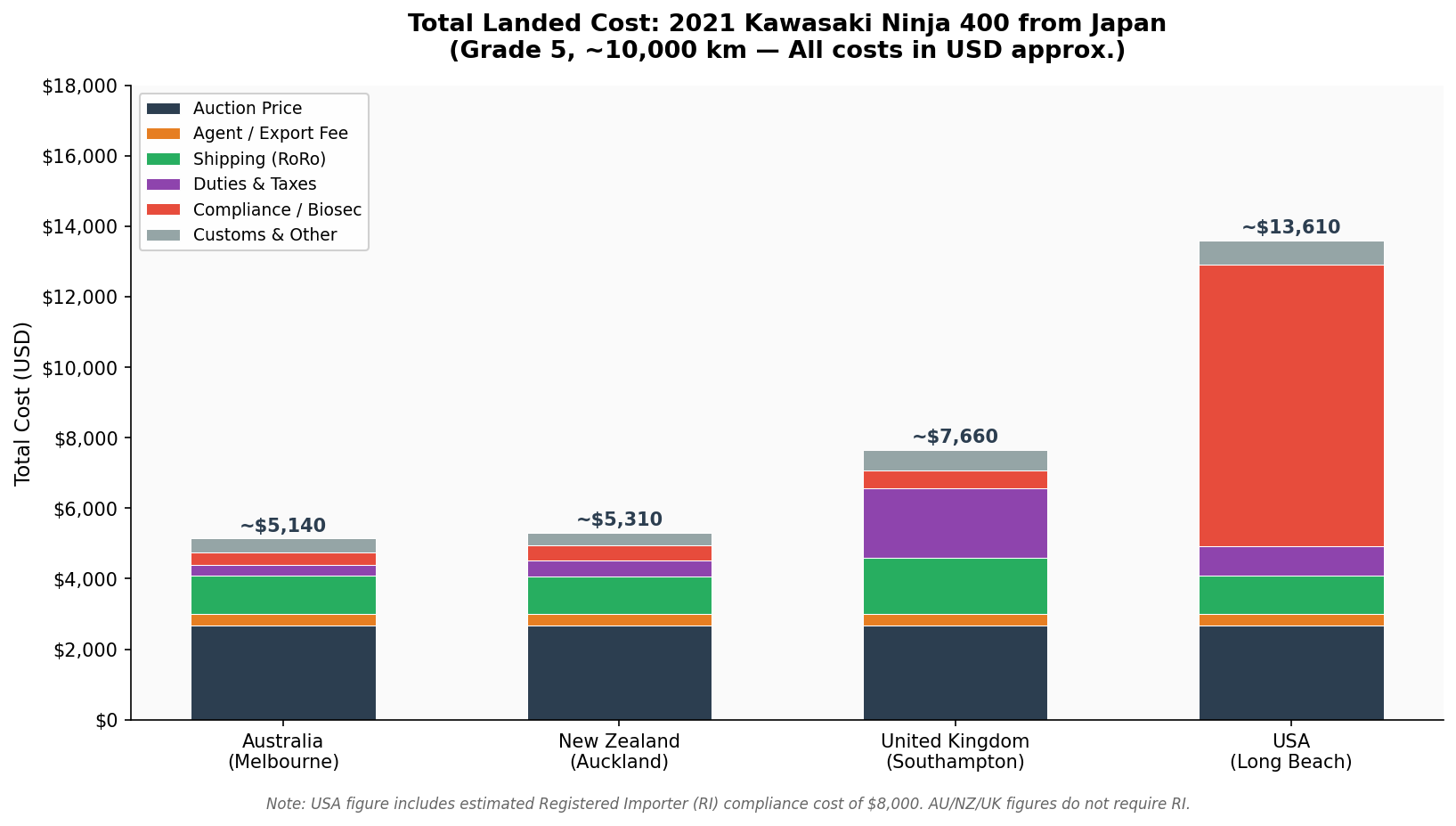 Total cost to land a 2021 Kawasaki Ninja 400 (grade 5, 10,000 km) across four key markets, including auction price, agent fees, freight, and applicable duties.
Australia: - Auction price: ¥400,000 (~$2,665 AUD equivalent at current rates, roughly A$4,000) - Agent/export fee: ¥50,000 (~A$500) - Marine insurance: ~A$150 - Shipping RoRo (Yokohama to Melbourne, Sydney, or Brisbane): ~A$1,200–$1,600 - Import duty: 0% under Japan-Australia EPA - GST: 10% applied to dutiable value (CIF) - AQIS biosecurity inspection and treatment: ~A$250–$350 - Customs broker fee: ~A$400 - Total estimated landed: ~A$8,000–$10,000
Compare to: Used Ninja 400 in Australian market typically A$8,500–$12,000. The import math works comfortably for 2020–23 model years, where local supply is thinner.
New Zealand: - Shipping (Yokohama to Auckland): ~NZ$1,400–$1,800 - Import duty: 0% under Japan-NZ EPA - GST: 15% on CIF value - MPI biosecurity levy and inspection: ~NZ$350–$450 - NZTA compliance plate/WoF: ~NZ$300–$500 - Total estimated landed: ~NZ$8,500–$11,000
NZ buyers targeting JDM full-power spec get a meaningful performance advantage over LAMS-detuned local units, plus the full selection of Japanese market colors.
United Kingdom: - Shipping (Yokohama to Southampton): ~£900–$1,200 - Import duty: 6.7% under UK-Japan CEPA (Economic Partnership Agreement) - VAT: 20% - DVLA registration/first MoT: ~£100–£200 - Customs clearance: ~£400–£600 - Total estimated landed: ~£7,500–$10,000
UK used Ninja 400 prices: £5,500–$9,000. The import math is tighter here. It makes most sense for buyers wanting specific 2023 KRT specification bikes or for those sourcing multiple units.
The US Import Reality: What Nobody Fully Explains
Here's the thing nobody tells you when they talk about importing a Ninja 400 from Japan to the US: the 25-year rule doesn't help you.
The 25-year rule exempts vehicles manufactured at least 25 years ago from EPA and FMVSS safety standards. A 2021 Ninja 400 isn't eligible until 2046. A 2018 Ninja 400 won't clear that threshold until 2043. You're not buying a vintage machine here.
For a bike under 25 years old that wasn't originally EPA-certified for the US market, you have two realistic options:
Option A: Registered Importer (RI) route. An RI is an EPA and NHTSA-registered company that takes a foreign-market bike, modifies it to meet US emissions and FMVSS safety standards, certifies the work, and submits documentation to NHTSA. Cost: typically $5,000–$15,000 depending on the RI and the specific bike. Lead time after arrival: 6–18 months. Total US street-ready cost from Japan for a 2021 Ninja 400: potentially $12,000–$20,000, more than double the US used market price.
Option B: Buy the US-spec used market. A 2021 Ninja 400 ABS in the US already has all the compliance work done — it was built to US spec from the factory. Used prices on Autotrader: $4,500–$7,500 depending on mileage and condition.
Then factor in the Section 232 tariffs implemented in April 2025: 25% on Japanese motorcycles imported to the US. On a bike with a declared value of $3,000, that's another $750 before shipping even starts.
The verdict for US buyers: Unless you have a very specific reason to want a JDM-spec unit — a particular color unavailable in the US, a very low-km 2023 KRT that doesn't exist in your market, or you're a dealer doing volume with an established RI relationship — buying used in the US market is the more practical path. The economics don't stack in favor of individual US buyers importing Ninja 400s from Japan under current tariff conditions.
For Australian, New Zealand, and UK buyers, the calculation is meaningfully different. The duty structures are friendlier, the compliance requirements are simpler, and the value proposition clears comfortably.
 RoRo and container shipping routes from Yokohama and Nagoya connect Japanese auctions to ports in Australia, the UK, and New Zealand on regular weekly sailings.
The Import Process Step by Step
Regardless of destination, the core import process follows the same sequence.
Step 1: Find Your Target (Weeks 1–4)
Work with a Japan-based motorcycle exporter who has BDS or USS access. Provide your specification: model year, acceptable grade range, maximum km, destination port, and maximum budget. Most exporters maintain email alert systems — when a matching bike appears at auction, they notify you with the full auction sheet translated into English.
Review the auction sheet yourself. The grading and damage codes are standardised across all Japanese auctions; once you understand the system (see the section below on reading auction sheets), you can evaluate a BDS sheet as clearly as any professional.
Don't rush this phase. The Ninja 400 is not scarce at Japanese auction. A new selection of bikes appears every week. The discipline to wait for the right unit rather than accepting an acceptable-but-not-ideal one is what separates buyers who are satisfied with their import from those who have regrets.
Step 2: Bid and Win (1 auction cycle, typically 1 week)
Your agent bids at the next available auction session. BDS Kanto runs every Wednesday; regional auctions run on other weekdays. USS Ninja has its own schedule. Your agent will advise you on the appropriate maximum bid for your target unit based on current market conditions.
Expect to pay a deposit (typically 30–50% of estimated total cost) before the bid is placed. This protects the agent from commitment risk — they're legally obligated to pay the auction house once the hammer falls.
Step 3: Payment, Documentation, and Export Prep (Weeks 2–5 after auction win)
After winning, you pay the remaining balance. The exporter handles:
- Export certificate (抹消登録証明書): Deregisters the bike from the Japanese vehicle registry. Required for customs clearance at the destination.
- Bill of Lading (B/L): The document of title for the shipment. Essential for customs clearance and insurance.
- Pre-export biosecurity treatment: Required for Australia and New Zealand — the bike must be cleaned to specific standards and certified free of soil, insect matter, and prohibited materials before loading.
- Country-specific declarations: Each destination country has its own import declaration format.
Step 4: Ocean Freight (Weeks 4–10 depending on destination)
Transit times from major Japanese export ports (Yokohama, Nagoya, Osaka):
| Destination | Transit Time | Typical Shipping Cost |
|---|---|---|
| Australia (major ports) | 2–4 weeks | $900–$1,600 USD |
| New Zealand (Auckland) | 3–5 weeks | $800–$1,200 USD |
| UK (Southampton) | 6–9 weeks | $1,200–$1,800 USD |
| US West Coast | 2–3 weeks | $800–$1,400 USD |
RoRo (Roll-on Roll-off) is the standard method for motorcycle shipping — cheaper and simpler than a dedicated container. Container shipping adds cost but provides better protection for high-grade bikes or multi-unit shipments.
Step 5: Customs Clearance and Local Registration (Weeks 10–14 total)
At your destination port, a licensed customs broker handles clearance. Budget $300–$600 in Australia and NZ, $400–$800 in the UK. Once cleared, transport the bike to your preferred workshop for a pre-registration inspection, any minor service or setup work, and then to your local transport authority for registration.
Complete timeline, auction to registration: 10–14 weeks for Australia and New Zealand. 12–18 weeks for the UK. Add 6–24 months for US RI process if applicable.
Ninja 400 vs. Ninja 500: Why Some Riders Still Choose the 400
Kawasaki's Ninja 500 is the official successor. It has more displacement, more torque, and a more relaxed ergonomic posture. So why are so many people still specifically hunting for a Ninja 400 from Japan?
Several reasons, and they're all legitimate.
Weight and Track-Day Handling
The Ninja 400 tips the scales at 167 kg wet. The Ninja 500 comes in at 170 kg. Three kilograms doesn't sound like much, but experienced riders feel it immediately in direction changes and corner-entry behaviour. The 400's lighter chassis combined with its stiffer sport-oriented suspension tune makes it sharper in turn-in and more communicative through the front end — qualities that matter enormously on track.
YammieNoob's 2023 Ninja 400 first ride video (739,000+ views, 665 comments) consistently returns to this theme: the bike rewards aggressive riding more than its displacement number suggests. MC Commute's 2018 review (781,000 views, 1,040 comments) surfaces similar observations from riders who've tracked both the 400 and its replacement and prefer the 400's sharper character.
The High-Rev Character vs. Midrange Torque
The Ninja 400's 399cc twin is tuned to rev — peak power arrives around 10,000 RPM. The Ninja 500's 451cc engine, retuned for broader midrange delivery, makes peak power around 9,000 RPM and pulls confidently from 5,000. For urban commuting and highway riding, the Ninja 500 is unambiguously more relaxed to use. For track day sessions and sporting country roads, many riders find the Ninja 400's character more engaging and rewarding.
This isn't nostalgia. It's a real difference between two bikes with different performance philosophies sharing nearly identical sheet metal.
LAMS Full Power in Australia and New Zealand
In Australia and NZ, both bikes are LAMS-approved for learner riders. The complication: locally-sold Ninja 400s were detuned for LAMS compliance. A JDM-imported Ninja 400 runs the full factory tune. When an Australian rider reaches full licence, a locally-purchased LAMS Ninja 400 suddenly feels like a different bike in a positive sense — the LAMS restriction maps have different thresholds. Many experienced AU riders deliberately import JDM Ninja 400s to get the full performance envelope from the start without waiting for the restriction to lift.
Price Stability After Discontinuation
When Kawasaki stopped making new Ninja 400s, used prices in most markets stabilised rather than declining — supply of new bikes disappeared while demand from riders specifically wanting the 400 character didn't. In Australia, a clean 2021 Ninja 400 typically lists at A$9,000–$11,000 and moves quickly. Japan's auction supply prevents a full scarcity premium from developing, but doesn't flood the market either. The result is a bike that holds value consistently and remains a genuine performance proposition alongside the Ninja 500.
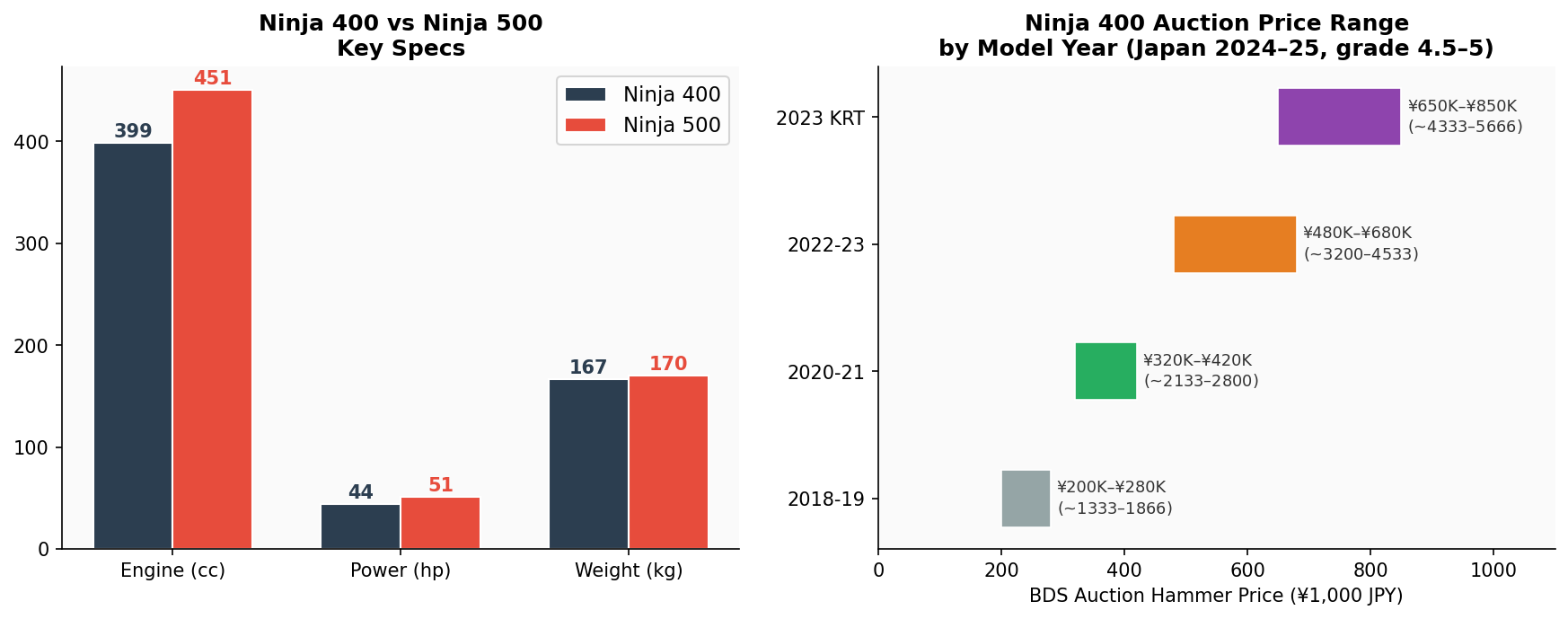 Key specifications compared: Ninja 400 vs Ninja 500 on the metrics that matter most to import buyers.
Reading the Auction Sheet Before You Bid
Reading a Japanese auction sheet is a skill worth developing. Here's a quick reference for Ninja 400 buyers.
The sheet shows a top-down and side-profile diagram of the motorcycle. Inspectors mark each panel section with alphanumeric damage codes — the letter indicates damage type, the number (1–3) indicates severity:
- A1: Light surface scratch, cosmetic only. Very common.
- A2: Deeper scratch, visible at normal viewing distance. Still cosmetic.
- A3: Significant scratch or road rash. Cosmetic but more extensive.
- U1–U2: Dent or deformation. U2 means clearly visible.
- B: Broken or cracked part that needs replacement.
- W: Repainted surface. Could mean minor touch-up or damage concealment — look at location.
- X: Major panel damage. Investigate what's underneath.
- XX: Structural damage. Walk away unless you know exactly what it is.
For a Ninja 400 bought for road use, target grade 4.5 or above with damage codes limited to A-series on fairing panels only. An A2 on the lower right fairing is a tip-over mark — structurally irrelevant and extremely common on used sport bikes. A U code on the tank or frame is a different matter and warrants a closer look before bidding.
The sheet also includes tyre tread depth remaining (in mm, front and rear), brake pad thickness, battery condition, and a free-text comments field where inspectors add anything the coded system doesn't capture — a non-standard aftermarket exhaust, a replacement instrument cluster, a tyre near the replacement threshold.
Use the inspector's comments field. This is where the detail that matters most often lives.
How AWA Auction Connects You to Ninja 400 Inventory
AWA Auction provides English-speaking buyers direct access to Japanese motorcycle auctions — the same BDS and USS inventory that Japanese dealers use — with documentation handling, shipping coordination, and destination customs support built in.
You specify your target: model year, acceptable grade, maximum km, destination port. AWA's team monitors weekly auction inventory and contacts you when a matching unit appears, with the full auction sheet and a bid recommendation. Once you confirm and the bid is won, AWA coordinates the export documentation, Shaken certification, ocean freight booking, and connects you with customs clearing at your port.
For Ninja 400 specifically: Japanese auction inventory replenishes every week. If this week's auction doesn't surface a match, next week will. The key is having your parameters clearly defined so the search runs efficiently without wasting time on close-but-not-right units.
Browse current listings — including Kawasaki Ninja 400 inventory — and see what's available at this week's auctions. Or contact the team to set up a monitored search with your specific criteria.
One more thing worth knowing: Ninja 400 auction prices in Japan have remained remarkably stable since the model was discontinued. Unlike some models that drop sharply in value once production ends, the Ninja 400 benefits from sustained global demand and a loyal following that actively resists moving to the 500. The week-over-week data from BDS shows only minor seasonal variation, with prices typically 5–8% lower in winter months (October–February in Japan) when domestic demand drops and more units hit auction. Buying in winter and shipping for a spring arrival in the Southern Hemisphere gives you both the best auction pricing and the best riding conditions when the bike arrives.
Frequently Asked Questions
Can I import a Kawasaki Ninja 400 from Japan to the US without a Registered Importer?
If the bike is under 25 years old, it must meet US EPA and FMVSS standards to be street-legal. A JDM Ninja 400 was not certified for the US market, so it requires modification by an NHTSA-registered Registered Importer. You can bring it in as an off-road or track-only machine without RI certification, but you cannot register it for public road use. The RI route costs $5,000–$15,000 on top of the bike and all import costs — making it uneconomic for individual buyers unless you have a very specific reason.
Is the Kawasaki Ninja 400 still being made?
Kawasaki stopped global production of the Ninja 400 after the 2023 model year. No new production is planned. What exists now is the used inventory accumulated during the 2018–2023 production run — which is substantial. Japan specifically has a large supply flowing through auction channels every week.
What's the best model year of the Ninja 400 to buy from Japan?
For value: 2020–2021 (common at auction, well-maintained, under ¥420,000 for grade 5 examples). For newest specification: 2022–2023 (lowest km, highest prices). For budget buyers: 2018–2019 (fully proven reliability record, highest availability, lowest prices but accumulated km).
How long does it take to import a Ninja 400 from Japan to Australia?
From auction win to delivery, expect 10–14 weeks total: 2–3 weeks for export documentation and biosecurity prep, 2–4 weeks ocean transit, 1–2 weeks customs clearance and local transport.
Does a JDM Ninja 400 have more power than the Australian LAMS version?
Yes. Kawasaki detuned the fuel and ignition maps for Australian and New Zealand LAMS compliance. The JDM version runs the full factory tune — approximately 44–45 hp versus the restricted LAMS output. For riders on a full licence, the JDM spec is the better choice.
What import duty applies when bringing a Ninja 400 from Japan to Australia?
Zero. The Japan-Australia Economic Partnership Agreement eliminated import duties on motorcycles from Japan. You'll pay 10% GST on CIF value (cost + insurance + freight) — but no separate import tariff.
How do I verify a Ninja 400 from Japan hasn't been in an accident?
The BDS or USS auction sheet documents all visible damage using standardised codes. Your exporter can also request a Japanese vehicle registration history (showing previous registered prefectures and number of owners). A bike registered in urban Tokyo, with one or two owners, under 15,000 km, on full current Shaken certification, provides very high confidence in provenance. For additional certainty, some exporters arrange pre-export physical inspection by an independent mechanic for a fee of ¥15,000–¥30,000.
Can AWA Auction source a specific colour or trim level?
Yes — you can specify KRT (green) or standard colour, and preferred model year, when setting up a monitored search. Specific configurations may take longer to source, but the volume of weekly auction listings makes it feasible to wait for the right unit without indefinite delay. Contact the team to discuss your specific requirements.
Is the Ninja 400 a good first motorcycle?
It's the answer most experienced riders give when someone asks what to buy for their first sportbike. 44 hp is genuinely exciting without being immediately dangerous. ABS is standard across all model years. The riding position is aggressive enough to feel sporting without causing fatigue on longer rides. The suspension is calibrated well for both urban and weekend sport use. The YouTube community's consensus — across millions of cumulative views and thousands of comments — is overwhelmingly positive for new and intermediate riders.
What's the difference between buying from a Japanese exporter vs AWA Auction?
A direct exporter handles the Japan-side transaction and export documentation, then hands the logistics to you at the destination. AWA Auction provides end-to-end coordination including destination-side customs broker liaison, shipping tracking, and ongoing communication throughout the process — particularly valuable if you've never imported a vehicle before and want one point of contact for the entire journey.
The Bottom Line
The Kawasaki Ninja 400 is still very much available. It's just available in Japan, not at your local Kawasaki dealer.
For Australian and New Zealand buyers, the math often works in your favour: zero import duty under the free trade agreements, strong weekly auction availability of grade 5 bikes in the ¥380,000–¥480,000 range, and the added advantage of JDM full-power spec. For UK buyers, the calculation is tighter but viable for specific model years and configurations. For US buyers, the RI complexity and Section 232 tariffs mean the domestic used market is the more practical route for individual buyers — unless you have a specific and compelling reason to source from Japan.
The weekly BDS and USS auction cycles mean inventory replenishes continuously. You're not competing for a rare find; you're making a systematic decision about which of many available units best matches your criteria.
Browse current Kawasaki Ninja 400 listings at AWA Auction, or contact the team to set up a monitored search with your specifications.
See Also
Share this article: