
If you want to import a Kawasaki Versys 1000 from Japan, you are chasing one of the most quietly clever bikes in the sport-touring world: a 1,043cc inline-four wrapped in adventure-style bodywork, comfortable enough to cross a continent two-up, and priced like a bargain compared to a BMW GS. It looks like a big adventure bike, but it rides like a fast, plush road tourer — and that mismatch is exactly why so many owners fall for it.
Here is the thing nobody spells out in the glossy reviews. The Versys 1000 is a superb used buy, but the market is full of easy mistakes: people confuse it with the smaller Versys 650 twin, they expect it to go off-road and get burned, they overpay for a base bike when a fully-loaded SE is only a little more, and they ignore the one or two known weak spots that turn a clean example into a headache. Japan is where the low-mileage, honestly-graded stock lives — if you know what you are looking at.
This guide walks you through every generation, the trim-level maze, the genuine known problems, the years to avoid, real used prices, the all-in cost of landing one in the UK, Australia or New Zealand, and how to read a Japanese auction sheet so you do not overpay for a tired bike. Let's get into it.
What is the Kawasaki Versys 1000?
The Kawasaki Versys 1000 (model code KLZ1000) is a road-biased adventure-sport tourer built around a retuned version of Kawasaki's 1,043cc liquid-cooled inline-four. The name is a contraction of "Versatile System," and that is the whole pitch: upright bars, long-travel suspension, a tall screen and adventure looks, but 17-inch cast wheels and road tyres underneath. It is a sport-tourer in a fancy dress, and it is very good at that job.
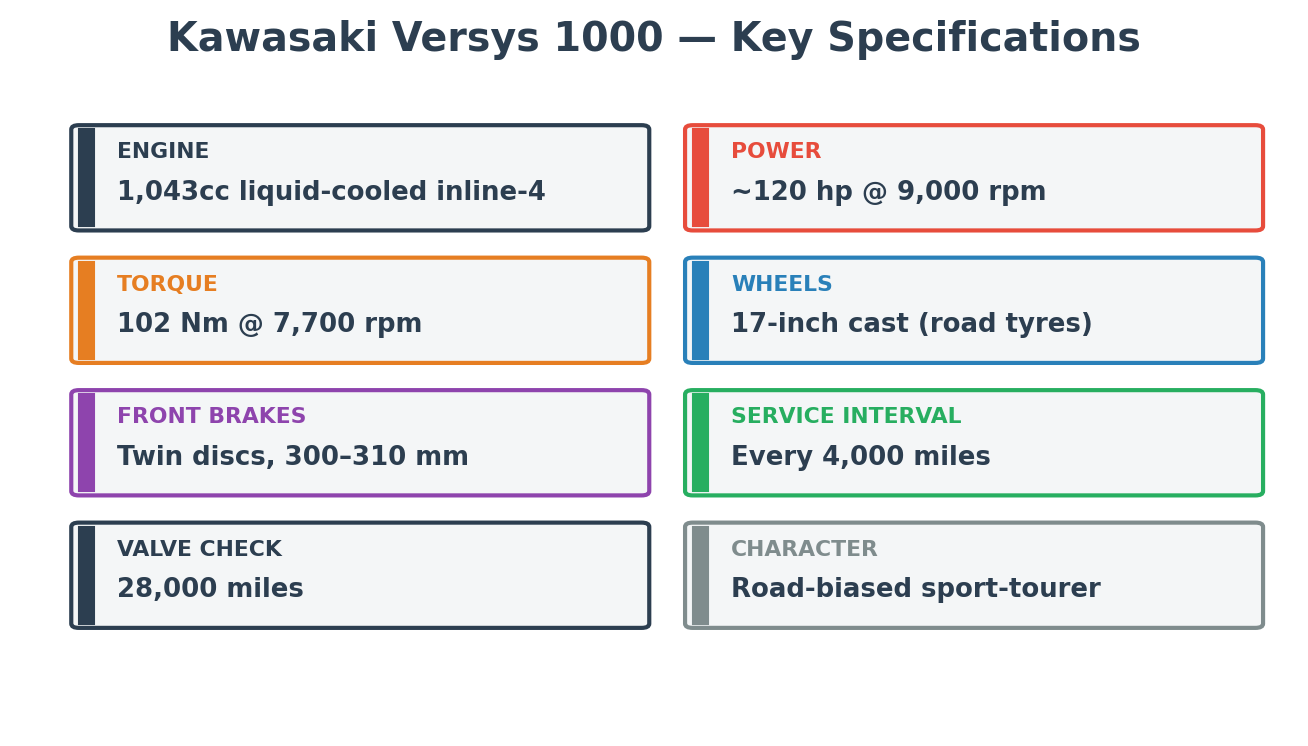
Kawasaki launched it in 2012 using a detuned Z1000 engine, softened for midrange torque rather than top-end fireworks. First-generation bikes made about 118hp at 9,000rpm and 102Nm at 7,700rpm, riding on a 1,520mm wheelbase with dual 300mm front discs. The idea was simple: take the smooth, under-stressed four-cylinder, give it relaxed ergonomics and real luggage capacity, and undercut the European adventure-tourers on price by a wide margin.
What you get is a bike that is happiest eating motorway miles, sweeping A-roads and two-up trips with panniers loaded. It is fast enough to embarrass most traffic, refined enough to do 400-mile days, and cheap enough that people describe it as the sensible enthusiast's secret. It is not a dirt bike, it never was, and the sooner a buyer accepts that, the happier they will be.
Why import a Kawasaki Versys 1000 from Japan?
Japan is the best used-bike warehouse on earth, and the Versys 1000 is a perfect example of why. Bikes there are typically low-mileage, rust-free, dealer-serviced and sold through a transparent auction grading system that tells you the truth about condition before you ever bid. A Versys is a big, comfortable tourer that many Japanese owners buy, ride gently, and trade in — which means clean, honest examples turn up constantly.
The financial case is straightforward. A well-kept Japanese Versys 1000, landed in the UK with all fees paid, frequently comes in cheaper than an equivalent-condition local bike — and with a documented history you can actually trust. You skip the tired, thrashed, previously-crashed examples that clog the domestic classifieds, and you get to choose from a much deeper pool of stock, including higher-spec SE and Grand Tourer versions that are rarer at home.
There is also the choice factor. In Japan you can find specific colours, trims and low-mileage years that barely exist in your local market. If you want a 2019 SE with semi-active suspension and 6,000 miles, Japan probably has three of them this week — browse our current stock to see what is landing now. That is the real reason experienced buyers import: not just price, but access to the exact bike they want, graded honestly, from a market that looks after its motorcycles.
Versys 1000 vs Versys 650: don't buy the wrong one
This is the single most common mix-up, so let's kill it now. The Versys 650 and the Versys 1000 share a name and a silhouette, but they are completely different motorcycles with different engines. The 650 uses a 649cc parallel-twin — light, friendly, and aimed at newer or shorter riders. The 1000 uses a 1,043cc inline-four with nearly double the power and a totally different character: smoother, faster, torquier and far better suited to long-distance, two-up touring.
If your plan is loaded touring, motorway cruising and effortless overtakes, the 1000 is the bike. If you want something light and flickable for commuting and shorter rides, the 650 makes more sense. Japanese auction listings label them clearly, but photos can fool you — always confirm the engine (four cylinders, not two) and the KLZ1000 model code before you bid.
The other trap is the adventure styling. Despite the beak, the tall screen and the "adventure" marketing, the Versys 1000 runs 17-inch road wheels and has modest suspension travel. It handles gravel driveways and broken tarmac just fine, but it is not built for green lanes or serious off-road, and buying one expecting a GS-style dirt machine is a recipe for disappointment. Treat it as a comfortable, fast road tourer and it will delight you.
Kawasaki Versys 1000 generations explained
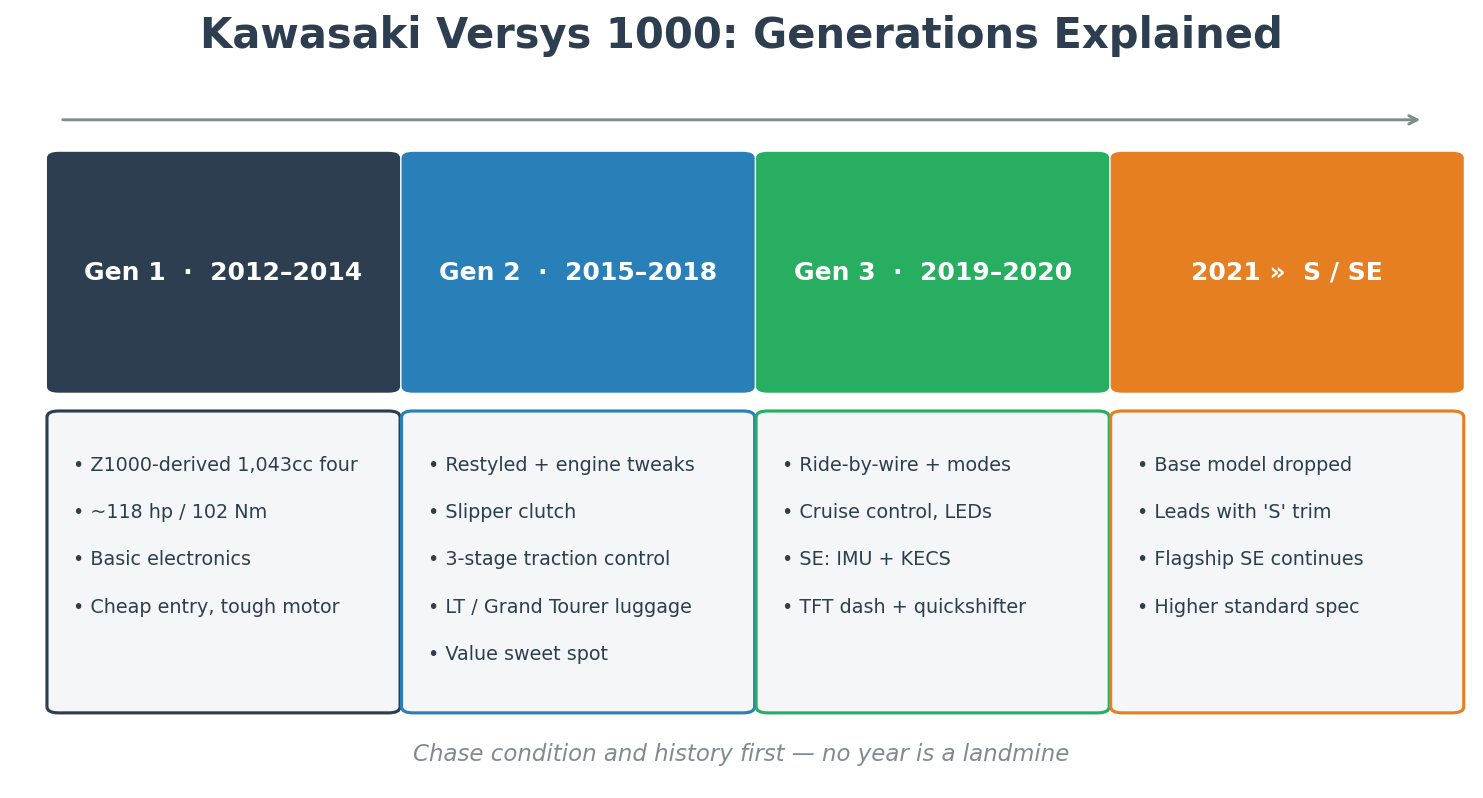
There are three clear generations, plus a mid-life spec shuffle. Knowing which is which tells you what to pay and what to expect.
First generation (2012-2014)
The original. A Z1000-derived 1,043cc four making around 118hp, with basic-but-honest running gear: dual 300mm front discs, non-adjustable-ish suspension by later standards, and — depending on market and year — limited or no traction control. These are the cheapest way into a Versys 1000, and mechanically they are tough. The styling is more restrained than later bikes, and the electronics are simple. Buy one for value, not for gadgets.
Second generation (2015-2018)
The big update, and for many buyers the value sweet spot. Kawasaki gave it fresh styling, new cylinders and heads that nudged power up and fattened the low-rpm torque curve, a slipper clutch, proper three-stage traction control, and a claimed 5% better fuel economy. Front rotors grew from 300mm to 310mm for stronger braking, and weight rose about 11kg. This is also when the LT and Grand Tourer packages (panniers, hand guards) became a common sight. A clean Gen2 is a lot of comfortable, reliable tourer for the money.
Third generation (2019-onwards)
The modern one. A major refresh brought an all-new electronic throttle valve system with proper riding modes (Sport, Road, Rain and a custom Rider mode), cruise control, and updated bodywork with LED lighting. The top-spec SE went further: a Bosch inertial measurement unit unlocking cornering-aware traction control and ABS, KECS electronically controlled semi-active suspension, a TFT dash, cornering lights, heated grips and a quickshifter. This is the Versys that finally feels premium.
2021 spec shuffle
For 2021 Kawasaki dropped the plain base model and pushed the range upmarket, leading with a better-equipped "S" version and the flagship SE. If you are importing a 2021-onwards bike, expect more standard kit and a higher price than an equivalent early Gen3. The core engine and chassis carried over, so the buying advice stays the same: chase condition and history first.
Base vs LT vs Grand Tourer vs SE: the trims decoded
Kawasaki's naming makes people dizzy, so here is the plain-English version. The differences are mostly about luggage and electronics, not the engine.
Base / standard: the bike, no frills. Great value, but you will likely want to add panniers and hand guards yourself.
LT: essentially a base bike with Kawasaki's colour-matched hard panniers and hand guards fitted from the factory. If you tour, buying an LT is usually cheaper than sourcing genuine panniers later.
Grand Tourer: the LT kit plus extras that vary by year and market — think top box, heated grips and a taller screen. The full touring package in one box.
SE (2019 on): the technology flagship. IMU-based cornering electronics, KECS semi-active suspension, TFT screen, quickshifter, cornering lights and heated grips as standard. The SE is a genuinely different riding experience, not just a sticker pack.
Here is the money-saving insight: because Japan has so much stock, a used LT or Grand Tourer with factory luggage often costs less than a base bike plus a set of genuine Kawasaki panniers bought separately. If you want to tour, let someone else pay for the accessories — buy the loaded trim.
Common problems and known issues
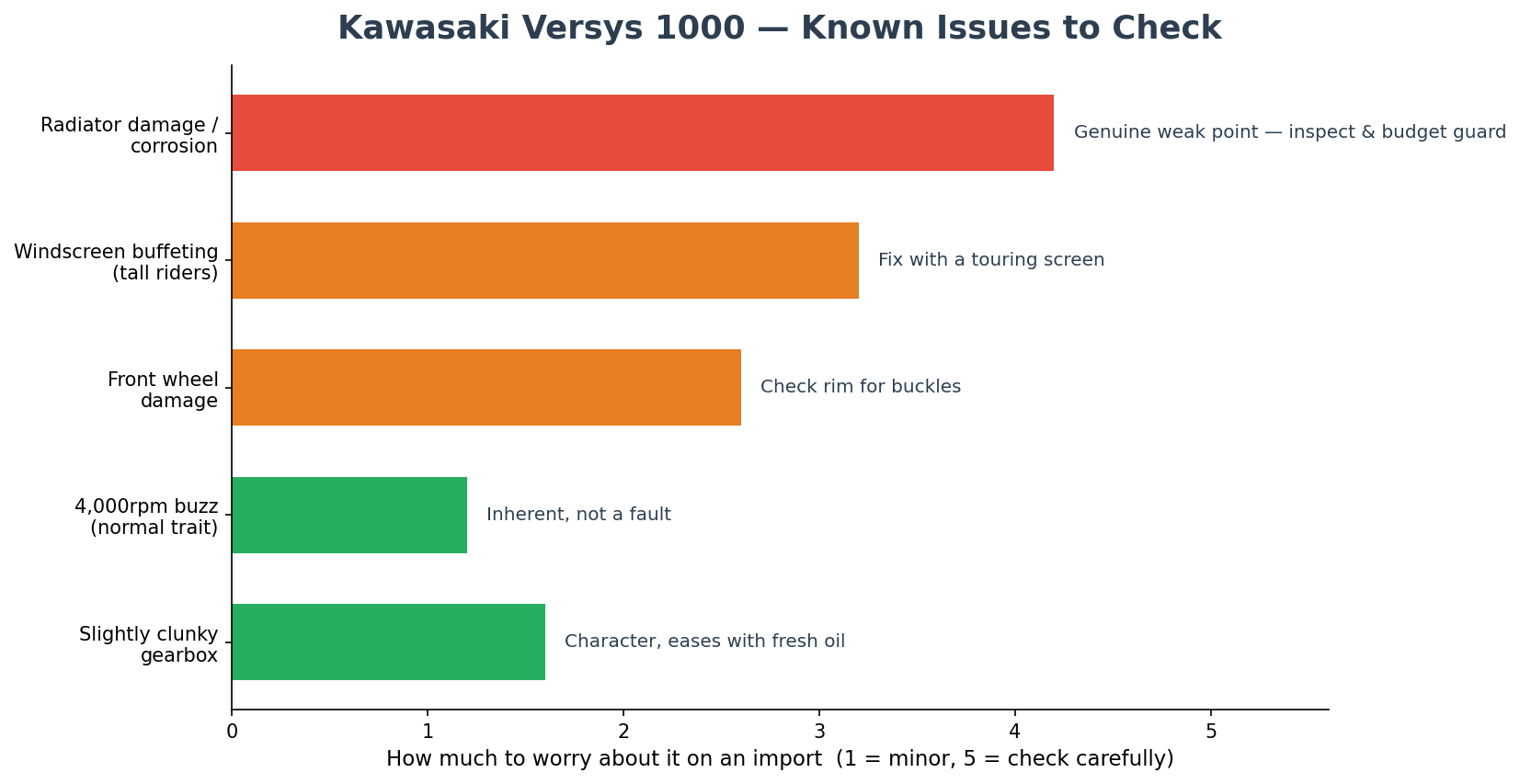
Let's be honest and specific, because this is where you save or lose money. The good news first: the Versys 1000's inline-four is seriously under-stressed and has a strong reliability record. When something does go wrong, it is far more often a cheap sensor or a consumable than a major mechanical failure. But there are a handful of things to check.
The 4,000rpm buzz. Many Versys 1000s have a faint vibration around 4,000rpm. This is normal for this engine, not a fault — do not let a nervous seller convince you it is a problem, and do not panic if you feel it on a test ride. It smooths out above and below that band.
Radiator vulnerability. The radiator sits exposed and is the bike's genuine weak point. Stone strikes and corrosion have forced some owners to replace theirs. On any import, inspect the radiator core closely for damage, bent fins and corrosion, and factor a possible replacement into your budget on higher-mileage bikes. A radiator guard is a cheap, smart upgrade.
Front wheel damage. A minority of owners have reported bending front wheels, sometimes even a factory replacement. It is not epidemic, but check the front rim carefully for buckles and kerb damage, and watch for vibration at speed that a simple balance will not cure.
Windscreen buffeting. Taller riders often complain about wind buffeting from the standard screen at motorway speeds. It is an easy fix with an aftermarket touring screen, but budget for one if you are over six foot.
Slightly clunky gearbox. A few owners find the gearbox a touch notchy, especially cold. It is a character trait rather than a defect; a fresh oil change and correct chain adjustment usually take the edge off.
None of these are deal-breakers. The Versys 1000 is one of the more dependable big bikes you can import — the trick is simply to inspect the radiator, check the front wheel, and confirm the vibration you feel is the normal 4,000rpm buzz and nothing else.
Which years to avoid, and which to buy
There is no genuinely bad Versys 1000 — no year is a landmine. But value and equipment vary a lot, so here is how to spend wisely.
Best value: a clean 2015-2018 Gen2, ideally an LT or Grand Tourer with factory luggage. You get the improved engine, slipper clutch, three-stage traction control and better brakes at a genuinely cheap used price. For most buyers, this is the smart money.
Best all-rounder: a 2019-onwards Gen3 with riding modes and cruise control. Modern manners, LED lighting and electronic throttle for a moderate premium over Gen2.
Best bike, full stop: a 2019-on SE. Semi-active suspension, cornering electronics and a quickshifter transform the bike. If your budget stretches and Japan has a low-mileage one, it is worth the extra — tell our team your budget and we will find the right SE.
Buy on a budget: a 2012-2014 Gen1 is the cheapest entry and mechanically tough, but you sacrifice the slipper clutch, some electronics and the sharper later brakes. Fine if the price reflects it.
In short: do not avoid a year — avoid a bad example. History and condition beat model year every time on this bike.
What a used Kawasaki Versys 1000 costs
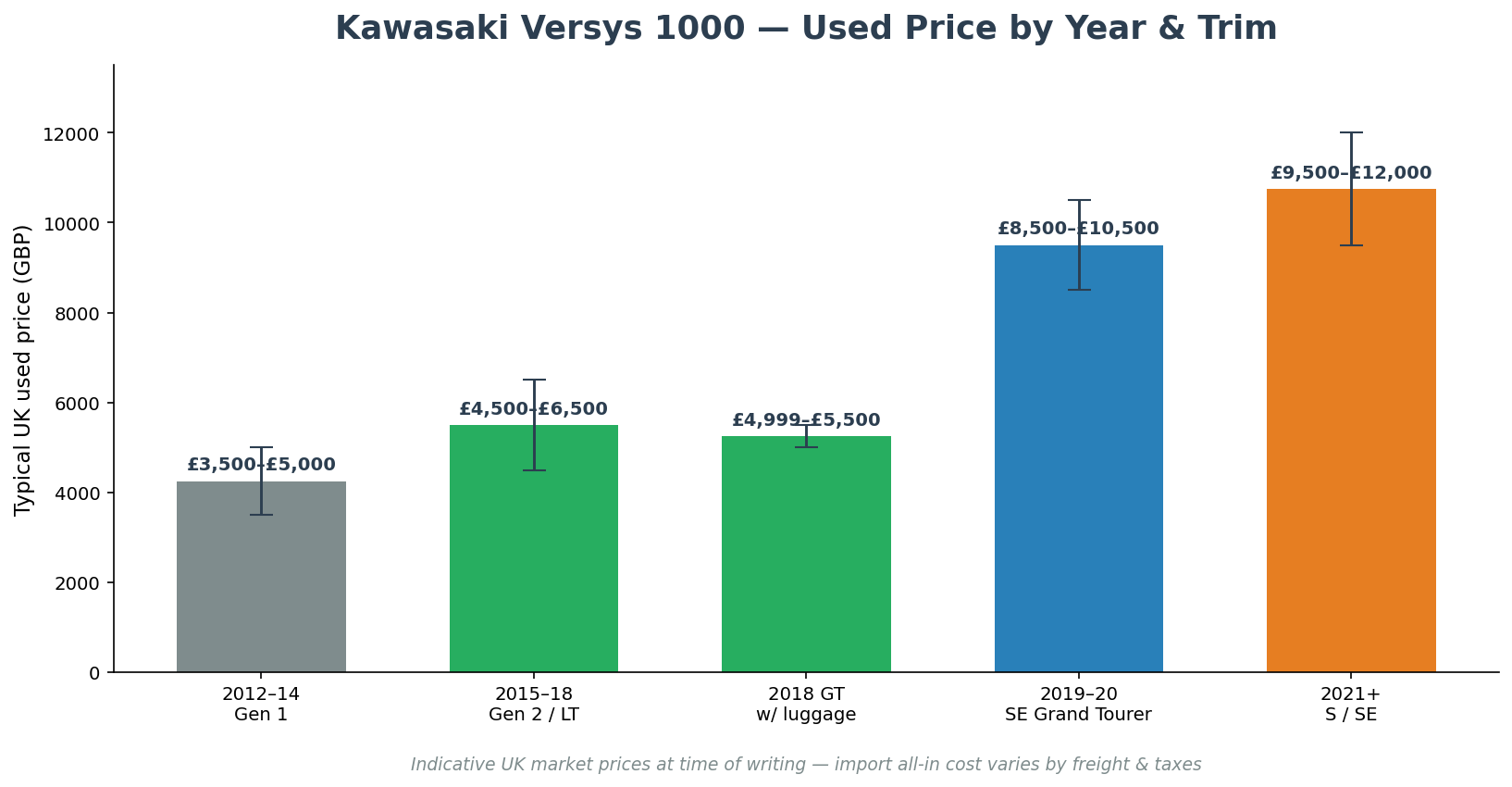
Here is where the import maths gets fun. To give you a real-world anchor, these are typical UK used prices at the time of writing:
- 2012-2014 Gen1: roughly £3,500–£5,000 depending on mileage and history.
- 2015-2018 Gen2 / LT: around £4,500–£6,500; a tidy 2018 with luggage sits near £5,000–£5,500.
- 2019-2020 SE Grand Tourer: around £8,500–£10,500 for low-mileage examples.
- 2021-onwards S / SE: a step up again, tracking the higher launch spec.
When you import from Japan, your all-in cost is the winning auction bid plus export handling, sea freight, your home country's import duty and tax, and any inspection or compliance work. On a bike in this price band, importing a clean, low-mileage Japanese example often lands you a better bike for similar or less money than buying locally — and crucially, with a graded auction sheet you can trust rather than a stranger's word.
The value equation is strongest on the higher-spec trims. Loaded Grand Tourer and SE models are rarer and pricier at home, but plentiful in Japan, so that is where importing saves you the most. Budget bikes are cheaper to buy locally once freight is added, so it is the mid-to-high-spec Versys that rewards the effort of importing.
Is the SE worth importing over a standard Versys?
This is the question that separates a good import from a great one, so it gets its own section. The SE's headline feature is KECS — Kawasaki's electronically controlled semi-active suspension — plus the IMU-based cornering electronics, TFT dash and quickshifter. The suspension continuously adjusts damping to the road and your inputs, and on a heavy, comfort-focused tourer that makes a real difference: it stays composed loaded up, soaks up bad surfaces, and firms up when you push.
Here is the honest verdict. If you tour two-up with luggage, or you simply value the plushest possible ride and the safety net of cornering ABS and traction control, the SE is absolutely worth importing. Retrofitting that kind of electronic suspension to a base bike is impossible, so the only way to get it is to buy the SE — and Japan is the cheapest place in the world to find a low-mileage one.
If you ride mostly solo, on smooth roads, and you are watching every penny, a well-sorted Gen2 with a suspension service will make you very happy for far less money. The SE is the connoisseur's choice; the Gen2 is the value champion. Neither is wrong — it just depends on how you ride and what your budget allows.
The inline-four character and what touring is really like
Reviewers keep coming back to one word for the Versys 1000: refined. In head-to-head tests against the Yamaha Tracer, riders describe the Versys as roomier, better at isolating vibration and altogether more grown-up, where the smaller triple feels buzzier and more frantic. That smooth four-cylinder is the bike's soul — it hums along at motorway speed without the tingles that tire you out on lesser machines, then surges hard when you crack the throttle for an overtake.
Owners consistently praise the comfort. The seat is wide and supportive, the riding position is genuinely all-day, and the pillion accommodation is among the best in the class — a big reason couples choose it over sportier rivals. In long-term tests the bike shrugs off big daily mileages and simply gets on with the job, which is exactly what you want from a tourer you plan to keep.
The trade-off is weight and stature. This is a large, tall bike, and at low speed and a standstill you feel every kilo, which matters for shorter riders. But get it rolling and that mass disappears — it steers more lightly than its size suggests, and the stability at speed, loaded, is superb. If your riding is mostly open roads and distance rather than tight-town stop-start, the Versys 1000 is one of the most relaxing fast bikes you can own.
Running costs and maintenance
Running a Versys 1000 is refreshingly sane for a litre bike. Service intervals are typically every 4,000 miles, and the big one — a valve-clearance check — is not due until 28,000 miles, which is a long way between major services. The under-stressed engine sips fuel by big-bike standards, helped by that 2015 efficiency update, so real-world economy is genuinely tourer-friendly.
Consumables are reasonable. It runs common tyre sizes, chain and sprockets are standard fare, and because the engine is so lightly tuned it does not chew through parts. The things to budget for on an import are the known checkpoints: a possible radiator replacement or guard on a higher-mileage bike, a touring screen if you are tall, and fresh fluids on arrival as a matter of course.
Insurance and depreciation are kind too. The Versys 1000 is not a headline-grabbing superbike, so premiums are moderate, and values hold up steadily because the bikes are dependable and desirable to a loyal touring crowd. A well-chosen import bought at a sensible price should not lose you much if you decide to move it on later.
Kawasaki Versys 1000 vs its rivals
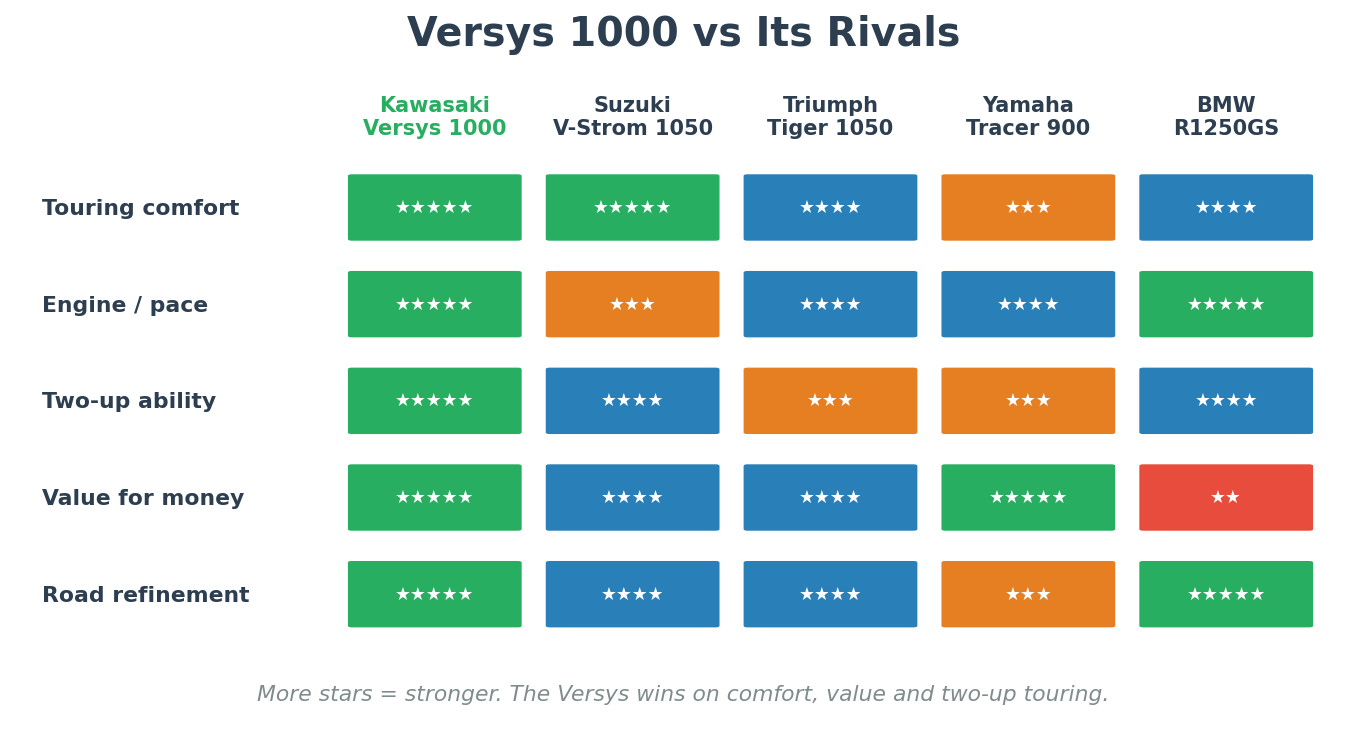
The Versys 1000 fights in a crowded corner of the market. Here is how it stacks up against the bikes buyers cross-shop.
vs Suzuki V-Strom 1050: the V-Strom (1,037cc, around 107hp) is stable and comfortable but down on power. The Versys is faster and, over distance, arguably the more comfortable of the two thanks to a softer, wider seat and a properly usable pillion perch. If outright touring comfort and pace matter, the Versys edges it.
vs Triumph Tiger 1050 / Sport: the Tiger is lighter and more sporting, closer to a sports-tourer than an adventure bike. If you want handling and a sportier feel, the Tiger appeals. If you want more comfort, better two-up ability and stronger value for money, the Versys wins.
vs Yamaha Tracer 900: the Tracer is lighter and cheaper, and its triple is a hoot, but it is smaller, buzzier and less refined. The Versys is the calmer, roomier, more grown-up long-hauler. Choose the Tracer for fun and flickability, the Versys for distance and refinement.
vs BMW R1250GS: the GS does everything, including real off-road, and holds its value like gold — but it costs dramatically more to buy and maintain. The Versys does the road-touring 90% of what most GS owners actually do, for a fraction of the money. For pure tarmac touring, the Versys is the value knockout.
Can US buyers import a Versys 1000 from Japan?
Short answer: usually you do not need to. Kawasaki sold the Versys 1000 in the US from 2015 (as the Versys 1000 LT), so there is a healthy domestic supply and no import barrier for those years. The import route mainly matters for the 2012-2014 first-generation bikes, which were not sold new in the States — and under the 25-year rule those will not be road-legal to import until 2037 onward.
So if you are in the US and you want a Versys 1000, buy a domestic 2015-onwards bike. The Japan import play is really for UK, Australia and New Zealand buyers, where importing opens up a deeper, cheaper, better-graded pool of stock — including the loaded trims that are hard to find locally. We would rather tell you the truth than sell you an import you do not need.
How to import a Versys 1000 from Japan step by step
The process is far simpler than most people assume, especially with an agent handling the Japanese side. Here is the flow:
- 1. Set your spec and budget. Decide on generation, trim (base, LT, Grand Tourer or SE) and your all-in ceiling including freight and taxes.
- 2. Search the auctions. We monitor the Japanese auction houses daily for Versys 1000s that match your brief, checking grades and photos against your shortlist.
- 3. Read the auction sheet. Every bike is graded for overall condition and mapped for damage. Aim for grade 4 or higher, verified mileage and a clean map. We translate and interpret the sheet for you.
- 4. Bid and win. We bid on your behalf up to your limit. No emotion, no overpaying.
- 5. Ship, land and register. We handle export paperwork, sea freight, and guide you through your country's import duty, tax and compliance so the bike arrives ready to register.
The single most important skill in that list is reading the auction sheet, because it is what protects you from a tired bike dressed up in good photos. Get that right and importing becomes low-risk and genuinely enjoyable.
Popular modifications
Most Versys 1000 owners modify for comfort and touring, not power — the engine is plenty strong as it is. The common upgrades are a taller touring screen to kill the buffeting, a radiator guard to protect that known weak spot, engine bars and hand guards for peace of mind, and a comfort seat for the biggest days. Heated grips are a must in colder climates if your trim did not come with them.
Luggage is the other big one. If you bought a base bike, genuine Kawasaki panniers or quality aftermarket cases transform its usefulness — though, as noted, buying an LT or Grand Tourer with factory luggage is usually cheaper. A slip-on exhaust wakes up the four-cylinder soundtrack for those who want a bit more character, and a windscreen and bar-riser combo dials in the ergonomics for taller riders.
Is the Versys 1000 a good first big bike?
With honest caveats, yes — for the right rider. The engine is smooth, predictable and easy to modulate, the riding modes (on later bikes) let you dial power down in the wet, and the upright ergonomics inspire confidence. There is nothing peaky or intimidating about how it makes its performance; it is a friendly big bike in the way it delivers power.
The caveat is size and weight. This is a tall, heavy machine, and for a nervous newer rider or someone with a shorter inseam, low-speed manoeuvres and stops can feel intimidating at first. If you can flat-foot it comfortably and you are stepping up from a mid-capacity bike rather than a 125, the Versys 1000 is a very manageable and rewarding place to graduate to. If you are unsure about the height, sit on one before you commit.
How to read a Japanese auction sheet
This is the skill that makes importing safe, so it is worth understanding even if an agent does it for you. Every bike sold through the Japanese auctions comes with an inspection sheet: an independent grader assigns an overall condition grade and draws a map of the bodywork marking scratches, dents and repairs. It is the closest thing motorcycling has to an honest, standardised used-bike report.
The overall grade runs on a rough scale where 4 and above means a genuinely good, honest bike, 3.5 is usable but tired, and anything lower needs real scrutiny. For a Versys 1000 you want grade 4 or higher, a clean or lightly-marked map, and verified mileage. The sheet also flags whether the bike has been repaired after damage, which on a big tourer is exactly what you want to know before you bid.
Cross-check the grade against the photos and the mileage. A "low-mileage" Versys with worn grips, scuffed panniers and a tired seat is telling you a story the odometer is not. On the Versys specifically, use the sheet and photos to zero in on the radiator condition and the front wheel, because those are the two areas that cost real money to put right. Get comfortable with the auction sheet and you remove almost all the risk from importing.
Fuel range, tank size and real-world touring numbers
Tourers live and die by their range, and the Versys 1000 does well here. That 2015 efficiency update, combined with a generous fuel tank and the relaxed, under-stressed nature of the inline-four, gives it a genuinely useful touring range between fill-ups — enough that you plan stops around your bladder, not the fuel light. Ridden sensibly on a motorway cruise it returns economy that shames most litre-class bikes.
Push hard and the economy drops, as it does on any big four, but the point is that the Versys does not punish you for distance. Combine the range with the wide seat, the effective screen and the cruise control on later bikes, and you have a machine built to dispatch 300 to 400-mile days without drama. That is the whole reason to buy one, and it is exactly the kind of bike Japan sells in clean, cared-for condition.
Pre-purchase checklist for a used Versys 1000
Before you commit — whether at auction or in the metal — run through this:
- Confirm the model: four-cylinder KLZ1000, not the 650 twin. Check the engine and code, not just the photos.
- Radiator: inspect the core for stone damage, bent fins and corrosion. Factor a guard or replacement into your budget.
- Front wheel: check the rim for buckles and kerb damage; look for high-speed vibration a balance will not fix.
- Service history: full and stamped, with the 28,000-mile valve check done if the mileage is there.
- Cold start and gearbox: confirm the 4,000rpm buzz is the normal one; a slightly notchy box cold is fine, grinding is not.
- Electronics (SE): cycle the modes, KECS suspension settings, quickshifter and TFT dash to confirm everything works.
- Crash evidence: check bar ends, levers, pegs, panniers and engine cases for scuffs or replacement parts.
- Auction sheet: grade 4 or above, clean damage map, verified mileage.
Tick those boxes and you are buying one of the great value tourers with your eyes wide open. Browse our current stock or tell our team the exact Versys 1000 you want — generation, trim, colour, mileage — and we will find it in Japan and land it at your door.
See Also
Share this article: