
A Kawasaki ZX-10R import from Japan is how serious riders get the cleanest, lowest-mileage Ninja superbikes on the planet for wholesale money. The ZX-10R is the bike Kawasaki built to win World Superbike, and for several seasons it did exactly that. But here is the thing the local classifieds never tell you: the home market that bought these bikes new, babied them, and serviced them on schedule is Japan. The straightest, most honest ZX-10Rs are sitting in Japanese auction halls right now, graded by an independent inspector, waiting for a buyer who knows what to look at.
You want one of those bikes. Not a tired track refugee that has been lowsided twice, "stage-three tuned" by a teenager, and sold three times in two years. This guide shows you exactly how to buy a proper ZX-10R from Japan, which years to chase, which years to walk past, what it really costs to land on your driveway, and how to read the one document that separates a clean bike from an expensive mistake.
What the Kawasaki ZX-10R actually is (and why importing one makes sense)
The Ninja ZX-10R launched in 2004 as Kawasaki's no-compromise litre-class superbike. It replaced the heavier ZX-9R with something lighter, sharper, and genuinely frightening for its era. Over two decades it grew from a raw, twitchy missile into one of the most electronically sophisticated production bikes ever sold, with a five-axis IMU feeding cornering ABS, multi-level traction control, wheelie control, launch control, engine-braking control, and an up-and-down quickshifter.
That long production run is exactly why importing one from Japan is smart. There are good ZX-10Rs at almost every price point, from a sub-\$4,000 early model to a near-new RR. And because Japan registered, rode, and exported so many of them, the supply of clean, documented examples there is deeper than anywhere else in the world.
Japanese owners also ride differently. Tight inspection laws, expensive parking, and a culture that treats a motorcycle as something you maintain rather than thrash means the average Japanese ZX-10R has lived an easier life than its Western equivalent. You are not just buying a bike. You are buying a maintenance history baked into the whole market.
ZX-10R generations explained: which years to chase and which to avoid
This is the section that will save you the most money, so read it twice. The ZX-10R changed character several times, and each generation has its own personality, its own faults, and its own recall history. Buying blind is how people end up with the one year everyone in the know quietly avoids.
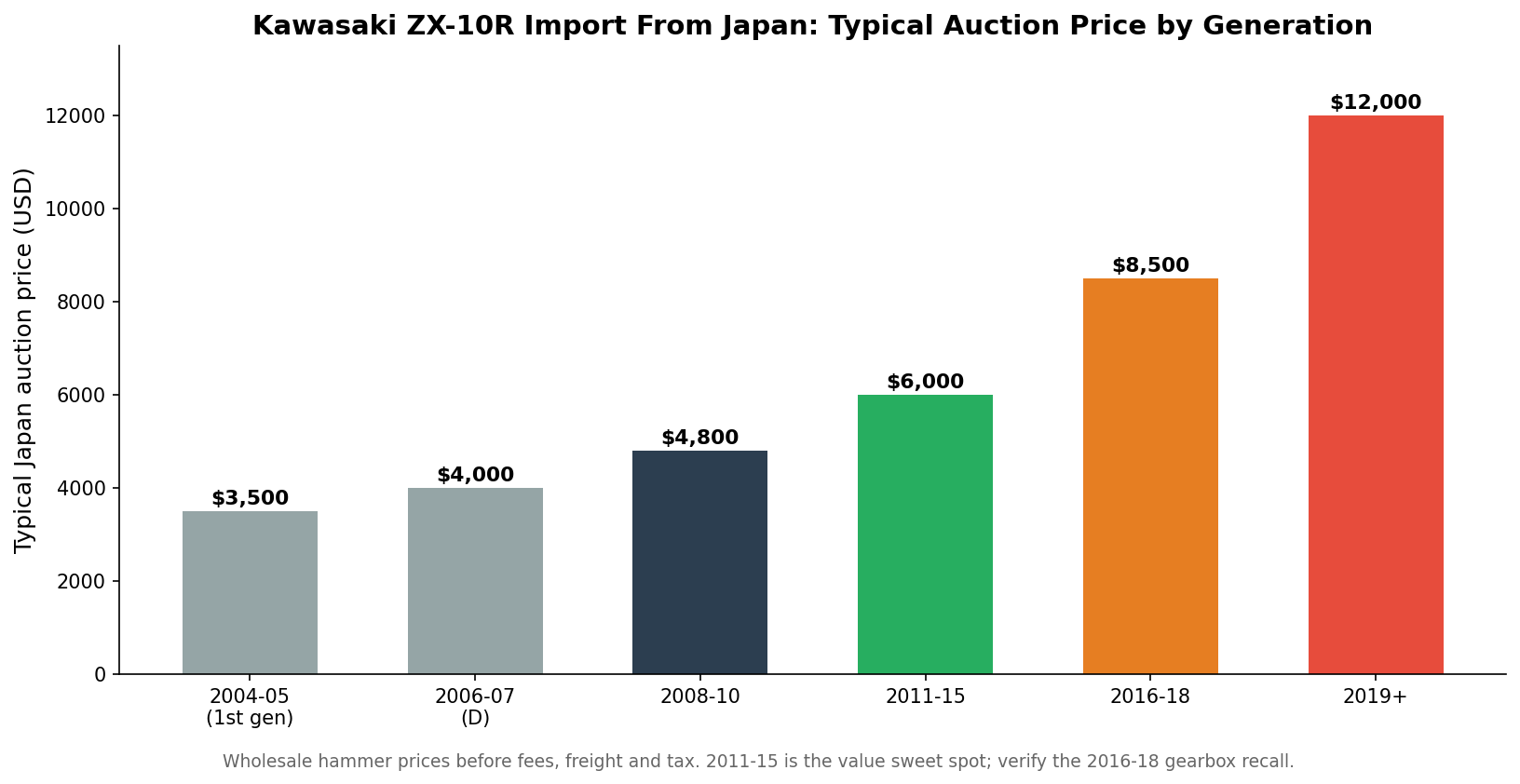
2004–2005 (first generation, "C" model). Light, brutal, and analog. This is the one that built the legend and scared a generation of riders. It is also the cheapest way into a ZX-10R. The catches: first-gen frames are known to develop cracks, valve cover gaskets weep oil, and the tail section plastics crack around the mounting points. None of that is a dealbreaker on a cared-for bike, but it means inspection matters more here than on any other year.
2006–2007 ("D" model). Smoother and a touch more civilised, with revised bodywork. Watch two things. Stator failures show up most commonly on the 2006 bikes, so a charging-system check is non-negotiable. And the cam-chain tensioner can rattle as it wears, with the internal lock bouncing around when the teeth go. Some owners also report noticeable play in the front brake lever before the pads bite.
2008–2010 (third generation). Bigger, more planted, and the first ZX-10R that felt like a complete road bike. Two known issues define this era. First, the clutch basket can fail if the bike has been used for drag launches or constant wheelies, with enough reported failures that the fix is a welded or billet basket. Second, there was a voltage-regulator recall covering 2008 to 2010, so confirm the regulator was replaced. A bike with launch-control-style abuse in its past is one to walk away from.
2011–2015 (the electronics arrive). The 2011 redesign was a genuine leap. This is the first ZX-10R with traction control and a properly modern chassis, and for many importers it is the sweet spot: fast, usable, and now affordable. The faults are wear-related rather than design flaws. Valves can go out of spec on hard-ridden examples, so a valve-clearance check is worth its weight in gold. The radiator sits exposed enough that road debris can ding it, and a few owners report clutch wear with aggressive use. A well-kept 2011–2015 is one of the best superbike-pound-for-pound buys you can import.
2016–2018 (the one to inspect hardest). The 2016 update brought the electronics suite closer to the race bike, but this generation carries the ZX-10R's most serious recall. A batch of roughly 4,000 motorcycles left the factory with gearbox components made from substandard material that could fail under high load. Kawasaki recalled them. The bikes themselves are excellent once fixed, but you must verify the gearbox recall work was actually completed before you bid. We give this its own section below because importers get burned by it constantly.
2019 onward (the modern era). Restyled, refined, and loaded with the full IMU-based electronics package. These are the closest thing to a current superbike you can buy used, and Japan has clean, low-mileage examples coming through auction as owners trade up. They cost more, but the depreciation has already been paid by someone else.
Why import a Kawasaki ZX-10R from Japan instead of buying local
You can buy a ZX-10R down the road. So why deal with shipping and paperwork? Three reasons, and they all come down to condition, price, and proof.
Condition. The Japanese domestic market is full of bikes that were ridden gently, stored indoors, and maintained to pass the country's strict periodic inspections. A 40,000 km Japanese ZX-10R often presents better than a 15,000 km Western bike, because the life it lived was kinder.
Price. At a Japanese auction you buy at wholesale, not retail. The same bike that a UK or Australian dealer would advertise with a fat margin is sold in Japan at the price dealers themselves pay. Even after the agent fee, freight, and your country's duty and tax, you frequently land the bike for less than the local retail number, and you get a better example for the money.
Proof. Every bike that runs through a major Japanese auction is graded by an independent inspector who has no stake in the sale. They note crash repairs, frame damage, rust, mileage authenticity, and overall condition on a standardised sheet. Nowhere else in the used-bike world do you get a neutral third party telling you the truth before you commit. Once you can read that sheet, you are buying with information most local buyers never see.
If you want to see what is actually clearing auction right now, browse our current listings — it is the fastest way to calibrate what a clean ZX-10R should cost.
What a Kawasaki ZX-10R import from Japan actually costs
Here is the honest math, with no hidden surprises. The total landed cost of a ZX-10R is the auction price plus four predictable layers: the agent and auction fees, Japan-side logistics, ocean freight, and your country's duty, tax, and registration. None of it is mysterious once you see it laid out.
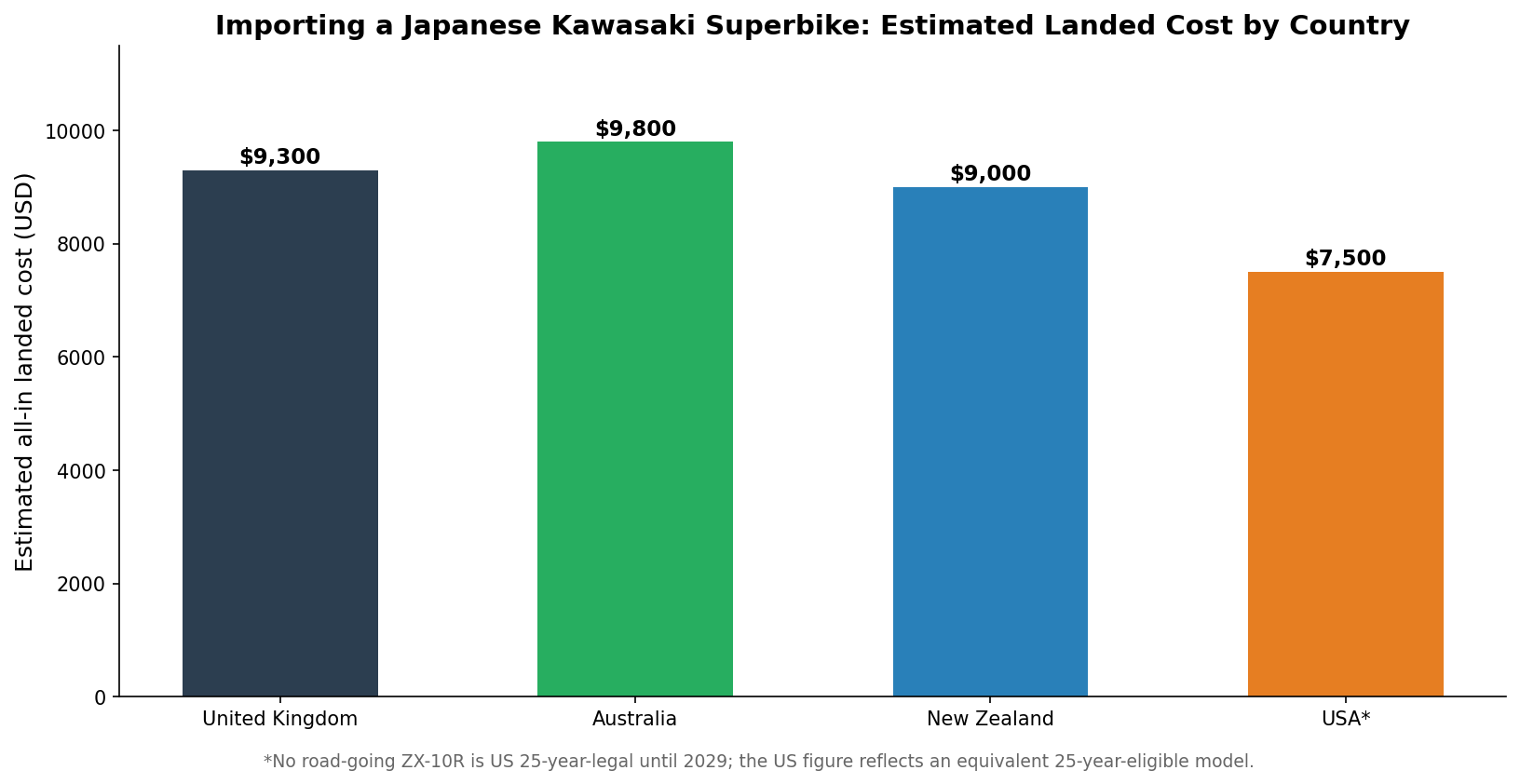
Take a clean 2012 ZX-10R landing in the UK as a worked example. The hammer price at auction sits around \$5,500. Add an agent and auction fee of roughly \$600, Japanese inland transport and export handling of about \$500, and ocean freight of around \$600 if you share a container. That puts the bike on a ship for about \$7,200 before your government takes its cut.
Then come the destination charges. The UK applies 6% import duty and 20% VAT on the landed value, which on this bike adds roughly \$1,800 combined. Registration, an IVA or NOVA submission where required, and a little admin add another \$300 or so. All in, that clean 2012 lands somewhere around \$9,300 — for a bike that a UK dealer in equivalent condition would happily ask more for, with no inspection sheet to back it up.
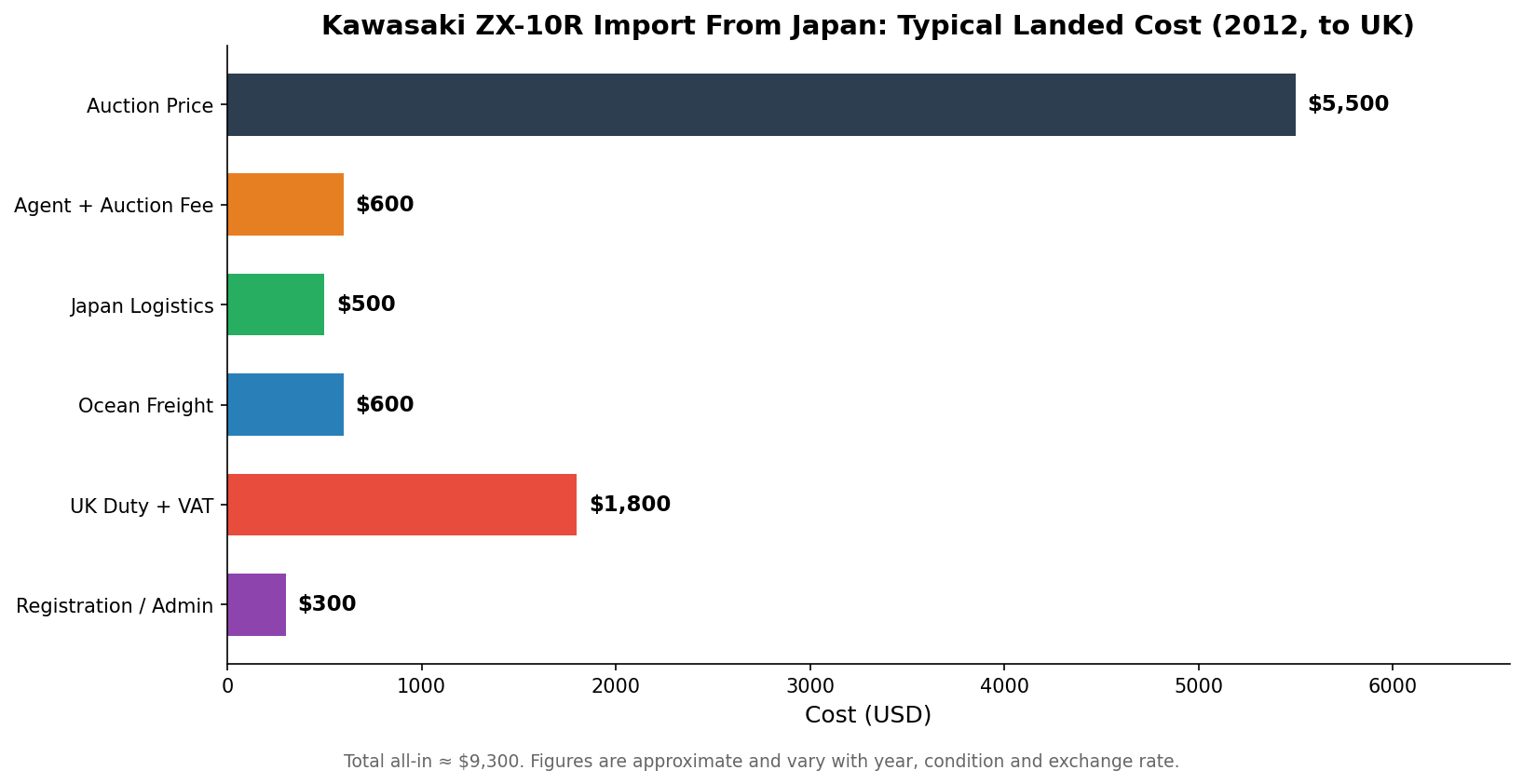
The exact numbers move with the bike, the year, and the exchange rate, but the shape stays the same. Roughly 60% of your spend is the bike, around 20% is logistics and fees, and the rest is tax. The single biggest lever you control is the auction price, which is why knowing the generations and reading the sheet pays for itself many times over.
Reading the auction sheet: the ZX-10R faults that hide on a clean-looking bike
The auction inspection sheet is the most powerful tool you have, and on a superbike it matters more than on anything else. A grade tells you the overall condition — 4 and 4.5 are the honest sweet spot for a used ZX-10R, 5 and 6 are near-new and priced accordingly, and anything at 3 or below needs a very good reason. But the grade is only the headline. The notes and the body diagram are where the truth lives.
On a ZX-10R specifically, scan for these. Crash markers. Look for notes around the fairing edges, bar ends, frame sliders, and rearsets. A superbike that has never been down is rare and valuable; one that has been down is not automatically bad, but you want to know. Replaced bodywork. Aftermarket or repainted panels can hide a repair. Tyre and chain wear hint at how hard the previous owner rode. Modifications — an aftermarket exhaust, a Power Commander, a tail tidy — are common and usually fine, but a bike covered in race parts has often lived a track life.
The mileage stamp matters too. Japanese sheets record whether the odometer reading looks consistent with the bike's condition, and the inspector flags suspected discrepancies. A ZX-10R with suspiciously low mileage and worn controls is telling you a story. Send us the auction sheet before you bid and we will translate every mark on it, because one ambiguous note can be the difference between a bargain and a project.
Step-by-step: how to import a ZX-10R from Japan
The process is the same whether you are in Los Angeles, Manchester, Brisbane, or Auckland. Here is the whole thing, start to finish.
Step 1: Confirm your country's rules for the year you want. This is the first thing to settle, because it decides which ZX-10R you can even bid on. The US 25-year rule, UK registration, Australian import approval, and New Zealand compliance all have different age and paperwork requirements, covered in the next section.
Step 2: Set your real budget. Use the cost breakdown above and work backwards from the all-in number you can afford. Decide your maximum hammer price so you do not get caught up in auction adrenaline.
Step 3: Partner with an export agent. You cannot bid at a Japanese motorcycle auction as a private overseas buyer. You bid through a licensed agent who holds the auction membership, places your bid, handles payment, and arranges export. This is the role AWA Auction plays.
Step 4: Search the auctions and shortlist. Thousands of bikes run every week. You shortlist by year, mileage, grade, and budget, then request the inspection sheets for the ones you like.
Step 5: Read the sheets and bid. Your agent translates the sheet, you agree a maximum bid, and the agent bids on your behalf. If you win, you pay the invoice — bike, fees, and freight.
Step 6: Export and ship. The bike is de-registered for export, prepared, and loaded. You choose RoRo, where the bike is rolled onto a vessel, or container shipping, which costs a little more but offers more protection and the option to share space.
Step 7: Clear customs and register at home. The bike arrives, you or your broker clears it through customs, pay the duty and tax, complete any inspection or compliance step, and register it. Then you ride.
Most ZX-10R imports take roughly four to eight weeks from winning bid to delivery, depending on sailing schedules and how busy your destination port is.
Country rules: US, UK, Australia and New Zealand
This is where importers trip up, so let us be precise for each market.
United States. The US 25-year rule is the key. A motorcycle becomes exempt from EPA and DOT import restrictions once it is at least 25 years old, measured from its build date. Because the ZX-10R only launched in 2004, no road-going ZX-10R is 25-year eligible yet — the first 2004 bikes become freely importable in 2029. Until then, US buyers who want a ZX-10R are looking at the closed-course competition route (a track-only bike that cannot be registered for the road) or the expensive Registered Importer and Independent Commercial Importer path. If you want a street-legal Japanese Kawasaki superbike in the US today, an older ZX-9R is the bike that already clears the rule. Always confirm current requirements with the NHTSA importation FAQ.
United Kingdom. The UK has no 25-year wall, which makes it the easiest big market for a ZX-10R. You import the bike, pay 6% duty and 20% VAT on the landed value, complete the NOVA notification to HMRC, pass the relevant inspection where required, and register it with the DVLA. Any year of ZX-10R is fair game. Start with the official guide to importing vehicles into the UK.
Australia. Australia requires import approval before the bike arrives, and the rules favour older machines through the 25-year-or-older pathway, which an early ZX-10R will reach progressively. Newer bikes can still be imported but face stricter compliance. Check the current pathways on the Australian Border Force import page before committing.
New Zealand. New Zealand is one of the friendliest markets for Japanese imports, with a well-trodden process for bringing bikes in, a compliance inspection on arrival, and GST to pay. The infrastructure exists precisely because so many Japanese vehicles already come through. Any ZX-10R can generally be imported provided it passes entry certification.
The 2016–2018 gearbox recall: what every importer must check
This deserves its own section because it is the single most expensive thing you can miss on a ZX-10R. Between 2016 and 2018, Kawasaki identified that a batch of roughly 4,000 ZX-10R transmissions had been built with gearbox components made from material that did not meet spec. Under high load — exactly the load a litre superbike sees — those gears could fail.
Kawasaki issued a recall and replaced the affected parts. The fixed bikes are completely sound; this generation is fast, refined, and a genuinely great buy once corrected. The problem is the bikes where the recall was never actioned. A Japanese-market bike may or may not have had the work done, and the recall paperwork does not always travel with the machine to an auction.
So before you bid on any 2016, 2017, or 2018 ZX-10R, treat the recall as a hard checklist item. Ask your agent to confirm the recall status by frame number, look for service records showing the transmission work, and factor in the cost and risk if it cannot be confirmed. This is precisely the kind of buried detail that a good export partner catches and a solo overseas bidder does not. Here is the thing nobody mentions: a 2017 ZX-10R that looks identical to another can be worth thousands less if that recall is still open.
Track bikes, crash history and the superbike-specific risks
A ZX-10R is a race-bred machine, which means a meaningful slice of the used market has seen a circuit. That is not inherently bad — a track-day bike maintained by an obsessive owner can be the best example out there — but it changes what you inspect.
Watch for the tells of a hard track life. Safety-wired fasteners, lockwire holes drilled in bolts, removed mirrors and indicators, a missing centre stand, aftermarket rearsets, and a belly pan designed to catch oil are all signs the bike has lapped a circuit. None of these is a red flag on its own. Together they tell you to look harder at the engine internals, the gearbox, and the suspension, because track use accelerates wear everywhere.
Then there is crash history, the superbike buyer's real enemy. A bike that has been crashed and rebuilt can be perfectly safe or quietly bent, and the difference is invisible in photos. This is the entire value of the Japanese auction sheet: the independent inspector notes frame damage, repair evidence, and panel replacement that a seller's listing would simply leave out. On a 200-horsepower motorcycle, that neutral assessment is not a nice-to-have. It is the whole reason to buy this way.
How AWA Auction gets you a clean ZX-10R
AWA Auction is your licensed partner inside the Japanese auction system. We hold the auction memberships, so you get access to the same wholesale inventory the dealers bid on — thousands of bikes a week, including the ZX-10Rs that never reach a public listing.
For every bike you shortlist, we pull and translate the full auction sheet, flag crash markers, confirm recall status on the 2016–2018 transmission issue, and give you a straight read on condition. We agree your maximum bid, place it for you, handle payment, arrange export and shipping in the method you choose, and support the customs and registration paperwork on your end.
You get a wholesale price, an independently inspected bike, and someone in Japan who knows what a ZX-10R should look like under the fairing. Browse what is clearing auction now, or tell us the year and budget you have in mind and we will start hunting.
ZX-10R vs ZX-10RR vs the SE: which version to import
Kawasaki has sold the litre Ninja in more than one flavour, and the badges matter when you are spending real money. Get them straight before you bid.
The standard ZX-10R is the one most people mean, and the one most worth importing. It is the full-fat superbike with the complete electronics package, sold in the largest numbers, which means the deepest used supply and the most sensible prices. For ninety per cent of buyers, this is the right bike.
The ZX-10RR is the homologation special. Built in limited numbers so Kawasaki could run certain parts in World Superbike, the RR adds lighter wheels, a single seat, uprated internals on some years, and a higher rev ceiling. It commands a premium and holds value well, but you pay for the badge, and clean low-mileage RRs are genuinely rare. If you find one in Japan with a documented history, it is a collector-grade buy. Just do not pay RR money for a standard bike wearing RR stickers, which is a trick the inspection sheet helps you avoid.
The ZX-10R SE, offered on certain recent years, adds semi-active electronic suspension and a few cosmetic touches. It is a brilliant road bike, but the electronic suspension is an extra system to maintain, and replacement parts cost more. Worth it if you want the most sophisticated version; skip it if you value simplicity.
For an importer, the decision usually comes down to budget and intent. Track-focused collectors chase the RR. Road riders who want the best blend of performance, supply, and price take the standard bike. Anyone who values plush long-distance comfort over outright track edge looks at the SE.
Spec and performance: what the numbers actually mean
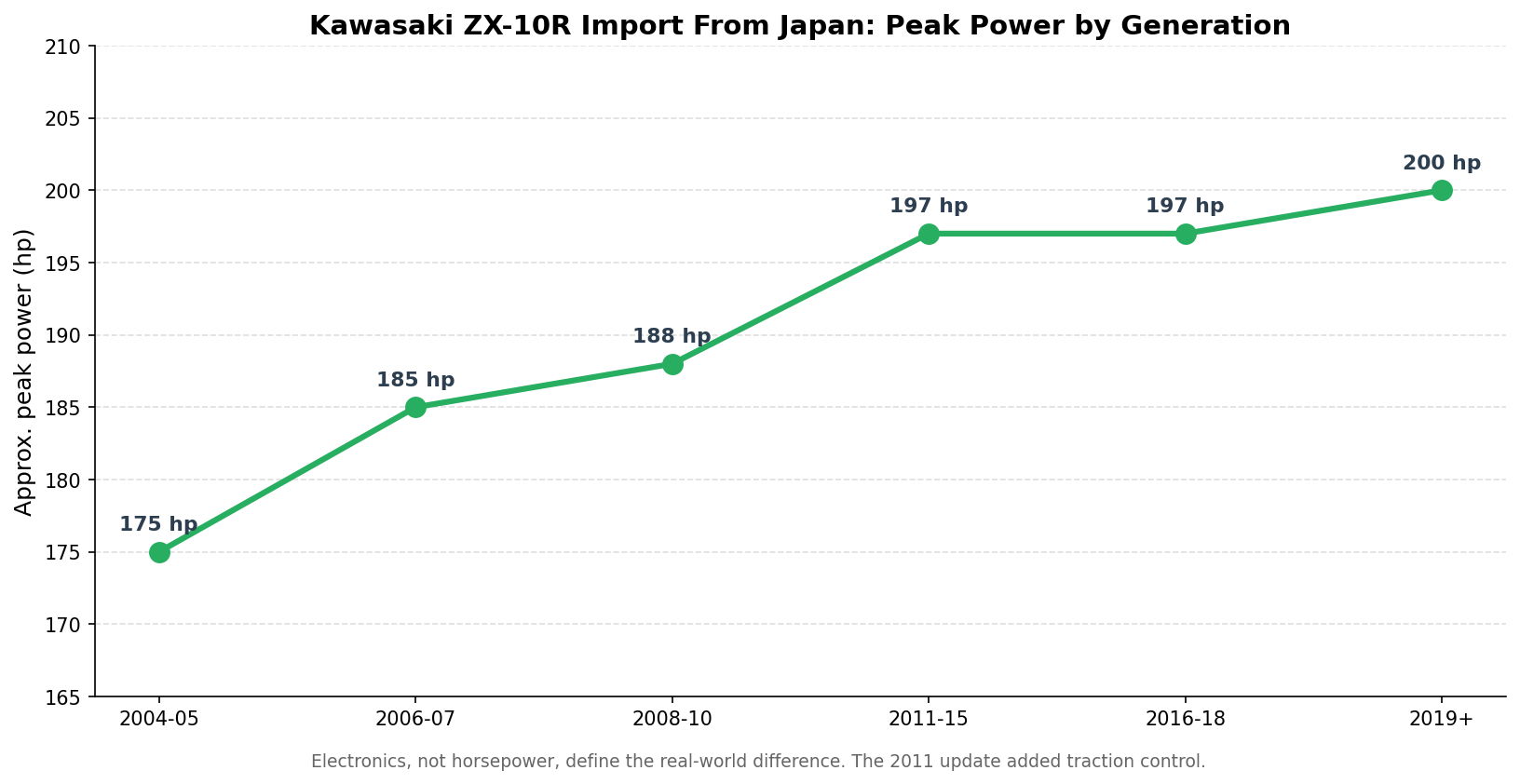
It is easy to drown in figures, so here is what actually matters on a ZX-10R you are about to import. Across the generations, peak power climbed from roughly 175 horsepower on the first bikes to around 200 horsepower on the latest, with the RR pushing a little beyond that. The headline number sells magazines, but it is not the reason to choose a year.
What changes the riding experience far more is the chassis and the electronics. The 2004–2007 bikes are raw and demand respect; they will reward a skilled rider and punish a careless one, with no traction control net underneath you. The 2008–2010 bikes added stability and usability. The 2011 redesign brought the first real rider aids and a chassis that flatters rather than frightens. From 2016 the IMU-based suite made the bike genuinely approachable at speed, managing slides and wheelies so smoothly that the power becomes usable rather than terrifying.
So when you read a listing, do not just chase the biggest horsepower figure. A 2013 with sorted electronics and a clean sheet is a faster real-world bike for most riders than a pristine 2005 that wants to throw you off at every corner exit. Match the generation to your skill and your intent, not to the dyno chart.
Weight is the other number worth knowing. The ZX-10R has always been one of the lighter litre bikes, which is why it feels so flickable for its power. That lightness is also why crash damage matters so much: there is not a lot of spare metal, and a hard hit transmits straight into the frame and subframe. Back to the sheet, again.
Maintenance, parts and running costs once it lands
Buying the bike is half the story. Owning a ZX-10R imported from Japan is straightforward if you know what to budget for, and reassuringly cheap on parts because these bikes were built in huge numbers worldwide.
Consumables come first. A litre superbike eats tyres and chains faster than a commuter, and the ZX-10R is no exception if you use the performance it offers. Budget for a quality sport tyre set, a chain and sprocket kit at the usual intervals, and brake pads that can cope with stopping 200 horsepower. Oil and filter changes are simple and frequent on a hard-worked engine.
The valve-clearance check is the service that catches people out. On the 2011-onward bikes especially, the valves can drift out of spec if the previous owner rode hard, and the inspection is labour-intensive because of how the engine is packaged. Get it checked when the bike lands, factor a possible shim adjustment into your first-year budget, and you will avoid the expensive surprise of doing it reactively.
Parts availability is a genuine strength. Because Kawasaki sold the ZX-10R globally, OEM and aftermarket parts are everywhere, and Japan in particular has a thriving used-parts ecosystem. If you import the bike through an agent who can also source parts from Japan, you can land a spare fairing set, a clean exhaust, or a replacement instrument cluster for a fraction of Western prices. That is a quiet advantage of buying from the country that made the bike.
Insurance and registration costs sit with your local market, but the import itself does not make them worse. Once the bike is registered, it is just a ZX-10R like any other in the eyes of your insurer, and a documented, inspected import history can actually help if you ever sell.
RoRo vs container: choosing how your ZX-10R ships
Once you win the bike, you choose how it crosses the ocean, and the two options suit different buyers.
RoRo (roll-on, roll-off) is the simpler, usually cheaper route. The bike is secured to a dedicated vehicle vessel and rolled off at the destination port. Local fees at the far end tend to be lower, and the process is quick. The trade-off is exposure: the bike travels strapped down but not enclosed, so it is the right call for a solid rider you are not precious about, and a slightly nervier one for a pristine collector RR.
Container shipping costs a little more but wraps the bike in protection. It is crated or securely braced inside a steel box, shielded from weather and handling, and you can often share a container with other bikes to split the cost. For a high-value, low-mileage, or collector-grade ZX-10R, container is the sensible choice, and the price difference is small relative to the bike.
For a typical mid-range ZX-10R, either works. For anything special, spend the extra and ship it in a box. Your agent will quote both so you can see the real difference for your specific bike and route rather than guessing.
Common mistakes importers make with the ZX-10R
After enough of these, the same avoidable errors show up again and again. Sidestep them and you are ahead of most first-time importers.
Chasing horsepower instead of history. The fastest year on paper is worthless if that specific bike has an open recall, a bent subframe, or a worn-out gearbox. Buy the best example, not the biggest number.
Ignoring the 2016–2018 recall. We said it above and we will say it again, because it is the costliest mistake on this model. Confirm the transmission recall before you bid on those years, full stop.
Misreading the auction grade. A grade 3.5 is not automatically a bad bike, and a grade 5 is not automatically worth the premium. The grade is a summary; the notes and the diagram are the substance. Learn to read both, or work with someone who can.
Underbudgeting the destination charges. People fixate on the hammer price and forget the duty, tax, compliance, and registration waiting at home. Use the full landed-cost math from the start so the final number is never a shock.
Buying a track bike by accident. Safety wire, missing road equipment, and a belly pan are not red flags by themselves, but if you wanted a clean road bike and the sheet is quietly screaming "circuit weapon," you are about to buy someone else's project. Read the signs.
Skipping the agent. You cannot bid directly at a Japanese auction as a private foreign buyer, and the people who try to shortcut the system through informal middlemen are the ones who get burned. A licensed export partner is not an optional extra; it is how the whole thing legally works.
A short history of the ZX-10R: from 2004 missile to modern weapon
Understanding where the ZX-10R came from helps you buy the right one, so here is the quick version of two decades of evolution.
When Kawasaki launched the ZX-10R in 2004, the litre-superbike class was a horsepower war and Kawasaki wanted to win it outright. The bike replaced the well-respected but heavier ZX-9R with something radically lighter and more aggressive, and it made an immediate impression for being savagely fast and slightly unhinged. Riders loved it and feared it in equal measure, which is exactly the reputation Kawasaki was after.
The 2006 revision smoothed the rough edges without dulling the attitude. By 2008 the bike had grown into a more complete machine, bigger and more stable, the kind of superbike you could actually live with on the road as well as flatter on a track. But the bike was still fundamentally analog, relying on the rider rather than electronics to keep everything pointing forward.
That changed in 2011. The redesign was the most important moment in the model's history: a new engine, a sharper chassis, and the arrival of traction control. This was the ZX-10R growing up, and it coincided with Kawasaki's dominant run in World Superbike, where the bike won championship after championship. Race success on Sunday sold bikes on Monday, and it cemented the ZX-10R as the litre bike to beat.
The 2016 generation pulled the road bike even closer to the race bike, with a far more sophisticated electronics package built around an inertial measurement unit. From 2019 onward, Kawasaki refined the formula with new styling, more electronics, and the SE variant's semi-active suspension. Each step made the bike faster and more usable, and each step is now represented in the Japanese used market at a different price. Knowing this arc means you can match your budget to the exact era of ZX-10R that suits you.
Who the ZX-10R import is right for
Let us be honest about fit, because a litre superbike is not the right bike for everyone, and importing one is a commitment.
The ZX-10R import makes the most sense for a rider who already knows their way around a fast bike, wants genuine superbike performance, and refuses to overpay for it. If you have the experience to respect 180 to 200 horsepower and the patience to buy properly rather than impulsively, importing from Japan gets you a better bike for less money than your local market will, with documentation your local market cannot match.
It is also the right move for the collector. The limited-run RR models, the cleanest early first-generation bikes, and the lowest-mileage examples of every year flow through Japanese auctions in numbers you simply will not see at home. If you are building a serious garage, Japan is where the unicorns live.
It is the wrong move if you want a relaxed first big bike, if you are not prepared to wait four to eight weeks for delivery, or if you would rather pay a premium to point at a bike on a local showroom floor and ride it home the same day. There is no shame in any of that. But if condition, value, and proof matter to you, and you are buying a ZX-10R specifically, importing from Japan is the route that rewards you.
Whichever camp you are in, the smart first step is to see real inventory and real prices. Look at what is clearing auction now, and when a bike catches your eye, get the sheet read before you commit. That single habit is what separates the buyers who are thrilled with their imported ZX-10R from the ones who learned an expensive lesson.
One last practical note on timing. The yen-to-dollar exchange rate moves your landed cost as much as your bidding does, and a favourable rate can shave hundreds off the same bike from one month to the next. You cannot control the currency markets, but you can be ready: line up your agent, settle your budget, and have your shortlist prepared so that when a clean ZX-10R and a good exchange rate land in the same week, you can move fast. The riders who get the best deals are the ones who did the boring preparation before the right bike appeared, not the ones scrambling to learn the process after they have already fallen in love with a listing.
\n\nFrequently asked questions about importing a Kawasaki ZX-10R from Japan
Below are the questions buyers ask us most often before they commit to a ZX-10R import.
See Also
Share this article: