
For six straight years, one motorcycle held the title of fastest production bike on Earth. Not a Ducati, not a Honda — a big, comfortable, slightly anonymous Kawasaki that could clear 170 mph and then take you across a continent in one sitting. The Kawasaki ZZR1100, sold as the ZX-11 in North America, was the bike that made the word "hyperbike" mean something. And here's what most buyers never clock: the cleanest, best-value examples left on the planet are sitting in Japanese auction halls right now, graded, photographed and waiting for a bid.
This is your straight-talking guide to importing a Kawasaki ZZR1100 from Japan: what the bike actually is, the crucial C-versus-D decision, the JDM trap nobody warns you about, the one engine fault you must check, what it really costs landed on your driveway, and whether it's even legal to import where you live. We live inside the Japanese motorcycle auctions at AWA Auction, so the goal is simple. By the end of this page you'll read a ZZR1100 listing like an insider, tell a gem from a grenade, and know roughly what the whole thing will cost you.
No filler, no "consult a specialist" hand-waving. Just what matters when you're buying a 30-year-old speed record from 9,000 km away.
What is the Kawasaki ZZR1100 (ZX-11)?
The ZZR1100 is the motorcycle that turned raw top speed into a usable, everyday weapon. Launched in 1990 as the successor to the ZX-10 Tomcat, it held the crown of fastest production motorcycle in the world for six years — from its debut right up until Honda's CBR1100XX Super Blackbird finally edged past it in 1996. Recorded top speeds sat between 272 and 283 km/h (169–176 mph). In 1990, that was science fiction with a numberplate.
Kawasaki pulled it off with a three-part recipe. Big power first: early bikes made just shy of 130 bhp, later ones a claimed 147. Then forced induction — the ZZR was the first production bike to genuinely exploit ram-air, force-feeding the airbox at speed for a harder hit the faster you went. And finally, slippery aerodynamics to cheat the wind that wrecks every other bike's top end. The result was a machine that felt unburstable: massive, lazy power everywhere, wrapped in a fairing that actually kept the weather off you.
Here's the detail that tells you everything about its cult status: three decades on, riders still make YouTube retrospectives about this bike, and the owner forums — ZZRBikes, Kawasaki World, the ZX forums — are still busy with people swapping advice. Nobody builds a community like that around an appliance. They build it around a legend that's still genuinely fast today.
Why import a ZZR1100 from Japan?
Three reasons, and they stack.
One: Japan's used market is enormous and brutally honest. Bikes are graded by independent auction inspectors, documented on a standardised auction sheet, and sold in numbers that simply don't exist anywhere else. You're not picking between the two tired ZX-11s for sale in your county. You're choosing from a steady stream of them, with mileage, condition and damage history laid out in front of you before you bid.
Two: condition and originality. Japanese owners tend to maintain bikes meticulously, ride in a milder climate, and store them indoors. A 25-year-old ZZR out of Japan routinely presents better than a 15-year-old example from a salt-soaked market — less corrosion, more original parts, fewer hack repairs. On a heavy, fast bike that lived its life on motorways, condition is everything.
Three: the spec you actually want. Want an early C model in an original colour? A late D with the improved oiling? A clean unmolested bike that hasn't been turned into a streetfighter? Japan's volume means you can hold out for the exact bike instead of settling for whatever turned up locally with a dented tank and a fork brace.
The catch — and there's always a catch — is that bidding blind on an auction halfway around the world is exactly where people get burned. That's what the rest of this guide is for.
C vs D: which ZZR1100 to import
If you take one thing from this guide, make it this section. "ZZR1100" covers two meaningfully different bikes, and picking the wrong one is the most common mistake first-time importers make. Know the difference, and you know what you're buying.
| Model | Years | What it is |
|---|---|---|
| ZZR1100 C (ZX-11C) | 1990–1993 | The original record-breaker. A single ram-air intake, slightly smaller fairing, raw and a touch rougher around the edges. The purist's choice and the cheaper way in, but it carries the early bike's quirks — including a known second-gear weakness. |
| ZZR1100 D (ZX-11D) | 1993–2001 | The properly sorted bike. Twin ram-air intakes, a bigger free-flowing exhaust, a larger fairing with more weather protection, a longer wheelbase for stability, and easier maintenance access. Crucially, the late D models also got the engine oiling fix. The one most buyers should chase. |
Here's the honest take. The C is the icon — the actual bike that set the record — and a clean one is a lovely thing with real collector appeal. But the D is the better motorcycle in almost every measurable way: faster, comfier, more stable, easier to live with, and free of the C's worst habits. For most people importing one bike to ride and enjoy, a good D is the smart-money pick. Buy the C only if you specifically want the original, and go in with your eyes open about its foibles.
There's one more wrinkle that matters more than the fairing or the exhaust, and it's hiding in the engine. We'll get to it in the reliability section, because it can decide which exact year you should be hunting.
The JDM catch nobody warns you about: speed limiters and full-power export bikes
This is the section the generic buyer's guides leave out, and it matters enormously on a bike whose entire identity is top speed.
Through the 1990s and 2000s, motorcycles built for the Japanese domestic market were sold under a set of self-imposed industry restrictions. For big bikes like the ZZR, that meant a 180 km/h (112 mph) speed limiter baked into the bike, and on some models a tamer state of tune than the full-power export machines sold in Europe. The bikes enthusiasts actually fought over were the full-power export versions — known in Japan as gyakusha (逆車), literally "reverse-import": export-spec bikes brought back into Japan unrestricted.
Think about what that means on a ZZR1100. A restricted JDM bike capped at 180 km/h is, on paper, hiding most of what makes the bike famous. The good news: de-restriction on these old Kawasakis is cheap and thoroughly documented — it's largely a wiring and tuning job, not an engine rebuild. The important thing is to know which spec you're buying before you bid, because a JDM bike and a full-power export can look identical in photos.
| You're buying | What to expect | What to do |
|---|---|---|
| JDM-spec ZZR1100 | 180 km/h limiter, possibly milder tune | Fine for most riders; de-restriction is cheap and well documented. Just know what you have. |
| Full-power export / gyakusha | Unrestricted, the full hyperbike experience | Confirm via VIN and auction sheet; expect a small premium. |
Don't panic about this — plenty of imported ZZRs are JDM bikes that have been freed up and run perfectly. But anyone selling you a "full-power import" should be able to prove it from the VIN. If they can't, treat it as JDM-spec and price accordingly. Knowing this one thing puts you ahead of most first-time importers.
Is the Kawasaki ZZR1100 reliable, and what actually goes wrong?
Short answer: the big air-cooled-looking lump is tough, these engines routinely cover huge mileages, but there is one fault you absolutely must understand before you buy. Get the inspection right and a ZZR will run for decades. Get it wrong and you could buy a very expensive paperweight.
The big one: oil starvation and the number-three bearing. This is the fault that separates a smart ZZR buyer from a sorry one. Early ZZR1100 engines can suffer oil starvation under hard use that hammers the number-three main bearing — in the worst cases it lets go and puts a valve in the sump and another on the oil pump. Kawasaki addressed it by adding a second oil-pressure relief valve, fitted to late-1996 models onward through to 2001. That single detail is a genuine reason to favour a late D model. On any earlier bike, evidence of careful ownership and full oil levels matters more than the odometer, and many owners religiously fill the sight glass to the very top as cheap insurance. It's not a total cure, but it helps.
Second-gear shift dogs. The 1993 ZX-11C is known for undercut second-gear dogs that can wear and jump out of gear under load. Kawasaki corrected it on the later D models. On any C, ride it (or have your agent confirm) through second under power. A bike that jumps out of second is telling you it needs gearbox work.
Charging system. Like most period bikes, the regulator/rectifier runs hot and can fail, sometimes taking the stator with it. Check the battery holds charge and the lights stay steady. Replacement units are cheap and plentiful if you budget for them.
Carbs and the usual age stuff. The ZZR runs a bank of four carburettors that gum up when a bike sits unused for long periods. A bike that's been ridden and serviced is fine; one that's been parked for years often needs a full carb strip and balance. Beyond that it's standard old-bike diligence: corrosion on fasteners, tired fork seals, perished brake lines, and calipers that need a rebuild after years of standing.
| Area | What to check | Why it matters |
|---|---|---|
| Engine oiling / year | Late-1996-on has the 2nd relief valve; full oil level | The ZZR's one serious fault — #3 bearing |
| Second gear under load | No jumping out of gear (esp. C models) | Undercut dogs on early bikes |
| Charging system | Battery holds charge, steady lights | Reg-rec runs hot and fails |
| Carbs / running | Clean idle, no hunting; recent balance | Four carbs gum up when parked |
| Corrosion & originality | Fasteners, fairings, fork seals | Reveals storage and care |
| Auction sheet flags | Frame (X) marks, accident notes | Walk away from structural repairs |
Can you legally import a ZZR1100 right now? The 25-year rule and your country
This is where the ZZR1100's age works entirely in your favour, especially if you're American.
United States — the whole range is open. The US 25-year rule exempts any motorcycle at least 25 years old from DOT and EPA standards, letting it in as a collector vehicle. The ZX-11 launched in 1990, so for 2026 the math is simple: every single model year, from the first 1990 C through the last 2001 D, is now eligible. There's no waiting and no grey area — the entire ZZR1100 line is legal to import to the US today. For American riders who've watched JDM legends roll in for years, the door on this one is wide open.
Everywhere else, it ranges from easy to trivial:
| Country | Rule | ZZR1100 status (2026) |
|---|---|---|
| United States | 25-year exemption | Every year (1990–2001) eligible now. No waiting. |
| United Kingdom | No age limit | Any year importable. Pay duty + VAT, then register. The easiest major market. |
| Australia | 25-year rule / import approval | Most ZZR1100s qualify under the 25-year option; confirm the pathway before bidding. |
| New Zealand | Entry certification | One of the simplest markets; straightforward certification for any age. |
| Canada | 15-year rule | Every ZZR1100 is comfortably over 15 years old — all eligible. |
Always verify the exact build date from the VIN, not just the listed model year. A bike sold as a 1996 can be built in late 1995, and on a ZZR that one detail also tells you whether it has the improved oiling, which matters more here than on almost any other import.
What it costs to import a ZZR1100 from Japan
Let's talk real money, because the hammer price is only the start. The honest rule of thumb: budget the auction price plus roughly 60 to 90 percent in fees to get the bike landed and legal at home. The percentage runs high because the bike itself is cheap while the fixed shipping and clearance costs stay the same.
Take a clean, sorted late D model that hammers for around 2,800 USD in Japan. Stack on the Japan-side export and handling fees, ocean freight, your country's import duty, local VAT or sales tax, any compliance or inspection cost, and an agent fee, and you're looking at a landed total in the region of 5,000 to 6,000 USD depending on where you live.
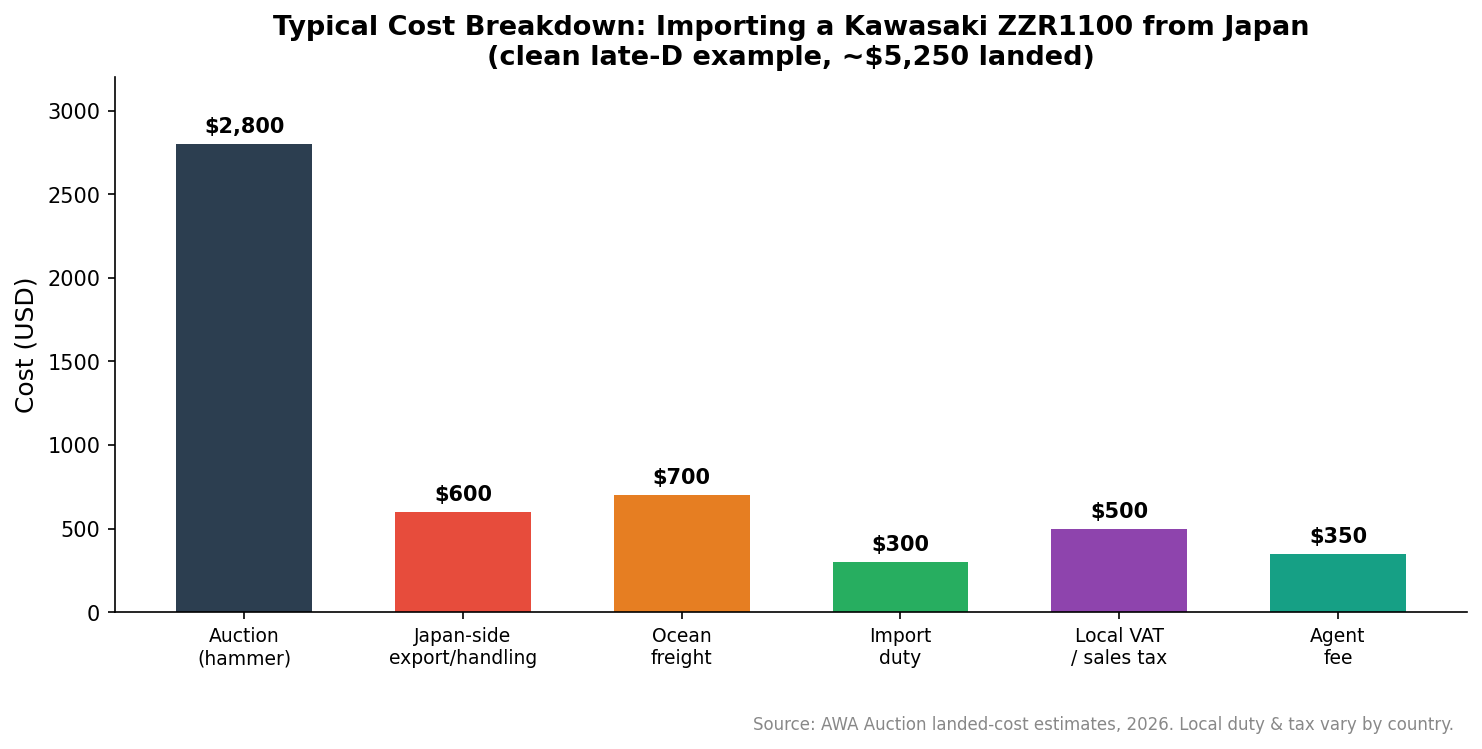
Two numbers swing that total more than anything else: your country's duty-and-tax rate, and which bike you chase. A rough-but-running early C at 1,800 USD lands cheaper; a minty low-mile late D at 4,500 USD lands a long way north of it. The shipping and agent costs barely move — it's the bike price and your local tax that decide your final figure.
Here's the part nobody markets: even at the top of that range, you're buying a genuine 170 mph legend in better condition than your local money would find. For the price of a tired modern middleweight, you can land an icon. That's the whole point of importing.
Reading the auction sheet on a ZZR1100
This is a competitor blind spot — most guides explain Japanese auctions in general but never tell you what to look for on this specific bike. So here's the ZZR-specific read.
Every bike at a Japanese auction is inspected by an independent grader who fills out a standardised sheet: an overall grade (commonly 1 to 6, plus letters like S for near-new and R for repaired), a mileage reading, and a map of the bike marked with codes for scratches, dents, rust and corrosion. That sheet is the single most important document in the whole transaction. Here's how to read it for a ZZR1100.
Grade. For a 25-to-35-year-old hyperbike, target grade 3.5 or above. A 3.5 can be a great buy if the deductions are honest wear rather than damage — read why it scored what it did. Anything with an "X" on the frame map (structural repair) gets a hard pass: a repaired-frame bike that does 170 mph is not where you save money.
Mileage in context. ZZRs were built to cover huge distances, so a 50,000 km bike with full history can be a far safer buy than a 15,000 km bike that sat for a decade with stale fuel and gummed carbs. On this engine, evidence of regular use and oil changes beats a low number — especially given the oiling fault on earlier bikes.
Modifications. These bikes got modified hard: aftermarket cans, fork braces, lowered gearing, streetfighter conversions. A tasteful exhaust is fine. A bike that's been chopped into a naked special with a hacked loom is a project, not a clean import. Note every mod on the sheet and price accordingly.
Originality and corrosion. Original bodywork and fasteners that aren't furred with corrosion tell you the bike was stored and ridden properly. On a heavy bike that lived on motorways, tidy underneath usually means tidy everywhere.
How to buy a ZZR1100 at a Japanese auction
Japanese motorcycle auctions aren't open to the public — you bid through a licensed agent with access. Here's how the process actually runs.
Bikes are consigned by dealers and private sellers, then inspected and graded. Your agent searches the week's listings for ZZR1100s matching your spec, sends you the sheets and photos, and translates the grader's shorthand into plain English. You set a maximum bid, the agent bids on your behalf, and if you win, the bike moves into the export pipeline. You never have to be awake at 3 a.m. Japan time or speak a word of Japanese.
What you do have to do is trust the sheet and pick your battles. The ZZR has a loyal following, but it was built in big numbers, so clean examples turn up constantly — there's almost always another good one next week. Never let auction fever push you past your number. On a model with this much supply, discipline beats desperation every time.
One question we get constantly: how do the agent's fees work, and are there hidden ones? On a transparent service the costs are simple — a fixed auction-agent fee, the genuine Japan-side handling and export charges, and the shipping quote, all laid out before you bid. The fees that ambush people are the home-country ones: duty, local tax, and any compliance inspection that varies by where you live. That's exactly why we tell every buyer to work backwards from a landed-cost ceiling rather than getting excited about a low hammer price. A 2,500 USD bargain that costs 2,500 USD to land is still a 5,000 USD bike, and knowing that before you bid is the difference between a smart import and an expensive lesson.
Step-by-step: importing your ZZR1100 from Japan
Here's the whole journey, start to finish, so nothing blindsides you.
Step 1 — Decide your spec and budget. C or D, JDM vs full-power export, ideally a late D with the oiling fix, and your all-in landed ceiling (hammer plus 60–90%). Lock the number before you feel anything.
Step 2 — Confirm it's legal where you live. Every ZZR1100 clears the US 25-year and Canadian 15-year rules; check the exact build date from the VIN anyway, because it also tells you the oiling spec.
Step 3 — Find candidates. Your agent searches the week's auction listings for ZZRs matching your spec and sends you the sheets and photos.
Step 4 — Vet the sheet. Grade, mileage, frame map, modifications, originality. Shortlist the clean ones, and confirm JDM vs export spec from the VIN.
Step 5 — Bid. Set your maximum, the agent bids, you win (or you wait for next week — there's no shortage).
Step 6 — Japan-side processing. Payment, export deregistration, and booking onto a vessel.
Step 7 — Ocean freight. A few weeks at sea, depending on your country and whether it goes RoRo or in a container.
Step 8 — Home customs and compliance. Clear customs, pay duty and tax, complete any required inspection or certification.
Step 9 — Register and ride. Title or register it locally, insure it, and go remind a few modern bikes that old hyperbikes don't read the spec sheet.
Realistic timeline: plan on roughly six to twelve weeks from winning the auction to legally riding at home. Shipping method and your local paperwork are the two things that swing it most.
RoRo vs container: shipping your ZZR1100
Two ways to get a bike across the ocean, and the right answer depends on the bike and your nerves.
Roll-on/roll-off (RoRo) is usually cheaper. The bike is secured and rolled aboard a dedicated vehicle vessel. It's efficient and fine for the majority of imports, but the bike sits exposed in a shared hold, so it's hands-off and slightly higher risk for knocks.
Container shipping costs more but lets the bike be crated or strapped inside a sealed container, sometimes sharing with other vehicles to split the cost. For a clean, original low-mile D you want to keep mint, many buyers happily pay the premium for the protection. For a tidy rider-grade ZZR you plan to ride and enjoy, RoRo is usually the sensible call.
Your country can also force the decision — some markets prefer or require one method for biosecurity or customs reasons, so confirm with your agent before you commit.
What a good ZZR1100 costs in Japan right now
Ballpark hammer prices for clean, honest bikes at Japanese auction in 2026:
| Model / era | Typical hammer (USD) | Best for |
|---|---|---|
| Early C (1990–1993) | ~$1,800–$3,200 | The original record-holder; purists and project buyers |
| Early/mid D (1993–1996) | ~$2,200–$3,800 | Better all-rounder; the value sweet spot |
| Late D (1997–2001) | ~$2,800–$4,800 | Improved oiling; the one to buy and keep |
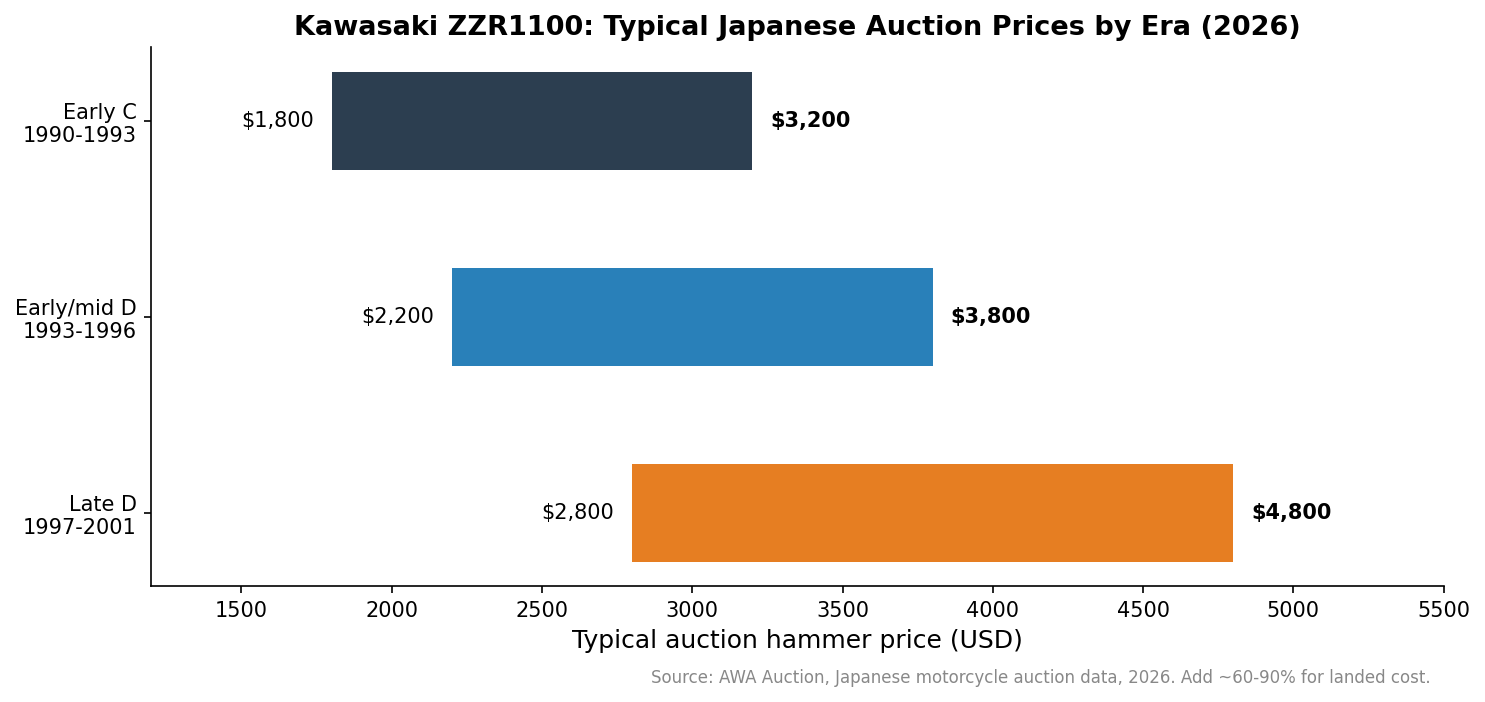
Prices move with mileage, originality and condition. A genuinely low-mileage, all-original late D in a sought-after colour can blow past the top of that range — the cleanest ones are starting to be treated as modern classics rather than cheap fast bikes. Remember to add roughly 60–90% to any of these figures for your landed cost.
The first things to do when your ZZR1100 lands
Here's the thing nobody mentions: the smart money on an imported ZZR isn't just the purchase price — it's the short list of jobs that turn a 30-year-old import into a bike you can trust at three-figure speeds. Budget a weekend and a few hundred dollars, and you'll have a ZZR that's sorted for years.
Oil, and plenty of it. Fresh oil and filter, and on any pre-1997 bike, get into the habit of keeping the sight glass filled right to the top. Given the ZZR's one serious weakness is oil-related, this is the cheapest insurance you'll ever buy.
Sort the carbs. If the bike has sat, a full carb strip, clean and balance transforms how it runs — smooth idle, crisp pickup, no flat spots. On a four-carb bike that's been imported, assume it needs attention until proven otherwise.
Charging system and fresh fluids. Check the reg-rec and stator, and renew brake and clutch fluid and coolant. These are old bikes; the electrics and hydraulics deserve the same care as the engine.
Brakes, seals and rubber. Rebuild the calipers if the bite is wooden, check the fork seals, and look hard at the tyres' date codes. Japanese bikes often come with plenty of tread because they were lightly used, but old rubber that sat can look fine and grip like a hockey puck. On a 170 mph bike, fresh tyres aren't optional.
Do those, and you've effectively reset the clock on a motorcycle that was built to be ridden hard and last.
ZZR1100 vs the rivals: Blackbird, Hayabusa, GSX-R1100
The ZZR didn't rule alone, and if you're spending import money on a 1990s hyperbike you'll meet its rivals at the same auctions. Here's the honest case for each.
| Bike | The pitch | The catch |
|---|---|---|
| Kawasaki ZZR1100 | The original speed king; massive midrange, comfy, cheap to buy, huge supply | Early oiling fault and C-model gearbox to check |
| Honda CBR1100XX Blackbird | The bike that beat it; smoother, more refined | Pricier, and later so fewer cheap early imports |
| Suzuki Hayabusa | The bike that beat them both; cult status, even faster | Strong values, the hype tax is real |
| Suzuki GSX-R1100 | Sportier, lighter-feeling, big tuning scene | Less comfortable; more of a focused sport bike |
Here's the thing nobody disputes: every one of these is a great bike, and the Blackbird and Hayabusa are smoother and faster. But the ZZR1100 is the one that started the hyperbike era, the cheapest way into a genuine 170 mph legend, and the one with the deepest supply in Japan. You're not buying the fastest bike ever made. You're buying the bike that made "fastest ever made" a thing worth chasing — for a fraction of what its successors cost.
And because the ZZR community is enormous and global, you're never alone with a problem. Forums have answered virtually every question a C or D can raise, parts are still plentiful, and any competent classic-sportbike mechanic knows these engines. For someone importing a 30-year-old bike from the other side of the world, that depth of support is worth as much as the bike's mechanical toughness. You're not buying an orphan; you're joining one of the most committed owner clubs in motorcycling.
Who the Kawasaki ZZR1100 is really for
This is the bit that seals the deal. The ZZR suits the rider who wants effortless, ludicrous speed without the wrist-ache and the fragility of a modern superbike. It's a missile you can tour on: massive lazy power, a fairing that keeps the weather off, and a riding position you can actually live with for hundreds of miles. It does 90 mph at a yawn and 150 without drama, and it'll do it all day.
It's also, increasingly, a bargain that's quietly appreciating. Clean original ZZRs are no longer being thrown away as cheap fast bikes — the good ones are being kept, and the cult following guarantees a buyer when you sell. Import a tidy late D, look after the oiling, and you've got a 170 mph icon that's unlikely to cost you money.
Who should look elsewhere? Riders who want sharp, flickable, modern sport-bike handling (the ZZR is big and heavy — it changes direction like an ocean liner with ambitions), and anyone after the absolute last word in top speed (buy a Hayabusa and pay for the privilege). But for the rider who gets why the speed king mattered, nothing else delivers this much legend for this little money.
How AWA Auction helps you import a Kawasaki ZZR1100
This is what we do every day. AWA Auction gives you direct access to the Japanese motorcycle auctions — the same steady supply of clean, original ZZR1100s that local buyers never see — without you needing a Japanese licence, a translator, or a 3 a.m. alarm.
We read the auction sheet for you and tell you, in plain English, what the grade and the frame map actually mean for that specific bike. We confirm whether a ZZR is JDM-spec or a full-power export from its VIN, check the build date so you know whether it has the improved oiling, set your maximum and bid for you, handle the Japan-side export and paperwork, arrange shipping, and guide you through customs and compliance at home. On a bike with this much supply, our honest advice is often "skip that one, there's a cleaner ZZR next week" — because the whole advantage of importing from Japan is choice, and we'd rather you bought the right bike than the first bike.
Browse our current listings to see what's coming through the auctions, or contact our team with your spec and budget and we'll start hunting your ZZR1100.
Cover photo via Pexels (free to use under the Pexels License). Charts by AWA Auction.
See Also
Share this article: